
Life, 1928-07-19 · page 28 of 40
Life — July 19, 1928 — page 28: what you’re looking at
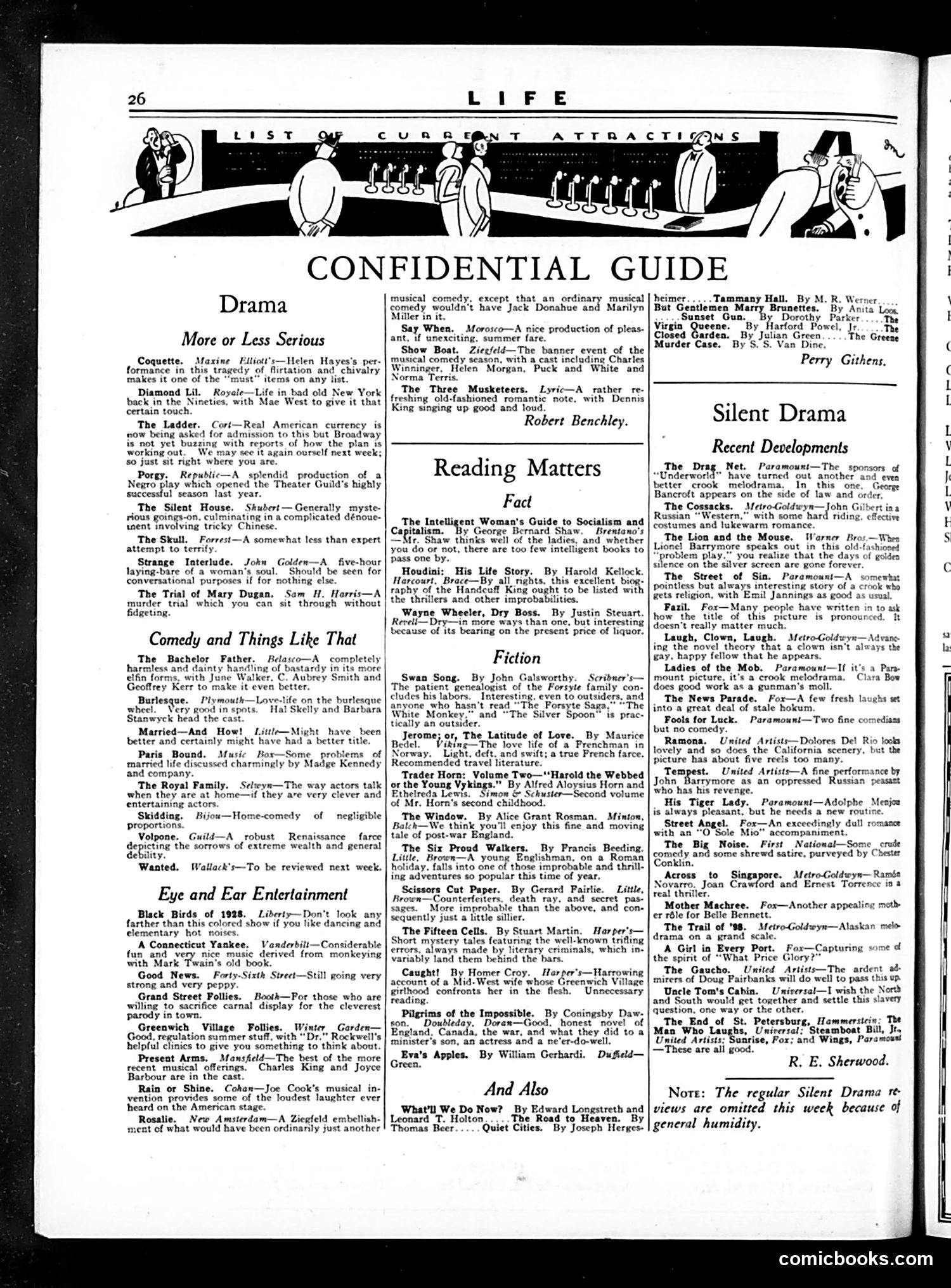
What you’re looking at
This page is a **"Confidential Guide"** theater review section from Life magazine, likely from the late 1920s based on show titles and references. It's not primarily satirical cartoon content—it's a entertainment guide with critical commentary on current Broadway productions. The page lists contemporary stage productions across three categories: serious drama, comedies, and musical entertainment. Reviewer **Robert Benchley** provides witty, brief critiques of shows like "Porgy" (noted as a "Negro play"), "Strange Interlude," and popular musicals like "Show Boat." The satire is gentle and embedded in Benchley's commentary rather than visual—he mocks productions' pretensions ("The Ladder" asks real money for admission), pokes fun at overwrought plots, and notes which shows are worth seeing "for conversational purposes if for nothing else." The small decorative header illustration shows theater-related figures but carries no specific political meaning—it's decorative branding for the entertainment section. This reflects 1920s popular culture and Broadway's prominence in American entertainment.
📄 Transcribed text from this page (OCR, searchable)
Machine-transcribed from the original scan — historical spelling and the odd misread are preserved.
CONFIDENTIAL GUIDE Drama More or Less Serious Coquette. Maxine Fuliott's—Helen Hayes's per- formance in this tragedy of flirtation and chivalry makes it one of the “must” items on any list. Diamond Lil. Royale—Life in bad old New York back in the Nineties, with Mae West to give it that certain touch. The Ladder. Cort—Real American currency is now being asked for admission to this but Broadway is not yet buzzing with reports of how the plan is working out. We may see it again ourself next week; so just sit right where you are. Porgy. Republic—A splendid production of a Negro play which opened the Theater Guild's highly successful season last year. _The Silent House. Shubert—Generally myste- rious goings-on. culminating ina complicated dénoue- anent involving tricky Chinese. The Skull. Forrest—A somewhat less than expert attempt to terrify, Strange Interlude. John Golden—A five-hour laying-bare of a woman's soul, Should be seen for conversational purposes if for nothing else. The Trial of Mary Dugan. Sam H. Harris—A murder trial which you can sit through without fidgeting. Comedy and Things Like That The Bachelor Father. Belasco—A completely harmless and dainty handling of bastardy in its more elfin forms, with June Walker. C. Aubrey Smith and Geoffrey Kerr to "make it even better. Burlesque. Plymouth—Love-life on the burlesque wheel. Very good in spots. Hal Skelly and Barbara Stanwyck head the cast Married—And_ How! better and certainly might ha Paris Bound. Music Box married life discussed charmingly and company. The Royal Family. Selweyn—The way actors talk when they are at home—if they are very clever and entertaining actors Skidding. Bijou—H. proportions. Volpone. Guild—A robust Renaissance farce depicting the sorrows of extreme wealth and general debility. Wanted. Littl—Might have been e had a better title. e-comedy of negligible Wallack's—To be reviewed next week. Eye and Ear Entertainment Black Birds of 192: farther than this colore elementary hot noises. A Connecticut Yankee. Vanderbili—Considerable fun and very nice music derived from monkeying with Mark Twain's old book. Good News. Forty-Sixth Street—Still going very strong and very peppy. Grand Street Follies. Booth—Por those who are willing to sacrifice carnal display for the cleverest parody in town. Greenwich Village Follies. Winter, Garden— Good, regulation summer stuff, with "Dr." Rockwell's helpful clinics to give you something to think about. Present Arms. Mansfeld—The best of the more recent musical offerings. Charles King and Joyce Barbour are in the cast. Rain or Shine. Cohan—Joe Cook's musical in- vention provides some of the loudest laughter ever heard on the American stage. Rosalie. New Amsterdam—A Ziegfeld embellish- ment of what would have been ordinarily just another Liberty—Don't look any show if you like dancing and musical comedy, except that an ordinary musical comedy wouldn't have Jack Donahue and Marilyn Miller in it, Say When. Morosco—A nice production of pleas- ant, if unexciting, summer fare. Show Boat. Zies/eld—The banner event of the musical comedy season, with a cast including Charles Vinninger, Helen Morgan, Puck and White and Norma Terris. The Three Musketeers. Lyric—A rather re- freshing old-fashioned romantic note. with Dennis King singing up good and loud. Robert Benchley. Reading Matters Fact The Intelligent Woman's Guide to Socialism and Capitalism. By George Bernard Shaw, Brentano's Mr. Shaw thinks well of the ladies, and whether you do or not, there are too few intelligent books to pass one by. Houdini: His Life Story. By Harold Kellock. Harcourt, Brace—By all rights, this excellent biog- raphy of the Handcuff King ought to be listed with the thrillers and other improbabilities. Wayne Wheeler, Dry Boss. By Justin Steuart. Revell—Dry—in more ways than one, but interesting because of its bearing on the present price of liquor. Fiction Swan Song. By John Galsworthy. Scribmer's— The patient genealogist of the Forsyte family con- cludes his labors. Interesting, even to outside anyone who hasn't read “The Porsyte S. White Monkey,” and “The Silver Spoon’ tically an outsider. Jerome; or, The Latitude of Love. By Maurice Bedel. Vittng—The love life of a Prenchman in Norway. Light, deft, and swift; a true French farce. Recommended travel literature. Trader Horn: Volume Two—'‘Harold the Webbed or the Young Vykings.” By Alfred Aloysius Horn and Ethelreda Lewis, Simon & Schuster—Second volume of Mr, Horn’s second childhood. The Window. By Alice Grant Rosman. Minton, Balch—We think you'll enjoy this fine and moving tale of post-war England. The Six Proud Walkers. By Prancis Beeding. Little, Brown—A young Englishman, on a Roman holiday, falls into one of those improbable and thrill ing adventures so popular this time of year. Scissors Cut Paper. By Gerard Pairlie. Little, Brown—Counterfeiters, death ray, and secret pas- sages. More improbable than the above, and con- sequently just a little sillier. The Fifteen Cells. By Stuart Martin. Harper's— Short mystery tales featuring the well-known trifling errors, always made by literary criminals, which in- variably land them behind the bars. Caught! By Homer Croy. | Harper's—Harrowing account of a Mid-West wife whose Greenwich Village girlhood confronts her in the flesh. Unnecessary reading. Pilgrims of the Impossible. By Coningsby Daw- son. Doubledey, Dora: Good, honest novel of England, Canada, the war, and what they did to a minister's son, an actress and a ne'er-do-well. Eva's Apples. By William Gerhardi. Dufield— Green. is prac- And Also What’ll We Do Now? By Edward Longstreth and Leonard T. Holton.....The Road to Heaven. By Thomas Quiet Cities. By Joseph Herges- heimer..... Tammany Hall. By M. R. Werner But Gentlemen Marry Brunettes. By Anita Loca Sunset Gun. Dorothy Parker.....The Virgin Queene. By fMarford Powel. Jr. TRE Closed Garden. By Julian Green he Greene Murder Case. “By SS. Van Dine. Perry Githens. Silent Drama Recent Developments The Drag Net. Paramount—The sponsors of “Underworld” have turned out another better crook melodrama. In this on Bancroft appears on the side of law and « The Cossacks. Metro-Goldwyn—John Russian “Western,” with some hard riding, effective costumes and lukewarm romance. The Lion and the Mouse. Warner Bros.—Whes Lionel Barrymore speaks out in this old-fashioned “problem play.” you realize that the days of goldes silence on the silver screen are gone forever The Street of Sin. Paramount—A somewhat pointless but always interesting story of a crook who gets religion, with Emil Jannings as good as usual, Fazil. Fox—Many people have written in to ack how the title of this picture is pronounced. It doesn’t really matter much. Laugh, Clown, Laugh. Metro-Goldwyn—Advanc- ing the novel theory that a clown isn’t always the tay. happy fellow that he appears. Ladies of the Mob. Paramount—It it’ mount picture, it's a crook melodrama, Cl does good work as a gunman’s moll. The News Parade. Fox—A few fresh la into a great deal of stale hokum. Fools for Luck. Paramount—Two fine comediass but no comedy. Ramona. United Artists—Dolores Del Rio looks lovely and so does the California scenery, but the picture has about five reels too many. Tempest. United Artists—A fine performance by John Barrymore as an oppressed Russian peasatt who has his revenge. His Tiger Lady. Paramount—Adolphe Menjou is always pleasant, but he needs a new routine. Street Angel. Fox—An exceedingly dull r with an “O Sole Mio” accompaniment. The Big Noise. First National—Some cr comedy and some shrewd satire, purveyed by Chester Conklin. Across to Singapore. Metro-Goldwyn— Novarro. Joan Crawford and Ernest Torren: real thriller. Mother Machree. Fox—Another appealing + er réle for Belle Bennett. The Trail of '88. Metro-Goldwyn—Alaskan drama on a grand scale. A Girl in Every Port. Fox—Capturing some & the spirit of “What Price Glory?” The Gaucho. United Artists—The ardent ad- mirers of Doug Pairbanks will do well to pass this up Uncle Tom's Cabin. Unirersal—I wish the Nort and South would get together and settle this slavery question, one way of the other. The End of St. Petersburg, Hammersicin: The Man Who Laughs, Unirersal; ‘Steamboat Bill, Jt. United Artists: Sunrise, Fox; and Wings, Params! —These are ali good. R. E. Sherwood. Para Note: The regular Silent Drama re views are omitted this week because of general humidity. comicbooks.com nek Ge (ia wen Th ae eee