
Life, 1928-07-19 · page 6 of 40
Life — July 19, 1928 — page 6: what you’re looking at
What you’re looking at
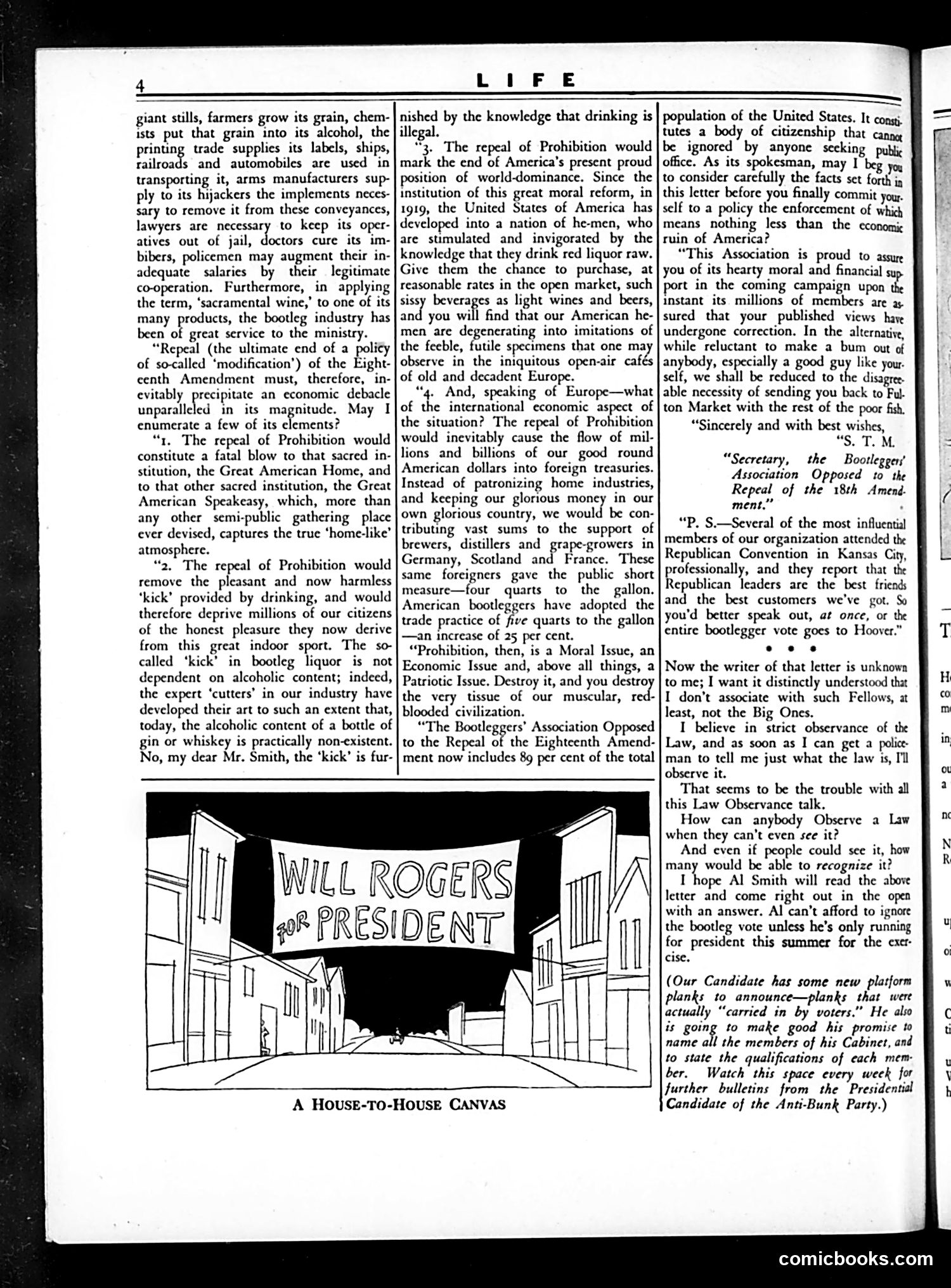
This cartoon satirizes the 1928 presidential campaign of Will Rogers, a famous humorist and social commentator, as a fictional candidate for the "Anti-Bunk Party." The image shows a large banner reading "WILL ROGERS FOR PRESIDENT" displayed prominently on a building, suggesting grassroots campaign efforts reaching voters door-to-door. The accompanying text discusses Prohibition's repeal, bootlegging, and economic concerns—issues central to 1920s politics. The cartoon uses Rogers (known for witty political commentary) as a humorous vehicle to mock both political candidates and campaign promises of the era. The "Anti-Bunk Party" name itself is satirical, suggesting Rogers represents honest, no-nonsense politics against conventional political rhetoric.
📄 Transcribed text from this page (OCR, searchable)
Machine-transcribed from the original scan — historical spelling and the odd misread are preserved.
4 LIFe eS ee giant stills, farmers grow its grain, chem- ists put that grain into its alcohol, the printing trade supplies its labels, ships, railroads and automobiles are used in transporting it, arms manufacturers sup- ply to its hijackers the implements neces- sary to remove it from these conveyances, lawyers are necessary to keep its oper- atives out of jail, doctors cure its im- bibers, policemen may augment their in- adequate salaries by their legitimate co-operation. Furthermore, in applying the term, ‘sacramental wine,’ to one of its many products, the bootleg industry has been of great service to the ministry. “Repeal (the ultimate end of a polity of so-called ‘modification’) of the Eight- centh Amendment must, therefore, in- evitably precipitate an economic debacle unparalleled in its magnitude. May I enumerate a few of its elements? “1, The repeal of Prohibition would constitute a fatal blow to that sacred in- stitution, the Great American Home, and to that other sacred institution, the Great American Speakeasy, which, more than any other semi-public gathering place ever devised, captures the true ‘home-like’ atmosphere. “2, The repeal of Prohibition would remove the pleasant and now harmless ‘kick’ provided by drinking, and would therefore deprive millions of our citizens of the honest pleasure they now derive from this great indoor sport. The so- called ‘kick’ in bootleg liquor is not dependent on alcoholic content; indeed, the expert ‘cutters’ in our industry have developed their art to such an extent that, today, the alcoholic content of a bottle of gin or whiskey is practically non-existent. No, my dear Mr. Smith, the ‘kick’ is fur- nished by the knowledge that drinking is illegal. 2 The repeal of Prohibition would mark the end of America’s present proud position of world-dominance. Since the institution of this great moral reform, in 1919, the United States of America has developed into a nation of he-men, who are stimulated and invigorated by the knowledge that they drink red liquor raw. Give them the chance to purchase, at reasonable rates in the open market, such sissy beverages as light wines and beers, and you will find that our American he- men are degenerating into imitations of the feeble, futile specimens that one may observe in the iniquitous open-air cafés of old and decadent Europe. “4. And, speaking of Europe—what of the international economic aspect of the situation? The repeal of Prohibition would inevitably cause the flow of mil- lions and billions of our good round American dollars into foreign treasuries. Instead of patronizing home industries, and keeping our glorious money in our own glorious country, we would be con- tributing vast sums to the support of brewers, distillers and grape-growers in Germany, Scotland and France. These same foreigners gave the public short measure—four quarts to the gallon. American bootleggers have adopted the trade practice of five quarts to the gallon —an increase of 25 per cent. “Prohibition, then, is a Moral Issue, an Economic Issue and, above all things, a Patriotic Issue, Destroy it, and you destro the very tissue of our muscular, ae blooded civilization. “The Bootleggers’ Association O) d to the Repeal of the Eighteenth ‘Amend- ment now includes 89 per cent of the total A HOUSE-TO-HOUSE CANVAS population of the United States. It const; tutes a body of citizenship that oa be ignored by anyone secking office. As its spokesman, may I beg you to consider carefully the facts set forth ig this letter before you finally commit your. self to a policy the enforcement of which means nothing less than the cconomi¢ ruin of America? “This Association is proud to assure you of its hearty moral and financial sup rt in the coming campaign upon the instant its millions of members are ay sured that your published views have undergone correction. In the alternative, while reluctant to make a bum out of anybody, especially a good guy like your. self, we shall be reduced to the disagree. able necessity of sending you back to Ful- ton Market with the rest of the poor fish. “Sincerely and with best wishes, “S. T. M. “Secretary, the — Bootlegger’ Association Opposed to the Repeal of the 18th Amend. ment.” . “P. S.—Several of the most influential members of our organization attended the Republican Convention in Kansas City, professionally, and they report that the ‘epublican leaders are the best friends and the best customers we've got. So you'd better speak out, at once, or the entire bootlegger vote goes to Hoover.” eee Now the writer of that letter is unknown to me; I want it distinctly understood that I don’t associate with such Fellows, at least, not the Big Ones. I believe in strict observance of the Law, and as soon as I can get a police- man to tell me just what the law is, I'll observe it. That seems to be the trouble with all this Law Observance talk. How can anybody Observe a Law when they can’t even see it? And even if people could see it, how many would be able to recognize it? I hope Al Smith will read the above letter and come right out in the open with an answer. Al can’t afford to ignore the bootleg vote unless he’s only running for president this summer for the exer- cise. (Our Candidate has some new platform planks to announce—planks that were actually “carried in by voters.” He also is going to make good his promise to name all the members of his Cabinet, and to state the qualifications of each mem- ber. Watch this space every week for further bulletins from the Presidential Candidate of the Anti-Bunk Party.) comicbooks.com