
Life, 1928-07-19 · page 20 of 40
Life — July 19, 1928 — page 20: what you’re looking at
What you’re looking at
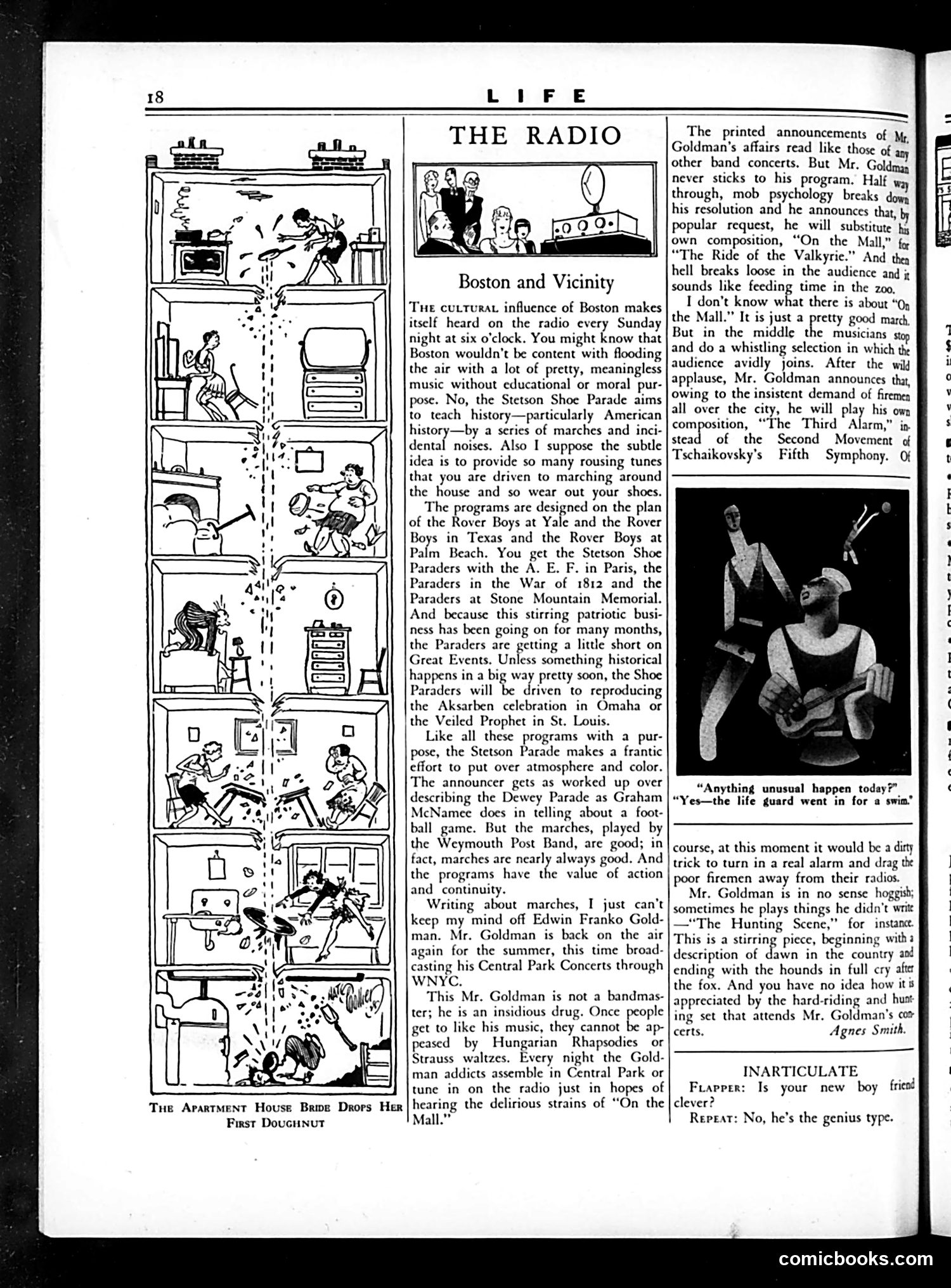
This page satirizes popular 1920s radio programming and two bandleaders. **Left cartoon:** "The Apartment House Bride Doors Her First Doughnut" humorously depicts a bride accidentally destroying her apartment while attempting to cook—showing early 20th-century anxieties about women's domestic competence. **Main text:** Critiques the "Stetson Shoe Parade," a Boston radio program that teaches American history through patriotic marches. The satire targets its heavy-handed educational purpose and repetitive patriotic content, suggesting the station is running out of significant historical events to dramatize. **Central focus:** Edwin Franko Goldman, a real bandleader broadcasting Central Park Concerts on WNYC radio. The writer humorously describes Goldman as an "insidious drug"—his signature composition "On the Mall" so addictive that audiences demand he play it repeatedly instead of his announced program. The satire affectionately mocks how Goldman caves to listener demand and substitutes his own compositions for classical works like Tchaikovsky. The page reflects radio's novelty and cultural significance in this era.
📄 Transcribed text from this page (OCR, searchable)
Machine-transcribed from the original scan — historical spelling and the odd misread are preserved.
LIFE Tue Apartment House Brie Drors Her First DoucHNuT Boston and Vicinity Tue cucturat influence of Boston makes itself heard on the radio every Sunday night at six o'clock. You might know that Boston wouldn't be content with flooding the air with a lot of pretty, meaningless music without educational or moral pur- pose. No, the Stetson Shoe Parade aims to teach history—particularly American history—by a series of marches and inci- dental noises. Also I suppose the subtle idea is to provide so many rousing tunes that you are driven to marching around the house and so wear out your shoes. The programs are designed on the plan of the Rover Boys at Yale and the Rover Boys in Texas and the Rover Boys at Palm Beach. You get the Stetson Shoe Paraders with the A. E. F. in Paris, the Paraders in the War of 1812 and the Paraders at Stone Mountain Memorial. And _ because this stirring patriotic busi- ness has been going on for many months, the Paraders are getting a little short on Great Events. Unless something historical happens in a big way pretty soon, the Shoe Paraders will be driven to reproducing the Aksarben celebration in Omaha or the Veiled Prophet in St. Louis. Like all these programs with a pur- pose, the Stetson Parade makes a frantic effort to put over atmosphere and color. The announcer gets as worked up over describing the Dewey Parade as Graham McNamee does in telling about a foot- ball game. But the marches, played by the Weymouth Post Band, are good; in fact, marches are nearly always good. And the programs have the value of action and continuity, Writing about marches, I just can’t keep my mind off Edwin Franko Gold- man. Mr. Goldman is back on the air again for the summer, this time broad- casting his Central Park Concerts through WNYC. This Mr. Goldman is not a bandmas- ter; he is an insidious drug. Once people get to like his music, they cannot be ap- peased by Hungarian Rhapsodies or Strauss waltzes. Every night the Gold- man addicts assemble in Central Park or tune in on the radio just in hopes of hearing the delirious strains of “On the Mall.” — The printed announcements of Mr, Goldman's affairs read like those of am other band concerts. But Mr. Goldmay never sticks to his program. Half through, mob psychology breaks down his resolution and he announces that, popular request, he will substitute hy own composition, “On the Mall,” fo “The Ride of the Valkyrie.” And thea hell breaks loose in the audience and iz sounds like feeding time in the zoo, I don’t know what there is about “Op the Mall.”’ It is just a pretty good march, But in the middle the musicians and do a whistling selection in which the audience avidly joins. After the wild applause, Mr. Goldman announces that, owing to the insistent demand of firemen all over the city, he will play his own composition, “The Third Alarm," in stead of the Second Movement of Tschaikovsky's Fifth Symphony. 0f “Anything unusual happen today?” “Yes—the life guard went in for a swim? course, at this moment it would be a dirty trick to turn in a real alarm and drag the poor firemen away from their radios. Mr. Goldman is in no sense hoggish; sometimes he plays things he didn’t writ —"The Hunting Scene,” for instance. This is a stirring piece, beginning with? description of eva in the country and ending with the hounds in full cry afte the fox. And you have no idea how its appreciated by the hard-riding and hust ing set that attends Mr. Goldman's cor certs. Agnes Smith. INARTICULATE Frapper: Is your new boy friend clever? Repeat: No, he’s the genius type. comicbooks.com poe ey ry Se a a en er a le ee ee