
Life, 1928-07-19 · page 25 of 40
Life — July 19, 1928 — page 25: what you’re looking at
What you’re looking at
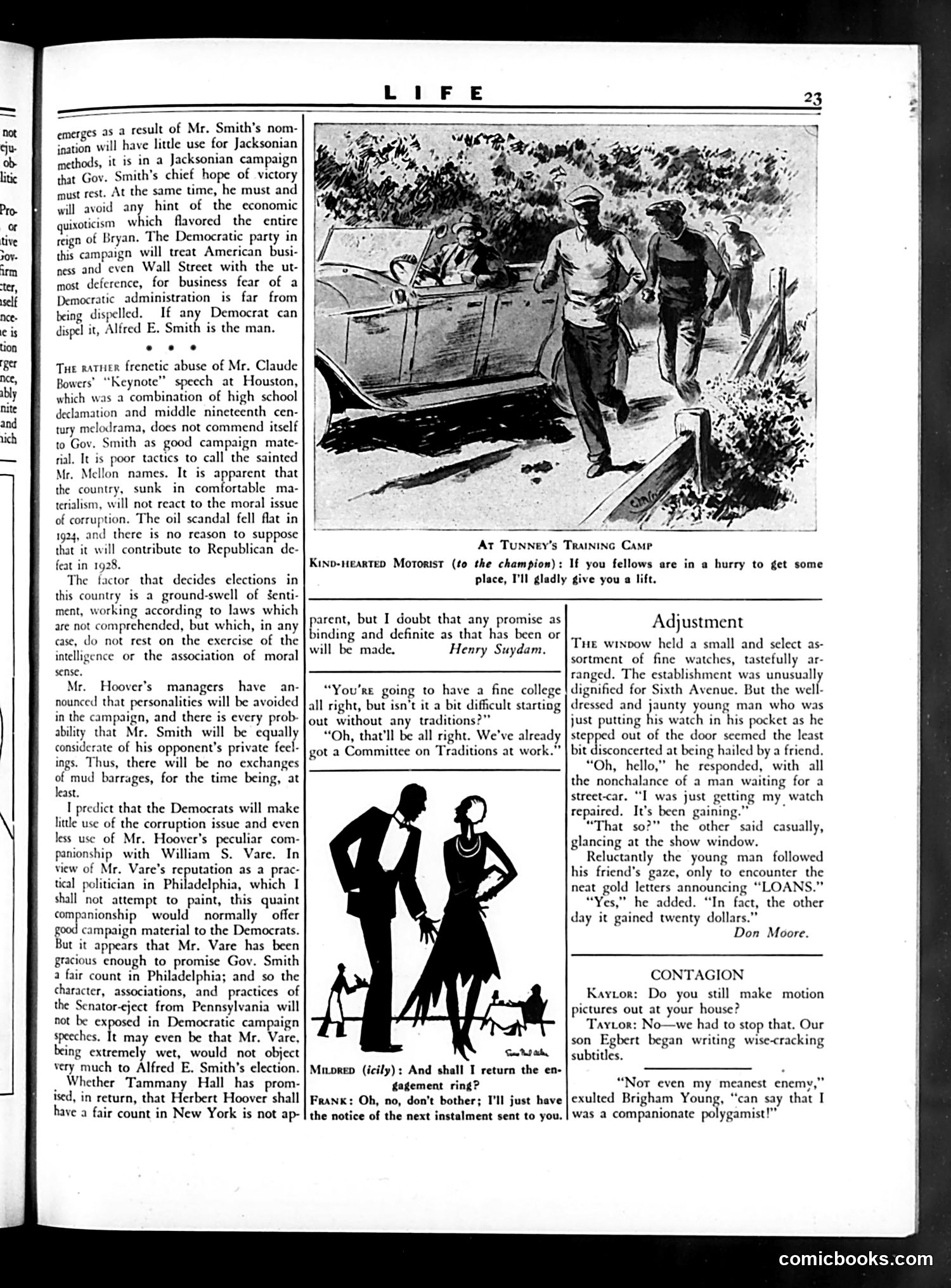
This page contains political commentary on the 1928 U.S. presidential election, discussing Democratic candidate Alfred E. Smith's campaign strategy against Republican Herbert Hoover. The text argues Smith should avoid moral corruption arguments (referencing the Teapot Dome scandal of 1924) and instead appeal to business interests and sentiment rather than intelligence. The main cartoon shows a motorist offering a ride to racing cyclists, captioned "If you fellows are in a hurry to get some place, I'll gladly give you a lift"—likely satirizing campaign maneuvering and backroom deals mentioned in the text, possibly alluding to Philadelphia political boss William S. Vare's promise of a "fair count." The page also includes lighter humor: a couple discussing college traditions, and a young man explaining he's having his watch "adjusted" (repaired) rather than admitting he's pawning it—typical 1920s financial satire.
📄 Transcribed text from this page (OCR, searchable)
Machine-transcribed from the original scan — historical spelling and the odd misread are preserved.
emerges as a result of Mr. Smith's nom- ination will have little use for Jacksonian methods, it is in a Jacksonian campaign that Gov. Smith’s chief hope of victory must rest. At the same time, he must and will avoid any hint of the economic quixoticism which flavored the entire reign of Bryan. The Democratic party in this campaign will treat American busi- ness and even Wall Street with the ut- most deference, for business fear of a Democratic administration is far from being dispelled. If any Democrat can dispel it, Alfred E, Smith is the man. eee Tue ratuer frenetic abuse of Mr. Claude Bowers’ “Keynote” speech at Houston, which was a combination of high school declamation and middle nineteenth cen- tury melodrama, does not commend itself to Gov. Smith as good campaign mate- rial, It is poor tactics to call the sainted Mr. Mellon names. It is apparent that the country, sunk in comfortable ma- terialism, will not react to the moral issue of corruption. The oil scandal fell flat in 1924, and there is no reason to suppose that it will contribute to Republican de- feat in 1928. The factor that decides elections in this country is a ground-swell of Senti- ment, working according to laws which are not comprehended, but which, in any case, do not rest on the exercise of the intelligence or the association of moral sense, Mr. Hoover’s managers have an- nounced that personalities will be avoided in the campaign, and there is every prob- ability that Mr. Smith will be equally considerate of his opponent’s private feel- ings. Thus, there will be no exchanges of mud barrages, for the time being, at least. I predict that the Democrats will make little use of the corruption issue and even less use of Mr. Hoover's peculiar com- panionship with William S. Vare. In view of Mr. Vare’s reputation as a prac- tical politician in Philadelphia, which I shall not attempt to paint, this quaint companionship would normally — offer good campaign material to the Democrats. But it appears that Mr. Vare has been gracious enough to promise Gov. Smith a fair count in Philadelphia; and so the character, associations, and practices of the Senator-eject from Pennsylvania will not be spose in Democratic campaign speeches. It may even be that Mr. Vare, being extremely wet, would not object very much to Alfred E. Smith's election. _ Whether Tammany Hall has prom- ised, in return, that Herbert Hoover shall have a fair count in New York is not ap- Kino-teartep Motorist (to the champion): If you fellows are in a hurry to get some place, I'll gladly give you a lift. parent, but I doubt that any promise as binding and definite as that has been or will be made. Henry Suydam. u're going to have a fine college all right, but isn’t it a bit difficult starting out without any traditions?” “Oh, that'll be all right. We've already got a Committee on Traditions at work.” Te cal Mnorep (icily): And shall I return the en- agement ring? Frank: Oh, no, don’t bother; I'll just have the notice of the next instalment sent to you. Adjustment Tue winvow held a small and select as- sortment of fine watches, tastefully ar- ranged. The establishment was unusually dignified for Sixth Avenue. But the well- dressed and jaunty young man who was just putting his watch in his pocket as he stepped out of the door seemed the least bit disconcerted at being hailed by a friend. “Oh, hello,” he responded, with all the nonchalance of a man waiting for a street-car. “I was just getting my watch repaired. It’s been gaining.” . “That so?” the other said casually, glancing at the show window. Reluctantly the young man followed his friend’s gaze, only to encounter the neat gold letters announcing “LOANS.” “Yes,” he added. “In fact, the other day it gained twenty dollars.” Don Moore. CONTAGION Kaytor: Do you still make motion pictures out at your house? Taytor: No—we had to stop that. Our son Egbert began writing wise-cracking subtitles. “Nor even my meanest enemy,” exulted Brigham Young, “can say that I was a companionate polygamist!” comicbooks.com