
Life, 1928-07-19 · page 18 of 40
Life — July 19, 1928 — page 18: what you’re looking at
What you’re looking at
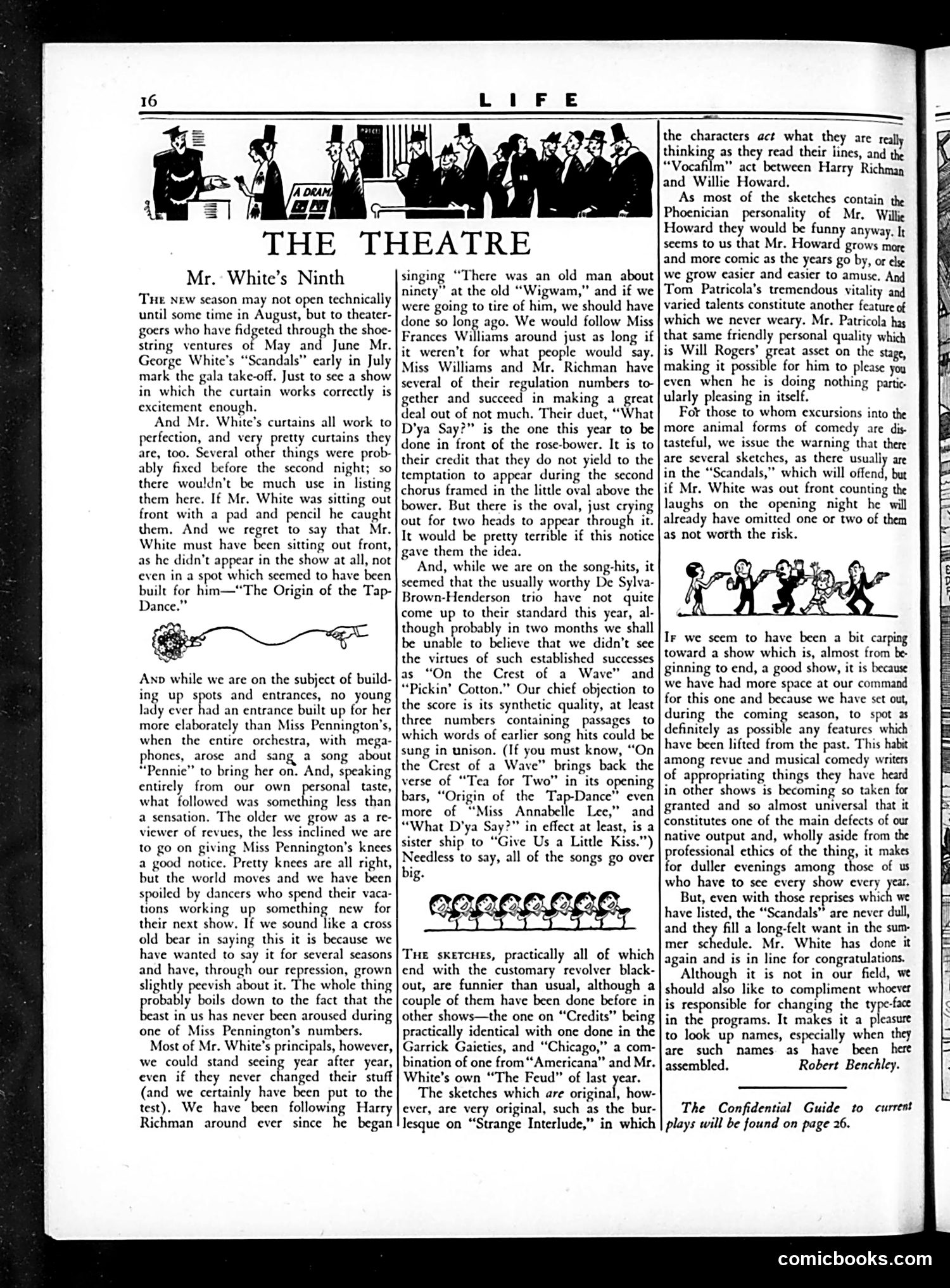
This page is a theater review by Robert Benchley critiquing Mr. White's theatrical production, "The Ninth," which opened in August. The review discusses various cast members and production elements. The silhouette illustration at top shows theater-goers in formal dress entering a venue. Benchley praises the work of Miss Frances Williams and Mr. Richman, noting their "regulation numbers" and chemistry. However, he criticizes the production's synthetic quality and specific song choices like "On the Crest of a Wave" and "Rockin' Cotton," finding them derivative of earlier hits. The small cartoon figures at the bottom appear to be generic dancers or chorus performers, illustrating Benchley's commentary on the show's choreography and entertainment value. The review's tone is witty but somewhat dismissive of the production overall.
📄 Transcribed text from this page (OCR, searchable)
Machine-transcribed from the original scan — historical spelling and the odd misread are preserved.
THEATRE Mr. White’s Ninth THE NEW season may not open technically until some time in August, but to theater- goers who have fidgeted through the shoe- string ventures otf May and June Mr. George White’s “Scandals” early in July mark the gala take-off. Just to see a show in which the curtain works correctly is excitement enough. And Mr. White's curtains all work to perfection, and very pretty curtains they are, too. Several aber things were prob- ably fixed before the second night; so there wouldn't be much use in listing them here. If Mr. White was sitting out front with a pad and pencil he caught them. And we regret to say that Mr. White must have been sitting out front, as he didn’t appear in the show at all, not even in a spot which seemed to have been built for him—“The Origin of the Tap- Dance.” Ano while we are on the subject of build- ing up spots and entrances, no young lady ever Pad an entrance built up for her more elaborately than Miss Pennington’s, when the entire orchestra, with mega- phones, arose and sang a song about “Pennie” to bring her on. And, speaking entirely from our own personal taste, what followed was something less than a sensation, The older we grow as a re- viewer of revues, the less inclined we are to go on giving Miss Pennington’s knees a good notice. Pretty knees are all right, but the world moves and we have been spoiled by dancers who spend their vaca- tions working up something new for their next show. If we sound like a cross old bear in saying this it is because we have wanted to say it for several seasons and have, through our repression, grown slightly peevish about it. The whole thing robably boils down to the fact that the east in us has never been aroused during one of Miss Pennington’s numbers. Most of Mr. White's principals, however, we could stand seeing year after year, even if they never changed their stuff (and we certainly have been put to the test). We have been following Harry Richman around ever since he began “There was an old man about were going to tire of him, we should have done so long ago. We would follow Miss Frances Williams around just as long if it weren’t for what people would say. Miss Williams and Mr. Richman have several of their regulation numbers to- gether and succeed in making a great deal out of not much. Their duet, “What D'ya Say?” is the one this year to be done in front of the rose-bower. It is to their credit that they do not yield to the temptation to appear during the second chorus framed in the little oval above the bower. But there is the oval, just crying out for two heads to appear through it. It would be pretty terrible if this notice gave them the idea. And, while we are on the song-hits, it seemed that the usually worthy De Sylva- Brown-Henderson trio have not quite come up to their standard this year, al- though probably in two months we shall be unable to believe that we didn’t see the virtues of such established successes as “On the Crest of a Wave” and “Pickin? Cotton.” Our chief objection to the score is its synthetic quality, at least three numbers containing passages to which words of earlier song hits could be sung in unison. (If you must know, “On the Crest of a Wave” brings back the verse of “Tea for Two” in its opening bars, “Origin of the Tap-Dance” even more of “Miss Annabelle Lee,’ and “What D'ya Say?” in effect at least, is a sister ship to “Give Us a Little Kiss.”) Needless to say, all of the songs go over big. Tue sketcues, practically all of which end with the customary revolver black- out, are funnier than usual, although a couple of them have been done before in other shows—the one on “Credits” being practically identical with one done in the Garrick Gaieties, and “Chicago,” a com- bination of one from “Americana” and Mr. White’s own “The Feud” of last year. The sketches which are original, how- ever, are very original, such as the bur- lesque on “Strange Interlude,” in which the characters act what they are r thinking as they read their iines, and the “Vocafilm” act between Harry Richman and Willie Howard. As most of the sketches contain the Phoenician personality of Mr. Willie Howard they would be funny anyway, It seems to us that Mr. Howard grows more and more comic as the years go by, or ele we grow easier and easier to amuse. And Tom Patricola’s tremendous vitality and varied talents constitute another feature of which we never weary. Mr. Patricola has that same friendly personal quality which is Will Rogers’ great asset on the stage, making it possible for him to please you even when he is doing nothing partic. ularly pleasing in itself. For those to whom excursions into the more animal forms of comedy are dis tasteful, we issue the warning that there are several sketches, as there usually are in the “Scandals,” which will offend, bur if Mr. White was out front counting the laughs on the opening night he will already have omitted one or two of them as not worth the risk. Ir we seem to have been a bit carping toward a show which is, almost from be- ginning to end, a good show, it is because we have had more space at our command for this one and because we have set out, during the coming season, to spot as definitely as possible any features which have been lifted from the past. This habit among revue and musical comedy writers of appropriating things they have heard in other shows is becoming so taken for granted and so almost universal that it constitutes one of the main defects of our native output and, wholly aside from the professional ethics of the thing, it makes for duller evenings among those of us who have to see every show every he But, even with those reprises which we have listed, the “Scandals” are never dull, and they fill a long-felt want in the sum- mer schedule. Mr. White has done it again and is in line for congratulations. Although it is not in our field, we should also like to compliment whoever is responsible for changing the apes in the programs. It makes it a pleasure to look up names, especially when they are such names as have been assembled. Robert Benchley. The Confidential Guide to current plays will be found on page 26. comicbooks.com