
A complete issue · 46 pages · 1928
Life — May 3, 1928
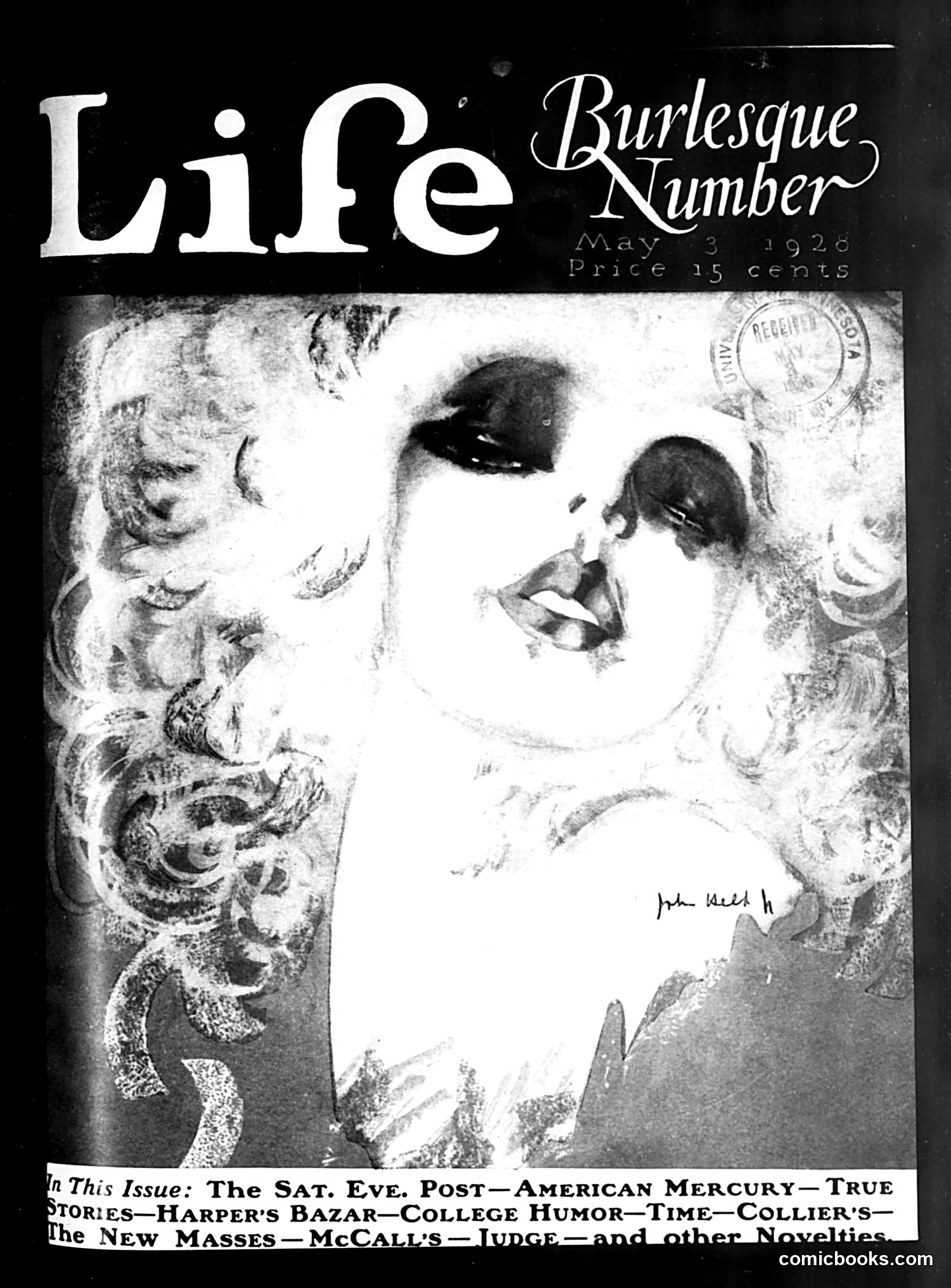
This is a **cover page** for Life's "Burlesque Number," priced at 15 cents. The main image shows a **theatrical makeup design** — specifically a stylized face with exaggerated features typical of stage burlesque performance. The decorative elements surrounding it (ornamental scrollwork and classical motifs) reference theatrical makeup and costuming. The cover is announcing Life's satirical content for this issue, which includes contributions from major publications (Saturday Evening Post, American Mercury, Harper's Bazaar) and humor magazines. "Burlesque" here refers to theatrical **parody and comedic exaggeration** rather than modern meanings — Life is presenting satirical takes on contemporary culture, politics, and society through the lens of theatrical mockery.
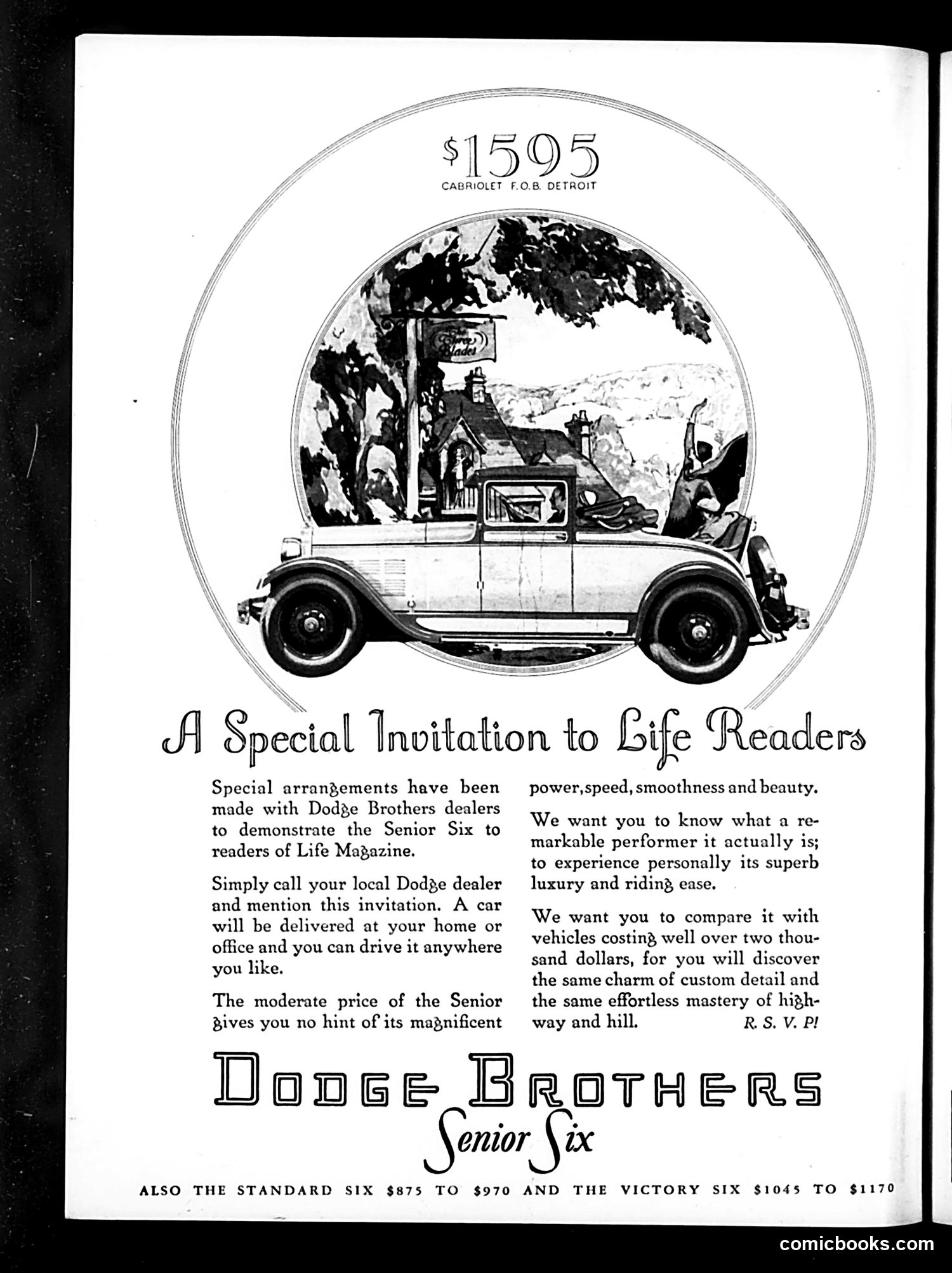
This is primarily **an advertisement**, not political satire. It's a 1920s Dodge Brothers promotional piece inviting *Life* magazine readers to test-drive the Senior Six model priced at $1595. The visual shows a convertible cabriolet with an illustrated scene inside the car's interior—a pastoral landscape with a cottage, suggesting leisure and escape. This was typical advertising imagery of the era, emphasizing that owning this moderately-priced vehicle would provide luxury experiences. The copy compares the Senior Six favorably to cars "costing well over two thousand dollars," positioning Dodge as offering comparable quality at lower cost. The invitation to call local dealers and arrange home delivery reflects 1920s sales practices. There is no political commentary or satire present—this is straightforward automobile marketing.
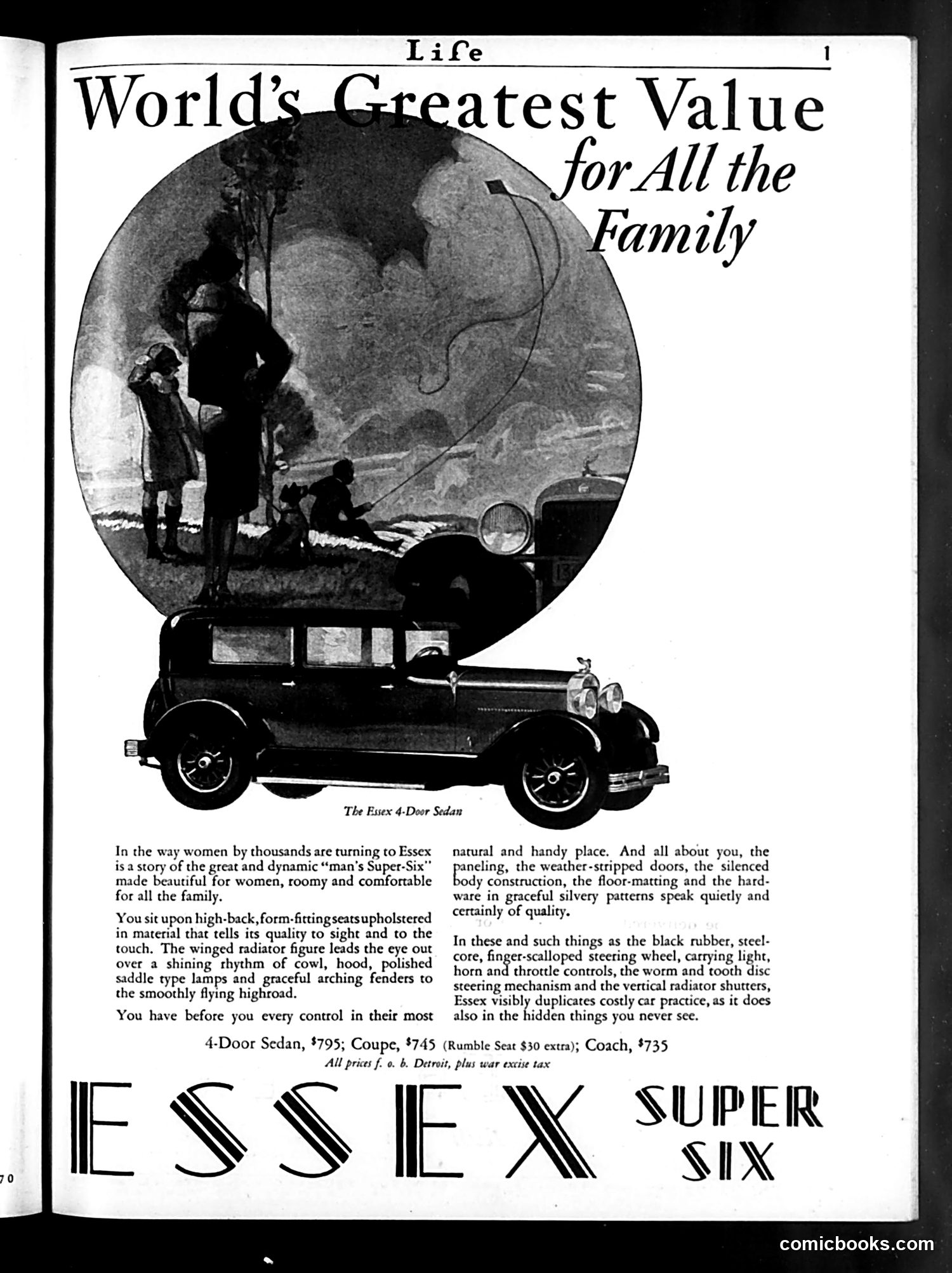
This is primarily a **car advertisement**, not satire or political commentary. The Essex Super-Six was marketed as "World's Greatest Value for All the Family." The imagery shows a family enjoying outdoor recreation—camping or picnicking—enabled by automobile ownership. The circular vignette depicts idealized leisure activities: parents and children in nature, suggesting the car provides both practical transportation and access to family experiences. The ad emphasizes quality features (upholstery, construction, steering mechanism) appealing to middle-class buyers concerned with durability and comfort. Pricing ranges from $735-$795, positioning it as an affordable family vehicle during what appears to be the 1920s automotive boom period. The "greatest value" messaging reflects post-WWI American consumer culture emphasizing accessible luxury and family-centered leisure.
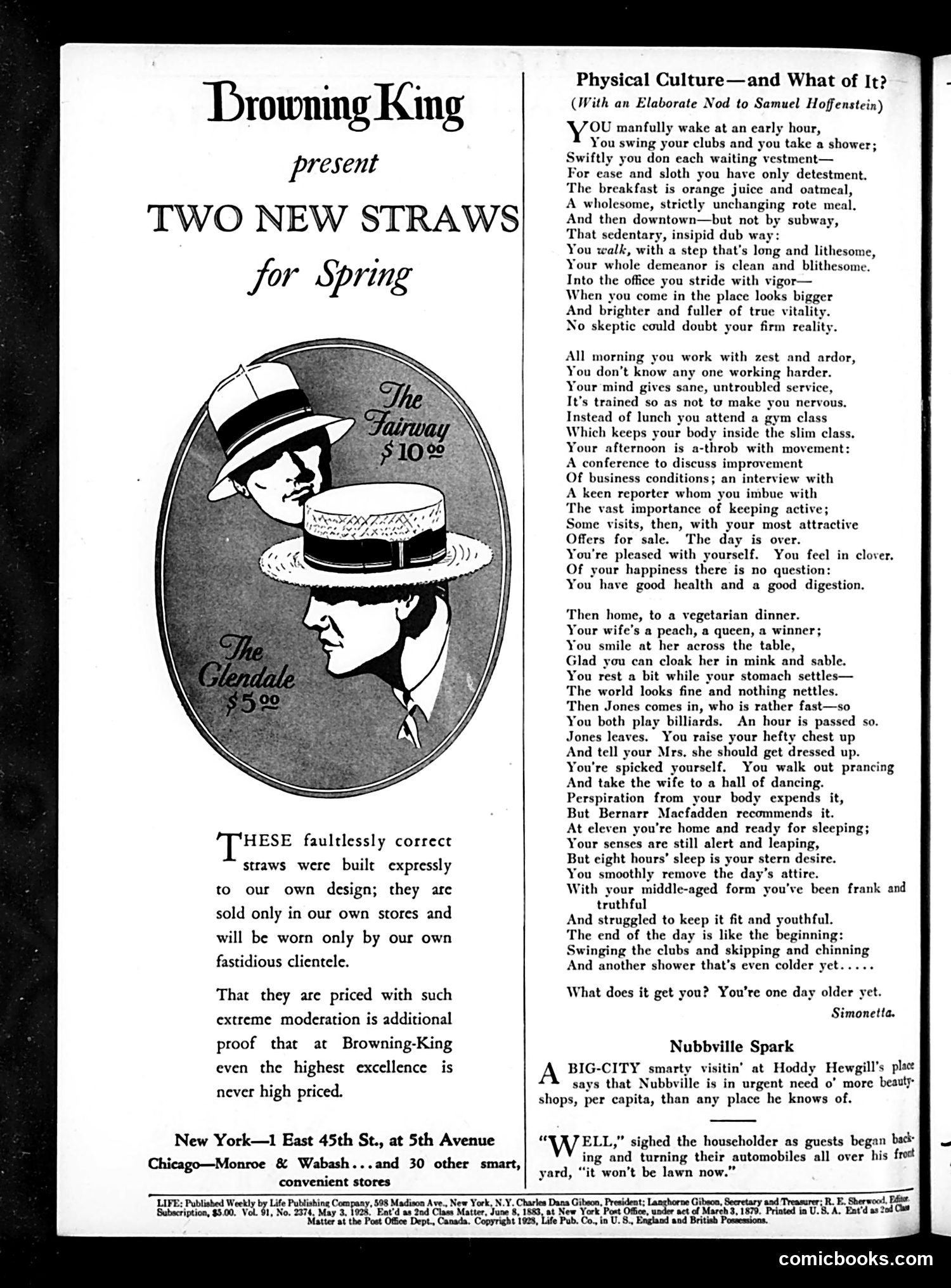
This page is primarily **advertising**, not political satire. The left side promotes two straw hat styles from Browning King—"The Fairway" ($10.98) and "The Glendale" ($5.00)—positioning them as fashionable spring accessories for the well-dressed man. The right side contains a poem titled "Physical Culture—and What of It?" (credited to Simonella) that satirizes the **health-conscious urban lifestyle** of the 1920s. It mocks the modern businessman who exercises, attends gym classes, conducts business efficiently, and maintains vigorous activity—only to end his day precisely as he began it, "one day older yet." The satire suggests that despite all this manufactured "physical culture," the protagonist achieves nothing meaningful. The page's tone reflects 1920s consumerism and the era's growing obsession with self-improvement through exercise and consumption.
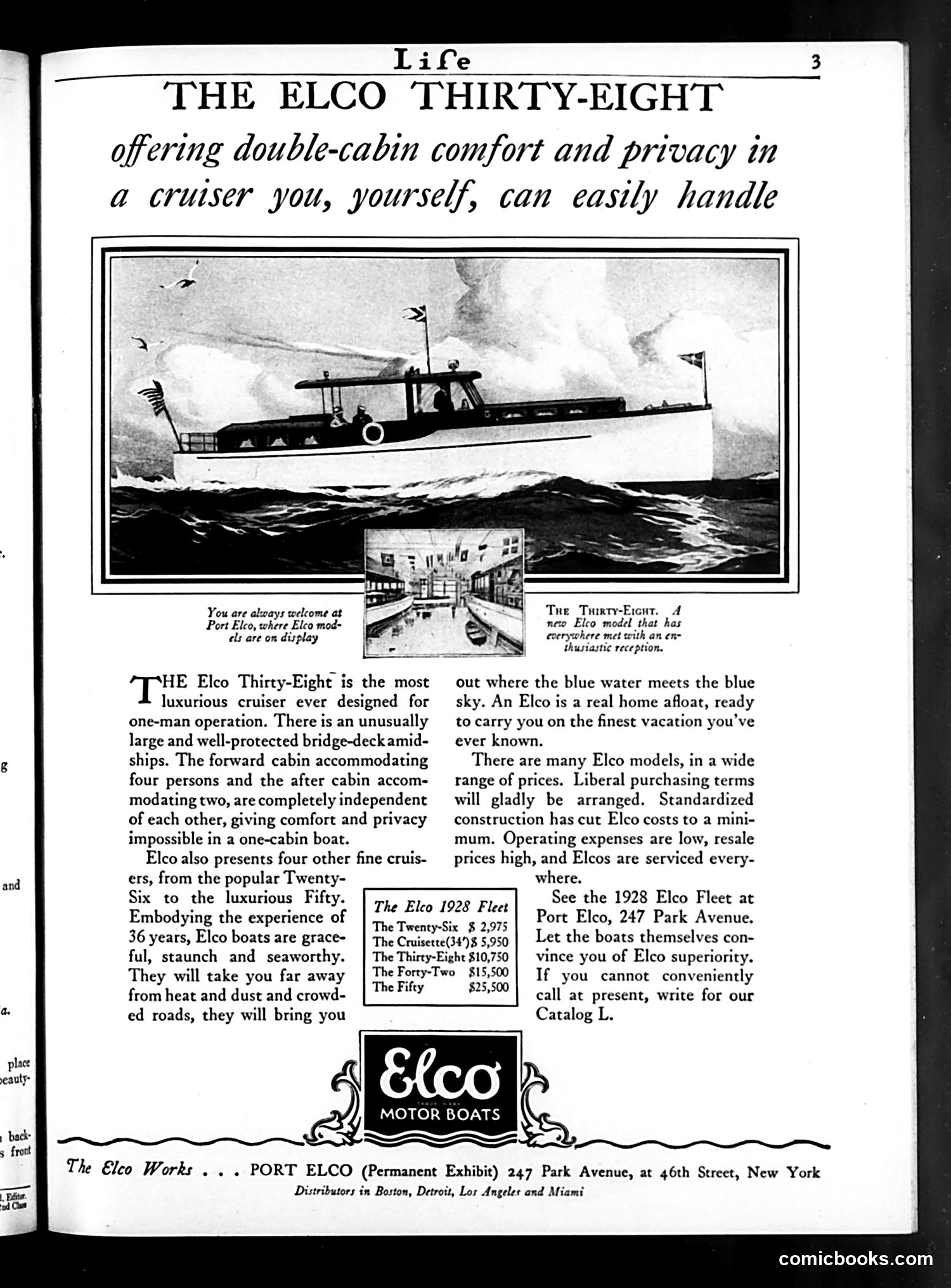
This page is **not a political cartoon or satire**—it's a straightforward **advertisement for Elco Motor Boats**, specifically the "Thirty-Eight" model luxury cruiser. The content promotes leisure and recreation for affluent Americans of the 1920s era. Key points: - The Elco Thirty-Eight offers "double-cabin comfort and privacy" for one-man operation - It's positioned as "the most luxurious cruiser ever designed" - The ad emphasizes reliability, low operating costs, and resale value - Pricing information is provided (Thirty-Eight: $10,750) - Distribution locations listed: Port Elco in New York, with dealers in Boston, Detroit, Los Angeles, and Miami This represents typical 1920s advertising targeting wealthy recreational boaters during the prosperous pre-Depression era.
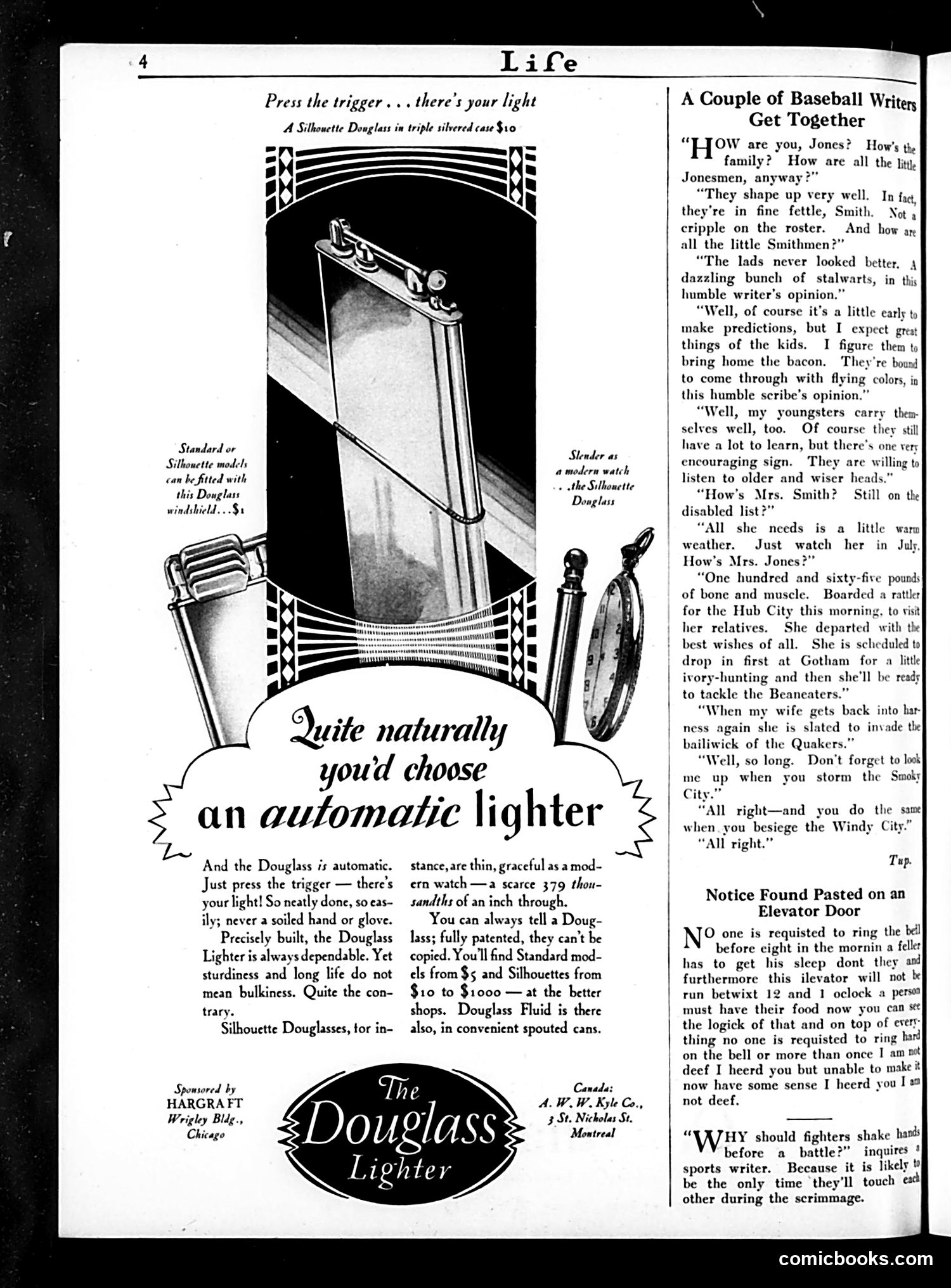
This page is primarily **advertising, not satire or editorial content**. The left side features a full-page advertisement for the Douglass Lighter, an automatic cigarette lighter. The ad uses the slogan "Quite naturally you'd choose an automatic lighter" and emphasizes the product's reliability and convenience—"just press the trigger." The right side contains two unrelated pieces: a humorous dialogue titled "A Couple of Baseball Writers Get Together" discussing players and team prospects, and a brief notice about elevator etiquette. These appear to be filler content typical of period magazines. The Douglass Lighter ad represents mid-20th-century consumer marketing targeting upscale buyers through lifestyle association rather than satirical commentary.
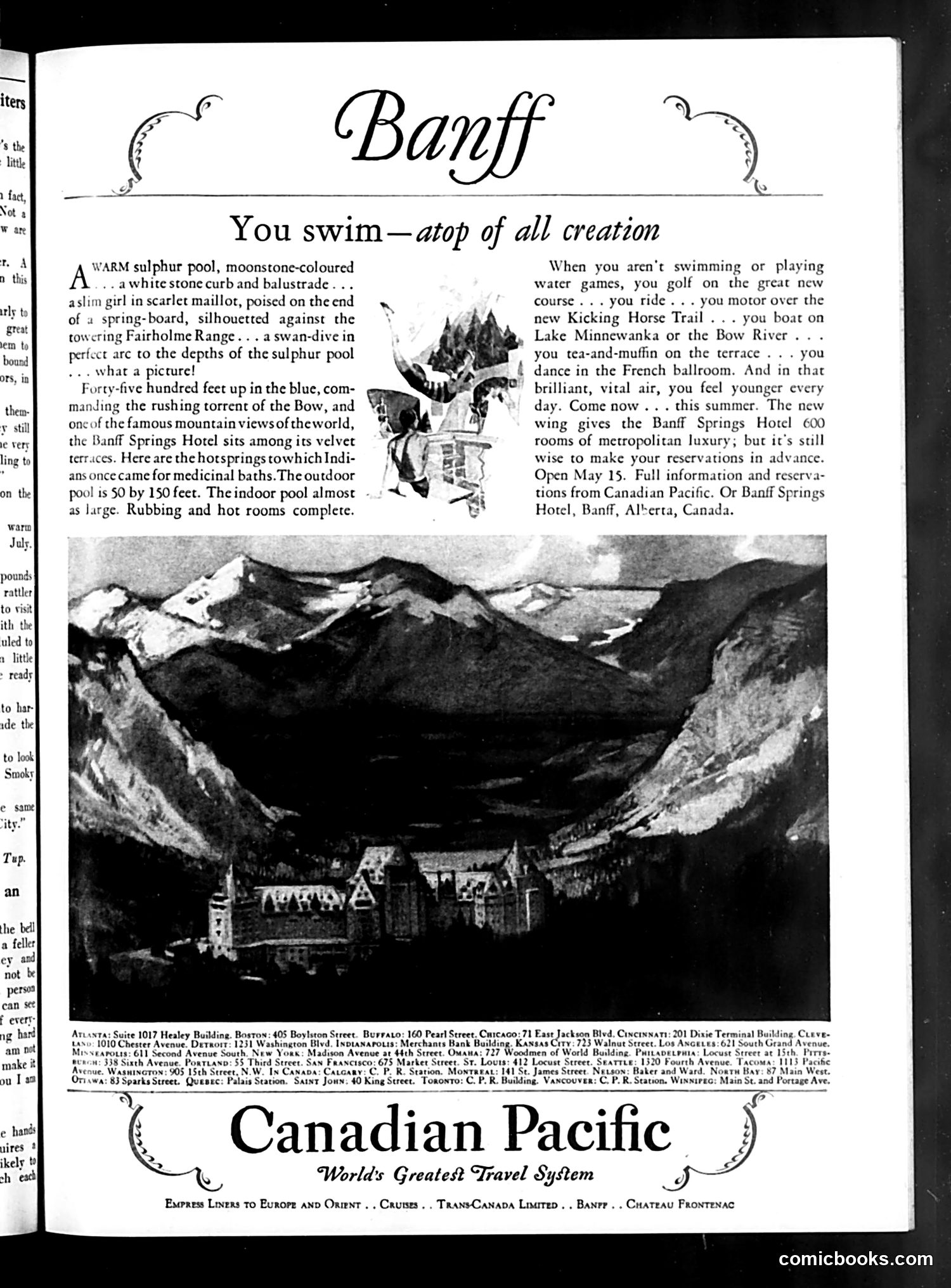
This page is primarily **advertising content**, not satirical editorial material. It's a Canadian Pacific Railway advertisement promoting the Banff Springs Hotel in Alberta, Canada. The page features: - A descriptive header "You swim—atop of all creation" highlighting the resort's sulphur pool situated 4,500 feet elevation in the Canadian Rockies - An illustration of a woman in swimming attire - A large photograph of Banff Springs Hotel nestled in a mountain valley - Details about recreational activities (golf, boating, dancing) and amenities - Hotel contact information and Canadian Pacific Railway office locations across North America There is **no political cartoon or satire** present. This is a straightforward travel advertisement typical of early-to-mid 20th century magazine promotional material, designed to attract wealthy tourists to the remote luxury resort.
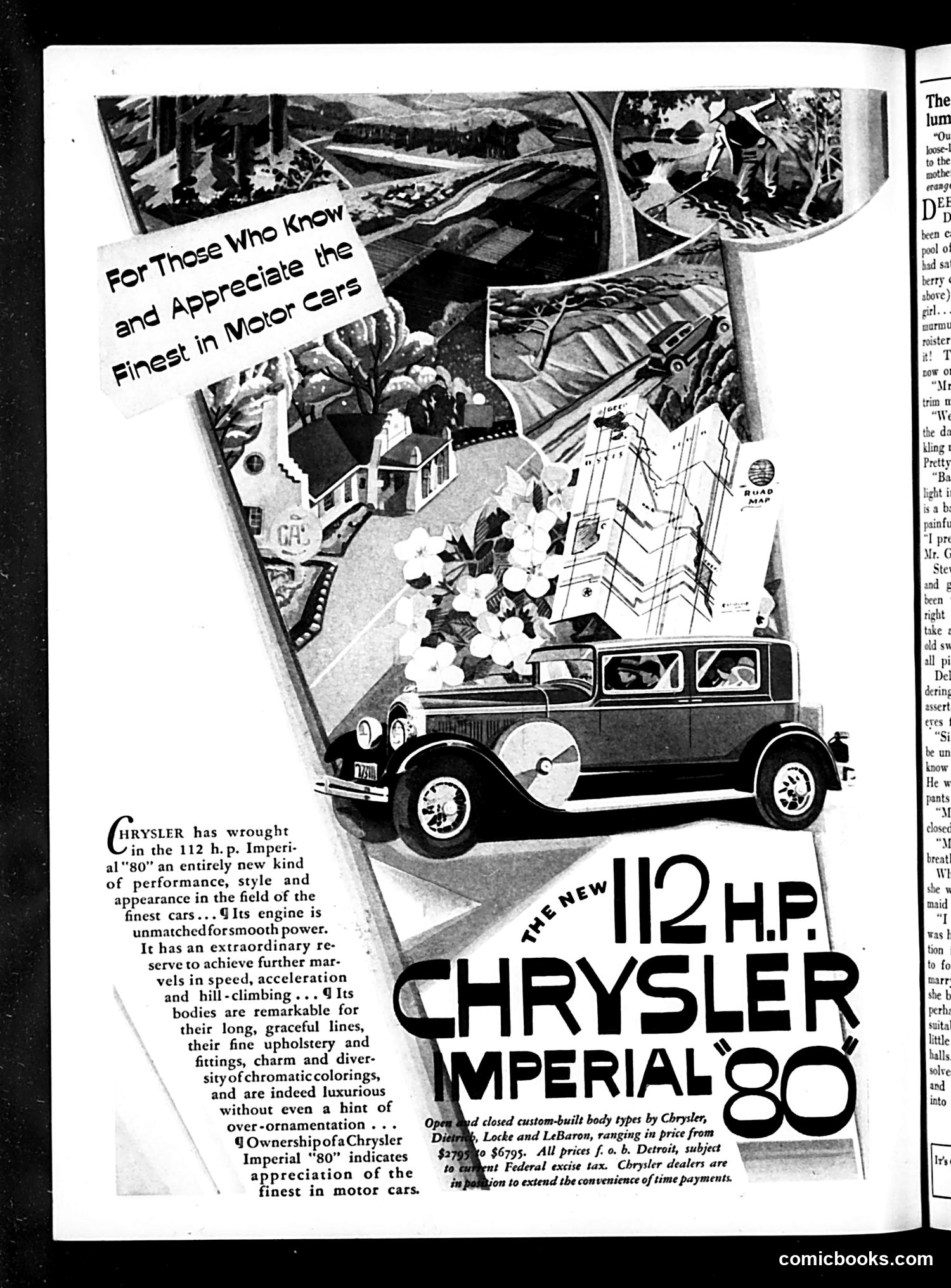
This page is a **Chrysler automobile advertisement**, not political commentary or satire. It promotes the "112 H.P. Imperial '80" car model to affluent consumers who "know and appreciate the finest in motor cars." The ad highlights the car's engineering (112 horsepower engine, smooth power delivery, speed, acceleration) and luxury features (fine upholstery, stylish body lines, color options). The collage-style imagery showcases the vehicle in various settings suggesting lifestyle and leisure activities. The small print notes pricing ($3795 to $6795) and that various custom body styles were available through Chrysler, Dietrich, Locke, and LeBaron coachbuilders. This was a premium product targeting wealthy Depression-era consumers.
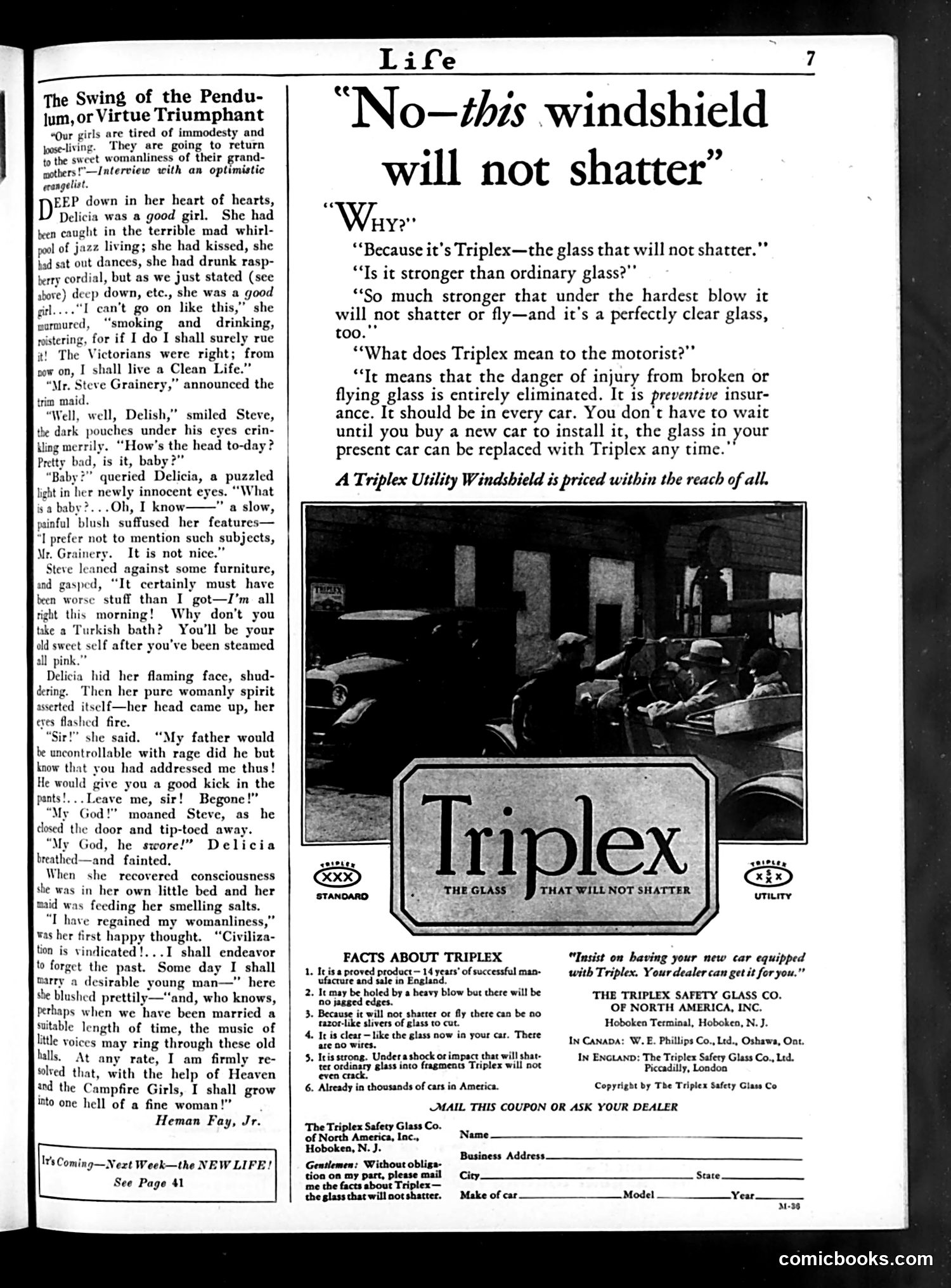
This page is primarily a **Triplex Safety Glass Company advertisement**, not political satire. The ad occupies the right half of the page with a photograph of a car windshield and promotional text. The left side contains a serialized fiction story titled "The Swing of the Pendulum, or Virtue Triumphant" by Herman Fay, Jr., featuring characters named Delicia and Steve in what appears to be a conventional moral tale about a young woman resisting impropriety. The advertisement promotes Triplex windshield glass as unbreakable safety glass for automobiles—a genuine product innovation for the 1920s-30s era when windshield safety was a real concern. The ad includes a coupon for dealers and emphasizes the product's preventive value against injury from broken glass. This is a **commercial publication page**, not editorial commentary.
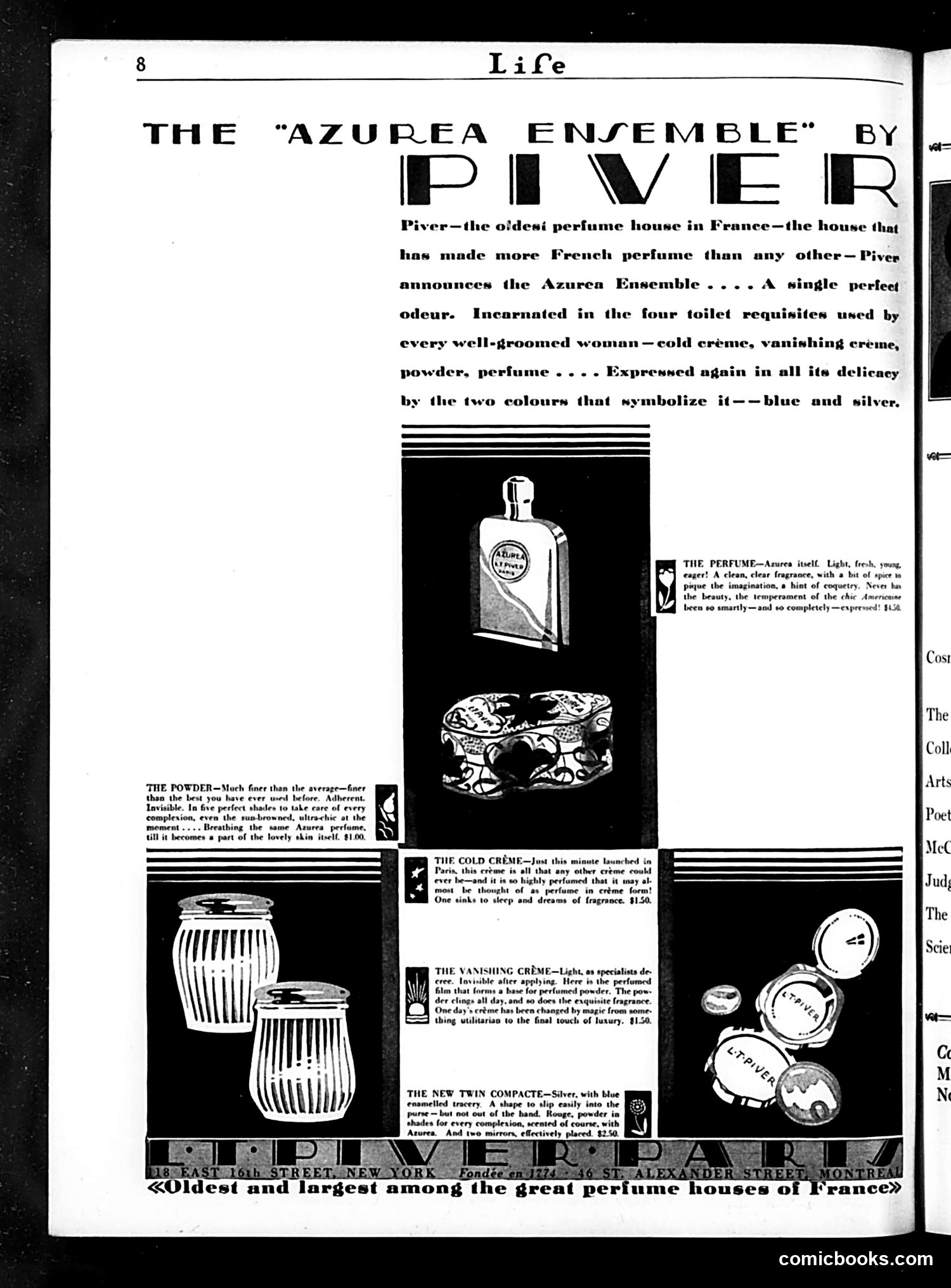
This is a **perfume advertisement**, not political satire or a cartoon. It promotes Piver's "Azurea Ensemble"—a complete grooming line from what the text identifies as "the oldest and largest among the great perfume houses of France." The ad showcases four luxury toiletries: perfume, powder, cold crème, and vanishing crème, each with detailed descriptions emphasizing elegance and effectiveness. Product illustrations show ornate packaging designed to appeal to affluent women readers. The advertisement uses typical early 20th-century marketing language emphasizing French sophistication, delicacy ("blue and silver" symbolism), and the promise that using these products signals refined femininity and social status. This represents **consumer advertising of the era**, not editorial content or satire.
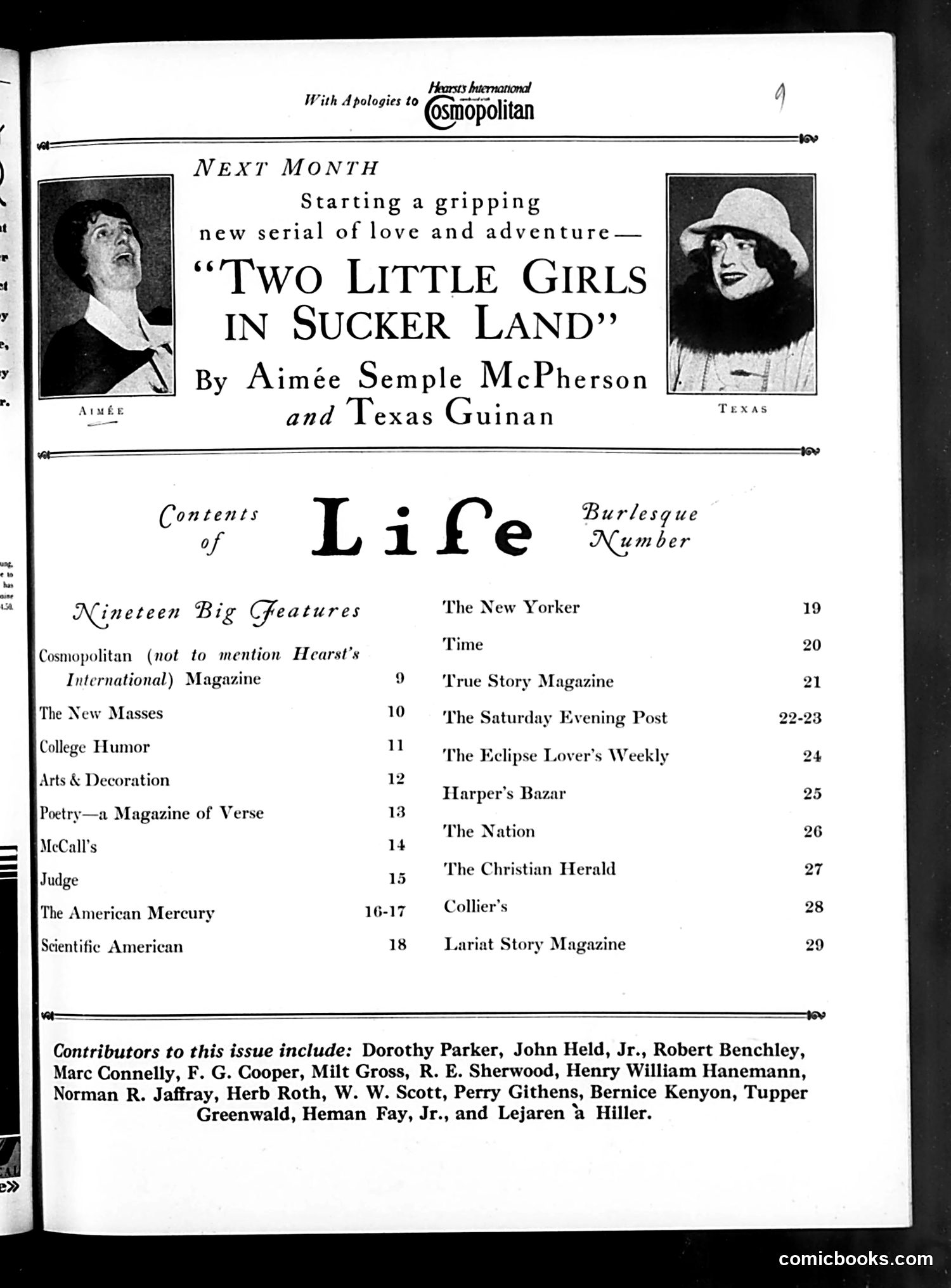
This is a contents/title page for *Life* magazine's "Burlesque Number." The page announces an upcoming serial called "Two Little Girls in Sucker Land" by Aimee Semple McPherson and Texas Guinan—two famous 1920s figures known for scandal and notoriety. **McPherson** was a controversial evangelist whose extravagant lifestyle contradicted her religious teachings. **Guinan** was a nightclub hostess famous for her "Hello, Sucker!" catchphrase, associated with Prohibition-era excess. The joke appears to be pairing these two notorious women as co-authors of a satirical serial, suggesting they represent different forms of American gullibility—religious exploitation versus nightclub hustlerism. The "Burlesque" designation indicates *Life* is mocking both women and the "suckers" they preyed upon. This leverages reader familiarity with these celebrities' controversial reputations.
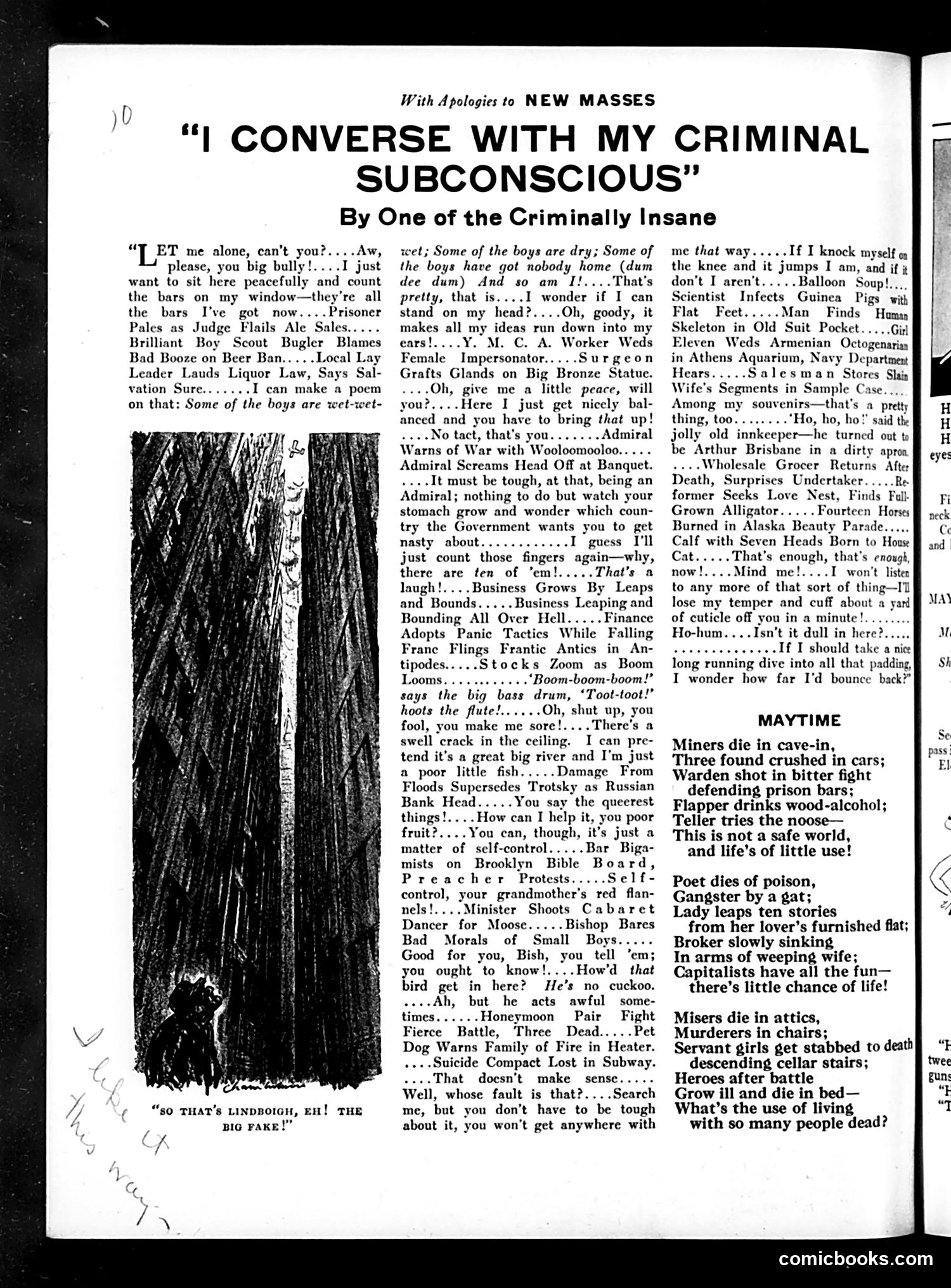
This page presents a satirical monologue titled "I Converse with My Criminal Subconscious," attributed to "One of the Criminally Insane." The accompanying illustration shows a distorted, somewhat grotesque face rendered in dark, scratchy lines—likely depicting mental illness or psychological disturbance. The text is a stream-of-consciousness rant mixing random violent and criminal thoughts (murder, theft, assault) with mundane observations, stream-of-consciousness tangents, and absurdist non sequiturs. The satire appears to mock pseudo-Freudian psychology popular in the 1920s-30s—the idea that respectable people harbor dark criminal impulses in their "subconscious." The humor derives from the jarring contrast between civilized society and the chaotic, violent thoughts supposedly lurking beneath, presented as darkly comedic rather than genuinely threatening.
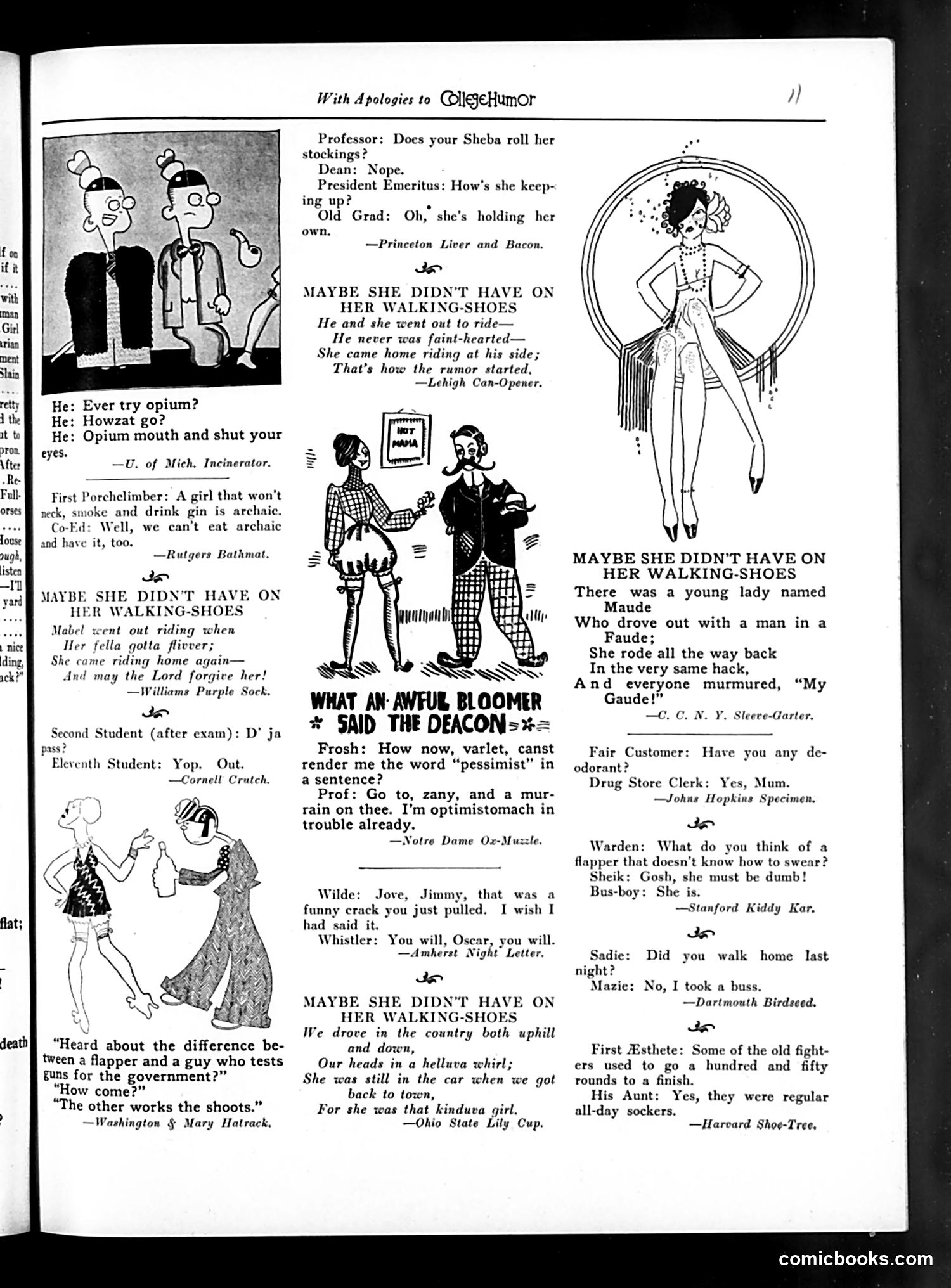
This page from *Life* magazine contains primarily **humorous social commentary rather than political cartoons**. The recurring theme "Maybe She Didn't Have On Her Walking-Shoes" appears multiple times with different jokes, playing on a contemporary rumor or scandal involving a woman (possibly named Maude) who rode out with a man and didn't return home properly—suggesting impropriety. The jokes mock various college types, drug store interactions, and social conventions of the era. The repeated refrain suggests satirizing how people excuse or explain away a woman's questionable behavior through increasingly absurd rationalizations. The cartoon illustrations accompany short jokes from various colleges and publications, representing typical early-20th-century college humor and social satire rather than direct political commentary.
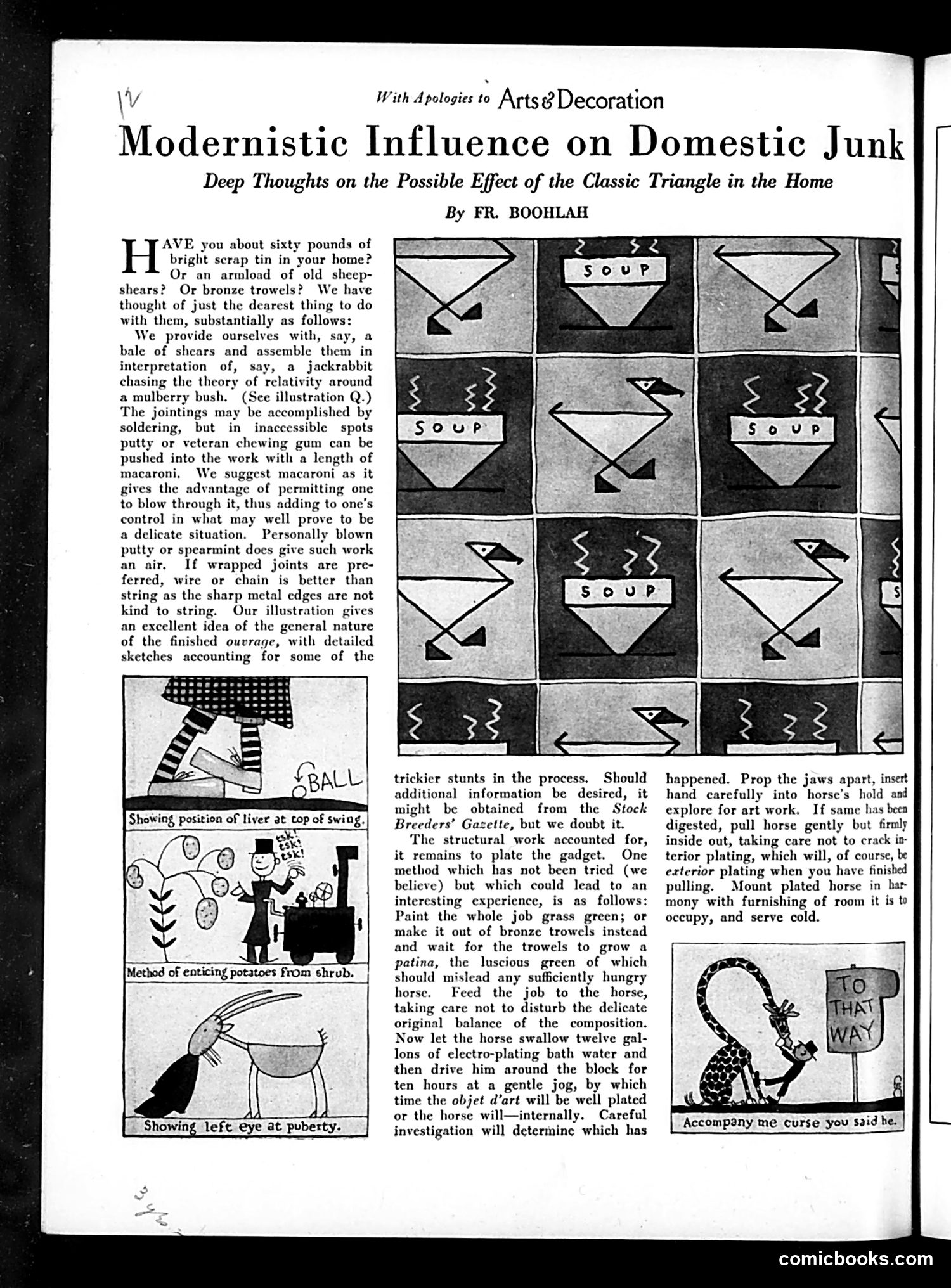
This is a satirical article by Fr. Boohlah mocking modernist art movements' influence on home decoration. The author ridicules the trend of assembling scrap metal (tin, shears, bronze trowels) into abstract "art" using geometric shapes—particularly triangles—inspired by modernism. The central joke: avant-garde artists are encouraging ordinary people to turn household garbage into pseudo-artistic sculptures using crude techniques (soldering, chewing gum, macaron). The accompanying diagrams with "soup" labels and geometric patterns humorously parody modernist abstraction as meaningless decoration. The smaller illustrations show absurd domestic "art projects" (fashioning objects from shrubbery, treating a horse as sculpture), further mocking how modernist pretension transforms worthless materials into supposedly valuable objets d'art. The satire targets both modernism's obscurity and middle-class aspirational decoration.
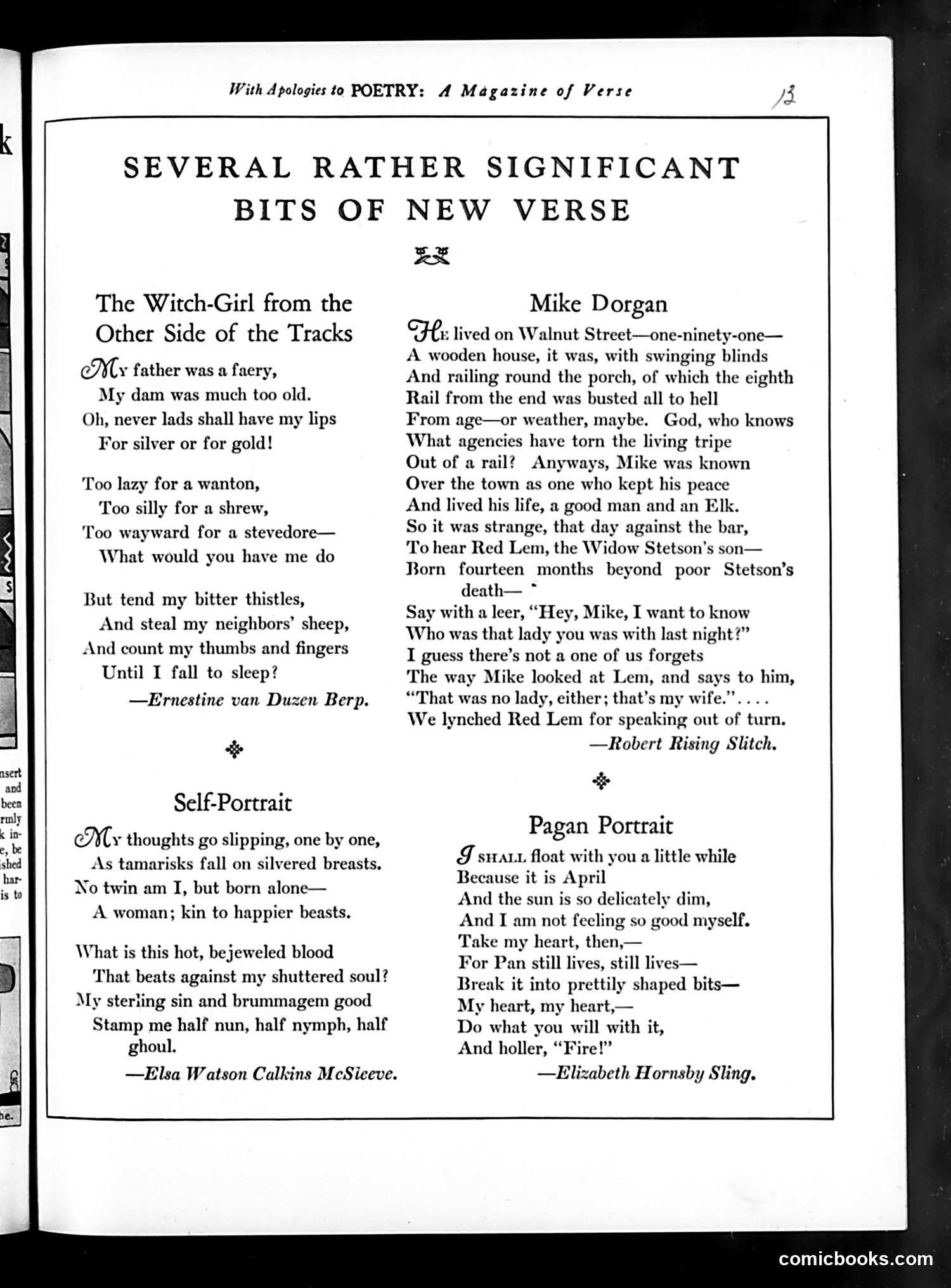
This page from *Poetry: A Magazine of Verse* presents four poems by different authors, not political cartoons or satire. The poems include "The Witch-Girl from the Other Side of the Tracks" by Ernestine van Duzen Herp (depicting a working-class girl's defiant rejection of social expectations), "Mike Dorgan" by Robert Rising Stitch (a narrative about a town man and a lynching), "Self-Portrait" by Elsa Watson Calkins McSieeve (introspective verse about identity), and "Pagan Portrait" by Elizabeth Hornsby Sling (an April poem addressing Pan). These are literary works, not satirical commentary. The page showcases contemporary poetry from the early 20th century, focusing on character studies, social themes, and romantic or mythological subjects rather than political messaging.
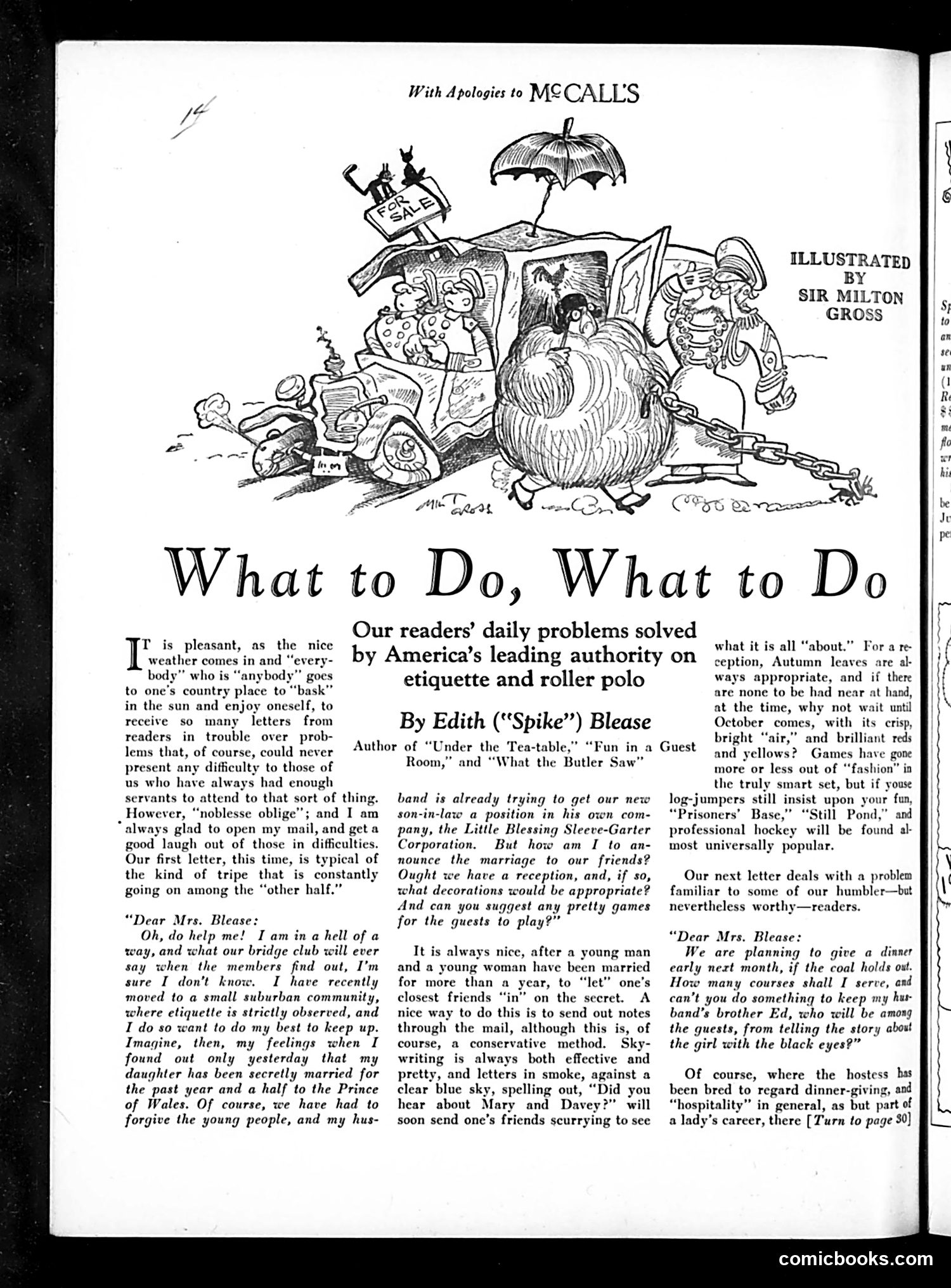
This page presents an advice column by Edith "Spike" Blease addressing readers' etiquette questions. The header illustration by Sir Milton Gross depicts a chaotic domestic scene—a large woman surrounded by various figures and activities (suggesting household management challenges). The column addresses typical 1920s-30s social concerns: a woman worried about her bridge club's etiquette, a son-in-law seeking advice about entertaining guests, and a hostess planning a formal dinner. The satire lies in the everyday absurdity of these concerns—people anxious over proper social forms while life appears comically disordered around them. The illustration's visual chaos contrasts with the formal advice being dispensed, gently mocking both rigid etiquette obsession and the difficulty of maintaining it.
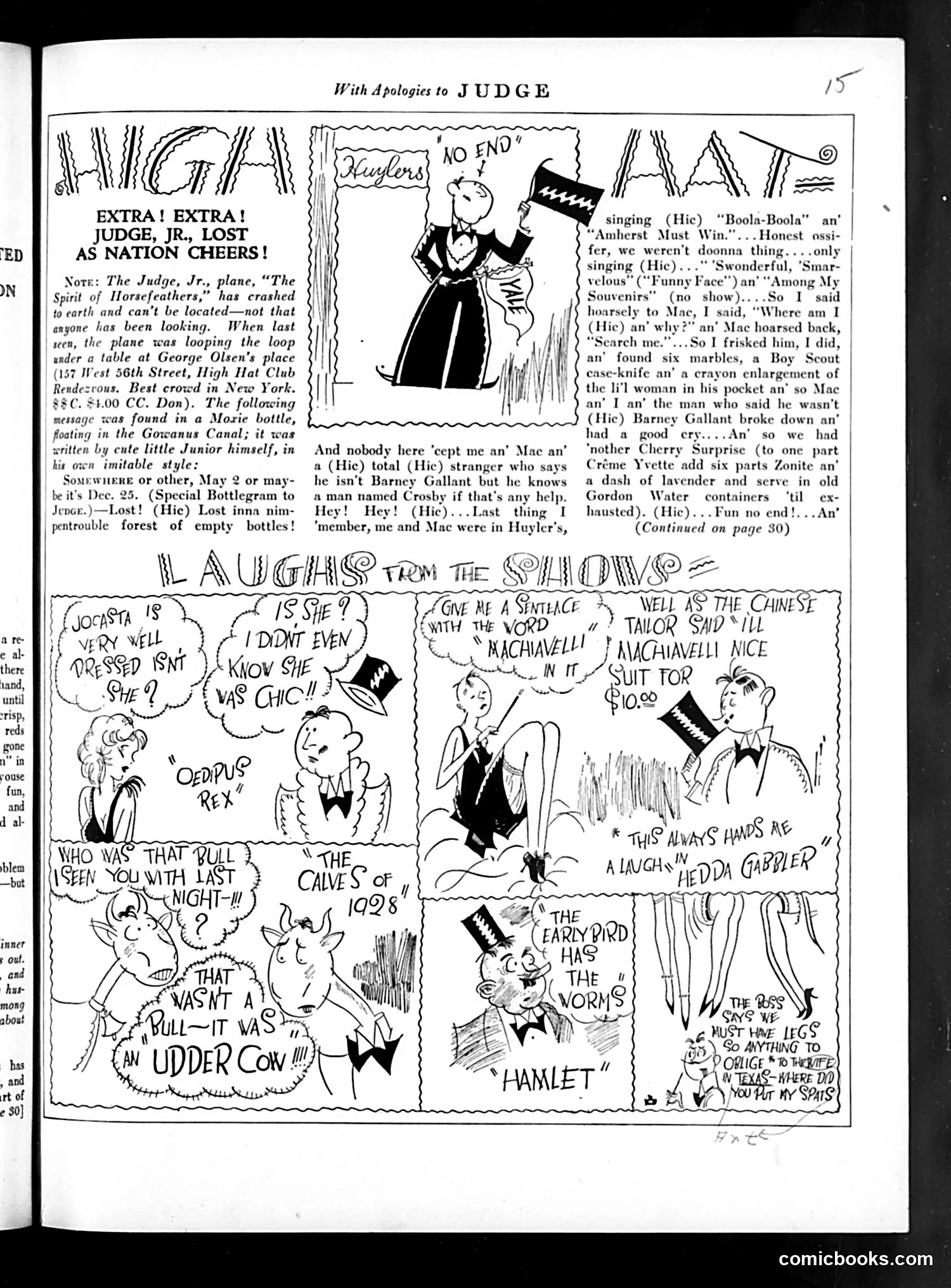
This page contains two comedic sections satirizing theatrical and social pretense: **Top section**: Reports that "Judge Jr." (a child character) is lost, with a humorous note explaining his plane crashed near George Olsen's nightclub location. A message in a Mozie bottle from the child uses deliberately malapropropisms and crude language, mocking both childish speech and affected theatrical performers. **Bottom section ("Laughs from the Shows")**: A multi-panel comic strip parodying Broadway theater culture. Characters discuss a show, reference classical theater (Oedipus Rex, Hamlet), and make jokes about pretentious theatrical language ("Machiavelli"), expensive clothing ($10 suits), and clichéd theater gossip ("The Calves of 1928"). The humor targets the self-importance and absurdity of theater world conventions. Overall, the page mocks theatrical affectation and Broadway's pretentiousness during the Jazz Age.
This page contains **no cartoon or satirical image**—it's entirely text. The page features two sections: 1. **"The Library" by H.L. Mencken**: A literary review attacking George Jean Nathan as a writer of "imbecile rationalization" and comparing him unfavorably to figures like Cabell and Dreiser. Mencken sarcastically praises Nathan's theatrical criticism while questioning his intellectual contributions. 2. **"Clinical Notes" by George Jean Nathan**: A response section where Nathan critiques local theatrical critics and discusses French cuisine, specifically *sauce rémoulade*. This appears to be a **feuding-critics segment**—two prominent cultural commentators publicly sparring through the magazine's pages. The satire targets pretension in both theater criticism and intellectual circles of the era.
This is a title page for the "Americana" section of *Life* magazine—a miscellaneous collection of brief humorous items from across the United States, not a political cartoon. The ornamental border frames the section header. The items are satirical short-form humor pieces mocking various American individuals and institutions. Examples include: - **California**: Golf course etiquette violations - **Illinois**: A minister's dubious divine insight about weather forecasting - **Maryland**: Praise for Abraham Lincoln and the American Creed - **Massachusetts**: A poultry association seeking government disease-control reports - **New York**: Criticism of pedantic literary critics - **Ohio through Vermont**: Various local observations on marriage announcements, theological coinage, and civic behavior These represent *Life*'s characteristic satirical commentary on American provincial life and pretension, without targeting specific named political figures.
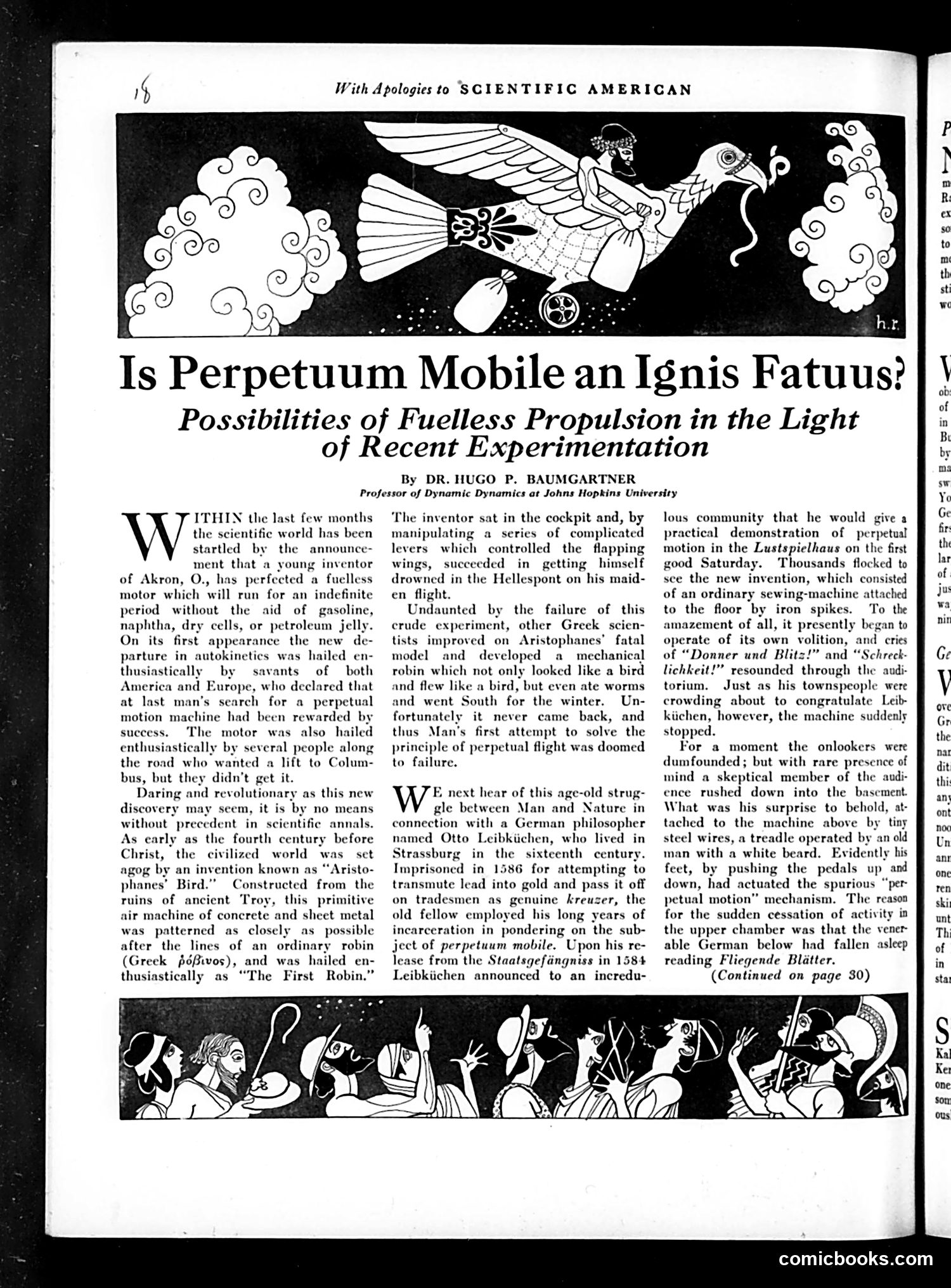
This is a satirical article mocking the recent announcement of a "fuelless motor" invented by a young man from Akron, Ohio—a perpetual motion machine that supposedly needs no fuel to run indefinitely. The author (Dr. Hugo P. Baumgartner, a fictitious academic) sarcastically traces the history of failed perpetual motion attempts. The joke: every historical example contains an obvious hidden power source. Aristophanes' ancient flying machine? The inventor drowned. A mechanical robin? It flew away. Most pointedly, Leibküchen's 16th-century perpetual motion device in Strasbourg that amazed crowds was revealed to be powered by an old man pumping a treadle below—literally the person operating the machine fell asleep reading a magazine, stopping the "perpetual" motion instantly. The satire targets public gullibility and scientific skepticism: the article implies the Ohio inventor's motor likely has a similarly mundane, hidden power source that observers simply haven't discovered yet. The elaborate historical "precedents" ridicule both past credulous believers and contemporary excitement over this dubious invention.
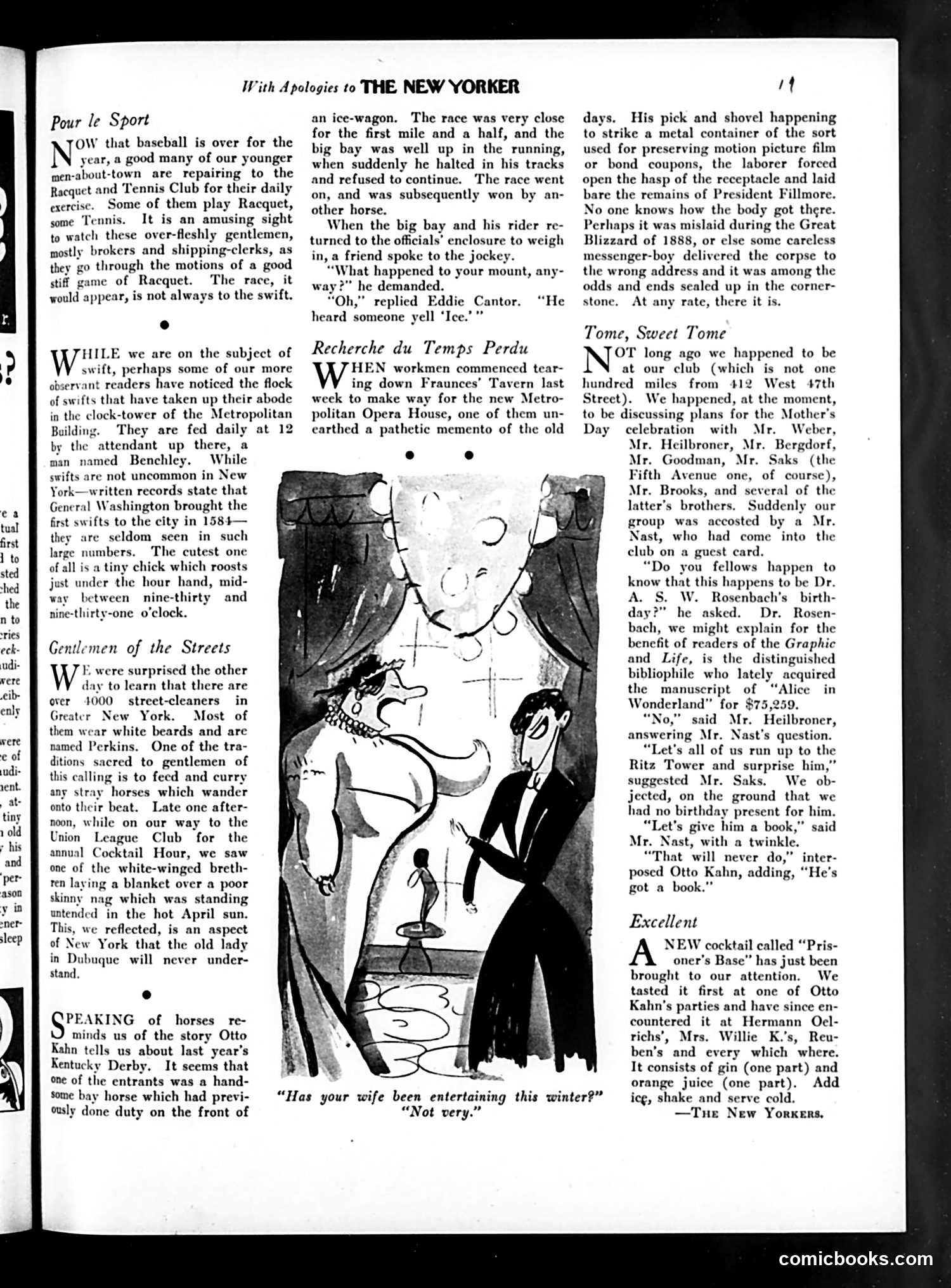
This page from *Life* magazine (parodying *The New Yorker*'s style) contains several satirical pieces mocking New York society and current events: **"Pour le Sport"**: Ridicules wealthy Manhattan "brokers and shipping-clerks" playing racquetball at exclusive clubs, suggesting their sedentary lifestyles make them unfit. **"Gentlemen of the Streets"**: Celebrates street-cleaners' dignity while gently mocking upper-class obliviousness—the author notes that New Yorkers' kindness to stray horses is something "the old lady in Dubuque will never understand." **The Kentucky Derby anecdote**: Features comedian **Eddie Cantor** explaining why a former ice-wagon horse refused to race—it halted upon hearing someone yell "Ice!" A joke about conditioning and class mobility. **The cartoon**: Shows a woman being asked if her wife entertained during winter—a mild marital joke. **"Recherche du Temps Perdu"**: An absurdist item claiming workers discovered **President Fillmore's remains** in a cornerstone during Fraunces' Tavern demolition—pure comedic fantasy satirizing New York's historical pretensions.
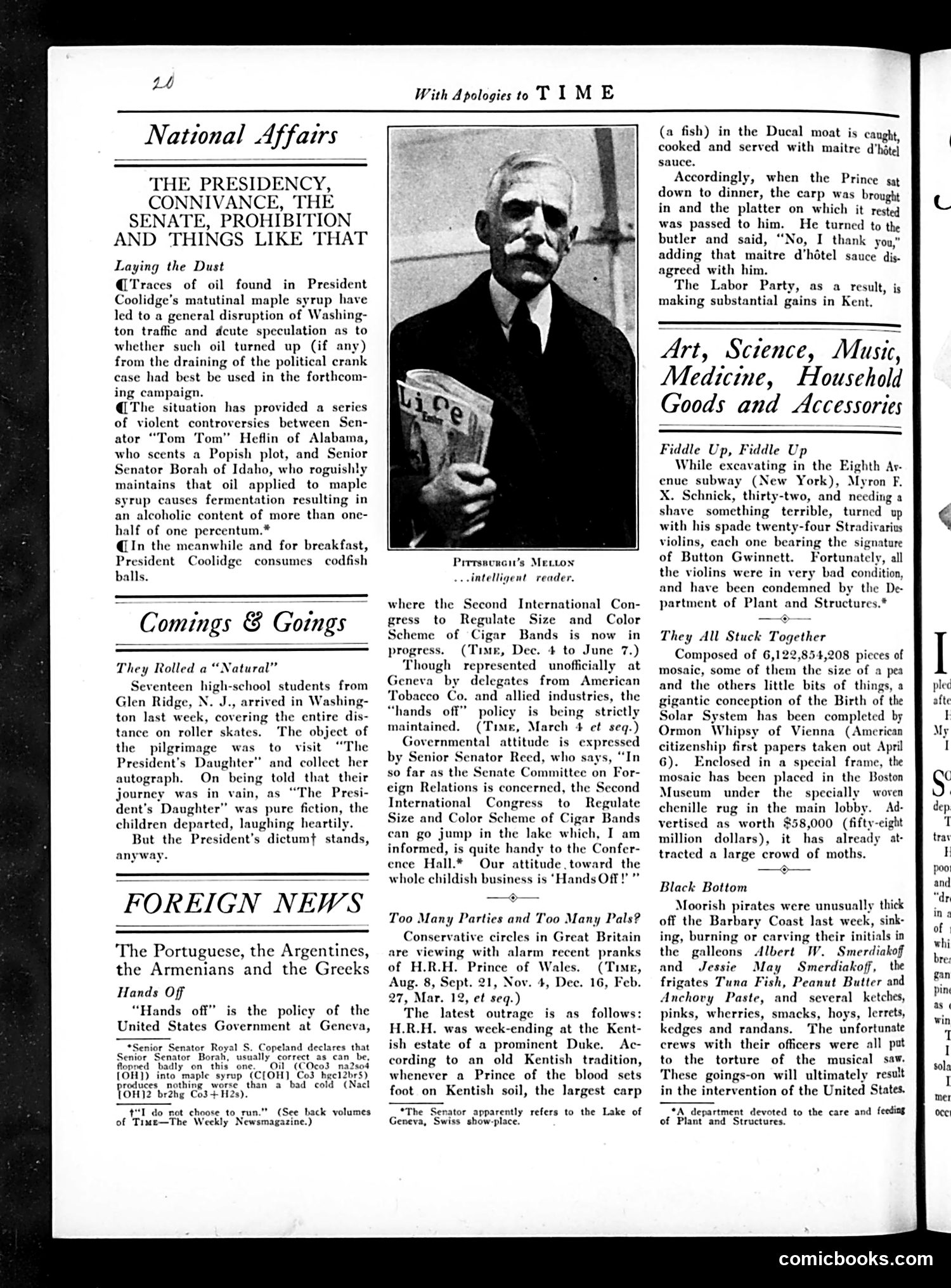
This page satirizes President Coolidge and contemporary political absurdities through mock-serious reporting. **"Laying the Dust"** mockingly presents three scandals: oil traces in Coolidge's maple syrup sparking Washington speculation; senators debating whether the oil causes fermentation and alcohol content (absurdly specific chemistry); and Coolidge's actual breakfast of codfish balls. The satire targets both political paranoia and Prohibition-era anxieties. **"They Rolled a 'Natural'"** ridicules high schoolers roller-skating to Washington to meet "The President's Daughter"—a fictional character—demonstrating public gullibility. **Foreign News items** parody Time magazine's earnest reporting style, treating trivial matters (cigar band regulations, the Prince of Wales refusing carp sauce) as serious international incidents with political consequences. The overall effect: Life mocks Coolidge's silent presidency, governmental pointlessness, and the era's obsession with Prohibition and propriety, all while imitating Time's authoritative but often absurd newswriting.
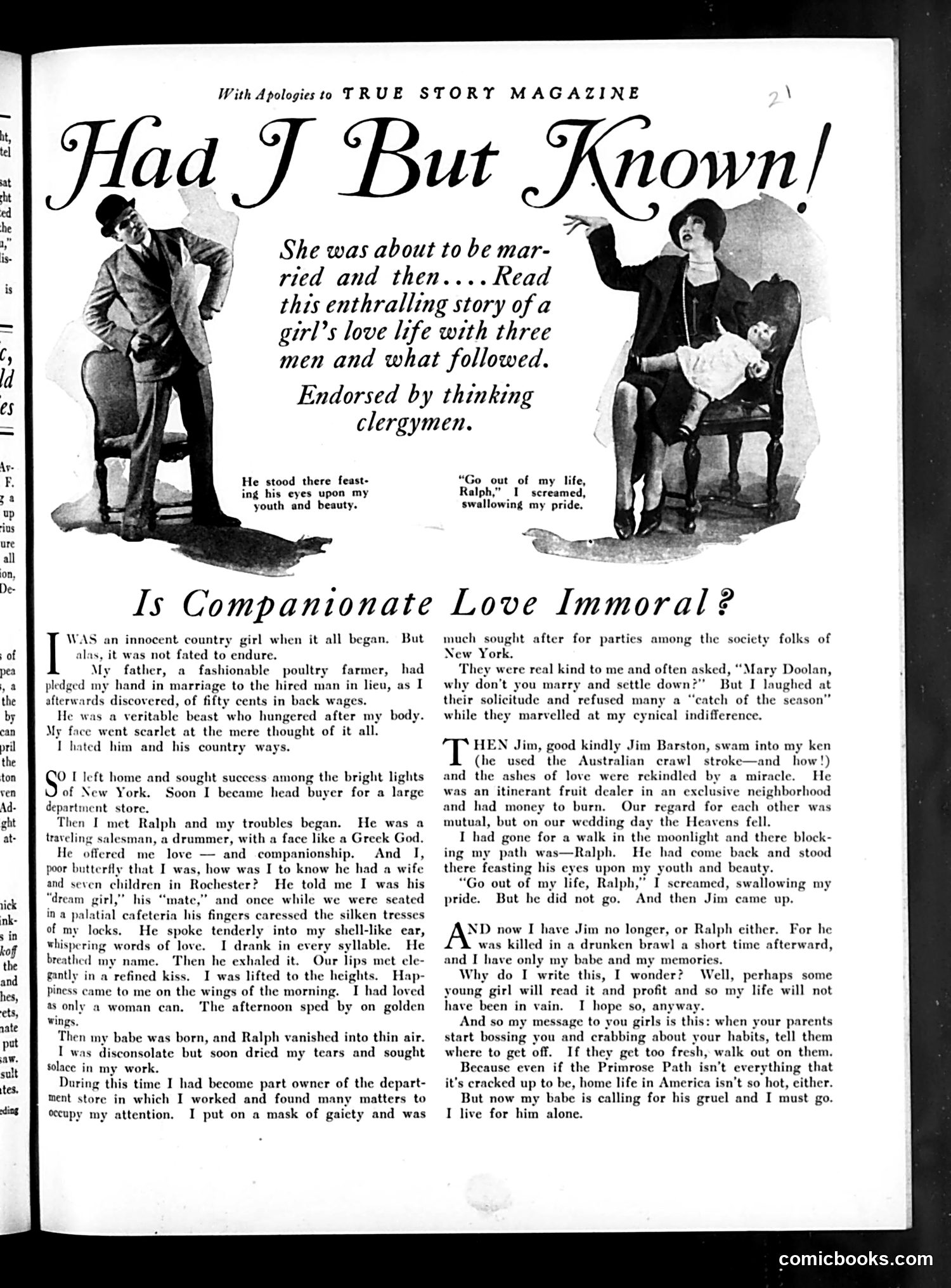
This page parodies the melodramatic "true confession" stories popular in 1920s magazines like *True Story*. The headline mockingly frames a cautionary tale: a country girl seduced by a traveling salesman (Ralph) who abandons her after she becomes pregnant, then faces complications when she remarries (Jim) and Ralph reappears. The satire targets the genre's overwrought moralism. The story is "endorsed by thinking clergymen," yet its actual message undercuts that endorsement—the narrator advises girls to rebel against parents and ignore consequences, sarcastically suggesting the "Primrose Path" (vice/immorality) is preferable to American home life. The illustrations show melodramatic moments: a man "feasting his eyes" on her youth, and a dramatic confrontation. The entire piece ridicules how pulp magazines simultaneously warned against vice while sensationalizing it, ultimately offering questionable moral guidance wrapped in false piety.
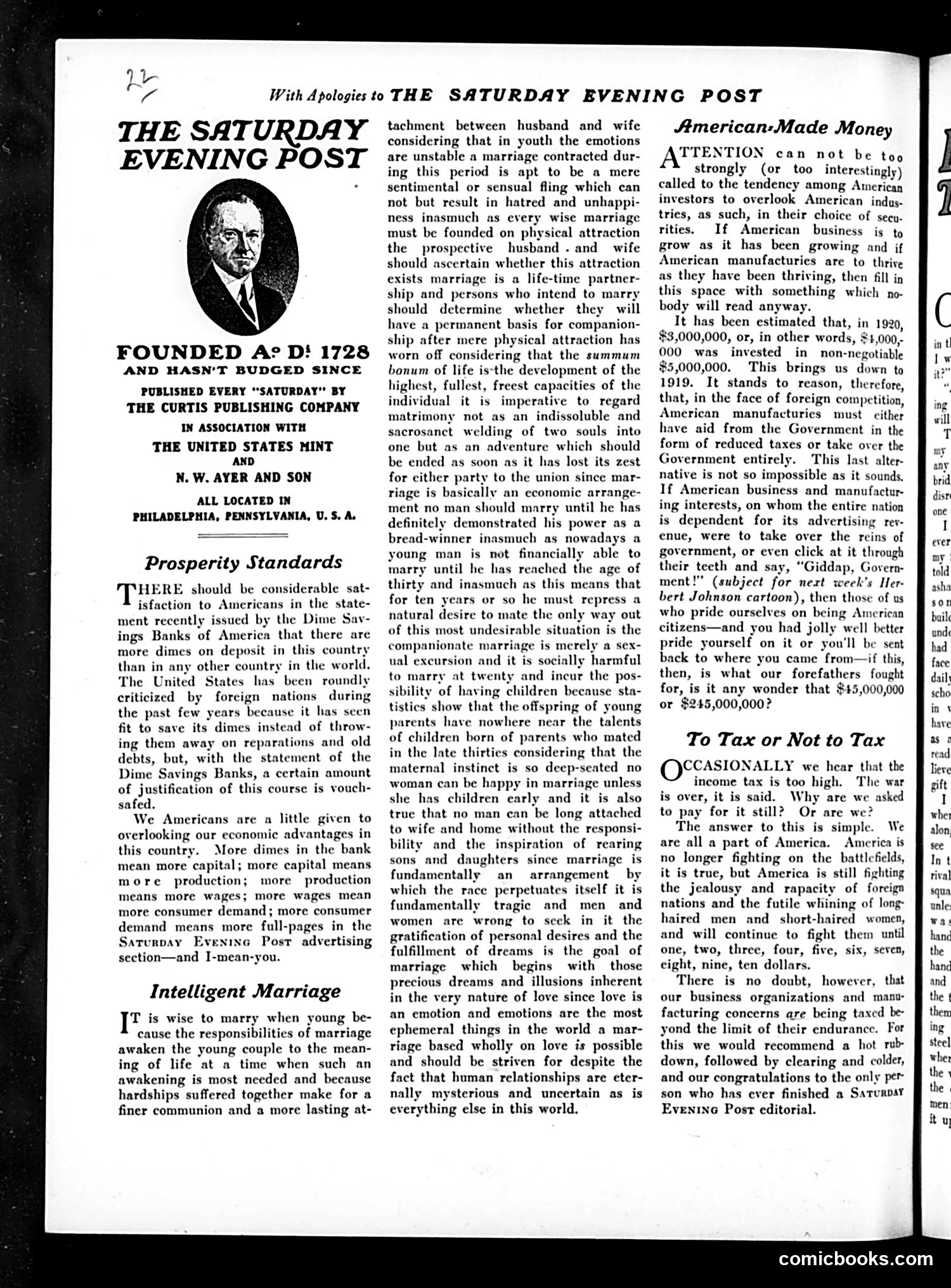
This page parodies *The Saturday Evening Post*, a major rival publication, through fake "apologies." The masthead mockingly claims the Post was "founded" in 1728 and "hasn't budged since"—satirizing its stodgy conservatism. The three satirical sections ridicule Post editorial positions: 1. **"Prosperity Standards"**: Mocks the Post's celebration of American dime savings as evidence of virtue, then cynically reveals the real benefit: more advertising revenue for the Post itself ("full-pages in the Saturday Evening Post advertising section—and I-mean-you"). 2. **"Intelligent Marriage"**: A deliberately contradictory, run-on passage that presents conflicting marriage advice—marry young for growth yet wait until thirty for financial stability; have children early yet offspring of young parents lack talent. This parodies the Post's moralistic yet confused relationship advice. The satire targets the Post's self-congratulatory patriotism and muddled social commentary, exposing financial self-interest beneath editorial preaching.
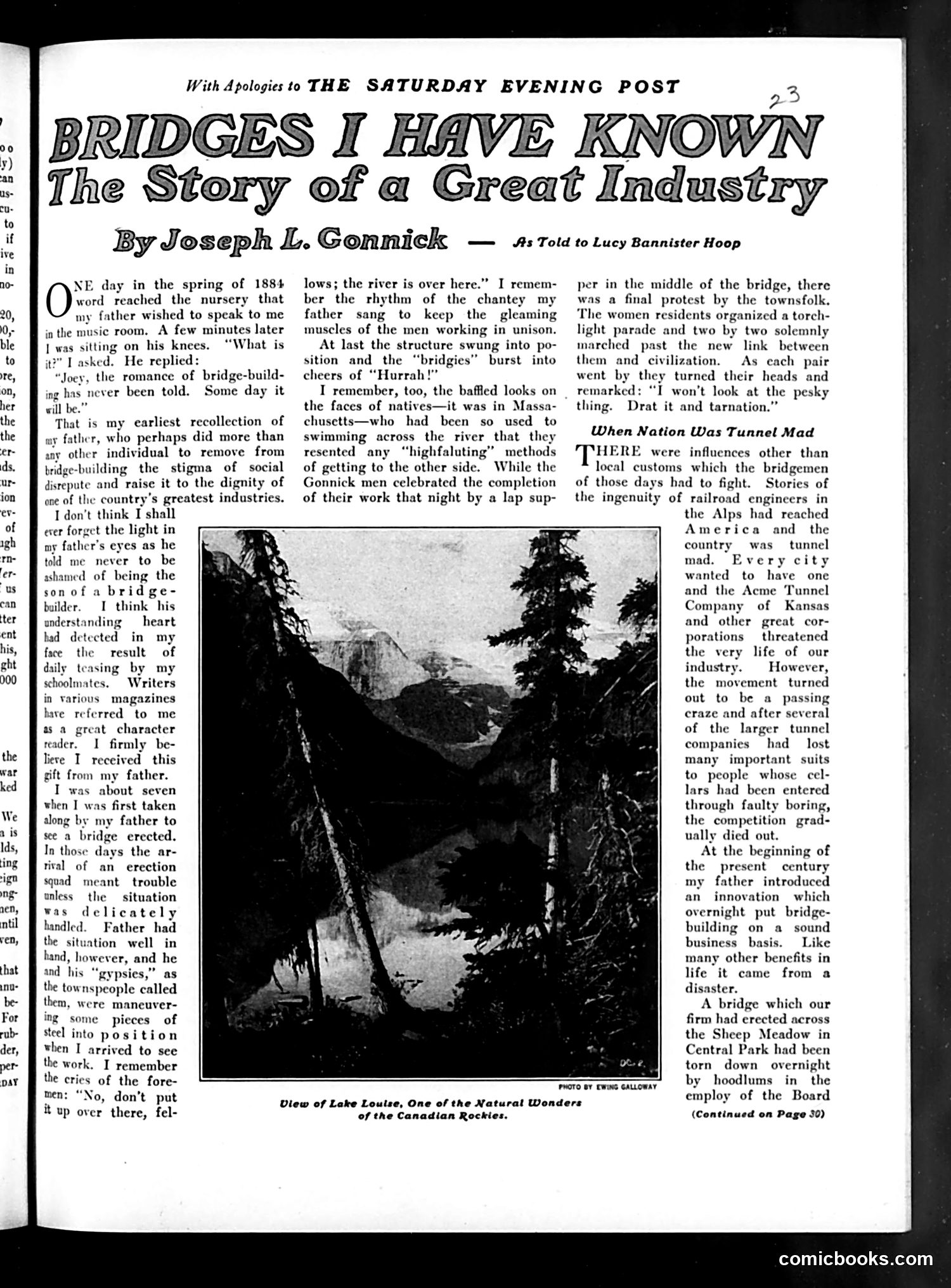
This is **not a cartoon page**, but rather the opening of a satirical article disguised as a serious memoir. It parodies *The Saturday Evening Post*'s sentimental, romanticized industry profiles—a popular magazine genre of the era. The satire works by treating bridge-building with mock-heroic earnestness: a father proudly tells his son never to be ashamed of being a "bridge-builder's son" (implying the profession was socially stigmatized), workers sing sea-shanties while assembling steel, and townspeople organize torch-lit protests against a new bridge because they preferred swimming across rivers. The humor derives from **elevating an ordinary, unglamorous profession into grandiose narrative**—complete with dramatic obstacles (tunnel company competition, hoodlum sabotage) and noble persistence. The included photograph of Lake Louise, captioned as a "Natural Wonder," undercuts the text's self-importance through incongruity. The byline credit to "Lucy Bannister Hoop" is itself a comedic name suggesting the article's fictional nature. This is early 20th-century satirical commentary on American business mythology and magazine culture's tendency toward overwrought inspiration narratives.
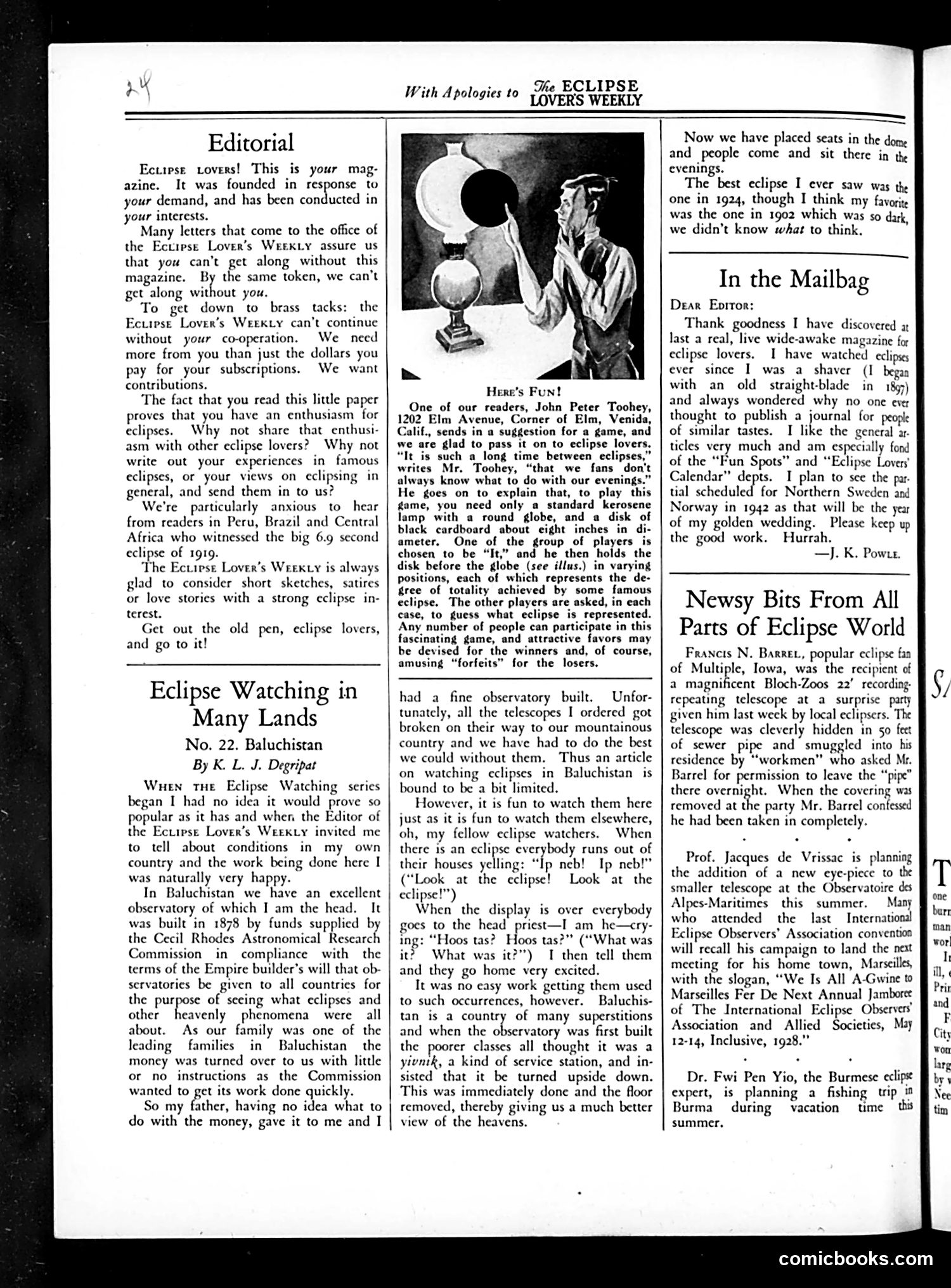
This page satirizes eclipse enthusiasm by presenting **"Eclipse Lovers' Weekly,"** a fake magazine parody of romance publications like "Lovers' Weekly." The humor lies in treating eclipse observation with the breathless passion typically reserved for romantic magazines. The illustration shows a man gazing intensely at an eclipse through a makeshift device (kerosene lamp and cardboard disk), mimicking the sentimental poses found in romance magazine covers. The editorial solicits reader contributions and advertisements as if eclipses were subjects of romantic obsession rather than astronomical interest. The article from "Baluchistan" continues the satire—narrating eclipse-watching with self-important detail while admitting the observatory's telescopes broke and do no actual work. A reader's "game" suggestion reveals the obsessive nature of eclipse fans: recreating famous eclipses as party entertainment. The joke: eclipse enthusiasts are portrayed as comically passionate, almost romantic in their devotion—a gentle mockery of niche hobby communities and their fervent dedication.
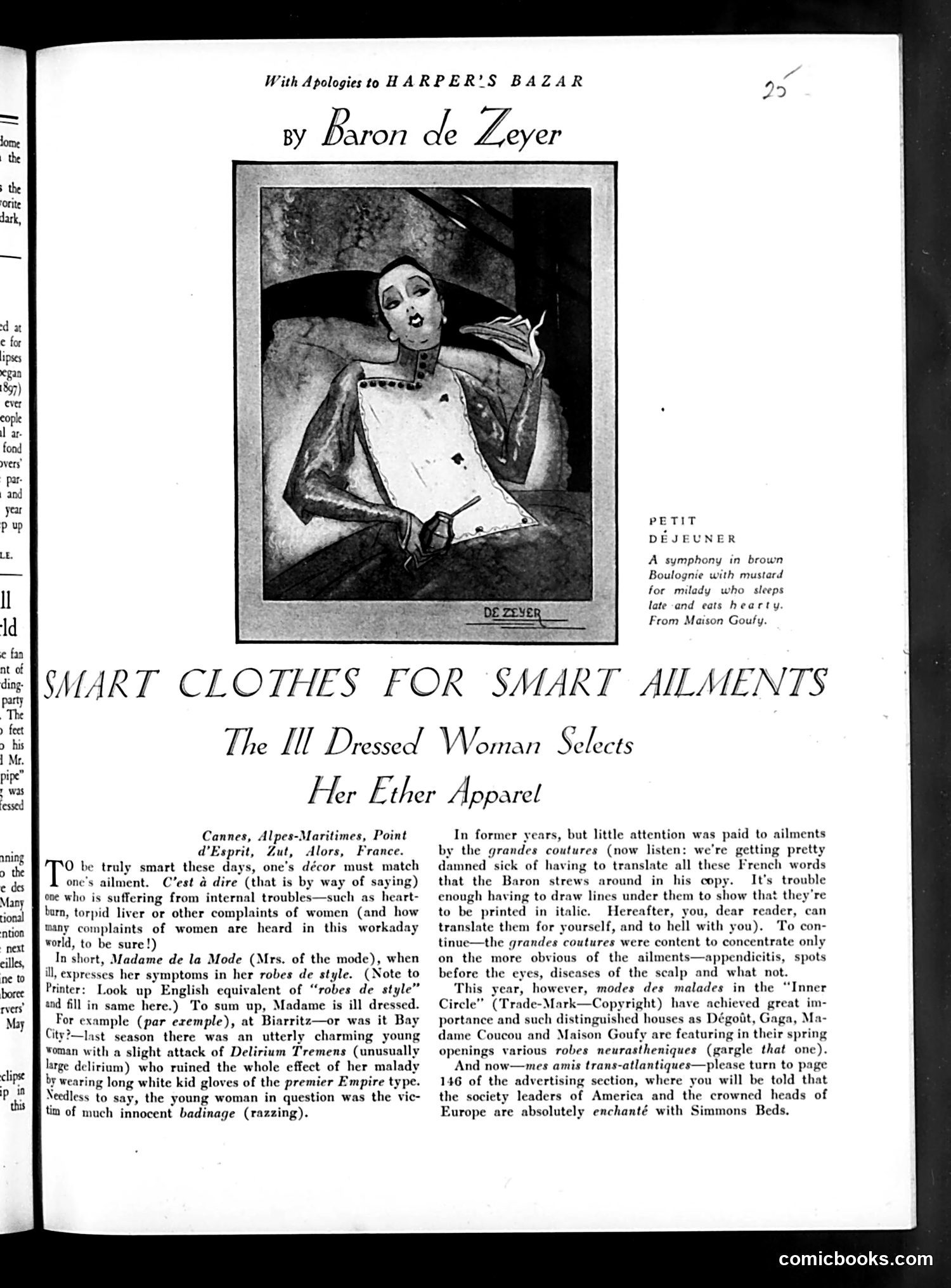
This is a satirical fashion piece mocking both haute couture pretension and women's health complaints. The illustration by Baron de Zeyer shows a fashionably dressed woman in an exaggerated, theatrical pose—likely meant to represent a hypochondriac displaying her "designer illness." The article parodies *Harper's Bazaar* by suggesting that fashionable Parisian couturiers now design clothes that *match* a woman's ailments rather than conceal them. The satire targets: 1. **Fashion snobbery**: The excessive use of French terms (robes de style, modes des malades, neurastheniques) 2. **Women's health complaints**: The running joke that women constantly suffer from ailments 3. **Consumer culture**: The implication that women will buy clothes based on whatever sickness they claim to have The editorial asides (especially the printer's notes complaining about translating French phrases) add meta-humor about Life magazine's own editorial frustrations. The final joke—redirecting readers to furniture advertisements—undercuts the whole piece as parody of advertising culture itself.
This article is pure political satire attacking Secretary of Commerce Herbert Hoover. The text fabricates absurd "scandals" from June 1905: that Hoover (under the alias "Humphrey Hofer") pierced children's ears and is covered in ship tattoos with women's names. The satire mocks both Hoover's public image and government secrecy. By inventing ridiculous charges that the government supposedly covered up, Life lampoons how political figures are whitewashed by official silence and how the public accepts whatever narrative authorities present. The final line—"a man who sets fire to old people's houses"—escalates the absurdity to expose the technique itself: outrageous claims repeated matter-of-factly become "news." The "India Resurgent" section similarly satirizes muddled reporting on Indian independence movements, fabricating nonsensical political factions and invoking Ohm's Law (physics) to ridicule oversimplified colonial discourse.
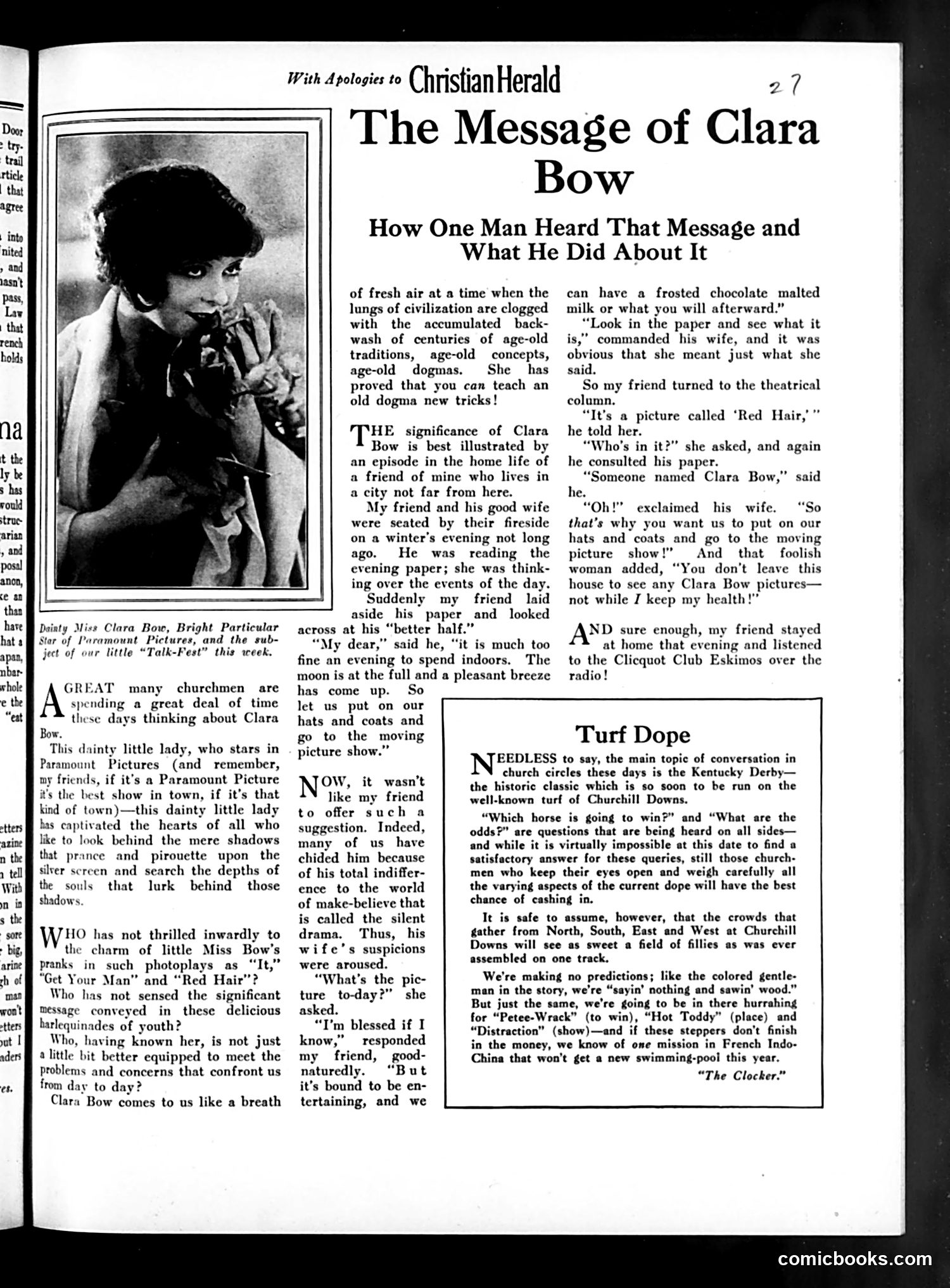
This is a satirical piece mocking the cultural obsession with silent film star Clara Bow in the 1920s. The article uses mock-serious language (parodying religious publications like *Christian Herald*) to ridicule how churchmen were discussing her films. The joke centers on a domestic anecdote: a man unexpectedly wants to see a Clara Bow picture, which so alarms his wife that she forbids him from going—fearing her husband has fallen under Bow's spell. The satire targets both the intense fan devotion to Bow and the anxiety about cinema's moral influence on audiences, particularly men. The second section, "Turf Dope," similarly mocks church circles obsessing over Kentucky Derby betting predictions, suggesting that congregants were equally preoccupied with horse racing as they were with cinema. The overall message: despite churches' moral concerns about entertainment and vice, churchgoers themselves were deeply invested in both popular culture and gambling—revealing hypocrisy in religious institutions' positions on worldly pleasures.
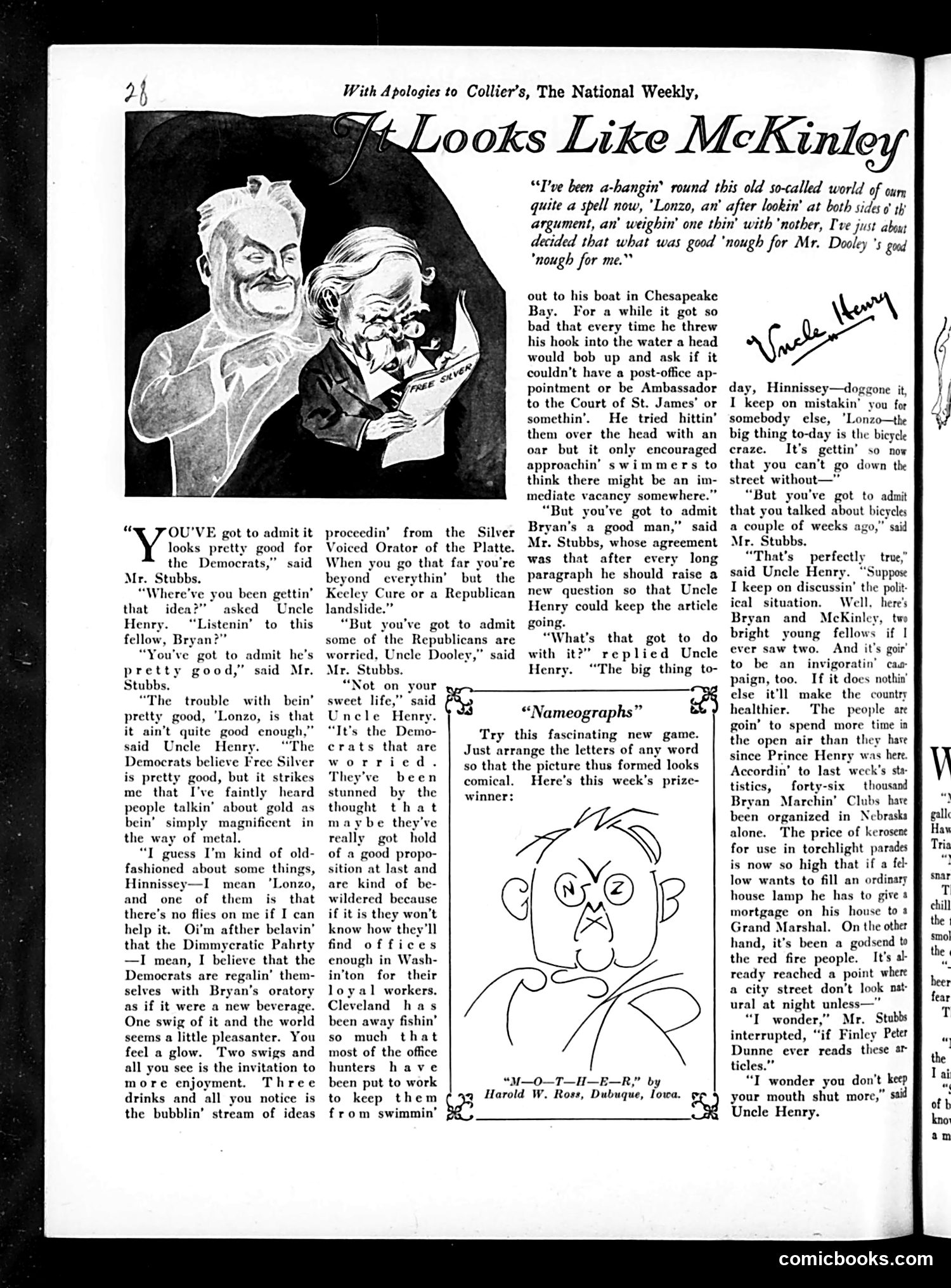
This page satirizes the 1896 U.S. presidential campaign between Democrat William Jennings Bryan and Republican William McKinley. Uncle Henry (a Mr. Dooley-type character) argues that while Bryan is an eloquent speaker ("Silver Voiced Orator of the Platte"), eloquence alone doesn't make good policy. Henry dismisses the Democrats' Free Silver platform as intoxicating but insubstantial—mere oratory that feels good but lacks substance. The satire suggests Bryan's rhetoric seduces voters like alcohol, creating a pleasant glow without real merit. Henry implies McKinley is the sounder choice, despite Bryan's superior speaking abilities. The cartoon also mocks Democrats' patronage anxieties and criticizes their reliance on Bryan's personality over policy. The "Nameographs" puzzle is unrelated filler content typical of the era's magazines.
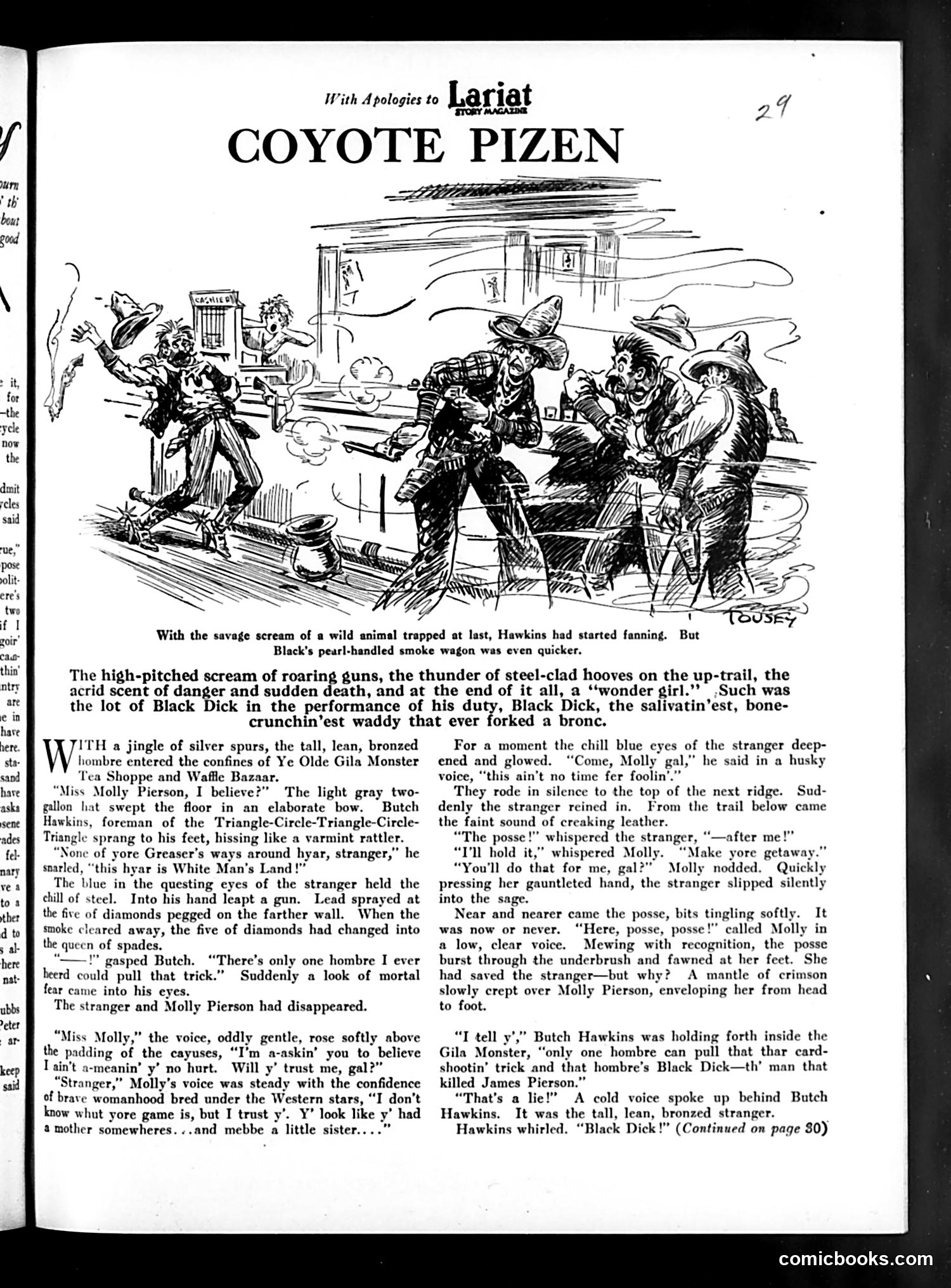
This is a satirical Western story parodying the melodramatic pulp fiction and dime novels popular in early 20th-century America. The page mocks overwrought Western tropes: the mysterious stranger with a mysterious past, the virtuous frontier girl, the jealous local tough guy, gunfights over card tricks, and dramatic reveals of hidden identities. The story features "Black Dick," apparently a legendary gunslinger, and "Miss Molly Pierson," a frontier woman who must choose between the dangerous stranger and the local foreman Butch Hawkins. The exaggerated dialect ("hyar," "whut yore game is") and stock situations—the quick-draw duel, the posse chase, the emotional final confrontation—deliberately overstate Western fiction conventions for comedic effect. The subtitle notes this appears in *Lariat* magazine, suggesting it's mocking that very genre publication.
This page contains three distinct satirical pieces: **"Bridges I Have Known"** is a humorous anecdote about a father in the bridge-building business who learns a hard lesson when New York City's Board of Aldermen demolishes his newly constructed bridge in Central Park overnight. The satire targets municipal corruption and incompetence—the implication being that city officials sabotaged the work, possibly for graft or political reasons. The father's solution (requiring written orders and payment upfront from clients) mocks the dysfunctional relationship between private industry and corrupt local government. **"Coyote Pizen"** is a parody of Wild West pulp fiction, complete with stock characters (the ranger detective, the villainous coward, the grieving heroine). It satirizes overwrought Western shoot-out narratives through exaggerated melodrama. **The other fragments** ("What to Do, What to Do," "High Hat," "Is Perpetuum Mobile an Ignis Fatuus?") appear to be column continuations offering domestic advice and commentary on perpetual motion machines. The page exemplifies Life's characteristic blend of domestic satire and social commentary aimed at educated, urban readers.
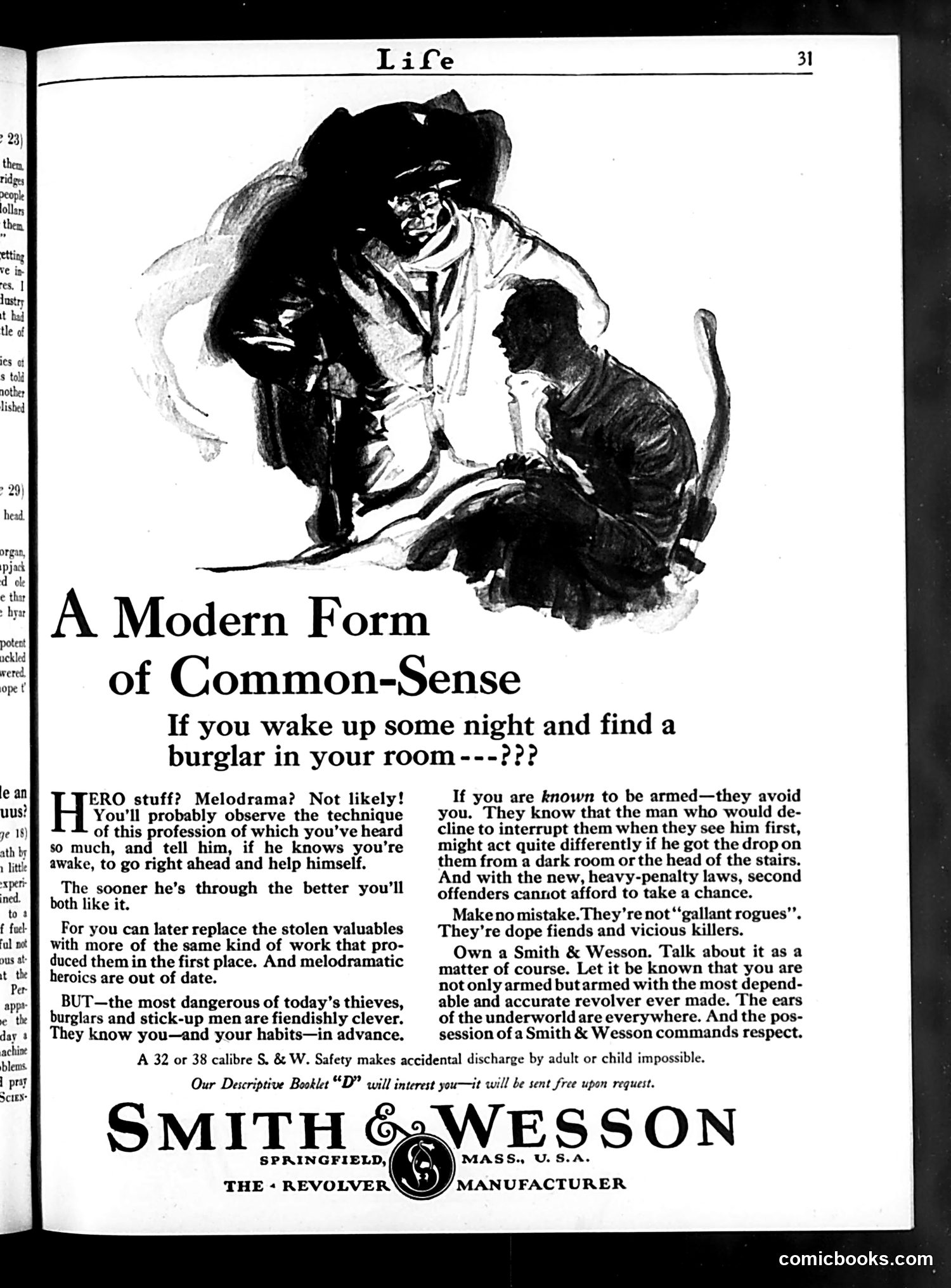
This is a Smith & Wesson revolver advertisement disguised as satirical advice. The cartoon depicts an older man confronting a burglar, illustrating the ad's premise: modern burglars are dangerous criminals (drug addicts and killers), not romantic rogues deserving mercy. The ad's "satire" argues that the old melodramatic response—allowing a burglar to proceed unmolested—is naive. Instead, the modern homeowner should own and visibly possess a Smith & Wesson revolver. The mere *knowledge* that you're armed deters dangerous criminals from targeting you, the text claims. The appeal is fundamentally about respect and deterrence through visible firepower in the criminal underworld ("the ears of the underworld are everywhere"). This reflects early 20th-century anxieties about urban crime and positions gun ownership as rational self-defense strategy rather than heroic fantasy.
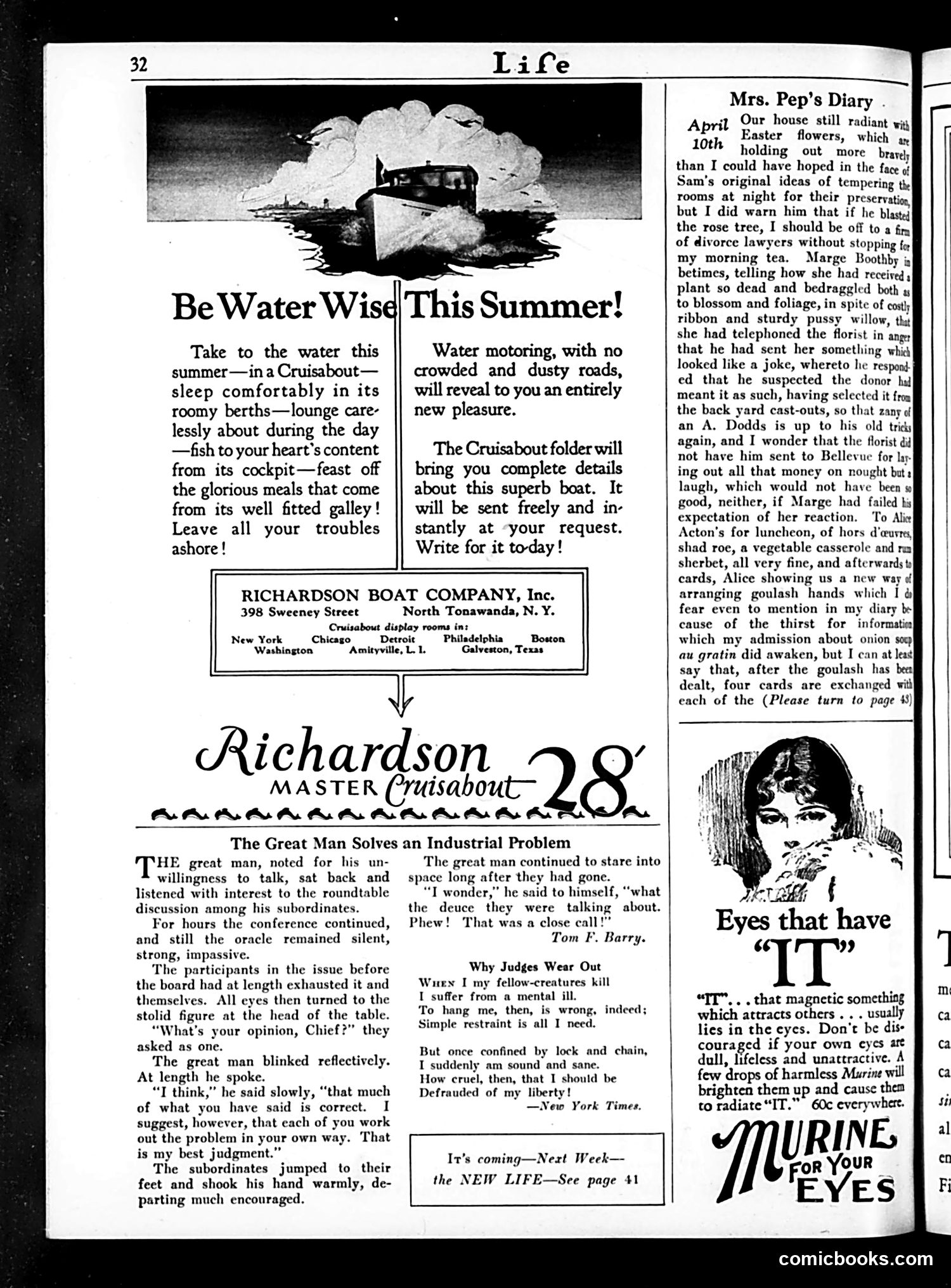
This page contains primarily **advertisements and humor columns** rather than political cartoons. The main content includes: 1. **"Be Water Wise This Summer!"** — A Richardson Boat Company advertisement promoting leisure cruising as an escape from "crowded and dusty roads," reflecting 1920s-30s aspirations for vacation comfort. 2. **"The Great Man Solves an Industrial Problem"** — A satirical piece by Tom F. Barry mocking executive pretension. A silent, powerful company leader impresses subordinates by telling them to solve problems themselves, when he actually admits (to himself) he didn't understand the discussion. The satire targets the cult of the "great man" in business who maintains authority through inscrutability. 3. **"Why Judges Wear Out"** — A brief satirical poem from the *New York Times* questioning whether imprisonment truly reforms criminals, or merely restrains them temporarily. 4. **"Mrs. Pep's Diary"** — A gossipy society column detailing trivial domestic and social events (Easter flowers, lunch parties, card games). The page reflects typical Life magazine content: lifestyle advertising, workplace satire, and society humor for educated middle-class readers.
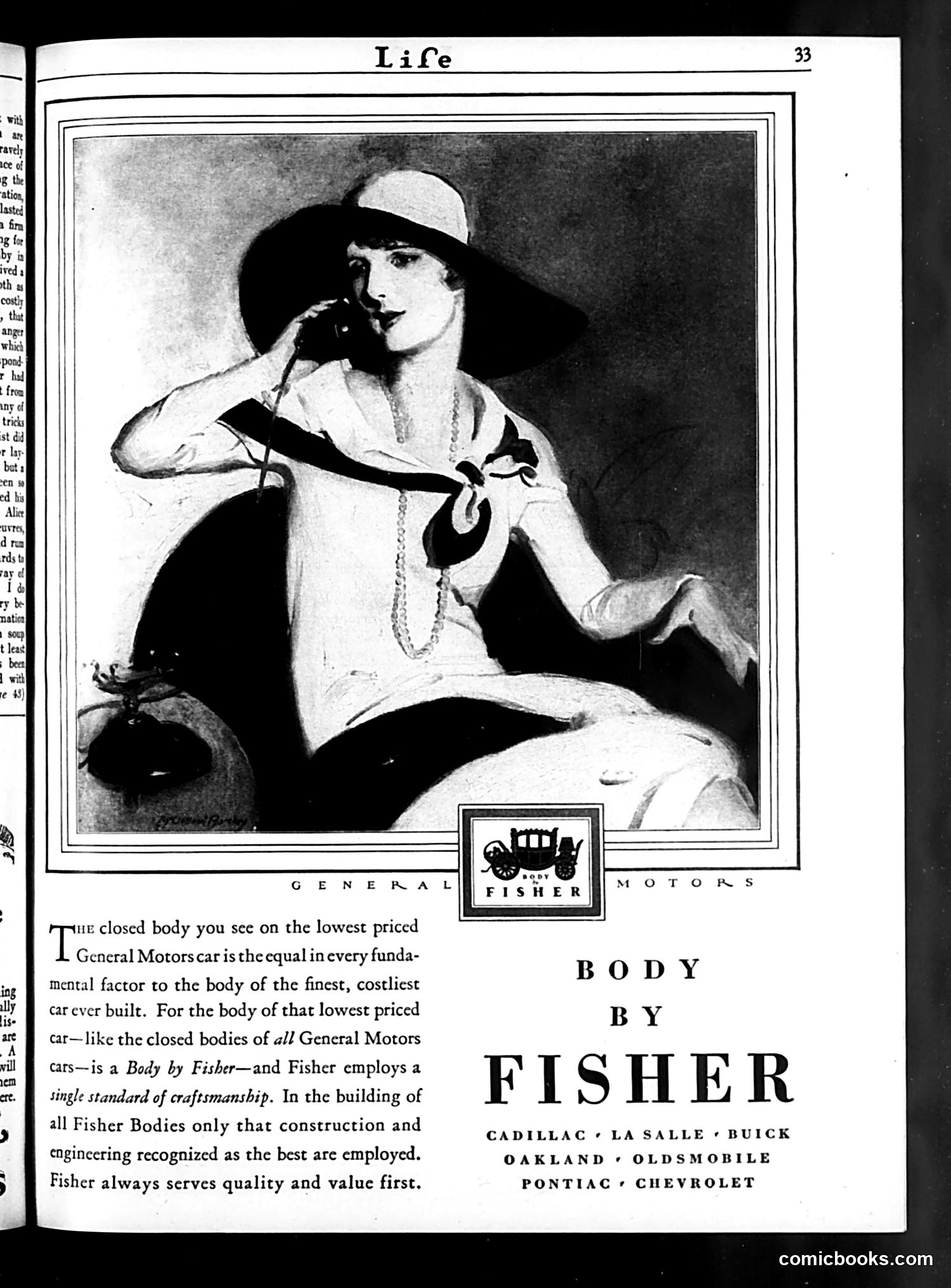
This page is primarily **advertising, not satire or political commentary**. It's a General Motors/Fisher Body advertisement from Life magazine (page 33). The image shows a fashionable woman in 1920s attire (cloche hat, pearl necklace, elegant dress) examining or adjusting her appearance—likely meant to suggest sophistication and modernity. The ad's message: Fisher Body manufactures car bodies for multiple GM brands (Cadillac through Chevrolet), claiming that even the cheapest General Motors vehicle receives the same quality craftsmanship as luxury models. The woman represents the aspirational consumer—suggesting that anyone can access quality and elegance through owning a GM car with a Fisher body. This reflects 1920s consumer capitalism: the democratization of luxury through mass production and branding. There is no political satire present—it's straightforward commercial messaging.
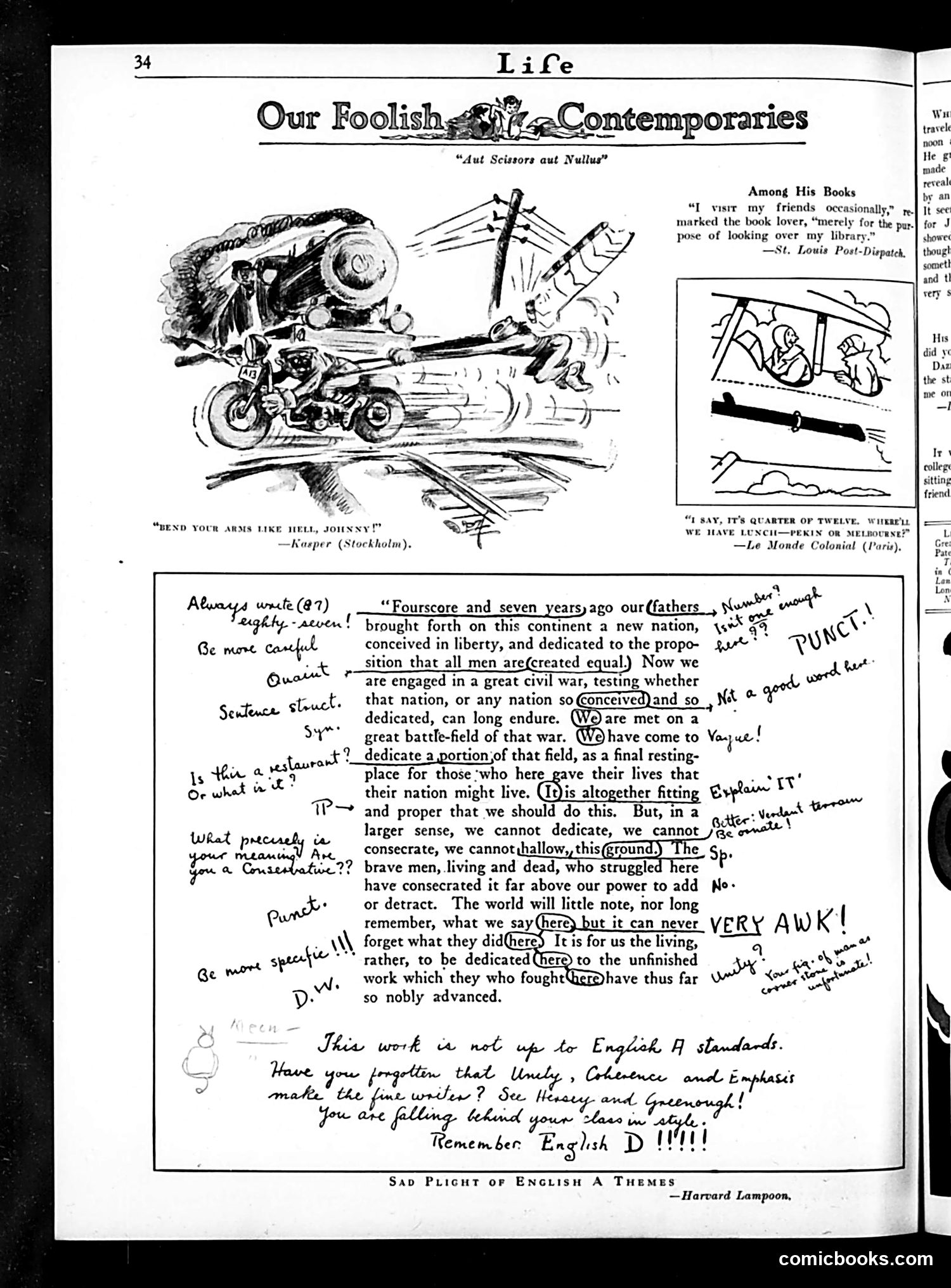
This page satirizes contemporary figures and events through marked-up text and cartoons. The main target is **Lincoln's Gettysburg Address**, which appears annotated with critical comments mocking its style and grammar as sub-standard English. The handwritten critiques suggest this is a homework or classroom exercise, making fun of treating the famous speech as if it were a student composition deserving of editorial correction. The surrounding cartoons mock foolish modern behavior: a motorcycle stunt ("Bend Your Arms Like Hell"), and a pedantic "book lover" who visits friends only to inspect their libraries. The attribution to "Harvard Lampoon" indicates this is collegiate satire. The overall point: contrasting the gravity of Civil War sacrifice with modern frivolity and pretension—critiquing both contemporary affectations and those who would nitpick historical greatness through a schoolmaster's red pen.
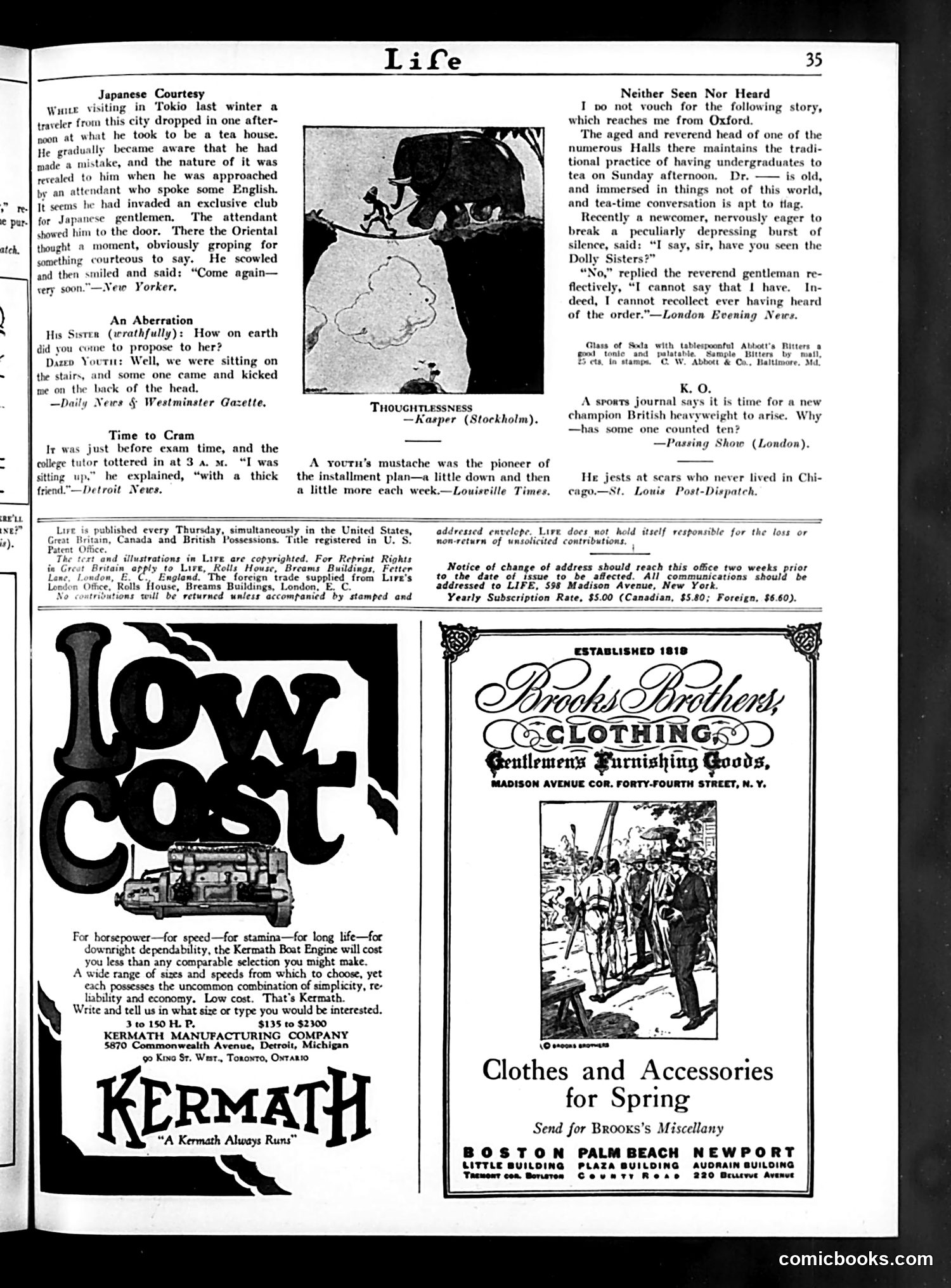
This page contains **short humorous anecdotes** rather than political cartoons. The jokes satirize social awkwardness and cultural misunderstandings: **"Japanese Courtesy"**: An American businessman accidentally enters an exclusive Japanese gentlemen's club. When politely ejected, the Japanese attendant, searching for something courteous to say despite the intrusion, invites him to "come again very soon"—satirizing exaggerated politeness masking an obvious rejection. **"An Aberration"**: A young man proposes to a woman after being kicked in the head while sitting on stairs—implying his proposal stems from stupidity rather than genuine affection. **"Time to Cram"**: A college tutor arrives at 3 a.m. before exams, explaining he stayed up with a "thick friend"—a pun suggesting either a dense companion or heavy drinking. **"Neither Seen Nor Heard"**: An Oxford don hasn't heard of the "Dolly Sisters" (likely contemporary entertainers), humorously implying his intellectual detachment from popular culture. The page is primarily **advertising** (Kermath engines, Brooks Brothers clothing).
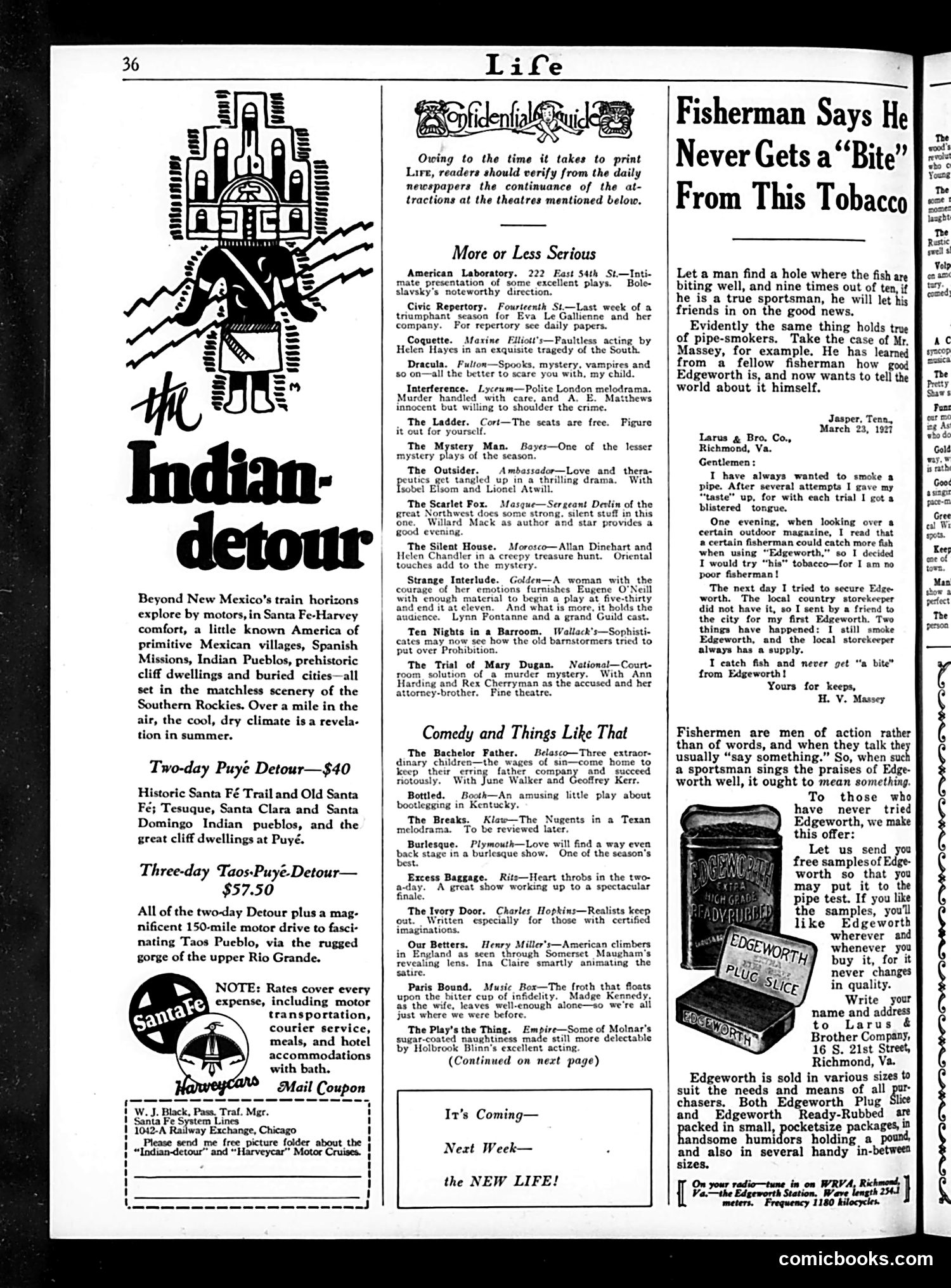
This page is primarily **advertising and entertainment listings**, not political satire. The left side features a **Santa Fe Railway ad** for "Indian-detour" motor tours through New Mexico, promoting visits to Native American pueblos, cliff dwellings, and Spanish missions as exotic tourist destinations. The stylized illustration depicts Native American imagery in the decorative, romanticized manner typical of 1920s travel marketing. The center and right contain **theater listings and reviews** for Broadway shows, including productions like "Strange Interlude" and "Dracula," plus a **tobacco advertisement** (Edgeworth pipe tobacco) featuring a fisherman's testimonial. The page reflects 1920s consumer culture: tourism marketed as exploration of "primitive" peoples, commercial theater entertainment, and tobacco advertising—all presented without the modern awareness of cultural appropriation or health concerns. There is no apparent political cartoon or satirical critique visible on this page.
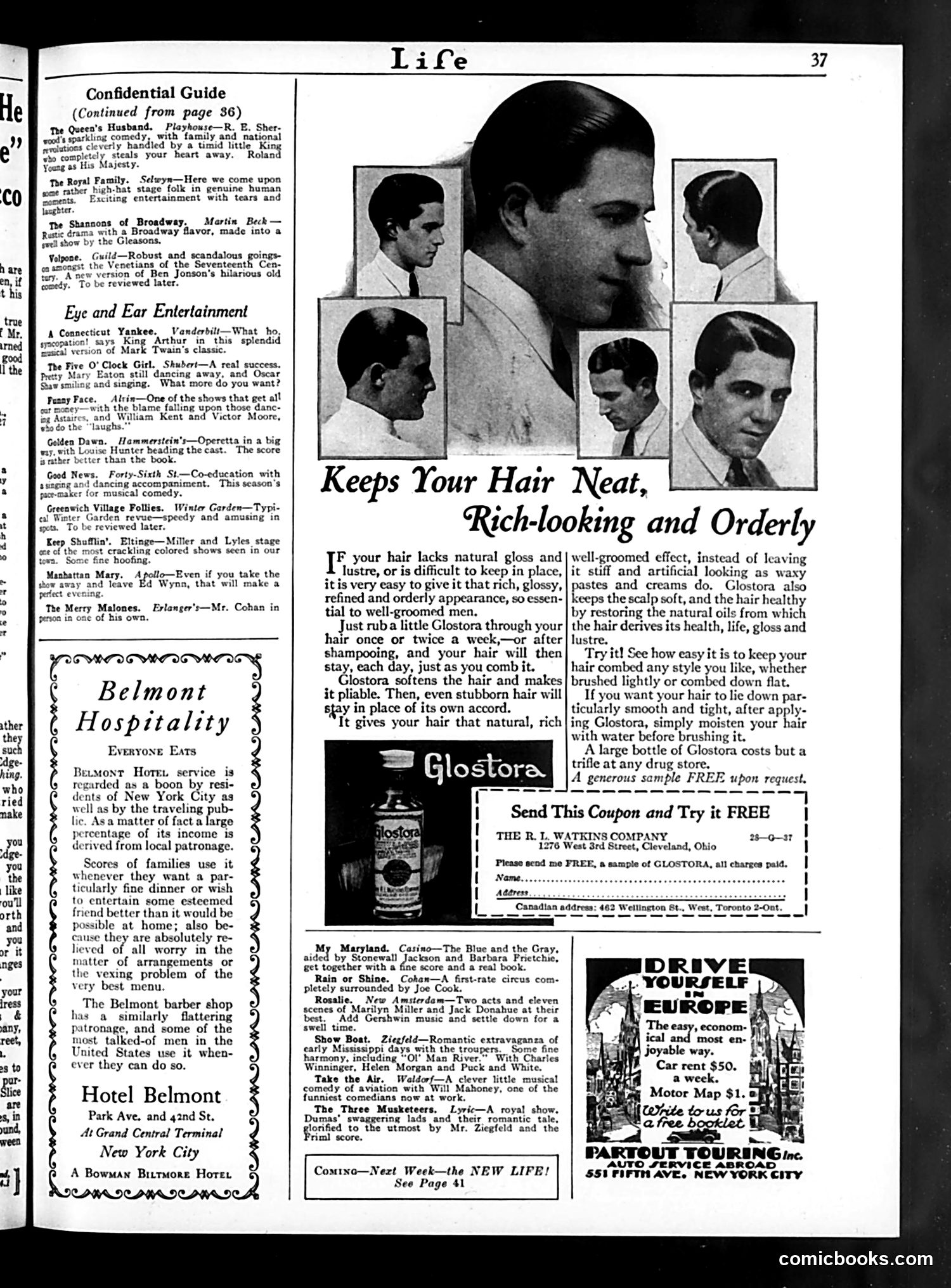
This page is primarily **advertising content** rather than political commentary or satire. The dominant feature is a **Glostora hair product advertisement** with photographs showing five male head profiles demonstrating various hairstyles. The ad copy emphasizes grooming standards for men of the era—promoting a product that keeps hair "neat, rich-looking and orderly" without the artificial appearance of competing products. This reflects 1920s masculine ideals valuing refined, natural-looking grooming. The left column contains theater reviews (the "Confidential Guide" continued from page 36), discussing Broadway shows and performances—standard entertainment criticism for Life magazine's readership. Below is a Hotel Belmont advertisement emphasizing hospitality and service, plus a smaller "Drive Yourself in Europe" touring advertisement. There is **no political cartoon or satirical content** visible on this page. It functions as a typical magazine layout mixing editorial theater reviews with commercial advertising.
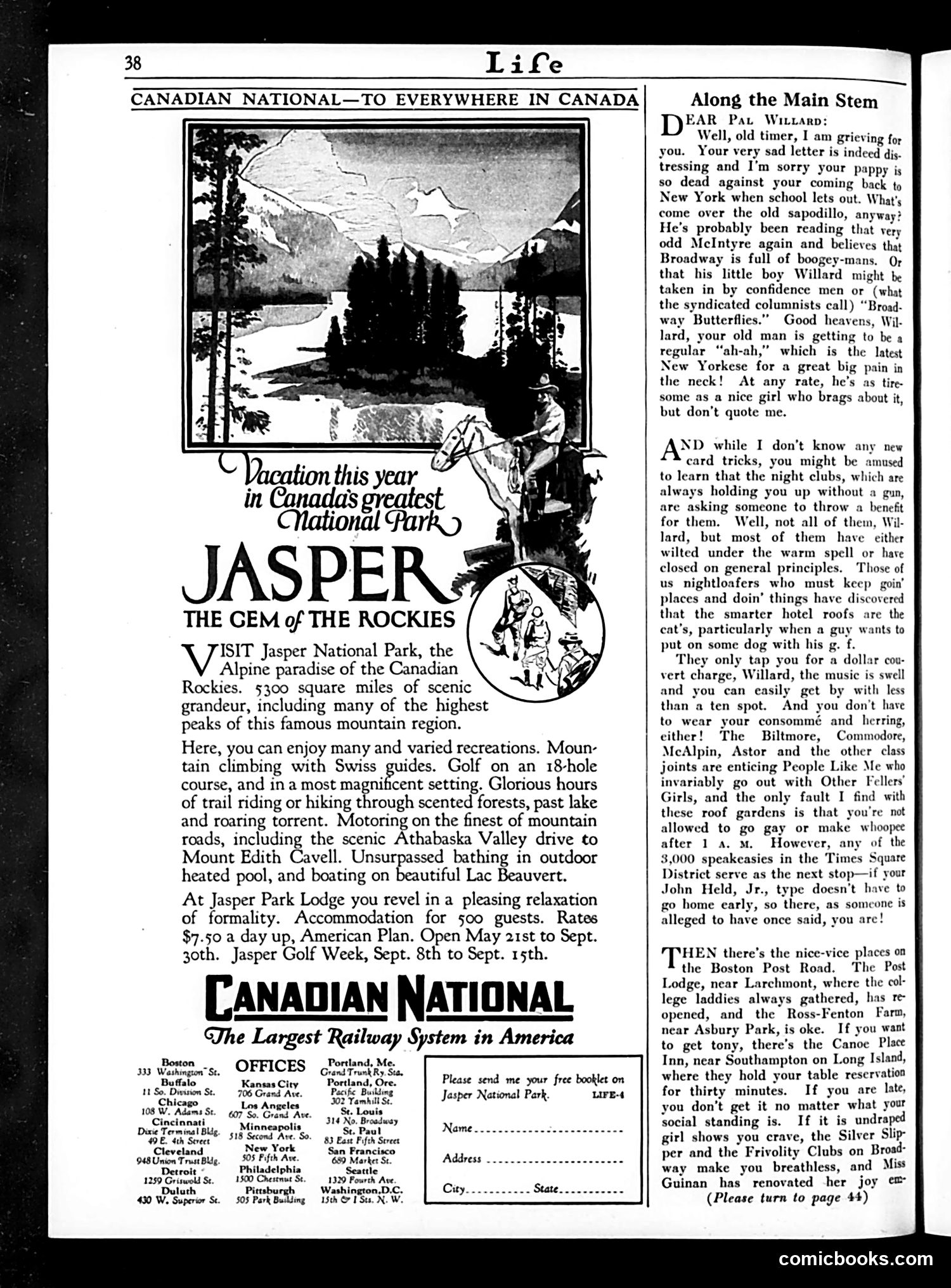
This page is primarily **advertising** for Jasper National Park in Canada, presented by Canadian National Railways. The large illustration depicts a scenic mountain landscape with a figure in the foreground—likely meant to represent an idealized tourist or adventurer enjoying the alpine scenery. The right column, titled "Along the Main Stem," is a **satirical advice column** by what appears to be a worldly correspondent addressing a young man named Willard. The humor targets 1920s anxieties: Willard's father fears Broadway's dangers (con men, "Broadway Butterflies"—a euphemism for women of questionable virtue). The columnist dismissively mocks the father as a killjoy ("ah-ah") while offering cynical advice about night clubs, speakeasies, and roof-garden establishments—reflecting Prohibition-era nightlife and the social divisions between "respectable" hotel venues and illegal speakeasies. The satire critiques both parental prudishness and the reality that expensive entertainment still overcharges customers, while casual morality runs rampant.
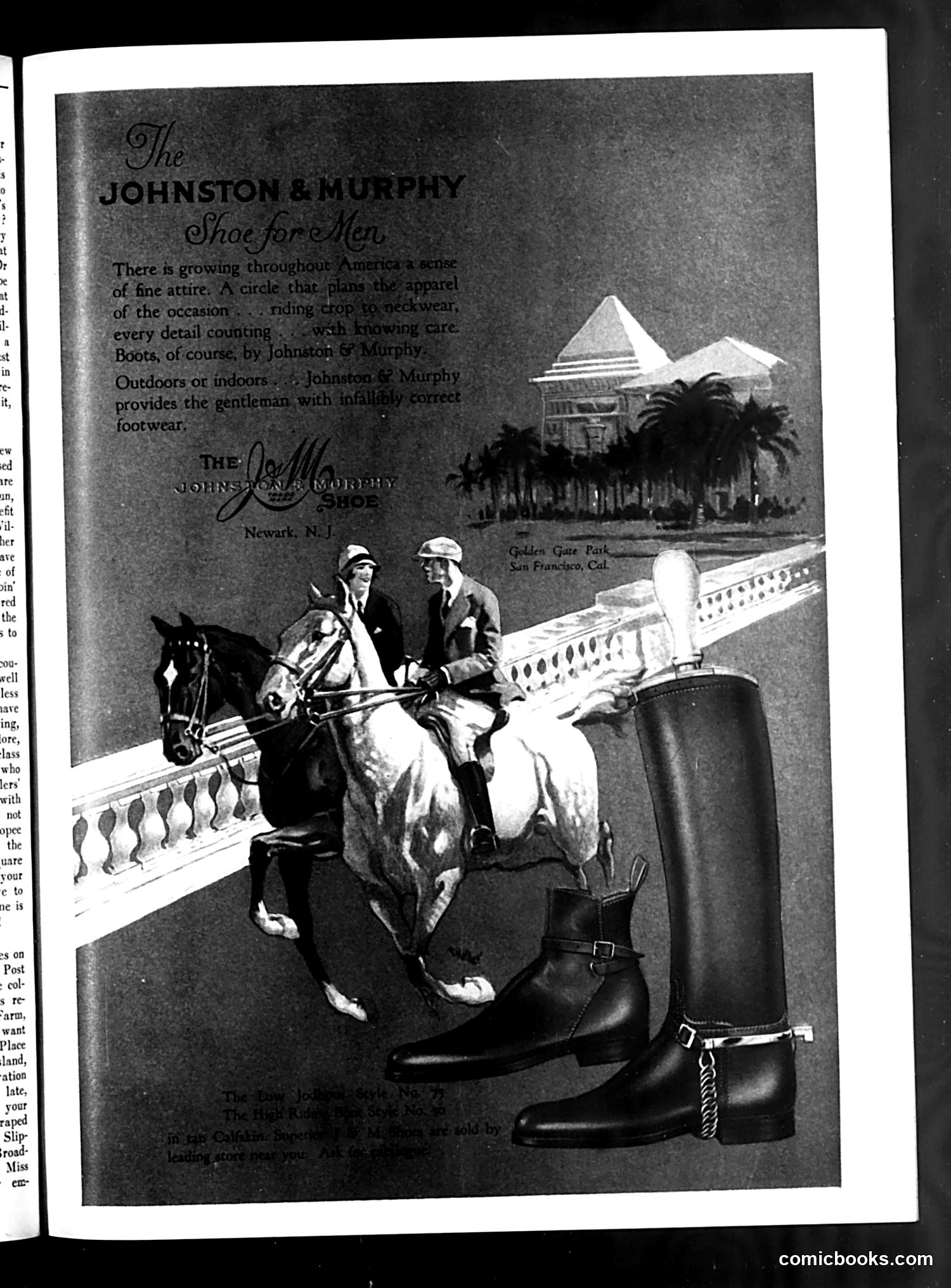
This is a **product advertisement**, not political satire. It promotes Johnston & Murphy shoes for men, manufactured in Newark, New Jersey. The ad emphasizes the brand's appeal to gentlemen across various social contexts—"outdoors or indoors." The imagery shows two well-dressed men on horseback near the Golden Gate Park in San Francisco, suggesting affluence and leisure. Large boots are displayed prominently at bottom right. The ad's text stresses attention to detail and quality craftsmanship for different occasions, from "riding crop to neckwear." This appears to be from an early-to-mid 20th century Life magazine, when such lifestyle advertising targeted upper-class male readers who valued social propriety and fine apparel.
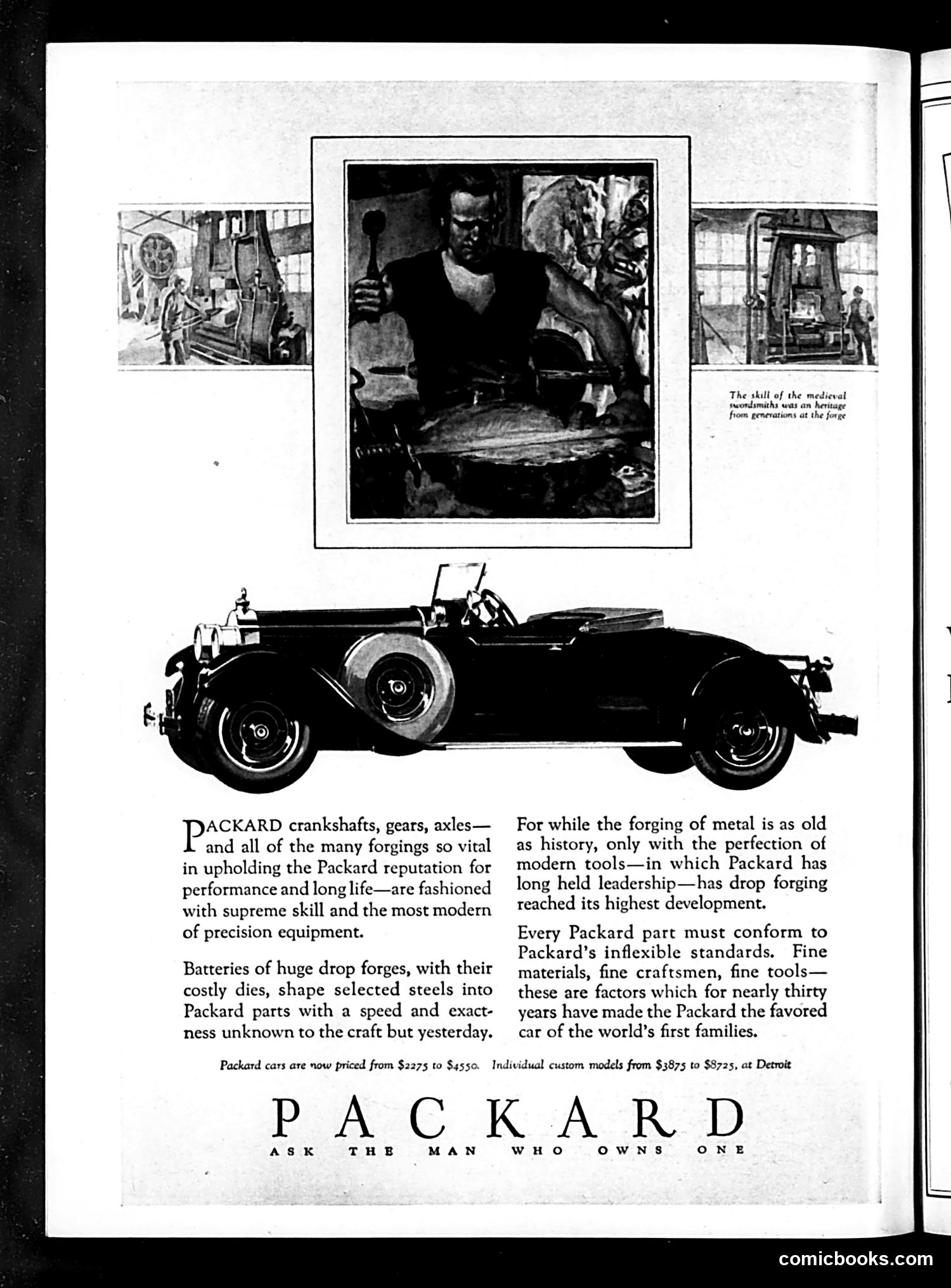
This is a **Packard automobile advertisement**, not political satire. The page uses historical imagery to market luxury cars. The three photographs above the car show **medieval and early modern metalworking**—blacksmiths at forges and anvils. These connect to the advertisement's argument that Packard automobiles represent the culmination of ancient craftsmanship traditions combined with modern precision manufacturing. The central image depicts a blacksmith working metal, while the side images show industrial foundry work, visually bridging "the skill of the medieval swordsmiths" (noted in the caption) with contemporary manufacturing. **The sales pitch**: Packard cars embody centuries of metalworking heritage perfected through modern drop-forge technology. The ad emphasizes that fine materials, craftsmen, and tools have made Packard "the favored car of the world's first families" for thirty years. The tagline "Ask the Man Who Owns One" was Packard's famous advertising slogan, implying owner endorsement and prestige. This reflects 1920s marketing strategy: positioning luxury goods as descendants of historical excellence.
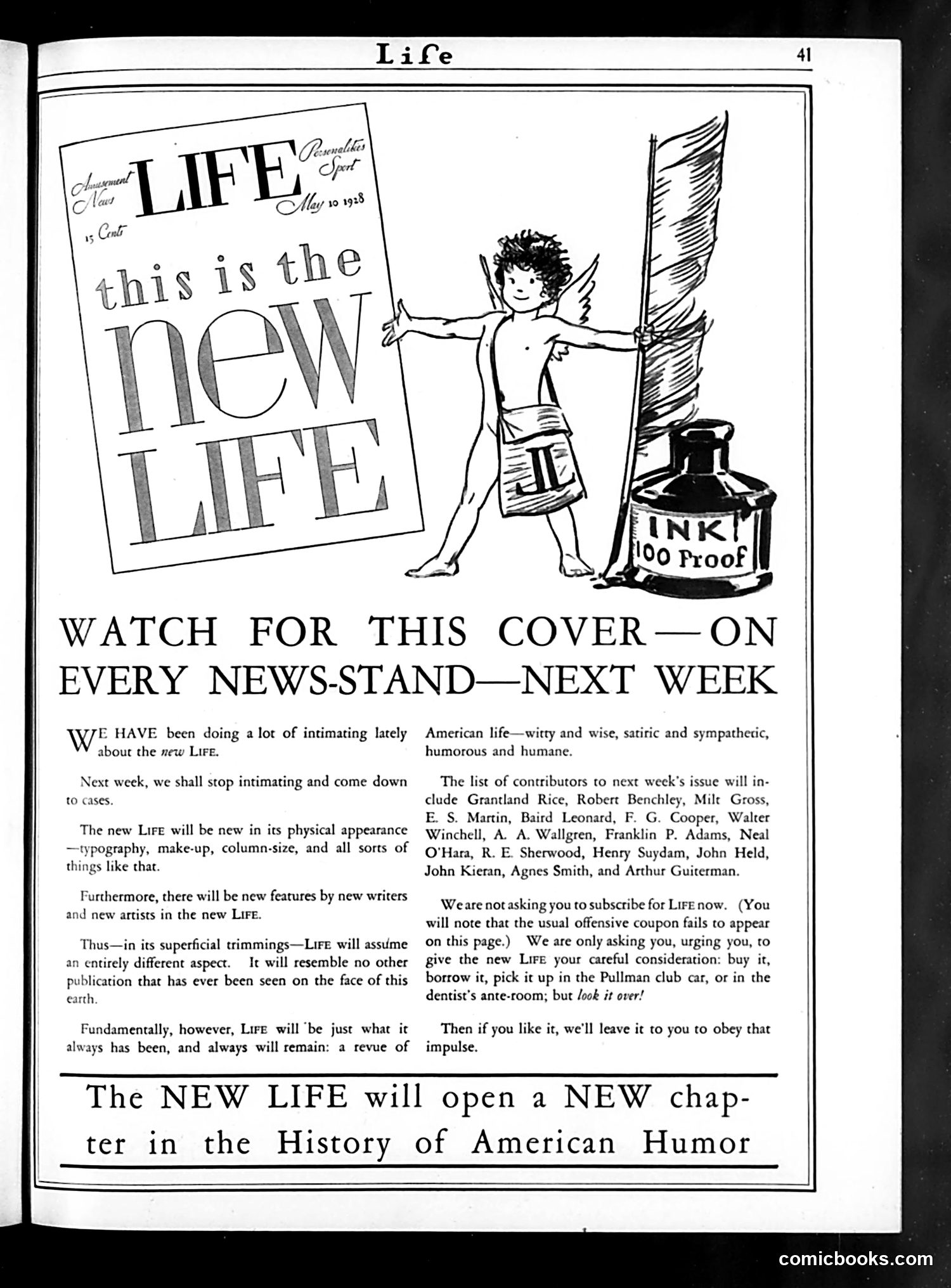
This is a promotional page announcing Life magazine's complete redesign. The cherub illustration depicts the magazine's "new life"—a visual pun on the publication's name. The text promises radical changes: new typography, layout, and column sizes that will make Life "resemble no other publication." Notably, it emphasizes that despite superficial changes, Life remains fundamentally a satirical revue of American life. The page lists prominent contributors (Robert Benchley, Grantland Rice, Franklin P. Adams, and others), establishing credibility for the redesign. Unusually, it explicitly *doesn't* ask for subscriptions—instead casually urging readers to simply buy or borrow the next issue to judge it themselves. The phrase "open a NEW chapter in the History of American Humor" reflects Life's self-importance as a leading satirical publication during this era. The "100 Proof Ink" bottle is a humorous touch, suggesting quality and strength.
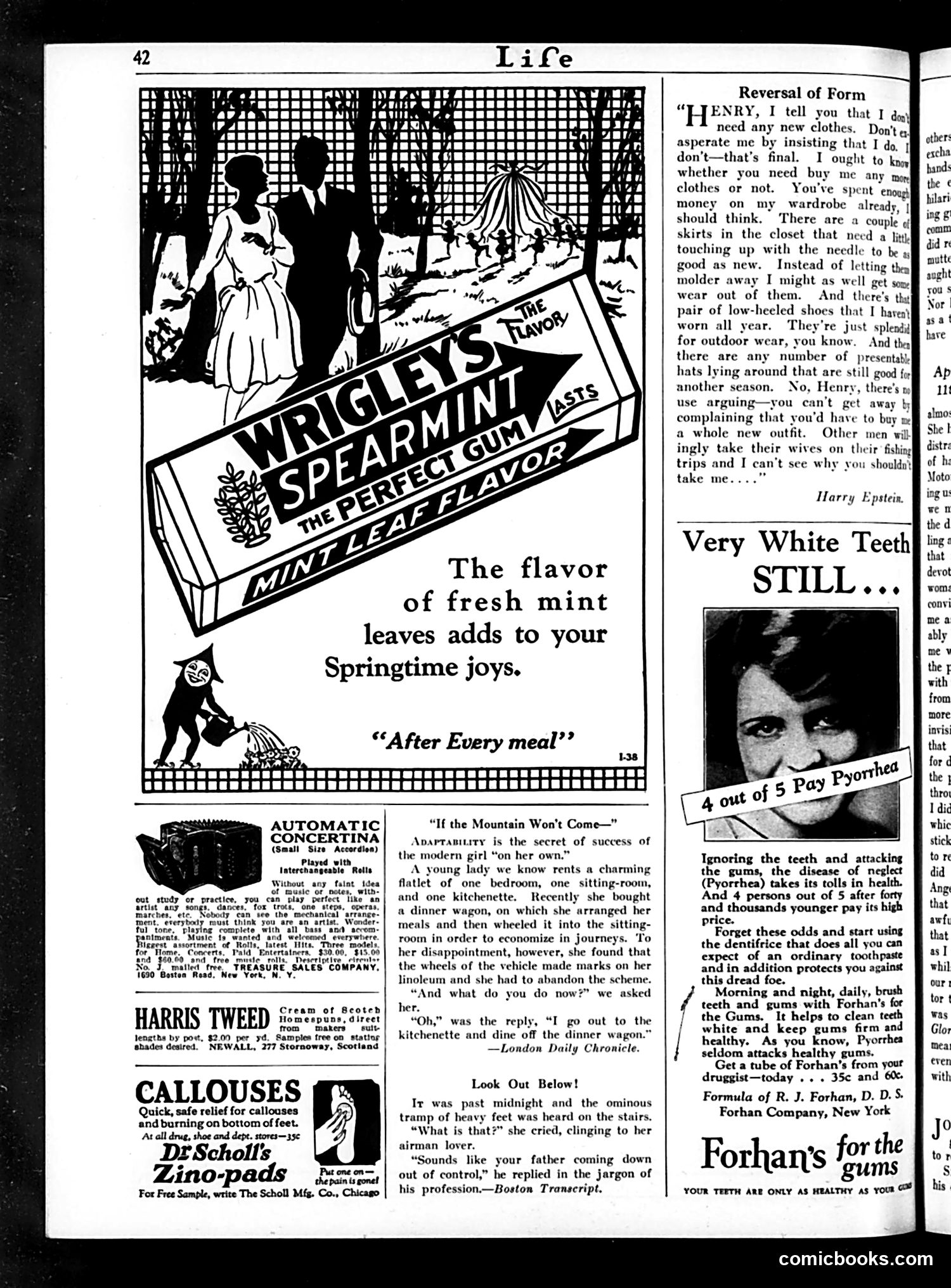
This page from *Life* magazine consists primarily of **advertisements and humorous short pieces** rather than political cartoons. The main visual element is a **Wrigley's Spearmint gum advertisement** featuring an elegantly dressed couple in a spring garden setting, promoting mint flavor for "Springtime joys." The text content includes: 1. **"Reversal of Form"** by Harry Epstein—a domestic humor piece where a wife refuses new clothes, insisting her husband stop spending money, then contradicts herself by listing reasons she needs them. The satire targets marital arguments and female consumer contradictions. 2. **"If the Mountain Won't Come"** and **"Look Out Below!"**—brief anecdotes about modern young women's resourcefulness and romantic situations. 3. **Product advertisements** for Harris Tweed fabric, Scholl's Zino-pads, and Forhan's toothpaste (targeting pyorrhea/gum disease). The page reflects 1920s-30s consumer culture and domestic gender dynamics, with humor aimed at middle-class anxieties about spending, modern efficiency, and courtship. No significant political content is present.
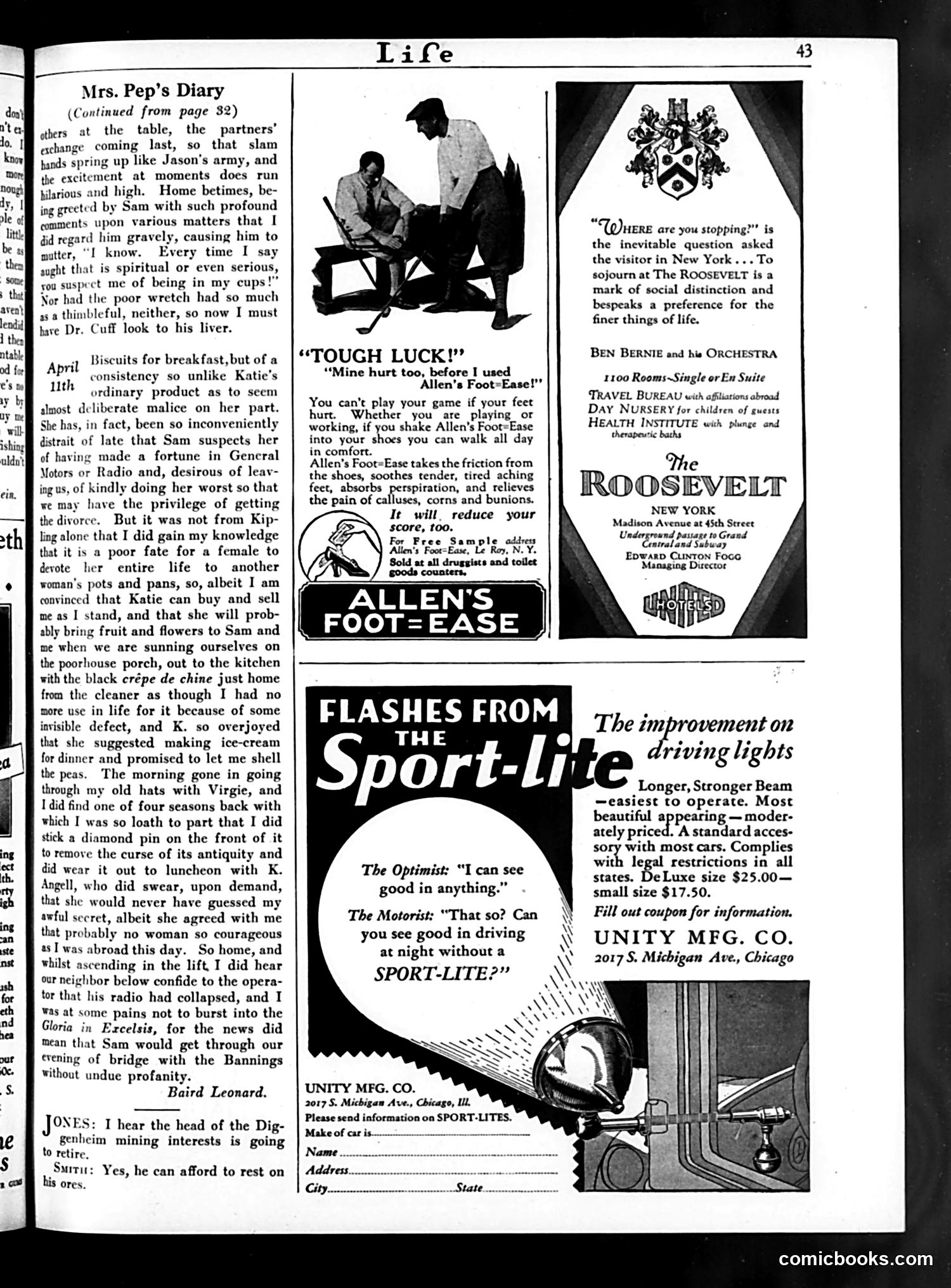
**Mrs. Pep's Diary** is a serialized gossip column about upper-middle-class domestic life. This excerpt humorously chronicles the diarist's complaints: incompetent staff (Katie the maid), her husband Sam's inane comments, worn-out hats, and neighbor dramas. The tone is satirical of women's preoccupations with trivial domestic concerns. **"Flashes from the Sport-lite"** features two stock characters debating whether one can drive safely at night without the product. The "Optimist" and "Motorist" represent opposing viewpoints in an advertisement presented as comic banter. The page is **primarily advertising** (Allen's Foot-Ease, The Roosevelt Hotel, Sport-lite driving lights, Unity MFG. Co.) disguised as editorial content and humor. The satirical diary and cartoonish dialogue serve as vehicles to present products to affluent readers. A brief joke about mining interests appears at bottom. The humor assumes familiarity with domestic servant complaints and automotive conveniences typical of 1920s-era Life magazine's affluent readership.
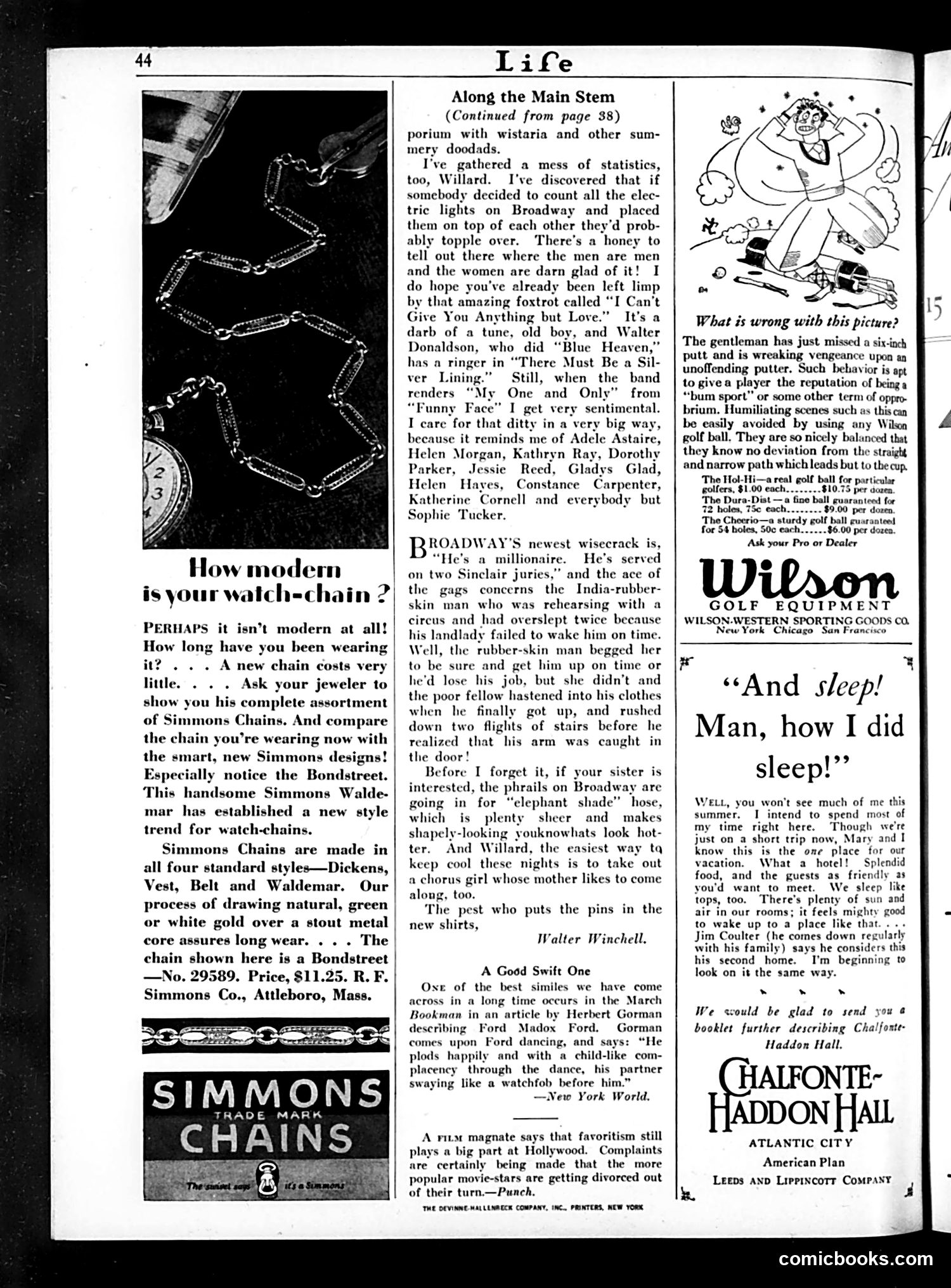
This page is primarily **advertising and entertainment gossip**, not political satire. The main content includes: **"How modern is your watch-chain?"** — A Simmons Chains advertisement promoting updated watch-chain designs (Waldemar, Bondstreet styles) to readers who may be wearing outdated versions. The pitch: modernize your accessories. **"Along the Main Stem"** — A Broadway gossip column by Walter Winchell discussing nightlife, musicals ("Funny Face"), performers (Adele Astaire, Helen Morgan, Dorothy Parker), and current fashions (including "elephant shade" hosiery). It's lighthearted, name-dropping entertainment commentary. **"What is wrong with this picture?"** — A golf etiquette cartoon showing a gentleman angrily smashing his putter after a missed putt. The point: such poor sportsmanship damages reputation. Wilson golf balls are promoted as so well-balanced they eliminate such frustrations. **No political content** is present. The page reflects 1920s consumer culture and celebrity gossip typical of Life magazine during this era.