
Life, 1928-05-03 · page 21 of 46
Life — May 3, 1928 — page 21: what you’re looking at
What you’re looking at
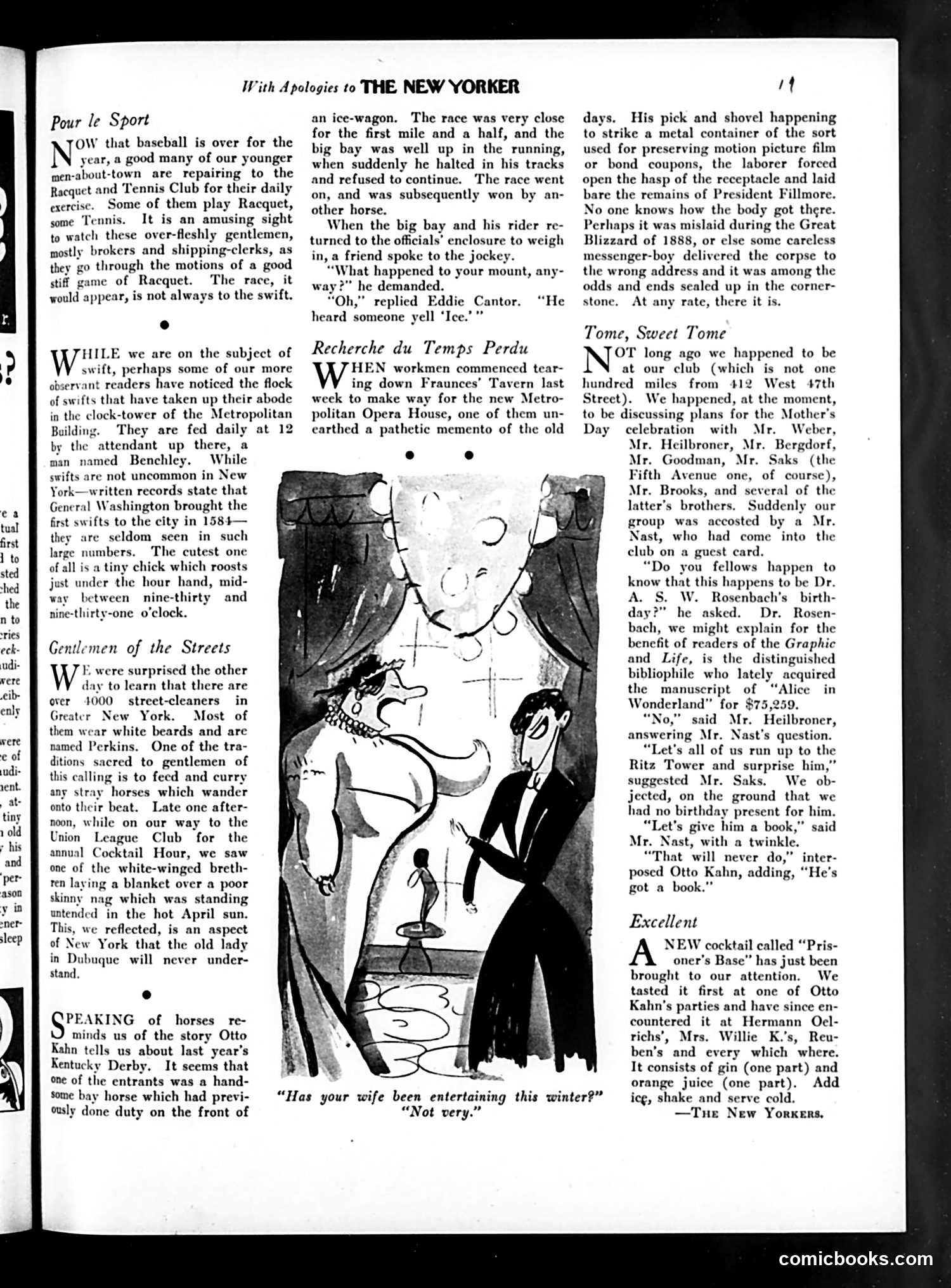
This page from *Life* magazine (parodying *The New Yorker*'s style) contains several satirical pieces mocking New York society and current events: **"Pour le Sport"**: Ridicules wealthy Manhattan "brokers and shipping-clerks" playing racquetball at exclusive clubs, suggesting their sedentary lifestyles make them unfit. **"Gentlemen of the Streets"**: Celebrates street-cleaners' dignity while gently mocking upper-class obliviousness—the author notes that New Yorkers' kindness to stray horses is something "the old lady in Dubuque will never understand." **The Kentucky Derby anecdote**: Features comedian **Eddie Cantor** explaining why a former ice-wagon horse refused to race—it halted upon hearing someone yell "Ice!" A joke about conditioning and class mobility. **The cartoon**: Shows a woman being asked if her wife entertained during winter—a mild marital joke. **"Recherche du Temps Perdu"**: An absurdist item claiming workers discovered **President Fillmore's remains** in a cornerstone during Fraunces' Tavern demolition—pure comedic fantasy satirizing New York's historical pretensions.
📄 Transcribed text from this page (OCR, searchable)
Machine-transcribed from the original scan — historical spelling and the odd misread are preserved.
With Apologies to THE NEW YORKER Pour le Sport OW that baseball is over for the year, a good many of our younger men-about-town are repairing to the Racquet « and Tennis Club for their daily exercise. Some of them play Racquet, some Tennis. It is an amusing sight to watch these over-fleshly gentlemen, mostly brokers and shipping-clerks, as they go through the motions of a good stiff game of Racquet. The race, it would appear, is not always to the swift. HILE we are on the subject of swift, perhaps some of our more observant readers have noticed the flock of swifts that have taken up their abode in the clock-tower of the Metropolitan Building. They are fed daily at 12 by the “attendant up there, a man named Benchley. While swifts are not uncommon in New York—written records state that General Washington brought the first swifts to the city in 1584— they are seldom seen in such large numbers. The cutest one ofall is a tiny chick which roosts just under the hour hand, mid- way between nine-thirty and nine-thirty-one o'clock. Gentlemen of the Streets FE. were surprised the other ay to learn that there are over 1000 street-cleaners in Greater New York. Most of them wear white beards and are named Perkins. One of the tra- ditions sacred to gentlemen of this calling is to feed and curry horses which wander beat. Late one after- on our way to the Union League Club for the annual Cocktail Hour, we saw one of the white-winged breth- ren laying a blanket over a poor skinny nag which was standing untended in the hot April sun. This, we reflected, is an aspect of New York that the old lady in Dubuque will never under- stand. PEAKING of horses re- minds us of the story Otto Kahn tells us about last year's Kentucky Derby. It seems that one of the entrants was a hand- some bay horse which had previ- ously done duty on the front of an ice-wagon. The race was very close for the first mile and a half, and the big bay was well up in the running, when suddenly he halted in his tracks and refused to continue. The race went on, and was subsequently won by an- other horse. When the big bay and his rider re- turned to the officials’ enclosure to weigh in, a friend spoke to the jockey. “What happened to your mount, any- way?” he demanded. “Oh,” replied Eddie Cantor. heard someone yell ‘Ice.’” Recherche du Temps Perdu HEN workmen commenced tear- ing down Fraunces’ Tavern last week to make way for the new Metro- politan Opera House, one of them un- earthed a pathetic memento of the old “He “Has your wife been entertaining this winter?” “Not very.” if days. His pick and shovel happening to strike a metal container of the sort used for preserving motion picture film or bond coupons, the laborer forced open the hasp of the receptacle and laid bare the remains of President Fillmore. No one knows how the body got there. Perhaps it was mislaid during the Great Blizzard of 1888, or else some careless messenger-boy delivered the corpse to the wrong address and it was among the odds and ends sealed up in the corner- stone, At any rate, there it is. Tome, Sweet Tome OT long ago we happened to be at our club (which is not one hundred miles from 412 West 47th Strect). We happened, at the moment, to be discussing plans for the Mother's Day celebration with Mr. Weber, Mr. Heilbroner, Mr. Bergdorf, Mr. Goodman, Mr. Saks (the Fifth Avenue one, of course), Mr. Brooks, and several of the latter’s brothers. Suddenly our group was accosted by a Mr. Nast, who had come into the club on a guest card. “Do you fellows happen to know that this happens to be Dr. W. Rosenbach’s _birth- he asked. Dr. Rosen- bach, we might explain for the benefit of readers of the Graphic and Life, is the distinguished bibliophile who lately acquired the manuscript of “Alice in Wonderland” for $75,259. “No,” said Mr. Heilbroner, answering Mr. Nast's question. “Let's all of us run up to the Ritz Tower and surprise him,” suggested Mr. Saks. We ob- jected, on the ground that we had no birthday present for him. “Let's give him a book,” said Mr. Nast, with a twinkle. “That will never do,” inter- posed Otto Kahn, adding, “He's got a book.” Excellent NEW cocktail called “Pris- oner’s Base” has just been brought to our attention. We tasted it first at one of Otto Kahn's parties and have since en- countered it at Hermann Ocl- richs’, Mrs. Willie K.’s, Reu- ben’s and every which where. It consists of gin (one part) and orange juice (one part). Add icg, shake and serve cold. —Tne New Yorkers, comicbooks.com