
Life, 1928-05-03 · page 25 of 46
Life — May 3, 1928 — page 25: what you’re looking at
What you’re looking at
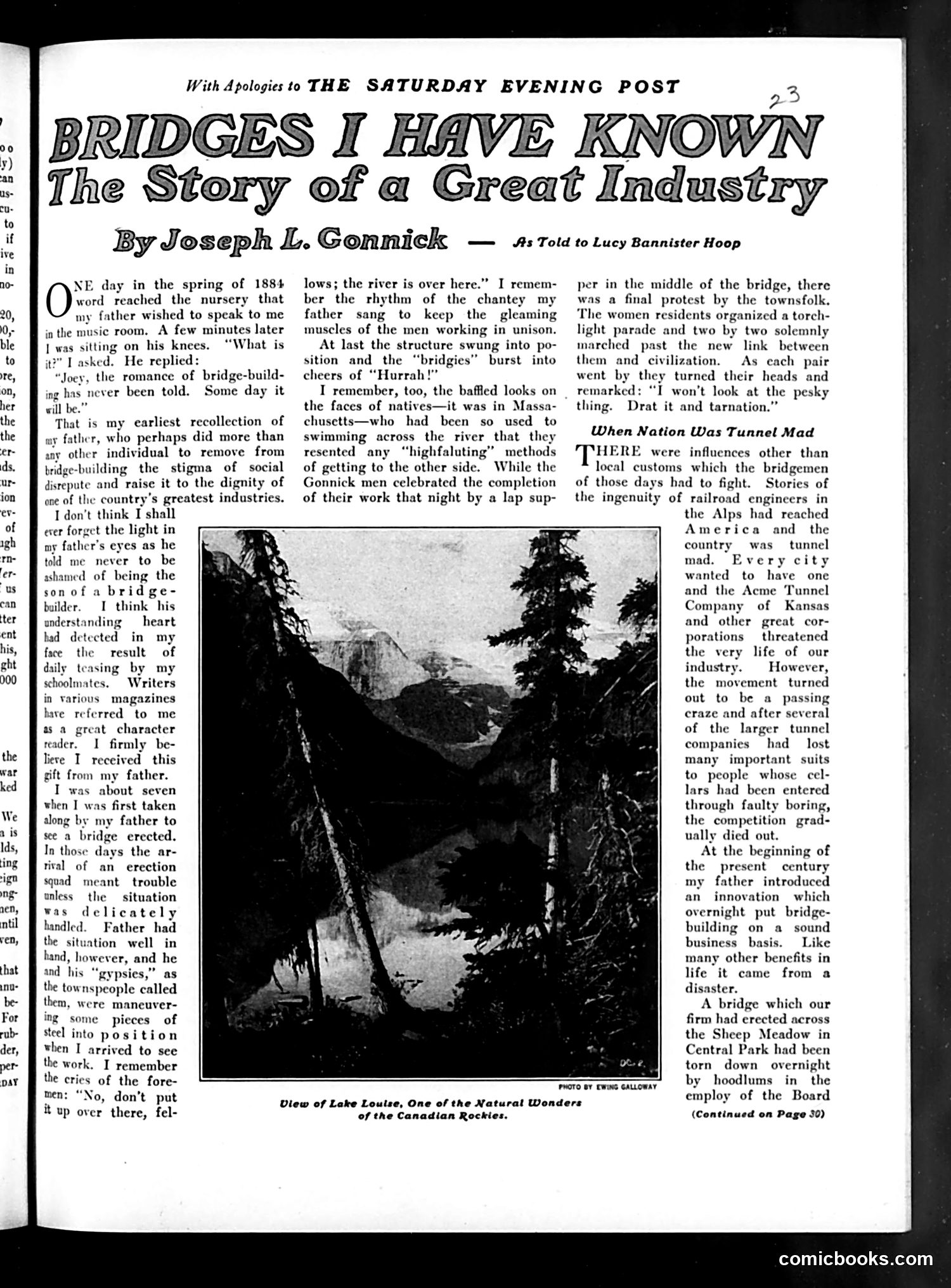
This is **not a cartoon page**, but rather the opening of a satirical article disguised as a serious memoir. It parodies *The Saturday Evening Post*'s sentimental, romanticized industry profiles—a popular magazine genre of the era. The satire works by treating bridge-building with mock-heroic earnestness: a father proudly tells his son never to be ashamed of being a "bridge-builder's son" (implying the profession was socially stigmatized), workers sing sea-shanties while assembling steel, and townspeople organize torch-lit protests against a new bridge because they preferred swimming across rivers. The humor derives from **elevating an ordinary, unglamorous profession into grandiose narrative**—complete with dramatic obstacles (tunnel company competition, hoodlum sabotage) and noble persistence. The included photograph of Lake Louise, captioned as a "Natural Wonder," undercuts the text's self-importance through incongruity. The byline credit to "Lucy Bannister Hoop" is itself a comedic name suggesting the article's fictional nature. This is early 20th-century satirical commentary on American business mythology and magazine culture's tendency toward overwrought inspiration narratives.
📄 Transcribed text from this page (OCR, searchable)
Machine-transcribed from the original scan — historical spelling and the odd misread are preserved.
With Apologies to THE SATURDAY EVENING POST the Story of a Great ‘Industry By Joseph LL. Gonnick — As Told to Lucy Bannister Hoop ‘E day in the spring of 1884 Over reached the nursery that my father wished to speak to me in the music room. A few minutes later | was sitting on his knees. “What is I asked. He replied: y, the romance of bridge-build- ing has never been told. Some day it will be.” That is my earliest recollection of my father, who perhaps did more than any other individual to remove from bridge- building the stigma of social disrepute and raise it to the dignity of one of the country’s greatest industries. I don’t think I shall ever forget the light in my father’s eyes as he told me never to be ashamed of being the sonof a bridge- builder. I think his understanding heart had detected in my face the result of daily teasing by my schoolmates. Writers in various magazines have referred to me asa great character reader. I firmly be- lieve I received this gift from my father. I was about seven when I was first taken along by my father to see a bridge erected. In those days the ar- tival of an erection squad meant trouble unless the situation was delicately handled. Father had the situation well in hand, however, and he and his “gypsies,” as the townspeople called them, were maneuver- ing some pieces of steel into position vhen I arrived to see the work. I remember Me cries of the fore- “No, don’t put in a over there, fel- lows; the river is over here.” I remem- ber the rhythm of the chantey my father sang to keep the gleaming muscles of the men working in unison. At last the structure swung into po- sition and the “bridgies” burst into cheers of “Hurrah!” I remember, too, the baffled looks on the faces of natives—it was in Massa- chusetts—who had been so used to swimming across the river that they resented any “highfaluting” methods of getting to the other side. While the Gonnick men celebrated the completion of their work that night by a lap sup- per in the middle of the bridge, there was a final protest by the townsfolk. The women residents light parade marched ps them and civil organized a torch- two by two solemnly the new link between ation. As each pair went by they turned their heads and remarked thing. won't look at the pesky Drat it and tarnation.” When Nation Was Tunnel Mad 2 were influences other than local customs which the bridgemen of those d the ingen of the Canadian Rockies. PHOTO BY EWING GALLOWAY View of Lake Louise, One of the Natural Wonders had to fight. Stories of of railroad engineers in the Alps had reached America and the country was tunnel mad. Every city wanted to have one and the Acme Tunnel Company of Kansas and other great cor- porations threatened the very life of our industry. However, the movement turned out to be a passing craze and after several of the larger tunnel companies had lost many important suits to people whose cel- lars had been entered through faulty boring, the competition grad- ually died out. At the beginning of the present century my father introduced an innovation which overnight put bridge- building on a sound business basis. Like many other benefits in life it came from a disaster. A bridge which our firm had erected across the Sheep Meadow in Central Park had been torn down overnight by hoodlums in the employ of the Board (Continued on Page $0) comicbooks.com