
Life, 1928-05-03 · page 24 of 46
Life — May 3, 1928 — page 24: what you’re looking at
What you’re looking at
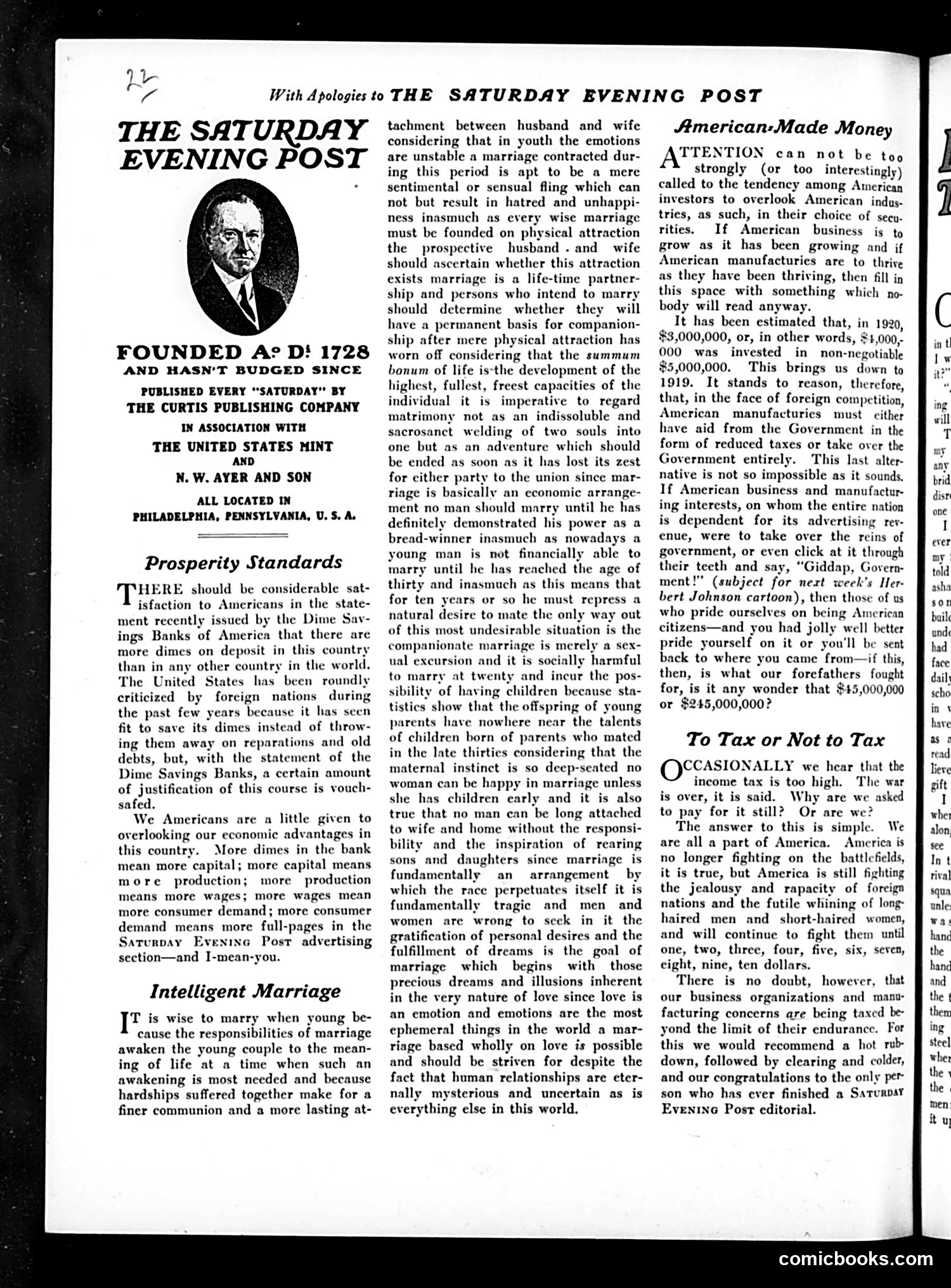
This page parodies *The Saturday Evening Post*, a major rival publication, through fake "apologies." The masthead mockingly claims the Post was "founded" in 1728 and "hasn't budged since"—satirizing its stodgy conservatism. The three satirical sections ridicule Post editorial positions: 1. **"Prosperity Standards"**: Mocks the Post's celebration of American dime savings as evidence of virtue, then cynically reveals the real benefit: more advertising revenue for the Post itself ("full-pages in the Saturday Evening Post advertising section—and I-mean-you"). 2. **"Intelligent Marriage"**: A deliberately contradictory, run-on passage that presents conflicting marriage advice—marry young for growth yet wait until thirty for financial stability; have children early yet offspring of young parents lack talent. This parodies the Post's moralistic yet confused relationship advice. The satire targets the Post's self-congratulatory patriotism and muddled social commentary, exposing financial self-interest beneath editorial preaching.
📄 Transcribed text from this page (OCR, searchable)
Machine-transcribed from the original scan — historical spelling and the odd misread are preserved.
With Apologiesto THE SATURDAY EVENING POST THE SATURDAY EVENING POST FOUNDED Ae D! 1728 AND HASN'T BUDGED SINCE PUBLISHED EVERY “SATURDAY” BY THE CURTIS PUBLISHING COMPANY IN ASSOCIATION WITH THE UNITED STATES MINT AND N. W. AYER AND SON ALL LOCATED IN PHILADELPHIA, PENNSYLVANIA, U.S. A. Prosperity Standards HERE should be considerable sat- isfaction to Americans in the state- ment recently issued by the Dime Sav- ings Banks of America that there are more dimes on deposit in this country than in any other country in the world. The United States has been roundly criticized by foreign nations during the past few years because it has seen fit to save its dimes instead of throw- ing them away on reparations and old debts, but, with the statement of the Dime Savings Banks, a certain amount of justification of this course is vouch- safed. We Americans are a little given to overlooking our economic advantages in this country. More dimes in the bank mean more capital; more capital means more production; more production means more wages; more wages mean more consumer demand; more consumer demand means more full-pages in the Saturvay Evenino Post advertising section—and I-mean-you. Intelligent Marriage T is wise to marry when young be- cause the responsibilities of marriage awaken the young couple to the mean- ing of life at a time when such an awakening is most needed and because hardships suffered together make for a finer communion and a more lasting at- tachment between husband and wife considering that in youth the emotions are unstable a marriage contracted dur- ing this period is apt to be a mere sentimental or sensual fling which can not but result in hatred and unhappi- ness inasmuch as every wise marriage must be founded on physical attraction the prospective husband . and wife should ascertain whether this attraction exists marriage is a life-time partner- ship and persons who intend to marry should determine whether they will have a permanent basis for companion- ship after mere physical attraction has worn off considering that the summum bonum of life isthe development of the highest, fullest, freest capacities of the individual it is imperative to regard matrimony not as an indissoluble and sacrosanct welding of two souls into one but as an adventure which should be ended as soon as it has lost its zest for cither party to the union since mar- riage is basically an economic arrange- ment no man should marry until he has definitely demonstrated his power as a bread-winner inasmuch as nowadays a young man is not financially able to marry until he has reached the age of thirty and inasmuch as this means that for ten years or so he must repress a natural desire to mate the only way out of this most undesirable situation is the companionate marriage is merely a sex- ual excursion and it is socially harmful to marry at twenty and incur the pos- sibility of having children because sta- tistics show that the offspring of young parents have nowhere near the talents of children born of parents who mated in the late thirties considering that the maternal instinct is so deep-seated no woman can be happy in marriage unless she has children early and it is also true that no man can be long attached to wife and home without the responsi- bility and the inspiration of rearing sons and daughters since marriage is fundamentally an arrangement by which the race perpetuates itself it is fundamentally tragic and men and women are wrong to seck in it the gratification of personal desires and the fulfillment of dreams is the goal of marriage which begins with those precious dreams and illusions inherent in the very nature of love since love is an emotion and emotions are the most ephemeral things in the world a mar- riage based wholly on love is possible and should be striven for despite the fact that human relationships are eter- nally mysterious and uncertain as is everything else in this world. American:-Made Money TTENTION can not be too strongly (or too interestingly) called to the tendency among American investors to overlook American indus- tries, as such, in their choice of seeu- rities. If American business is to grow as it has been growing and if American manufacturies are to thrive as they have been thriving, then fill in this space with something which no- body will read anyway. It has been estimated that, in 1920, $3,000,000, or, in other words, $4,000, 000 was invested in non-negotiable $5,000,000. This brings us down to 1919. It stands to reason, therefore, that, in the face of foreign competition, American manufacturics must cither have aid from the Government in the form of reduced taxes or take over the Government entirely. This last alter- native is not so impossible as it sounds, If American business and manufactur ing interests, on whom the entire nation is dependent for its advertising rev- enue, were to take over the reins of government, or even click at it through their teeth and say, “Giddap, Govern- ment!” (subject for next week's Her- bert Johnson cartoon), then those of us who pride ourselves on being American citizens—and you had jolly well better pride yourself on it or you'll be sent back to where you came from—if this, then, is what our forefathers fought for, is it any wonder that $45,000,000 or $245,000,000? To Tax or Not to Tax CCASIONALLY we hear that the income tax is too high. The war is over, it is said. Why are we asked to pay for it still? Or are we? The answer to this is simple. We are all a part of America. America is no longer fighting on the battlefields, it is true, but America is still fighting the jealousy and rapacity of foreign nations and the futile whining of long- haired men and short-haired women, and will continue to fight them until one, two, three, four, five, six, seven, eight, nine, ten dollars. There is no doubt, however, that our business organizations and manu facturing concerns are being taxed be- yond the limit of their endurance. For this we would recommend a hot rub- down, followed by clearing and colder, and our congratulations to the only per son who has ever finished a Satuapat Evenino Post editorial. any brid disr one I ever ay told asha son bail und had face dail) scho in 1 have as 3 read lieve gift I wher alon; see Int rival squa unle: was hand the hand and the | them ing steel wher the 1 the | men it y comicbooks.com