
Life, 1928-05-03 · page 20 of 46
Life — May 3, 1928 — page 20: what you’re looking at
What you’re looking at
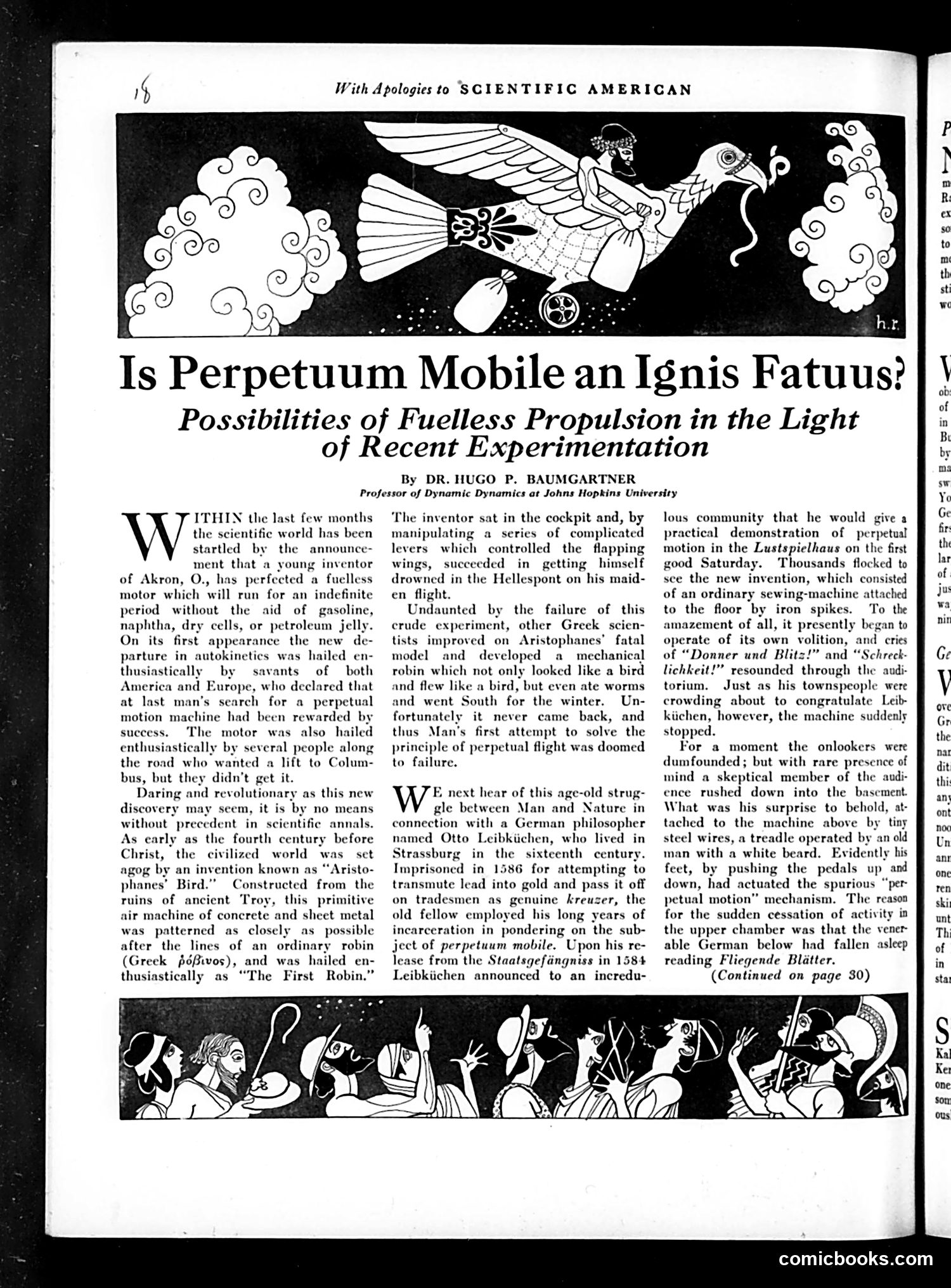
This is a satirical article mocking the recent announcement of a "fuelless motor" invented by a young man from Akron, Ohio—a perpetual motion machine that supposedly needs no fuel to run indefinitely. The author (Dr. Hugo P. Baumgartner, a fictitious academic) sarcastically traces the history of failed perpetual motion attempts. The joke: every historical example contains an obvious hidden power source. Aristophanes' ancient flying machine? The inventor drowned. A mechanical robin? It flew away. Most pointedly, Leibküchen's 16th-century perpetual motion device in Strasbourg that amazed crowds was revealed to be powered by an old man pumping a treadle below—literally the person operating the machine fell asleep reading a magazine, stopping the "perpetual" motion instantly. The satire targets public gullibility and scientific skepticism: the article implies the Ohio inventor's motor likely has a similarly mundane, hidden power source that observers simply haven't discovered yet. The elaborate historical "precedents" ridicule both past credulous believers and contemporary excitement over this dubious invention.
📄 Transcribed text from this page (OCR, searchable)
Machine-transcribed from the original scan — historical spelling and the odd misread are preserved.
With Apologies to SCIENTIFIC AMERICAN Is Perpetuum Mobile an Ignis Fatuus? Possibilities of Fuelless Propulsion in the Light of Recent Experimentation By DR. HUGO P. BAUMGARTNER Professor of Dynamic Dynamics at Johns Hopkins University ITHIN the last few months the scientific world has been startled by the announce- ment that a young inventor of Akron, O., has perfected a fuelless motor which will run for an indefinite period without the aid of gasoline, naphtha, dry cells, or petroleum jelly. On its first appearance the new de- parture in autokinetics was hailed en- thusiastically by savants of both America and Europe, who declared that at last man’s search for a perpetual motion machine had been rewarded by success. The motor was also hailed enthusiastically by several people along the road who wanted a lift to Colum- bus, but they didn’t get it. Daring and revolutionary as this new discovery may seem, it is by no means without preecdent in scientific annals. As early as the fourth century before Christ, the civilized world was set agog by an invention known as “Aristo- phanes’ Bird.” Constructed from the ruins of ancient Troy, this primitive air machine of concrete and sheet metal was patterned as closely as possible after the lines of an ordinary robin (Greek pofivos), and was hailed en- ically as “The First Robin.” ‘The inventor sat in the cockpit and, by manipulating a series of complicated levers which controlled the flapping wings, succeeded in getting himsclf drowned in the Hellespont on his maid- en flight. Undaunted by the failure of this crude experiment, other Greek scien- tists improved on Aristophanes’ fatal model and developed a mechanical robin which not only looked like a bird and flew like a bird, but even ate worms and went South for the winter. Un- fortunately it never came back, and thus Man's first attempt to solve the principle of perpetual flight was doomed to failure. E next hear of this age-old strug- gle between Man and Nature in connection with a German philosopher named Otto Leibkiichen, who lived in Strassburg in the sixteenth century. Imprisoned in 1586 for attempting to transmute lead into gold and pass it off on tradesmen as genuine kreuzer, the old fellow employed his long years of incarceration in pondering on the sub- ject of perpetuum mobile. Upon his re- lease from the Staatsgefingniss in 1584 Leibkiichen announced to an incredu- lous community that he would give a practical demonstration of perpetual motion in the Lustspielhaus on the first good Saturday. Thousands flocked to ntion, which consisted wing-machine attached y iron spikes. To the azement of all, it presently began to rate of its own volition, and cries of “Donner und Blitz!” and “Schreck- lichkeit!”” resounded through the audi- torium. Just as his townspeople were crowding about to congratulate Leib- kiichen, however, the machine suddenly stopped. For a moment the onlookers were dumfounded ; but with rare presence of mind a skeptical member of the audi- ence rushed down into the bascment. What was his surprise to behold, at- tached to the machine above by tiny steel wires, a treadle operated by an old man with a white beard. Evidently his feet, by pushing the pedals up and down, had actuated the spurious “per petual motion” mechanism. The reason for the sudden cessation of activity in the upper chamber was that the vener able German below had fallen asleep reading Fliegende Blatter. (Continued on page 30) comicbooks.com