
Life, 1928-05-03 · page 16 of 46
Life — May 3, 1928 — page 16: what you’re looking at
What you’re looking at
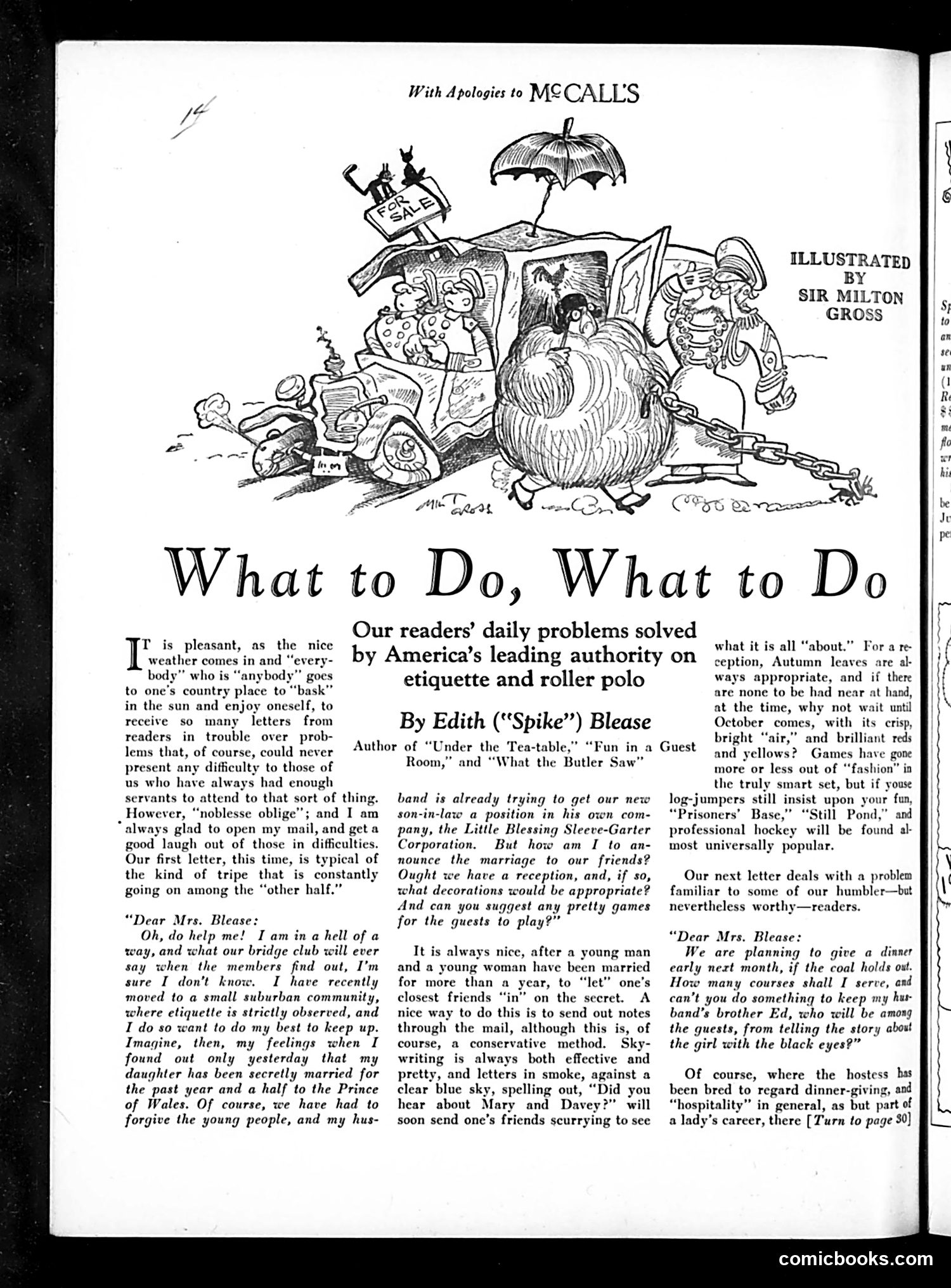
This page presents an advice column by Edith "Spike" Blease addressing readers' etiquette questions. The header illustration by Sir Milton Gross depicts a chaotic domestic scene—a large woman surrounded by various figures and activities (suggesting household management challenges). The column addresses typical 1920s-30s social concerns: a woman worried about her bridge club's etiquette, a son-in-law seeking advice about entertaining guests, and a hostess planning a formal dinner. The satire lies in the everyday absurdity of these concerns—people anxious over proper social forms while life appears comically disordered around them. The illustration's visual chaos contrasts with the formal advice being dispensed, gently mocking both rigid etiquette obsession and the difficulty of maintaining it.
📄 Transcribed text from this page (OCR, searchable)
Machine-transcribed from the original scan — historical spelling and the odd misread are preserved.
With Apologies to MECALL'S f) ILLUSTRATED BY SIR MILTON What to Do, What to Do is pleasant, as the nice weather comes in and “every- body” who is “anybody” goes to one’s country place to “bask” in the sun and enjoy oneself, to receive so many letters from readers in trouble over prob- lems that, of course, could never present any difficulty to those of us who have always had enough servants to attend to that sort of thing. However, “‘noblesse oblige”; and I am “always glad to open my mail, and get a good laugh out of those in difficulties. Our first letter, this time, is typical of the kind of tripe that is constantly going on among the “other half.” “Dear Mrs. Blease: Oh, do help me! I am ina hell of a way, and what our bridge club will ever say when the members find out, I’m sure I don’t know. I have recently moved to a small suburban community, where etiquette is strictly observed, and I do so want to do my best to keep up. Imagine, then, my feelings when I found out only yesterday that my daughter has been secretly married for the past year and a half to the Prince of Wales. Of course, we have had to forgive the young people, and my hus- etiquette and roller polo By Edith (‘Spike’) Blease Author of “Under the Tea-table,” “Fun in a Guest Room,” and “What the Butler Saw” band is already trying to get our new son-in-law a position in his own com- pany, the Little Blessing Sleeve-Garter Corporation. But how am I to an- nounce the marriage to our friends? Ought we have a reception, and, if so, what decorations would be appropriate? And can you suggest any pretty games for the guests to play?” It is always nice, after a young man and a young woman have been married for more than a year, to “let” one’s closest friends “in” on the secret. A nice way to do this is to send out notes through the mail, although this is, of course, a conservative method. Sky- writing is always both effective and pretty, and letters in smoke, against a clear blue sky, spelling out, “Did you hear about Mary and Davey?” will soon send one’s friends scurrying to see Our readers’ daily problems solved by America’s leading authority on what it is all “about.” For a re- ception, Autumn leaves are al- ways appropriate, and if there are none to be had near at hand, at the time, why not wait until October comes, with its crisp, bright “air,” and brilliant reds and yellows? Games have gone more or less out of “fashion” in the truly smart set, but if youse log-jumpers still insist upon your fun, “Prisoners’ Base, ill Pond,” and professional hockey will be found al- most universally popular. Our nest letter deals with a problem familiar to some of our humbler—but nevertheless worthy—readers. “Dear Mrs. Blease: We are planning to give a dinner early next month, if the coal holds out. How many courses shall I serve, and can’t you do something to keep my hus- band’s brother Ed, who will be among the guests, from telling the story about the girl with the black eyes?” Of course, where the hostess bas been bred to regard dinner-giving, and “hospitality” in general, as but part of a lady’s career, there [Turn to page 30] comicbooks.com