
A complete issue · 59 pages · 1928
Life — April 5, 1928
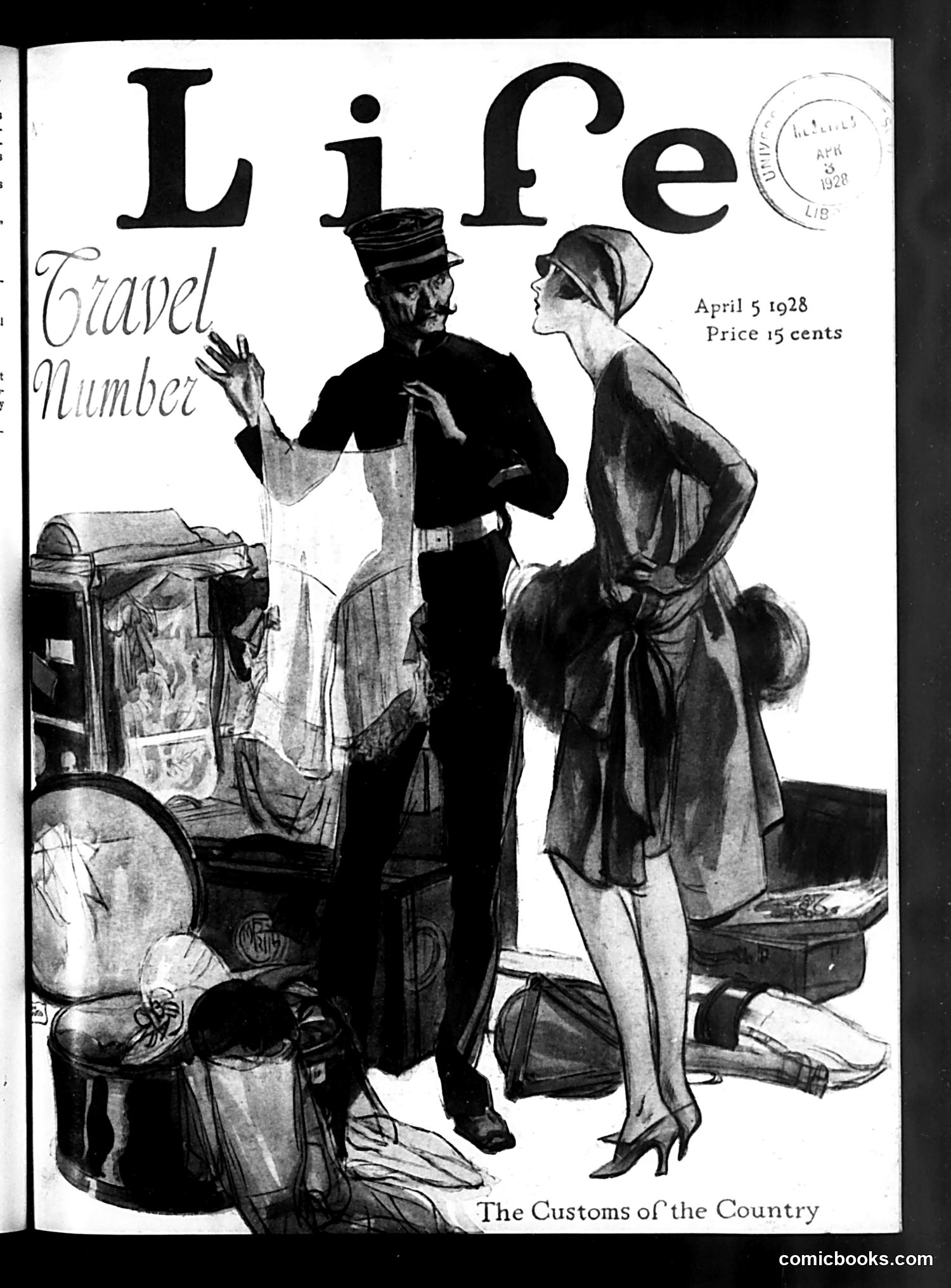
This "Travel Number" cover satirizes customs inspections at international borders. A stern, uniformed customs official gestures expressively while examining a fashionably dressed female traveler surrounded by luggage, suitcases, and travel goods. The satire likely concerns the absurdity or intrusiveness of customs procedures—either the official's theatrical manner of conducting inspections or the traveler's apparent anxiety about declaring items. Given this is 1928 (Prohibition era), the joke may reference smuggling concerns, particularly alcohol importation. The illustration captures the social tension between authorities and travelers, poking fun at either overzealous customs enforcement or travelers attempting to circumvent it. The woman's fashionable attire contrasts humorously with the tedious bureaucratic process she faces.
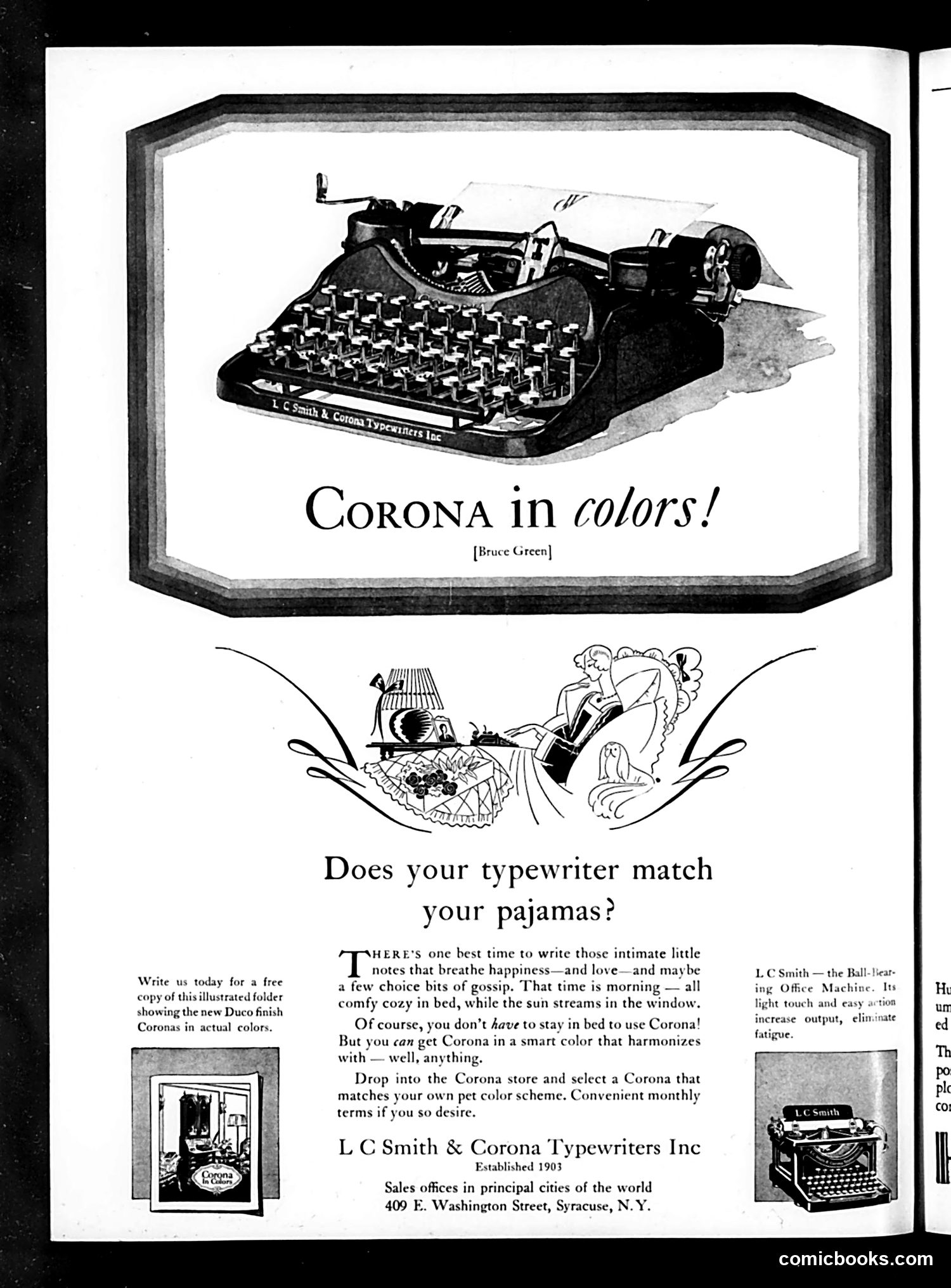
This page is primarily **advertising, not satire or political commentary**. It's a Corona typewriter advertisement from L.C. Smith & Corona Typewriters Inc (established 1901). The ad uses humor rather than satire: the headline "Does your typewriter match your pajamas?" is a lighthearted joke suggesting that Corona typewriters come in various colors to coordinate with one's personal style and bedroom décor. This was marketed as a novelty feature—you could select a Corona in a color matching your "pet color scheme." The illustration shows a woman in bed writing, humorously implying that users might want their typewriter to aesthetically complement their bedroom rather than just be functional. The "colors" reference in the main headline reinforces this consumer-choice appeal. This reflects 1920s-30s marketing aimed at making office equipment stylish and appealing to home use.
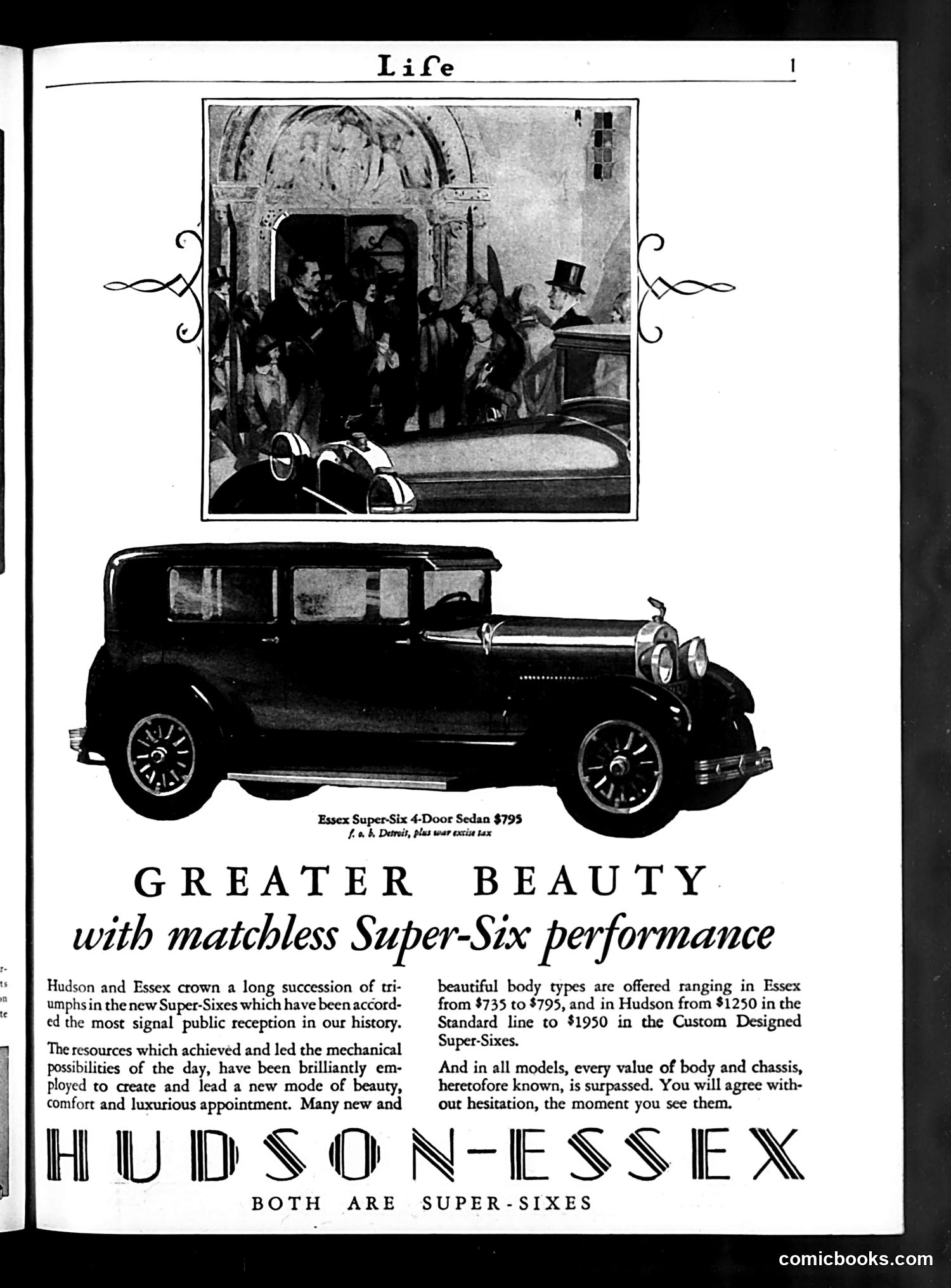
This page is primarily **automobile advertising**, not satire or political commentary. It promotes the Essex Super-Six and Hudson automobiles as luxury vehicles offering "Greater Beauty with matchless Super-Six performance." The top image shows what appears to be a **social scene at an elegant entrance**—possibly depicting wealthy people arriving at an upscale venue, meant to suggest the car's association with refinement and status. The main content highlights technical achievements ("resources which achieved and led the mechanical possibilities of the day") and emphasizes luxury appointments. Prices range from $795 to $1950 depending on model. This reflects **1920s automobile marketing**, where manufacturers positioned cars as status symbols for aspiring middle and upper-class consumers, combining performance claims with lifestyle imagery.
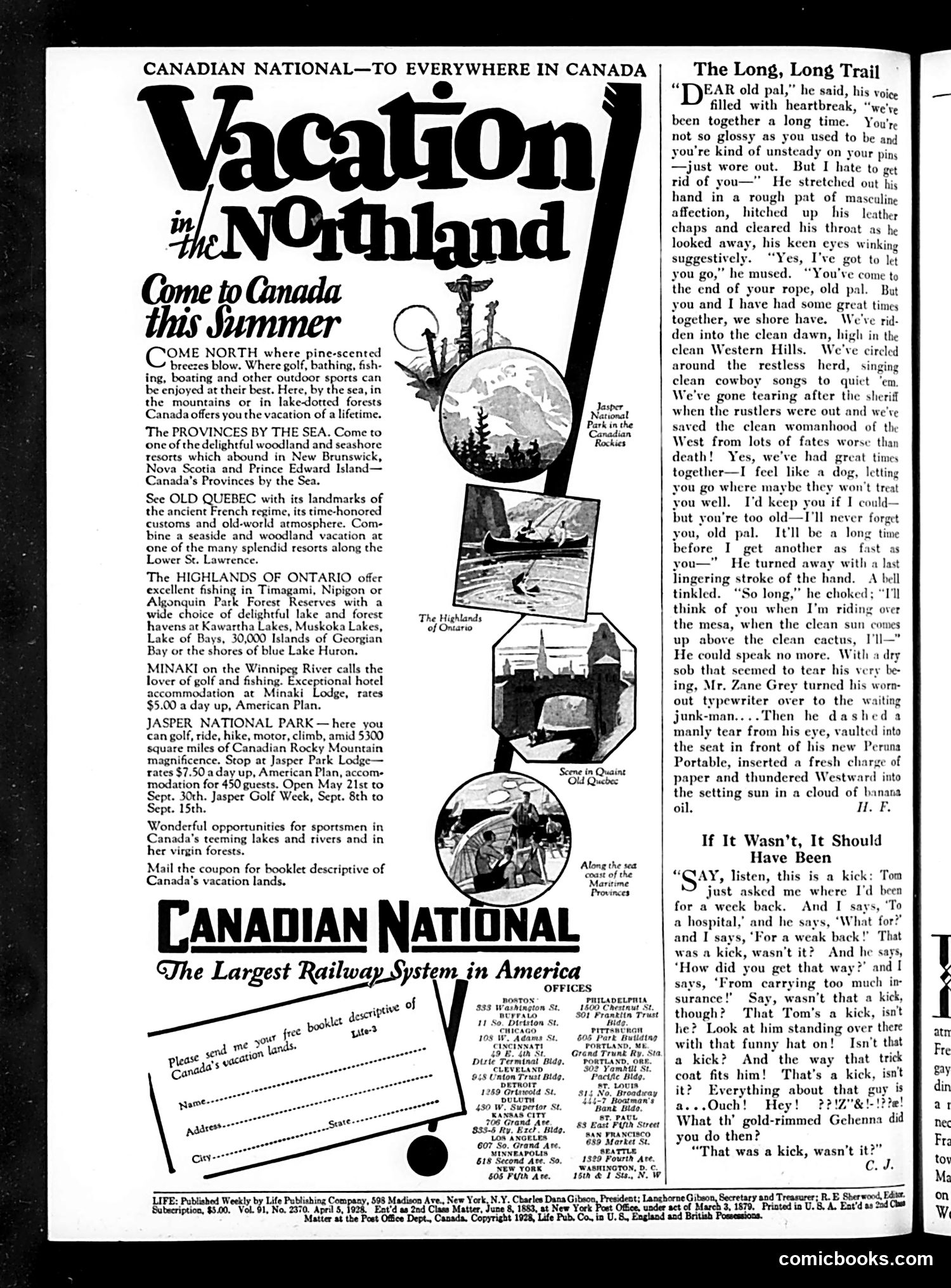
This page is primarily **advertising rather than political satire**. The dominant content is a Canadian National Railway vacation advertisement promoting "Vacation in the Northland" with travel copy and scenic photographs of Ontario wilderness, fishing, and mountain landscapes. The only narrative content—"The Long, Long Trail" and "If It Wasn't, It Should Have Been"—appears to be **sentimental fiction rather than satire**. The first depicts an emotional parting between old friends; the second humorously recounts a minor mishap involving overinsurance claims. No political figures, caricatures, or satirical commentary are evident. The page represents typical 1920s Life magazine: mixing travel promotion with light domestic humor for middle-class readers.
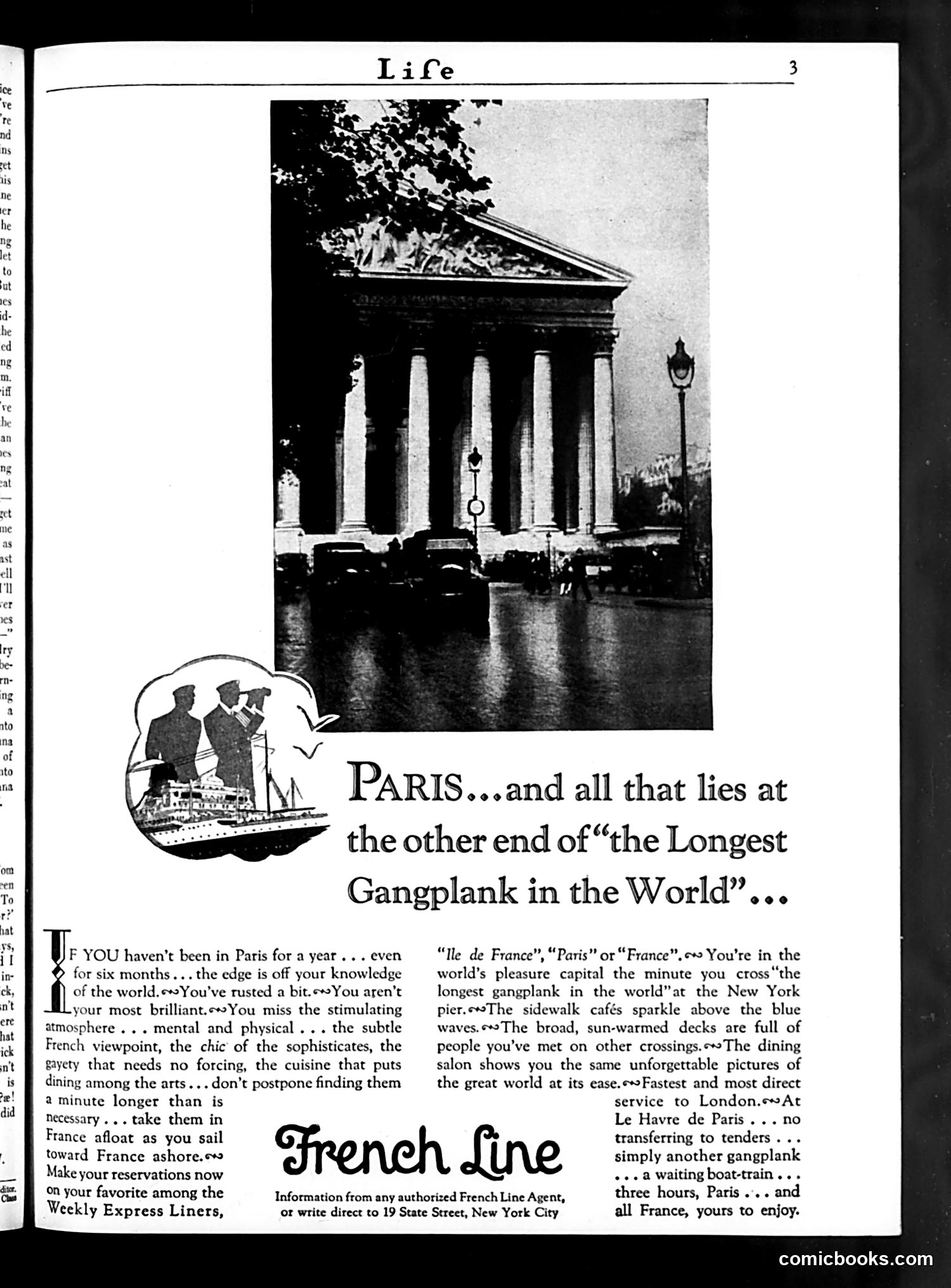
This page is primarily **advertising, not satire**. It's a French Line (steamship company) advertisement promoting transatlantic travel to Paris. The headline sarcastically addresses Americans who haven't visited Paris recently, claiming they've missed the city's sophistication—its cafés, cuisine, and cultural atmosphere. The advertisement plays on post-war (likely 1920s) American nostalgia for European travel and French culture. The classical building photograph (appears to be a Parisian landmark with columns) and the small illustration of ship passengers establish the luxurious travel experience being marketed. The text emphasizes the French Line's gangplank as a gateway connecting New York to Paris's pleasures, positioning ocean liner travel as essential leisure for cultured Americans. This reflects the era's transatlantic tourism boom.
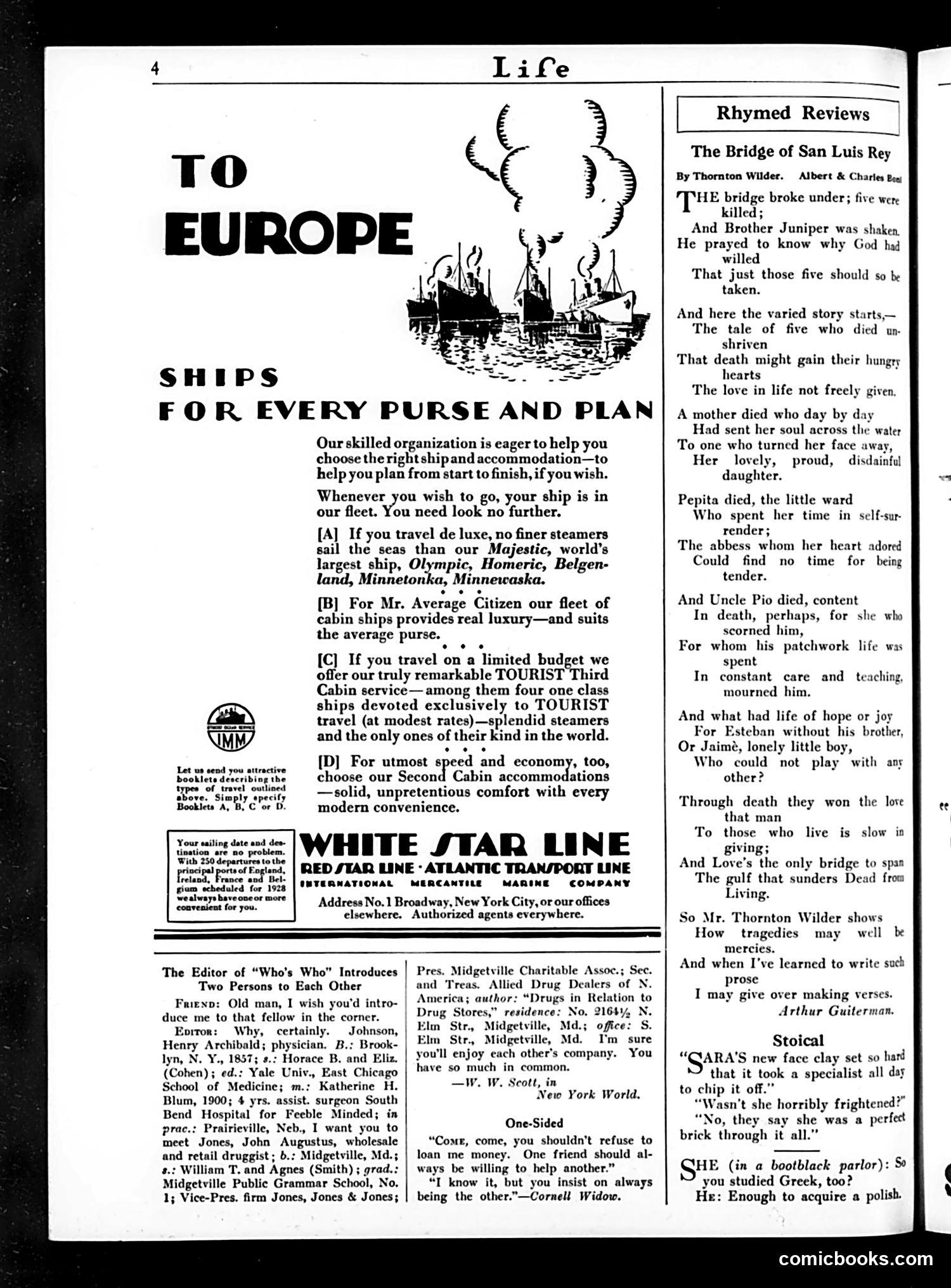
This page is primarily **advertising and light humor content**, not political satire. The dominant feature is a **White Star Line advertisement** promoting European steamship travel across multiple price tiers—from luxury liners (Majestic, Olympic) to budget tourist accommodations. The copy emphasizes accessibility for different income levels. The right side contains **"Rhymed Reviews,"** a humorous poetry section critiquing "The Bridge of San Luis Rey" by Thornton Wilder. The verses mock the novel's tragic deaths and philosophical themes with irreverent wit—typical of Life's sophisticated, literary humor for educated readers. Below are brief joke sections ("One-Sided," "Stoical") offering conversational witticisms. No political figures or references appear. This reflects Life's 1920s identity as a magazine balancing advertising revenue with literary satire and social commentary.
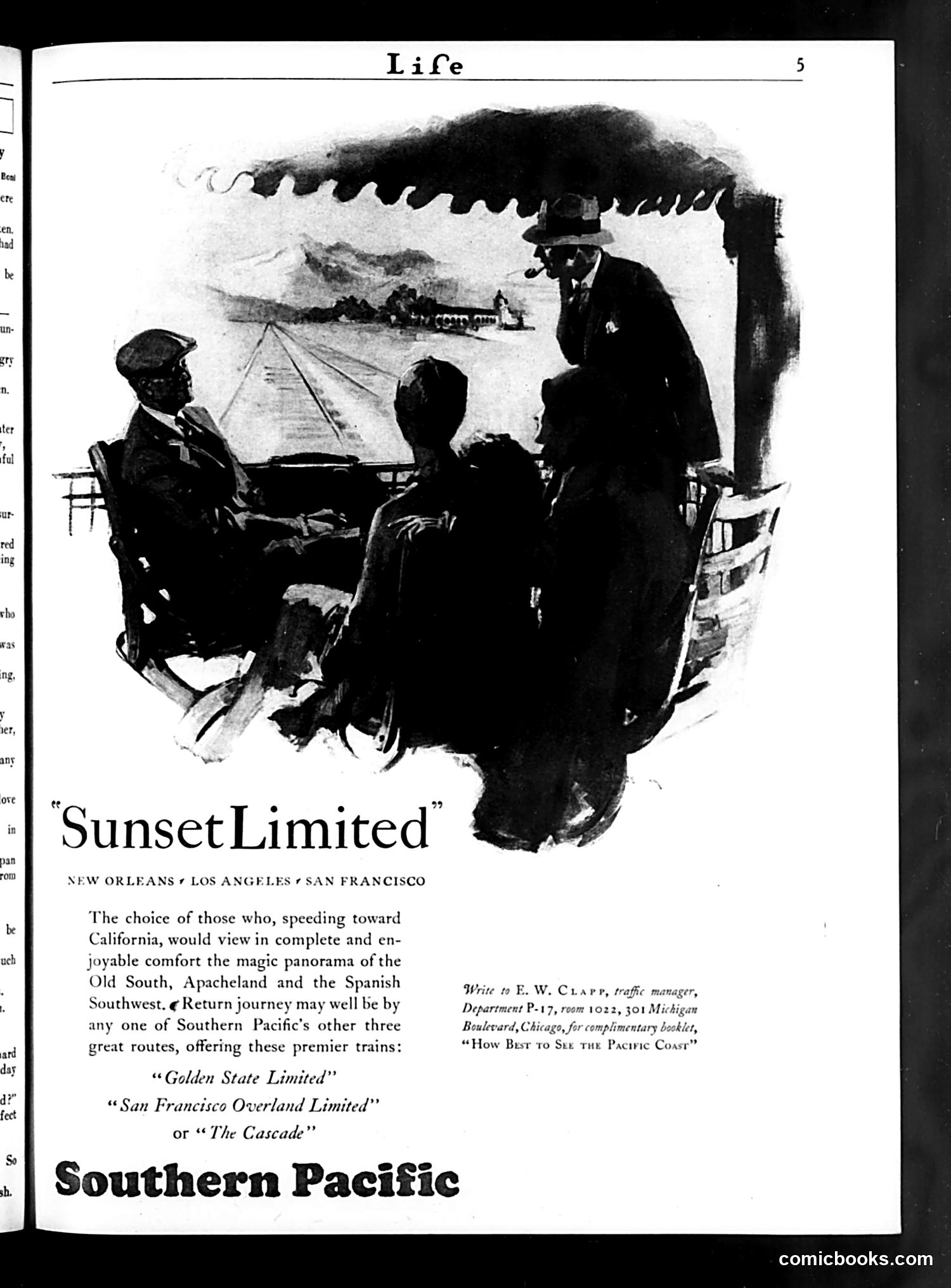
This page is **primarily an advertisement**, not satirical content. It advertises the "Sunset Limited" train service offered by Southern Pacific Railroad, connecting New Orleans, Los Angeles, and San Francisco. The illustration depicts three well-dressed passengers (two seated, one standing) viewing a scenic panorama through what appears to be an observation car window. The train is visible in the distant landscape, emphasizing the comfort and leisure of rail travel. The ad copy appeals to travelers heading to California, promoting the journey through "the magic panorama of the Old South, Apacheland and the Spanish Southwest." It mentions three competing Southern Pacific routes, including the "Golden State Limited" and "The Cascade." This reflects early 20th-century luxury train marketing, emphasizing comfort and scenic views rather than speed or efficiency—a selling point for leisure travel of that era.
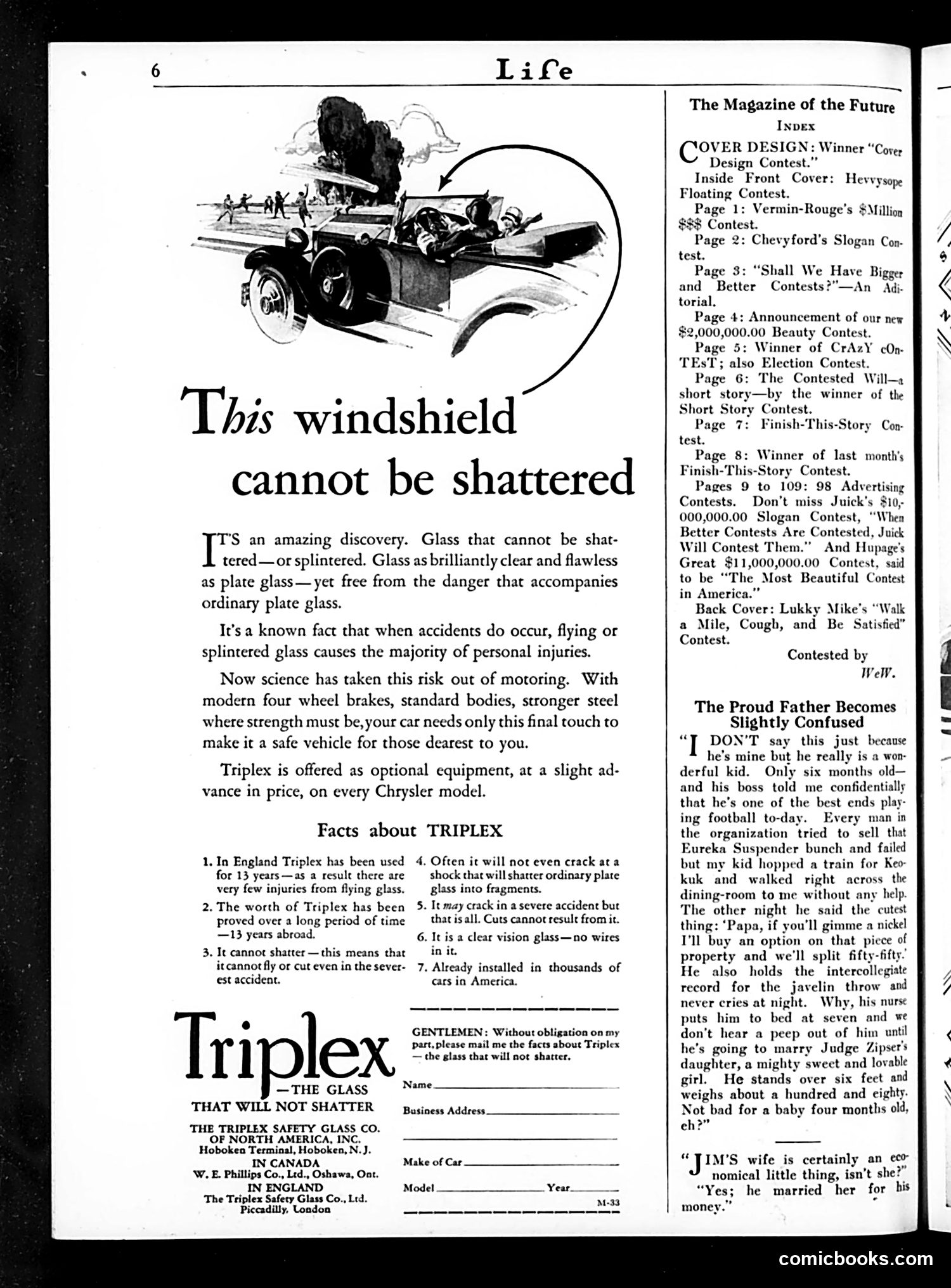
This page is primarily a **Triplex safety glass advertisement** (the main content), not political satire. The ad promotes Triplex windshields for automobiles, emphasizing they cannot shatter or splinter—a significant safety innovation at the time. The illustration shows a car with an impact circled, demonstrating the glass's durability. The ad lists factual claims (used 13 years in England, won't crack even in severe accidents) and includes a mail-in coupon. The right column contains the magazine's **index and brief satirical content** unrelated to the advertisement—including contest announcements and a humorous anecdote titled "The Proud Father Becomes Slightly Confused." This is primarily **commercial advertising**, not political commentary.
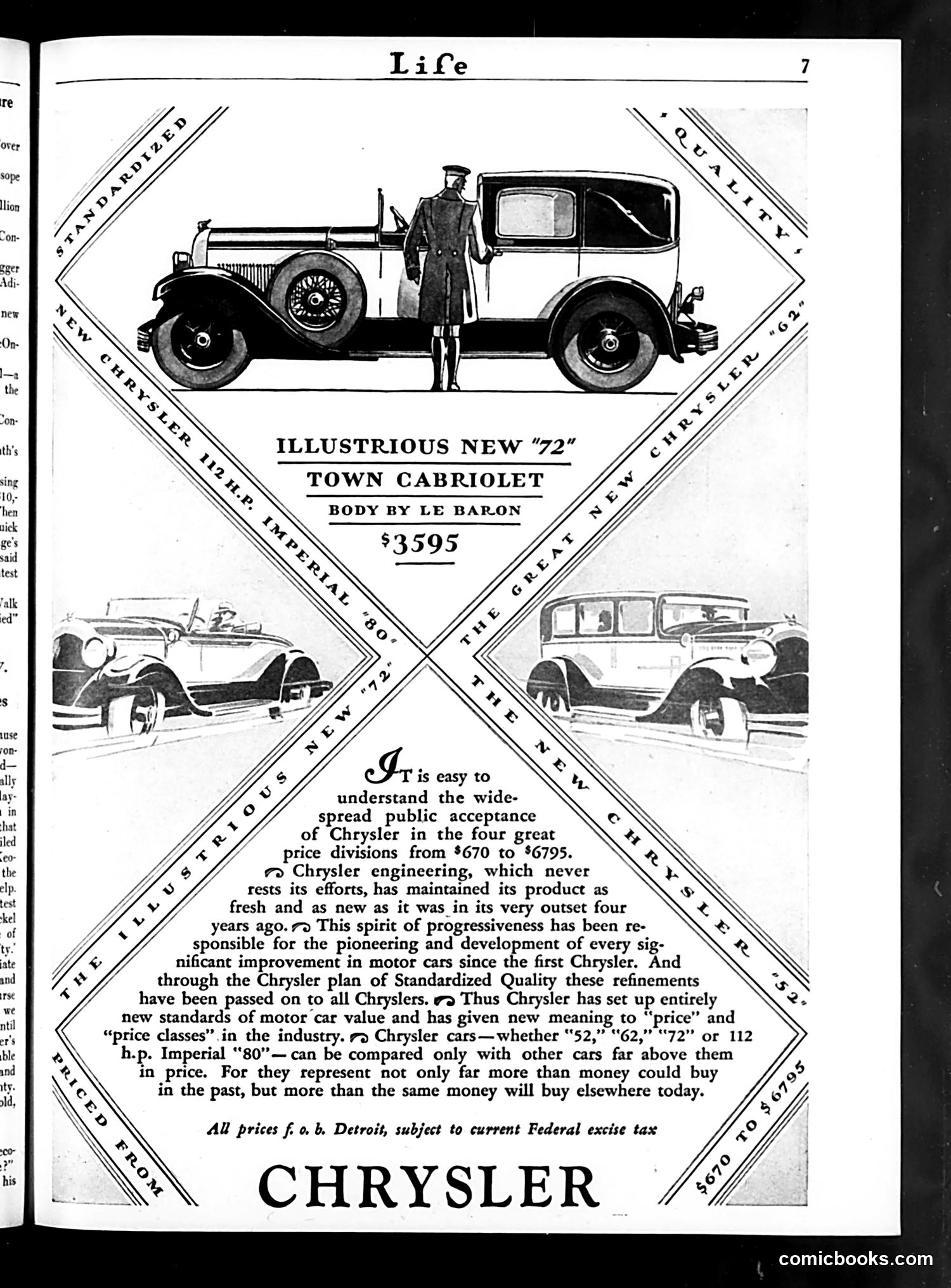
This page is **primarily a Chrysler automobile advertisement**, not political satire or cartoon content. The ad promotes the "Illustrious New '72' Town Cabriolet" (body by Le Baron) priced at $3,595. It features multiple vehicle illustrations arranged in a diamond pattern around promotional text. The marketing message emphasizes Chrysler's engineering excellence and value proposition: their cars offer more refinement and innovation than competitors at comparable price points. The text argues that Chrysler vehicles represent superior "price and price classes" in the industry—you get more quality for your money than elsewhere. This is a straightforward commercial advertisement using the visual layout and copy style typical of 1920s-era magazine advertising. There is no political satire or social commentary present on this page.
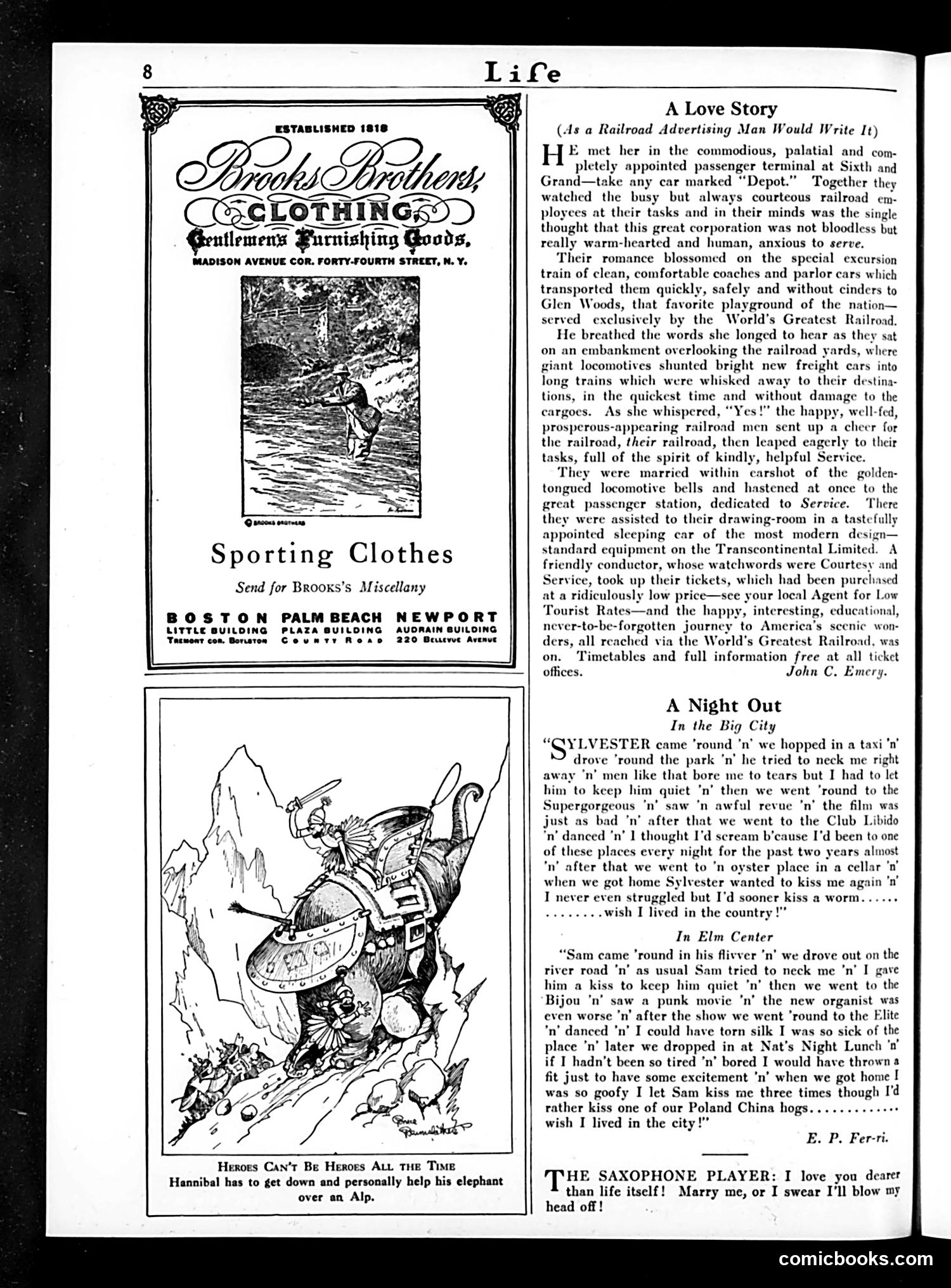
This page combines advertising with satirical short stories rather than political cartoons. **The cartoon** shows Hannibal helping an elephant over an Alpine mountain—a historical reference to Hannibal's famous crossing of the Alps with war elephants during the Second Punic War (218 BCE). The caption reads "Heroes Can't Be Heroes All the Time," suggesting the joke is that even great historical figures must occasionally perform mundane tasks or manual labor. **The written content** consists of three humorous anecdotes about courtship and dating in the early 20th century: romantic train rides, nightclub outings in the city, and a saxophone player's declaration. These reflect contemporary social life rather than political satire—they're lighthearted romance stories with dialect humor typical of Life's satirical style.
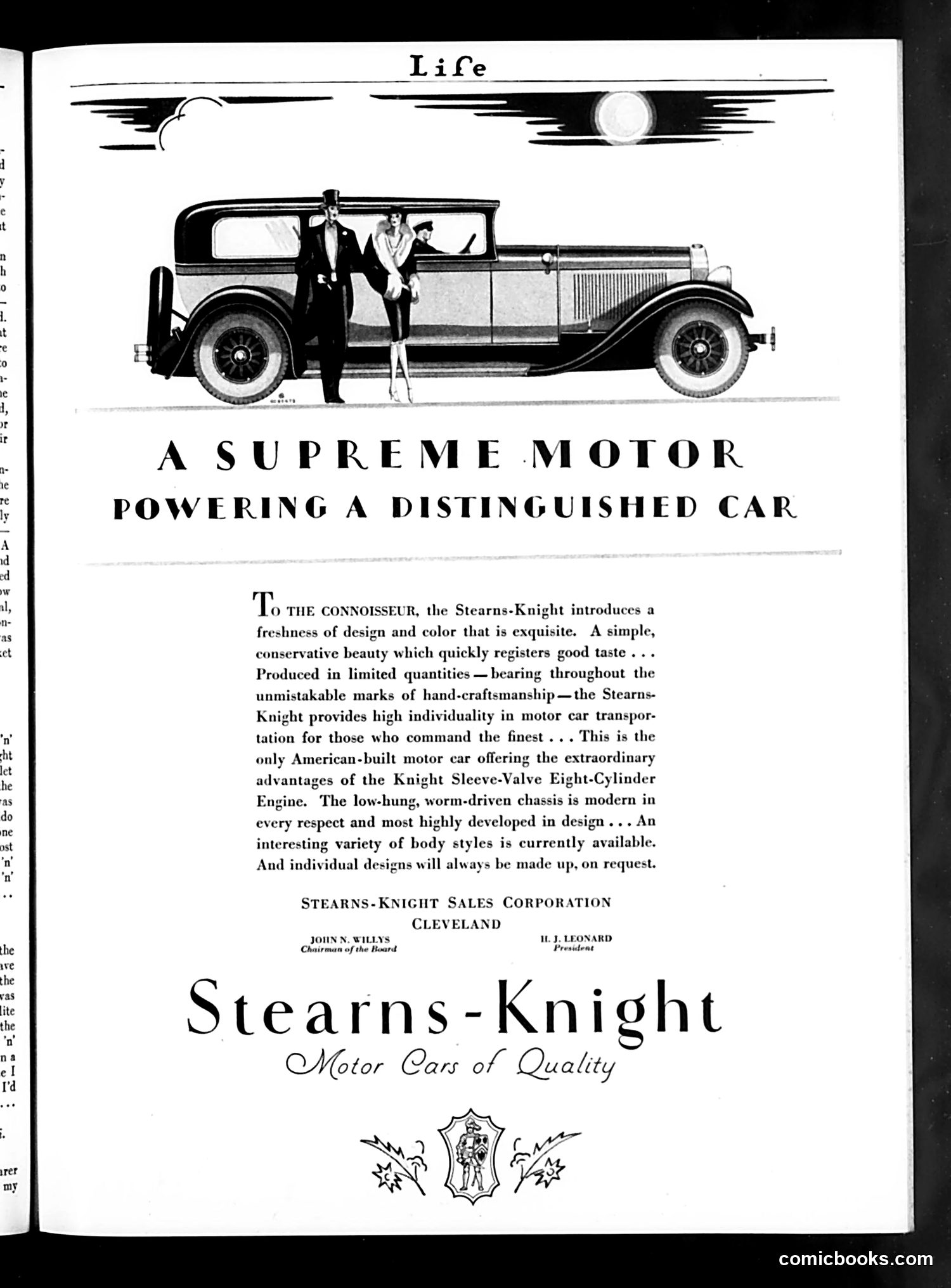
This is a **luxury automobile advertisement**, not a political cartoon or satire. It appears in *Life* magazine promoting the Sterns-Knight motor car, manufactured by the Sterns-Knight Sales Corporation in Cleveland. The ad emphasizes exclusivity and refined taste, targeting wealthy consumers. The illustration shows well-dressed figures (a man in formal wear and an elegantly dressed woman) posed beside the vehicle, designed to convey status and sophistication. Key selling points highlighted include the "Knight Sleeve-Valve Eight-Cylinder Engine," limited production ("produced in limited quantities"), hand-craftsmanship, and customization options. The tagline "Motor Cars of Quality" reinforces the premium positioning. This represents typical early-20th-century luxury marketing that associates automobiles with social distinction and refined aesthetics.
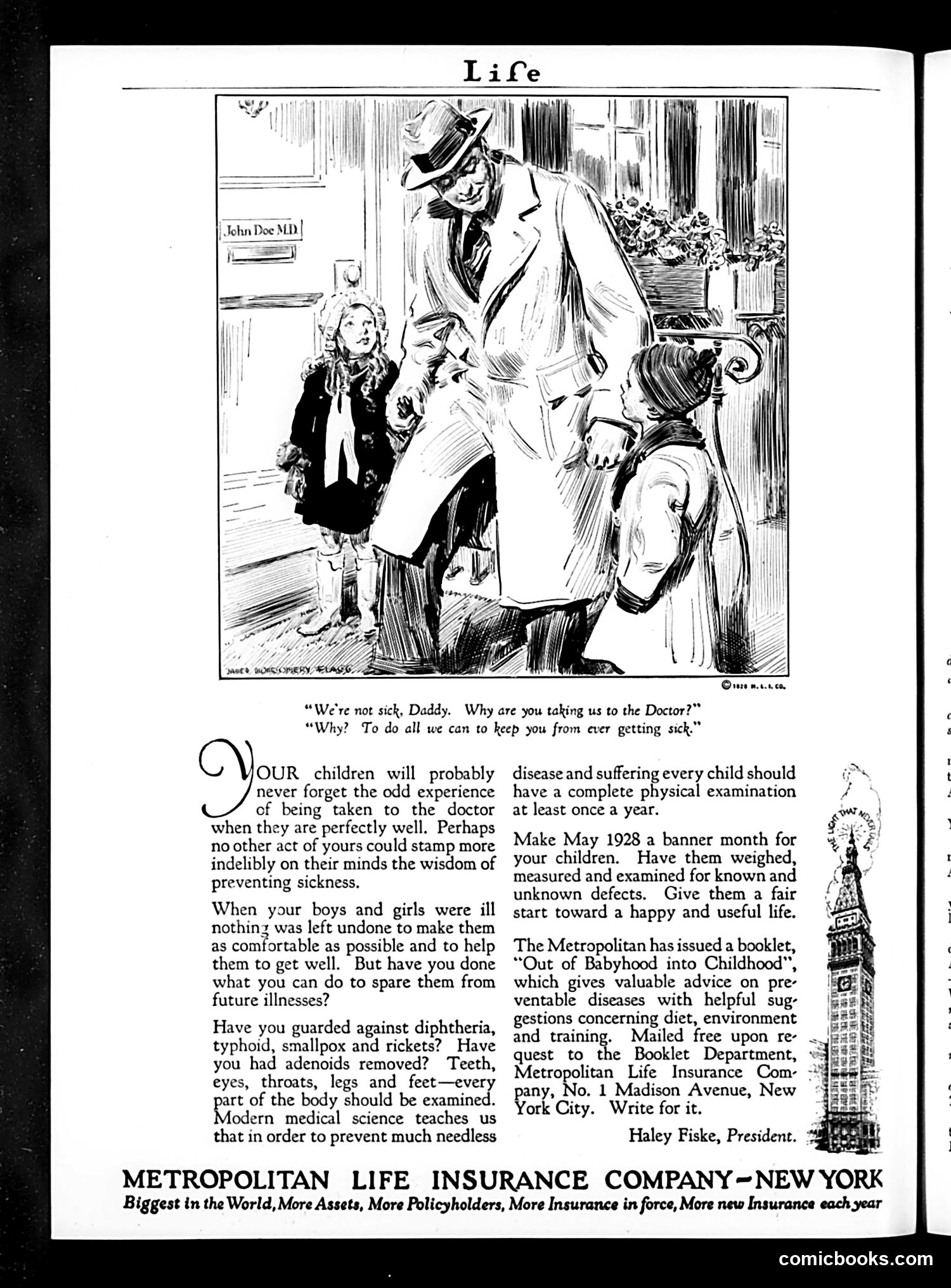
This page is primarily an **advertisement for Metropolitan Life Insurance Company** (1928), disguised as public health advice. The cartoon depicts a well-dressed doctor with two children, illustrating the caption: "We're not sick, Daddy. Why are you taking us to the Doctor?" / "Why? To do all we can to keep you from ever getting sick." The accompanying text promotes **preventive medicine**—annual physical exams, disease screening, and proper diet—as modern wisdom. It encourages parents to protect children from common illnesses like diphtheria, typhoid, and smallpox through medical vigilance. **The satire/point**: The ad conflates insurance company profit with child welfare, positioning Metropolitan Life as a guardian of public health while actually promoting its insurance products. The "preventive care" message serves the company's interests by normalizing routine medical visits and preventive spending.
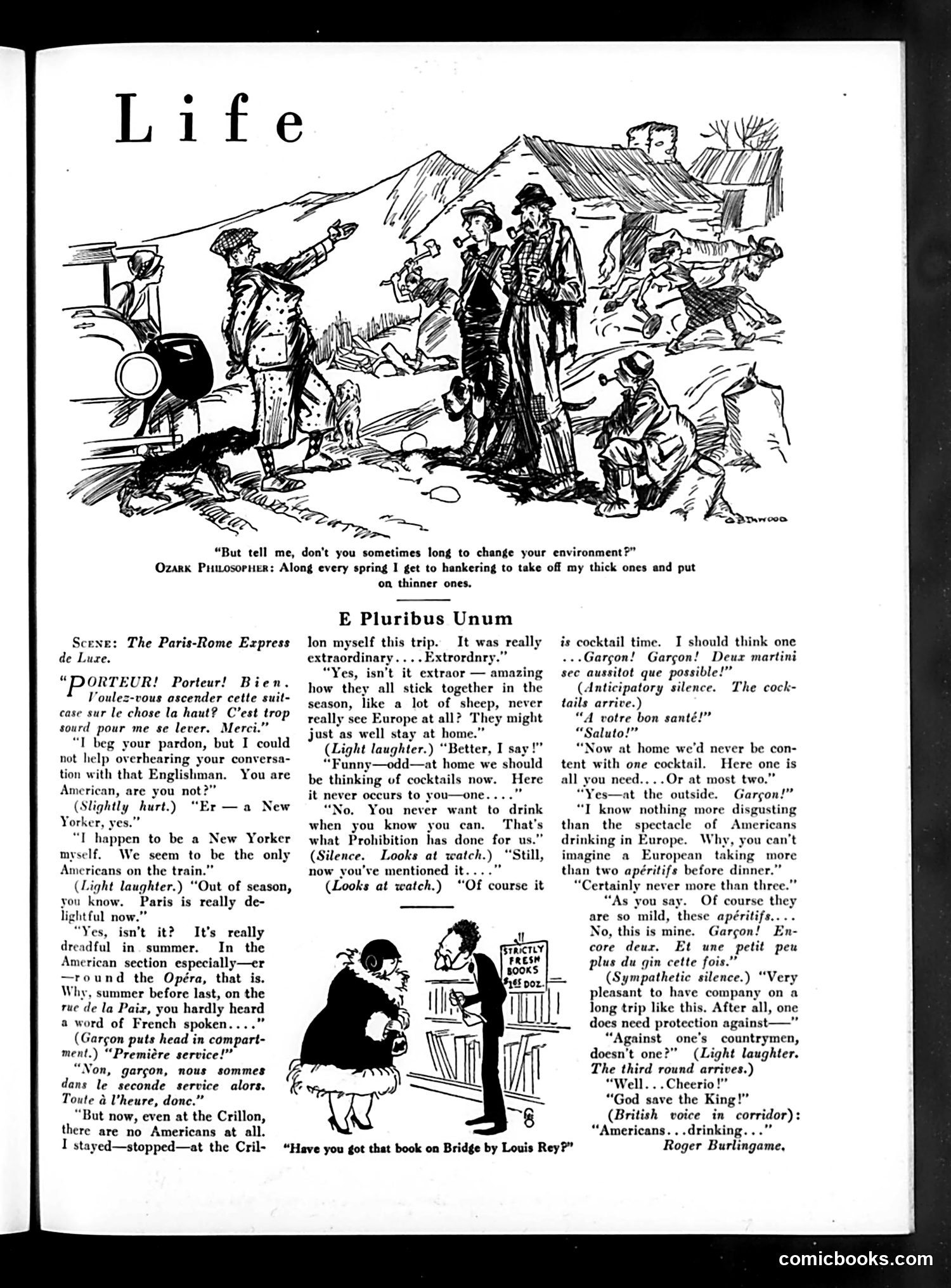
**The Cartoon:** The top illustration satirizes Americans abroad on the Paris-Rome Express train. It depicts wealthy tourists in stereotypical traveling clothes observing European peasants and rural life, with the caption questioning whether one "sometimes [longs] to change your environment." **The Story "E Pluribus Unum":** This is a satirical dialogue between an American tourist and a sophisticated Englishman discussing their travels. The satire mocks American tourists for: - Staying in European hotels but never truly experiencing European culture - Excessive drinking (contrasted with European aperitif culture) - Loud, uncultured behavior - Believing Americans are "the only Americans on the train" The piece lampoons American travel pretensions and cultural insularity during an era when overseas tourism was becoming fashionable among the wealthy middle class.
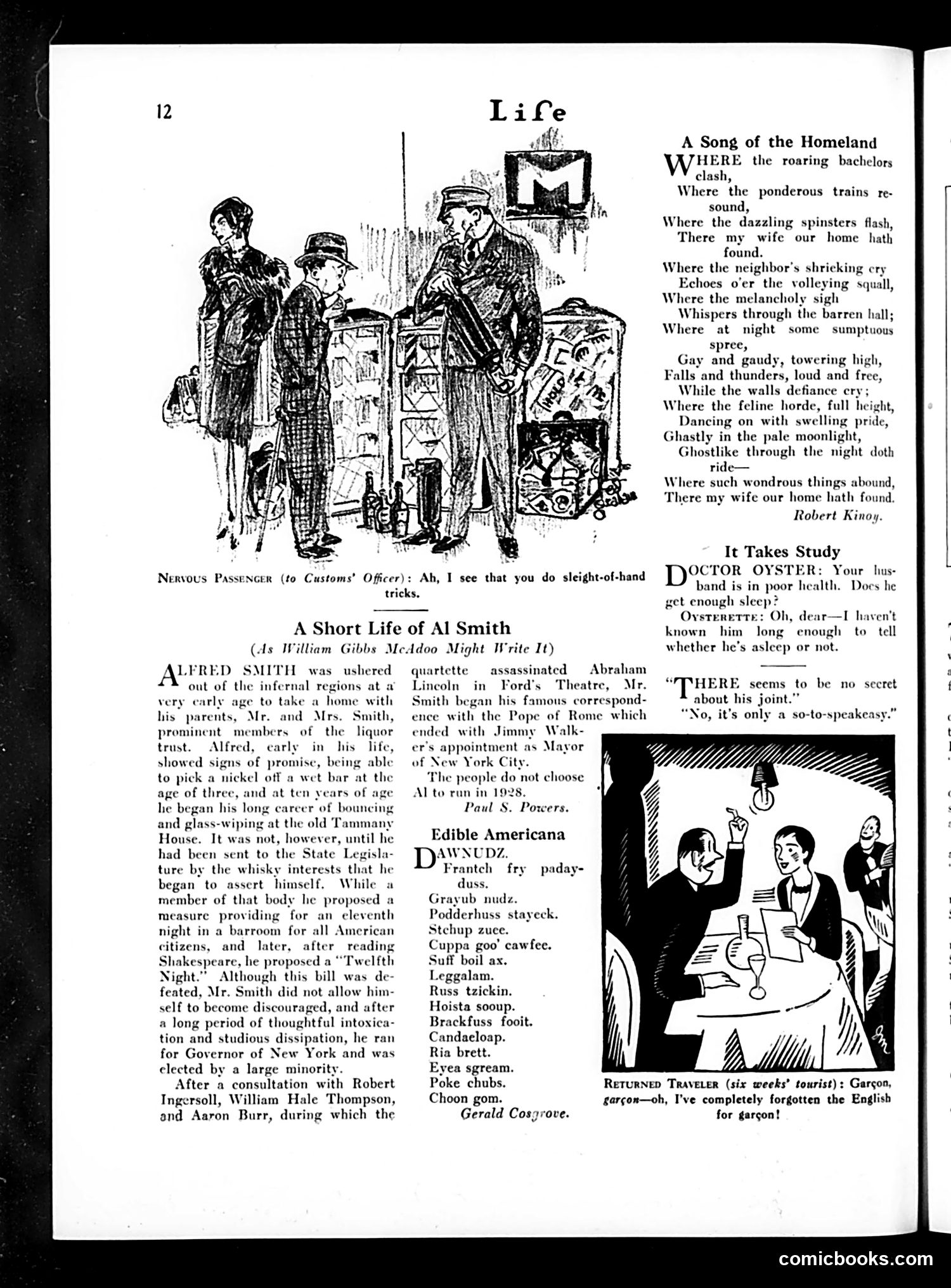
**Main Content:** The page features "A Short Life of Al Smith," a biographical sketch of Alfred Smith's early career. The text describes Smith's rise from working-class origins to prominent political positions, including his election as Governor of New York. This appears to be a sympathetic or celebratory profile rather than satirical commentary. **Cartoons:** 1. **Top illustration**: A customs officer catching someone performing "sleight-of-hand tricks"—likely satirizing smuggling or customs evasion. 2. **"It Takes Study"**: A doctor-patient dialogue joke about marital sleep habits, typical of period humor. 3. **Bottom cartoon**: A returning traveler who's "completely forgotten the English for garçon"—poking fun at affected Americans adopting French affectations while abroad. The page mixes political biography with light social satire typical of 1920s-era Life magazine humor.
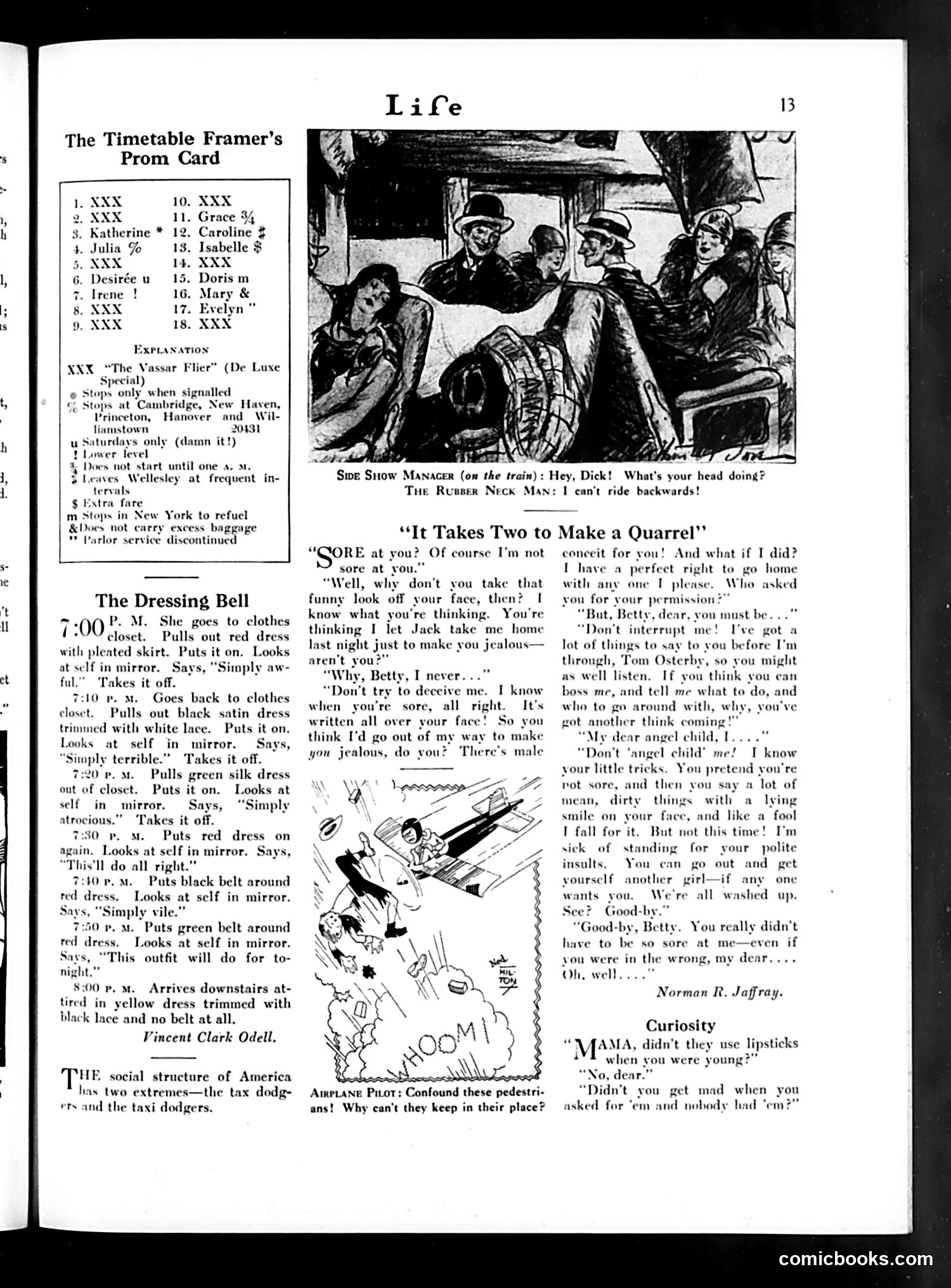
This page contains humor pieces and illustrations rather than political cartoons. The main content includes: **"The Dressing Bell"** (by Vincent Clark Odell): A comedic narrative about a woman preparing for an evening out, trying on multiple outfits between 7:00-8:00 PM. The humor derives from the tedious, repetitive nature of getting ready—a timeless domestic scene. **"It Takes Two to Make a Quarrel"** (by Norman R. Jaffray): A dialogue between a couple arguing about jealousy and relationship trust, with the woman (Betty) attempting to manipulate the situation. The satire mocks typical domestic disputes and female manipulation tactics of the era. **"Curiosity"**: A brief joke about lipstick use in earlier generations. The cartoons accompanying these pieces use illustration to enhance the comedic narratives rather than make explicit political statements.
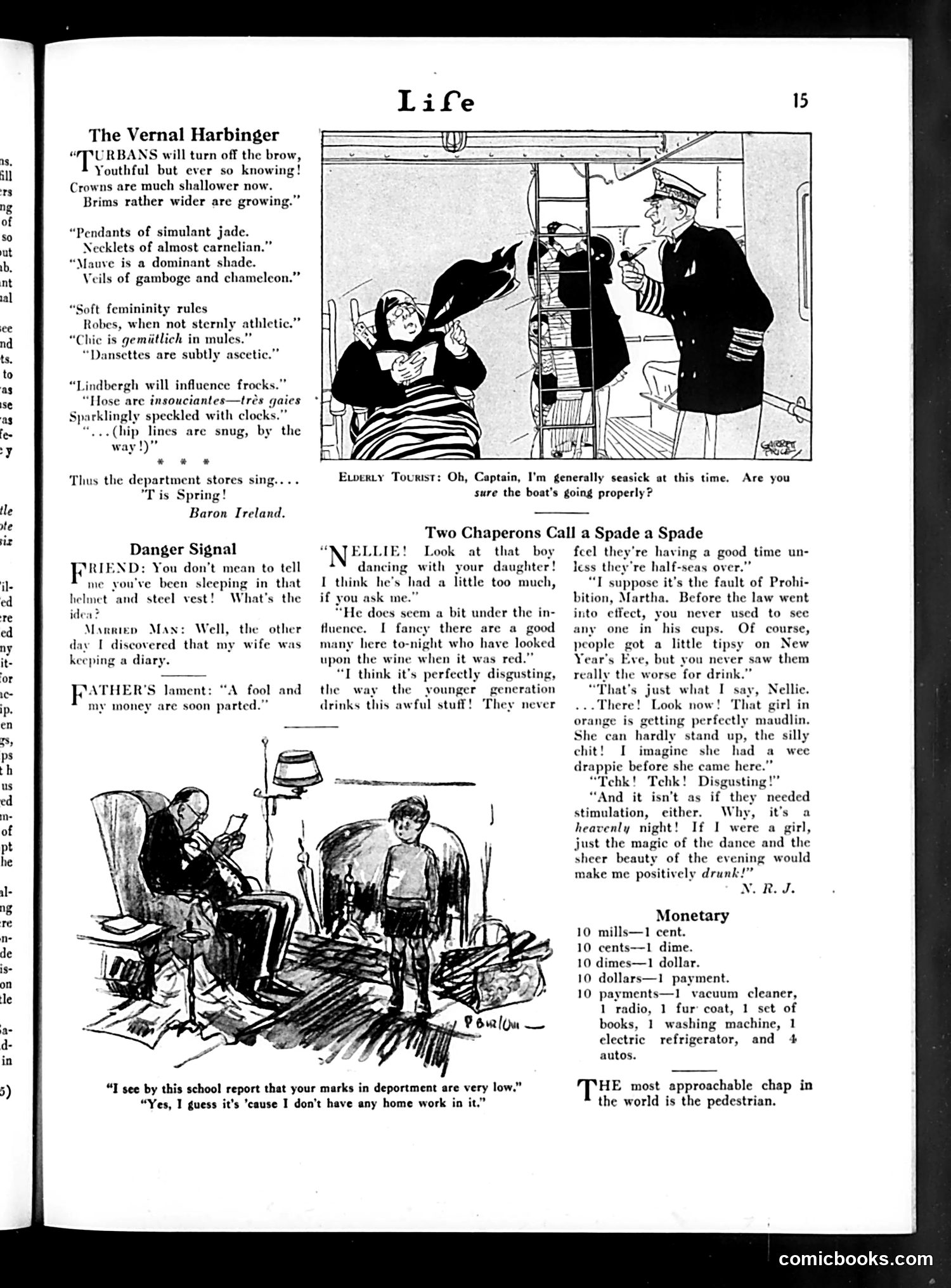
This cartoon depicts a father discovering his wife keeping a diary—a private record he views as evidence of infidelity. His shocked reaction ("my wife was keeping a diary") and the caption "A fool and my money are soon parted" suggest he's been cuckolded. The satire targets early 20th-century anxieties about women's privacy and independence. A wife maintaining a secret diary was presented as inherently suspicious—the cartoon assumes hidden thoughts equal hidden affairs. The joke relies on the era's assumption that wives should be transparent to husbands, and that a woman's private life automatically indicates wrongdoing. The cartoon reflects broader period concerns about changing gender roles and male insecurity about female autonomy.
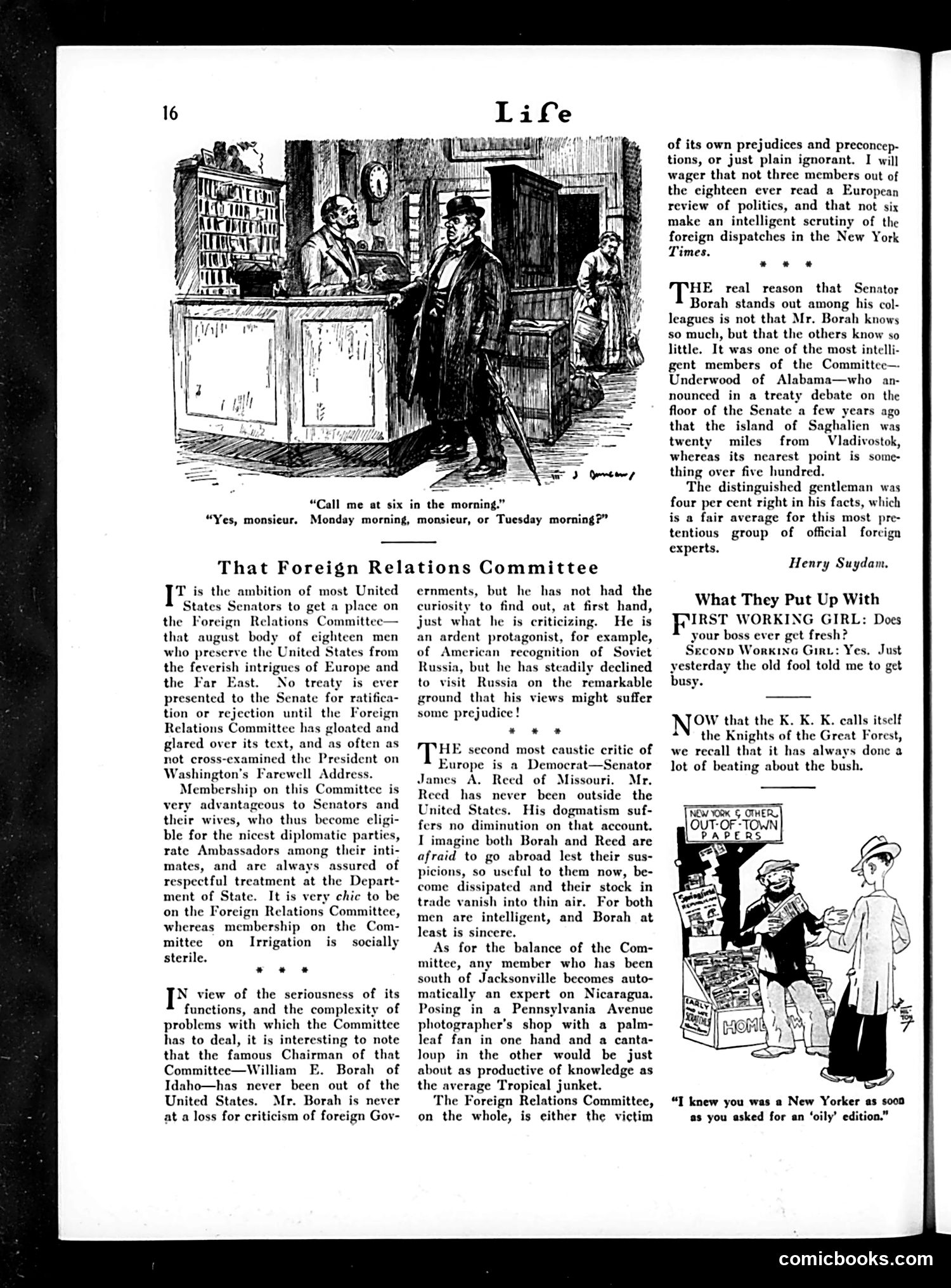
The main cartoon satirizes the Foreign Relations Committee's chairman, William E. Borah of Idaho. The text criticizes Borah as hypocritical: he loudly criticizes foreign governments despite never leaving the United States, never having firsthand knowledge, and lacking diplomatic experience. The caption "Call me at six in the morning, Monday morning, monsieur, or Tuesday morning?" mocks his pretentious European affectations while questioning his actual expertise. The secondary cartoon about the K.K.K. appears unrelated satirical content about that organization claiming to preserve American interests while, the text suggests, doing little substantive work. Both pieces exemplify *Life* magazine's style: sharp political commentary mocking politicians and organizations through exaggeration and direct criticism rather than subtle visual metaphor.
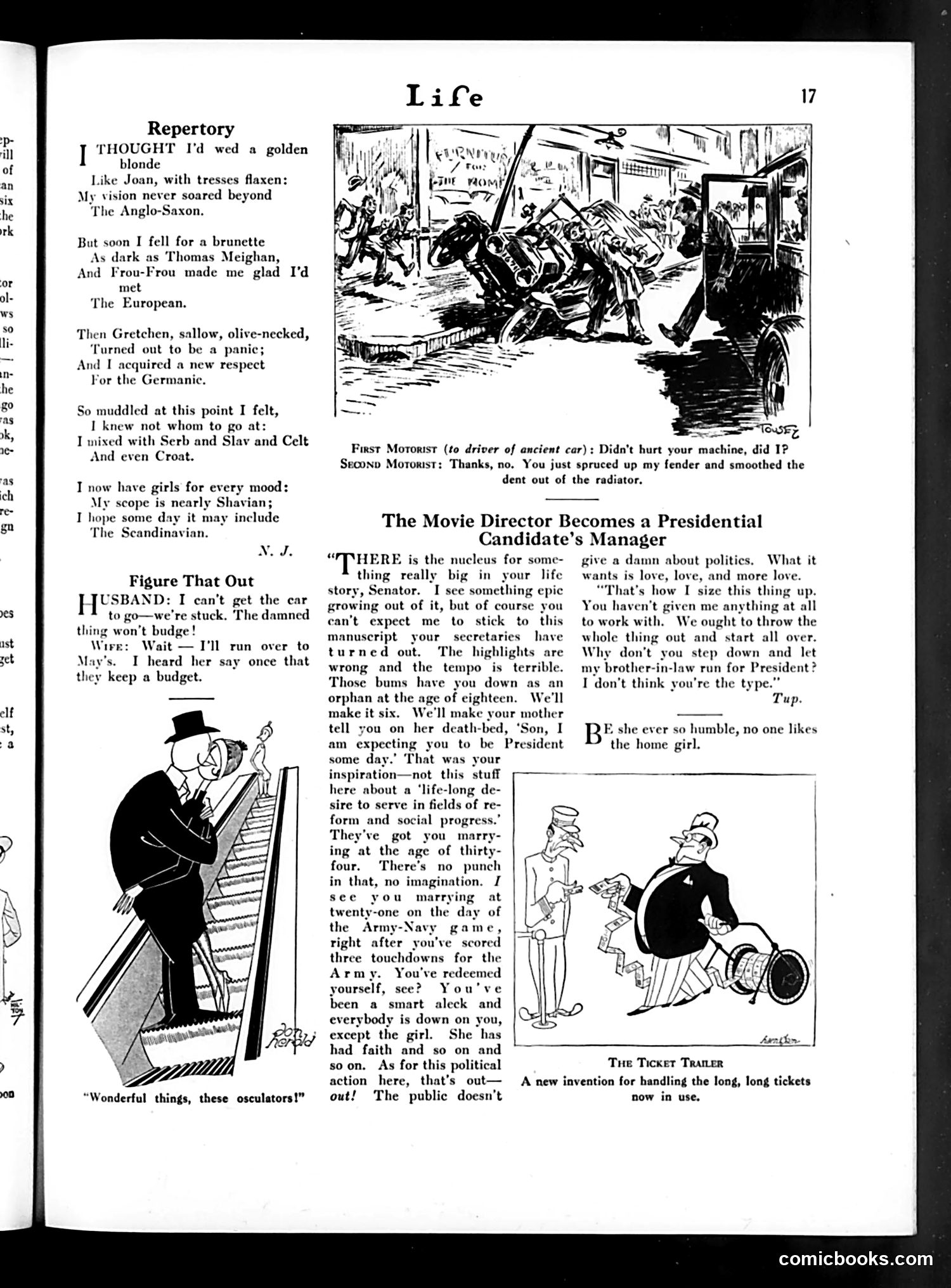
This page contains three distinct pieces of satire: 1. **"Repertory"** (poem): A humorous autobiographical poem about the author's romantic preferences, progressing from idealized ("golden blonde") to more pragmatic choices, ending with "I now have girls for every mood." 2. **"Figure That Out"** (cartoon): A husband-wife dialogue satirizing domestic budget disputes. The wife wants a car; the husband refuses because they're "stuck" financially. The joke lampoons marital financial tension and the husband's dismissive attitude. 3. **"The Movie Director Becomes a Presidential Candidate's Manager"** (article with cartoon): A satirical piece about a senator hiring a film director as his campaign manager. The senator lectures about political ambitions while the director remains skeptical about the candidate's authenticity and appeal—likely mocking both Hollywood's influence on politics and politicians' superficial image-crafting.
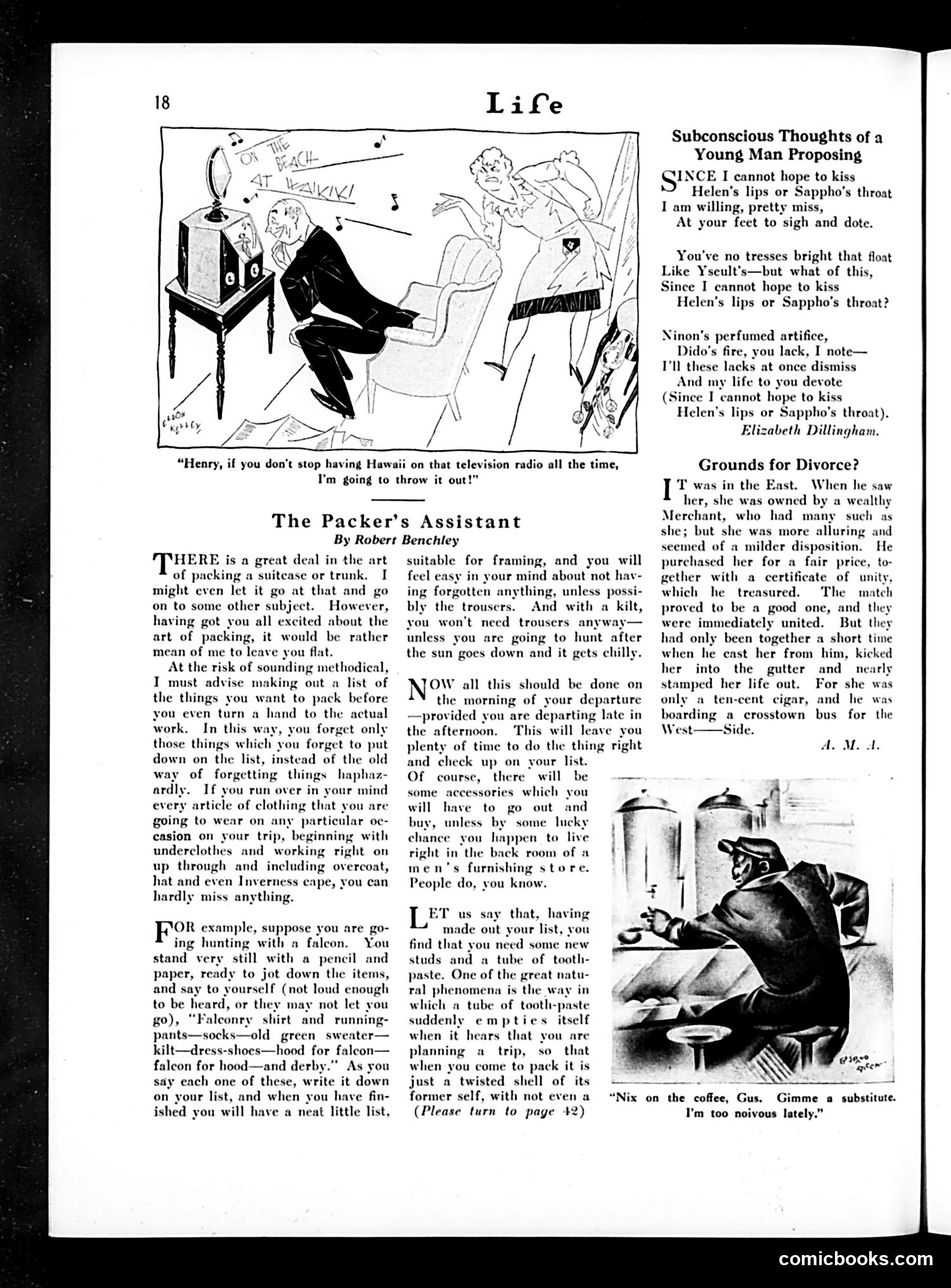
The top cartoon satirizes domestic discord over radio programming. A husband sits at a radio while his exasperated wife threatens to throw it out if he continues playing "Hawaii" (likely Hawaiian music, popular in the 1920s-30s). The joke mocks marital conflict over trivial entertainments and husbands' obliviousness to their wives' annoyance. Robert Benchley's "The Packer's Assistant" humorously advises travel preparation, with absurdist examples like packing a falcon for falconry trips and the comedic paradox of needing trousers with a kilt for nighttime hunting. The poetry by Elizabeth Dillingham parodies romantic proposal language, repeatedly referencing classical figures (Helen, Sappho, Yseult) while admitting the suitor cannot match such beauty—a self-deprecating, tongue-in-cheek marriage proposal. "Grounds for Divorce?" presents a shaggy-dog story: a wealthy merchant purchases and treasures a woman, only for the twist ending—she's a ten-cent cigar he abandons while boarding a bus. The bait-and-switch mocks melodramatic storytelling.
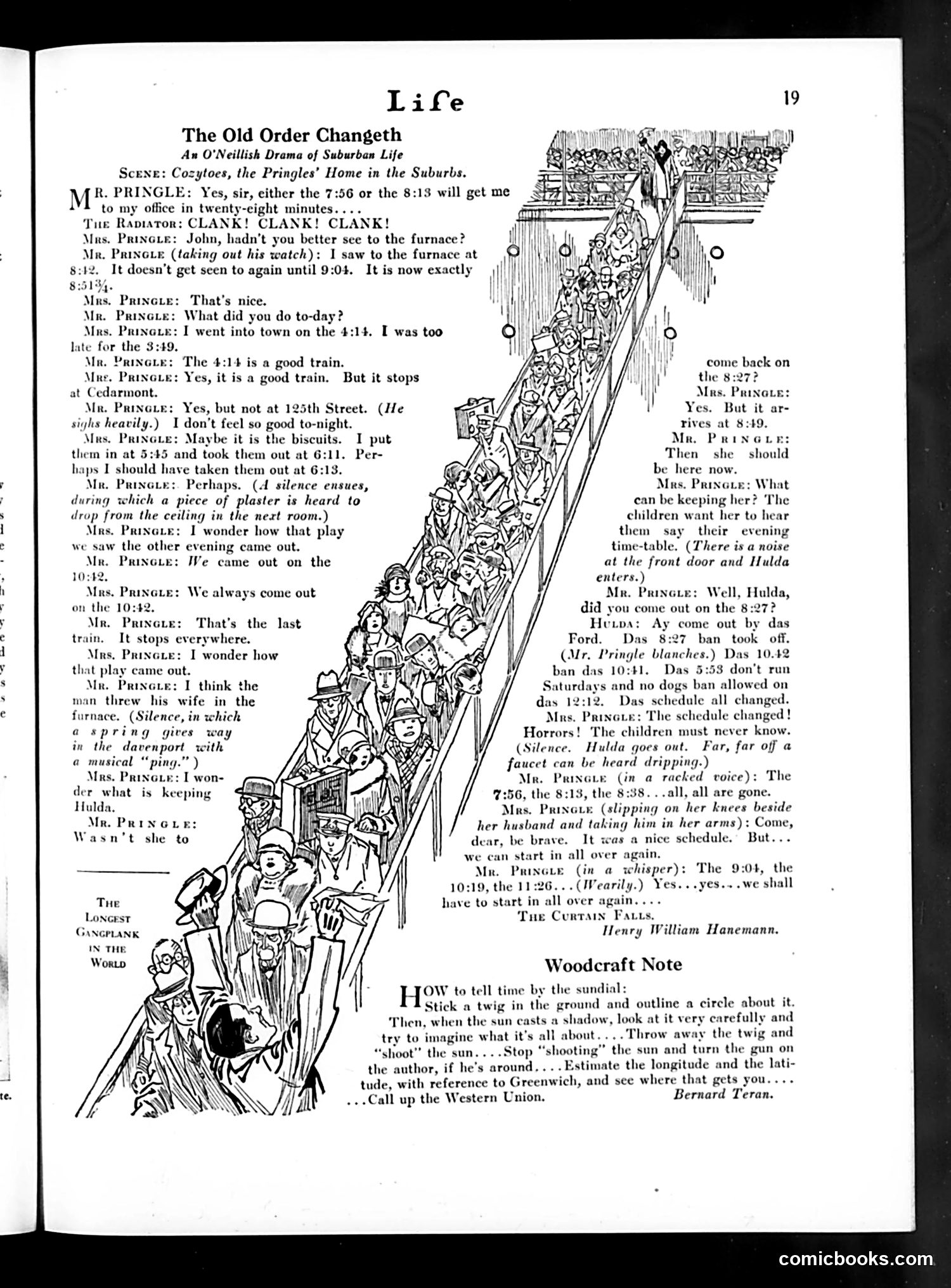
This one-act play satirizes the obsessive dependence of suburban commuters on train schedules in early 20th-century America. Mr. Pringle's entire existence revolves around precise train times—he discusses them constantly, timing household tasks (like the furnace) by them, and measuring his wife's activities by which trains she caught. The crisis erupts when their maid Hulda misses the 8:27 train, catastrophically disrupting the family's rigidly scheduled evening. The Pringles respond with genuine despair, treating it as tragedy requiring them to "start all over again" with alternative train times (9:04, 10:19, 11:26). The satire targets the dehumanizing effect of industrial punctuality on suburban middle-class life—people reduced to train schedules, emotional well-being contingent on timetables, and a loss of flexibility or spontaneity. The exaggerated melodrama (the wife kneeling beside her husband in anguish) amplifies the absurdity of treating a missed train as domestic catastrophe.
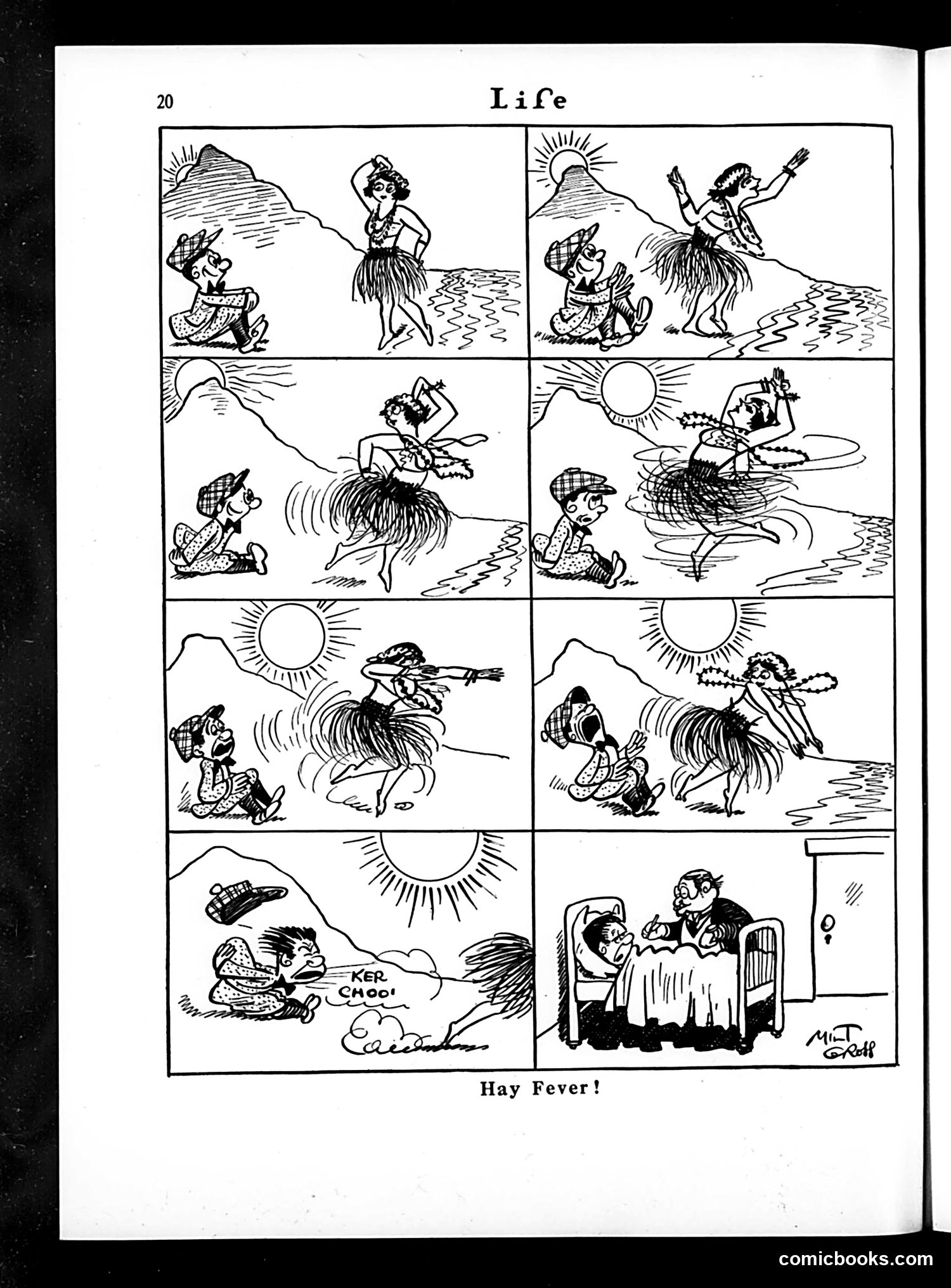
This is a visual joke about hay fever (allergic rhinitis). The comic shows a small man's escalating misery across eight panels: **The sequence:** A woman in a grass skirt dances increasingly energetically while the man watches from progressively lower positions. Each panel shows him getting worse—sneezing, covering his face, and losing strength as she kicks up more dust and debris. **The joke:** The "hay" being kicked up from her grass skirt triggers his allergies, worsening with each dance move. What should be an entertaining tropical performance becomes torture for an allergy sufferer. **The punchline:** The final panel shows him bedridden with a fever, having collapsed from his allergic reaction—the title "Hay Fever!" is a literal pun. This relies on early-20th-century reader familiarity with hay fever as a recognizable seasonal affliction, often mocked as a "gentleman's complaint."
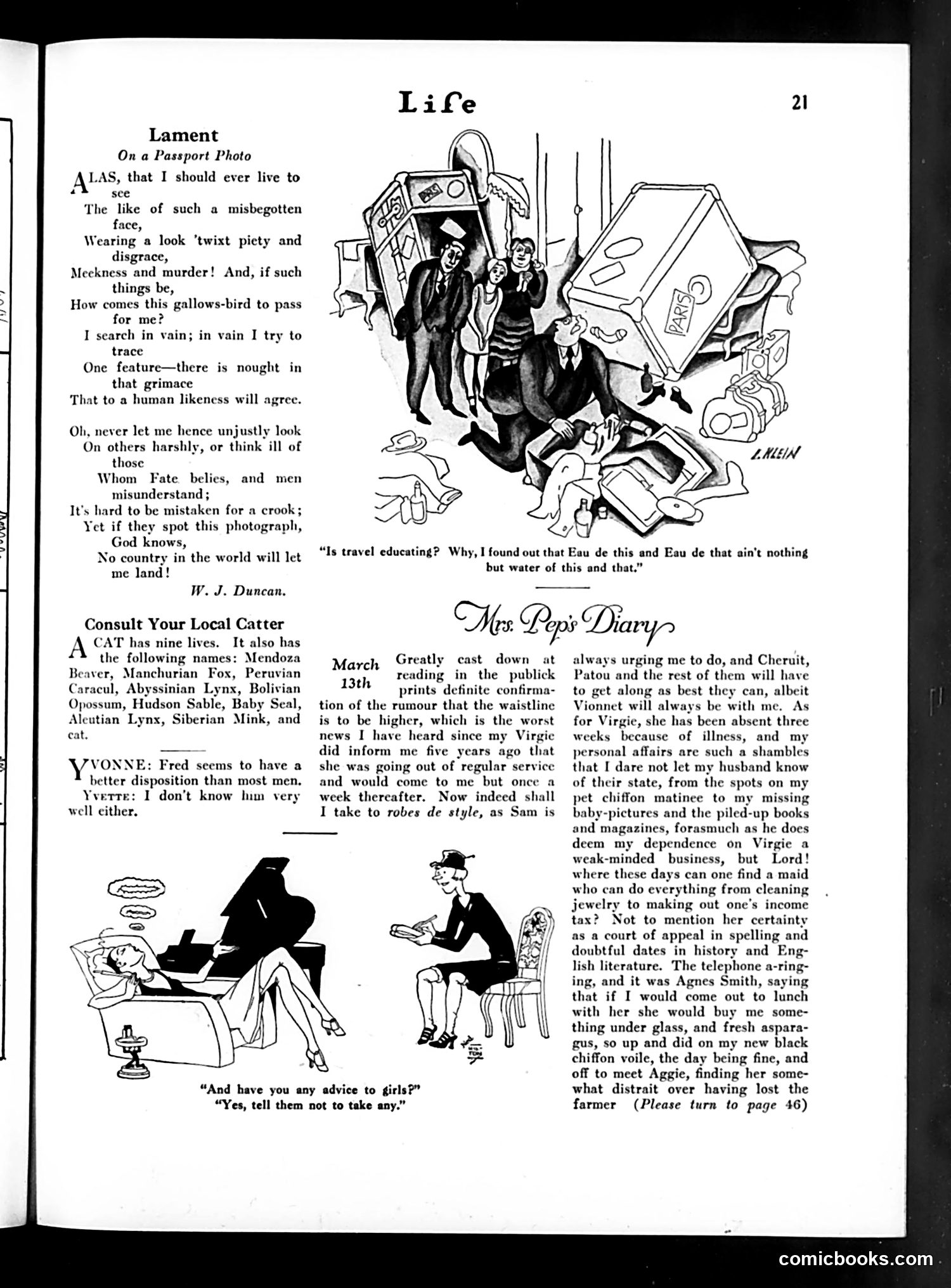
This page contains three distinct humor pieces reflecting 1920s concerns: **"Lament on a Passport Photo"** (poem by W.J. Duncan): A satirical complaint about unflattering passport photographs. The speaker laments that his photo makes him look like a criminal ("gallows-bird"), fearing no country will admit him based on this grimace. It's social satire about the absurdity of rigid passport photography—the tension between one's actual appearance and an unflattering official image that determines travel eligibility. **"Consult Your Local Catter"**: A brief joke exposing fur industry deception. Expensive fur coats were sold under exotic animal names (Manchurian Fox, Hudson Sable, etc.) when they were actually just cat fur—mocking consumer gullibility and marketing fraud in the luxury goods trade. **"Mrs. Peps' Diary"** (March 13th entry): Society humor about an upper-class woman distressed by fashion (higher waistlines) and dependent on her maid Virgie for managing life's details—from household tasks to spelling and historical facts. It satirizes wealthy women's frivolous concerns and helplessness without domestic staff.
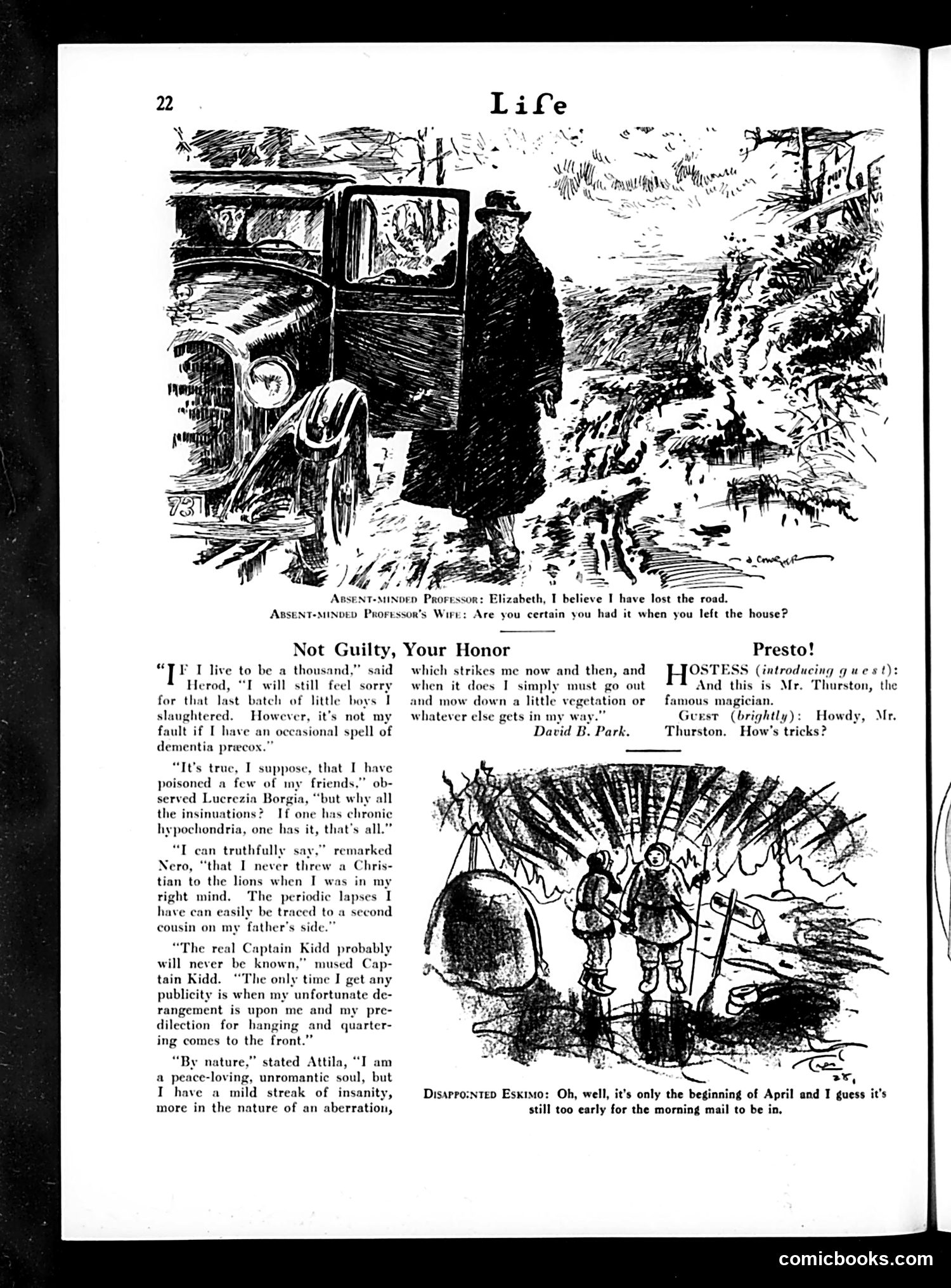
This page contains two distinct pieces of satire: **Top cartoon**: An absent-minded professor loses his way while driving, and his wife asks if he's certain he had the road when he left home—a joke about his forgetfulness being so extreme that he might have misplaced the actual road itself. **Main article "Not Guilty, Your Honor"**: A satirical piece where infamous historical villains (Herod, Lucrezia Borgia, Nero, Captain Kidd, and Attila) defend their atrocities by claiming temporary insanity or medical conditions. Each blames their crimes on periodic mental lapses rather than character, mocking the legal defense strategy of pleading mental illness. The satire suggests people were using dementia praecox (an early term for schizophrenia) and similar conditions as convenient excuses for bad behavior. **Bottom cartoon**: An Eskimo waits for mail in early April, reasoning it's too early for delivery—likely mocking either slow postal service or unrealistic expectations in remote regions. The page satirizes both individual absent-mindedness and the era's growing use of psychiatric explanations to evade moral responsibility.
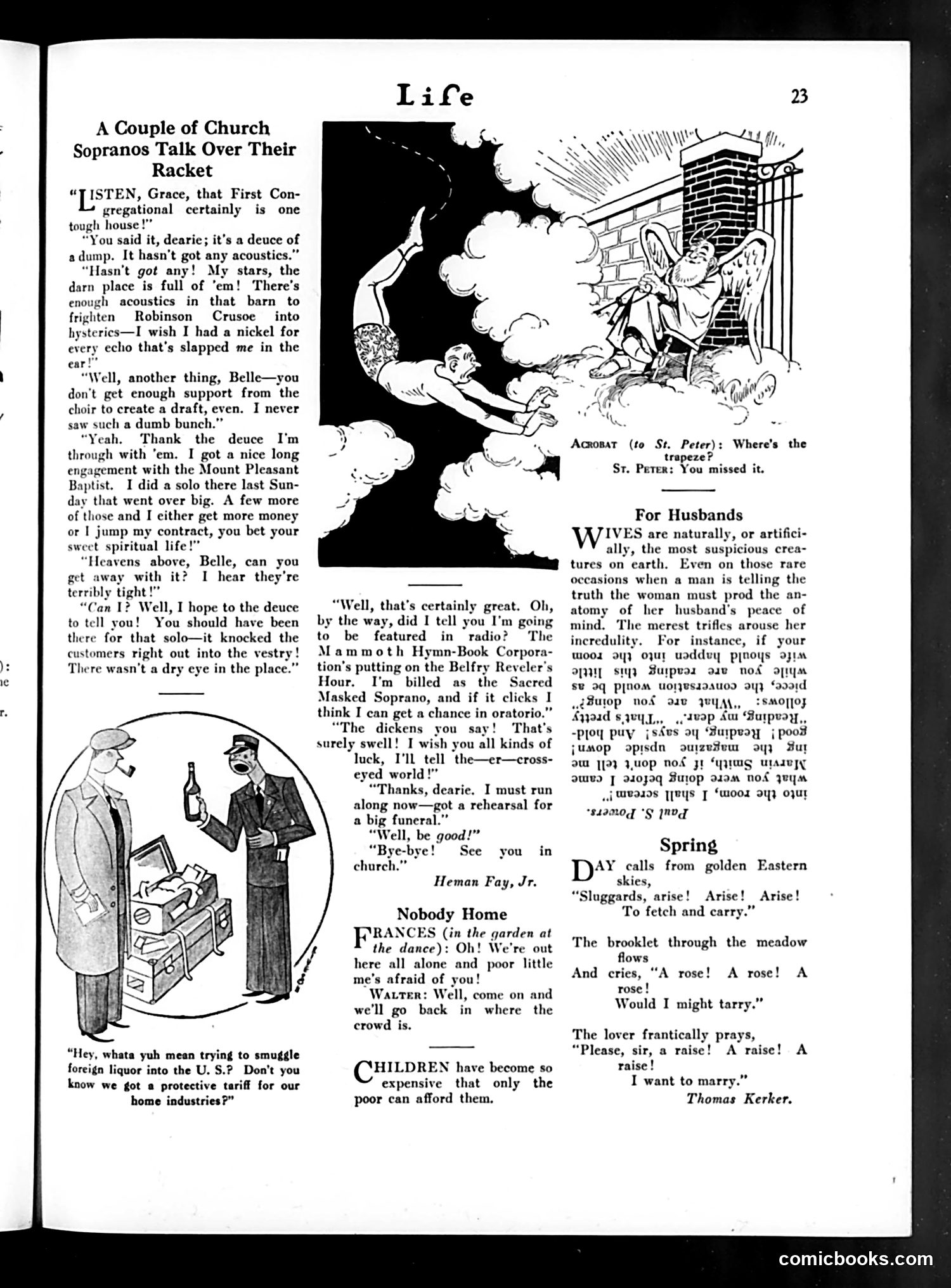
This page contains three distinct satirical pieces mocking early 20th-century American society: **"Church Sopranos Talk Over Their Racket"**: Two female church singers discuss their profession cynically, treating sacred music as a commercial enterprise. They complain about acoustics, demand better pay, and brag about their radio deals and "Sacred Masked Soprano" billing. The satire targets both the commercialization of religion and women's calculated approach to their careers. **"Nobody Home"**: A brief joke about a woman feigning vulnerability to a waiter, then requesting he take her back to the crowd—mocking courtship rituals and female coquettishness. **Bottom cartoons and text**: Include prohibition-era smuggling humor, commentary on expensive children, and a "For Husbands" section sarcastically advising men that wives are inherently suspicious. The final poems mock romantic sentimentality and financial desperation in courtship. Overall, the page satirizes commercialism, hypocrisy in religious institutions, gender relations, and social pretense in the Jazz Age.
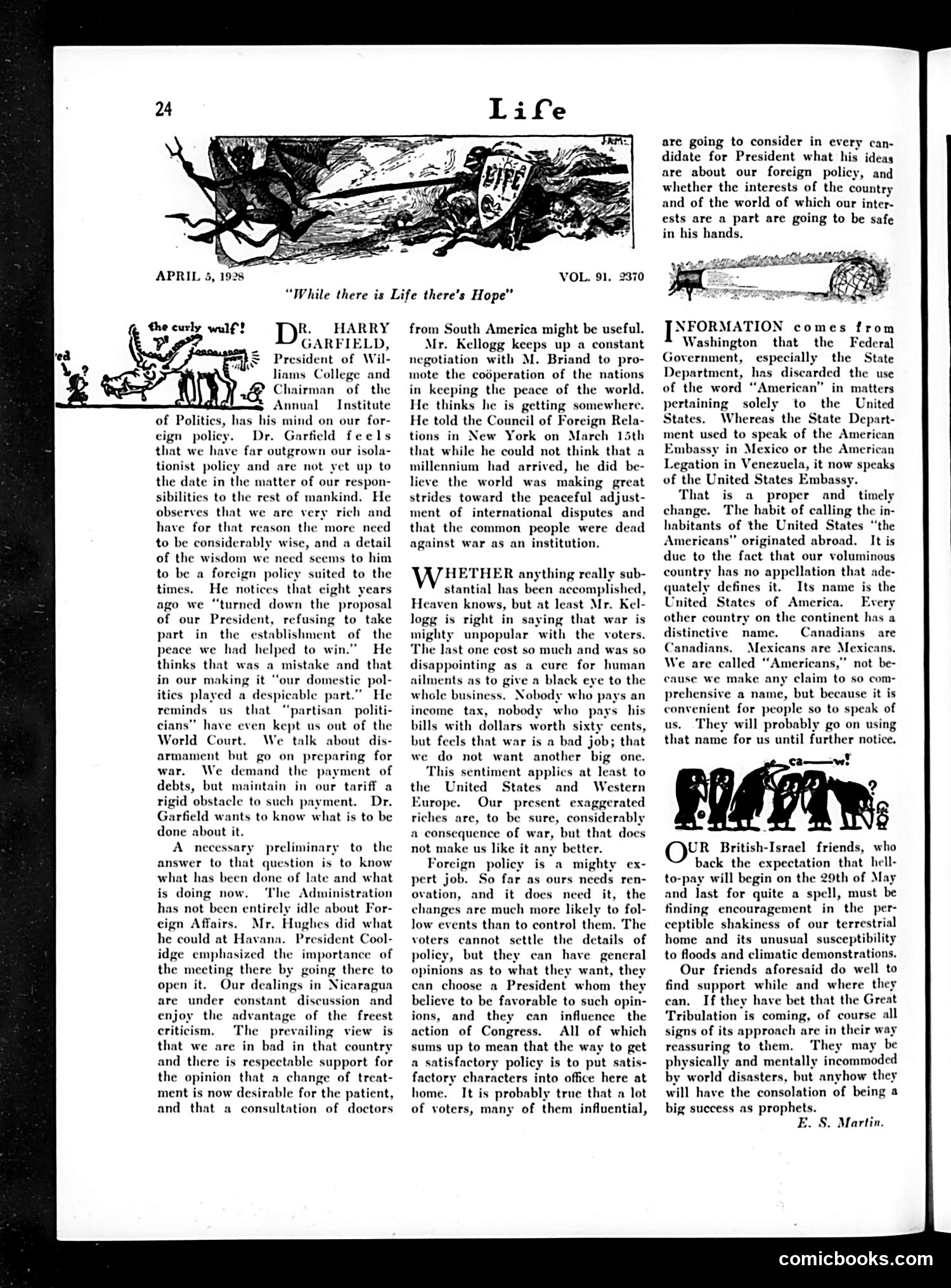
This page discusses America's foreign policy stance under President Coolidge's administration. The main cartoon (top left) appears to depict a skeletal or death-like figure labeled "DIFF" emerging from turbulent waters—likely representing the dangers or conflicts inherent in international disputes. The text critiques Dr. Harry Garfield (Williams College president) and others arguing the U.S. must abandon isolationism and take greater responsibility globally, given American wealth. However, the author notes contradictions: America demands debt repayment while maintaining protectionist tariffs; it discusses disarmament while preparing for war; it stayed out of the League of Nations after helping win WWI. The piece argues that foreign policy is too complex for voters to control directly, but they can influence it by electing favorable presidents and Congress members. Secretary of State Kellogg's peace negotiations with France receive cautious support—voters clearly oppose war after its massive costs and disappointing results. The "British-Israel friends" reference concerns a contemporary religious/political movement predicting future events.
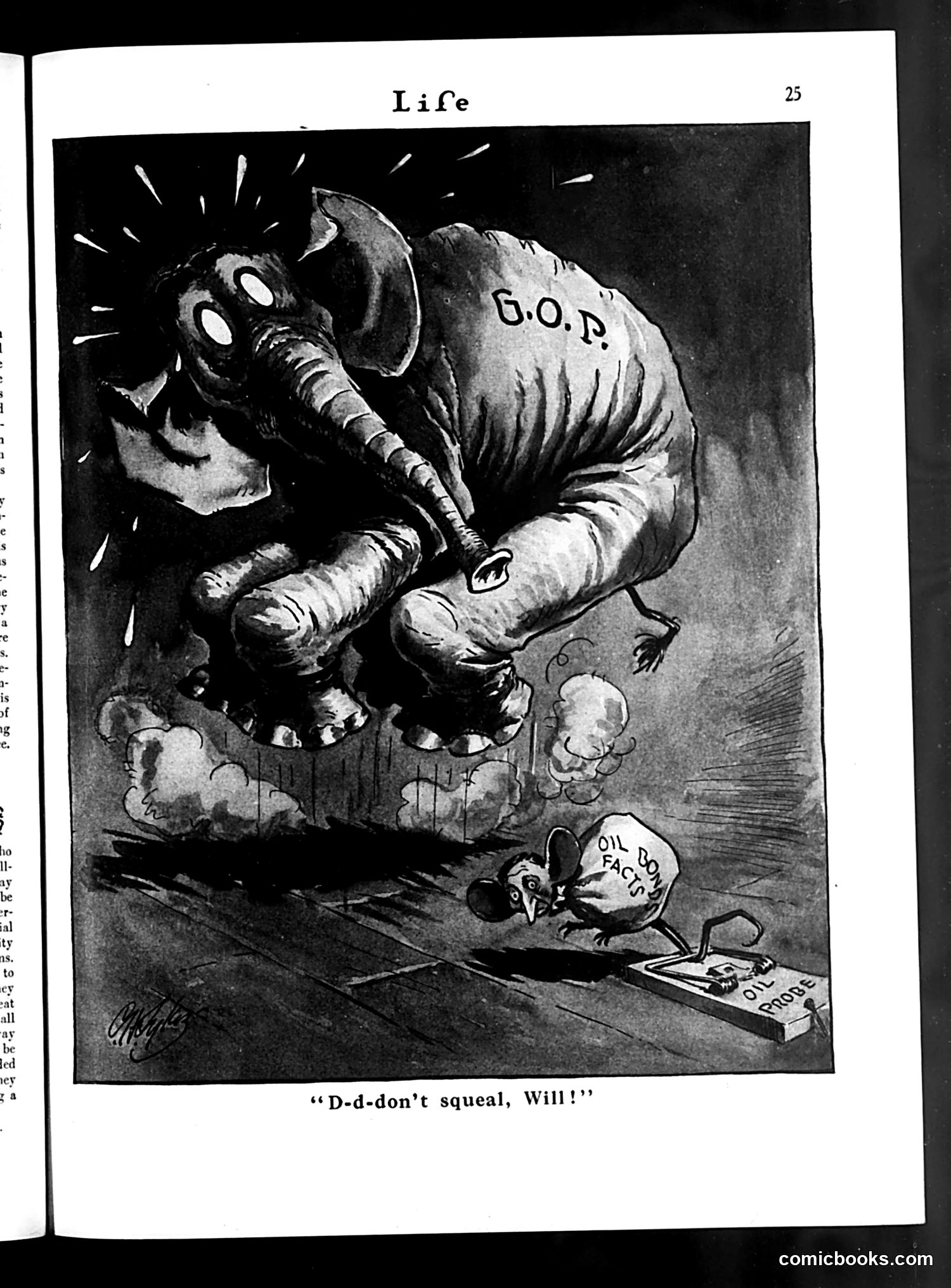
This is a satirical cartoon from *Life* magazine featuring an elephant labeled "G.O.P." (Republican Party) threatening a smaller figure labeled "Will" who holds papers marked "OIL BOND FACTS" and "OIL PROBE." The cartoon depicts the GOP attempting to intimidate someone named Will (likely Will Hays, a prominent political figure of the early 20th century) into silence regarding oil scandal facts and investigations. The elephant's aggressive posture and the speech bubble "D-d-don't squeal, Will!" suggest the GOP is pressuring him not to reveal damaging information. This likely references the Teapot Dome scandal or similar oil-related political corruption of the 1920s era, where the Republican establishment allegedly suppressed investigations into illegal dealings.
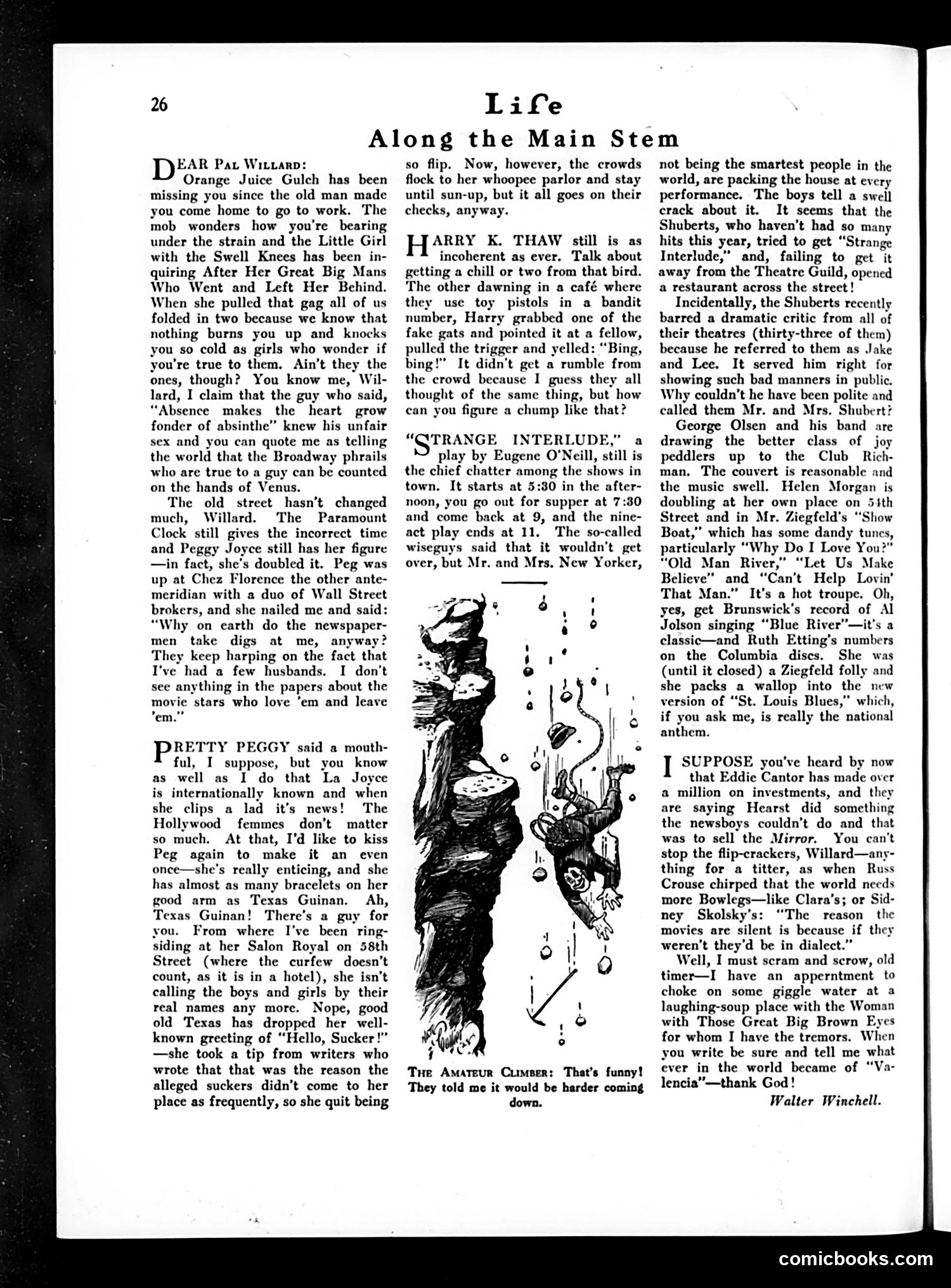
This satirical column gossips about Broadway and Manhattan nightlife figures: **Peggy Joyce**: A society woman notorious for multiple marriages, defending herself against press criticism while the columnist notes her extravagant jewelry and frequent nightclub appearances. **Texas Guinan**: A famous speakeasy hostess ("Salon Royal" on 58th Street) known for greeting customers with "Hello, Sucker!" The columnist reports she's dropped this catchphrase, possibly to attract more customers. **Harry K. Thaw**: An erratic wealthy man who recklessly brandished a fake gun at a café, apparently referring to his history of unstable behavior. **Eugene O'Neill's "Strange Interlude"**: The nine-act play is packing theaters despite critics' doubts. A joke suggests the Shubert theatre owners opened a competing restaurant across the street after failing to acquire the hit. The cartoon shows an amateur climber descending a treacherous cliff—likely illustrating the play's difficulty or length.
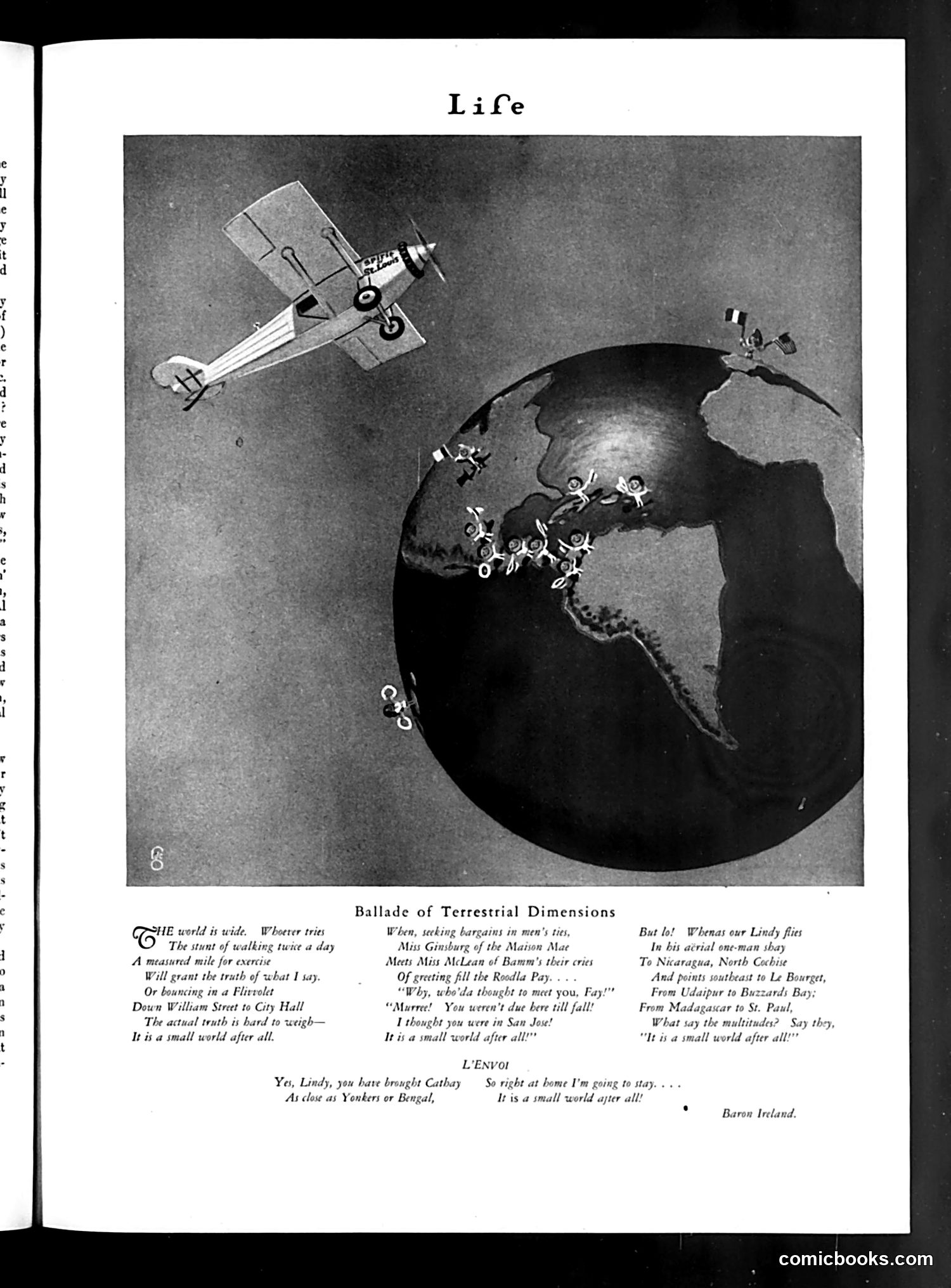
This is a humorous poem by Baron Ireland celebrating Charles Lindbergh's 1927 transatlantic flight. The cartoon illustrates how aviation has shrunk the world—Lindbergh's solo flight to Paris made distant places suddenly feel accessible. The poem uses the "small world" refrain ironically across three scenarios: ordinary pedestrians exercising in New York City, two women unexpectedly meeting while shopping (Miss Ginsburg and Miss McLean), and Lindbergh's remarkable aerial journey spanning Nicaragua, North Carolina, Le Bourget (France), Madagascar, and other far-flung locations. The central image shows a globe with aircraft scattered across continents, emphasizing how technology has collapsed geographical distances. The satire gently mocks how people express amazement at coincidental meetings while taking for granted that one man can now casually fly across oceans. The poem's refrain—"It is a small world after all"—captures the wonder and slight absurdity of this newly shrunken global reality.
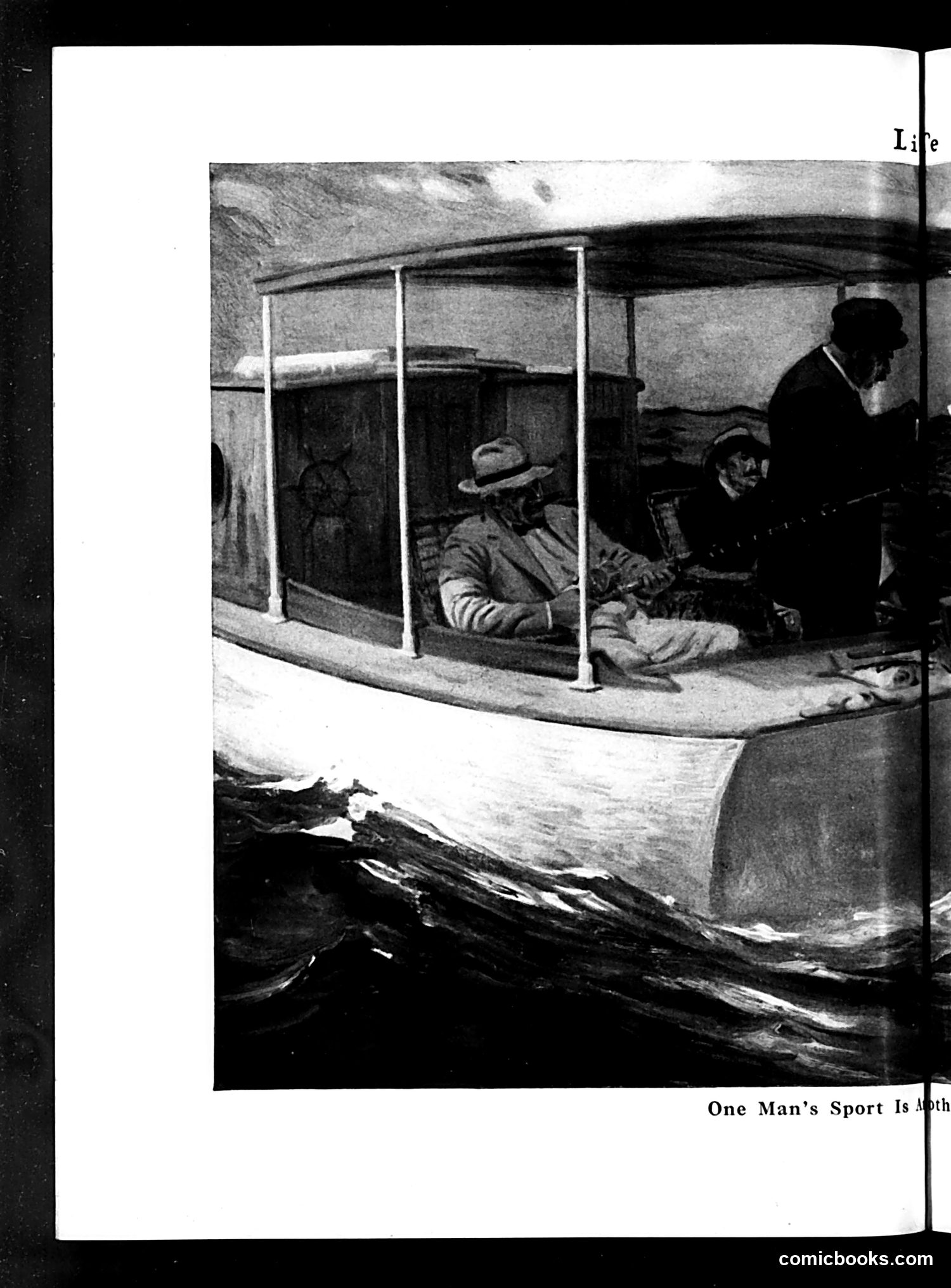
This appears to be a satirical photograph or illustration from *Life* magazine showing people inside what looks like a glass-enclosed viewing booth or shelter. The caption reads "One Man's Sport Is Apth[?]" (the text appears cut off or unclear). The image seems to satirize contrasting leisure activities or attitudes—possibly depicting wealthy spectators in a protected enclosure while others are outside or differently positioned. The composition suggests commentary on class differences or the gap between comfortable observation and direct participation in an activity. However, without the complete caption text or additional context, the specific target of the satire remains unclear. The cut-off caption text prevents definitive interpretation of what "sport" is being mocked or what social commentary is intended.
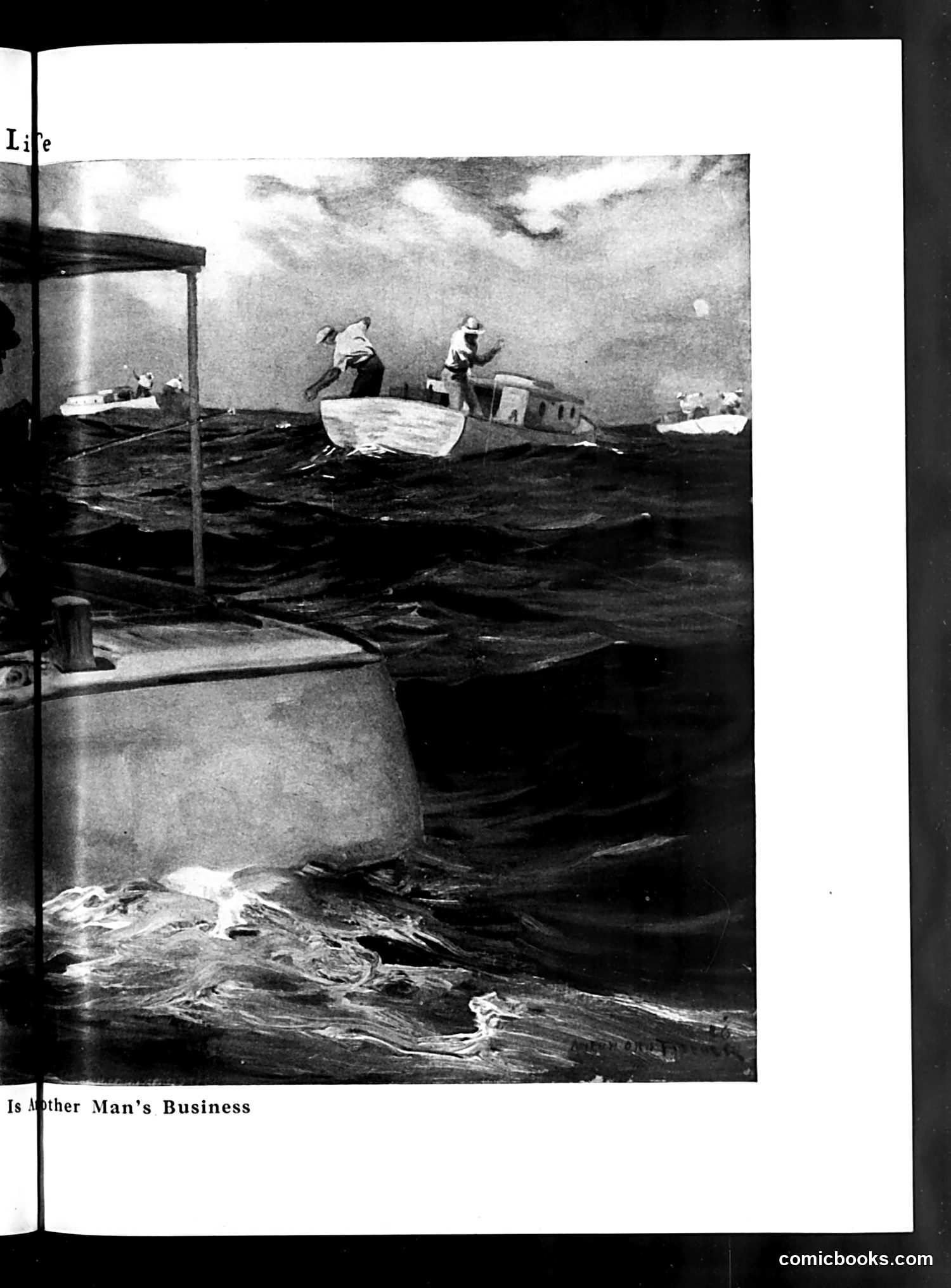
This page shows a black-and-white photograph of fishermen in boats on rough water, viewed from a dock or pier. The caption "Life Is Another Man's Business" appears to be a satirical commentary on indifference or detachment from others' struggles. The image depicts working-class fishermen engaged in manual labor on dangerous seas, while the viewer remains safely ashore. The phrase suggests that people often regard others' hardships or livelihoods as disconnected from their own concerns—literally "another man's business." Without additional context, the specific historical moment or event being referenced remains unclear, but the satire appears to critique social apathy toward working people's dangerous conditions or economic struggles. The photograph emphasizes the contrast between observer and laborer.
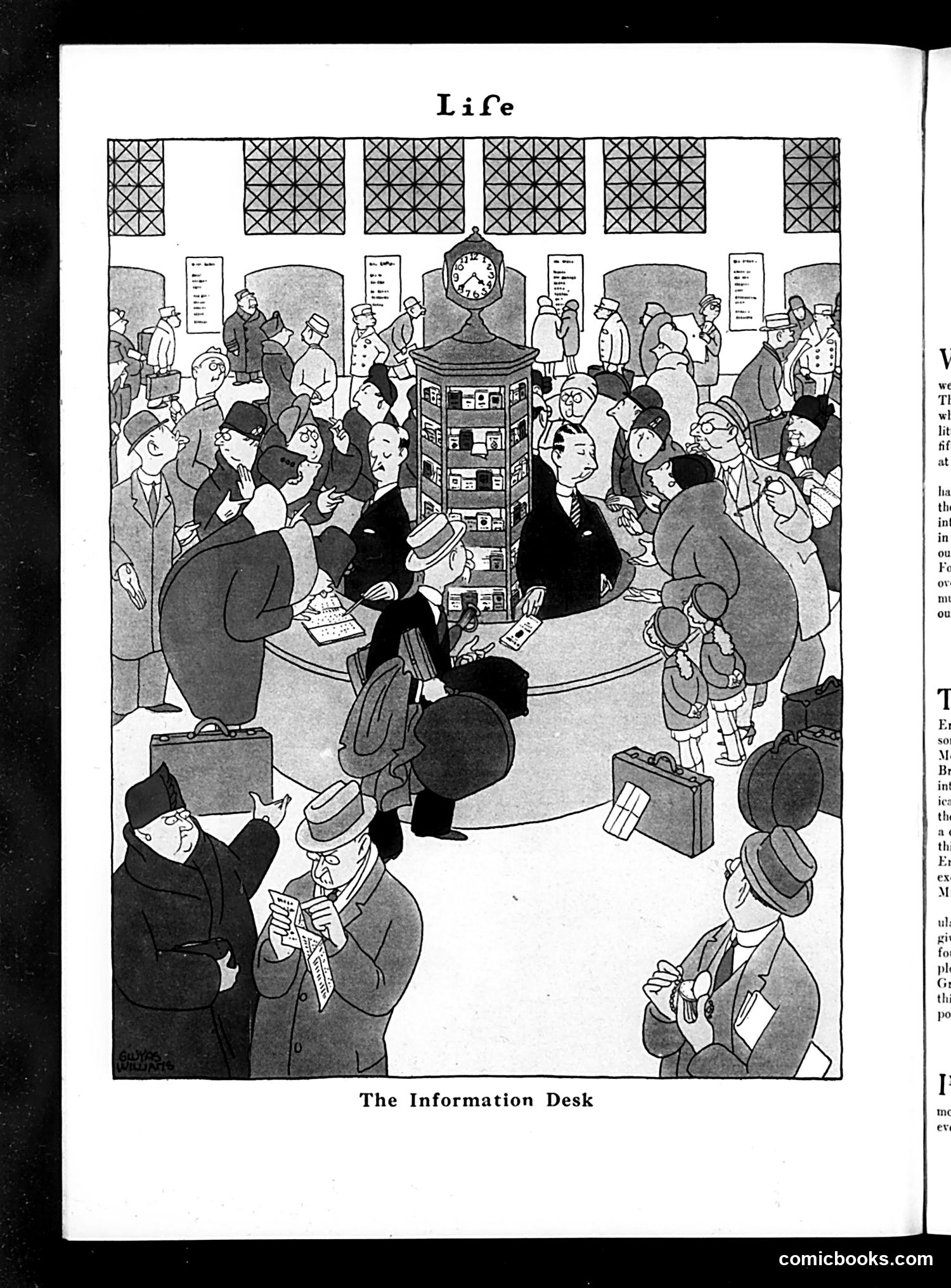
This cartoon satirizes the overwhelming flood of information and inquiries in modern urban life. A central kiosk serves as an "Information Desk" surrounded by a chaotic crowd of men in business attire and formal dress, all clutching papers, suitcases, and documents. The figures appear desperate and confused, gesturing toward the booth seeking answers. The satire targets information overload—a concern in early-to-mid 20th century America as bureaucracy, media, and public institutions expanded. The sardonic title suggests that even designated information centers cannot adequately manage society's growing complexity and citizens' need for guidance. The cartoon critiques how modern life generates more questions than answers, leaving people perpetually seeking clarification in an increasingly bewildering world.
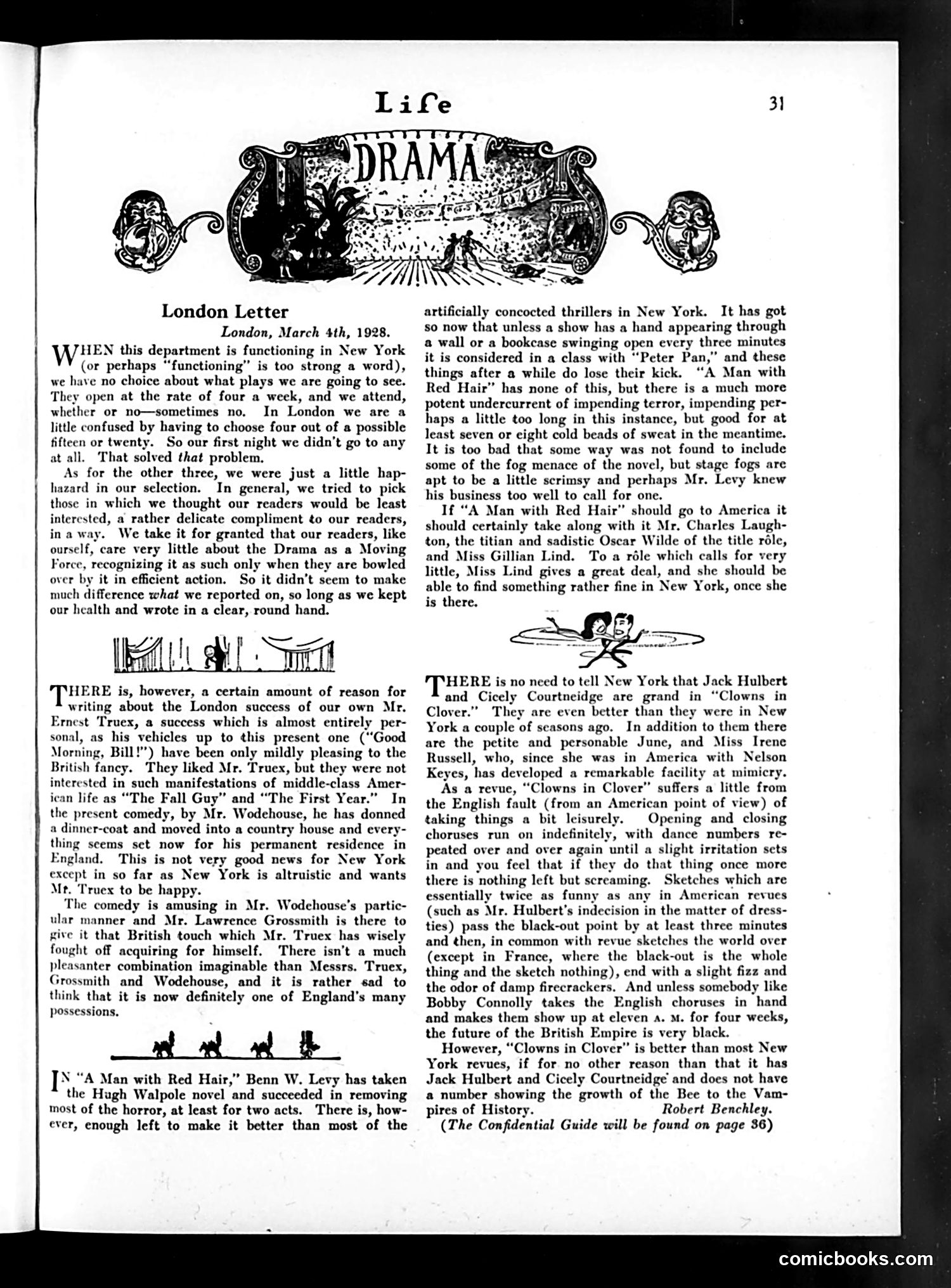
This London theater column compares British and American dramatic offerings. The author reviews three plays: **"Good Morning, Bill"** features American actor Ernest Truex, whose success in London surprises critics—his earlier American comedies ("The Fall Guy," "The First Year") depicting middle-class American life had failed to interest British audiences, but this P.G. Wodehouse play, with British actor Lawrence Grossmith, succeeds. The writer humorously laments this as a loss for New York. **"A Man with Red Hair"** (adapted from Hugh Walpole's novel) features Charles Laughton in a psychological thriller. Unlike artificially contrived American thrills requiring gimmicks like "a hand appearing through a wall," this play sustains genuine tension, though perhaps too prolonged. **"Clowns in Clover"** stars Jack Hulbert and Cicely Courtneidge (the text cuts off mid-sentence). The satirical point: American theater relies on cheap tricks while British drama achieves sophistication through acting talent and literary adaptation.
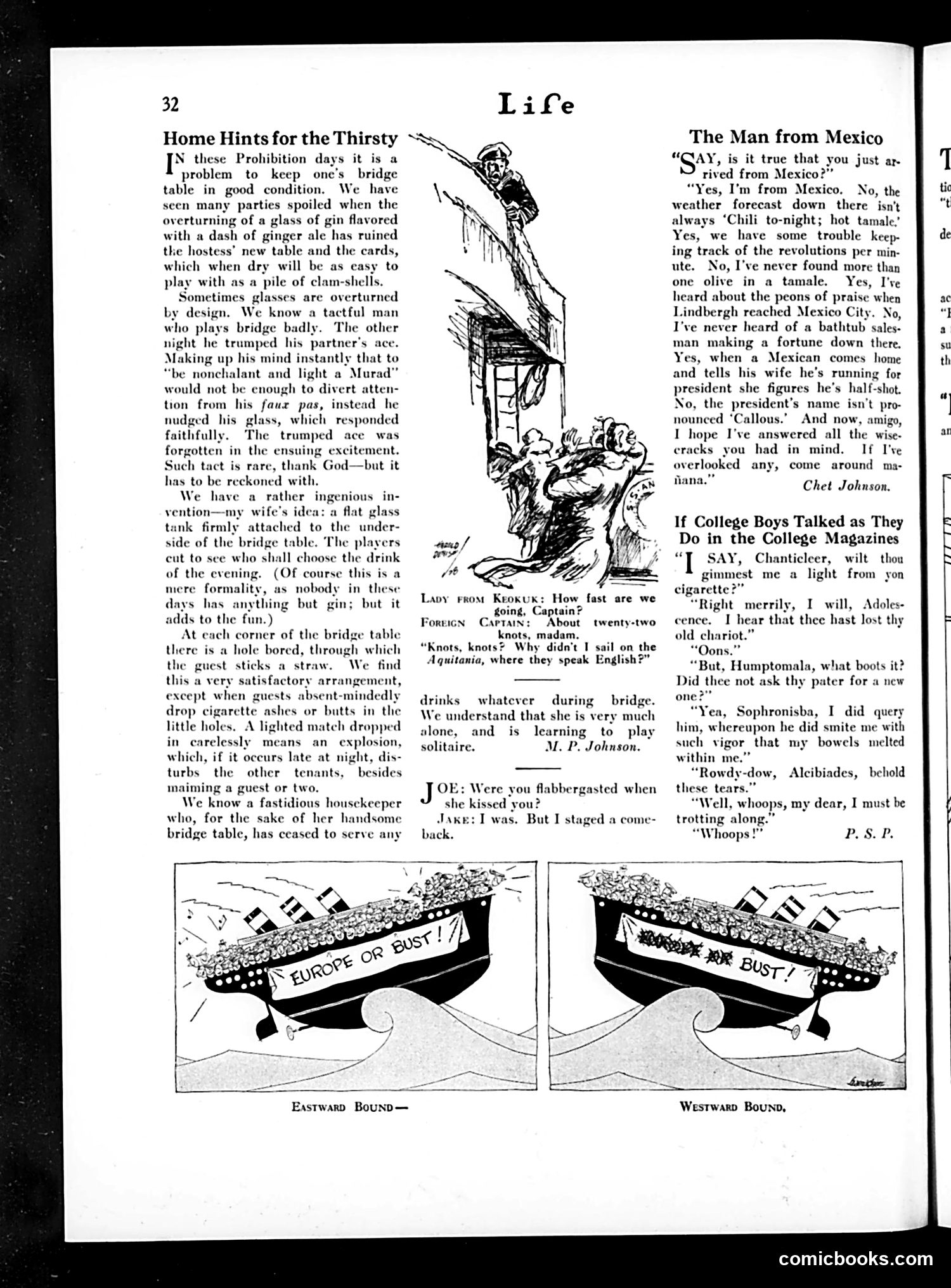
This page contains three satirical pieces typical of 1920s American humor: **"Home Hints for the Thirsty"** mocks Prohibition-era bridge parties. During alcohol's legal ban, hosts faced the problem of serving gin while maintaining decorum. The satire describes absurd solutions—a hidden glass tank under the bridge table with straws in corner holes—highlighting the awkward lengths people went to circumvent Prohibition laws. **"The Man from Mexico"** features stereotypical Mexican jokes: revolutionaries, peons, tamales, and low-quality bathtubs. It satirizes both tourist ignorance about Mexico and American condescension toward the country. **"If College Boys Talked as They Do in the College Magazines"** parodies affected pseudo-Shakespearean slang college magazines used—calling cars "chariots," using archaic pronouns ("thee/thou"), and dramatic exclamations ("Oons"). It mocks young writers' pretentious literary affectations. The two ship cartoons labeled "Eastward Bound" and "Westward Bound" appear to satirize transatlantic travel, showing the same vessel in opposite directions with the phrase "Europe or Bust."
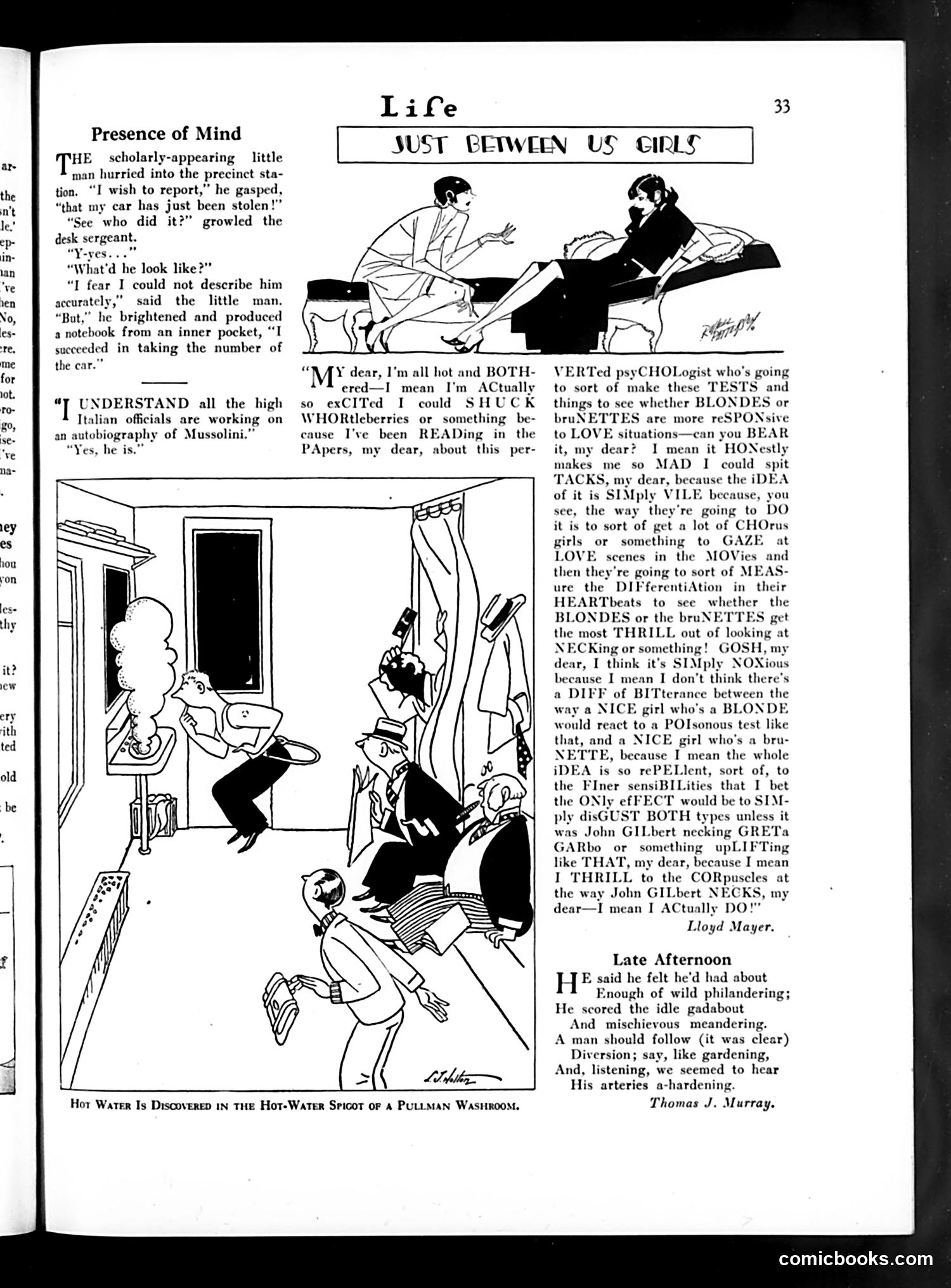
This page contains three separate humorous pieces typical of 1920s-30s Life magazine: 1. **"Presence of Mind"**: A joke about an absent-minded man reporting his stolen car to police. The punchline: he can't describe the thief but helpfully provides the car's license plate number—useless without identifying the car itself. 2. **"Just Between Us Girls"**: A woman's breathless monologue (with emphatic capitalization throughout) about a psychology experiment testing whether blondes or brunettes respond more emotionally to romantic movie scenes. She's scandalized by the idea, though she admits she herself thrills at watching actor John Gilbert kiss actress Greta Garbo—thus undermining her moral objection. 3. **"Late Afternoon"**: A poem about a man rejecting wild living for respectable pursuits like gardening, with the dark joke that even wholesome activities won't prevent aging ("arteries a-hardening"). The page satirizes contemporary concerns: absent-mindedness, evolving attitudes toward sexuality and psychology, and mortality.
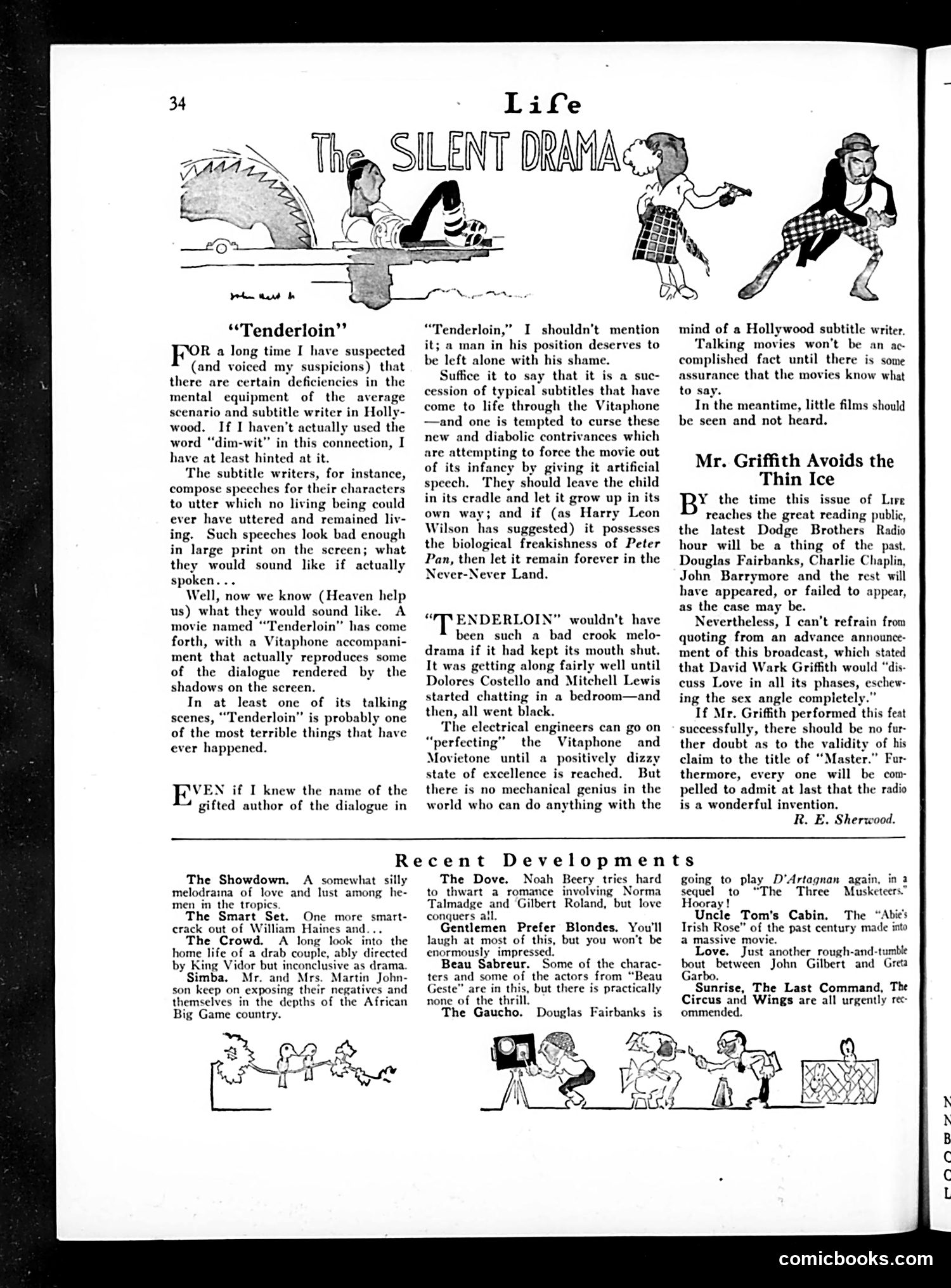
This page critiques early "talking pictures" (sound films), specifically the movie "Tenderloin," which used Vitaphone technology to add synchronized dialogue. The author argues that subtitle writers in Hollywood lack talent, and that adding actual spoken dialogue has exposed their incompetence catastrophically. The piece contends that silent films should remain silent—that artificial speech is ruining cinema's natural evolution. When actors like Dolores Costello and Mitchell Lewis actually speak in "Tenderloin," the results are so terrible that "all went black" (the film apparently malfunctioned or had to stop). The satire targets not specific political figures but rather Hollywood's creative mediocrity and the film industry's premature adoption of sound technology. The author fears talking pictures will destroy cinema's artistic potential before the medium matures.
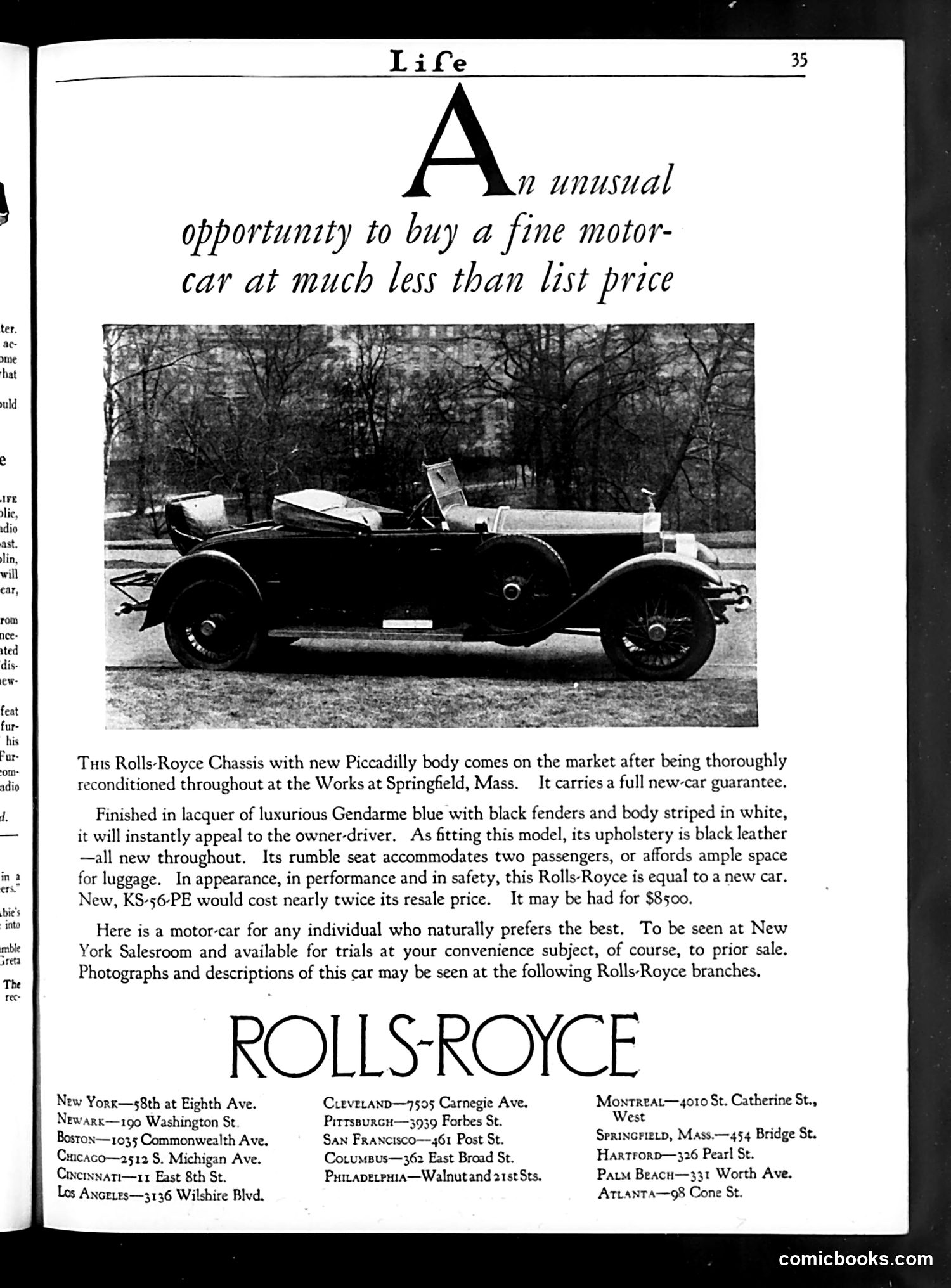
This page is primarily a **luxury automobile advertisement**, not political satire. It promotes a reconditioned Rolls-Royce chassis with a Piccadilly body, priced at $8,500—presented as a bargain since a new equivalent would cost nearly double. The pitch targets wealthy buyers seeking prestige: the car is finished in "luxurious Gendarme blue," features black leather upholstery, and comes with a full guarantee despite being used. The advertisement emphasizes that despite being reconditioned, it equals "a new car" in appearance, performance, and safety. The satirical *implication*—common in Life magazine's advertising parody—is subtle: the ad's breathless language about a "bargain" luxury car appeals to the nouveau riche or financially cautious wealthy, mocking the pretense of getting a deal on ultra-premium goods. However, this is straightforward advertising copy rather than explicit cartoon satire. The humor lies in the aspirational tone rather than in identifiable caricatures or political commentary.
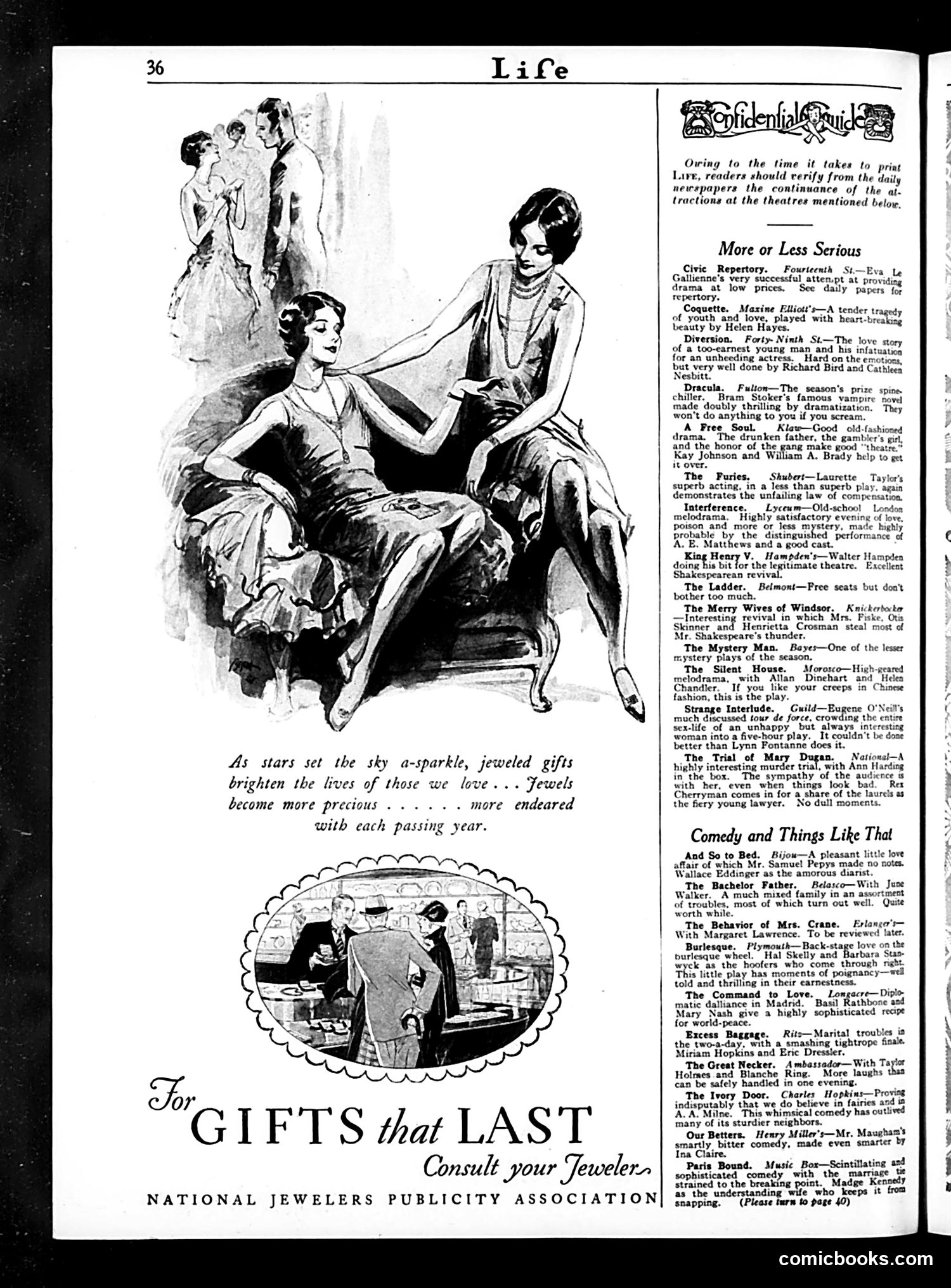
This page combines theater reviews with a jewelry advertisement. The top illustration depicts three fashionably dressed women in 1920s style, examining or discussing jewelry—likely representing the social scene where such gifts matter. The caption emphasizes jewelry's enduring value as gifts. The right column lists brief reviews of current Broadway productions, ranging from serious drama ("Dracula," "Henry V") to comedies ("And So to Bed"). These reviews note the plays' plots and lead actors, helping readers decide what to see. The bottom features a National Jewelers Publicity Association advertisement using the tagline "For GIFTS that LAST," positioning jewelry as superior to ephemeral entertainments—though the very page structure ironically surrounds this ad with descriptions of fleeting theatrical experiences. The overall message targets affluent readers who attend theater and give luxury gifts.
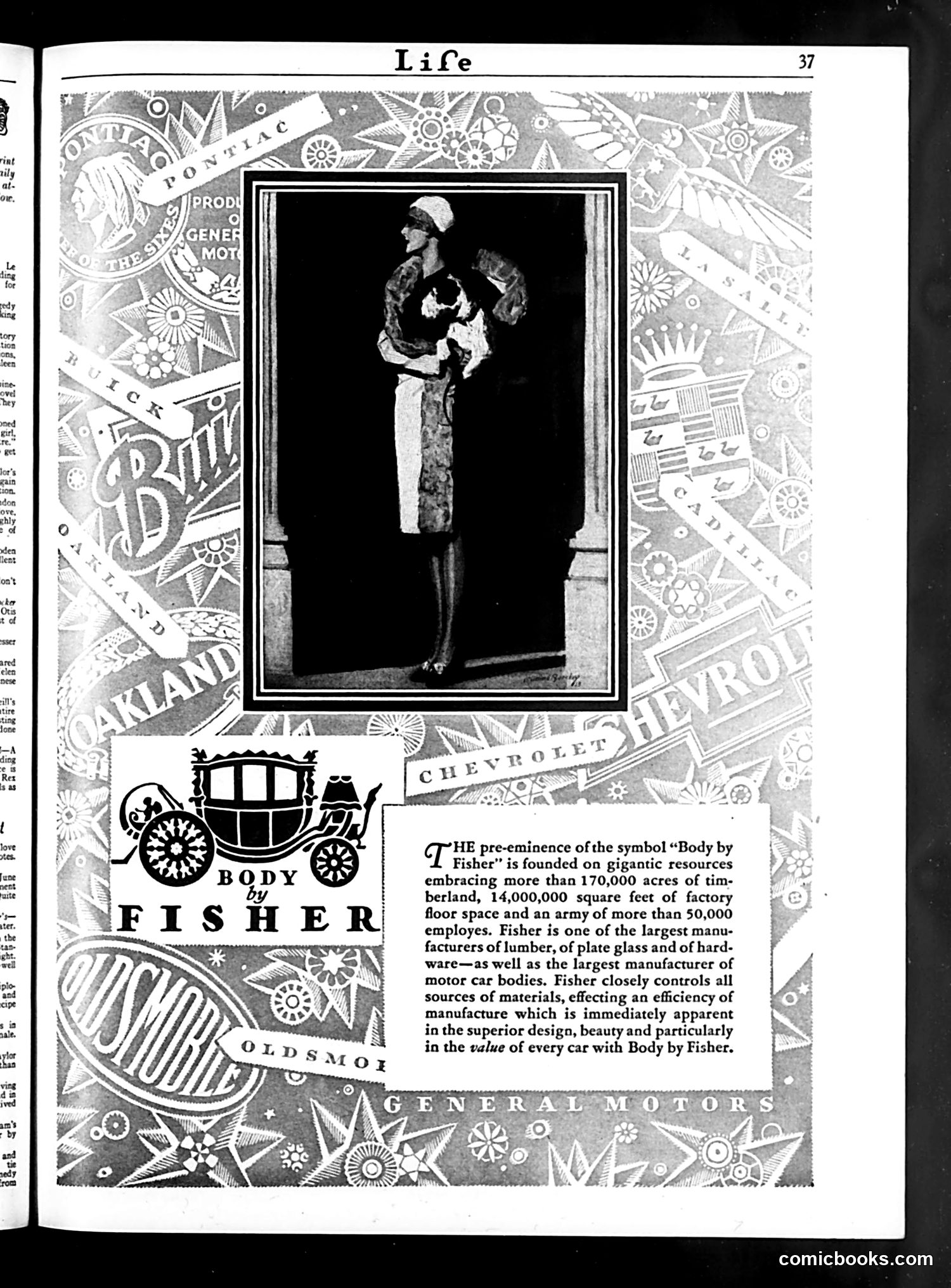
This is primarily a **General Motors advertisement** for "Body by Fisher," not political satire. The image shows a fashionably dressed 1920s woman holding a small dog, modeling the aesthetic appeal associated with Fisher auto bodies. The text emphasizes Fisher's massive industrial vertically-integrated operation—controlling timber, glass, hardware, and factory production to ensure quality automobile bodies. The advertisement argues that Fisher's size and resource control translate directly into superior "design, beauty and particularly in the value" of cars bearing the Fisher brand. This reflects 1920s consumer marketing strategy: associating a car component manufacturer with luxury, elegance (via the stylish woman), and industrial dominance as proof of quality. No political commentary appears present.
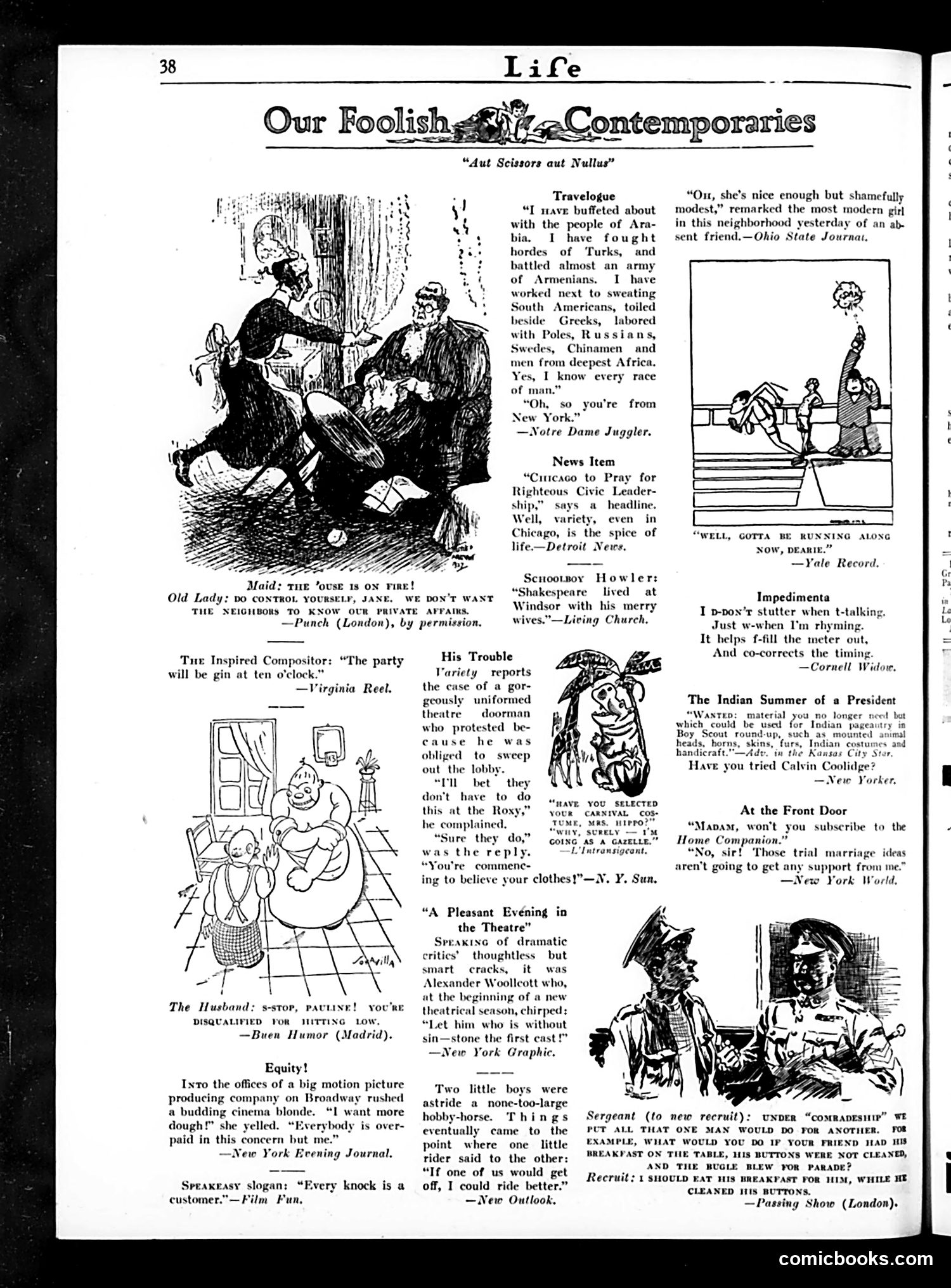
This page collects brief satirical jokes and cartoons from various publications, mocking contemporary absurdities. **Key items:** - **"Old Lady"**: A domestic comedy about controlling a neighbor's daughter - **"Equity!"**: Mocks a Hollywood actress demanding higher pay while claiming she's underpaid—the joke being studios routinely overpay performers - **"Travelogue"**: A traveler brags about experiencing every race globally, then reveals he's simply from New York—satirizing cosmopolitan pretension - **"Theatre Doorman"**: A uniformed doorman objects to sweeping, thinking it beneath his status—mocking class consciousness and dignity - **"Modern Girl"**: Critiques a girl for being modest (old-fashioned), reflecting 1920s attitudes toward women's changing social roles - **"Home Companion"**: A man refuses a magazine subscription promoting trial marriage—conservative reaction to progressive ideas The page reflects 1920s anxieties: Hollywood excess, changing gender roles, class pretension, and resistance to modern values. The humor targets both foolish individuals and social hypocrisy.
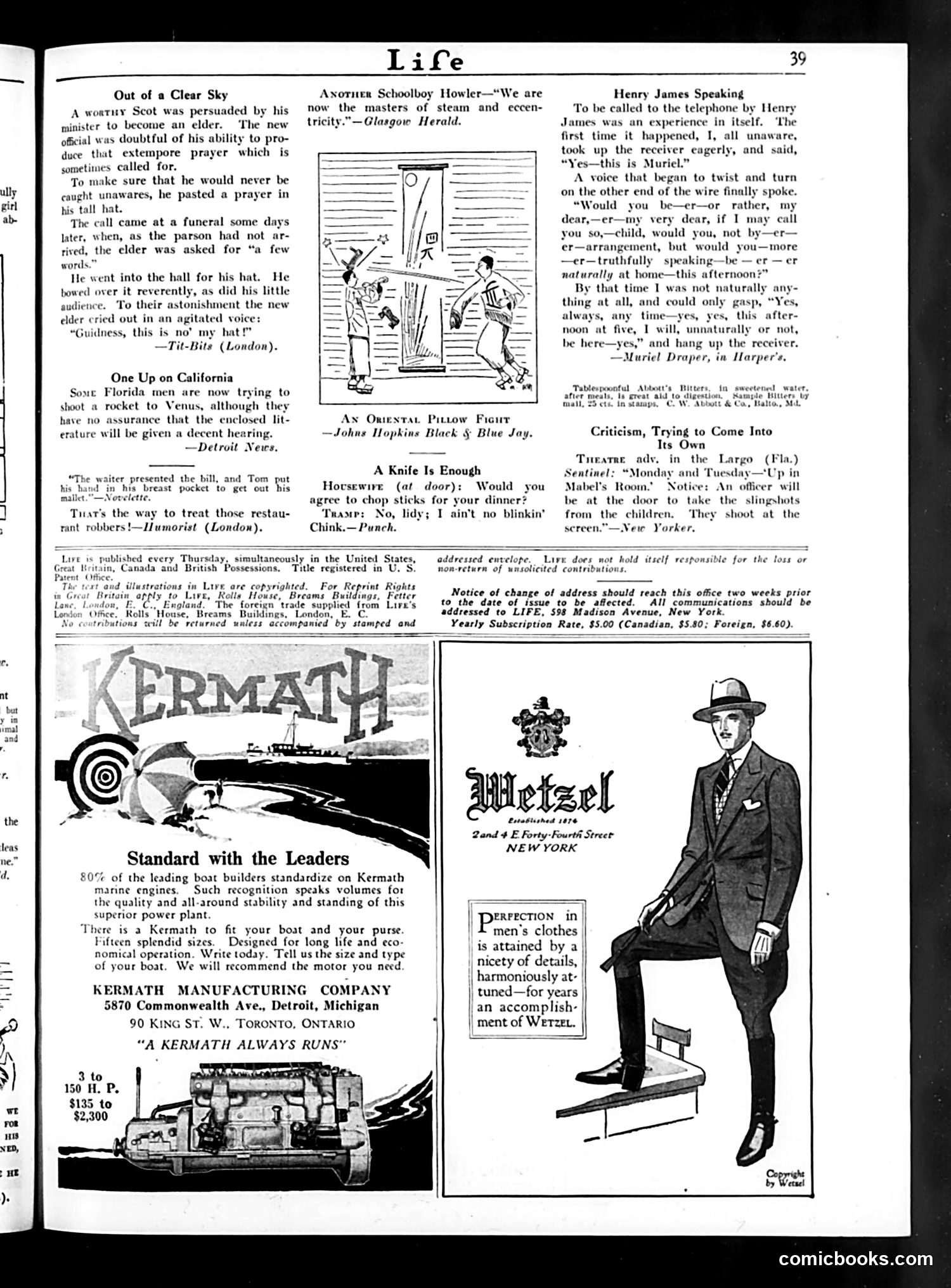
This page contains four humorous anecdotes and advertisements typical of early-to-mid 20th century Life magazine. **The cartoons/jokes:** 1. **"Out of a Clear Sky"** mocks a Scottish elder who secretly pastes a prayer in his hat to avoid embarrassment, then grabs the wrong hat at a funeral—revealing he'd been reciting someone else's prayer. 2. **"One Up on California"** jokes about Florida men launching a rocket to Venus without assurance the planet will provide "decent heating"—satirizing both space ambitions and regional boosterism. 3. **"Henry James Speaking"** parodies the famous novelist's notoriously convoluted speech patterns, depicting a telephone caller reduced to gasping "yes" repeatedly while James delivers an incomprehensibly baroque sentence. 4. **"A Knife Is Enough"** uses ethnic stereotyping (a Chinese laborer) for a pun about refusing to chop sticks for dinner. The page is otherwise filled with period advertisements for Kermath marine engines and Wetzel men's clothing, reflecting the magazine's commercial function.
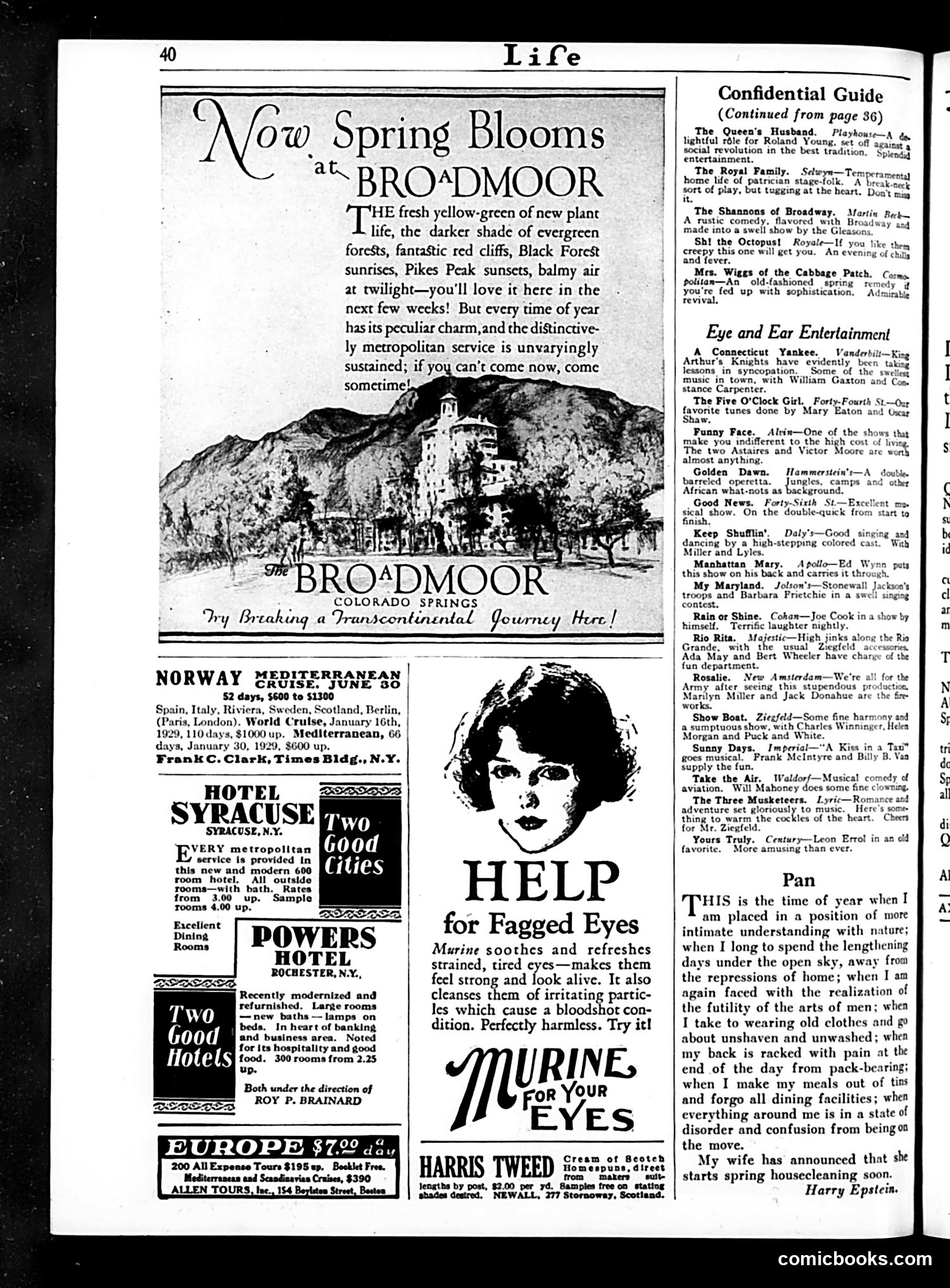
This page is primarily **advertising and entertainment listings**, not political satire or cartooning. The main content includes: 1. **The Broadmoor Resort advertisement** (top): A travel promotion for Colorado Springs' luxury hotel, emphasizing natural beauty and "metropolitan service." This represents 1920s leisure tourism marketing. 2. **"Help for Fagged Eyes"** (center): An advertisement for Murine eye drops, featuring a woman's face. "Fagged" meant tired/exhausted in period slang—this targets office workers and readers experiencing eye strain. 3. **Travel and hotel ads**: Multiple promotions for Mediterranean cruises, various hotels, and European tours—reflecting the prosperous 1920s travel industry. 4. **Entertainment listings** (right column): Reviews of Broadway shows like "The Five O'Clock Girl," "Funny Face," and "Rio Rita," with brief critical commentary. The page reflects 1920s consumer culture and entertainment rather than political messaging.
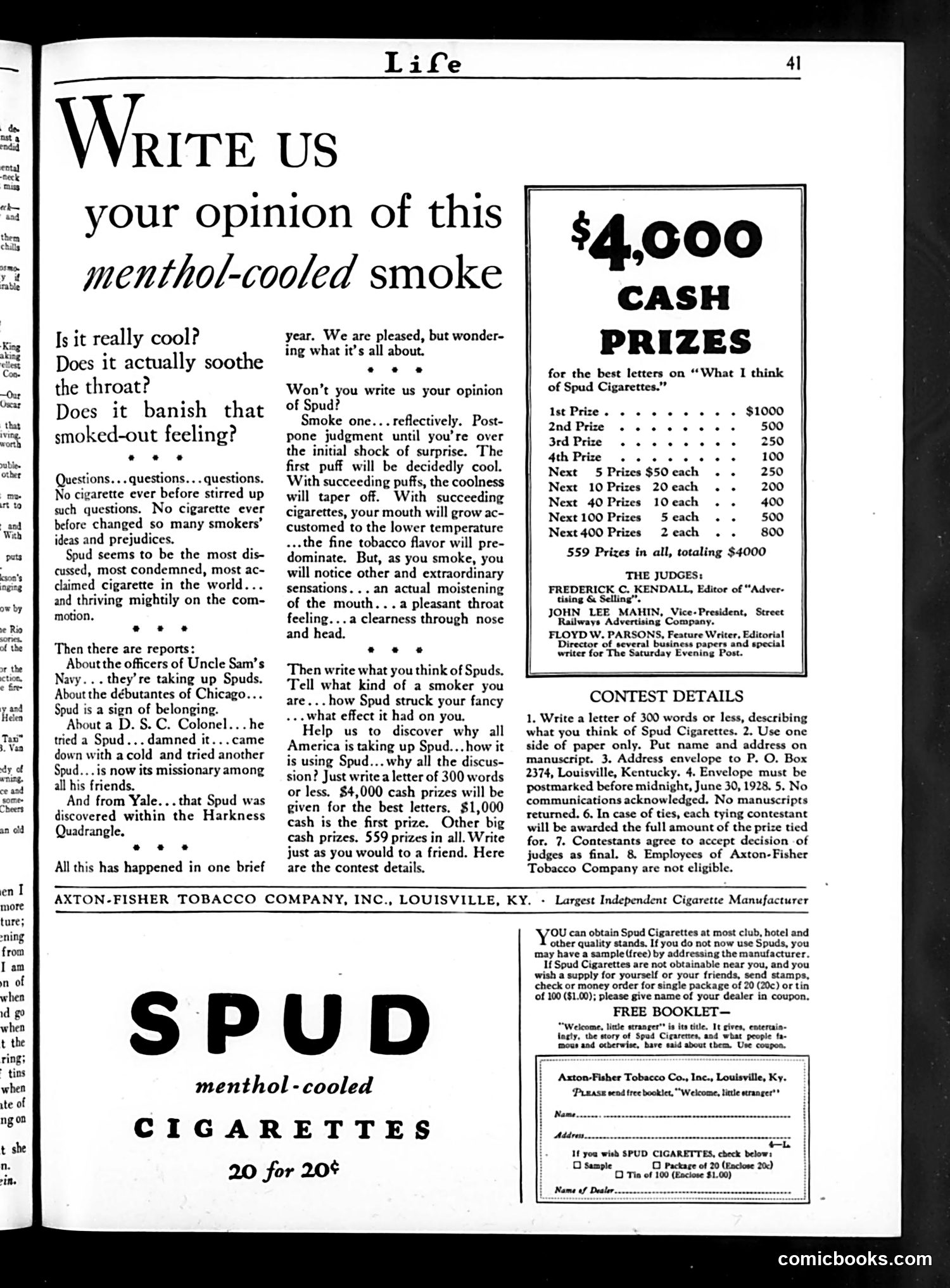
This is primarily a **cigarette advertisement**, not satire or political commentary. Axton-Fisher Tobacco Company promotes their new "Spud" menthol-cooled cigarettes by asking readers to submit opinions about the product in exchange for cash prizes ($4,000 total). The ad employs a pseudo-scientific marketing approach, presenting anecdotal "reports" suggesting Spuds appeal to military officers, debutantes, and Ivy League students—claims designed to position the cigarette as prestigious and exclusive. The menthol "coolness" is emphasized as novel and desirable. The text frames reader responses as helping the company "discover why all America is taking up Spud," using consumer participation as both marketing strategy and data collection. By modern standards, this represents early **mass consumer advertising** before tobacco health warnings and advertising restrictions. The casual mention of nicotine effects and the targeting of social prestige over product substance reveals pre-regulation marketing practices.
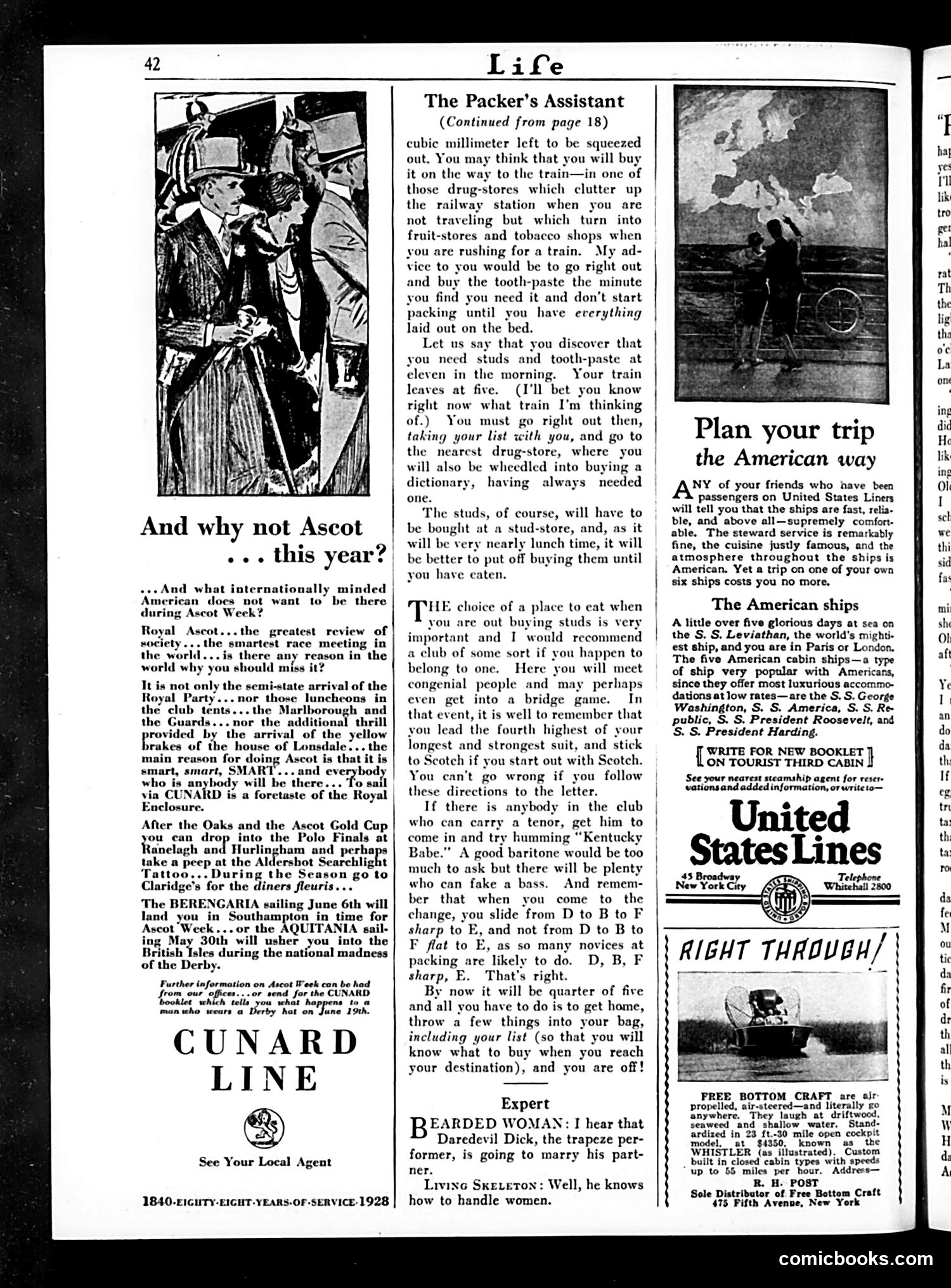
This page contains two distinct elements: **Left side - Cunard Line advertisement:** A glamorous travel ad encouraging wealthy Americans to attend Royal Ascot (England's premier horse-racing and social event) via Cunard ships. It emphasizes the event as the ultimate marker of sophistication and social status ("smart, smart, SMART"). **Center/Right - "The Packer's Assistant" humor column:** Satirical advice on how to pack for travel, mocking the incompetence of travelers who forget essentials and must frantically shop at the last minute. The humor targets the disorganization of the well-to-do—they procrastinate buying tooth-paste and studs, get distracted by lunch clubs and bridge games, and barely make their trains. The column gently satirizes the anxious, chaotic lifestyle of the wealthy leisure class who, despite extensive planning and access to resources, remain flustered and unprepared. It's class-conscious humor aimed at Life's affluent readers.
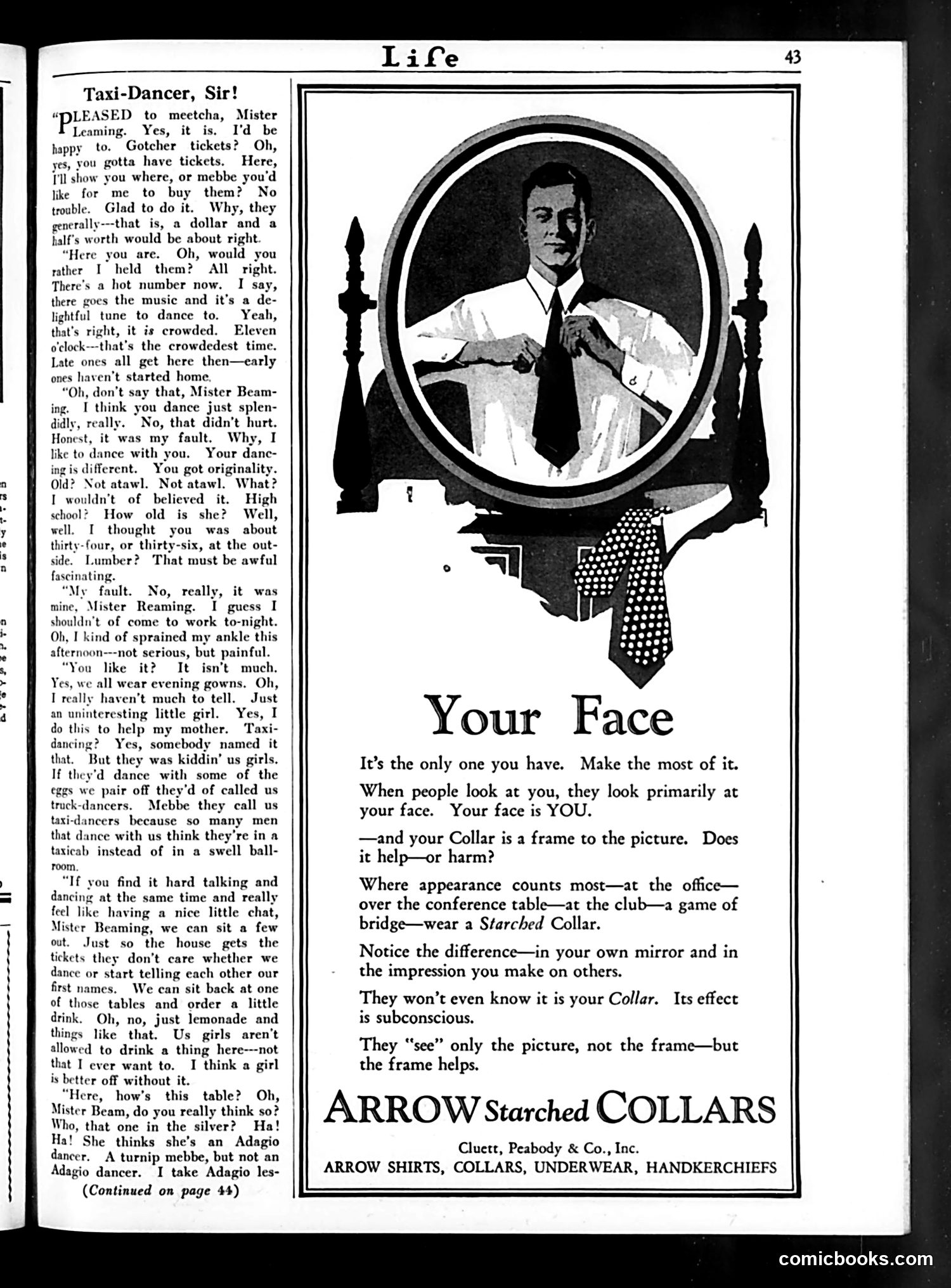
This page contains a satirical dialogue about "taxi-dancing"—a 1920s-era commercial dance hall practice where men paid women (taxi-dancers) per dance. The humor lies in the dancer's practiced flattery and evasions: she compliments her client's dancing while subtly insulting other dancers, claims to do this to help her mother, and deflects personal questions with rehearsed charm. The satire mocks both the transactional nature of the interaction and the taxi-dancer's scripted persona—her constant reassurances, invented compliments, and strategic vagueness about her life. References to "truck-dancers" and the taxicab joke suggest contemporary slang criticism of the profession. The page's second half is a full-page **advertisement** for Arrow Starched Collars, using the portrait framing device to argue that grooming (specifically, a proper collar) frames one's appearance—particularly important "where appearance counts most." There is no political cartoon here; the content is primarily satirical social commentary paired with commercial advertising.
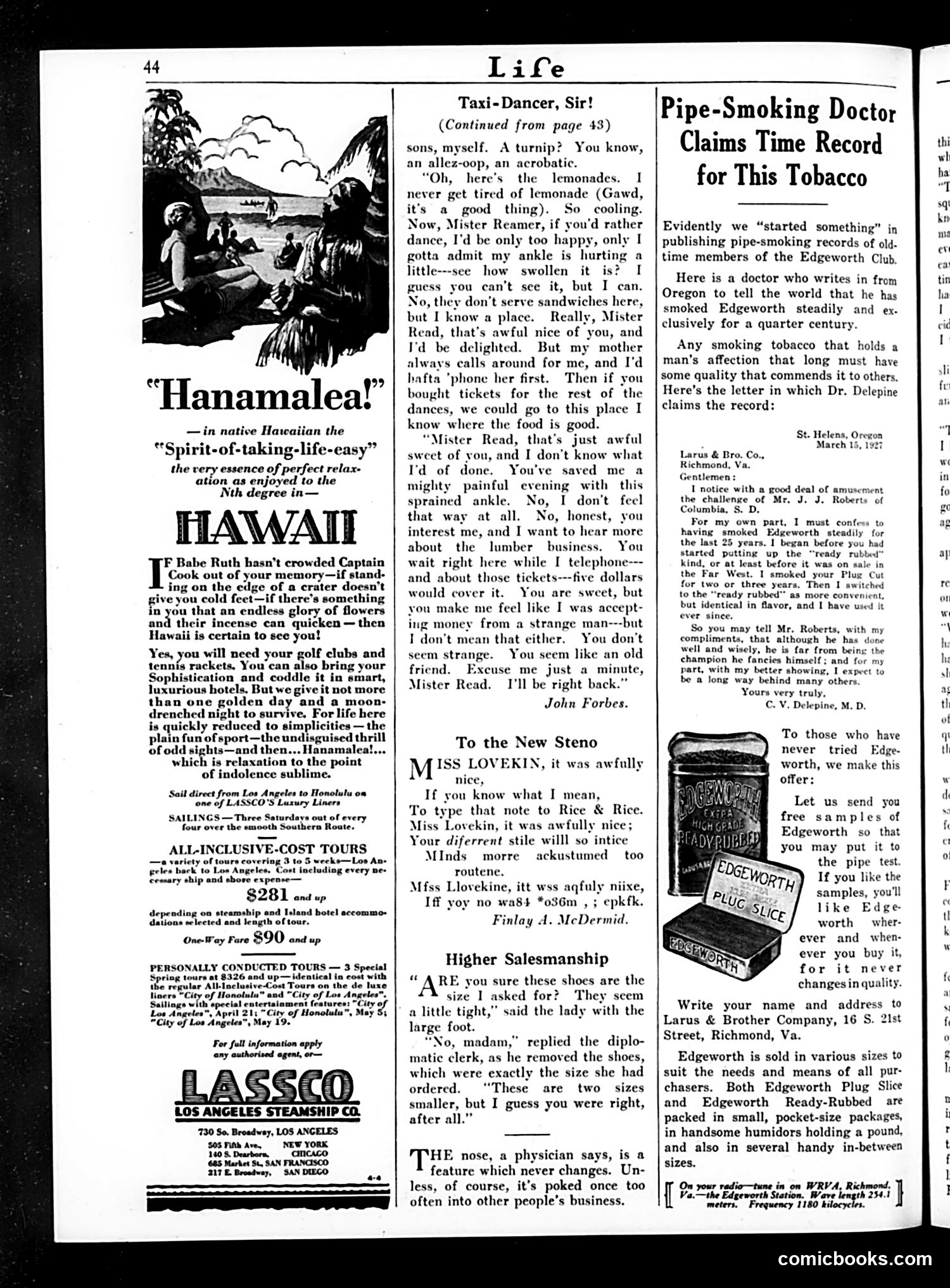
This page contains primarily **advertisements and light humor pieces** rather than political cartoons. The main visual is an **advertisement for Hawaiian tourism** (LASSO steamship line), featuring an illustration of tourists relaxing in Hawaii. The copy emphasizes escape and leisure—the Hawaiian word "Hanamalea" means "spirit of taking life easy." It appeals to affluent Americans seeking exotic relaxation, mentioning Babe Ruth and Captain Cook to establish aspirational glamour. The text pieces are **social humor**: - **"Taxi-Dancer, Sir!"** satirizes a taxi dancer (a woman paid to dance with male customers) who manipulates a client with flattery and emotional appeals while extracting money through various requests. - **"To the New Steno"** humorously depicts intentionally garbled typing, mocking a secretary's work quality. - **"Higher Salesmanship"** jokes about a dishonest shoe clerk who convinces a customer she was wrong about her shoe size. The humor targets **gender dynamics, workplace dishonesty, and consumer gullibility**—themes of 1920s urban life.
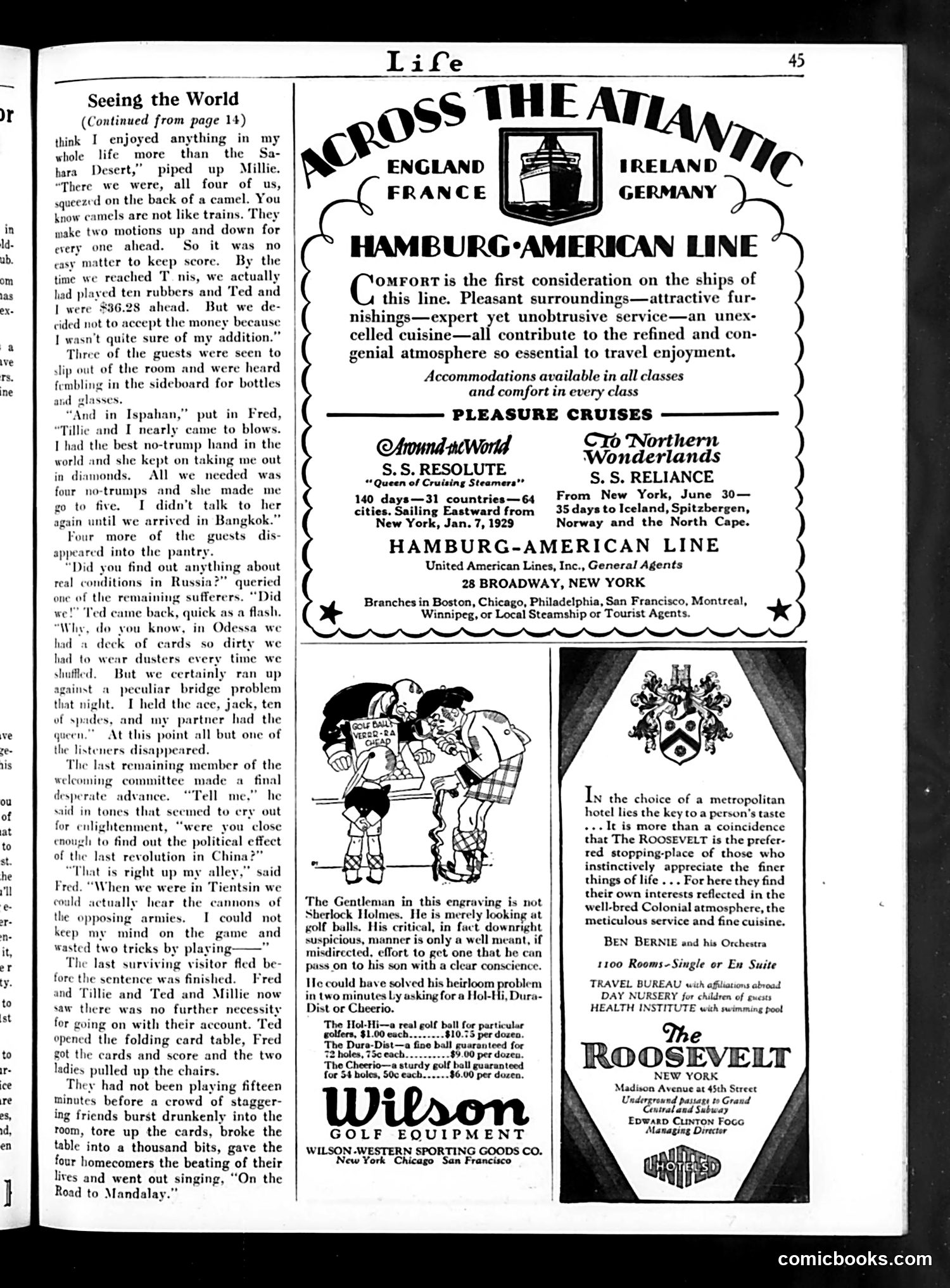
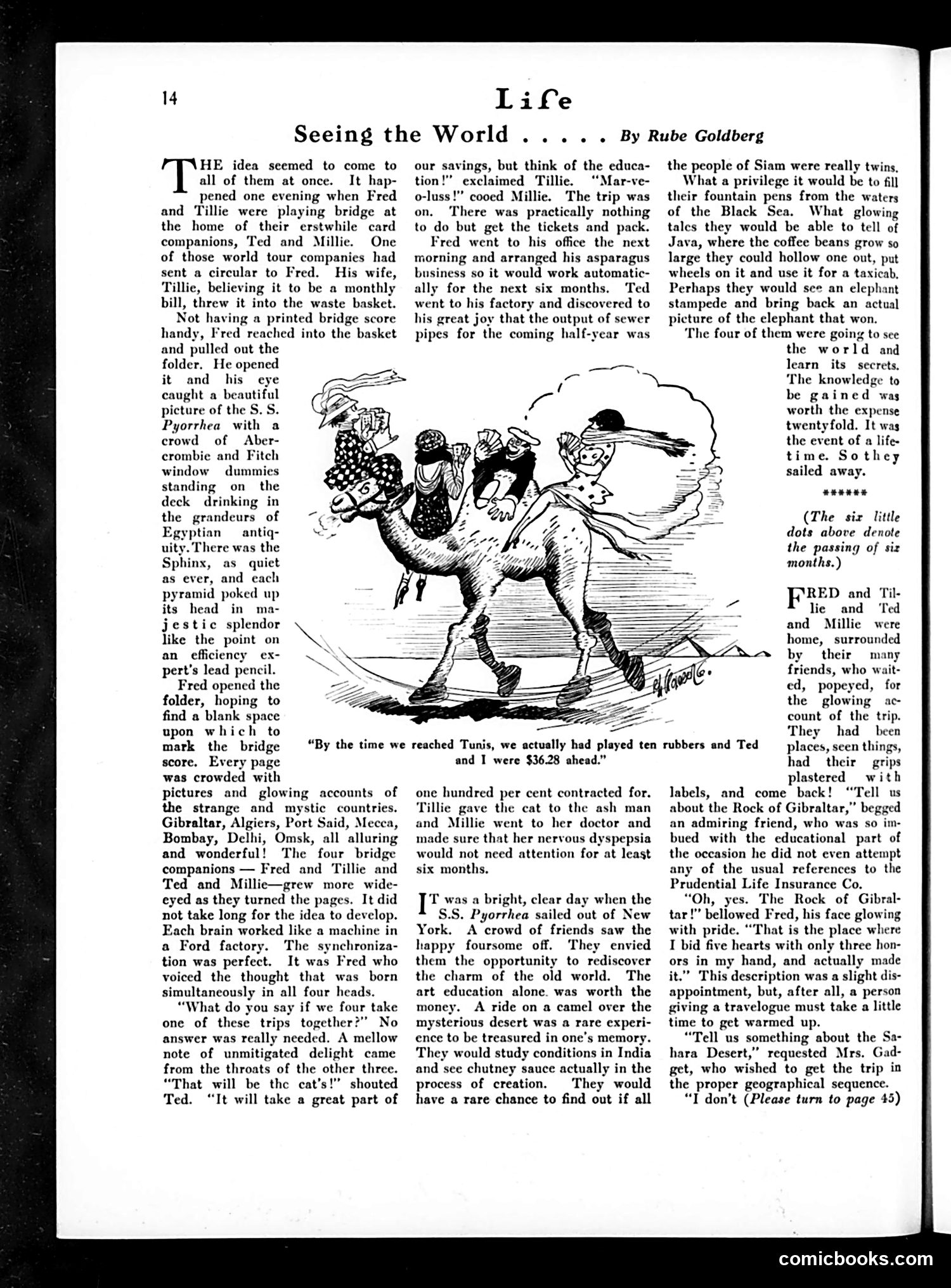
**Main Article: "Seeing the World"** This is satirical commentary on tedious travel braggarts. The narrative mocks wealthy tourists (Fred, Tillie, Ted, and Millie) who bore their hosts with endless stories about their travels—obsessively recounting card games played in exotic locations (Sahara Desert, Ispahan, Odessa, Tientsin). The humor escalates as each guest's attempt to engage the hosts with travel anecdotes drives listeners away, until finally all guests have fled except one desperate host. The story's darkly comic ending—that the hosts eventually beat the travelers and throw them out—is the satirical punchline: the only way to stop insufferable travelers from boring you is violence. **Context for modern readers:** This reflects 1920s American anxiety about wealthy travelers returning home with performative stories, treating travel experiences as social currency to display superiority rather than share genuine insight. The page also contains period cruise-ship and golf-equipment advertisements.
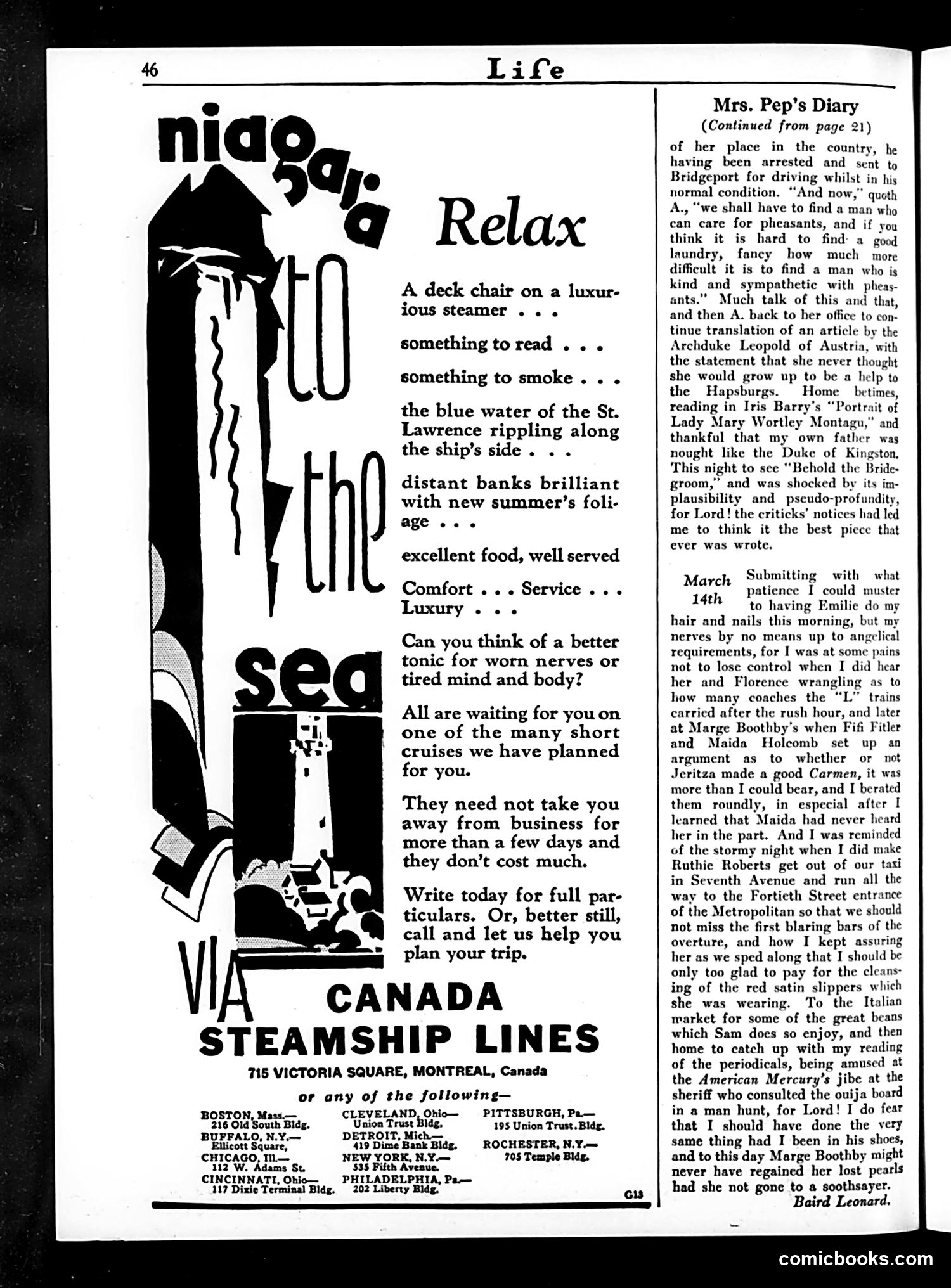
This page is primarily a **travel advertisement** for Canada Steamship Lines, promoting leisurely St. Lawrence River cruises as relaxation for busy professionals. The stylized illustration depicts a ship with art deco-influenced design. The ad's appeal is direct: it promises escape from work stress through short, affordable cruises featuring deck chairs, good food, and scenic views. The copy emphasizes that trips "need not take you away from business for more than a few days," suggesting cruises as a modern solution for worn-out businesspeople. The page also contains **"Mrs. Pep's Diary,"** a gossip column documenting the writer's social activities—theater outings, salon visits, encounters with society acquaintances. References to figures like Archduke Leopold and opera singer Jeritza suggest this addresses an educated, culturally aware audience. Together, these elements reflect 1920s-30s leisure culture: advertising modern escape for the affluent while chronicling their social world.
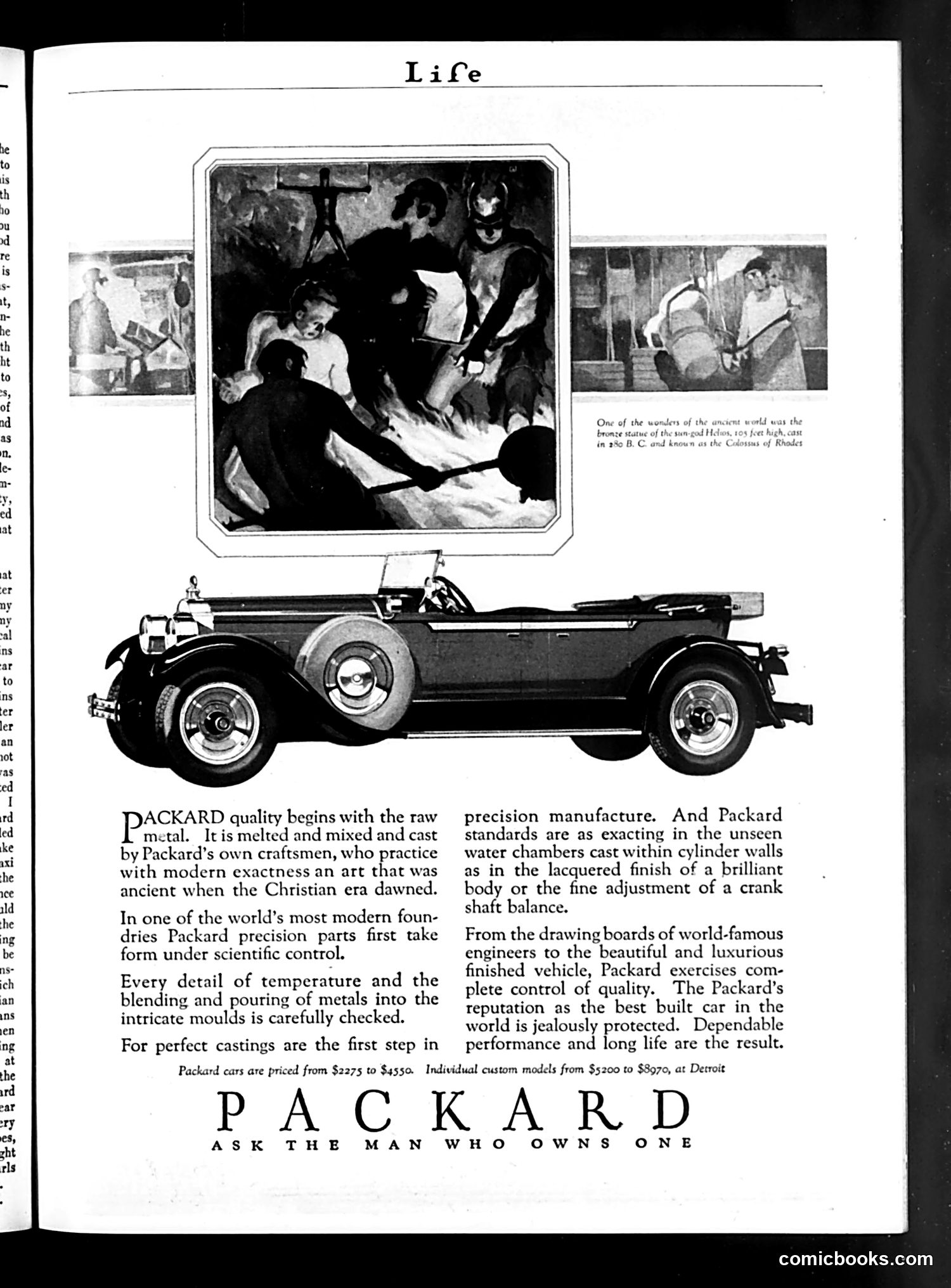
This is **not a cartoon or satire**—it's a straightforward **luxury automobile advertisement** for Packard cars, placed in Life magazine. The page features a 1920s Packard roadster with three photographs above showing manufacturing processes: metalwork, casting, and assembly. The ad emphasizes Packard's quality control, precision engineering, and craftsmanship—positioning the brand as America's finest automobile through detailed descriptions of foundry work, temperature control, and metal casting. The tagline "Ask the Man Who Owns One" was Packard's famous advertising slogan, implying satisfied ownership. Prices range from $2,275 to $8,970, positioning Packard as a luxury vehicle for the wealthy. There is no political commentary or satirical intent here—this is premium product advertising from the pre-Depression era, targeting affluent readers of Life magazine.
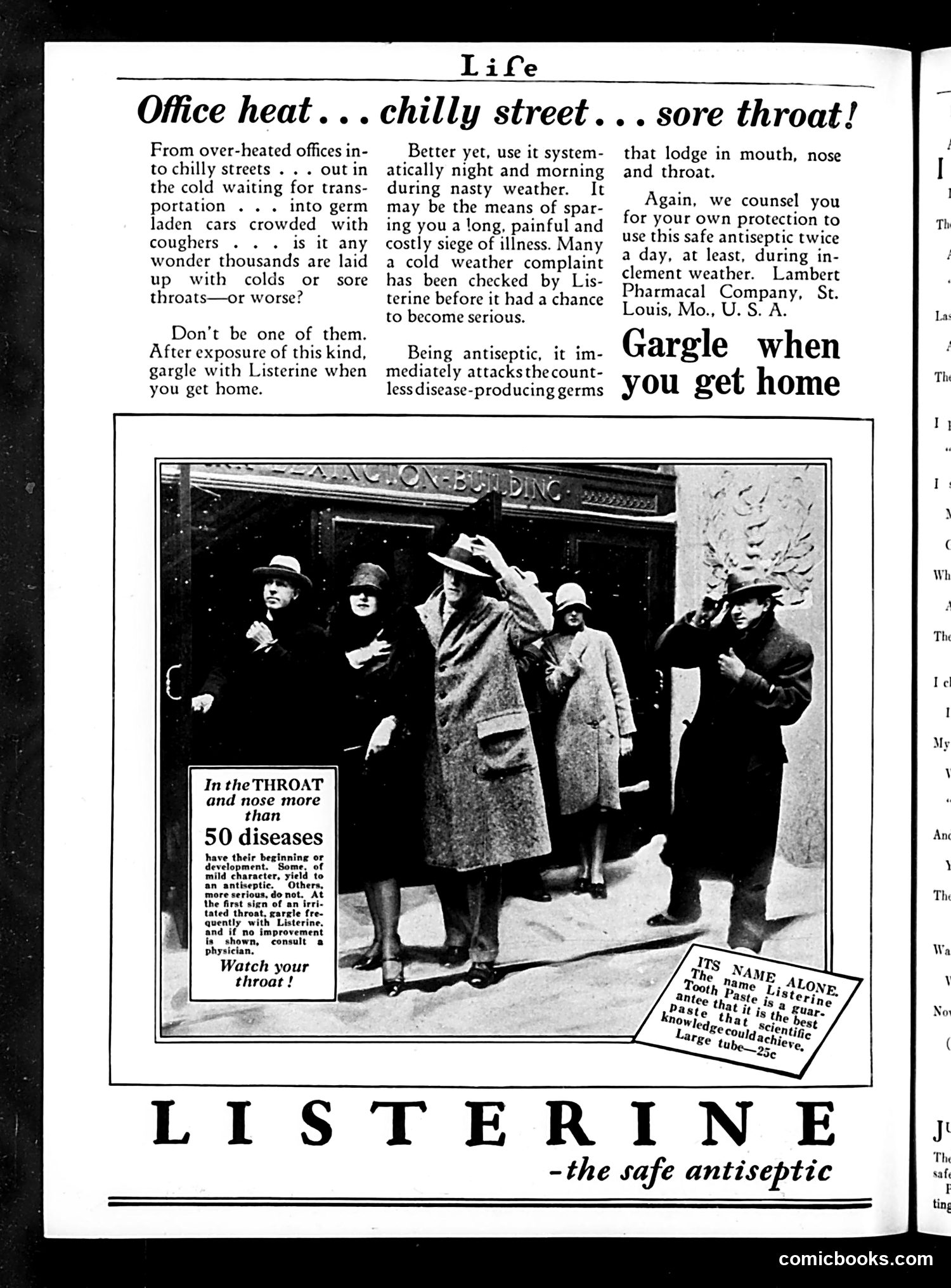
This is a **Listerine advertisement**, not satire or political commentary. The page uses the common cold-weather scenario of the 1920s-30s era to market mouthwash as preventive medicine. The advertisement depicts women in period coats standing outside, illustrating the health hazard described: moving between overheated indoor offices and cold streets, then crowded germy streetcars. The text claims this temperature shock and germ exposure causes sore throats and colds. The "joke" or persuasive angle is the practical solution: gargle with Listerine antiseptic twice daily during bad weather. The ad claims this will prevent the "50 diseases" that supposedly begin in the throat and nose. By modern standards, this is notable for its exaggerated health claims and the lack of medical evidence—now illegal in advertising. The approach treats a common cold as a serious preventable disease rather than an unavoidable viral infection.
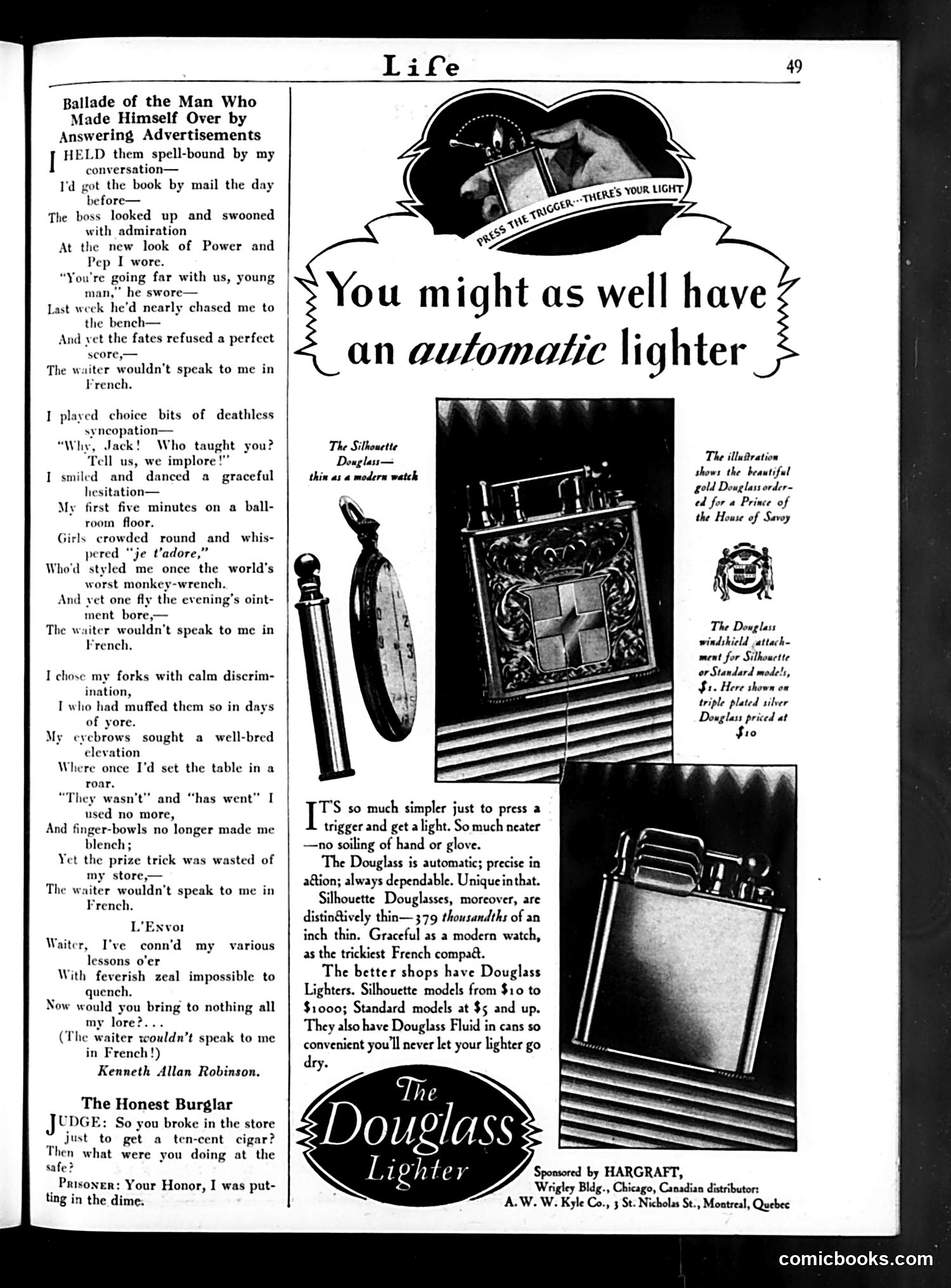
This page contains three distinct pieces: ## Main Content: "Ballade of the Man Who Made Himself Over" A satirical poem by Kenneth Allan Robinson mocking self-improvement through mail-order courses. The narrator buys books promising success—gaining conversational skill, workplace advancement, dancing ability, and proper etiquette. Each improvement impresses people around him, yet he remains unable to speak French to a waiter, suggesting that genuine sophistication cannot be purchased through correspondence courses. The repeated refrain undermines his manufactured self-improvement, implying that authentic refinement cannot be manufactured. ## Minor Content: "The Honest Burglar" A brief joke: A burglar broke into a store for a cigar but was caught at the safe. When questioned, he claims he was "putting in the dime"—a pun on the expression "putting in" effort, suggesting even criminals follow proper payment methods. ## Advertisement: Douglass Lighter A product advertisement occupying the right side, promoting automatic cigarette lighters with luxury positioning (mentioning a Prince of Savoy). This is commercial content, not editorial satire.
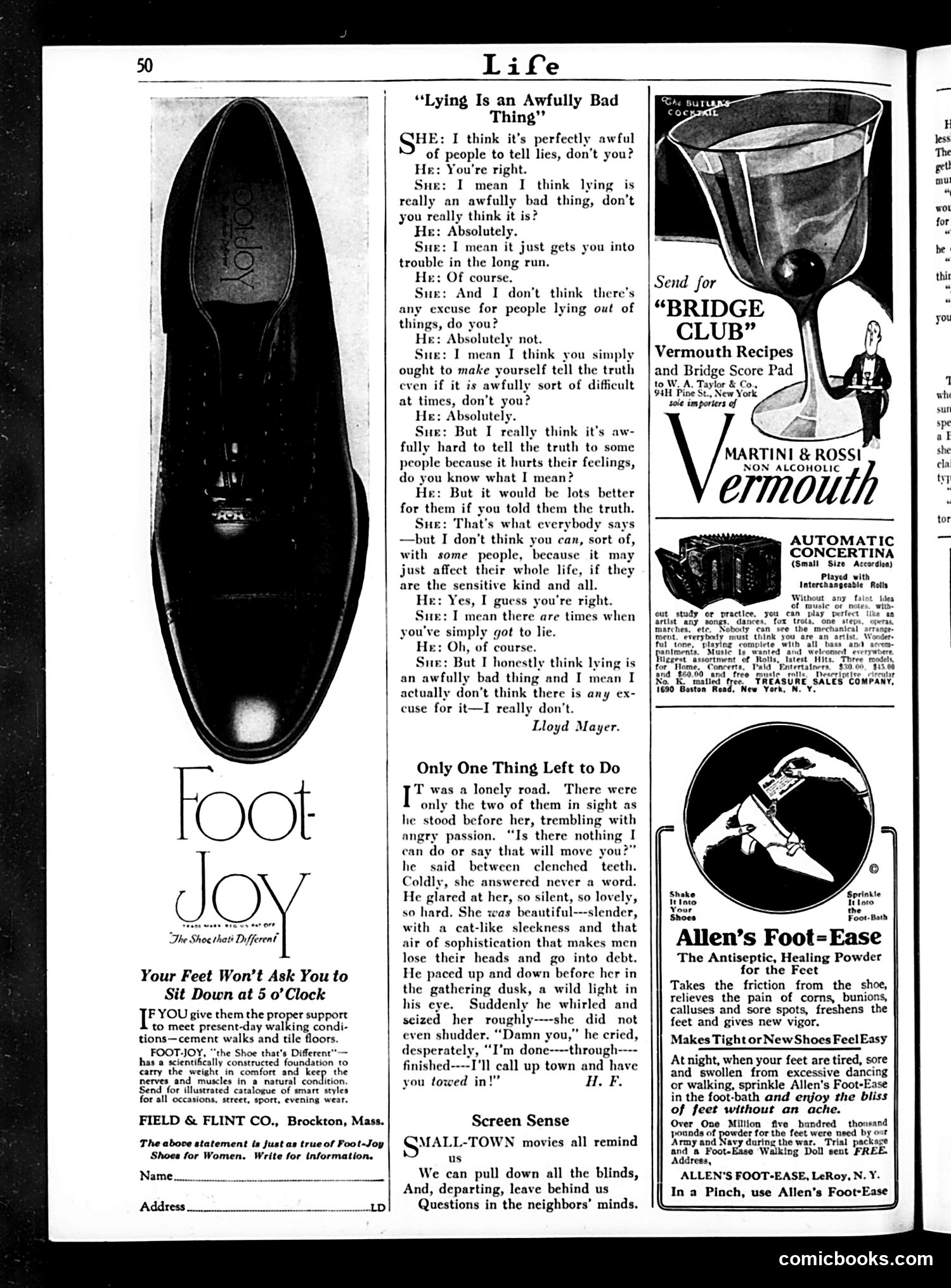
This page primarily contains **advertisements and humor pieces**, typical of Life's satirical format in the early 20th century. The main satirical content is **"Lying Is an Awfully Bad Thing,"** a dialogue by Lloyd Mayer. Two characters debate the morality of lying—he insists it's always wrong, she argues circumstances matter when protecting sensitive people's feelings. The satire lies in their circular, hypocritical reasoning: both agree lying is bad in principle, yet both rationalize exceptions, ultimately validating dishonesty. It mocks how people moralize abstractly while compromising in practice. **"Only One Thing Left to Do"** parodies melodramatic romantic fiction—a passionate scene of romantic desperation that apparently concludes anticlimactically (the OCR cuts off, but the title suggests an mundane resolution to the "dramatic" setup). **"Screen Sense"** is a brief comic poem about small-town movie theaters, joking that neighbors speculate about couples who leave to see films privately. The page is otherwise **advertisements** for shoes, vermouth, and other consumer goods—standard for Life's revenue model.
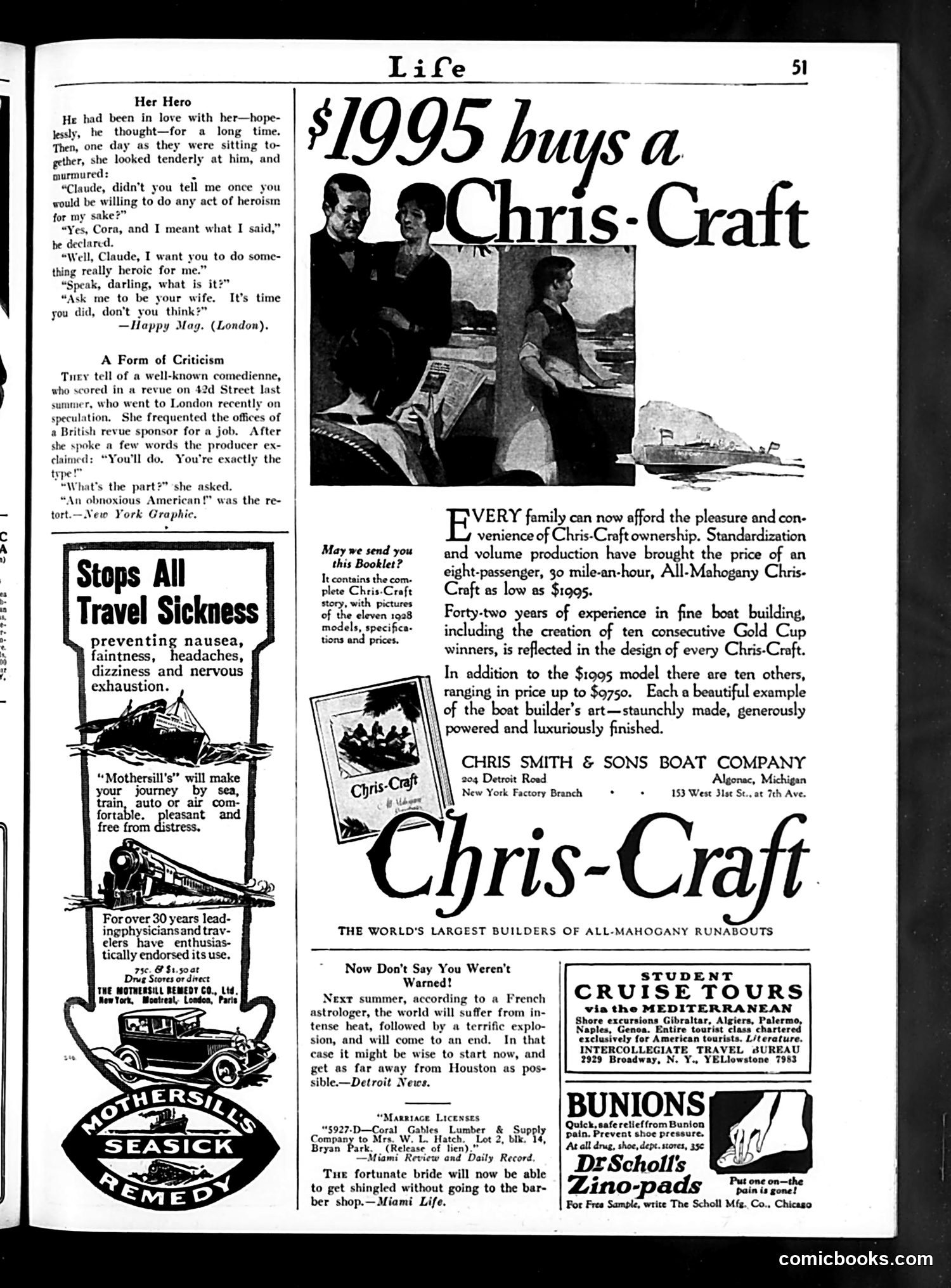
This page mixes short humor pieces with advertisements, typical of Life magazine's format. **"Her Hero"** is a romantic joke: a man declares he'd perform any heroic act for his beloved. When she finally asks him to be heroic, she requests he propose marriage—the implication being that commitment is the ultimate challenge for men. **"A Form of Criticism"** mocks American performers abroad. A comedienne seeks work in London; when the producer approves her, she asks what role. His reply—"An obnoxious American!"—is satirical commentary on how British theatrical circles stereotyped American entertainers as loud and unrefined. The page is dominated by **Chris-Craft boat advertisements** promoting an $1995 motorboat as newly affordable for average families through mass production. Other ads address period concerns: travel sickness remedy, student cruise tours, and foot-care products (bunions, corns). A brief joke references a French astrologer's apocalyptic prediction, suggesting readers escape Houston—likely poking fun at the city's reputation.
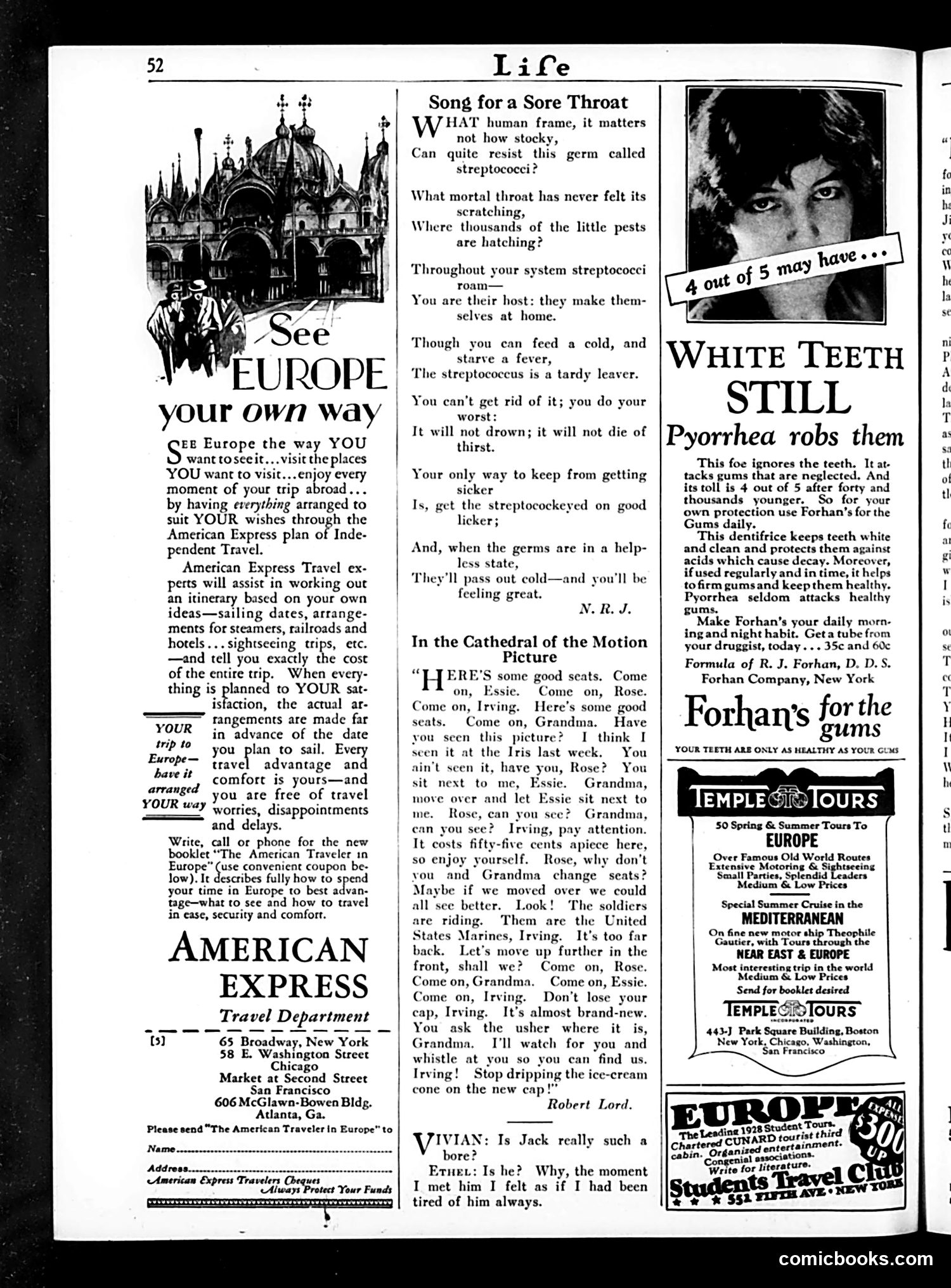
This page primarily contains **advertisements and humor pieces** rather than political cartoons. The main content includes: 1. **American Express Travel Ad** - promoting independently-planned European tours with full logistical support 2. **"Song for a Sore Throat"** - a humorous poem about streptococcus bacteria, personifying germs as unwanted "houseguests" in the body. The joke suggests getting drunk ("streptocockeyed on good licker") to kill the infection—dark medical humor typical of the era before antibiotics. 3. **"In the Cathedral of the Motion Picture"** - a satirical sketch depicting a loud, verbose Jewish family at a cinema, speaking over the film with running commentary. This reflects period stereotypes about immigrant audiences. 4. **Brief joke exchange** about a bore named Jack The page reflects 1920s-30s advertising culture and casual ethnic humor acceptable then but considered offensive today. No specific political figures or events are referenced.
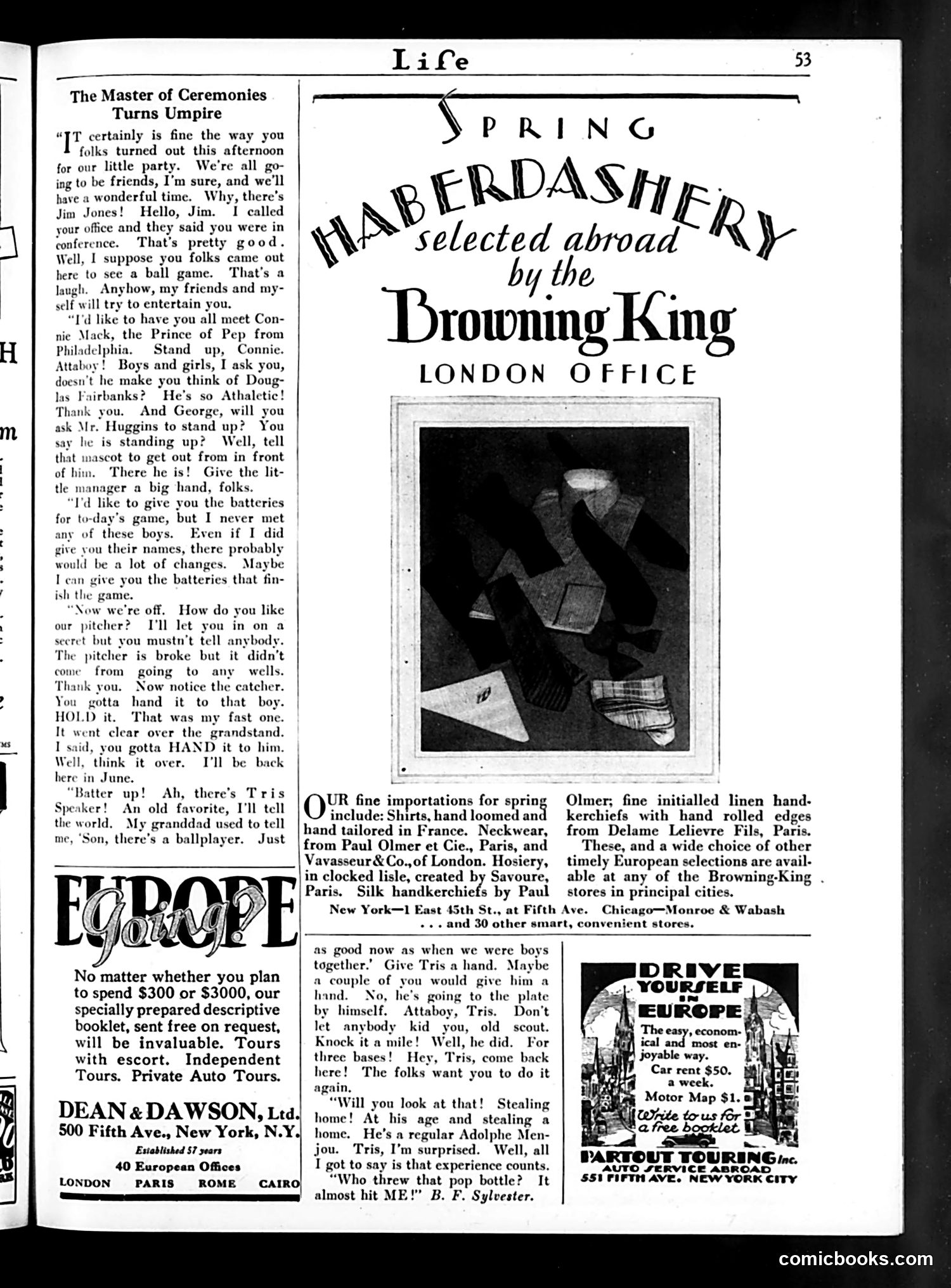
This page features a humorous piece titled "The Master of Ceremonies Turns Umpire," a satirical baseball commentary. The text presents a garrulous MC introducing famous baseball personalities of the era—Connie Mack (Philadelphia manager), Miller Huggins, and Tris Speaker—while making jokes about their appearance and abilities. The satire mocks both the MC's verbose, self-aggrandizing style and baseball culture itself. Jokes include comparing Connie Mack to actor Douglas Fairbanks, complaining the pitcher is "broke," and making puns about "handing it" to players. The piece pokes fun at celebrity worship and the spectacle surrounding professional sports. The remainder of the page consists of advertisements for travel services (Dean & Dawson tours), imported menswear (Browning-King), and European car rentals—typical for *Life* magazine's affluent readership during this period.
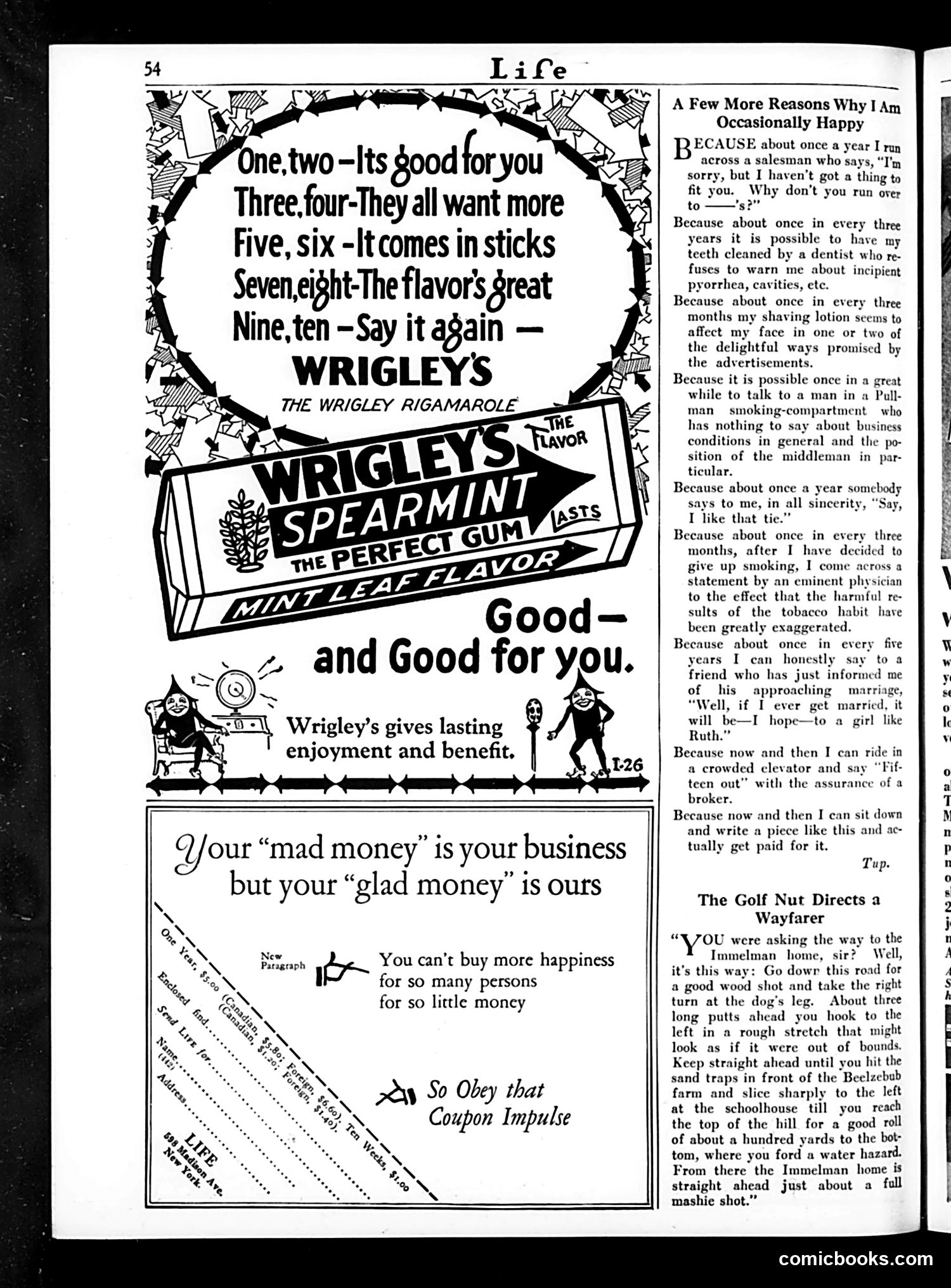
This page contains **advertising and humor columns** rather than political cartoons. The dominant content is a **Wrigley's chewing gum advertisement** featuring the "Rigamarole" jingle ("One, two—It's good for you...") promoting Spearmint gum. Below it sits a financial pitch: "Your 'mad money' is your business but your 'glad money' is ours"—essentially encouraging impulse purchases via coupons. The right column, "A Few More Reasons Why I Am Occasionally Happy," is **satirical social commentary** listing mundane pleasures: dentists who don't lecture about pyorrhea, salesmen admitting they can't help you, rare compliments on neckties, and dubious medical claims about tobacco. The humor mocks modern life's low expectations and advertising's false promises. At bottom, "The Golf Nut Directs a Wayfarer" is a **comedic golf anecdote** offering absurdly convoluted directions using golf terminology (mashie shots, sand traps, hooks), satirizing both golfers' obsession with their sport and unclear directions. No specific political figures are caricatured. The satire targets **consumer culture, advertising manipulation, and societal banality**.
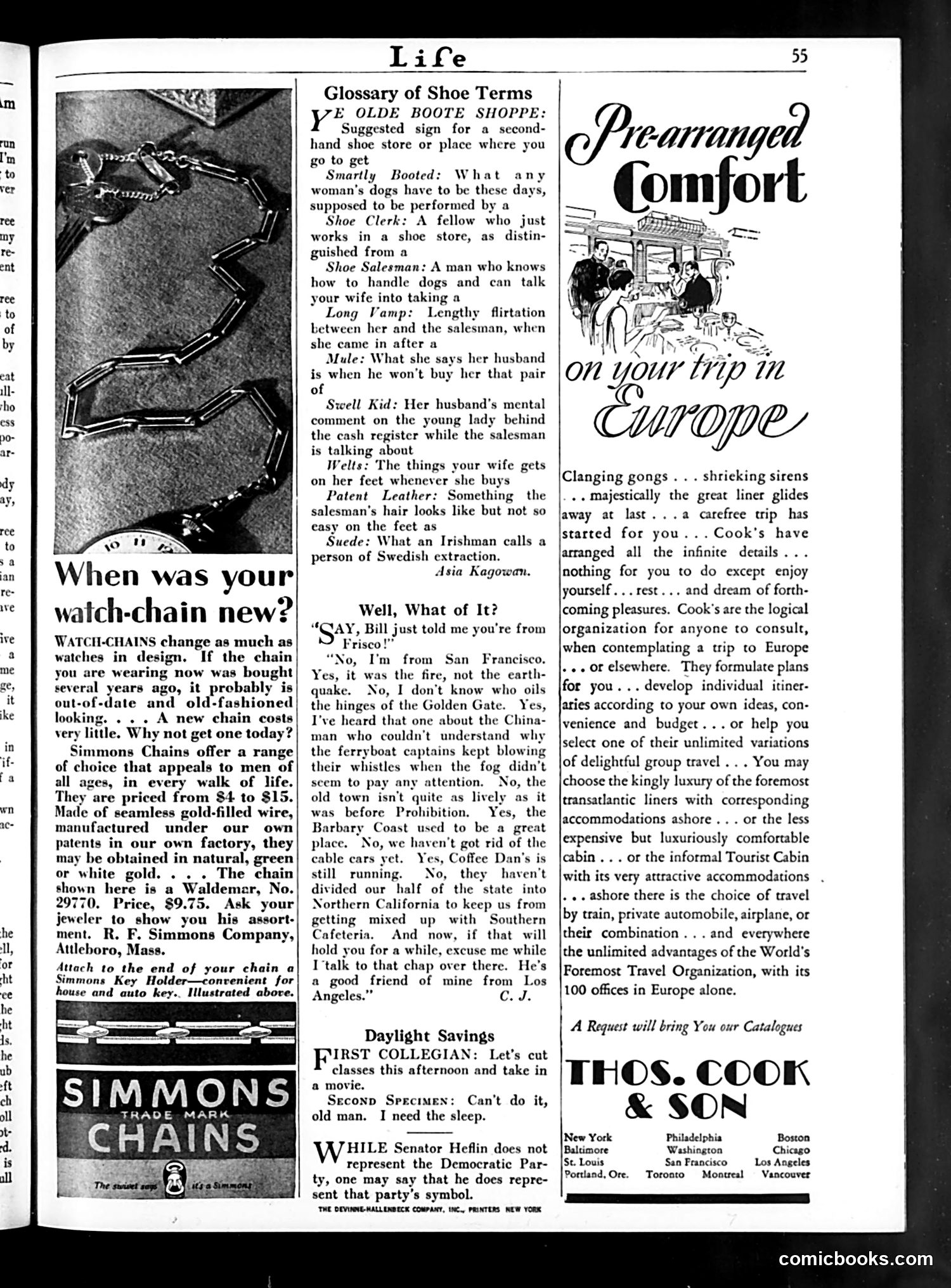
This page contains mostly **advertisements and humorous filler content**, typical of Life's satirical format. The main visual features a **Simmons watch-chain advertisement** with a photograph of an ornate chain, targeting men concerned with fashion currency—suggesting chains were status symbols requiring periodic updating. The text includes several **light satirical pieces**: 1. **"Glossary of Shoe Terms"**: A humorous guide mocking shoe-shopping culture, particularly women's shopping habits and the manipulative techniques of shoe salesmen. 2. **"Well, What of It?"**: A joke about San Francisco residents tired of standard questions about the 1906 earthquake and fire, Prohibition's effects, and local landmarks—reflecting post-disaster stereotypes. 3. **"Daylight Savings"**: A brief joke about college students and sleep schedules. 4. **A cryptic political reference** to Senator Heflin and Democratic symbolism (unclear without additional context). The page also advertises **Thomas Cook & Son travel services** for European trips, emphasizing luxury leisure travel for affluent readers.
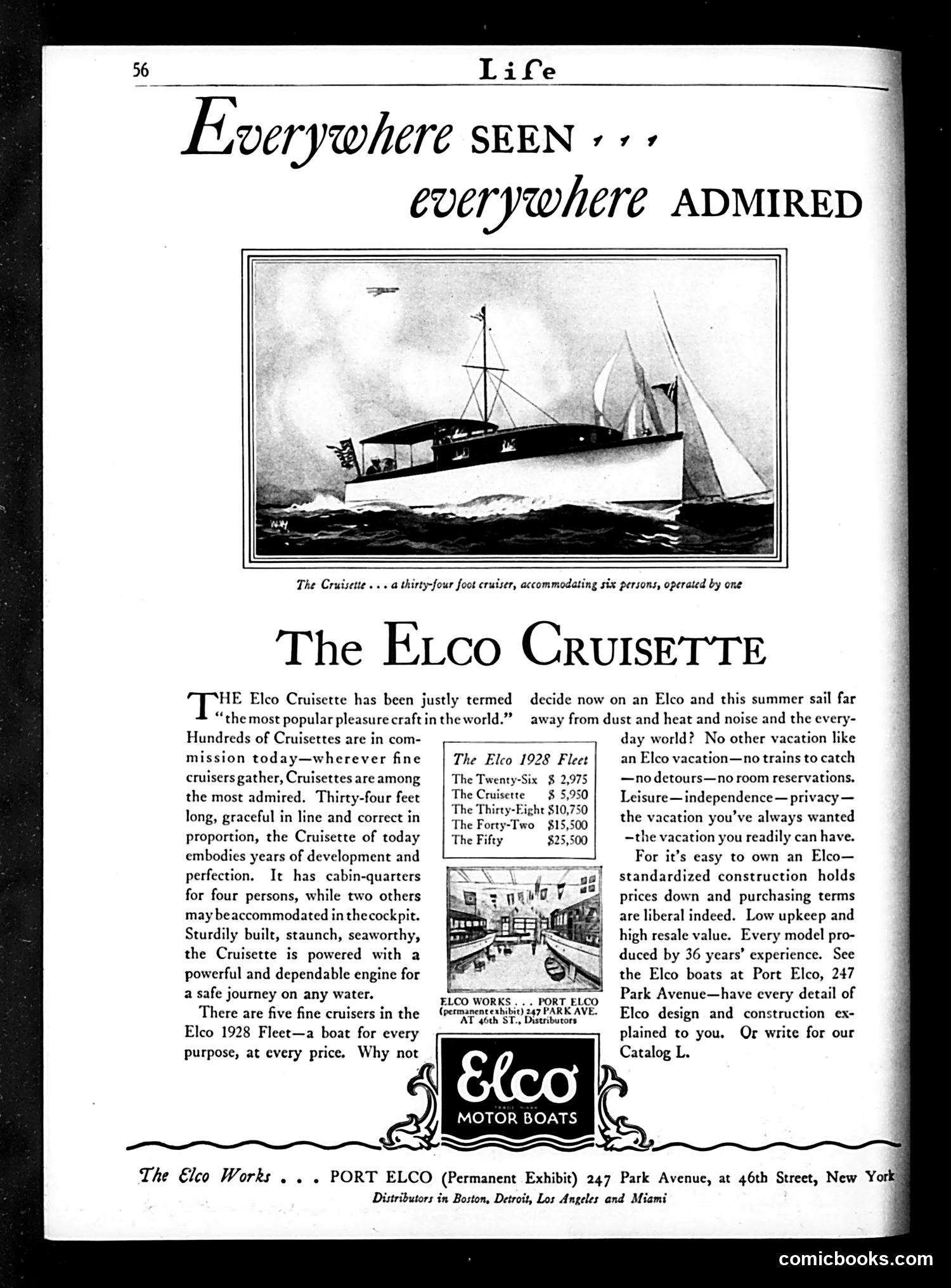
This is not political satire but rather a **luxury boat advertisement** from Life magazine's 1928 fleet promotion. The page advertises the Elco Cruisette, a 34-foot motorized pleasure yacht priced at $5,950. The "point" is aspirational marketing aimed at wealthy readers during the prosperous 1920s. The tagline "Everywhere Seen... Everywhere Admired" appeals to status consciousness—owning an Elco signals refinement and social standing. The sales pitch emphasizes escape from "dust and heat and noise and the everyday world," offering leisure and independence as purchasable lifestyle benefits. The accompanying image shows the sleek cruiser in profile, designed to convey elegance and seaworthiness. Five models are listed at escalating prices ($2,975–$25,500), suggesting options for different wealth levels, while emphasizing standardized construction keeps costs manageable. The advertisement represents 1920s consumer culture celebrating technological achievement and recreational luxury for the affluent.

I can see this is a very dark, low-contrast image that appears to be from a historical publication. However, the image quality is too poor for me to reliably make out specific cartoon details, caricatures, text, or satirical elements that would be necessary to accurately explain the content to a modern reader. The OCR text only shows "comicbooks.com," which appears to be a watermark rather than page content. To provide an accurate analysis following the accuracy-first rule, I must acknowledge that I cannot discern sufficient detail from this image to identify the figures, political references, or satirical points with confidence. A clearer scan would be needed for proper interpretation.