
Life, 1928-04-05 · page 33 of 59
Life — April 5, 1928 — page 33: what you’re looking at
What you’re looking at
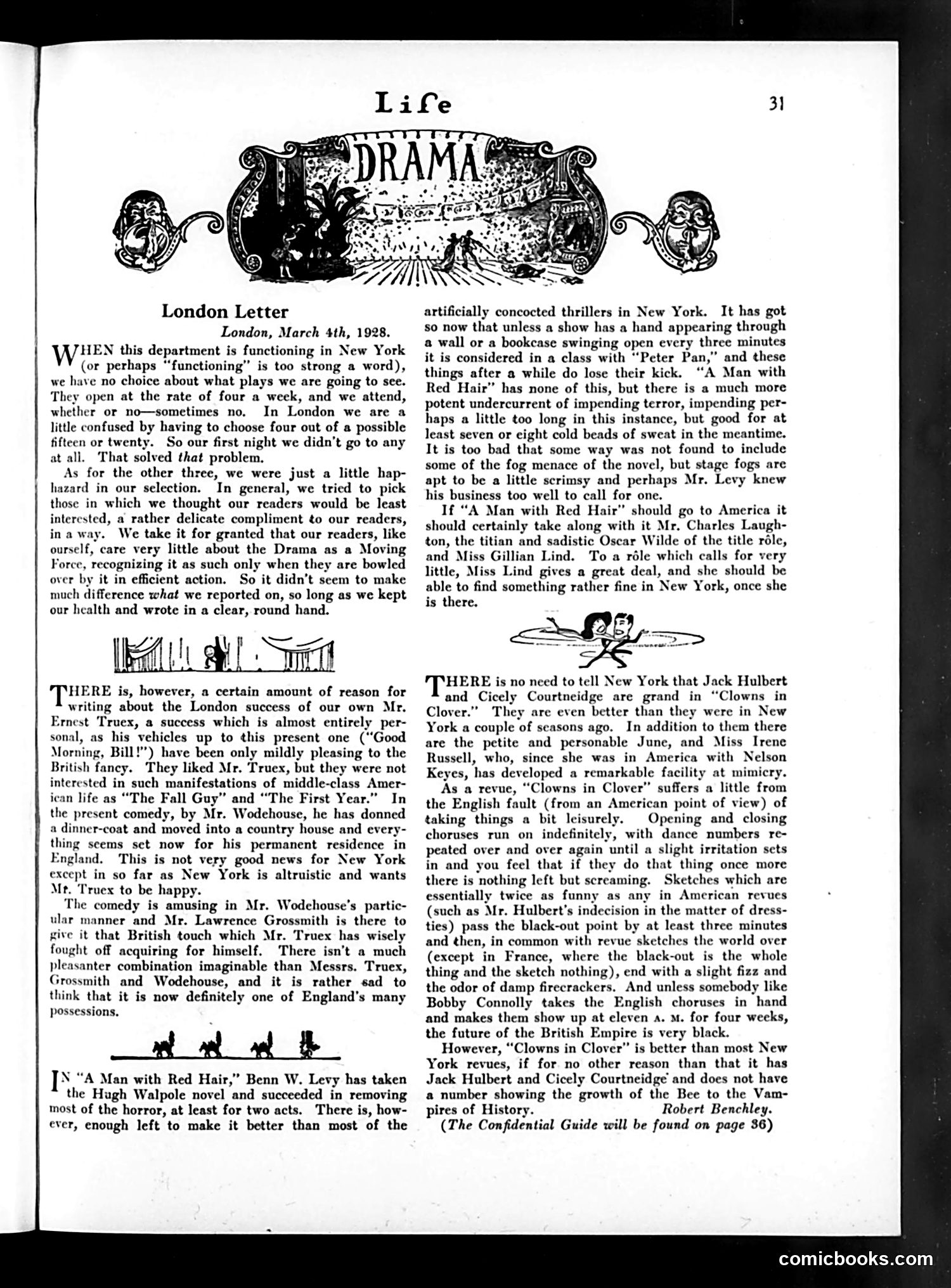
This London theater column compares British and American dramatic offerings. The author reviews three plays: **"Good Morning, Bill"** features American actor Ernest Truex, whose success in London surprises critics—his earlier American comedies ("The Fall Guy," "The First Year") depicting middle-class American life had failed to interest British audiences, but this P.G. Wodehouse play, with British actor Lawrence Grossmith, succeeds. The writer humorously laments this as a loss for New York. **"A Man with Red Hair"** (adapted from Hugh Walpole's novel) features Charles Laughton in a psychological thriller. Unlike artificially contrived American thrills requiring gimmicks like "a hand appearing through a wall," this play sustains genuine tension, though perhaps too prolonged. **"Clowns in Clover"** stars Jack Hulbert and Cicely Courtneidge (the text cuts off mid-sentence). The satirical point: American theater relies on cheap tricks while British drama achieves sophistication through acting talent and literary adaptation.
📄 Transcribed text from this page (OCR, searchable)
Machine-transcribed from the original scan — historical spelling and the odd misread are preserved.
London Letter London, March 4th, 1928. HEN this department is functioning in New York (or perhaps “functioning” is too strong a word), we have no choice about what plays we are going to see. They open at the rate of four a week, and we attend, whether or no—sometimes no, In London we are a little confused by having to choose four out of a possible fifteen or twenty. So our first night we didn’t go to any at all. That solved that problem, As for the other three, we were just a little hap- hazard in our selection. In general, we tried to pick those in which we thought our readers would be least interested, a rather delicate compliment ¢o our readers, ina way. We take it for granted that our readers, like ourself, care very little about the Drama as a Moving Force, recognizing it as such only when they are bowled over by it in efficient action. So it didn’t seem to make much difference what we reported on, so long as we kept our health and wrote in a clear, round hand. "THERE is, however, a certain amount of reason for writing about the London success of our own Mr. Ernest Truex, a success which is almost entirely per- sonal, as his vehicles up to this present one (“Good Morning, Bill!) have been only mildly pleasing to the British fancy. They liked Mr. Truex, but they were not interested in such manifestations of middle-class Amer- ican life as “The Fall Guy” and “The First Year.” In the present comedy, by Mr. Wodehouse, he has donned a dinner-coat and moved into a country house and every- thing seems set now for his permanent residence in England. This is not very good news for New York except in so far as New York is altruistic and wants Mt. Truex to be happy. The comedy is amusing in Mr. Wodchouse’s partic- ular manner and Mr. Lawrence Grossmith is there to give it that British touch which Mr. Truex has wisely fought off acquiring for himself. There isn’t a much pleasanter combination imaginable than Messrs. Truex, Grossmith and Wodehouse, and it is rather sad to think that it is now definitely one of England’s many possessions, N “A Man with Red Hair,” Benn W. Levy has taken the Hugh Walpole novel and succeeded in removing most of the horror, at least for two acts. There is, how- ever, enough left to make it better than most of the artificially concocted thrillers in New York. It has got so now that unless a show has a hand appearing through a wall or a bookcase swinging open every three minutes it is considered in a class with ‘Peter Pan,” and these things after a while do lose their kick. “A Man with Red Hair” has none of this, but there is a much more potent undercurrent of impending terror, impending per- haps a little too long in this instance, but good for at least seven or eight cold beads of sweat in the meantime. It is too bad that some way was not found to include some of the fog menace of the novel, but stage fogs are apt to be a little scrimsy and perhaps Mr. Levy knew his business too well to call for one. If “A Man with Red Hair” should go to America it should certainly take along with it Mr. Charles Laugh- ton, the titian and sadistic Oscar Wilde of the title réle, and Miss Gillian Lind. To a réle which calls for very little, Miss Lind gives a great deal, and she should be able to find something rather fine in New York, once she is there. HERE is no need to tell New York that Jack Hulbert and Cicely Courtneidge are grand in “Clowns in Clover.” They are even better than they were in New York a couple of seasons ago. In addition to them there are the petite and personable June, and Miss Irene Russell, who, since she was in America with Nelson Keyes, has developed a remarkable facility at mimicry. As a revue, “Clowns in Clover” suffers a little from the English fault (from an American point of view) of taking things a bit leisurely. Opening and closing choruses run on indefinitely, with dance numbers re- peated over and over again until a slight irritation sets in and you feel that if they do that thing once more there is nothing left but screaming. Sketches which are essentially twice as funny as any in American revues (such as Mr. Hulbert’s indecision in the matter of dress- ties) pass the black-out point by at least three minutes and then, in common with revue sketches the world over (except in France, where the black-out is the whole thing and the sketch nothing), end with a slight fizz and the odor of damp firecrackers. And unless somebody like Bobby Connolly takes the English choruses in hand and makes them show up at eleven a. M. for four weeks, the future of the British Empire is very black. However, “Clowns in Clover” is better than most New York revues, if for no other reason than that it has Jack Hulbert and Cicely Courtneidge and does not have a number showing the growth of the Bee to the Vam- pires of History. Robert Benchley. (The Confidential Guide will be found on page 36) comicbooks.com