
Life, 1928-04-05 · page 26 of 59
Life — April 5, 1928 — page 26: what you’re looking at
What you’re looking at
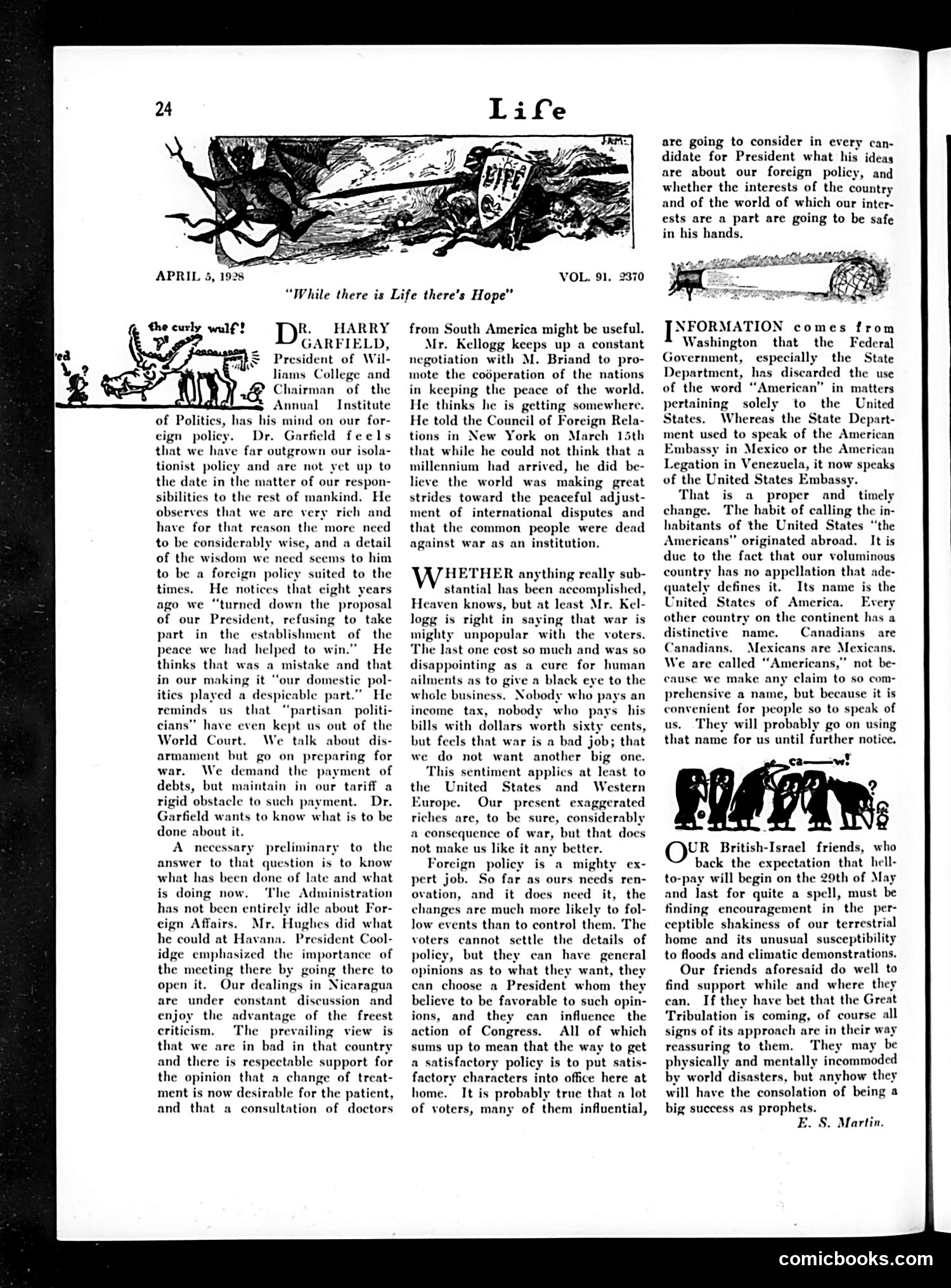
This page discusses America's foreign policy stance under President Coolidge's administration. The main cartoon (top left) appears to depict a skeletal or death-like figure labeled "DIFF" emerging from turbulent waters—likely representing the dangers or conflicts inherent in international disputes. The text critiques Dr. Harry Garfield (Williams College president) and others arguing the U.S. must abandon isolationism and take greater responsibility globally, given American wealth. However, the author notes contradictions: America demands debt repayment while maintaining protectionist tariffs; it discusses disarmament while preparing for war; it stayed out of the League of Nations after helping win WWI. The piece argues that foreign policy is too complex for voters to control directly, but they can influence it by electing favorable presidents and Congress members. Secretary of State Kellogg's peace negotiations with France receive cautious support—voters clearly oppose war after its massive costs and disappointing results. The "British-Israel friends" reference concerns a contemporary religious/political movement predicting future events.
📄 Transcribed text from this page (OCR, searchable)
Machine-transcribed from the original scan — historical spelling and the odd misread are preserved.
VOL. 91. 2370 “While there is Life there’s Hope” @& thecurly wilf! R. HARRY ba GARFIELD, President of Wil- liams College and Chairman of the Annual Institute of Politics, has his mind on our for- eign policy. Dr. Garfield feels that we have far outgrown our isola- tionist policy and are not yet up to the date in the matter of our respon- sibilities to the rest of mankind. He observes that we are very rich and have for that reason the more need to be considerably wise, and a detail of the wisdom we need seems to him to be a foreign policy suited to the times. He notices that cight years ago we “turned down the proposal of our President, refusing to take part in the establishment of the peace we had helped to win.” He thinks that mistake and that in our making it ‘‘our domestic pol- itics played a despicable part.” He reminds us that “partisan politi- cians” have even kept us out of the World Court. We talk about dis- armament but go on preparing for war. We demand the payment of debts, but maintain in our tariff a rigid obstacle to such payment. Dr. Garfield wants to know what is to be done about it. A necessary preliminary to the answer to that question is to know what has been done of late and what is doing now. ‘The Administration has not been entirely idle about For- eign Affairs. Mr. Hughes did what he could at Havana. President Cool- idge emphasized the importance of the meeting there by going there to open it. Our dealings in Nicaragua are under constant discussion and enjoy the advantage of the freest criticism. The prevailing view is that we are in bad in that country and there is respectable support for the opinion that a change of treat- ment is now desirable for the patient, and that a consultation of doctors from South America might be useful. Mr. Kellogg keeps up a constant negotiation with M. Briand to pro- mote the codperation of the nations in keeping the peace of the world. He thinks he is getting somewhere. He told the Council of Foreign Rela- tions in New York on March 15th that while he could not think that a millennium had arrived, he did be- lieve the world was making great strides toward the peaceful adjust- ment of international disputes and that the common people were dead against war as an institution. HETHER anything really sub- stantial has been accomplished, Heaven knows, but at least Mr. Kel- logg is right in saying that war is mighty unpopular with the voters. The last one cost so much and was so disappointing as a cure for human ailments as to give a black eye to the whole business. Nobody who pays an income tax, nobody who pays his bills with dollars worth sixty cents, but feels that war is a bad job; that we do not want another big one. This sentiment applics at least to the United States and Western Europe. Our present exaggerated riches are, to be sure, considerably a consequence of war, but that does not make us like it any better. Foreign policy is a mighty ex- pert job. So far as ours needs ren- ovation, and it does need it, the changes are much more likely to fol- low events than to control them. The voters cannot settle the details of policy, but they can have gencral opinions as to what they want, they can choose a President whom they believe to be favorable to such opin- ions, and they can influence the action of Congress. All of which sums up to mean that the way to get a satisfactory policy is to put satis- factory characters into office here at home. It is probably true that a lot of voters, many of them influential, are going to consider in every can- didate for President what his ideas are about our foreign policy, and whether the interests of the country and of the world of which our inter- ests are a part are going to be safe in his hands. ap ran atliretr ska tag gti aD AES [XFORMATION comes from Washington that the Federal Government, especially the State Department, has discarded the use of the word “American” in matters pertaining solely to the United States. Whereas the State Depart- ment used to speak of the American Embassy in Mexico or the American Legation in Venezuela, it now speaks of the United States Embassy. That is a proper and_ timely change. The habit of calling the in- habitants of the United States “the Americans” originated abroad. It is due to the fact that our voluminous country has no appellation that ade- quately defines it. Its name is the United States of America. Every other country on the continent has a distinctive name. Canadians are Canadians. Mexicans are Mexicans, We are called “Americans,” not be- cause we make any claim to so com- prehensive a name, but because it is convenient for people so to speak of us. They will probably go on using that name for us until further notice, ca——w! g UR British-Israel friends, who back the expectation that hell- to-pay will begin on the 29th of May and last for quite a spell, must be finding encouragement in the per- ceptible shakiness of our terrestrial home and its unusual susceptibility to floods and climatic demonstrations. Our friends aforesaid do well to find support while and where they can, If they have bet that the Great Tribulation is coming, of course all signs of its approach are in their way reassuring to them. They may be physically and mentally incommoded world disasters, but anyhow they have the consolation of being a big success as prophets. E. S. Martin. comicbooks.com