
Life, 1928-04-05 · page 36 of 59
Life — April 5, 1928 — page 36: what you’re looking at
What you’re looking at
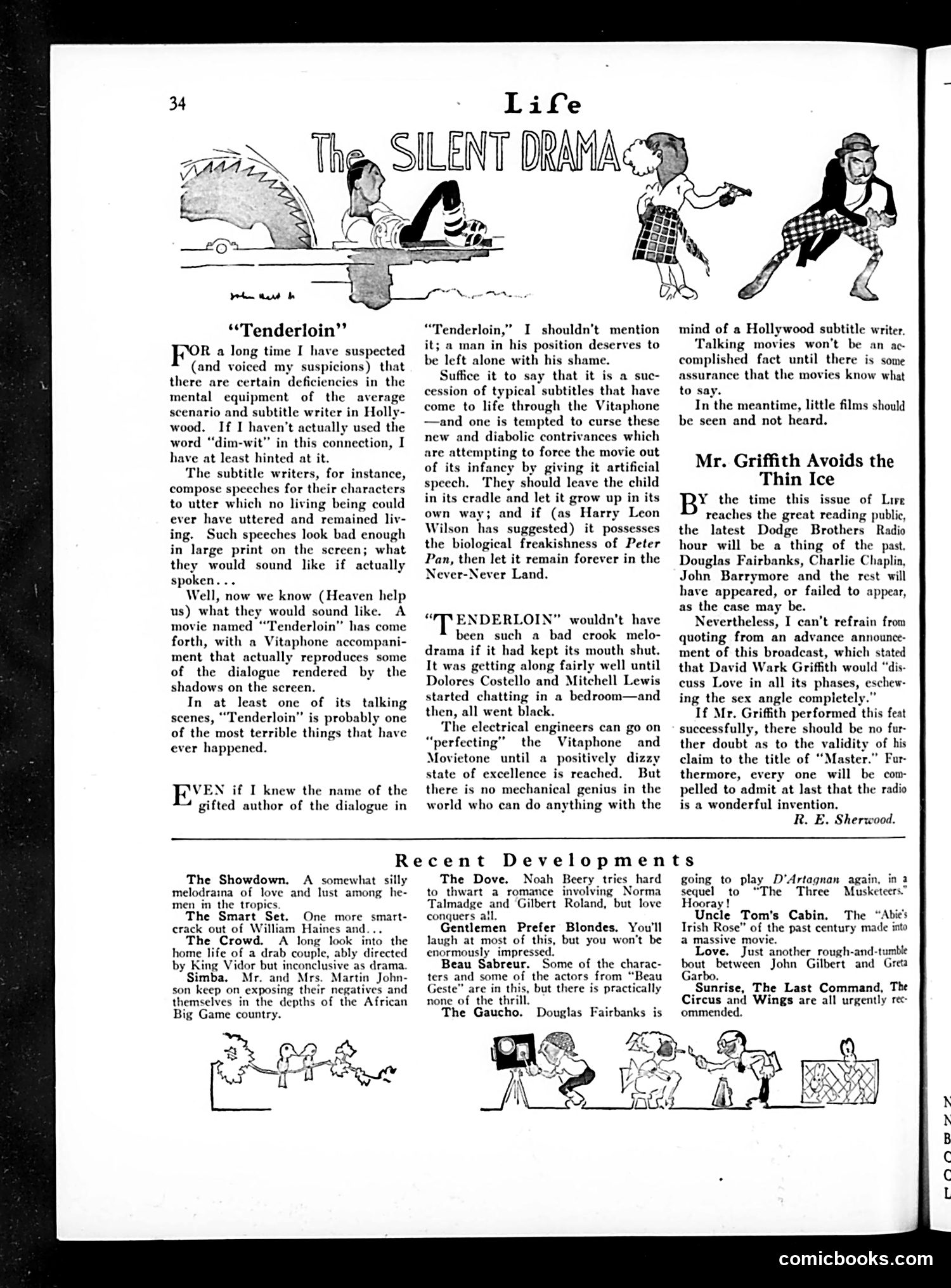
This page critiques early "talking pictures" (sound films), specifically the movie "Tenderloin," which used Vitaphone technology to add synchronized dialogue. The author argues that subtitle writers in Hollywood lack talent, and that adding actual spoken dialogue has exposed their incompetence catastrophically. The piece contends that silent films should remain silent—that artificial speech is ruining cinema's natural evolution. When actors like Dolores Costello and Mitchell Lewis actually speak in "Tenderloin," the results are so terrible that "all went black" (the film apparently malfunctioned or had to stop). The satire targets not specific political figures but rather Hollywood's creative mediocrity and the film industry's premature adoption of sound technology. The author fears talking pictures will destroy cinema's artistic potential before the medium matures.
📄 Transcribed text from this page (OCR, searchable)
Machine-transcribed from the original scan — historical spelling and the odd misread are preserved.
“Tenderloin” GOR a long time I have suspected (and voiced my suspicions) that there are certain deficiencies in the mental equipment of the average scenario and subtitle writer in Holly- wood. If I haven't actually used the word “dim-wit” in this connection, I have at least hinted at it. The subtitle writers, for instance, compose speeches for their characters to utter which no living being could ever have uttered and remained liv- ing. Such speeches look bad enough in large print on the screen; what they would sound like if actually spoken... Well, now we know (Heaven help us) what they would sound like. A movie named “Tenderloin” has come forth, with a Vitaphone accompani- ment that actually reproduces some of the dialogue rendered by the shadows on the screen. In at least one of its talking scenes, “Tenderloin” is probably one of the most terrible things that have ever happened. EY N if I knew the name of the “4 gifted author of the dialogue in Recent The Showdown. A somewhat silly melodraina of love and lust among he- men in the tropics. The Smart Set. One more smart- crack out of William Haines and... The Crowd. A long look into the home life of a drab couple, ably directed by King Vidor but inconclusive as drama. Simba. Mr. and Mrs. Martin John- son keep on exposing their negatives and themselves in the depths of the African Big Game country. “Tenderloin,” I shouldn't mention it; a man in his position deserves to be left alone with his shame. Suffice it to say that it is a suc- cession of typical subtitles that have come to life through the Vitaphone —and one is tempted to curse these new and diabolic contrivances which are attempting to force the movie out of its infancy by giving it artificial speech, They should leave the child in its cradle and let it grow up in its own way; and if (as Harry Leon Wilson has suggested) it possesses the biological freakishness of Peter Pan, then let it remain forever in the Never-Never Land. “FR ENDERLOIN” wouldn't have been such a bad crook melo- drama if it had kept its mouth shut. It was getting along fairly well until Dolores Costello and Mitchell Lewis started chatting in a bedroomn—and then, all went black. The electrical engineers can go on “perfecting” the Vitaphone and Movietone until a positively dizzy state of excellence is reached. But there is no mechanical genius in the world who can do anything with the The Dove. Noah Beery tries hard to thwart a romance involving Norma Talmadge and Gilbert Roland, but love conquers ail. Gentlemen Prefer Blondes. You'll laugh at most of this, but you won't be enormously impressed. Beau Sabreur. Some of the charac- ters and some of the actors from “Beau Geste” are in this, but there is practically none of the thrill. The Gaucho. Douglas Fairbanks is mind of a Hollywood subtitle writer. Talking movies won't be an ac. complished fact until there is some assurance that the movies know what to say. In the meantime, little films should be seen and not heard. Mr. Griffith Avoids the Thin Ice Y the time this issue of Live reaches the great reading public, the latest Dodge Brothers Radio hour will be a thing of the past, Douglas Fairbanks, Charlie Chaplin, John Barrymore and the rest will have appeared, or failed to appear, as the case may be. Nevertheless, I can’t refrain from quoting from an advance announce- ment of this broadcast, which stated that David Wark Griffith would “dis- cuss Love in all its phases, eschew- ing the sex angle completely.” If Mr. Griffith performed this feat successfully, there should be no fur- ther doubt as to the validity of his claim to the title of “Master.” Fur- thermore, every one will be cow- pelled to admit at last that the radio is a wonderful invention. R. E. Sherwood. Developments going to play D’Artagnan again, in 2 sequel to “The Three Musketeers” Hooray! Uncle Tom's Cabin. The “Abies Irish Rose” of the past century made into a massive movie. Love. Just another rough-and-tumble bout between John Gilbert and Greta Garbo. Sunrise, The Last Command, The Circus and Wings are all urgently rec ommended. comicbooks.com rnnwryzys,