
Life, 1928-04-05 · page 18 of 59
Life — April 5, 1928 — page 18: what you’re looking at
What you’re looking at
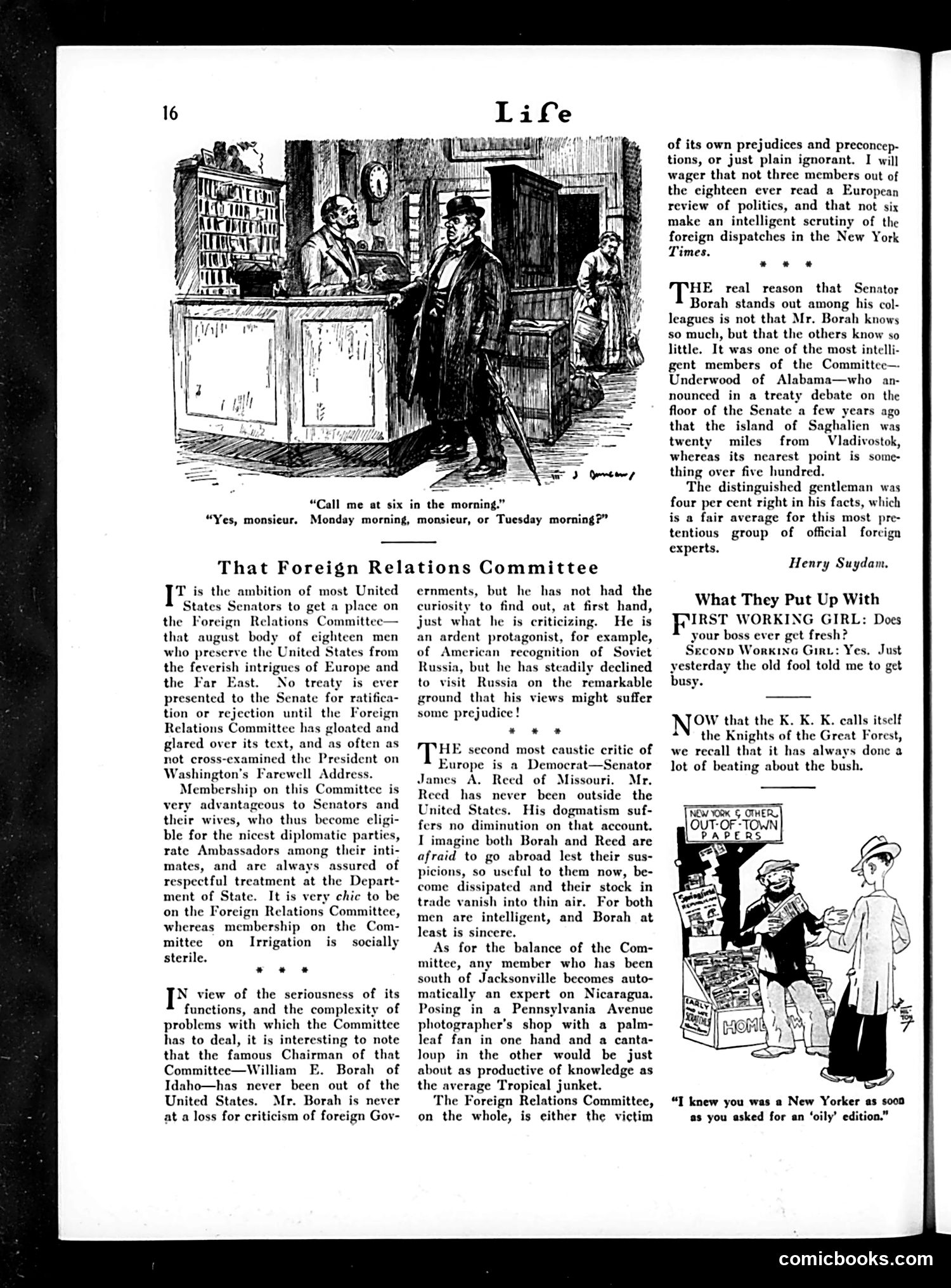
The main cartoon satirizes the Foreign Relations Committee's chairman, William E. Borah of Idaho. The text criticizes Borah as hypocritical: he loudly criticizes foreign governments despite never leaving the United States, never having firsthand knowledge, and lacking diplomatic experience. The caption "Call me at six in the morning, Monday morning, monsieur, or Tuesday morning?" mocks his pretentious European affectations while questioning his actual expertise. The secondary cartoon about the K.K.K. appears unrelated satirical content about that organization claiming to preserve American interests while, the text suggests, doing little substantive work. Both pieces exemplify *Life* magazine's style: sharp political commentary mocking politicians and organizations through exaggeration and direct criticism rather than subtle visual metaphor.
📄 Transcribed text from this page (OCR, searchable)
Machine-transcribed from the original scan — historical spelling and the odd misread are preserved.
“Call me at six in the morning.” “Yes, monsieur. Monday morning, monsieur, or Tuesday morning?” That Foreign Relations Committee T is the ambition of most United States Senators to get a place on the Foreign Relations Committee— that august body of cighteen men who preserve the United States from the feverish intrigues of Europe and the Far East. No treaty is ever presented to the Senate for ratifica- tion or rejection until the Foreign Relations Committee has gloated and glared over its text, and as often as not cross-examined the President on Washington's Farewell Address. Membership on this Committee is very advantageous to Senators and their wives, who thus become eligi- ble for the nicest diplomatic parties, rate Ambassadors among their inti- mates, and are always assured of respectful treatment at the Depart- ment of State. It is very chic to be on the Foreign Relations Committee, whereas membership on the Com- mittee on Irrigation is socially sterile. “* * N view of the seriousness of its functions, and the complexity of problems with which the Committee has to deal, it is interesting to note that the famous Chairman of that Committee—William E. Borah of Idaho—has never been out of the United States. Mr. Borah is never at a loss for criticism of foreign Gov- ernments, but he has not had the curiosity to find out, at first hand, just what he is criticizing. He is an ardent protagonist, for example, of American recognition of Soviet Russia, but he has steadily declined to visit Russia on the remarkable ground that his views might suffer some prejudice! ** * HE second most caustic critic of Europe is a Democrat—Senator James A, Reed of Missouri. Mr. Reed has never been outside the United States. His dogmatism suf- fers no diminution on that account. I imagine both Borah and Reed are afraid to go abroad lest their sus- picions, so useful to them now, be- come dissipated and their stock in trade vanish into thin air. For both men are intelligent, and Borah at least is sincere. As for the balance of the Com- mittee, any member who has been south of Jacksonville becomes auto- matically an expert on Nicaragua. Posing in a Pennsylvania Avenue photographer's shop with a palm- leaf fan in one hand and a canta- loup in the other would be just about as productive of knowledge as the average Tropical junket. The Foreign Relations Committee, on the whole, is either the victim of its own prejudices and preconcep- tions, or just plain ignorant. I will wager that not three members out of the eighteen ever read a European review of politics, and that not six make an intelligent scrutiny of the foreign dispatches in the New York Times. se # HE real reason that Senator Borah stands out among his col- leagues is not that Mr. Borah knows so much, but that the others know so little. It was one of the most intelli- gent members of the Committee— Underwood of Alabama—who an- nounced in a treaty debate on the floor of the Senate a few years ago that the island of Saghalien was twenty miles from Vladivostok, whereas its nearest point is some- thing over five hundred. The distinguished gentleman was four per cent right in his facts, which is a fair average for this most pre- tentious group of official forcign experts. Henry Suydam. What They Put Up With IRST WORKING GIRL: Does your boss ever get fresh? Srconp Workine Girt: Yes. Just yesterday the old fool told me to get busy. OW that the K. K. K. calls itself + the Knights of the Great Forest, we recall that it has always done a lot of beating about the bush, NOW. YORK § OTHER, | fe) “I knew you was a New Yorker as soon as you asked for an ‘oily’ edition.” comicbooks.com