
A complete issue · 72 pages · 1915
Life — April 1, 1915
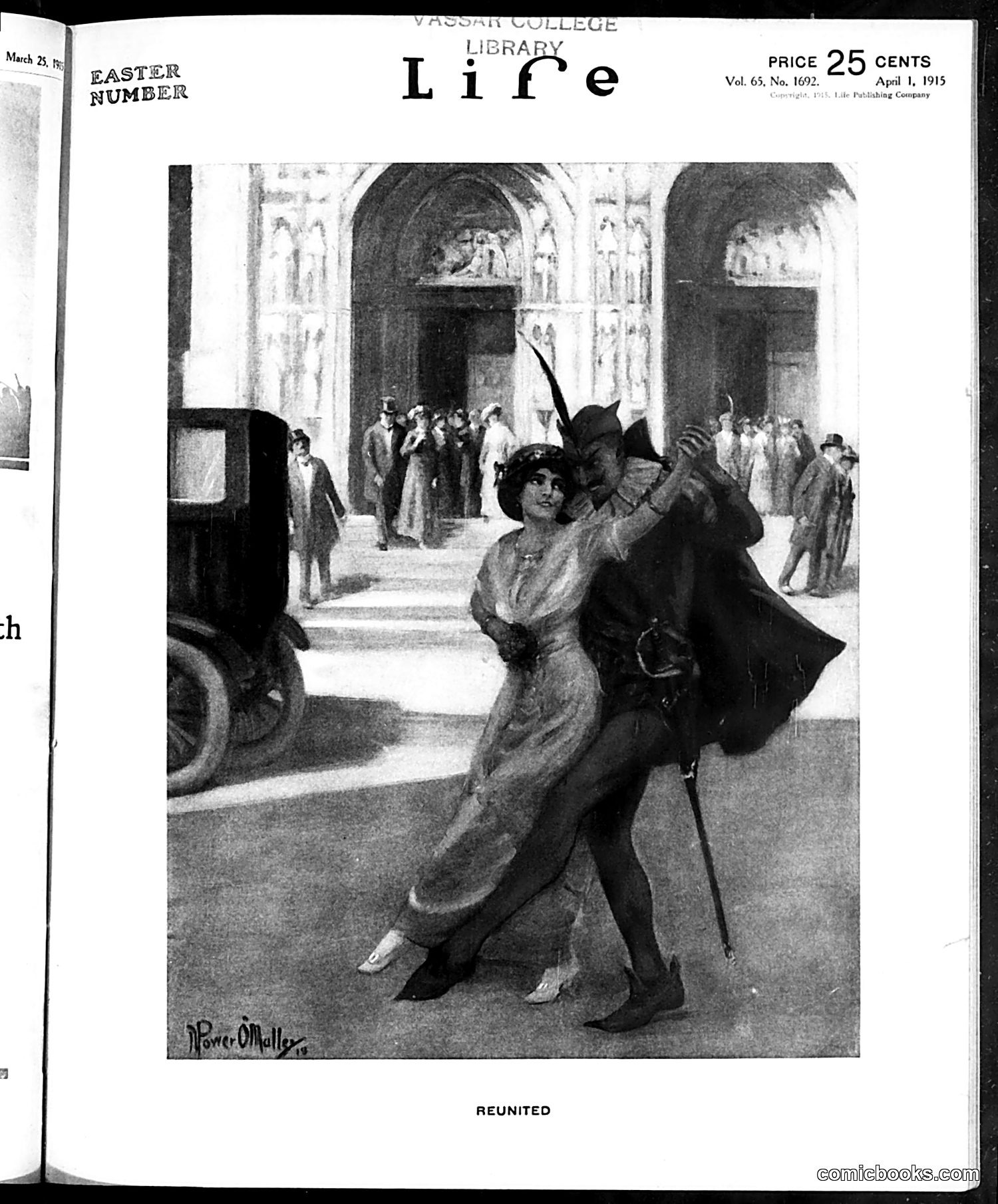
This illustration depicts a romantic reunion scene in what appears to be a European cathedral or grand building. A couple embraces emotionally in the foreground—the woman in a light dress and wide-brimmed hat, the man in a dark coat with cape. Other figures mill about in the background. Given the "Easter Number" context and the title "Reunited," this likely represents a sentimental wartime reunion. In 1915, World War I was ongoing, making separation and reunion of loved ones—soldiers and civilians—a resonant cultural theme. The European architectural setting supports this interpretation. The illustration trades in romantic idealism rather than satire, making it representative of Life magazine's patriotic, sentimental content during this period.
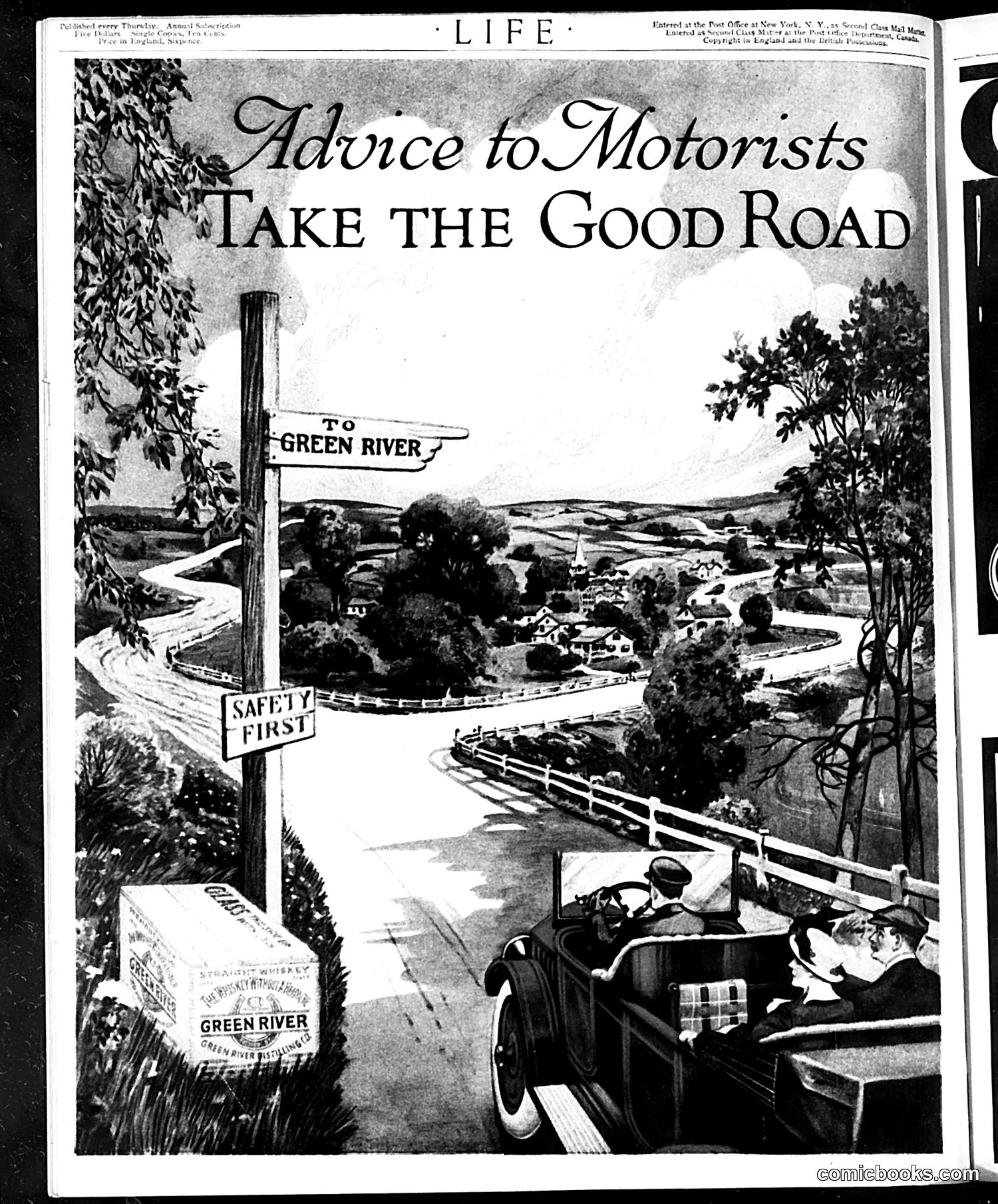
This appears to be a **Life magazine advertisement**, not political satire. The page promotes "Green River" whiskey with the headline "Advice to Motorists: Take the Good Road." The imagery depicts an idealized rural driving scene with a signpost reading "To Green River" and a "Safety First" sign. A well-dressed couple in an automobile travels through picturesque countryside with a distant village nestled in rolling hills. The advertisement uses the emerging automobile culture and road-safety messaging (popular in the early 1900s) as a marketing device. "Taking the good road" is both literal (the scenic route) and metaphorical (choosing quality whiskey). The juxtaposition of safety-conscious signage with alcohol promotion would likely be considered ironic by modern standards, reflecting different commercial attitudes of that era.
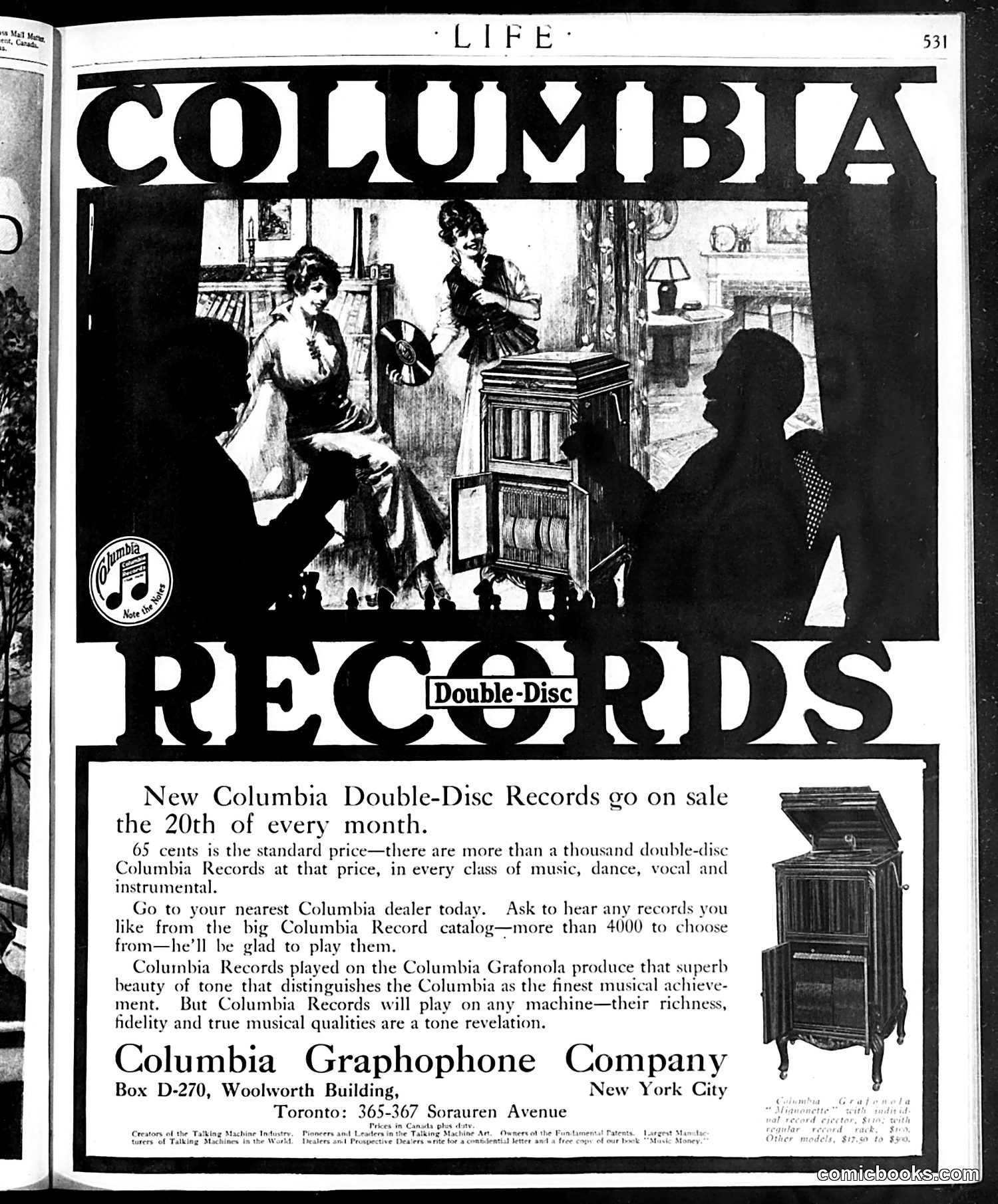
This page is primarily **advertising, not satire or political commentary**. It's a Columbia Records advertisement from *Life* magazine (page 531). The image shows a domestic interior scene with silhouetted figures — a man operating what appears to be a Columbia Graphophone (early phonograph) while women in early 20th-century dress listen. The advertisement promotes Columbia's "Double-Disc Records," sold on the 20th of each month at 65 cents, available "in every class of music, dance, vocal and instrumental." The ad emphasizes that Columbia Records play on any machine and highlights the Graphophone's superior tone quality. It directs readers to Columbia dealers in Toronto and New York City. There is **no political cartoon or satire** on this page — it's a straightforward product advertisement for recorded music technology.
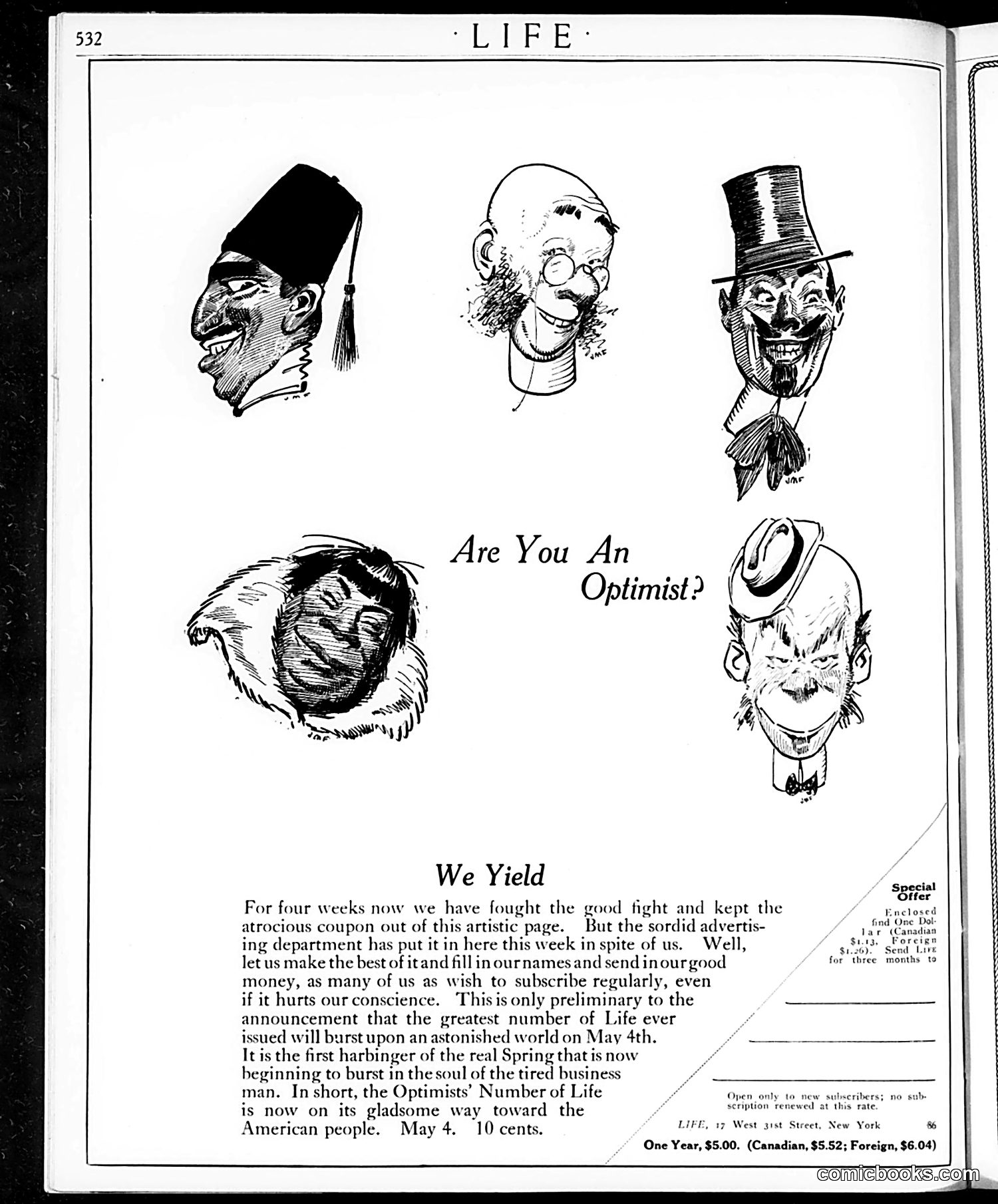
This page features five caricatured heads with exaggerated features, arranged around the question "Are You An Optimist?" The text below ("We Yield") indicates Life magazine's editorial surrender after a four-week campaign against a coupon advertisement they found objectionable. The specific identities of the caricatured figures are unclear from the image alone. However, the context suggests they may represent either: - Types of optimists or business figures - Political/public figures contemporary to the publication The satire targets the magazine's loss of editorial control—they've yielded to advertiser pressure despite their artistic objections, now promoting subscriptions themselves. The grotesque heads likely mock the irony of calling their compromise an "optimistic" outcome for readers. The date and pricing information suggests this is from approximately the 1920s-1930s era.
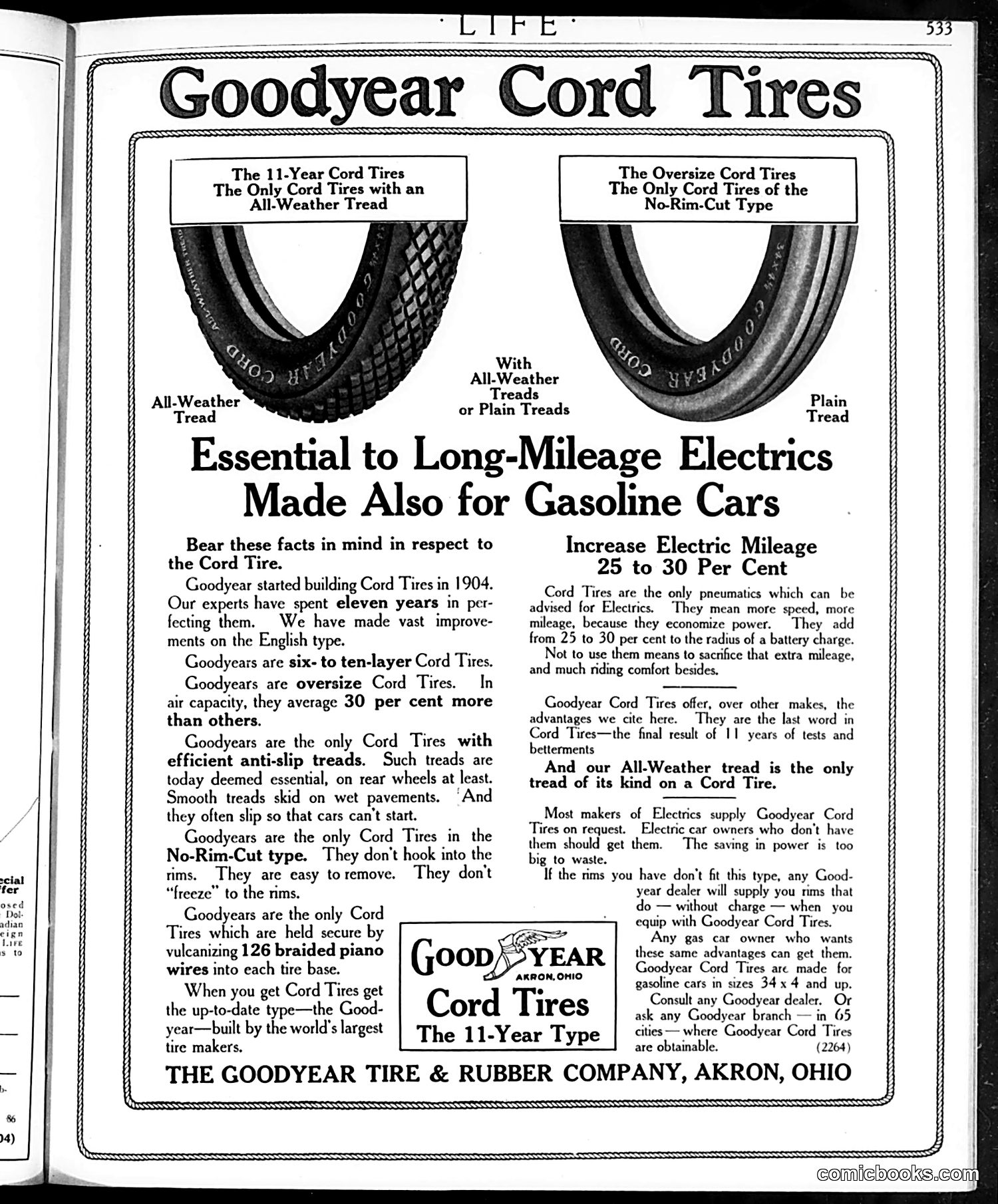
This is **not a cartoon or satirical content** — it's a straightforward advertisement for Goodyear Cord Tires from *Life* magazine (page 533). The page promotes Goodyear's tire technology to both electric and gasoline car owners, emphasizing features like: - All-weather tread patterns - "No-Rim-Cut" design - Increased mileage (25-30% improvement claimed) - Availability in multiple sizes The two tire cross-sections shown are product photography, not caricature or satire. The Goodyear logo and company name appear prominently. **Historical context**: This advertisement reflects early 20th-century automotive development, when electric vehicles competed with gasoline cars, and tire technology was a major selling point for vehicle performance. This is commercial advertising, not political satire.
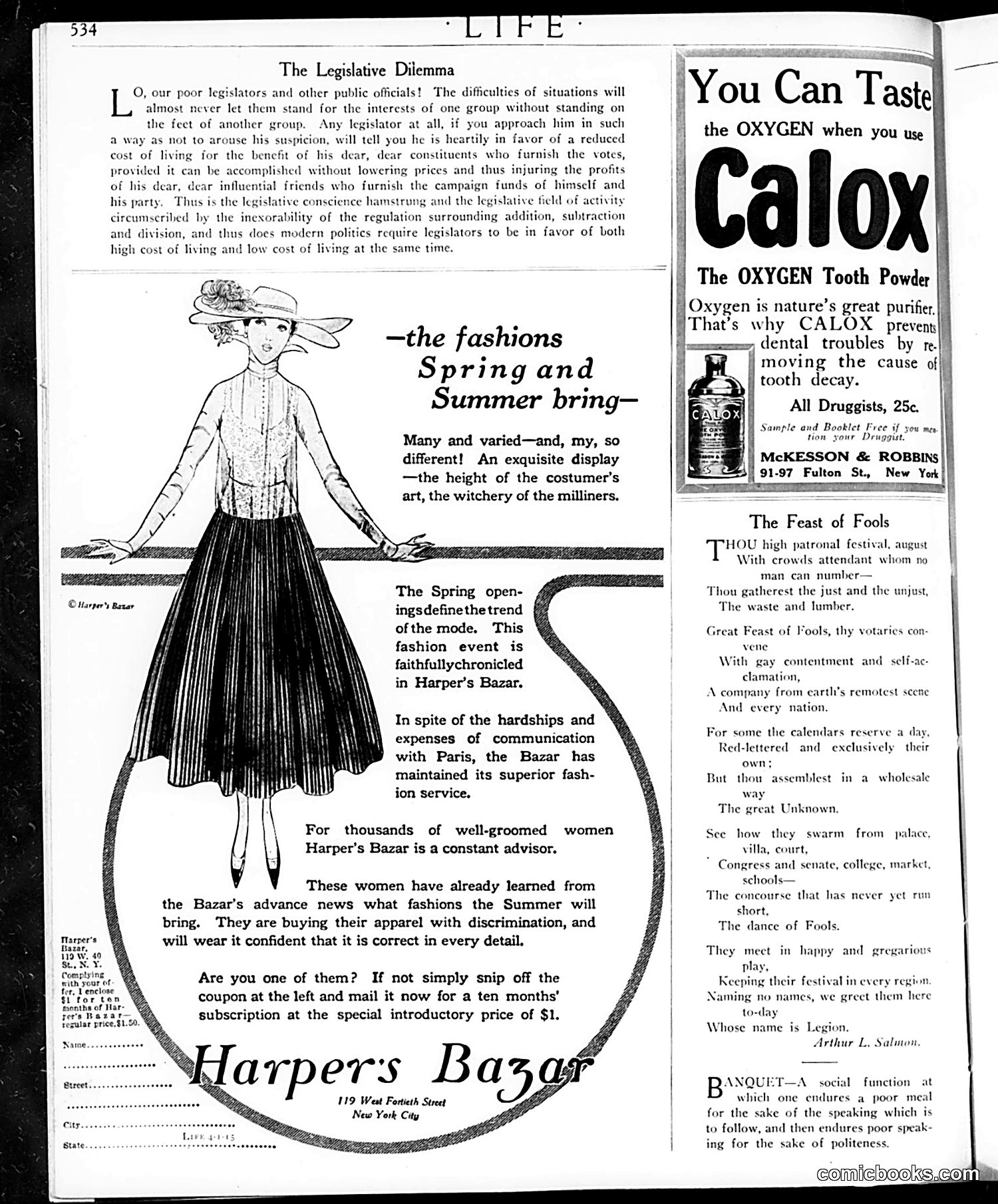
This page is primarily **advertising and fashion content** rather than political satire. The left side features a Harper's Bazaar advertisement promoting spring/summer fashion trends, with an illustration of a stylishly-dressed woman in a pleated skirt and wide-brimmed hat. The ad emphasizes Harper's Bazaar's role as a fashion authority, claiming it helps "well-groomed women" stay current with trends. The top article, "The Legislative Dilemma," discusses politicians' impossible task of simultaneously supporting both high and low costs of living—a genuine policy tension rather than satire. The right side contains unrelated advertisements (Calox tooth powder) and a poem called "The Feast of Fools" by Arthur L. Salmon about a festival. This page primarily serves as a **vehicle for advertising and lifestyle content** typical of early-20th-century Life magazine.
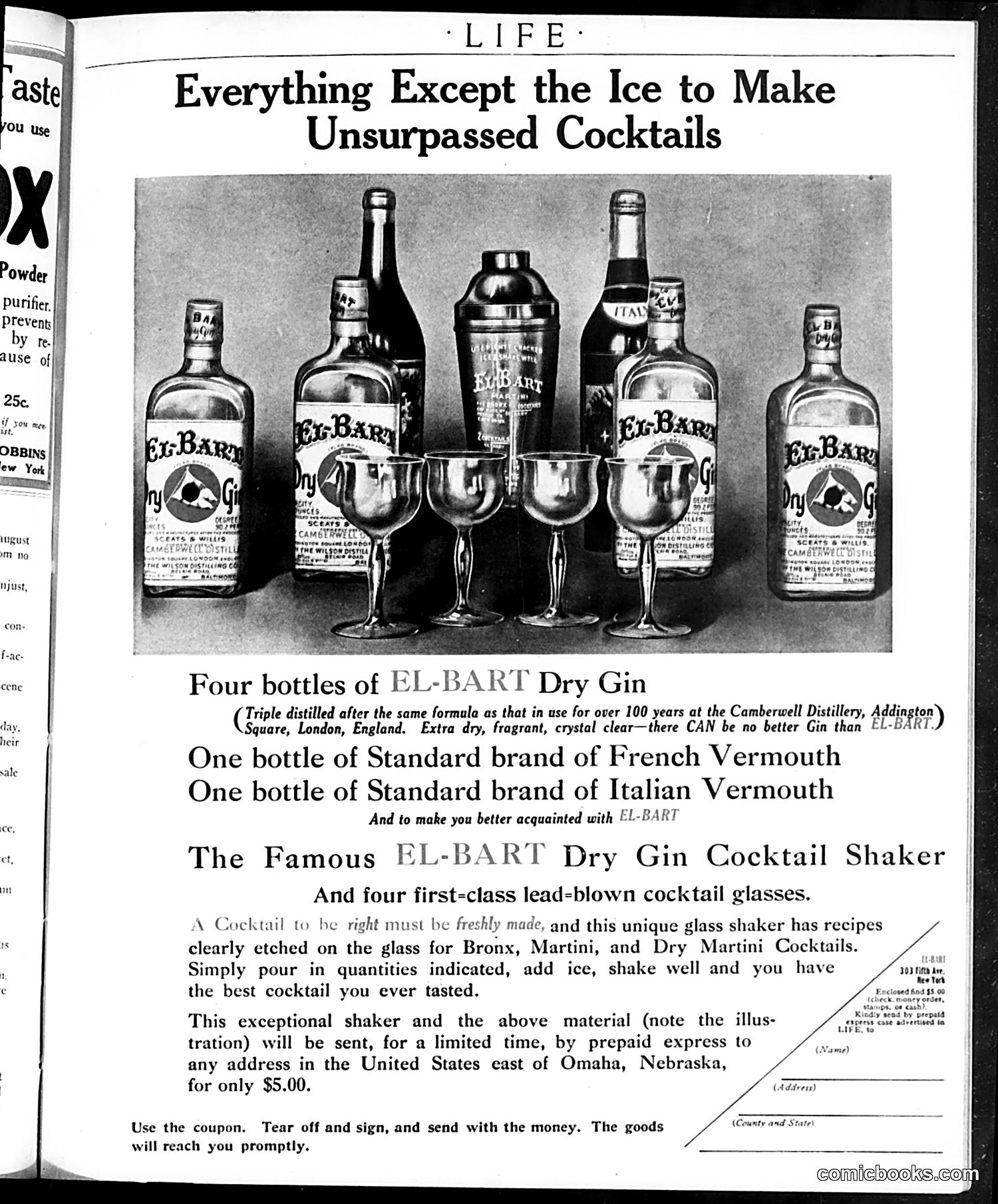
This is **not a political cartoon or satire page**—it is a straightforward **advertisement** for El-Bart Dry Gin. The ad promotes a cocktail-making kit that includes four bottles of gin, French and Italian vermouth, a cocktail shaker with etched recipe guides, and four lead-blown cocktail glasses. The headline's phrase "Everything Except the Ice" is a literal description: the kit provides all cocktail ingredients and equipment except ice, which customers would add themselves. The ad emphasizes the gin's pedigree (triple-distilled using a 100-year-old formula from Camberwell Distillery in London) and promises quality cocktails if made fresh with the provided shaker. The price is $5.00, available east of Omaha, Nebraska, via prepaid express mail. This reflects early 20th-century **advertising in Life magazine** before Prohibition—no satire intended.
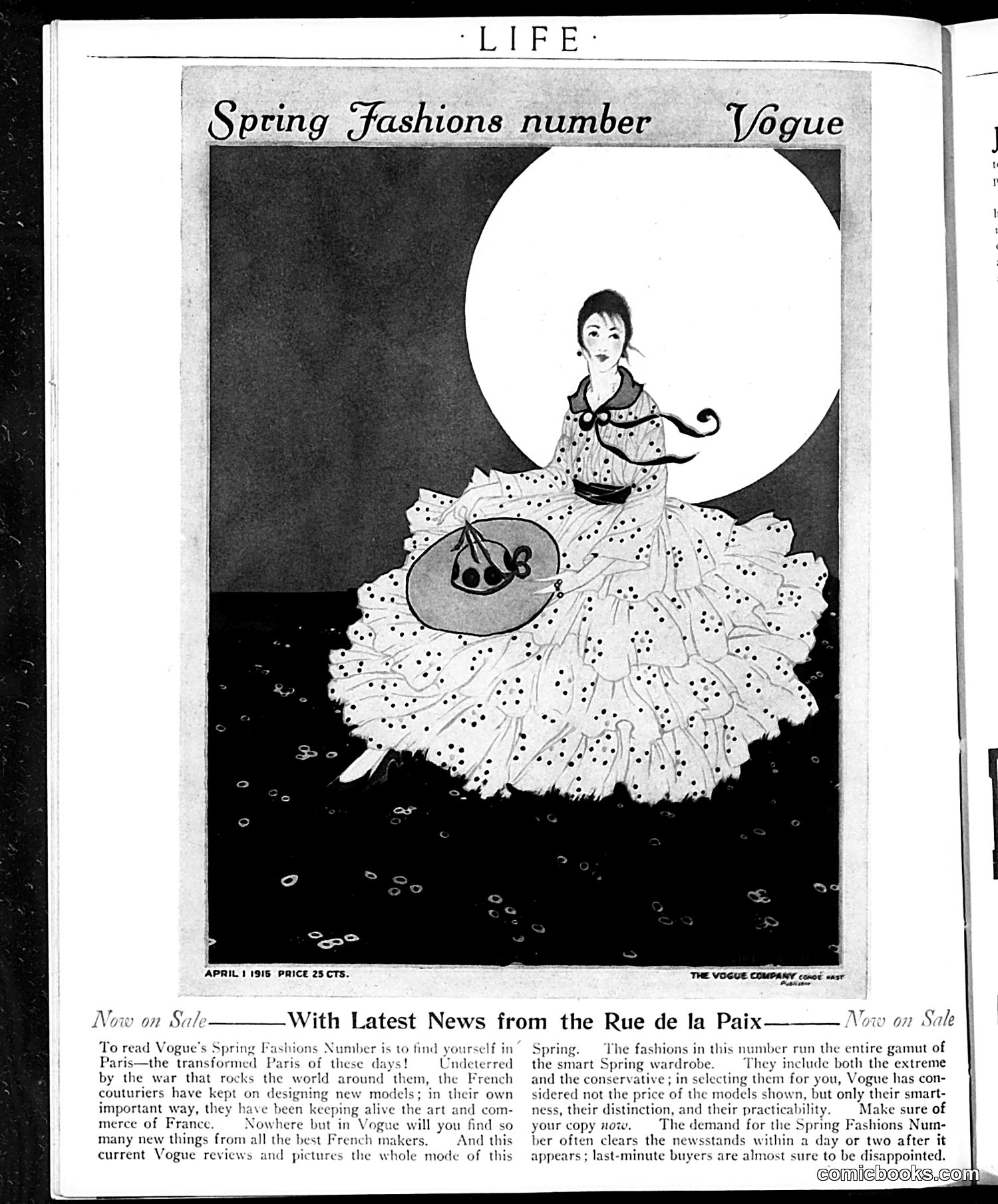
This is a fashion advertisement/editorial page rather than political satire. It promotes Vogue magazine's Spring Fashions issue, dated April 1, 1915, priced at 25 cents. The illustration depicts an elegantly dressed woman in an elaborate polka-dotted dress with a wide, ruffled skirt and a decorative hat, holding a fashionable handbag. A large moon glows behind her against a dark sky. The accompanying text emphasizes that Paris remains the fashion authority despite World War I disruptions ("the war that rocks the world around them"). It promises readers will find the latest spring wardrobe designs, describing fashions ranging from "extreme to the conservative," and notes that smart buyers should purchase the issue promptly to avoid disappointment.
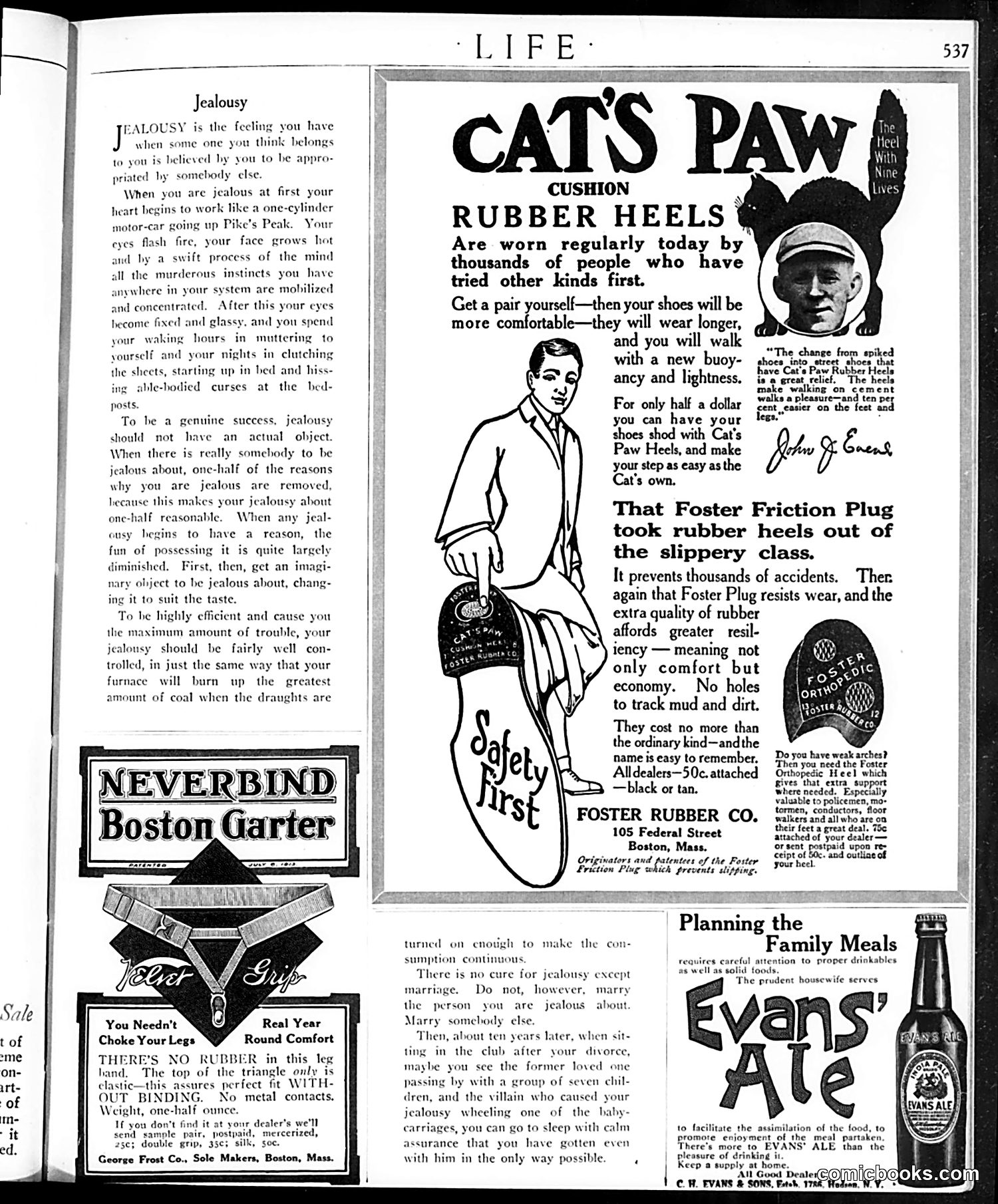
This page is primarily **advertising content** rather than satire or editorial cartooning. The main advertisement features **Cat's Paw Rubber Heels** — a shoe repair product. The ad uses a man demonstrating the heel product and includes a testimonial (signed "John J. Generel") praising the Foster Friction Plug technology that supposedly prevents accidents and offers comfort. The left side contains advertisements for **Neverbind Boston Garter** (with an illustration of leg wear) and **Evans' Ale** (a beverage). Above these is an editorial piece titled **"Jealousy"** — a satirical essay on the emotion itself, not a political cartoon. This appears to be a standard early 20th-century magazine page mixing consumer advertisements with lighter editorial content.
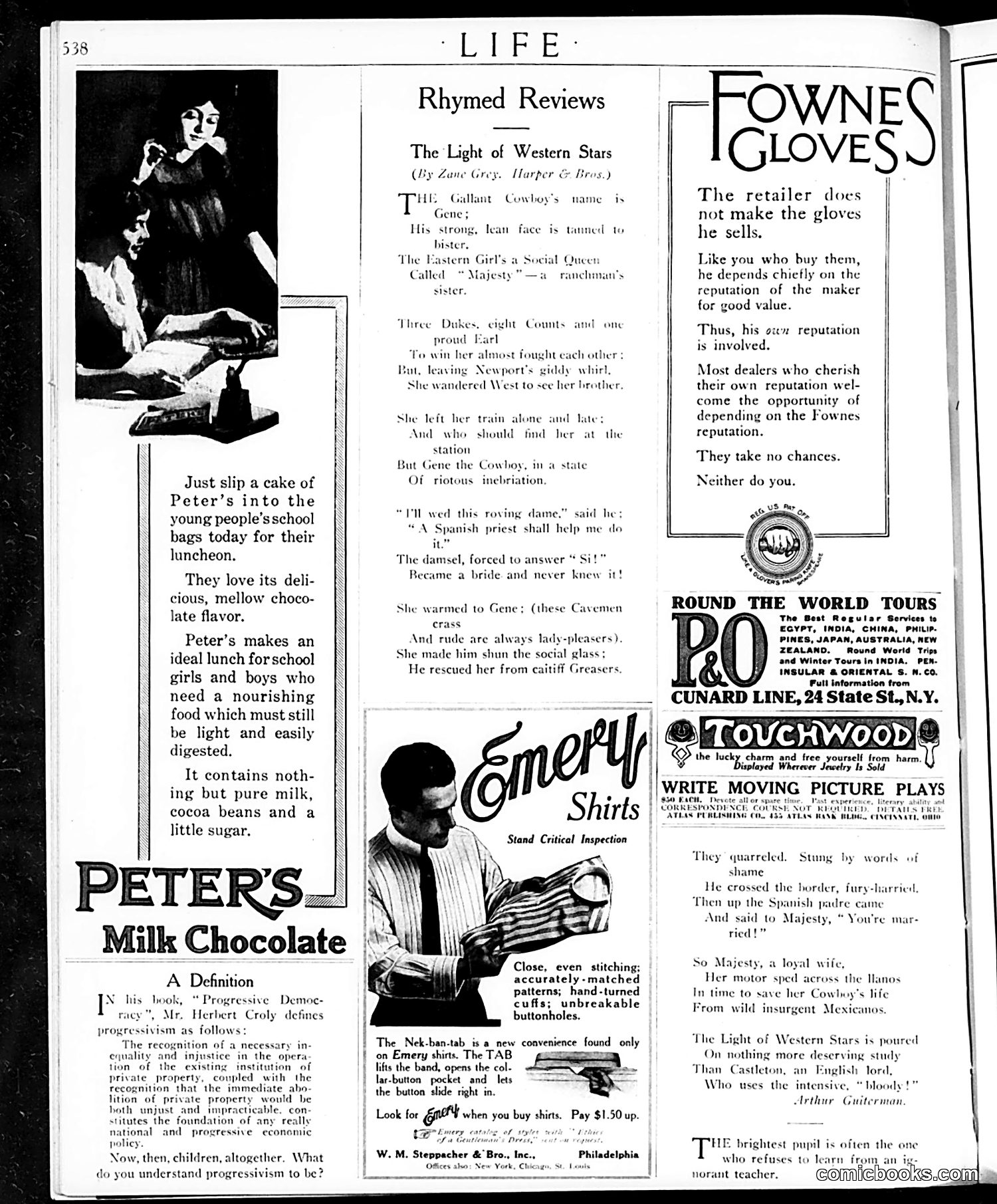
This page is primarily **advertising and light editorial content** rather than political satire. The main elements include: **"Rhymed Reviews"** — a humorous poem about *The Light of Western Stars*, a romantic novel featuring cowboys, dukes, and dramatic love entanglements. The verse mocks the melodramatic plot conventions of popular fiction. **Advertisements** dominate: Peter's Milk Chocolate (targeting schoolchildren), Emery Shirts (emphasizing quality stitching), Fownes Gloves (stressing maker reputation), and travel services. The tone is **lighthearted social commentary** on consumer goods and popular literature rather than political cartoon satire. The page reflects early 20th-century American magazine culture mixing entertainment, literature reviews, and commercial advertising.
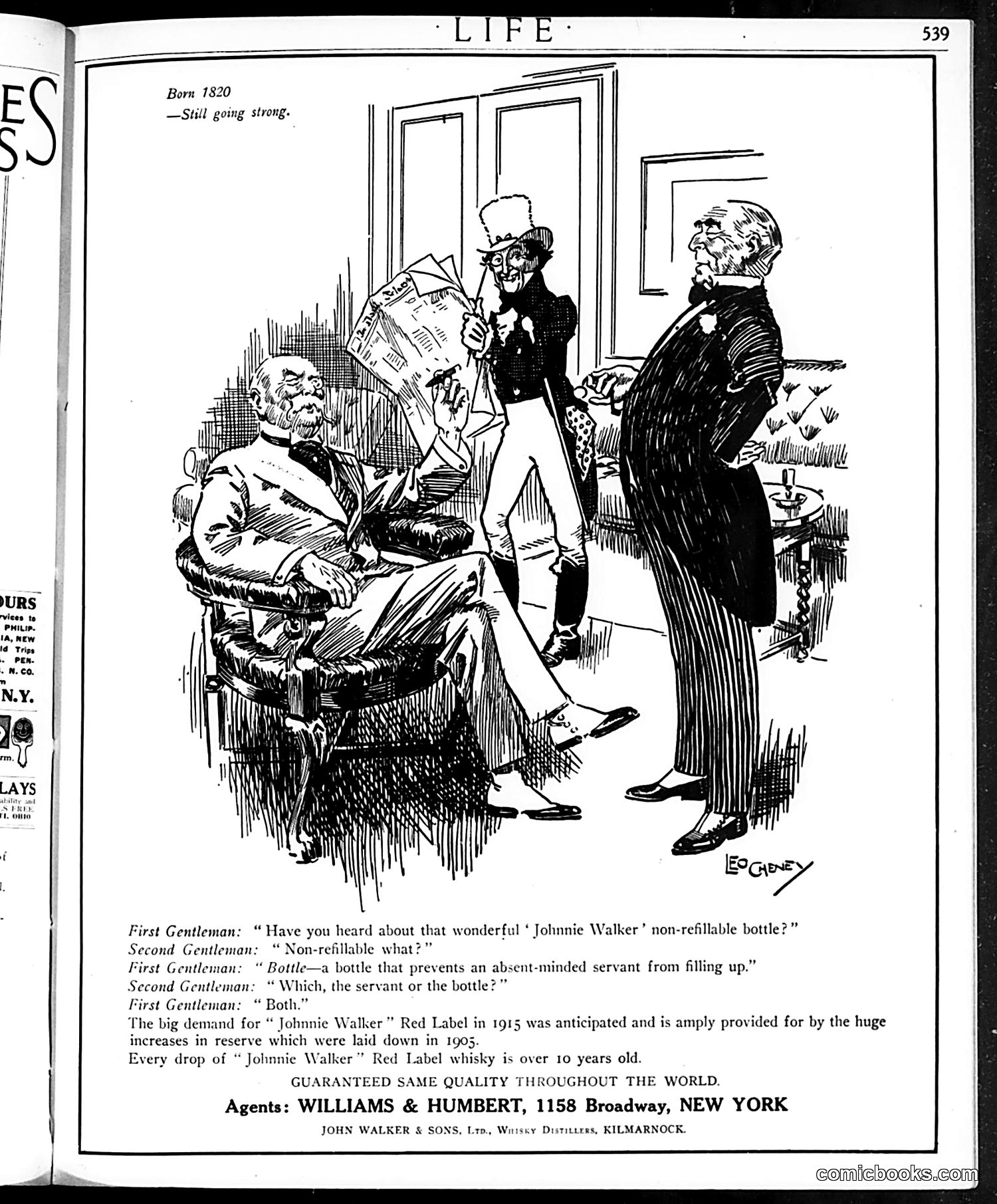
This is primarily a **Johnnie Walker whisky advertisement** disguised as a cartoon joke, published in Life magazine (page 539). The illustration shows three gentlemen in conversation about "Johnnie Walker" whisky's non-refillable bottle. The joke plays on a double meaning: the bottle itself prevents servants from secretly refilling it with cheaper liquor, but the "non-refillable" feature also humorously prevents an absent-minded servant from being filled (getting drunk). The ad emphasizes that Johnnie Walker Red Label whisky maintains consistent quality and has been aged over 10 years. It targets wealthy readers concerned about servant theft or adulteration of expensive spirits—a genteel class anxiety of the early 20th century. The agents listed are Williams & Humbert in New York and John Walker & Sons in Kilmarnock, Scotland.
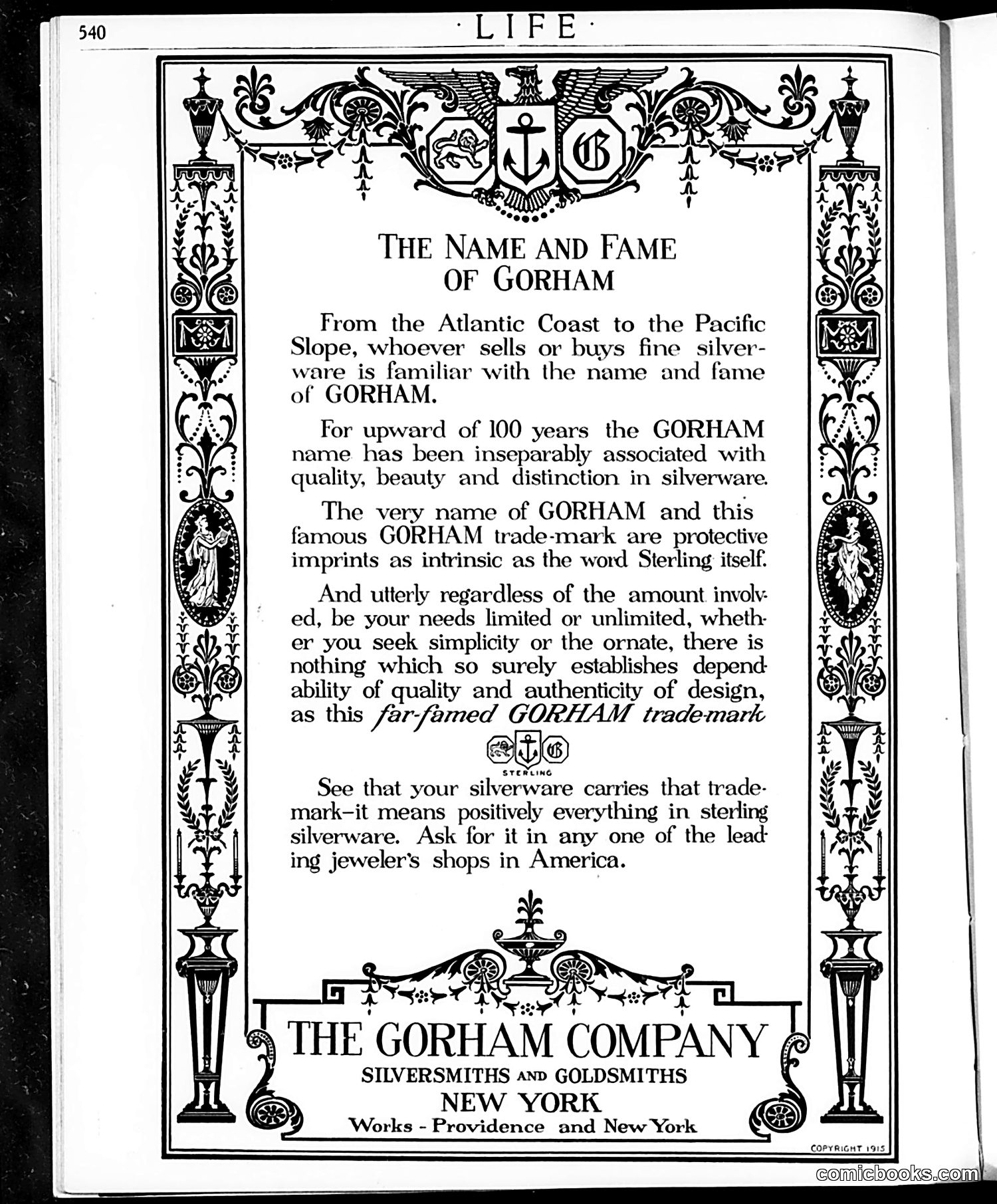
This is **not a cartoon or satirical content**—it's a full-page advertisement for the Gorham Company, silversmiths and goldsmiths based in New York. The ad makes marketing claims about Gorham's reputation: over 100 years of association with quality silverware, the protective value of their trade-mark (shown with an anchor symbol), and assertions that their name guarantees authenticity and design quality comparable to "Sterling" itself. The ornate decorative border and formal typography are typical of early 20th-century luxury advertising. The final instruction—"Ask for it in any one of the leading jeweler shops in America"—reflects the distribution strategy of the era. This appears in *Life* magazine's advertising section, not its editorial or humor pages.
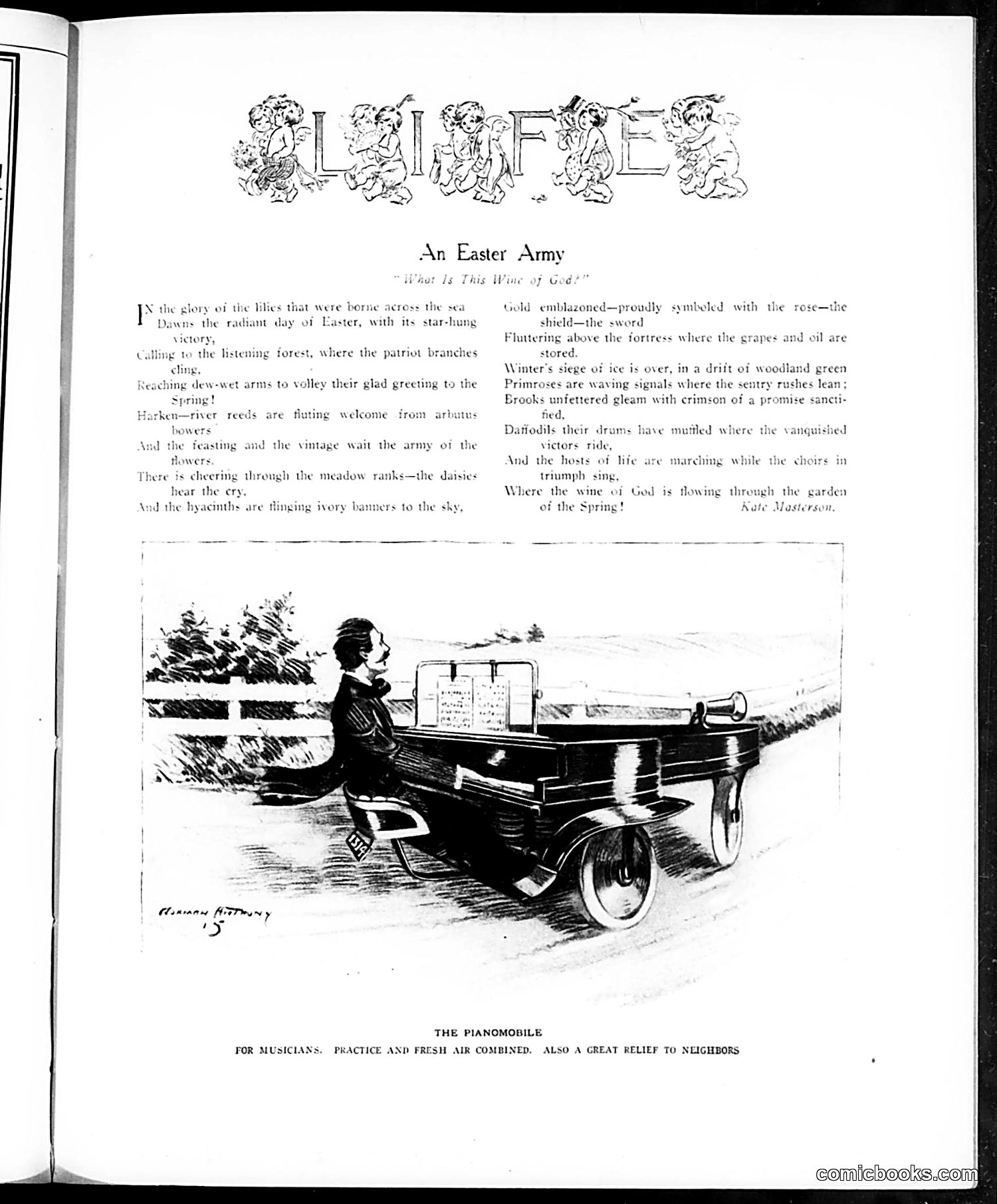
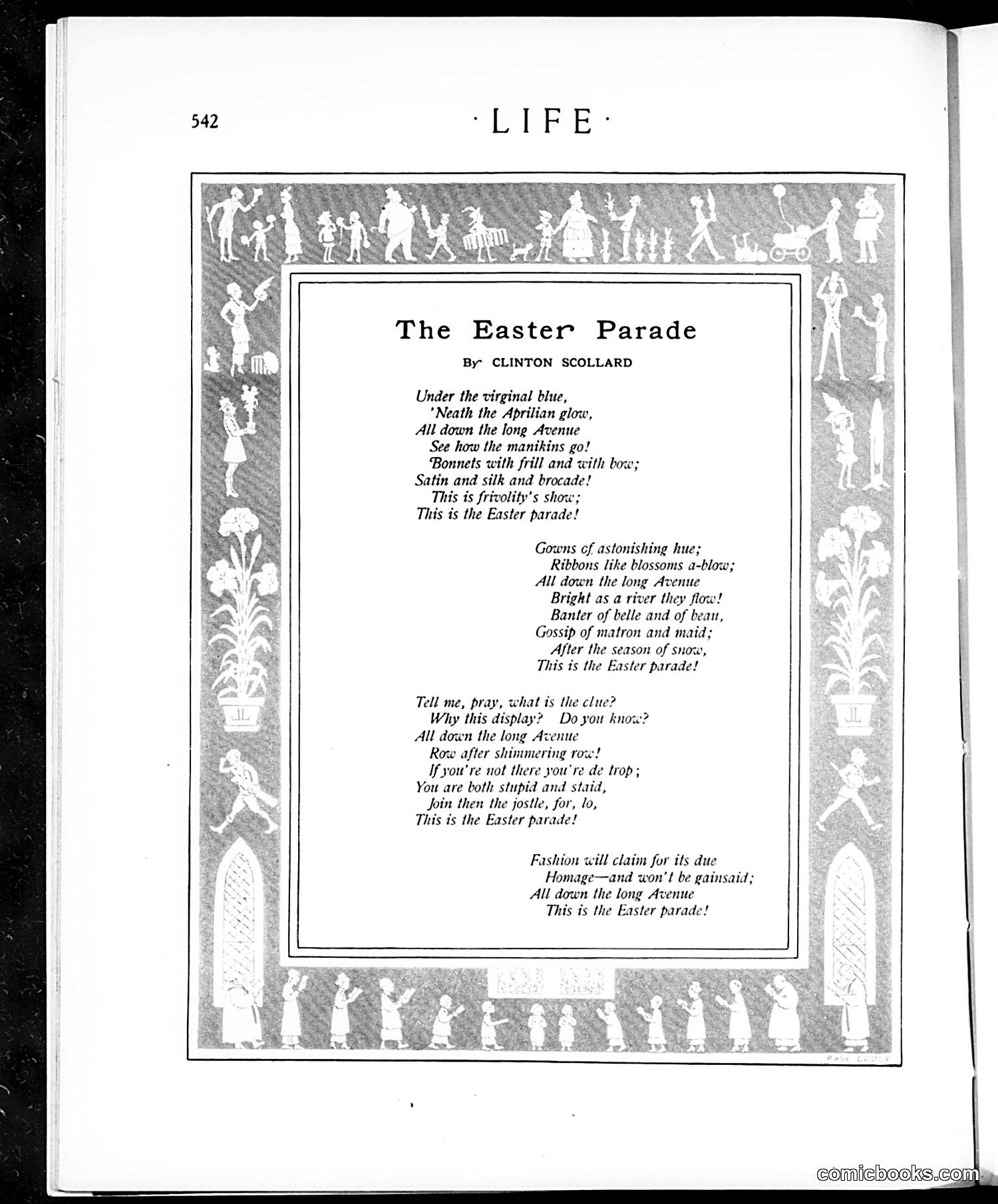
This is a poem rather than a political cartoon. It celebrates the Easter Parade—a real social tradition where New Yorkers, particularly fashionable women, displayed new spring clothing by walking down Fifth Avenue on Easter Sunday. The poem humorously captures the spectacle: elaborate bonnets and gowns, ribbons, silk, and brocade paraded "all down the long Avenue." The satirical edge appears in the final stanza, which notes that "Fashion will claim for its due / Homage—and won't be gainsaid," suggesting gentle mockery of fashion's power and vanity. The decorative border features silhouettes of people in period dress, emphasizing the parade's costume-like quality—the Easter Parade as public fashion theater rather than religious observance.
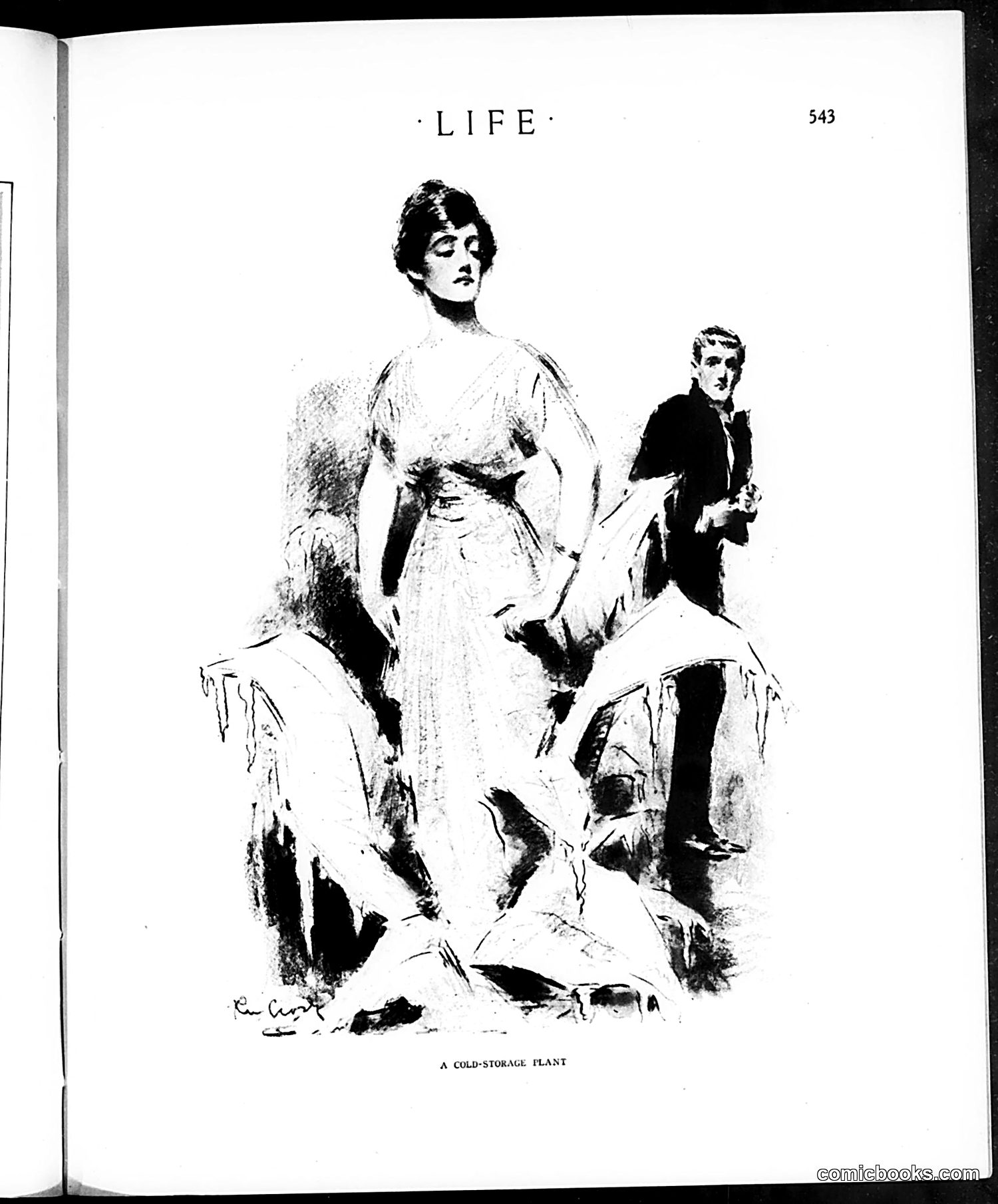
This is a satirical illustration from *Life* magazine (page 543) titled "A Cold-Storage Plant." The sketch depicts a woman in an elegant white Edwardian-era dress standing prominently, with two men in dark suits positioned behind her—one appearing somewhat removed or distant. The title's pun on "cold storage" (literal warehouse refrigeration) suggests the cartoon ridicules a woman being preserved or kept idle—likely commentary on restrictive gender roles or a specific society woman. The men's positioning and body language suggest they control or confine her, while she maintains a dignified but distant pose. Without additional context identifying the specific figures or dated reference, the satire appears to critique early 1900s attitudes toward women's autonomy and their treatment as decorative rather than active social participants.
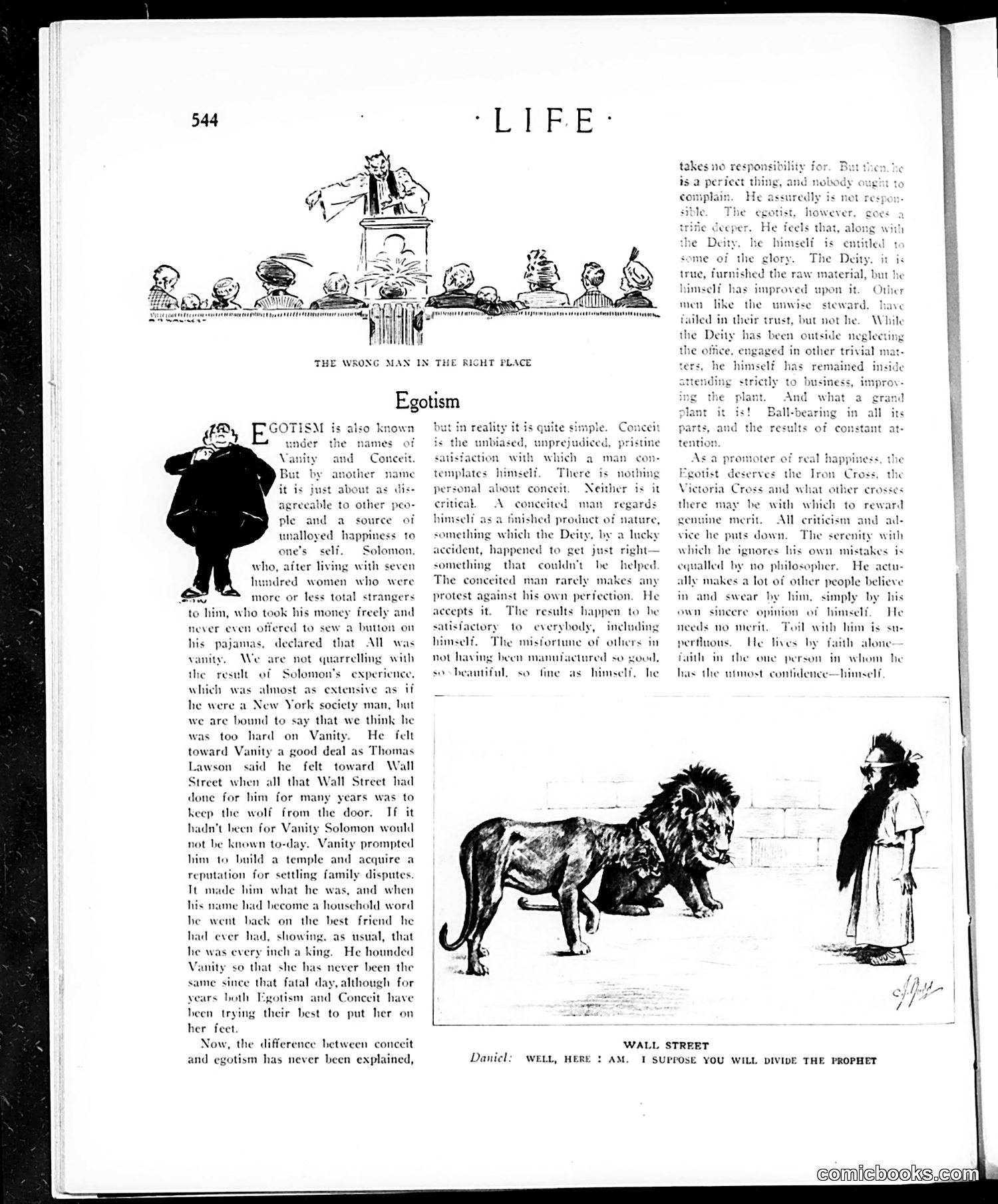
This page distinguishes between two character types through satirical prose and illustration. The top cartoon shows "The Wrong Man in the Right Place"—a figure at a podium addressing a crowd, presumably illustrating someone unfit for authority. The main article defines **Egotism** versus Conceit. An egotist believes himself self-made and superior, taking credit for all success while denying responsibility for others' misfortunes. A conceited person simply accepts his own perfection without protest. The text uses **Solomon** as a historical example—a man who built temples through vanity, then abandoned it. The lower cartoon titled "Wall Street" shows a woman with lions, captioned: "Well, here I am. I suppose you will divide the prophet." This likely references **Daniel in the lions' den** (biblical reference), darkly joking that Wall Street—personified as a woman—will "devour the prophet" (perhaps a financial forecaster or critic). The satire targets Wall Street's predatory nature toward outsiders.
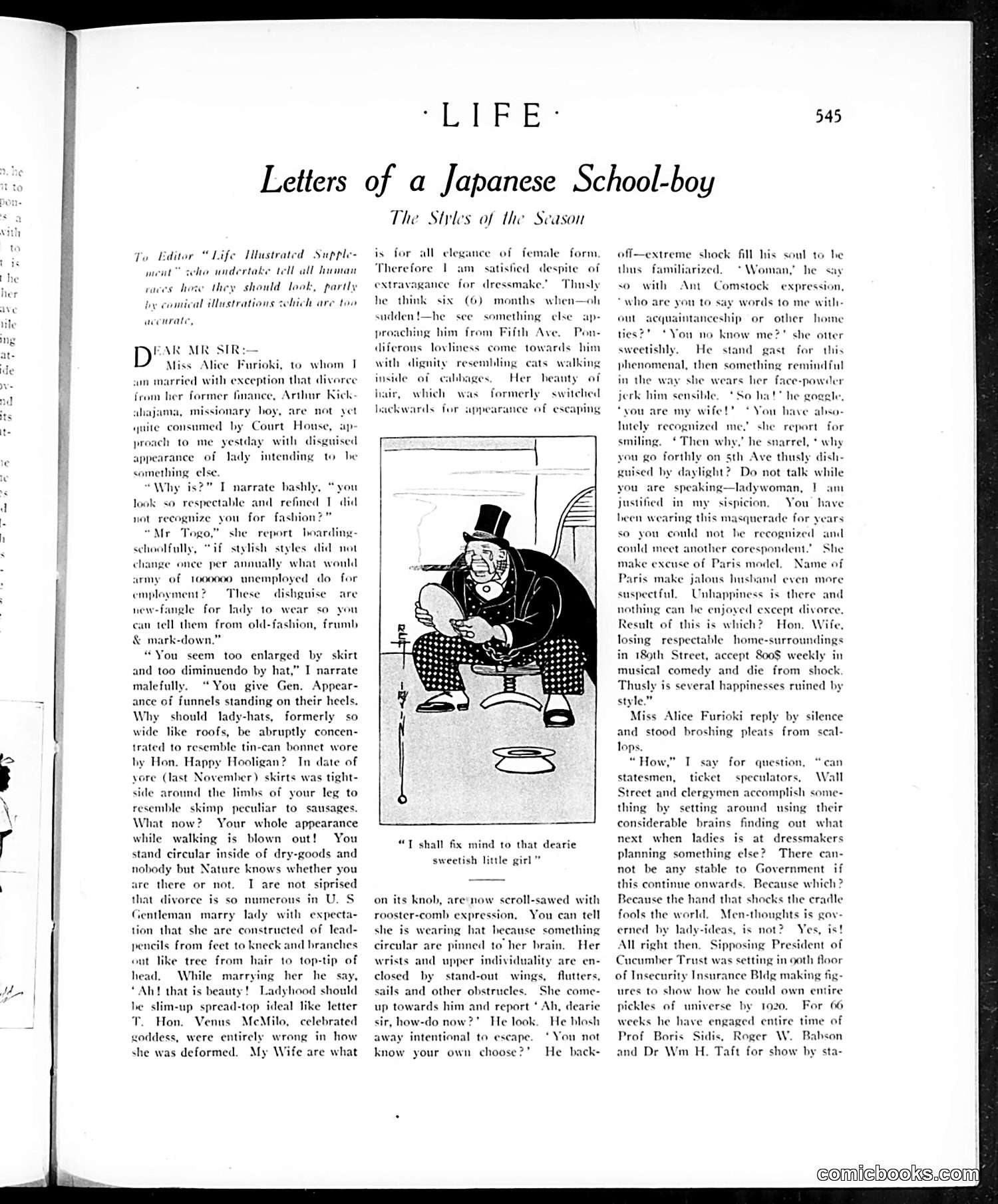
This is a satirical letter written in deliberately broken English by a Japanese writer critiquing American women's fashion changes. The cartoon shows a Japanese man in traditional dress observing Western fashion. The humor relies on several layers: 1. **The "Foreigner Perspective" Device**: Life magazine uses exaggerated fractured English to satirize both the speaker and his targets—American women's rapidly changing fashions. 2. **The Actual Target**: Despite the Japanese narrator framing, the real satire attacks American women's clothing styles. Women's fashion was changing dramatically in this era (the reference to "last November" suggests recent shifts), moving from fitted silhouettes toward looser, more voluminous designs. 3. **The Hypocrisy Angle**: The letter suggests women wear disguises and masquerades to hide infidelity or deception, blaming fashion changes for marital discord. 4. **Period Context**: The mention of "Anthony Comstock" (a real censorship crusader) and references to "Paris models" reflect early 1900s concerns about European fashion's "corrupting" influence on American morality. The satire ultimately mocks both the writer's outdated views and American fashion's rapid, confusing evolution.
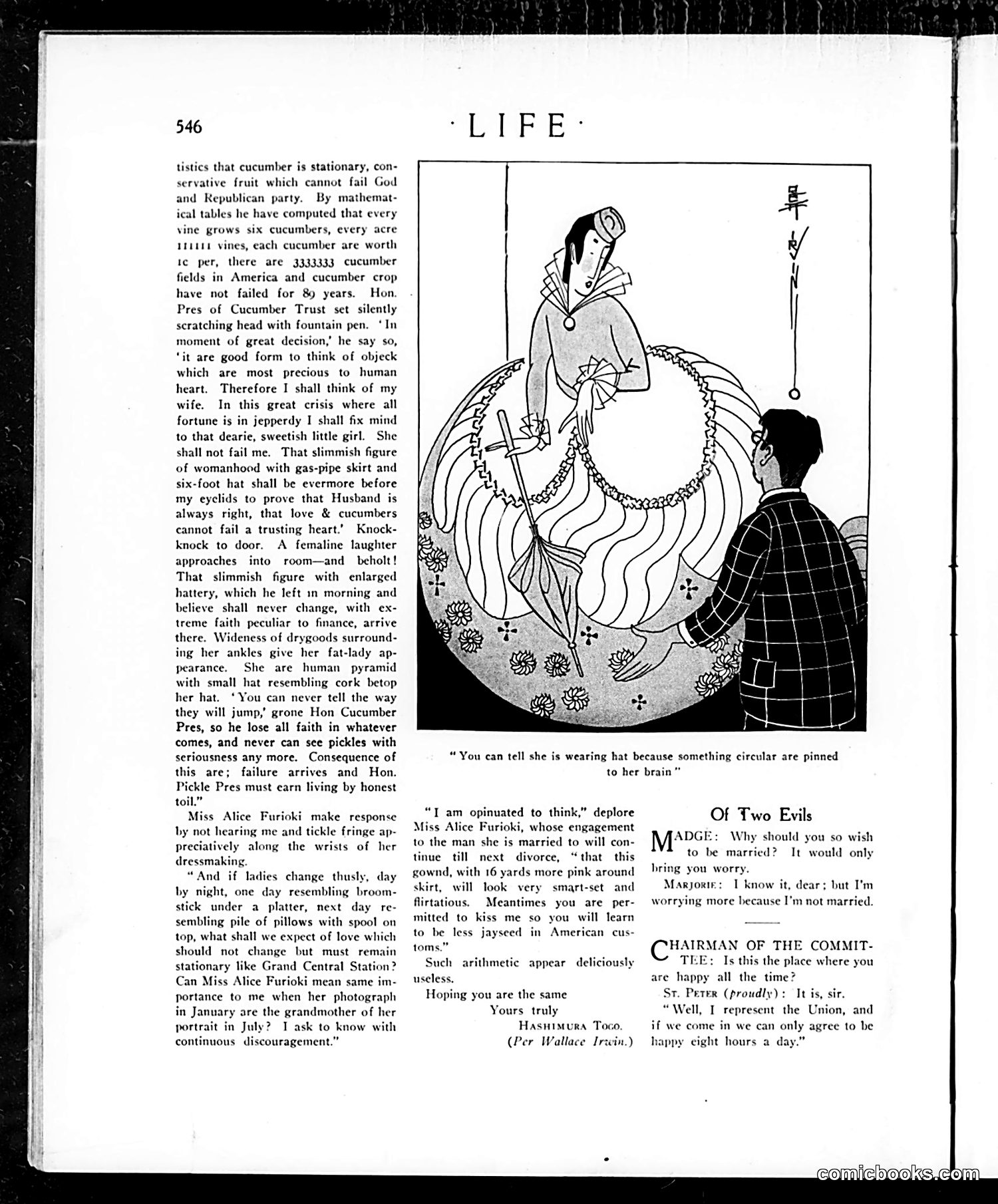
This page satirizes turn-of-the-century anxieties about women's fashion and marital instability. The main cartoon depicts a woman whose extravagant hat and voluminous skirts have become so enormous that her husband (the "Cucumber Trust President") loses faith in constancy itself—comparing women's unpredictability to market collapse. The joke plays on the absurdity of elaborate Edwardian women's fashion (16-yard skirts, impossibly tall hats) as evidence of female unreliability. The accompanying text mocks a wealthy businessman whose trust in cucumbers parallels his faith in his wife; when she arrives transformed by fashionable dress, both collapse. The lower section includes period humor about women's multiple appearances and the caption's joke that something "circular" on the hat proves its existence—satirizing the sheer illogic of contemporary fashion. The page reflects anxieties about women's changing roles and the perceived frivolity of women's fashion as threatening to masculine certainty.
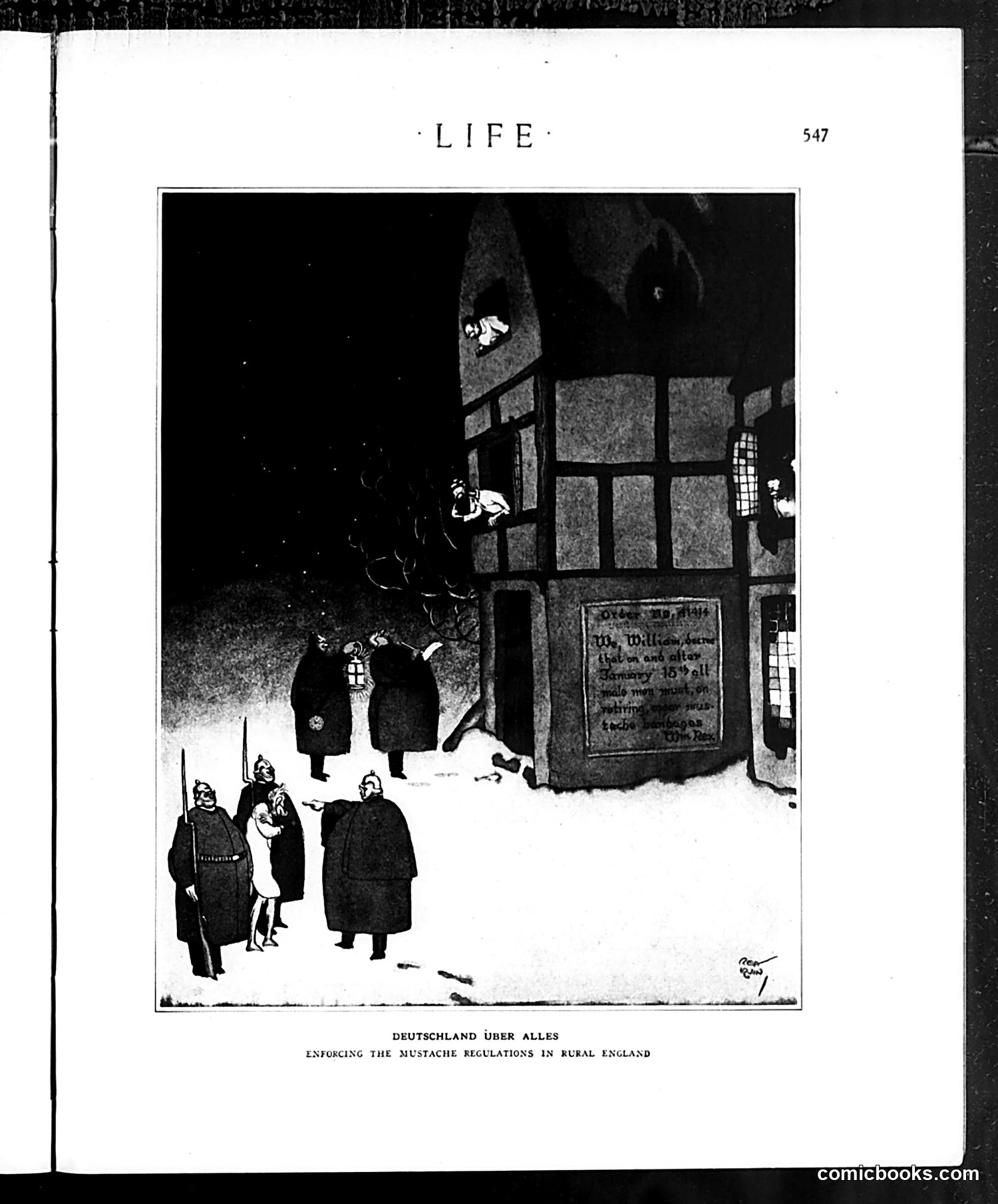
This satirical cartoon mocks Nazi Germany's authoritarian control by imagining German soldiers enforcing absurd "mustache regulations" in rural England—a fictional scenario that never occurred. The image shows armed German military personnel confronting English villagers outside a church, apparently inspecting or enforcing facial hair standards. The satire works on multiple levels: 1. **"Deutschland Über Alles"** references Nazi Germany's imperial ambitions and the famous nationalist motto 2. The absurdity of enforcing mustache rules satirizes Nazi obsession with rigid control and conformity 3. The English church setting implies a German invasion/occupation scenario 4. The cartoon ridicules both Nazi authoritarianism and British anxieties about potential German invasion during the pre-WWII or early WWII period The joke lies in depicting totalitarian control descending into petty, farcical micromanagement of citizens' appearance.
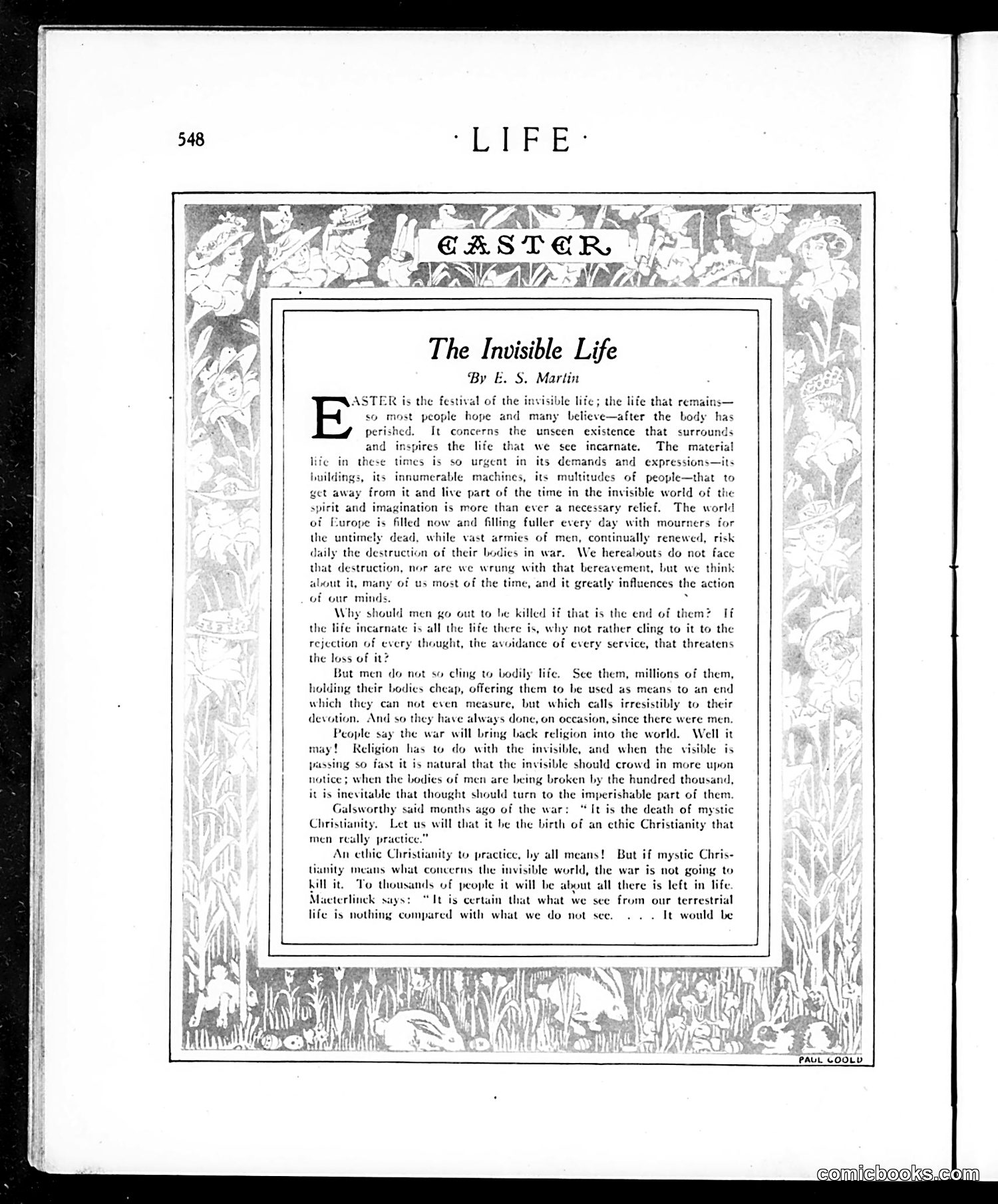
This is an editorial essay (not a cartoon) by E.S. Martin published in *Life* magazine around Easter, during World War I. The piece uses the holiday's spiritual significance to contemplate mortality and faith amid the war's massive casualties. Martin argues that widespread death in Europe has made the "invisible life"—the spiritual realm and afterlife—urgently relevant. He questions why men sacrifice their bodies for causes they cannot fully understand, yet observes they do so anyway, suggesting an innate human devotion to something beyond material existence. The essay references contemporary thinkers (Galsworthy, Maeterlinck) debating whether the war will revive religion. Martin distinguishes between "mystic Christianity" (concerned with the invisible/spiritual) and "ethic Christianity" (practical morality), suggesting the war's horrors paradoxically force people to contemplate spiritual rather than material life. The ornamental border and page design reflect *Life*'s sophisticated aesthetic approach to serious cultural commentary.
This page presents philosophical commentary on spirituality and warfare during World War I, featuring decorative classical borders with figures and ornaments. The text discusses how modern materialism and efficiency-focused thinking (represented by figures like "Dr. Eliot") neglect "the invisible life"—spiritual and intangible forces. The author argues that religion's strength lies in maintaining connection with the invisible/spiritual realm, despite historical abuses. The piece extends this framework to war itself, citing French General Joffre's observation that "chance" (unexplainable forces) influences military outcomes. The author suggests spiritual forces genuinely operate in the Great War. The conclusion draws a stark contrast: Germans represent pure materialism and cannot comprehend non-material forces, while Russians possess spiritual understanding that makes them willing to die—implying Russia's spiritual superiority gives it hidden strength. This reflects early WWI-era Western attitudes romanticizing Russian spirituality while portraying German culture as soulless and mechanical.
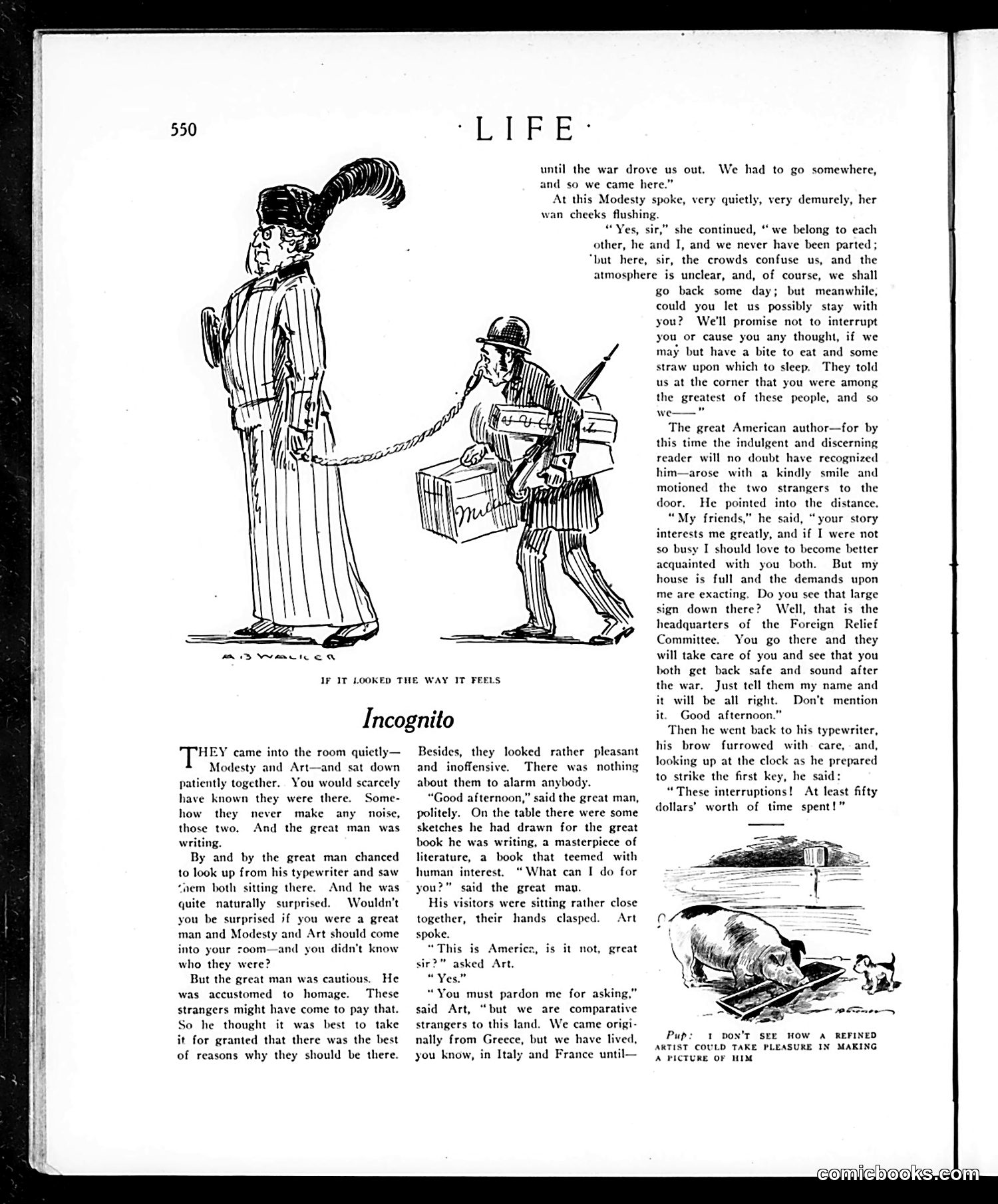
This story satirizes American literary celebrities and their selective charity. Two allegorical figures—**Modesty and Art**—personified as refugees from war-torn Europe, approach a famous American author seeking shelter and food. The author, initially courteous, quickly redirects them to the Foreign Relief Committee rather than offer personal hospitality. The satire's point: prominent American writers publicly champion causes and accept praise for their cultural importance, yet avoid actual inconvenience. The author prefers to donate his **name** to an organization rather than provide material help—delegating charity while maintaining his reputation. The cartoon's title, "If It Looked the Way It Feels," and the accompanying illustration of an artist sketching a sleeping vagrant suggest the gap between artistic sympathy and real action. The final dialogue about "fifty dollars' worth of time spent" emphasizes the author's self-importance over genuine assistance.
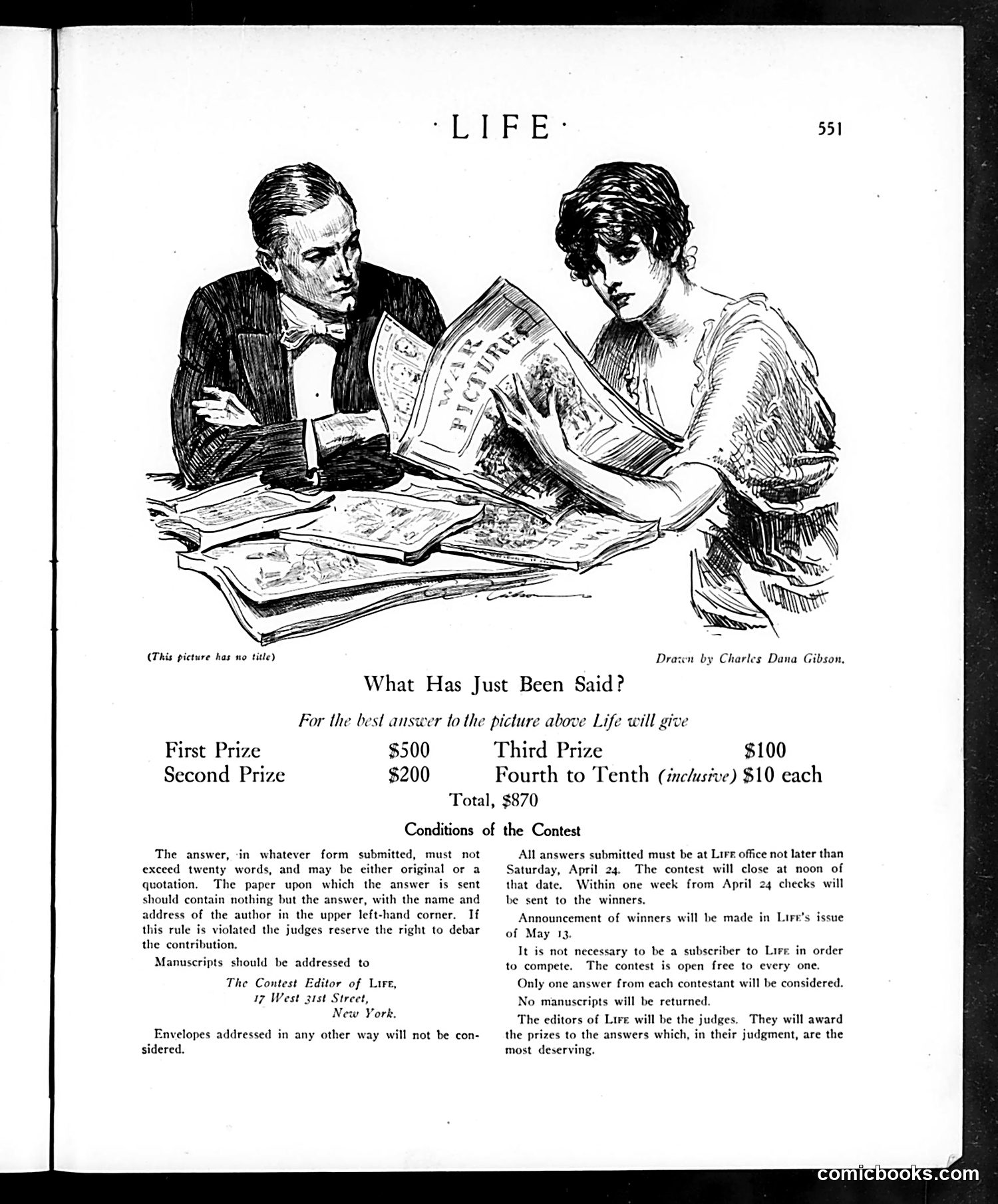
This page features a famous illustration by **Charles Dana Gibson**, the renowned cartoonist known for depicting idealized American women ("Gibson Girls"). The drawing shows a well-dressed couple examining illustrated magazines or publications together—likely depicting a romantic or domestic moment of shared leisure. **Life's Contest**: Rather than providing context or explanation, the magazine challenges readers to caption the image, asking "What Has Just Been Said?" Contestants could win up to $500 for the best answer (maximum twenty words). **The Satire**: The joke likely turns on the ambiguity of the couple's interaction—are they having a meaningful conversation, making idle remarks, or is one person ignoring the other? Gibson's illustration style typically carried subtle social commentary about relationships and gender dynamics in early 20th-century America. **Historical Context**: This was a common interactive feature in *Life*—a humorous, highbrow magazine that engaged readers while showcasing illustration talent and generating reader participation.
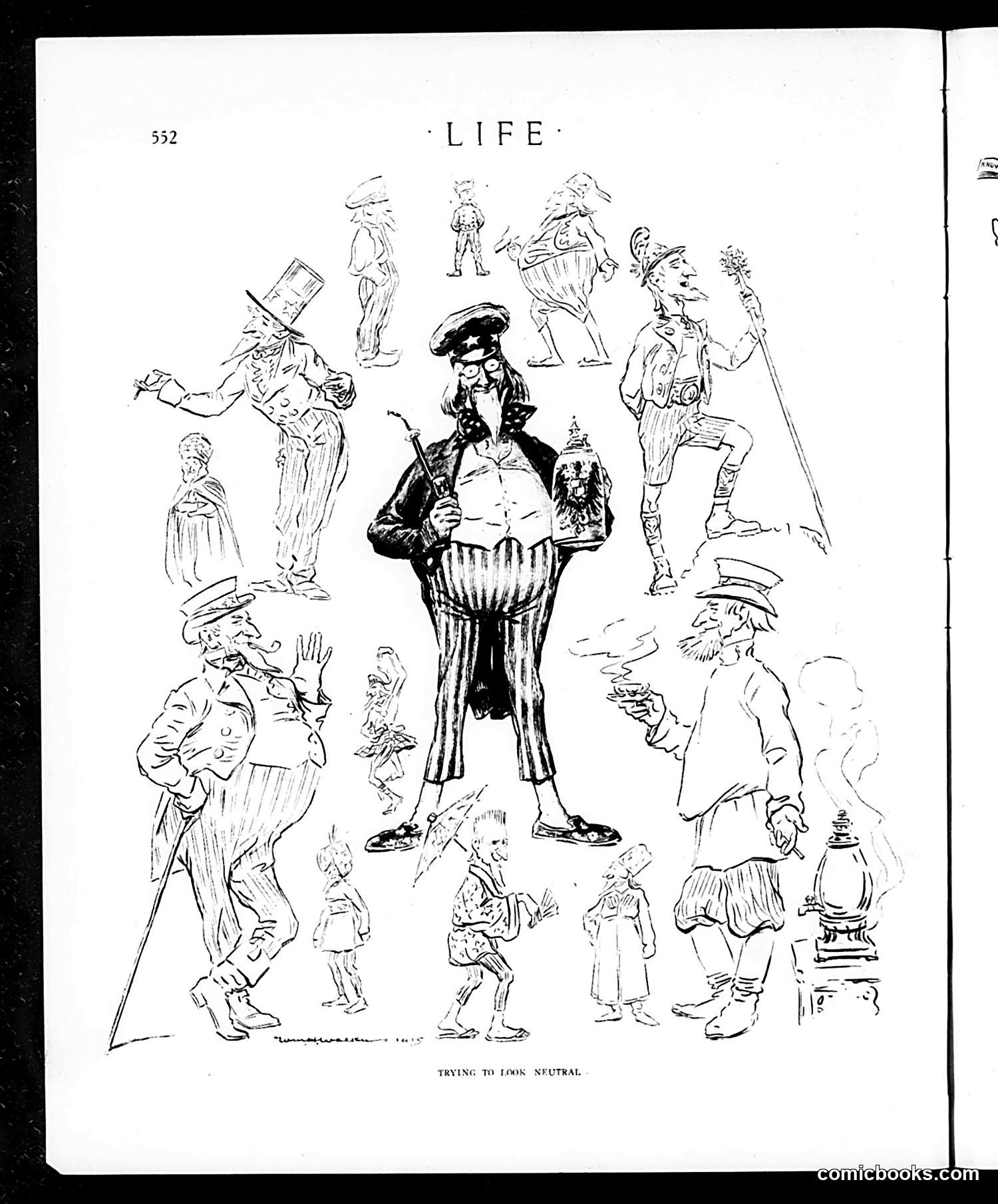
This political cartoon depicts a large central figure in formal dress (appearing to be a political or military leader) surrounded by various smaller characters representing different political factions, military types, and social groups. The caption "Trying to Look Neutral" suggests satire about someone attempting to maintain political neutrality while being pressured from all sides by competing interests and constituencies. The composition shows the central figure literally surrounded and hemmed in by these different groups—some wearing military uniforms, others in civilian dress—each seemingly making demands or exerting influence. The satire appears to mock the impossibility of true neutrality when facing pressure from diverse, competing political and social forces. Without the specific publication date visible, the precise historical context remains unclear, though the style suggests early-to-mid 20th century.
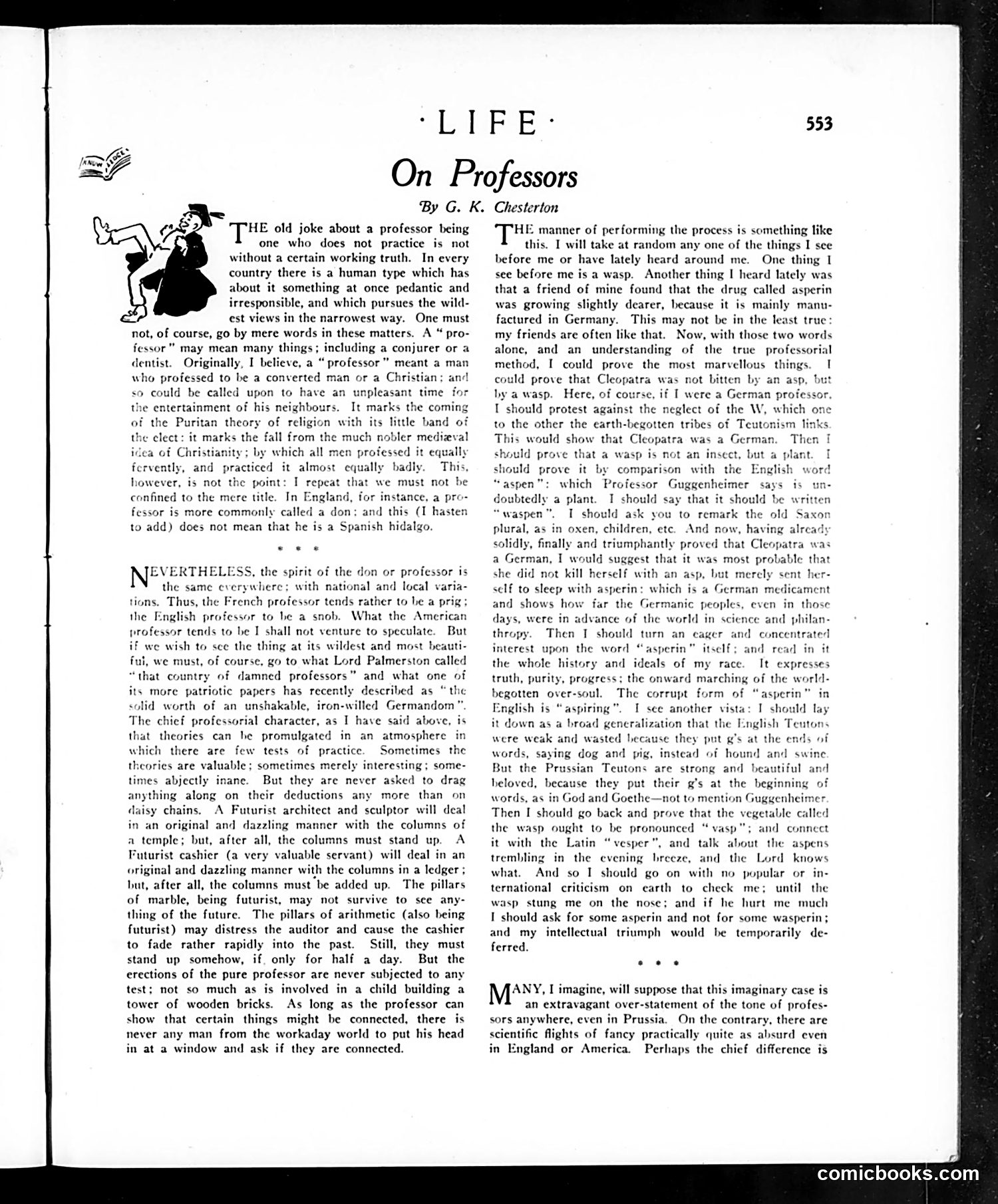
This is a humorous essay accompanying a small cartoon illustration. Chesterton satirizes academic professors across different nations, arguing they traffic in untested theories disconnected from practical reality. The piece characterizes professors by nationality: French professors are "prigs," English ones are "snobs," and German professors are the most egregiously theoretical—Chesterton sarcastically references them as inhabitants of "that country of damned professors." The main satire: professors construct elaborate intellectual arguments with no requirement for real-world verification, unlike architects (whose buildings must stand) or accountants (whose ledgers must balance). A professor can claim connections between anything—Chesterton humorously demonstrates by linking "wasp" with "aspirin" (a German drug)—without anyone practical questioning whether the theory actually works. The cartoon shows a caricatured figure representing this absent-minded academic type. The satire critiques academic pedantry and irresponsibility generally, but reserves particular mockery for German academia.
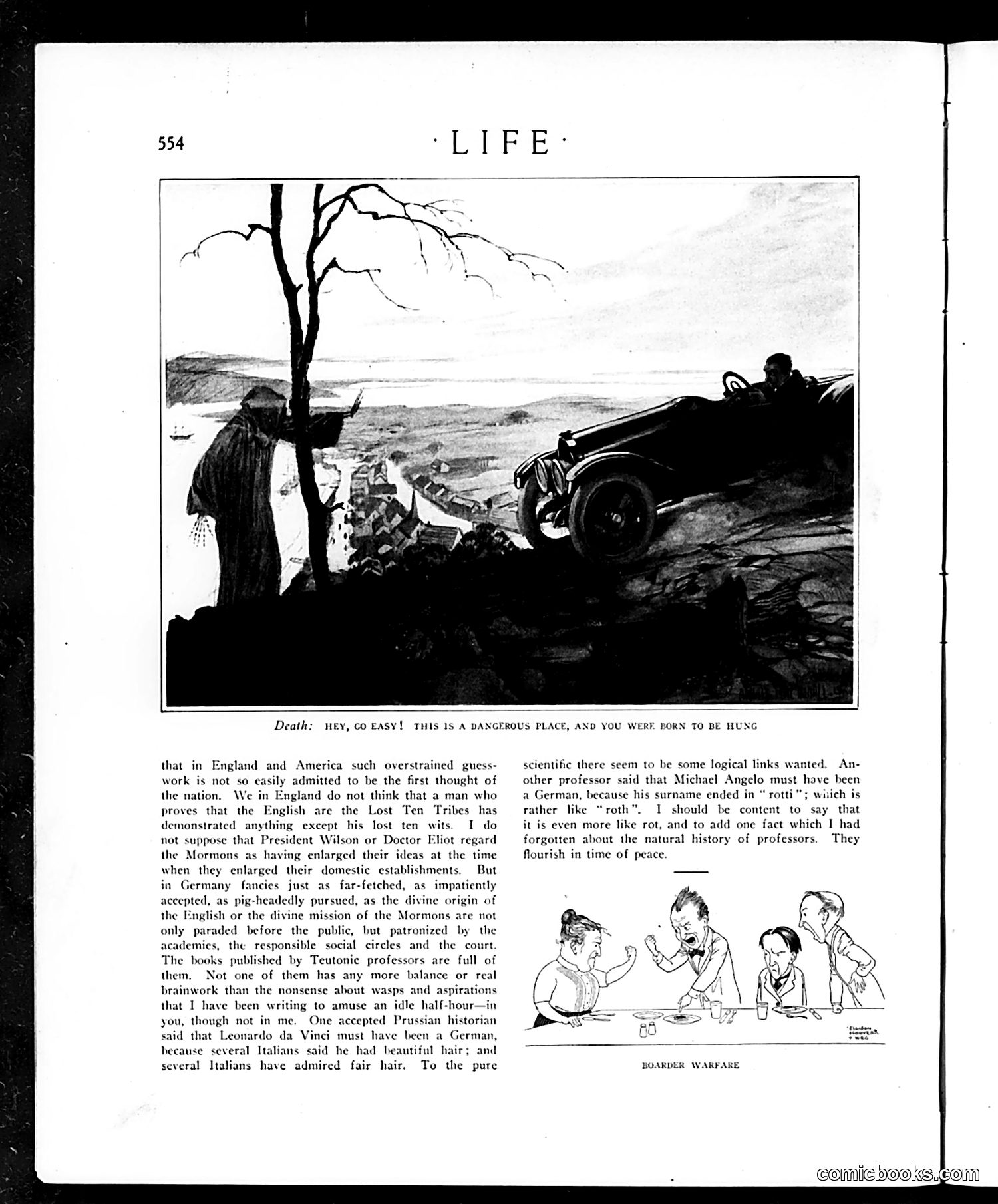
**Top Illustration ("Death"):** Shows a grim reaper figure confronting a motorist on a dangerous cliff road overlooking water. The caption's dark humor warns recklessly speeding drivers they're courting death—a cautionary comment on automotive safety hazards. **Main Text:** A satirical essay criticizing German academic pretentiousness. The author mocks how German professors publish absurd, far-fetched theories (claiming Leonardo da Vinci and Michelangelo were German based on ridiculous linguistic or physical "evidence") that get patronized by German academies and courts. The text contrasts this with Anglo-American skepticism toward such unfounded claims. The author's bitter conclusion: German academics' wild theorizing flourishes during peacetime. **Bottom Illustration ("Boarder Warfare"):** A humorous domestic scene depicting children apparently engaged in "boarder" conflict—likely depicting sibling rivalries or boarding school quarrels as comedic commentary on household chaos. The page reflects pre-WWI tensions and intellectual stereotypes about German scholarship.
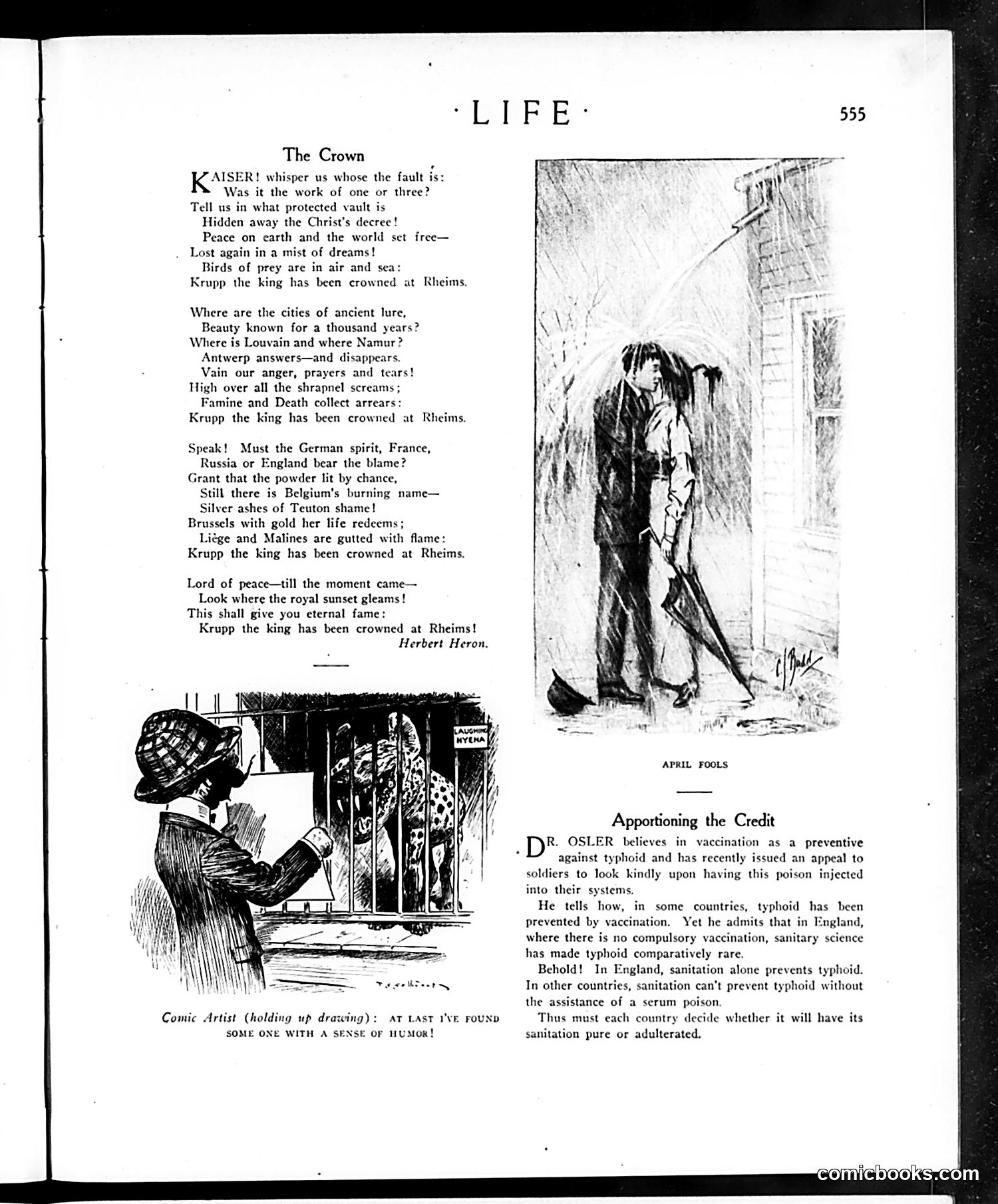
**"The Crown" Poem:** This is anti-German WWI propaganda verse by Herbert Heron. It attacks Krupp (the German armaments manufacturer/industrial dynasty), metaphorically crowned "king" at Rheims, France. The poem catalogs Belgian destruction—Louvain, Namur, Antwerp, Liège, Malines—asking who bears blame for the war while suggesting Germany's industrial-military complex profits from destruction. The refrain "Krupp the king has been crowned at Rheims" ironically invokes German coronation imagery to condemn German war-making. **"Comic Artist" Cartoon:** A soldier holds a drawing, apparently finding humor in wartime. The caption "At last I've found some one with a sense of humor!" suggests dark comedy about finding levity amid war's horrors. **"Apportioning the Credit" Article:** This satirizes Dr. Osler's typhoid vaccination campaign for soldiers. The piece argues England's superior sanitation (not vaccination) prevents typhoid, mocking other nations requiring both—implying they have poor sanitation. It's skeptical of mandatory medical interventions.
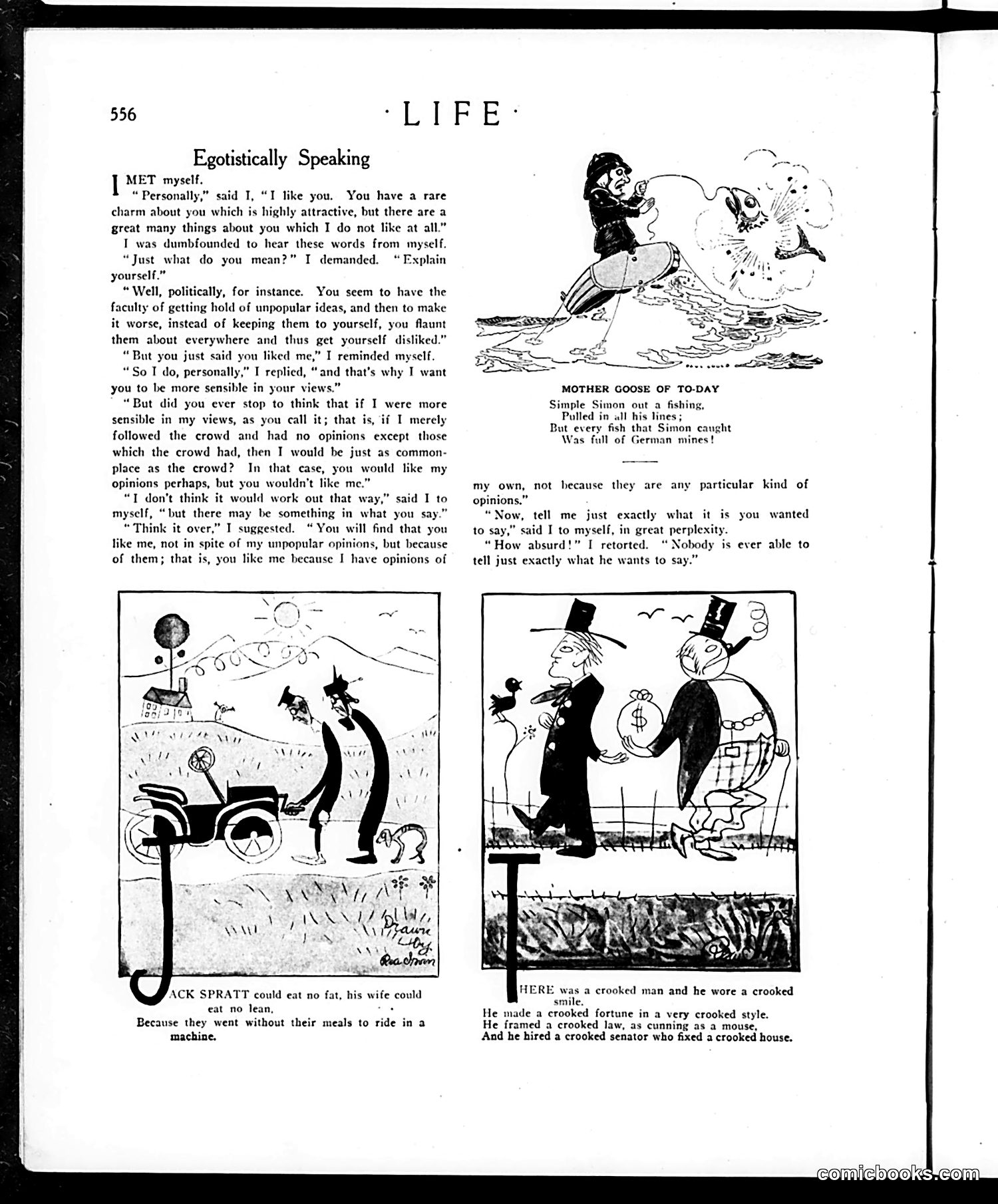
This page contains three satirical pieces targeting early 20th-century American society: **"Egotistically Speaking"**: A philosophical dialogue where the narrator confronts himself about holding unpopular political opinions. The satire critiques conformity—suggesting that popularity requires abandoning individual thought. The piece argues that authentic personality *depends* on holding independent views, even unpopular ones. **"Jack Spratt" modernization**: Updates the nursery rhyme to mock consumer culture and automobile obsession. The joke: the couple sacrifices meals (basic necessities) to afford a car—satirizing the era's automobile craze as economically irrational. **"Mother Goose of To-Day"**: Updates "Simple Simon" to reference WWI. The dark humor: fishing nets now catch mines instead of fish, reflecting wartime anxieties. This appears to reference German naval mines threatening shipping. **"The Crooked Man"**: A nursery rhyme update depicting political corruption—a crooked businessman who bribes a crooked senator to fix laws. It satirizes corruption in government and business as systemic and interconnected. All pieces use familiar nursery rhyme formats to critique modern vices: conformism, consumerism, militarism, and corruption.
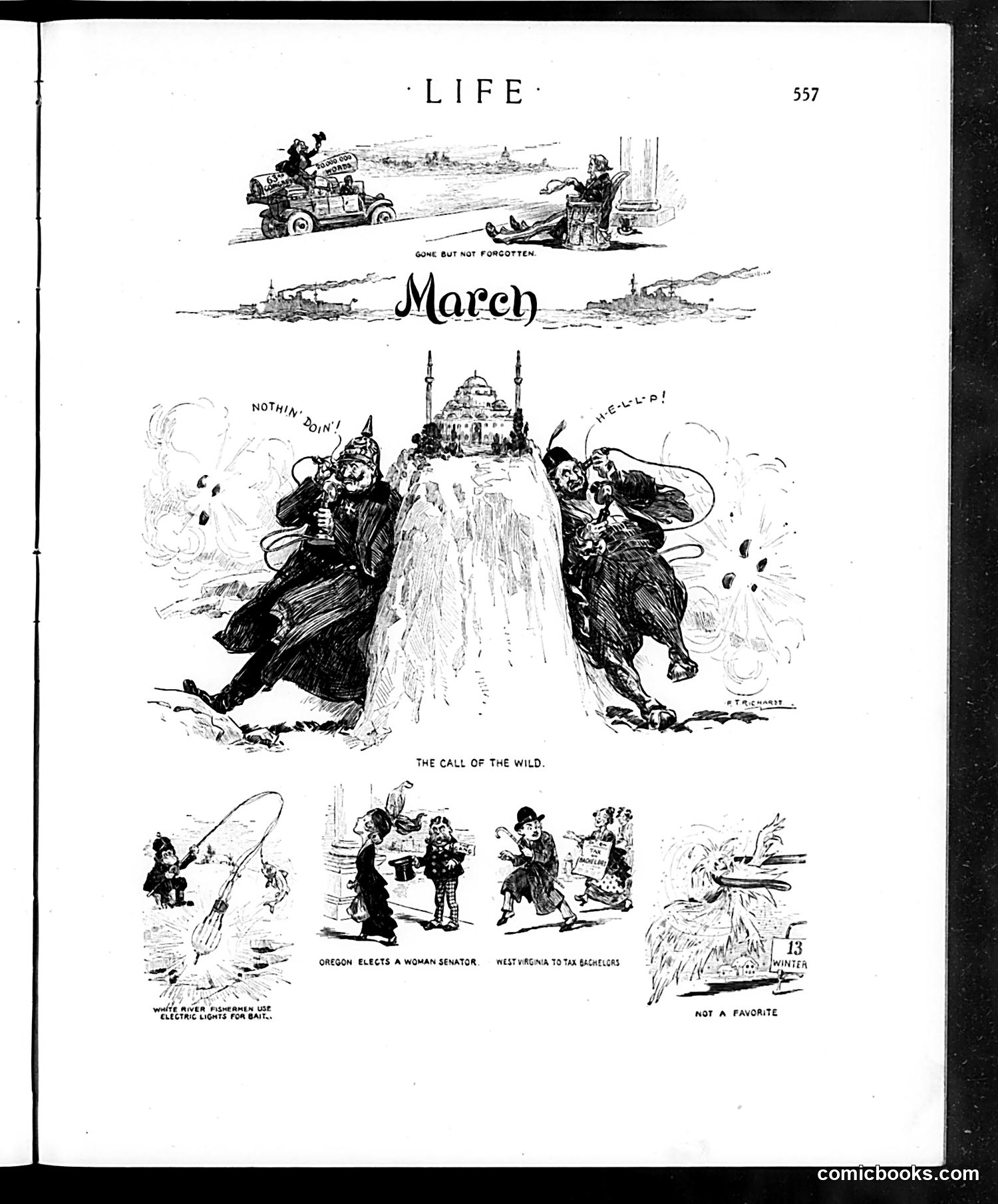
This page presents several satirical sketches for March. The main cartoon depicts two grotesque demon-like figures labeled "The Call of the Wild," likely representing political opponents or warring ideologies, positioned on either side of a domed building (possibly the Capitol). Below are smaller vignettes: one references Oregon electing a woman senator (a notable political development); another shows White River fishermen using electric lights for bait; a third depicts West Virginia tax issues; and the final sketch, captioned "Not a Favorite," shows what appears to be a winter scene. The cartoons mix contemporary political commentary with humorous observations about regional American life, reflecting Life's satirical approach to early 20th-century social and political events.
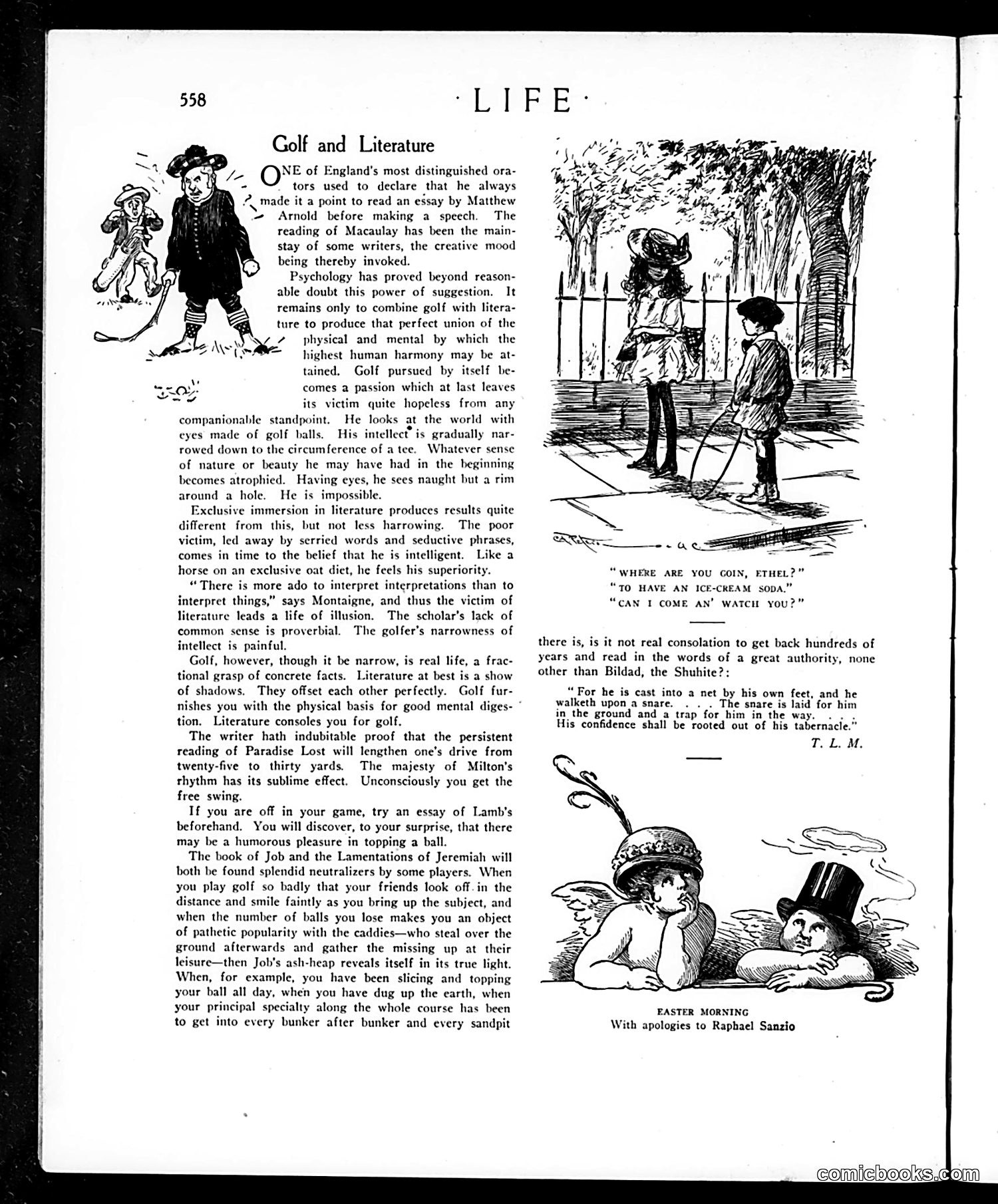
This essay satirizes two opposing intellectual extremes through the lens of golf. The author argues that exclusive devotion to *either* golf *or* literature produces mental damage: golf narrows one's mind to "the circumference of a tee," while literature produces delusional scholars who mistake verbosity for intelligence. The satire's main joke: these pursuits are *equally* absurd and limiting, yet perfectly complement each other. The essay proposes combining them—reading Milton improves one's golf swing; studying the Book of Job consoles you after terrible play. The cartoon at top depicts children discovering that even innocent leisure (ice cream) becomes complicated by social rules. The "Easter Morning" illustration below appears to be classical artwork, perhaps commenting on how high culture offers no real consolation either. The author (T.L.M.) mocks both the pretentious intellectual who reads to feel superior and the obsessed golfer equally.
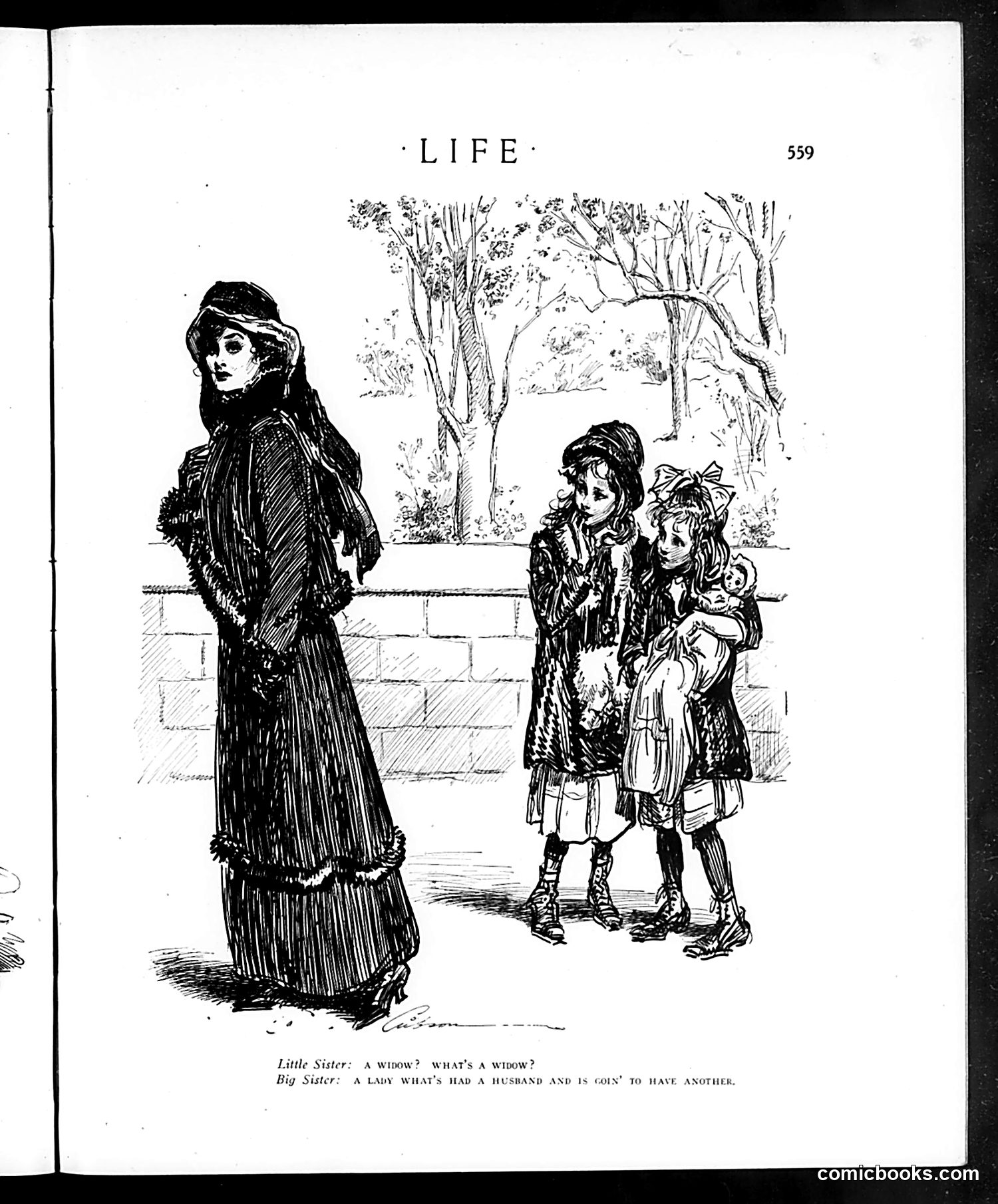
This is a satirical cartoon about widowhood and remarriage, likely from the early 20th century. A well-dressed woman (the "Big Sister") explains to a younger girl what a widow is—specifically, a lady who lost a husband and plans to marry again. The joke plays on the somewhat cynical or matter-of-fact attitude toward remarriage, suggesting that widows quickly sought new husbands rather than remaining in mourning. The satire likely comments on social attitudes toward widows and marriage prospects of the era. The illustration shows class distinctions through clothing and setting (a park or garden with children). The humor derives from the older sister's blunt, unsentimental explanation to the innocent younger child—treating remarriage as an expected, almost inevitable outcome of widowhood rather than a matter of romantic sentiment.
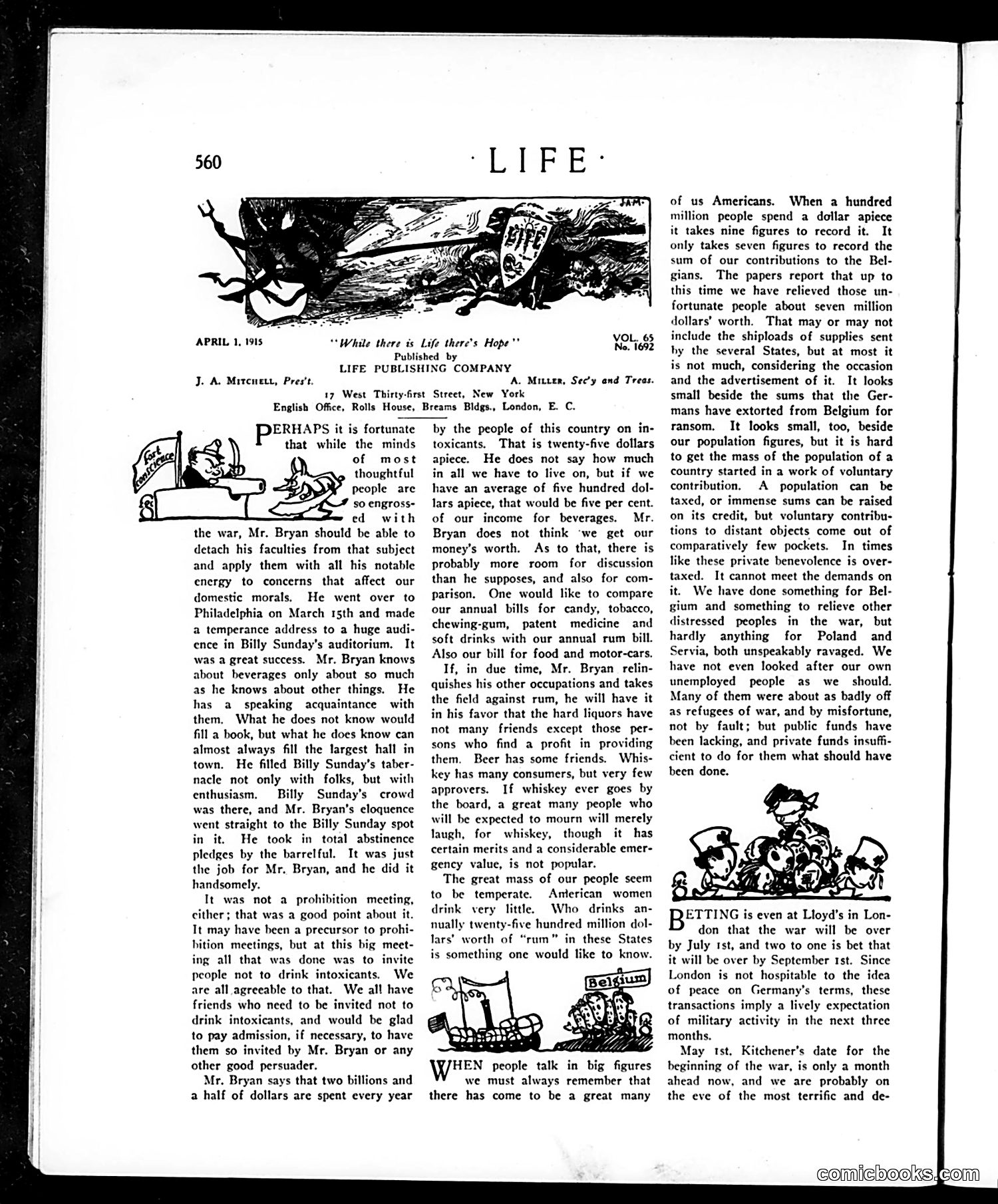
This page satirizes William Jennings Bryan's temperance crusade while America grapples with World War I. The article mocks Bryan for obsessing over prohibition—giving an impassioned speech at evangelist Billy Sunday's Philadelphia revival—while the nation faces far greater moral concerns. The satire's point: Bryan claims Americans waste $2.5 billion annually on alcohol, yet we've only contributed $7 million to Belgian war relief. Life's editors argue that lecturing about drink is trivial when civilians suffer in Europe. The cartoons (showing figures associated with alcohol) reinforce the contrast between Bryan's domestic moralizing and urgent international humanitarian needs. The piece implies Bryan's zealotry about personal virtue rings hollow when real suffering demands national attention—a critique of misplaced priorities during wartime.
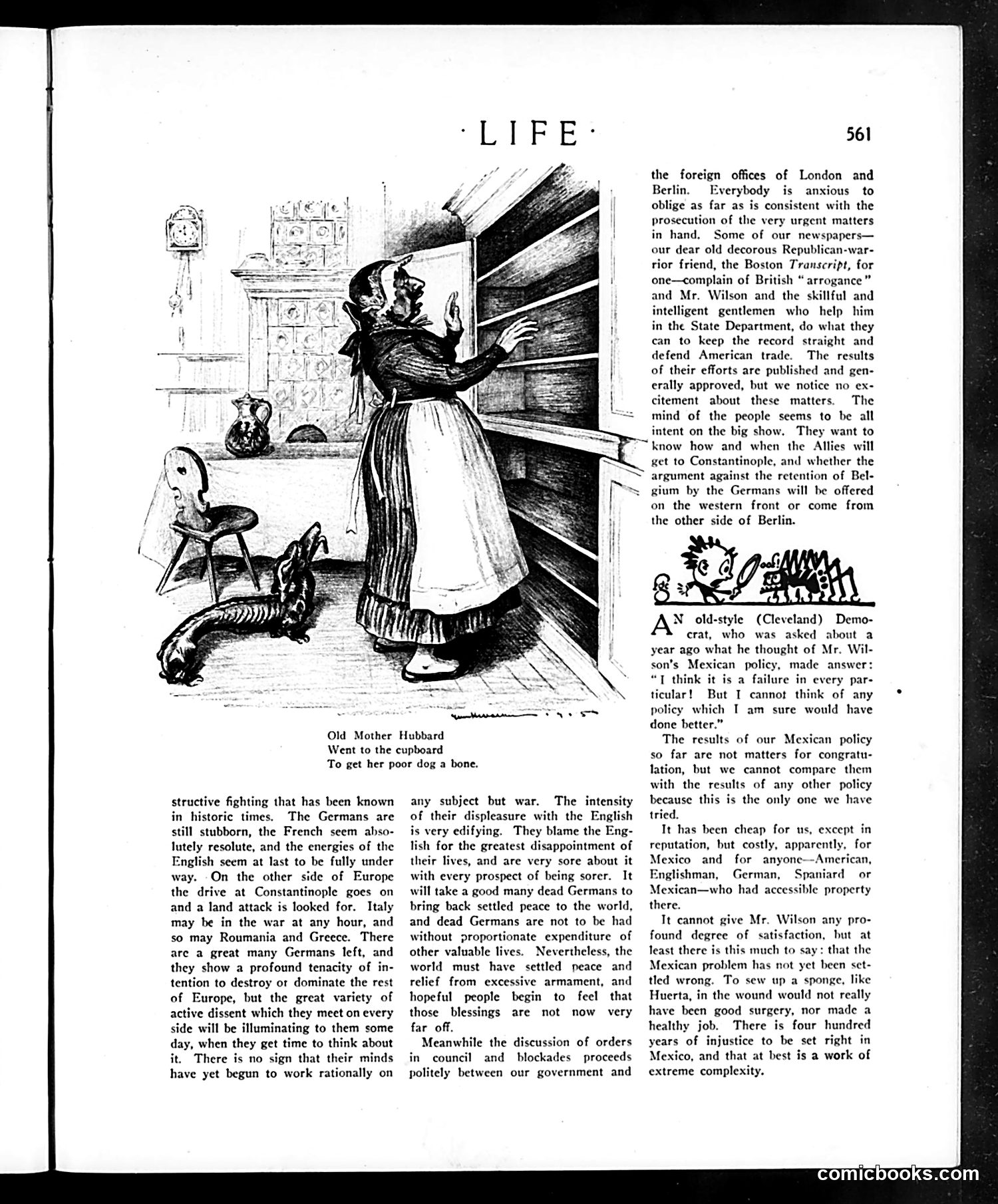
This page from *Life* magazine contains satirical commentary on two issues: World War I and President Wilson's Mexican policy. **The Illustration:** "Old Mother Hubbard" depicts a woman (likely representing America or a household) finding her cupboard bare—a metaphor for resource scarcity. The accompanying nursery rhyme suggests America cannot provide for its needs, probably referencing concerns about war's economic costs. **The Text:** The article criticizes American newspapers (notably the *Boston Transcript*) for complaining about British "arrogance" while praising Wilson's State Department efforts to defend American trade interests during WWI. It notes the public is more engaged with military developments than these diplomatic squabbles. The second section defends Wilson's Mexican policy—apparently controversial a year prior—arguing that while imperfect, it has at least not made things worse, unlike previous approaches. The writer emphasizes Mexico's historical injustices require complex solutions. The overall tone is cautiously supportive of Wilson's diplomacy while gently mocking public indifference to policy details.
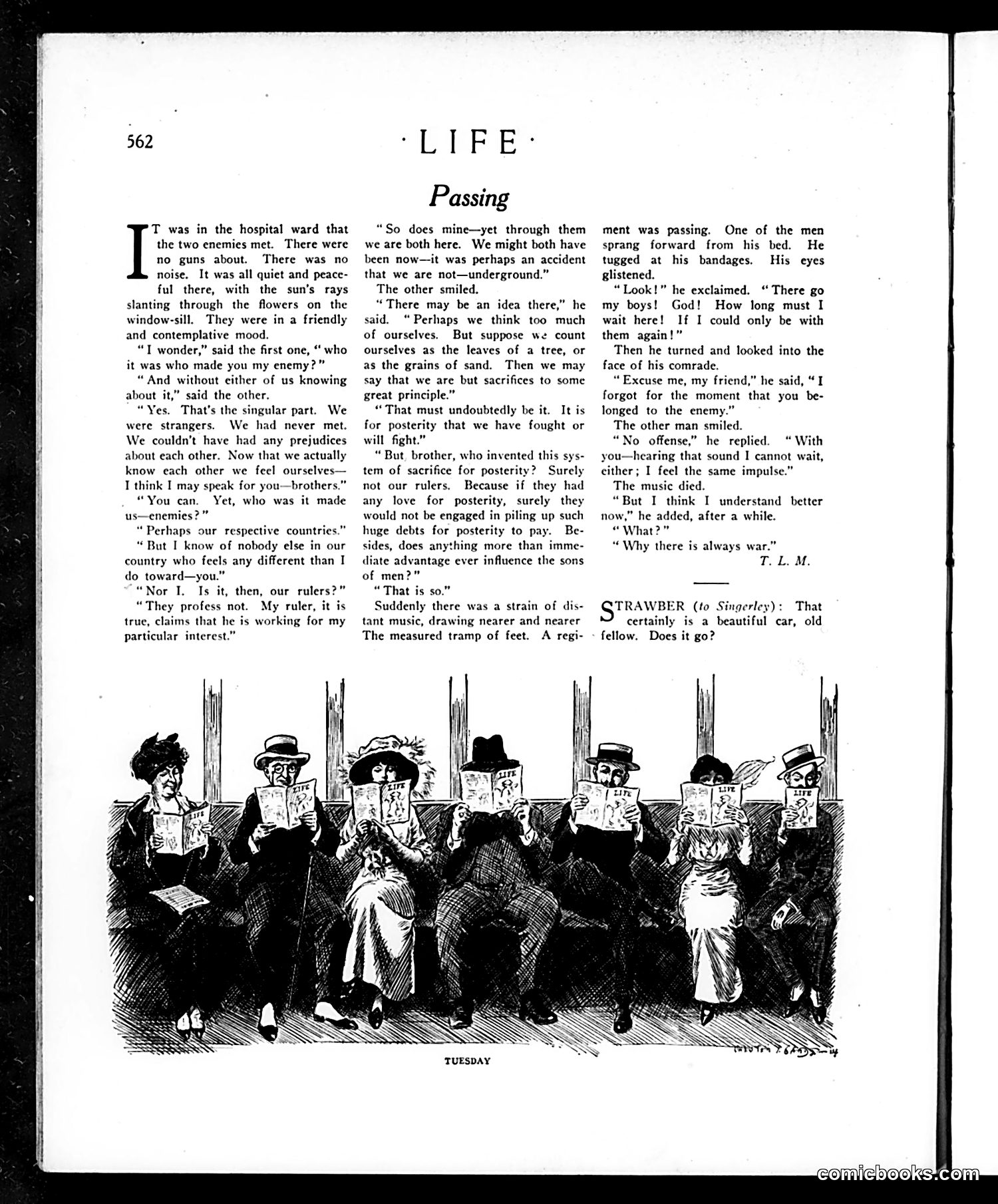
This page contains two distinct pieces: **The Story "Passing":** A dialogue between two wounded enemy soldiers in a hospital ward who realize they share common humanity and have no personal animosity. They philosophically debate whether their rulers or abstract "posterity" drove them to war. The satire's punch comes in the ending: when a military regiment marches past playing music, the patriotic impulse instantly overwhelms both men. Despite their reasoned conversation, they both forget their pacifist sentiments and yearn to rejoin their units. The author (T.L.M.) suggests war persists because emotional nationalism overrides rational thought—even among those who intellectually recognize its absurdity. **The Cartoon "Tuesday":** Shows a row of people reading "LIFE" magazine in what appears to be a waiting room or public space, likely depicting commuters or citizens casually consuming satirical commentary on current events. The juxtaposition critiques how easily propaganda and martial sentiment override anti-war sentiment among ordinary people.
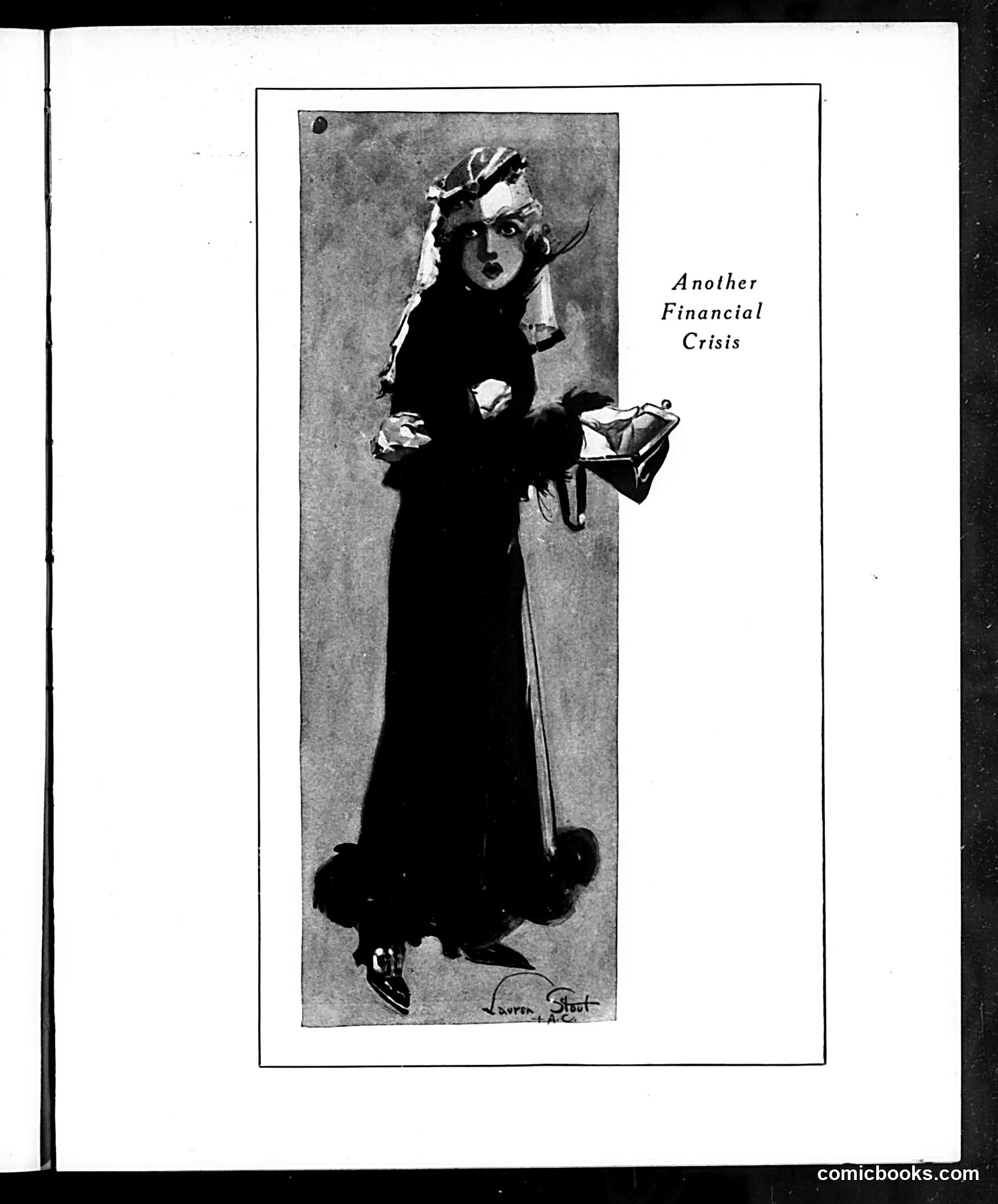
This satirical illustration depicts a distressed figure in fashionable 1920s dress—wearing a decorative headpiece and an elegant gown—holding an empty or nearly empty purse. The character's exaggerated facial expression conveys alarm and desperation. The caption "Another Financial Crisis" suggests this is commentary on personal or household financial troubles, likely targeting wealthy or upper-class individuals during an economic downturn. The contrast between the figure's fine clothing and their empty wallet creates the satire: despite outward displays of wealth and status, they face monetary problems. The artist's signature appears to read "Lowen Stott" (or similar). This appears to reference a period of economic instability, possibly the 1920s recession or similar financial upheaval affecting American society.
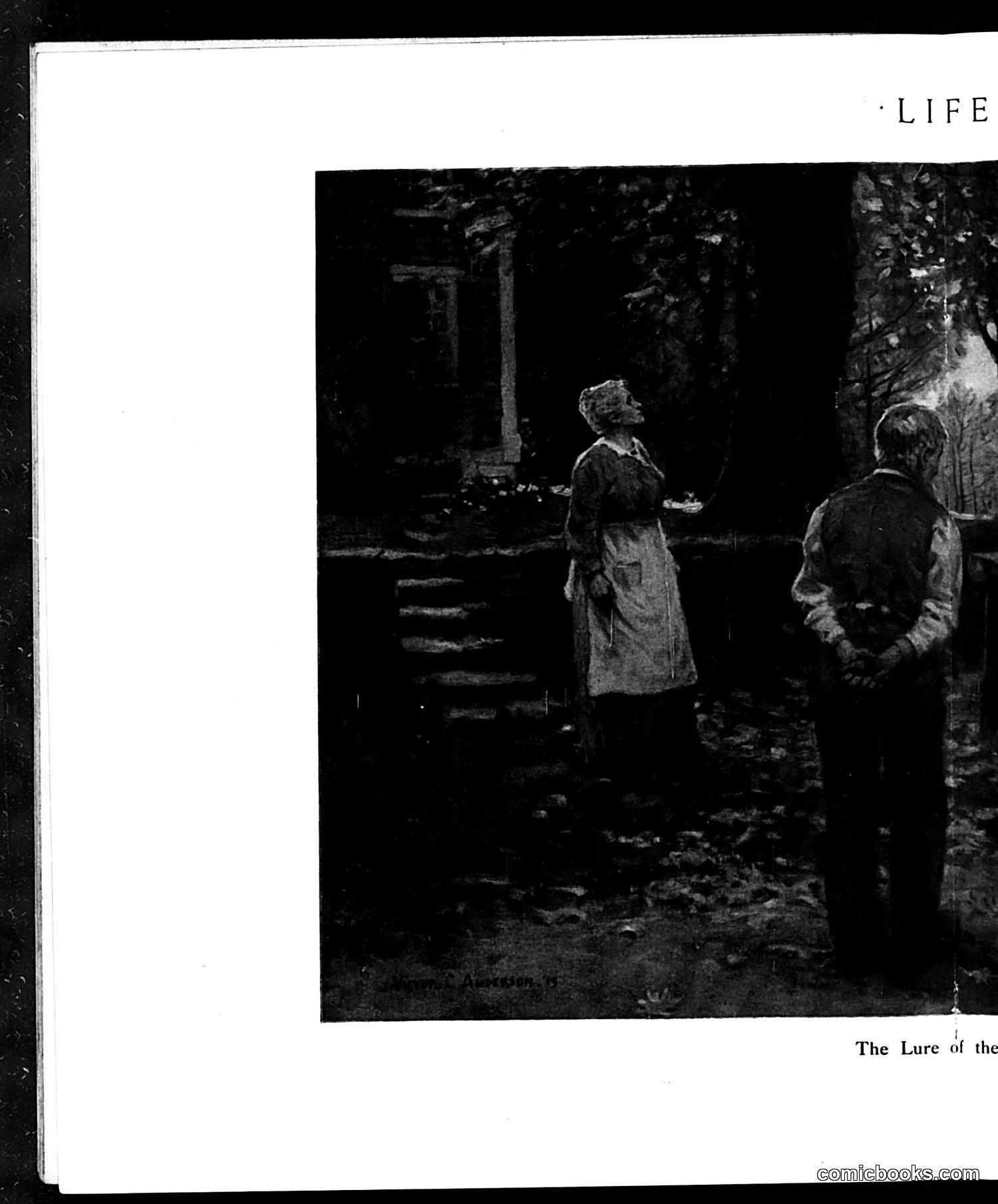
This appears to be a page from *Life* magazine featuring a black and white photograph or film still titled "The Lure of the" (title appears cut off). The image shows two figures in what seems to be an outdoor, wooded nighttime setting near a building with steps. Without the complete title visible and given the OCR text contains only formatting characters, I cannot definitively identify the specific satire, political reference, or joke intended. The dramatic lighting and composition suggest this may be illustrating a story or commentary, but the actual subject matter remains unclear from this page alone. The title fragment "The Lure of the..." suggests it's commentary on temptation or attraction, but specifics require additional context.

This appears to be a satirical illustration contrasting rural and urban life. The black-and-white photograph shows a figure standing on a rural dirt road, gazing toward a distant farmhouse and open fields. The composition—with the figure's back to the viewer, looking outward—suggests contemplation or longing. The caption "Lure of the City" likely presents ironic commentary on rural-to-urban migration patterns common in early 20th-century America. The image's actual rural setting may be intentionally at odds with the title, suggesting the *supposed* allure of city life pulling people away from agricultural communities. This reflects period anxieties about depopulation of farmland and industrialization's social effects. Without visible publication date or author attribution, the specific historical moment remains unclear.
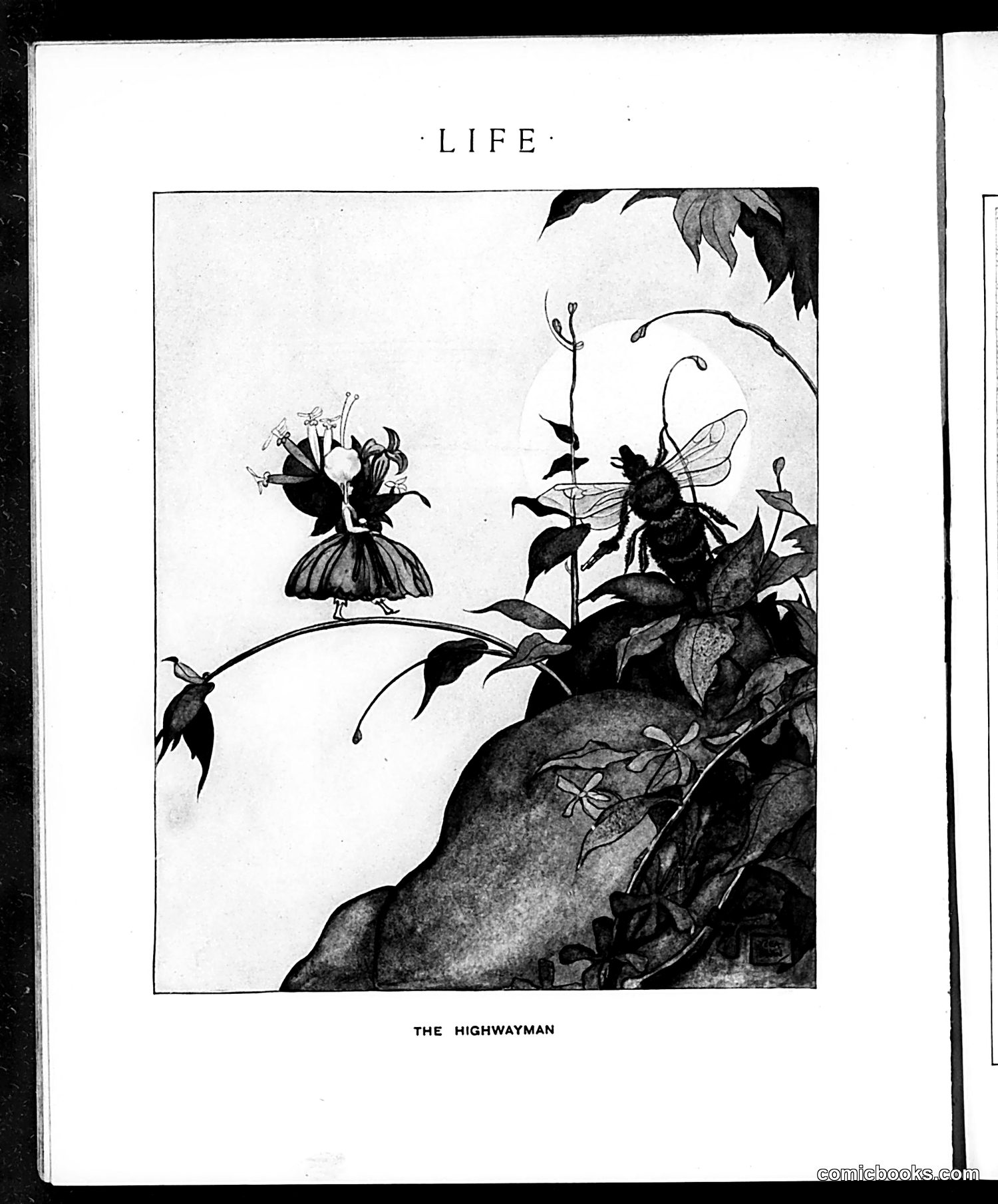
This illustration depicts an anthropomorphized bee as "The Highwayman"—a figure who appears to be robbing or accosting a flower. The bee, rendered with wings and a somewhat menacing posture, confronts delicate flowers growing on a curved stem or vine, with additional flowering plants visible in the composition. The satire likely plays on the dual meaning of "highwayman" (a robber/bandit) applied to the bee's natural behavior of visiting flowers for nectar and pollen. It's a whimsical anthropomorphization that transforms the bee's ordinary pollination activities into a comedic "robbery," suggesting the bee "steals" from flowers. The joke hinges on this unexpected comparison between criminal activity and natural ecological processes, typical of Life magazine's satirical humor.
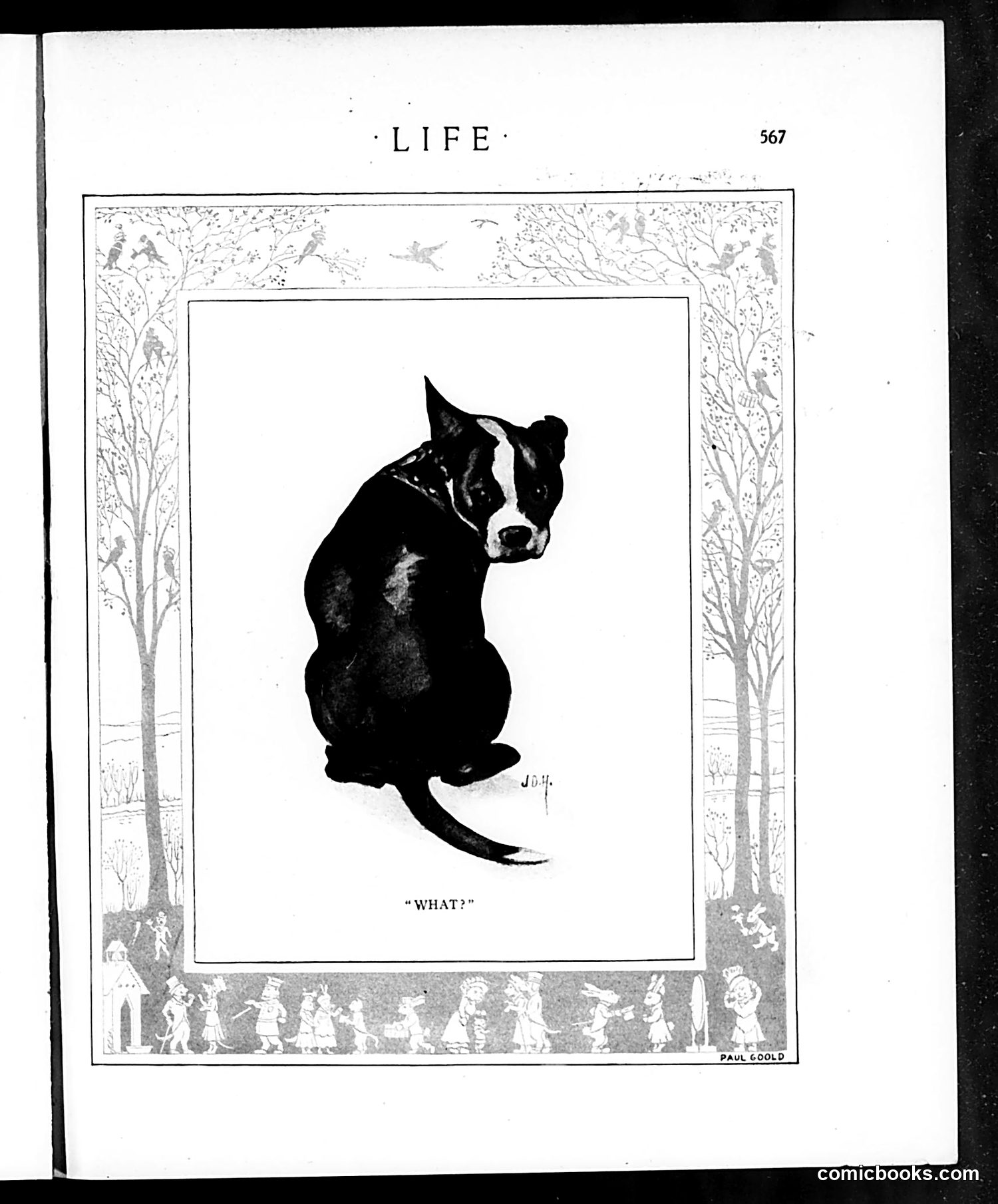
This single-panel cartoon from *Life* magazine (page 567) depicts a black and white dog sitting and looking back over its shoulder with a quizzical expression. The title "What?" suggests the dog has been called or summoned. The humor appears to rely on the dog's confused or innocent reaction—a relatable moment for pet owners. The cartoon anthropomorphizes the dog's perspective, capturing that moment when a dog responds to its name with apparent bewilderment about what it's being asked to do. The ornate border featuring trees, birds, and cherubic figures was typical of *Life* magazine's aesthetic during this era. Without additional context, this seems to be gentle, observational humor about pet behavior rather than political or social satire.
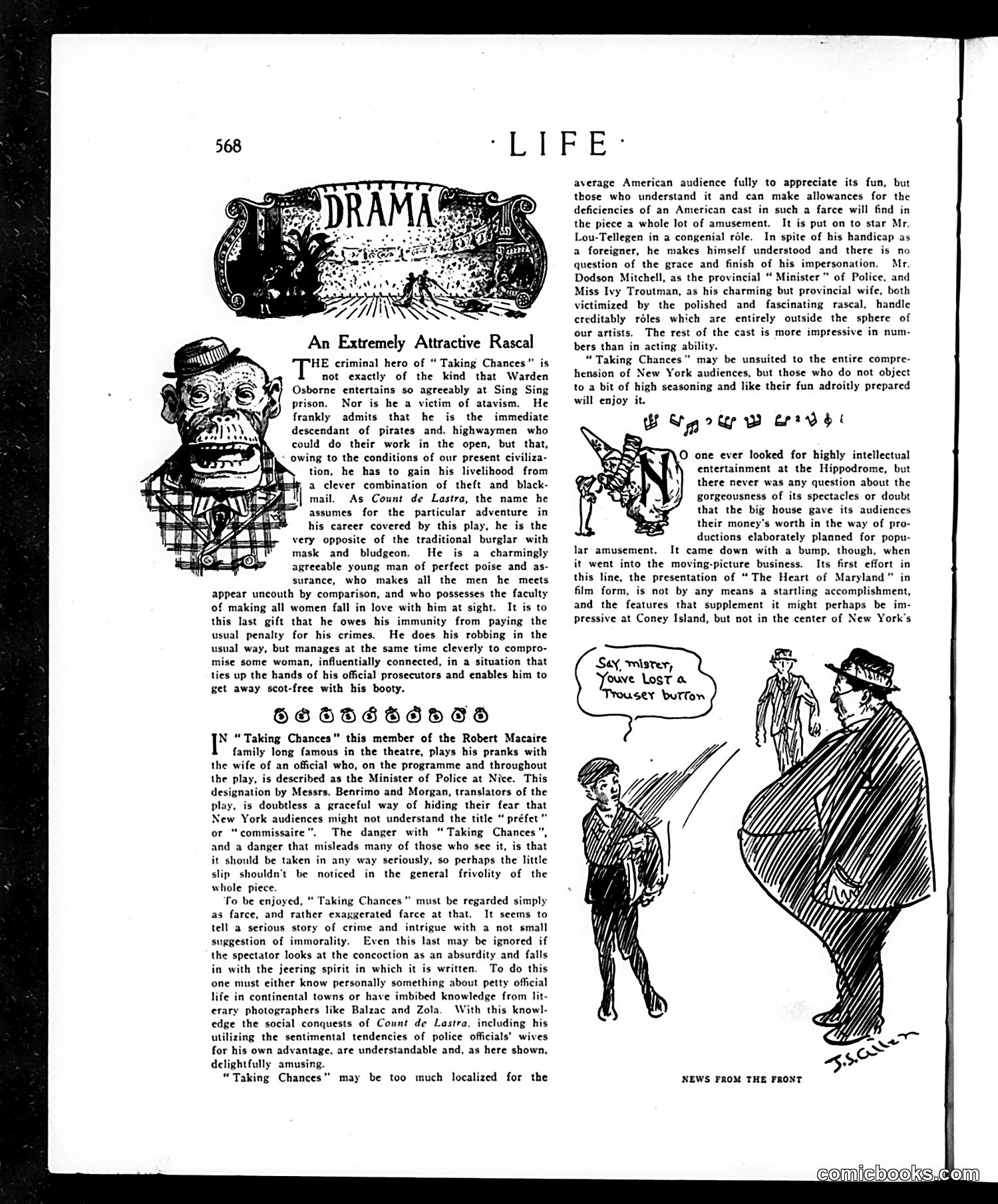
This page reviews the play "Taking Chances," starring Lou-Tellegen as Count de Lastra, a charming criminal who seduces the wife of a police official to escape prosecution. The critic explains the character is part of the "Robert Macaire family"—a theatrical tradition of clever rogues—descended from historical pirates and highwaymen. The accompanying cartoon shows a man who has lost a trouser button, approached by another figure. It illustrates the play's humor: the "rascal" uses seduction and blackmail against officials' wives to evade justice through their compromised positions. The review emphasizes this is *farce*, not serious drama, and warns American audiences may find it too "localized" (specifically French) without knowledge of continental official life. The satire targets how charm and manipulation—particularly of women—can corrupt law enforcement and justice.
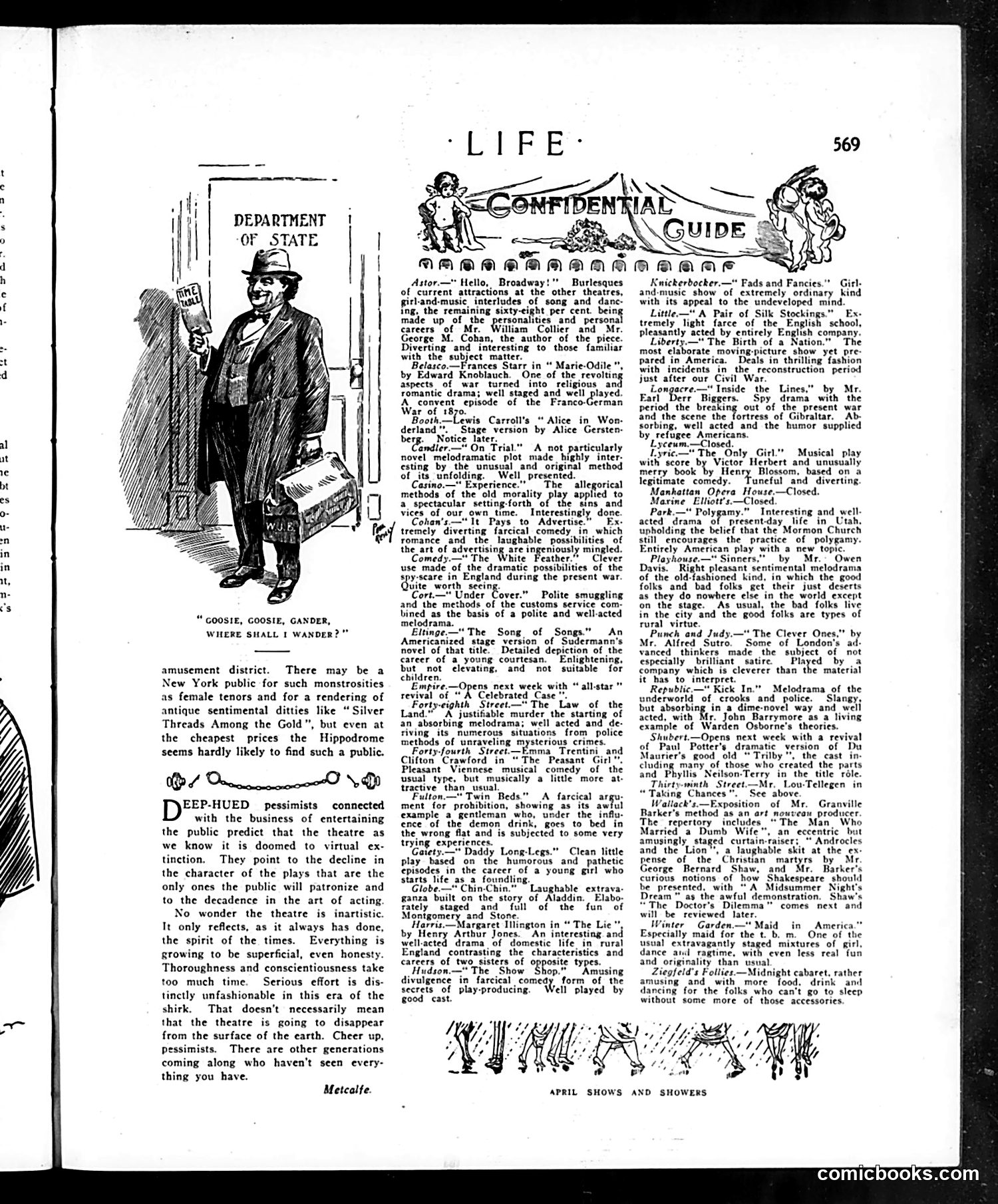
The main cartoon depicts a State Department official—identifiable by the "Department of State" door behind him—as a bewildered figure asking "Where shall I wander?" while clutching what appears to be a diplomatic document or passport. This satirizes American foreign policy indecision, likely during WWI era (referenced in the "Confidential Guide" header discussing war-related theatrical productions). The "goosie gander" nursery rhyme reference mocks the State Department's apparent aimlessness in navigating international affairs—the official literally doesn't know which direction to go. The cartoon critiques U.S. diplomatic confusion or lack of clear direction at a moment when international tensions demanded decisive leadership. The bureaucrat's confused demeanor suggests Life magazine viewed the State Department's approach as foolish and unprepared. The page's theatrical reviews appear contextual, reflecting contemporary American culture during wartime uncertainty.
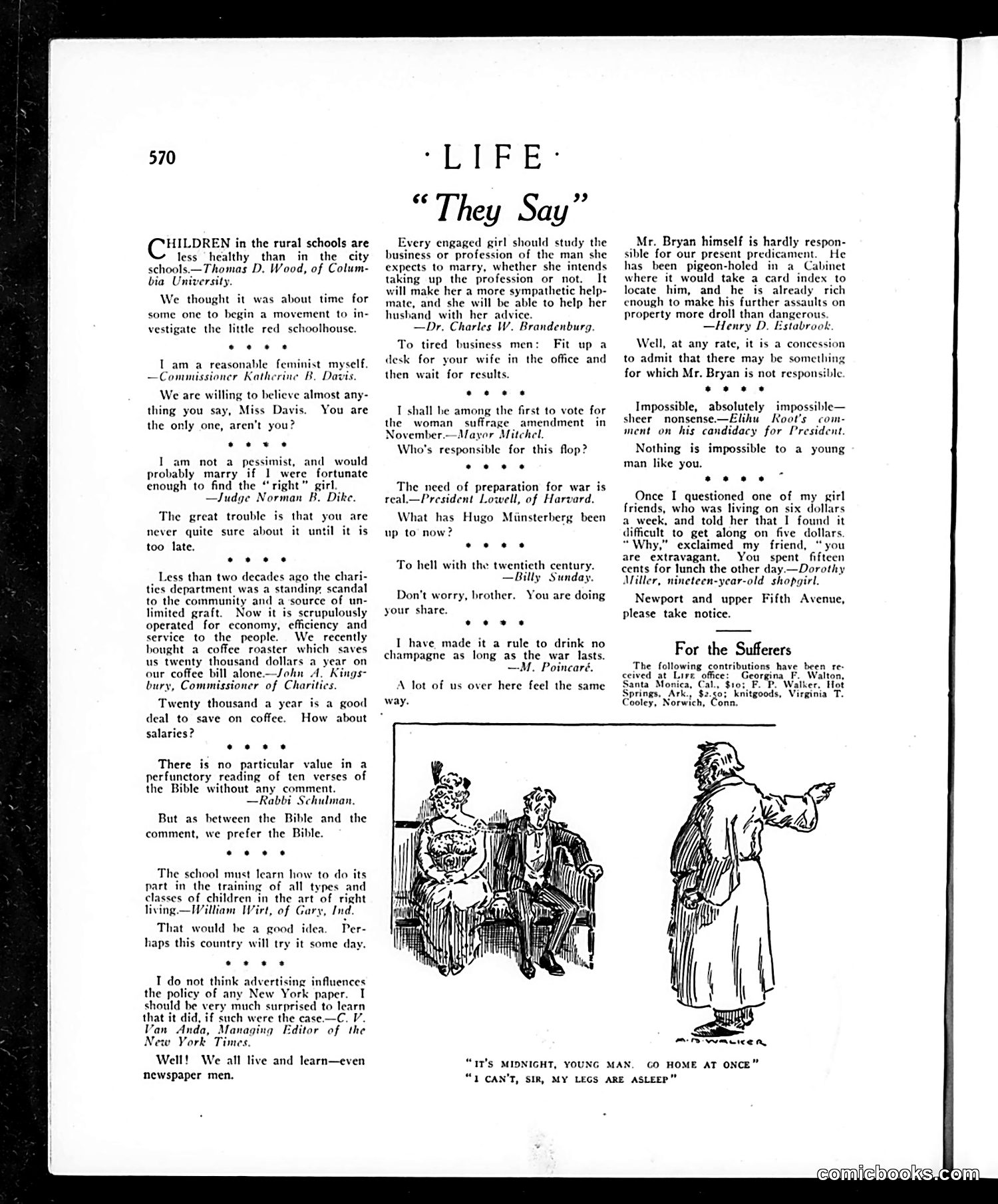
This page collects satirical quotations mocking public figures and social hypocrisy, typical of Life's "They Say" column. The cartoon depicts a gentleman telling seated listeners "It's midnight, young man—go home at once / I can't, sir, my legs are asleep," illustrating the absurdity of enforcing arbitrary rules. Key satirical targets include: - **Mayor Mitchel**: Pledging to vote for women's suffrage in November, then presumably doing nothing - **President Lowell & Hugo Münsterberg**: Vague calls for war preparedness without specifics - **Billy Sunday**: The evangelist's blanket rejection of modernity - **M. Poincaré**: Self-righteous wartime sacrifice while others struggle - **William Wirt & various reformers**: Grandiose educational ideals disconnected from reality The page's broader point: public officials and social leaders make lofty pronouncements while avoiding accountability. Life mocks the gap between stated principles and actual behavior—whether Mitchel's suffrage support or Bryan's political irrelevance in Wilson's cabinet.
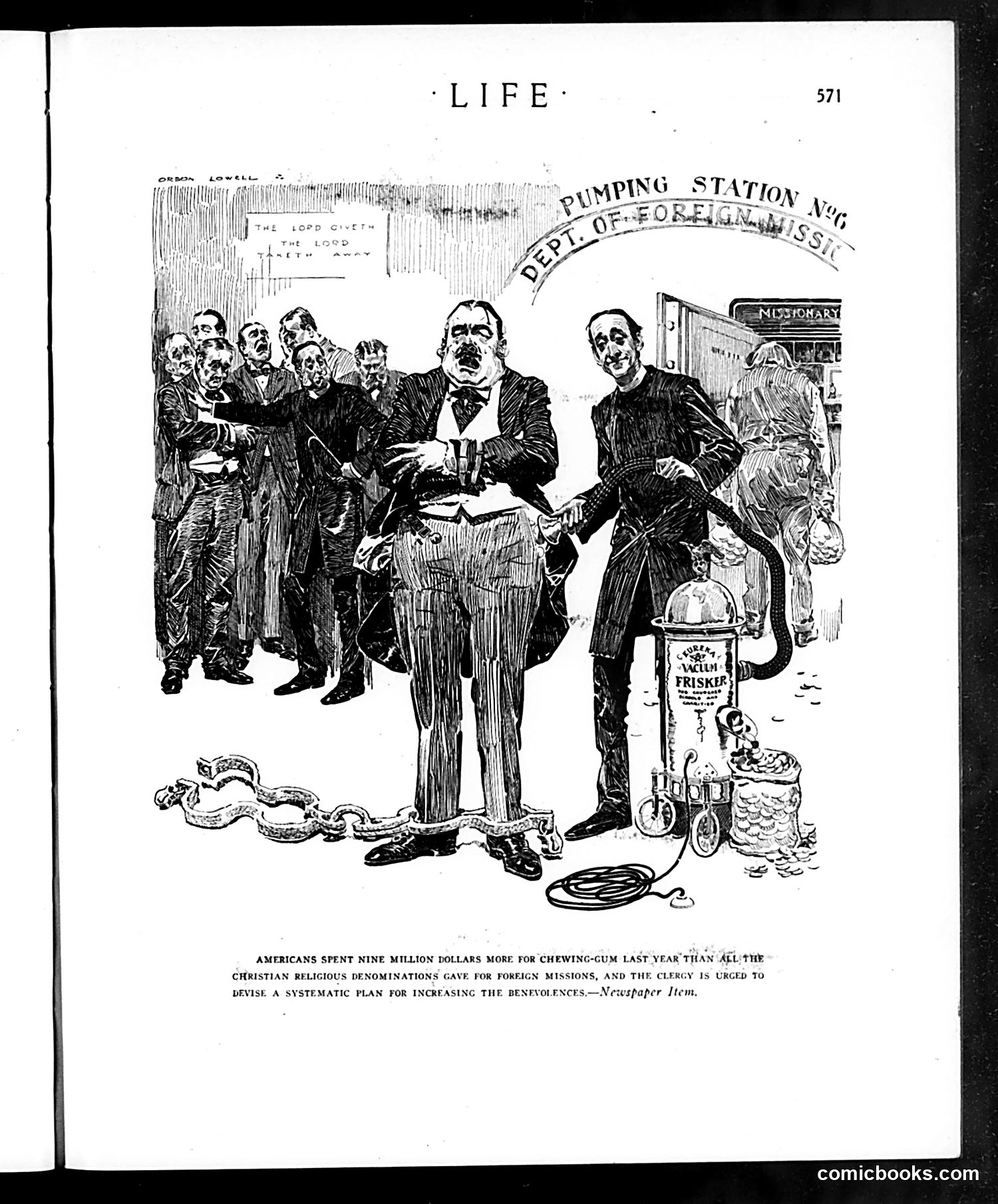
This satirical cartoon critiques American consumer priorities and religious institutions' fundraising. The central figure—likely representing clergy or religious leadership—is surrounded by men in suits (possibly congregants or donors) while standing atop various luxury items including a "Friskie" brand product container and other indulgences. The caption reveals the cartoon's point: Americans spent $9 million more on chewing gum than all Christian denominations collectively donated to foreign missions. The satire suggests that clergy are being urged to increase charitable giving despite Americans' evident preference for frivolous consumer goods over religious benevolence. The "Pumping Station" sign above appears to reference extracting money, reinforcing the cartoon's commentary on the difficulty of generating donations when materialism dominates American culture. The work mocks both consumer excess and the clergy's challenge in competing for charitable dollars.
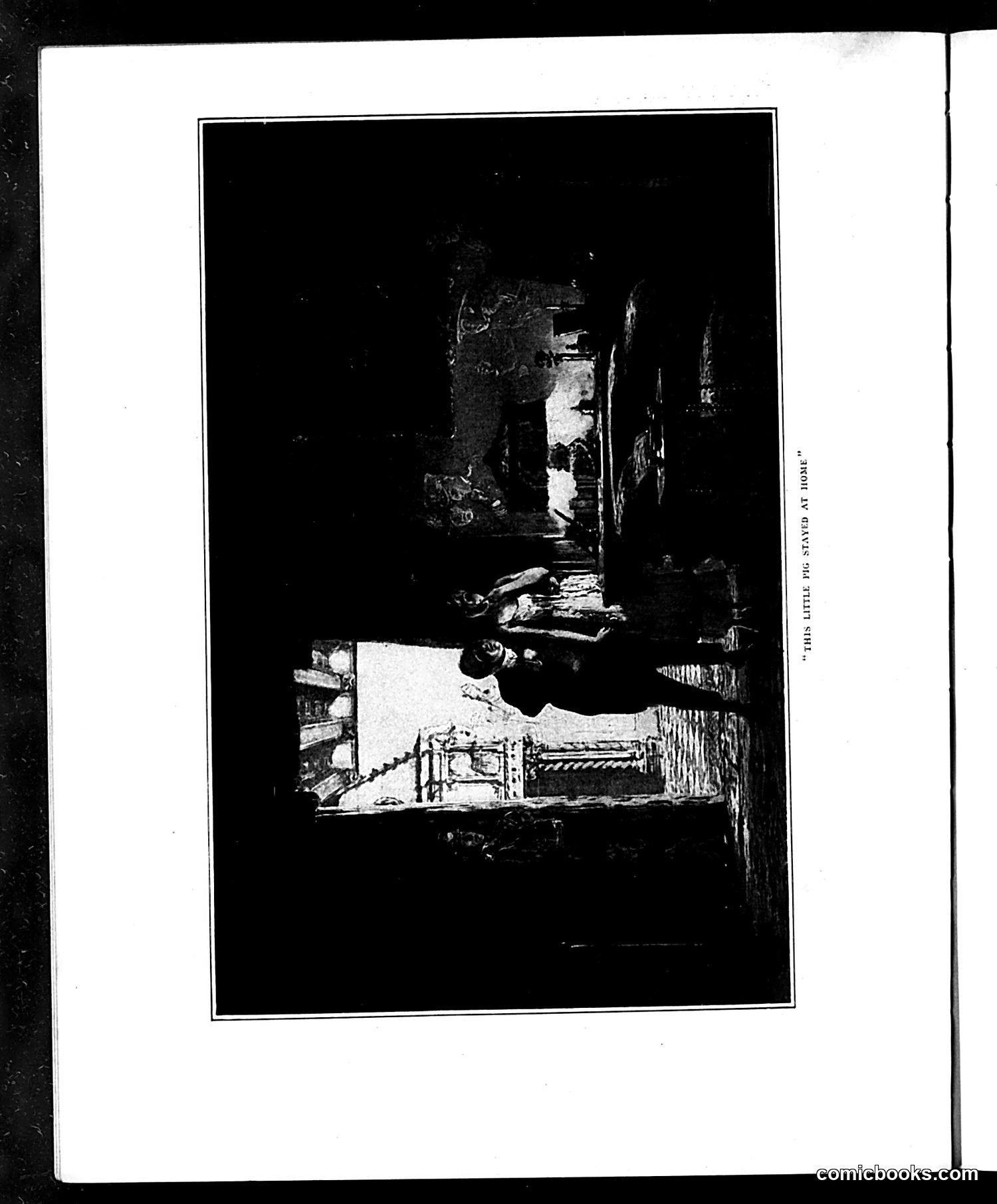
I can see this is a dark, atmospheric black and white photograph or illustration showing what appears to be an interior architectural scene with dramatic lighting and shadows. There are vertical elements that could be columns or doorways, and the composition creates a moody, theatrical effect. However, I cannot reliably read the OCR text provided ("AOI AV GRAVES OME ATLLIT STL"), which appears corrupted or unclear. Without legible text to establish context, and given only this single dramatic image, I cannot confidently identify specific political figures, social references, or explain the satirical intent that a Life magazine page would typically contain. To accurately explain this cartoon's meaning to a modern reader, I would need either clearer text or additional visual context clues that are not sufficiently visible here.
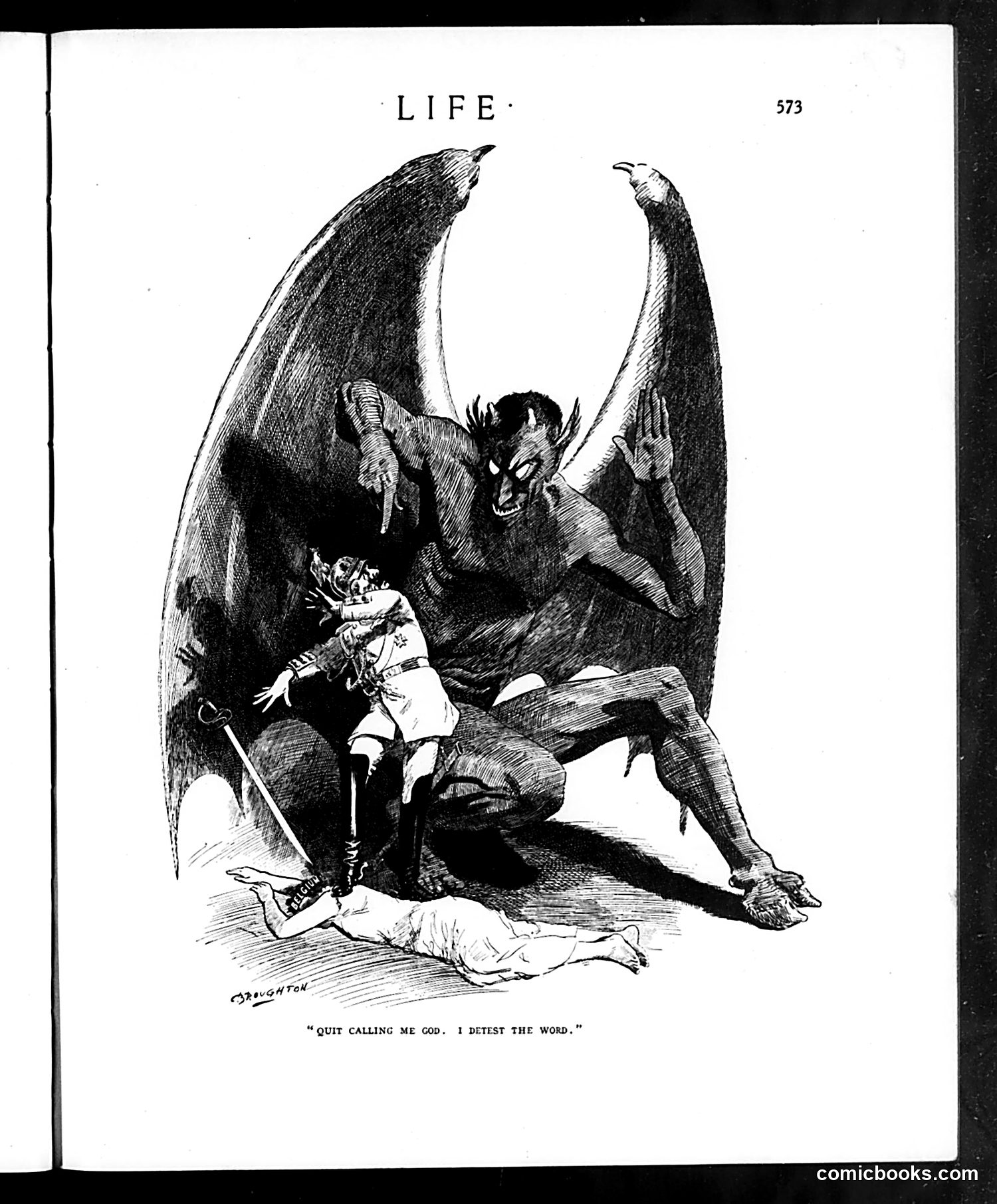
This political cartoon depicts a demon or devil figure seated on a log, appearing agitated or indignant. A winged creature looms behind in a threatening pose. The caption reads: "Quit calling me God. I detest the word." The satire appears to mock someone in a position of power or authority—likely a political or military figure of the era—who objects to excessive praise or godlike veneration from followers. The inversion is darkly humorous: the figure rejects being called "God" while being drawn as a demonic entity, suggesting the cartoonist views this powerful person as evil or corrupt despite (or because of) their claims to moral objection. The specific identity of the target figure is unclear without additional historical context about Life magazine's publication date.
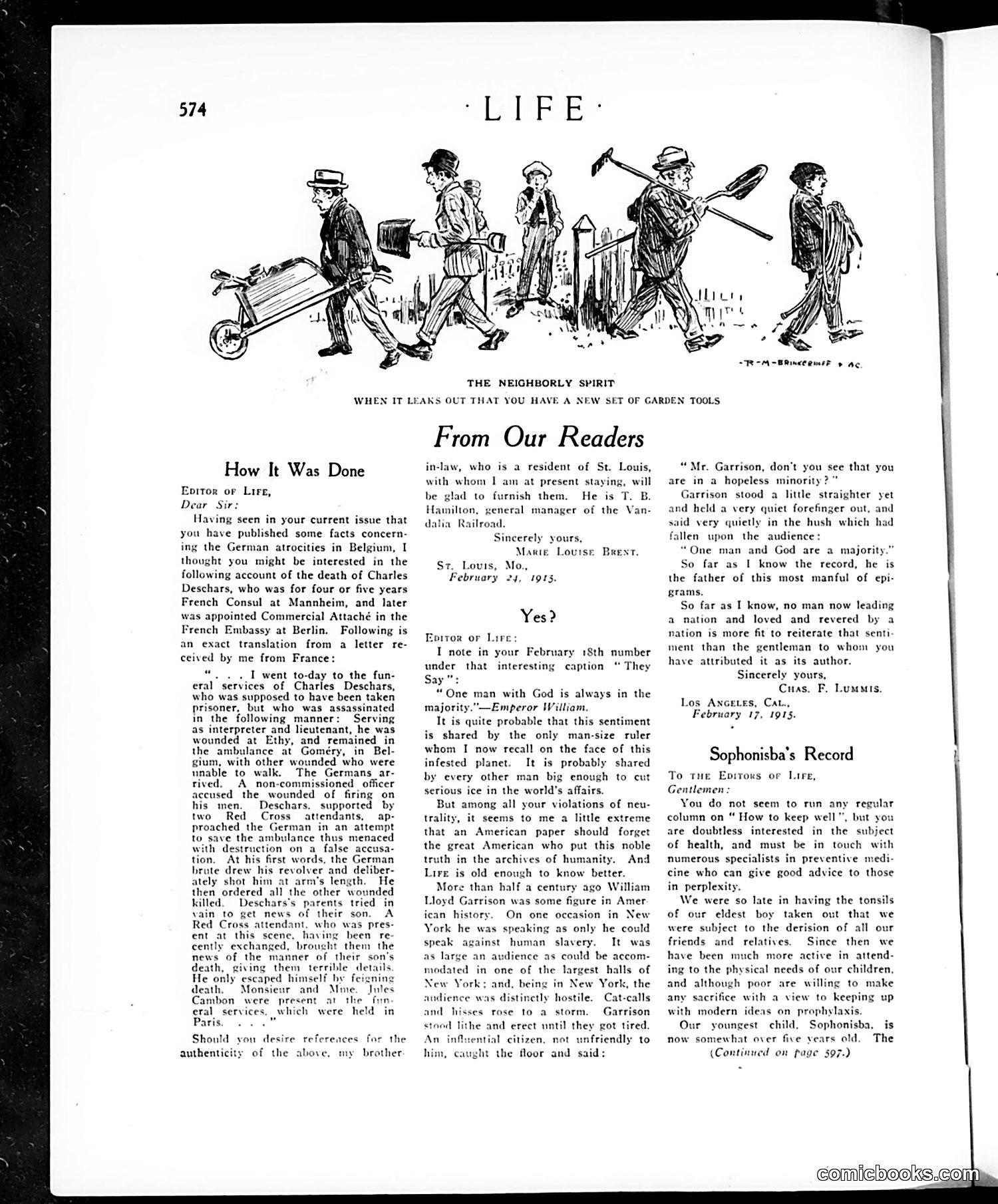
The top cartoon satirizes nouveaux riches ostentation: when neighbors discover you've bought new garden tools, they descend upon you like a mob to borrow them—depicted as figures looting and making off with rakes, shovels, and wheelbarrows. Below are three reader letters addressing serious WWI-era matters: 1. **"How It Was Done"** describes alleged German atrocities in Belgium—specifically the execution of French Consul Charles Deschars for defending wounded soldiers against false accusations of firing on German troops. 2. **"Yes?"** critiques *Life* magazine for attributing the quote "One man with God is always in the majority" to Kaiser Wilhelm II, when it actually originated with American abolitionist William Lloyd Garrison. The writer argues an American publication should credit the American antislavery hero, not the German wartime leader. Together, these items reflect American WWI-era concerns: German brutality, proper historical attribution during propaganda-heavy times, and the moral authority of American ideals versus European militarism.
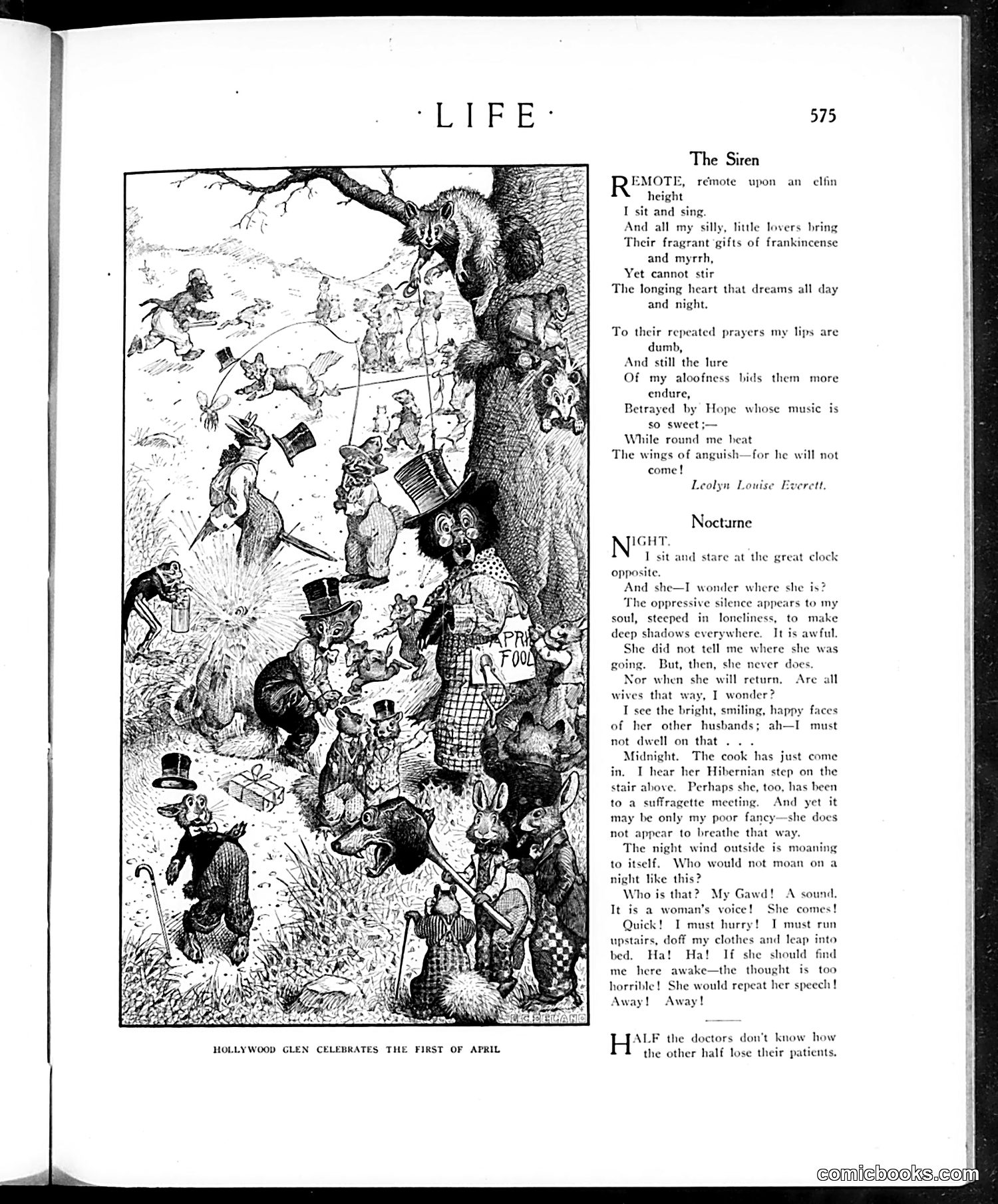
This is an April Fools' Day satirical illustration mocking Hollywood's pretentious artistic culture. The chaotic cartoon depicts absurd characters and scenarios typical of early 20th-century Hollywood—eccentric actors, directors, and aspirants engaged in ridiculous behavior around a massive tree. The accompanying poems parody overwrought romantic/artistic sentiment: "The Siren" mocks the seductive actress archetype, while "Nocturne" satirizes melodramatic domesticity—a jealous husband imagining his wife at "suffragette meetings" (contemporary women's rights activism, treated here as a comedic concern). The final quip about doctors and patients appears to be an unrelated joke playing on medical incompetence. The overall point: Hollywood produces absurd, self-important pretension masquerading as art, while domesticity breeds irrational anxiety. The April 1st date emphasizes these are foolish exaggerations of Hollywood types.
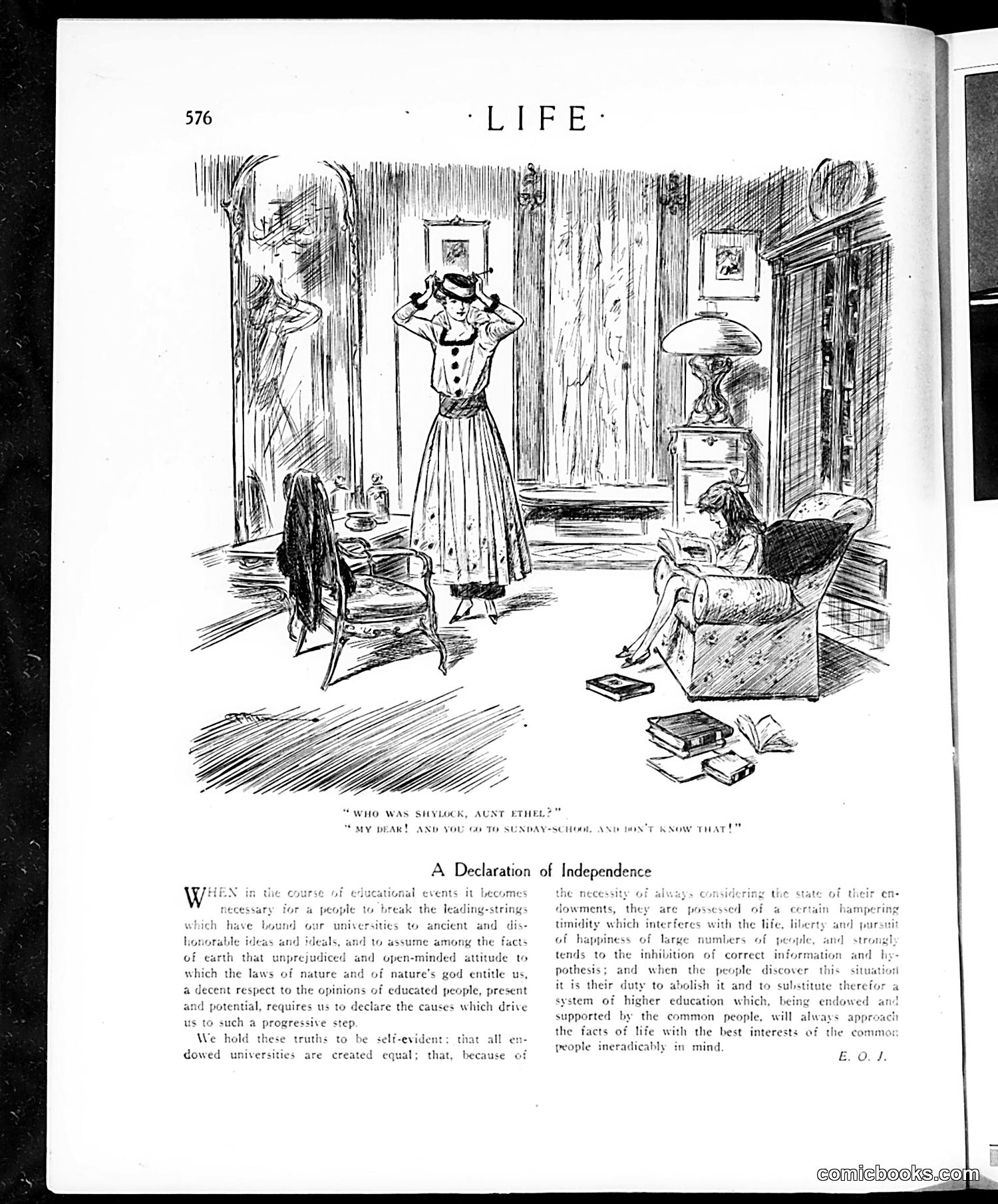
This page contains two distinct satirical pieces: **Top cartoon:** Shows a woman being quizzed by her aunt about "Shylock"—the Jewish moneylender from Shakespeare's *The Merchant of Venice*. The aunt's shocked response ("And you go to Sunday-school and don't know that!") satirizes upper-class pretension: educated people are expected to know classical literature, yet the aunt herself appears ignorant of the actual character. The humor targets snobbish cultural gatekeeping. **Bottom text:** "A Declaration of Independence" parodies the U.S. Declaration of Independence to critique higher education. It mockingly applies Revolutionary language to university systems, suggesting they're oppressive institutions needing rebellion. The satire likely targets educational establishment rigidity or elitism—the piece advocates replacing current systems with ones serving "common people's interests." Both items use established cultural references (Shakespeare, founding documents) to mock social pretension and institutional authority.
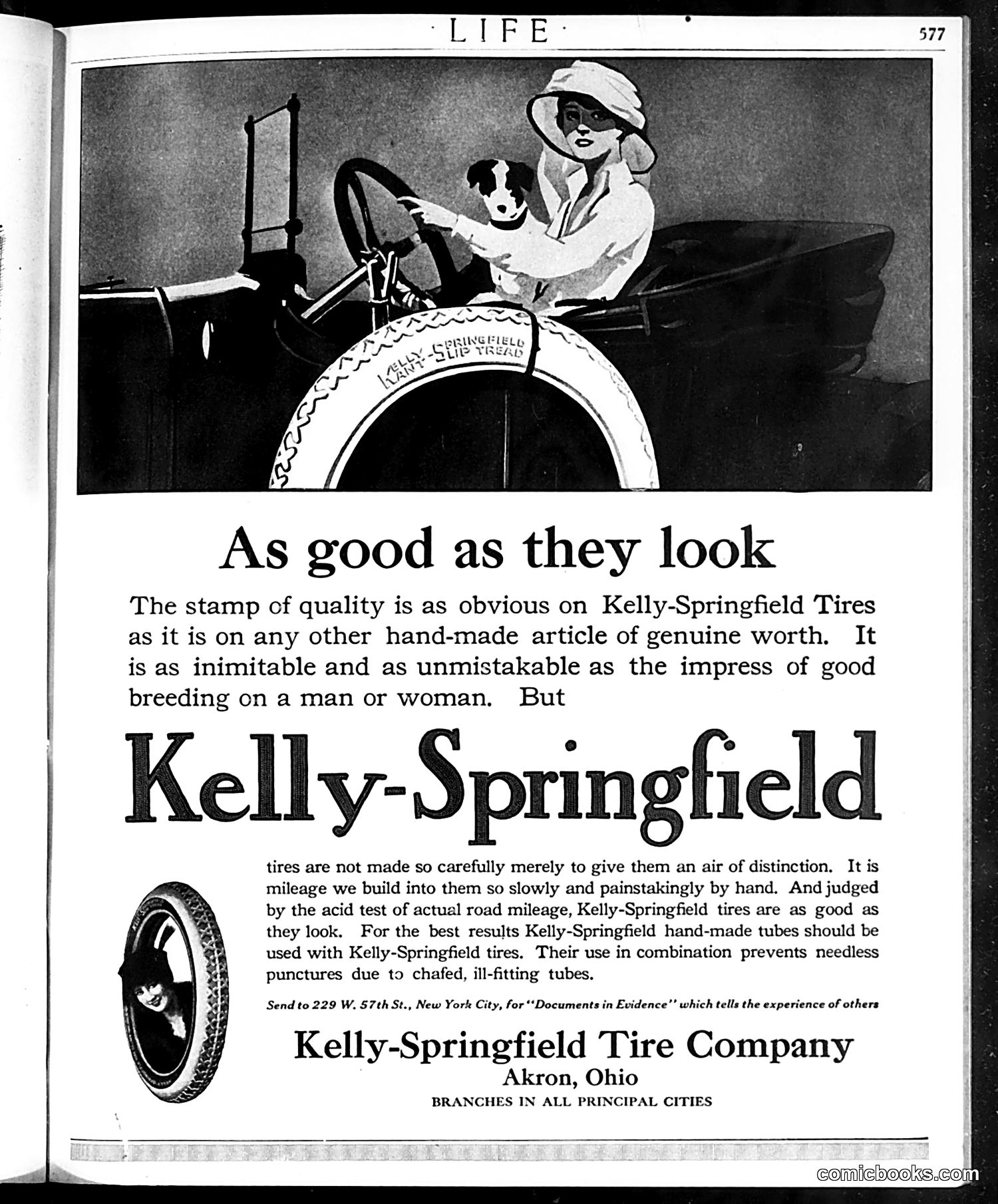
This is a **tire company advertisement**, not political satire. The image shows a fashionable woman in a motorcar with a small dog, steering by an oversized tire labeled "Kelly-Springfield." The ad's pitch centers on **quality and breeding**: it compares tire craftsmanship to "good breeding on a man or woman"—a genteel, class-conscious appeal typical of 1920s advertising. The message is that Kelly-Springfield tires look expensive and refined *and* actually perform well through "hand" manufacturing and careful "mileage building." The fashionable woman driver represents the target market: affluent motorists who value both appearance and genuine quality. The small dog adds charm and respectability. There is **no political cartoon or satire here**—this is straightforward product advertising emphasizing durability, handcrafted care, and status appeal to wealthy consumers. The page number (577) suggests this appeared in a regular *Life* magazine issue among other ads and articles.
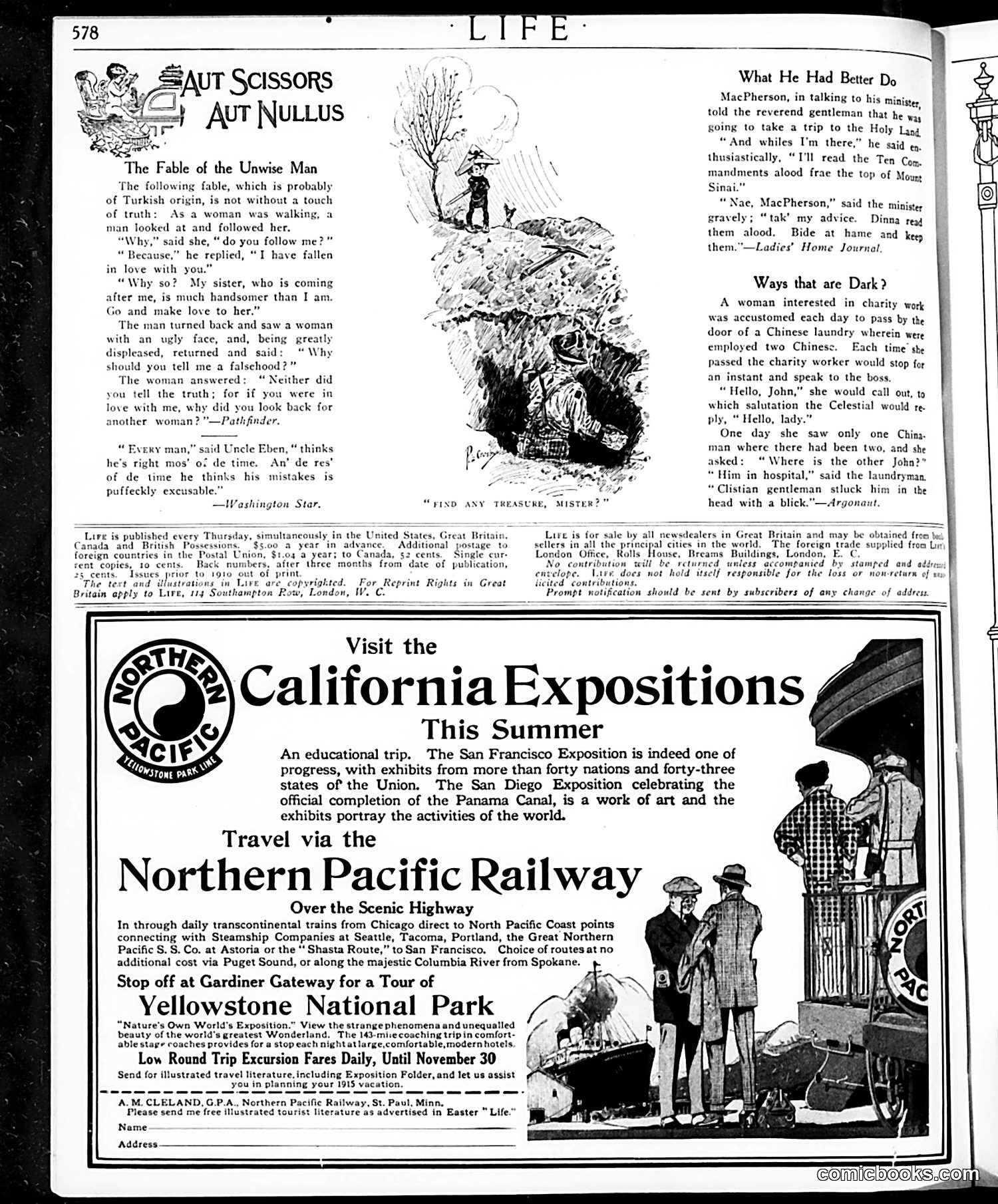
This page contains three brief satirical fables plus advertising. The cartoons use dated humor and stereotypes: **"The Fable of the Unwise Man"**: A man follows an attractive woman, who directs him to her uglier sister. When he returns disappointed, she accuses him of lying. The satire: men claim to love women for inner qualities but actually judge by appearance—hypocrisy exposed. **"What He Had Better Do"**: A Scottish man plans to read the Ten Commandments atop Mount Sinai during a Holy Land trip. A minister advises staying home and *following* them instead. The joke: performative religiosity (reading scripture in dramatic locations) versus actual moral behavior. **"Ways that are Dark?"**: A charity worker regularly greets a Chinese laundry owner named "John." When only one Chinese worker remains, she asks where the other is. He replies the other was hospitalized after "a Christian gentleman struck him in the head with a brick." The bitter irony: her charity work is performative while actual Christians commit violence against Chinese immigrants—reflecting real anti-Chinese prejudice of the era. The page is mostly travel advertising for California Expositions and Northern Pacific Railway.
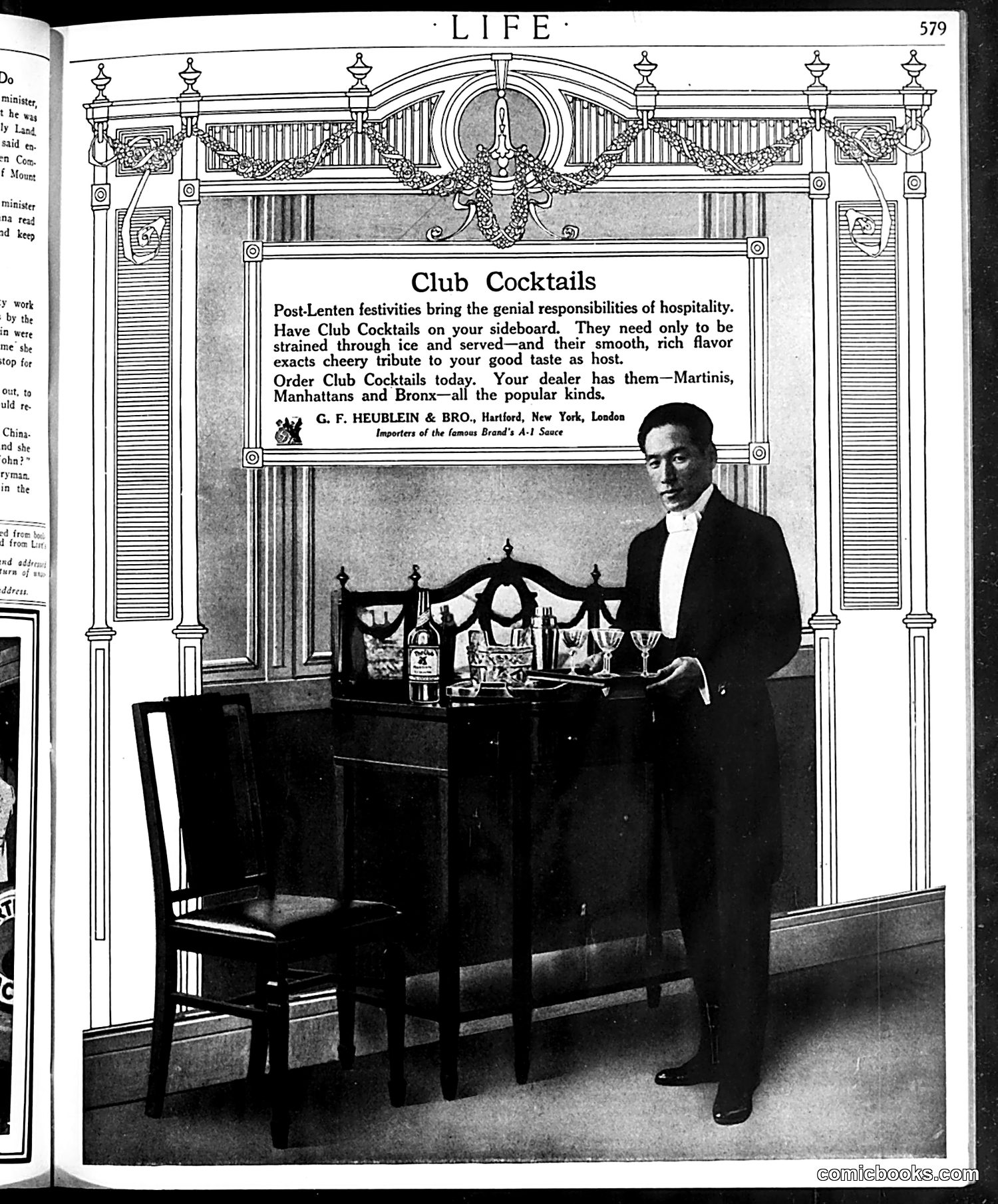
This is a full-page advertisement for Club Cocktails by G.F. Heublein & Bro., not a political cartoon. The ad targets post-Lenten social gatherings, when wealthy hosts would resume entertaining after the Catholic season of abstinence. The image shows a well-dressed man in formal attire standing beside a small bar table displaying cocktail bottles and glasses. The sophisticated setting and elegant furnishings emphasize luxury and hospitality. The text appeals to hosts' vanity, suggesting that serving Club Cocktails (available as Martinis, Manhattans, and Bronx cocktails) demonstrates "good taste." This reflects 1920s American consumer culture, where branded products signaled social status among the upper classes during Prohibition's peak.
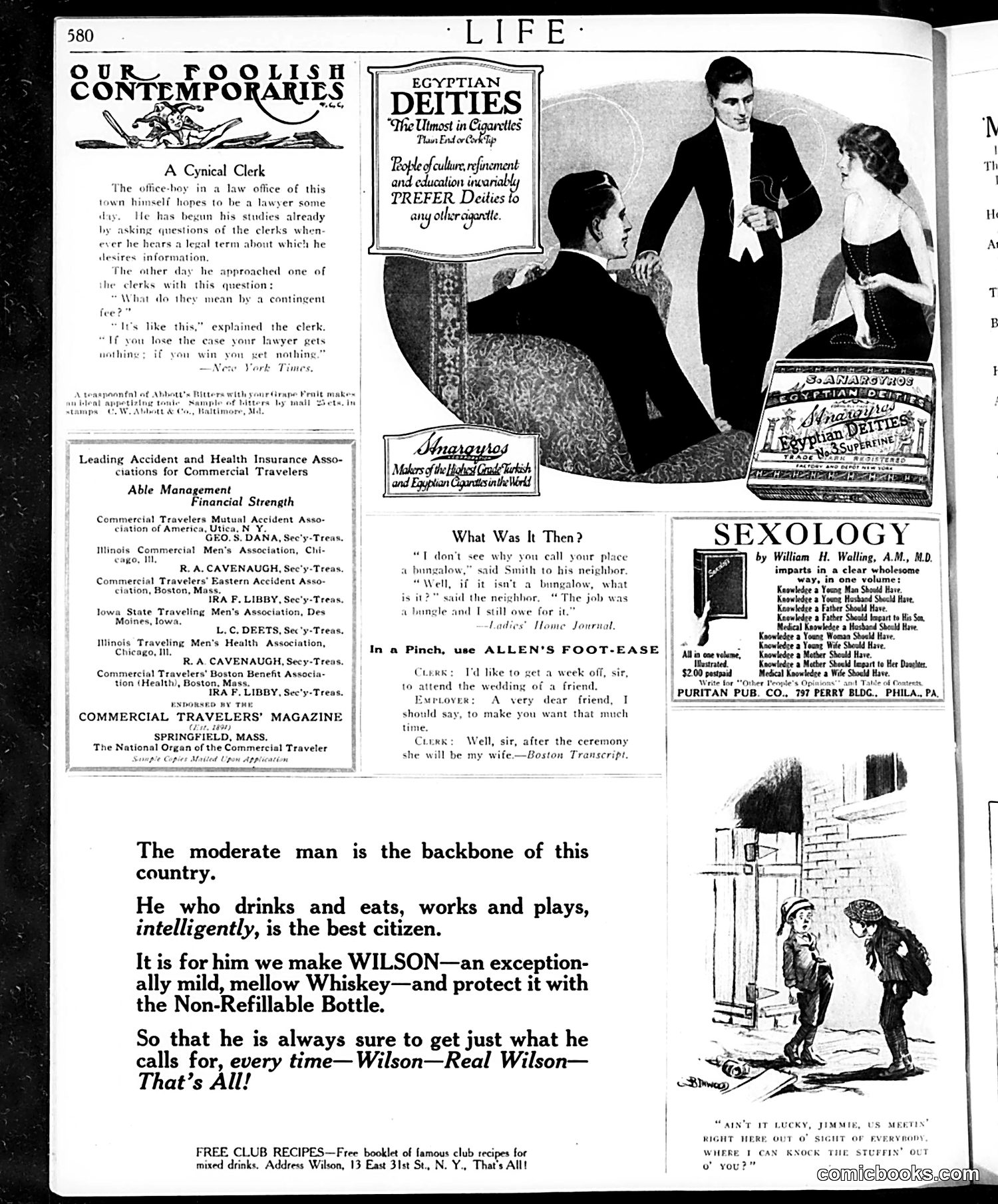
This page contains several distinct sections mixing humor, advertising, and social commentary typical of early 20th-century *Life* magazine. **"A Cynical Clerk"** satirizes legal practice: an office boy asks a clerk about "contingent fees," and the clerk explains cynically that the lawyer wins nothing if you lose, wins nothing if you win either—a joke about lawyers' supposed dishonesty or the futility of legal disputes. **"What Was It Then?"** is a brief joke: a man calls his house a "bungalow" but admits he still owes money on it, so it's not truly his—mocking either the term "bungalow" or middle-class pretension about homeownership. The page is otherwise dominated by **advertisements** for cigarettes (Egyptian Deities), insurance associations for traveling salesmen, a sex education book (*Sexology*), foot powder, and Wilson Whiskey—which includes ideology about the "moderate man" being society's "backbone." A cartoon at bottom shows two street urchins planning mischief, unrelated to other content. The page reflects early 1900s concerns: legal cynicism, home debt, traveling salesmen's welfare, and respectability through moderation.
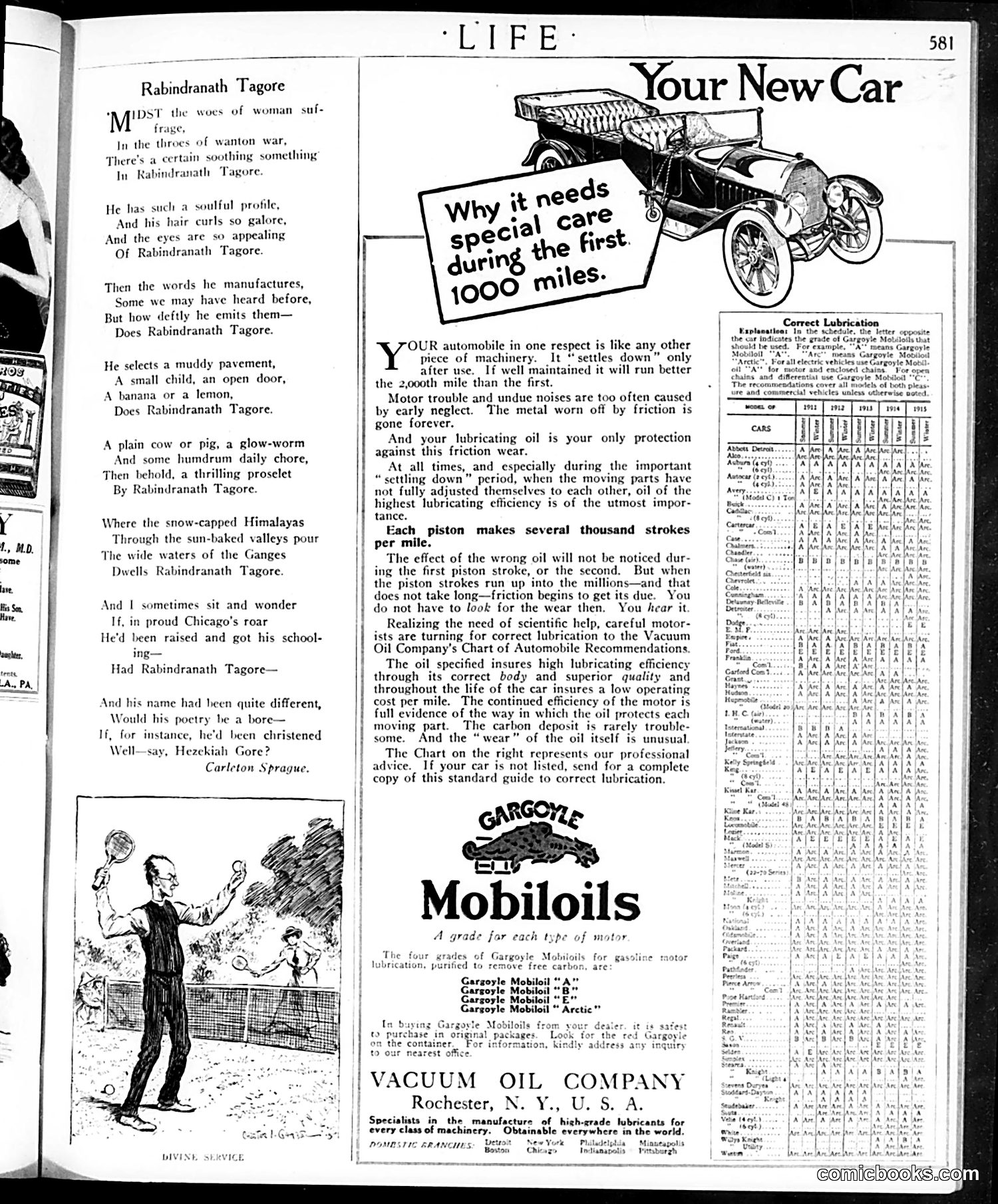
This page contains two distinct elements: **Left side - "Rabindranath Tagore" poem by Carleton Sprague:** A satirical verse mocking the Bengali poet and philosopher Rabindranath Tagore, who was enormously popular in early 20th-century American literary circles. The satire suggests Tagore's appeal relies on exotic mystique—his "soulful profile," poetic atmosphere, and association with the Himalayas and Ganges—rather than substance. The joke culminates in asking whether his poetry would seem boring if he had a mundane American name like "Hezekiah Gore" instead. This reflects skepticism about whether Westerners genuinely appreciated his work or were merely seduced by orientalist romance. **Right side - Advertisements:** Full-page ads for Gargoyle Mobiloils (Vacuum Oil Company) promoting proper automobile lubrication during the critical "first 1000 miles" of new car ownership, with a detailed chart recommending specific oil grades for different car models. The page juxtaposes literary satire with commercial messaging—typical of Life's satirical-yet-advertising-heavy format.
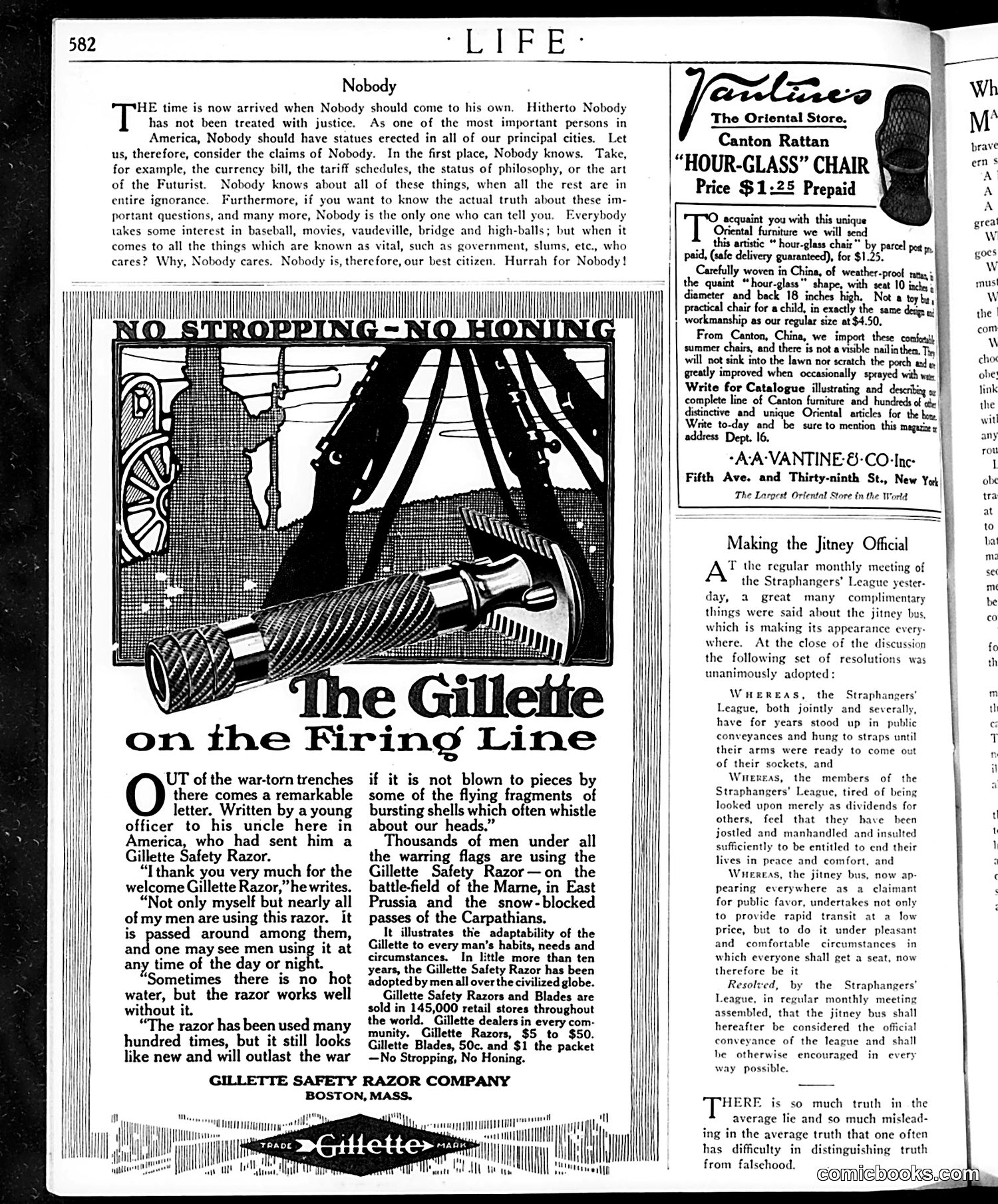
This page combines satirical editorial content with period advertising. **"Nobody" Editorial**: A sharp satirical piece arguing that "Nobody" deserves statues and recognition as America's best citizen. The satire targets public indifference and ignorance—Nobody knows about currency, tariffs, philosophy, or Futurism; only Nobody can tell the "actual truth." The joke mocks how citizens ignore vital issues (government, slums) while caring about entertainment. It's a biting commentary on civic apathy and collective ignorance in early 20th-century America. **"The Gillette on the Firing Line"**: A Gillette Safety Razor advertisement disguised as a war story. It features a letter from a young officer praising the razor's durability in WWI trenches. The pitch emphasizes the product's universal adaptability across "all the warring flags"—implying global commercial success even during wartime. This juxtaposes consumer convenience with battlefield conditions, a common advertising strategy during the war period. The remaining content advertises Oriental furniture and discusses the "Jitney" (early shared taxi service).
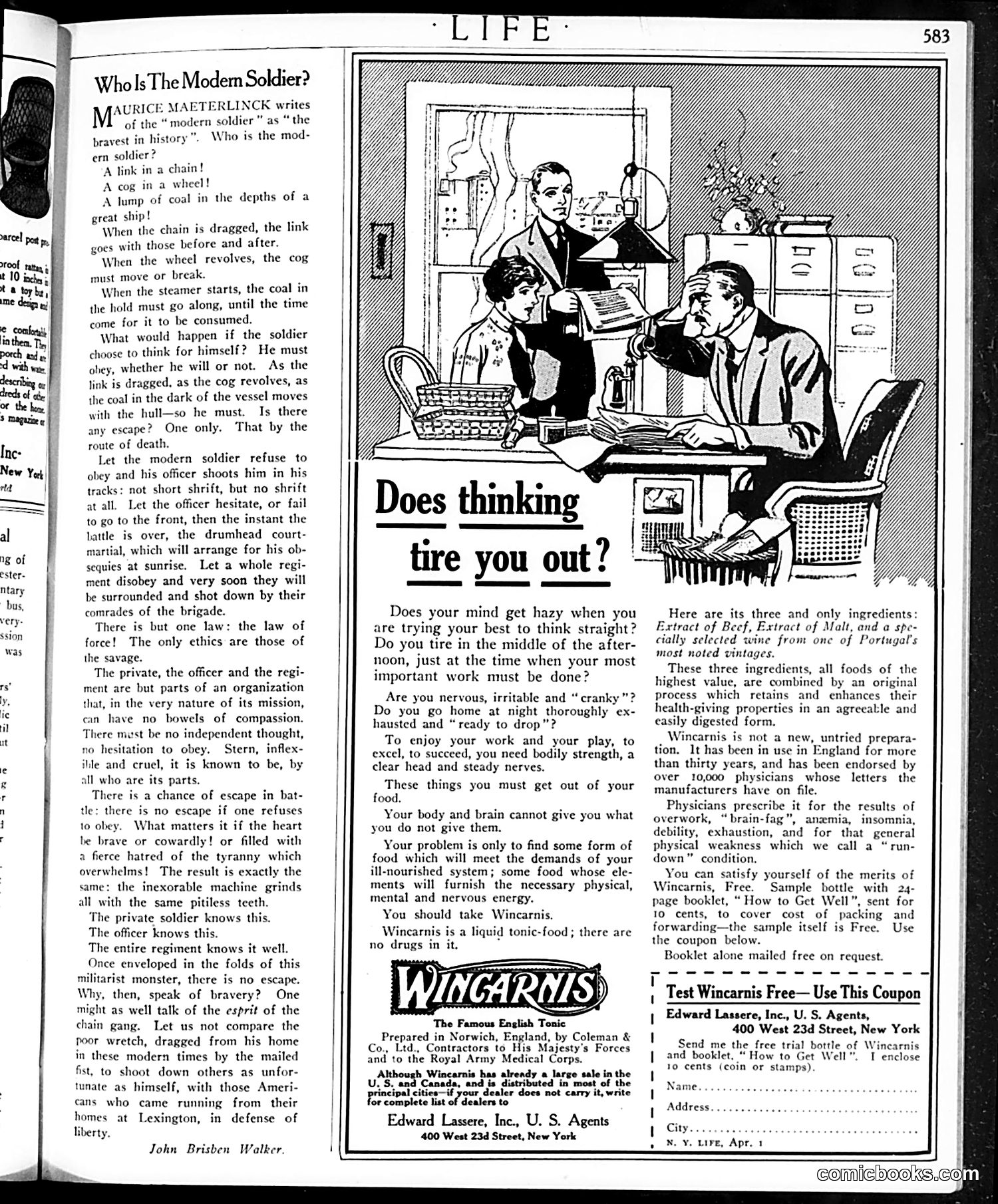
**Left column - "Who Is The Modern Soldier?"** By Maurice Maeterlinck, this is a **anti-militarist essay** using mechanical metaphors. The soldier is compared to interchangeable parts—a link in a chain, cog in a wheel, lump of coal—to argue that modern warfare strips individuality and enforces absolute obedience through force and threat of execution. The piece condemns military discipline as dehumanizing tyranny, contrasting contemporary conscripted soldiers unfavorably with American Revolutionary volunteers who fought for liberty. The author John Brisben Walker criticizes the "militarist monster" that crushes independent thought. **Right column - Advertisement for Wincarnis** This is an advertisement for a patent "tonic-food" marketed to combat mental and physical fatigue. The illustration shows office workers, and the ad claims Wincarnis addresses "brain-fag," anemia, and exhaustion without drugs—a typical early 20th-century health product claiming near-magical restorative properties. The coupon offers a free trial. The juxtaposition creates ironic contrast: the essay condemns dehumanizing systems while advertisements sell products promising to restore depleted workers.
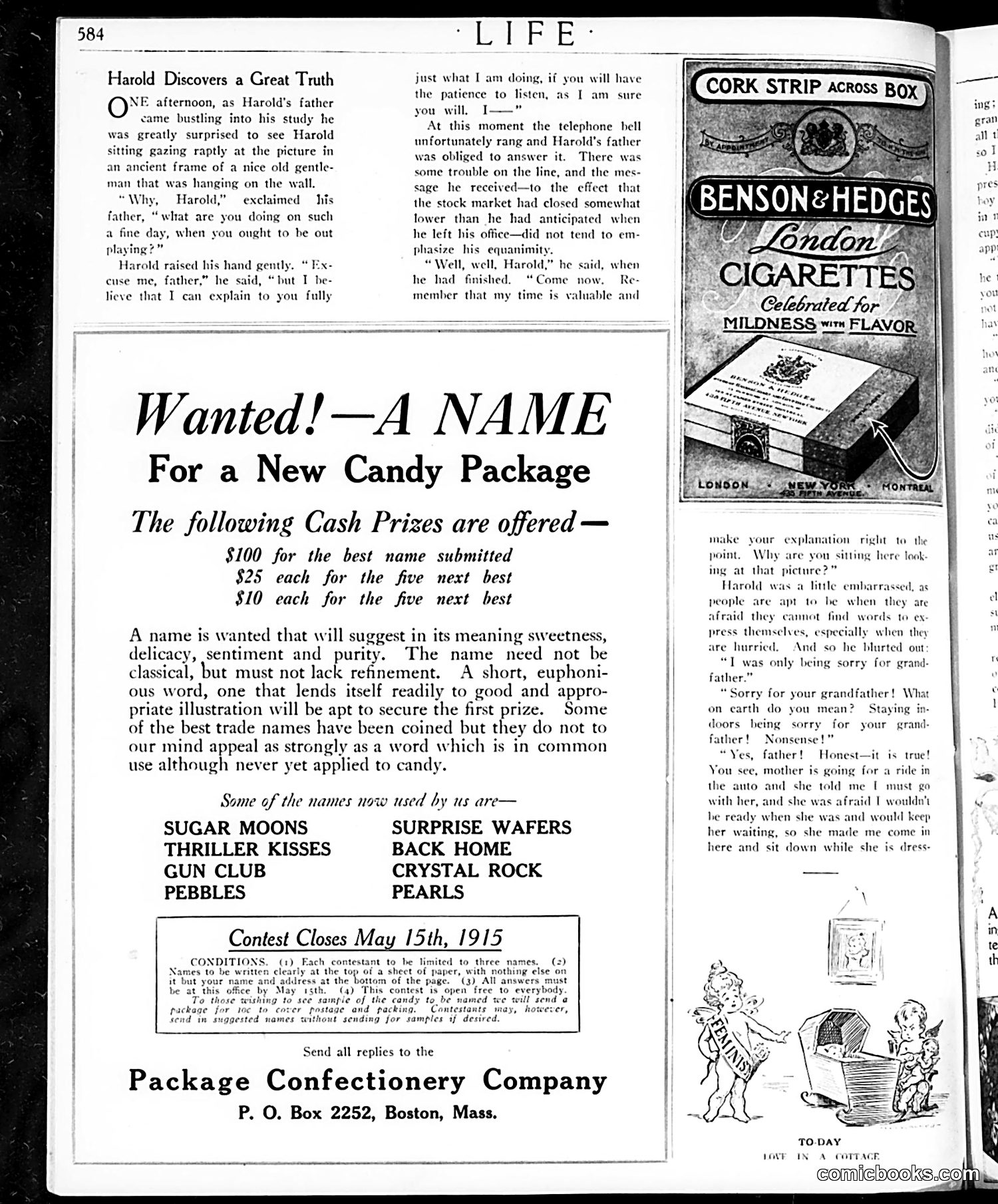
This is a **short humorous story** (not a political cartoon), likely satirizing early 20th-century parental hypocrisy and work-life values. **The Setup:** Harold gazes at a portrait of his grandfather, prompting his father to interrupt and demand his attention. The father receives a stock-market call that upsets him—the market closed lower than expected. **The Joke:** Harold explains he was "being sorry for grandfather" because his mother made him wait indoors while she dressed, to prevent him from dawdling. The father demands Harold not "waste" time on such sentiments when time is "valuable." **The Satire:** The irony is that Harold's father—who just spent time on a phone call about finances—scolds Harold for idle reflection. The piece mocks adults' obsession with productivity and commercial concerns (stock markets) while dismissing children's innocent emotional lives. Harold's simple empathy contrasts with the father's materialism. The accompanying **contest advertisement** for candy-package naming reinforces the commercial focus of the era.
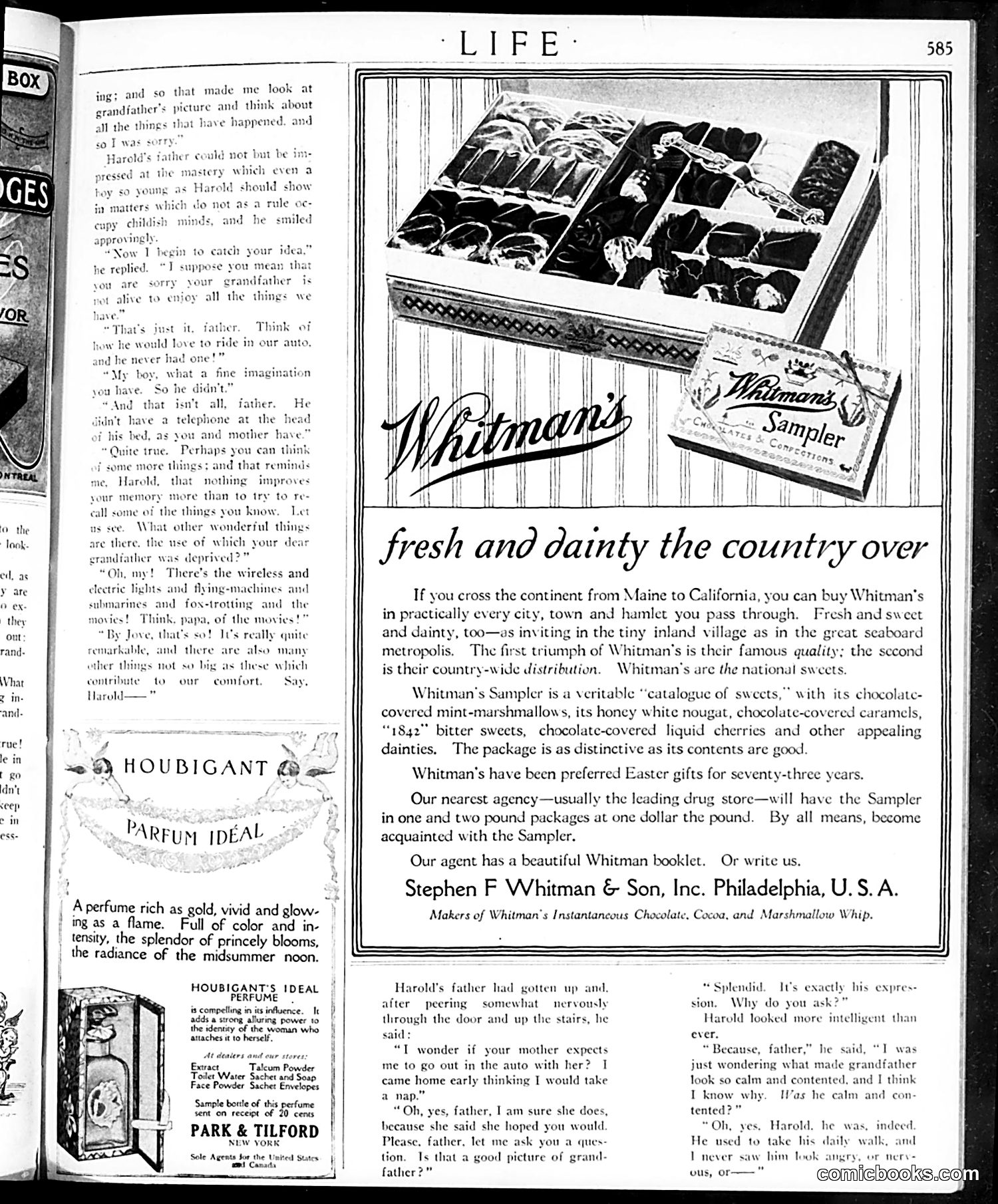
This page contains **advertising and serialized fiction rather than political satire**. The main content is a domestic story about a boy named Harold discussing modern conveniences with his father—automobiles, telephones, wireless, and movies—contrasting what his grandfather lacked. The father is somewhat reluctant about going out in the auto with Harold's mother. The page features two **commercial advertisements**: 1. **Whitman's Sampler** (candy): Emphasizes nationwide distribution and quality, positioning the product as "the national sweets" available everywhere from Maine to California. 2. **Houbigant's Ideal Perfume** and **Park & Tilford** (perfume/cosmetics): Luxury goods marketed with romantic language about elegance and allure. There is **no political cartoon or satire here**. The story's gentle humor derives from generational differences regarding modern technology and a child's innocent observation about his grandfather's contentment—likely implying the older generation's simpler, less-hurried life. This is primarily a period advertising page reflecting early 20th-century consumer culture and family dynamics.
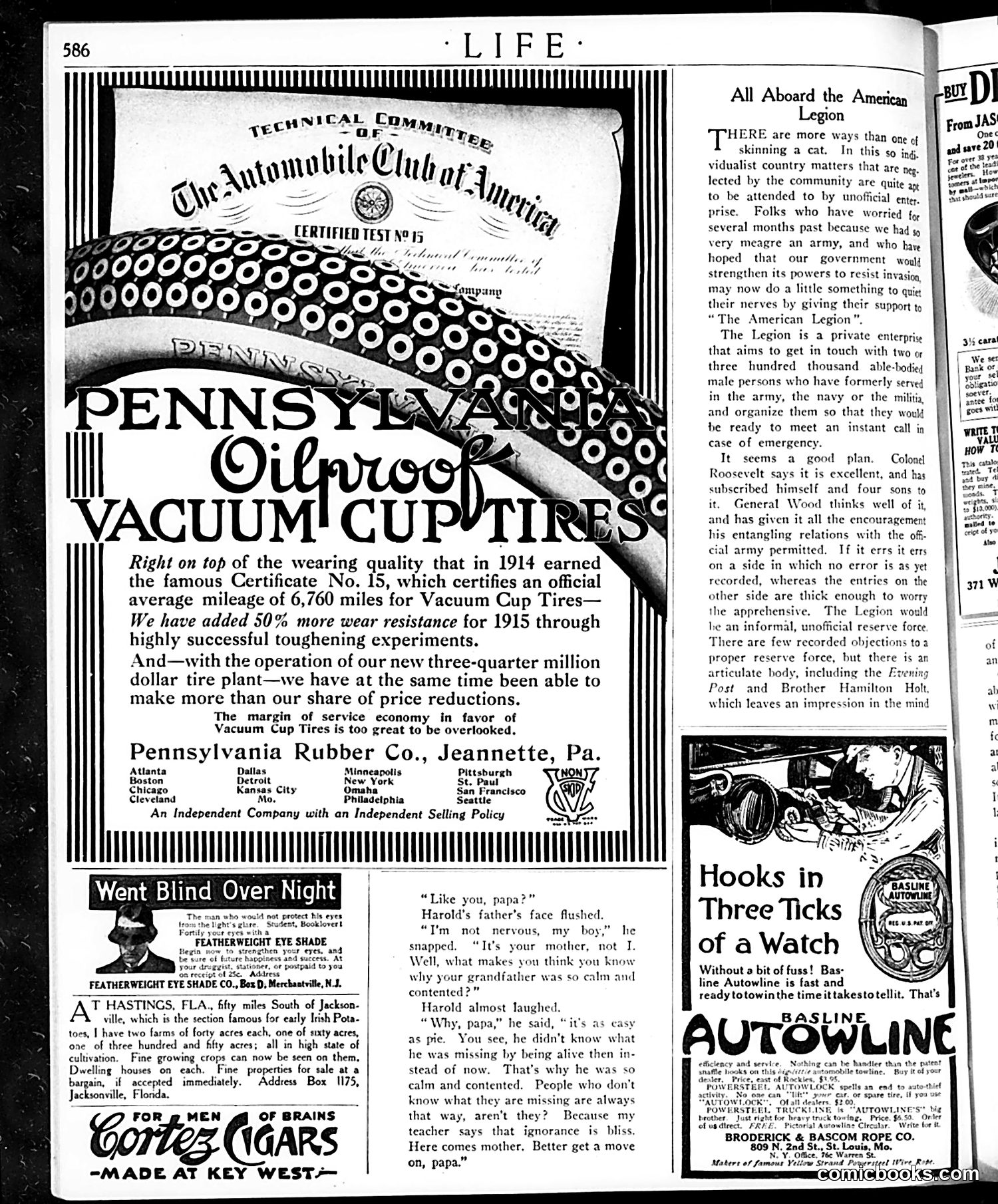
This page is primarily **advertisements** interspersed with brief editorial content and short fiction. The main editorial piece, "All Aboard the American Legion," discusses a private organization aimed at mobilizing former military personnel into an informal reserve force. It mentions **Colonel Roosevelt** and **General Wood** as supporters, presenting the Legion as a civilian solution to military preparedness concerns—apparently responding to anxieties about inadequate national defense. The larger advertisements are for **Pennsylvania Rubber Co.'s Vacuum Cup Tires** (emphasizing 50% improved wear resistance) and **Basline Autowline** (automotive products). A brief humorous story, "Went Blind Over Night," depicts a father reassuring his son about nervousness, using his grandfather's ignorance as an example of contentment—a gentle joke about blissful unawareness. The page contains typical early 20th-century small advertisements for real estate in Florida, cigars, and eye shades. **This is not primarily a political cartoon page**—it's a standard magazine layout mixing editorial content with commercial advertising.
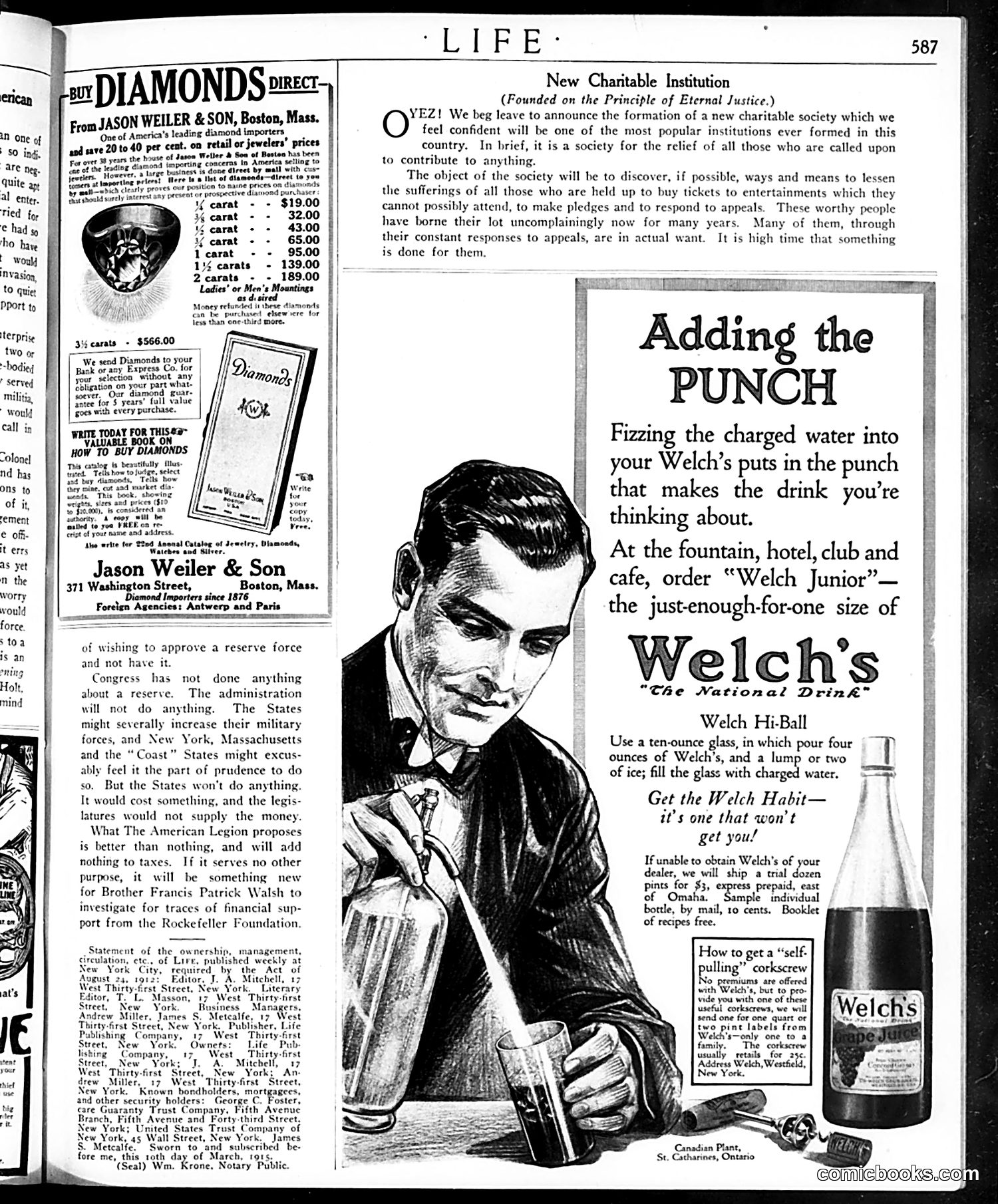
This page contains two distinct pieces of content: **Left side:** A satirical article titled "New Charitable Institution (Founded on the Principle of Eternal Justice)" mocks wealthy people who are compelled to buy charity tickets and make donations they cannot afford. The satire proposes creating a relief society for "those who are held up to buy tickets to entertainments"—people suffering from constant charitable appeals. It's social commentary on the burden of mandatory giving among the middle and upper classes. **Right side:** A Welch's grape juice advertisement featuring an illustration of a man preparing a "Hi-Ball" cocktail with Welch's juice and charged water. This is a straightforward commercial advertisement promoting Welch's as "The National Drink" and encouraging the "Welch Habit." The page juxtaposes sharp social satire with consumer marketing—typical of *Life* magazine's format mixing editorial content with paid advertising, offering no particular connection between the two items.
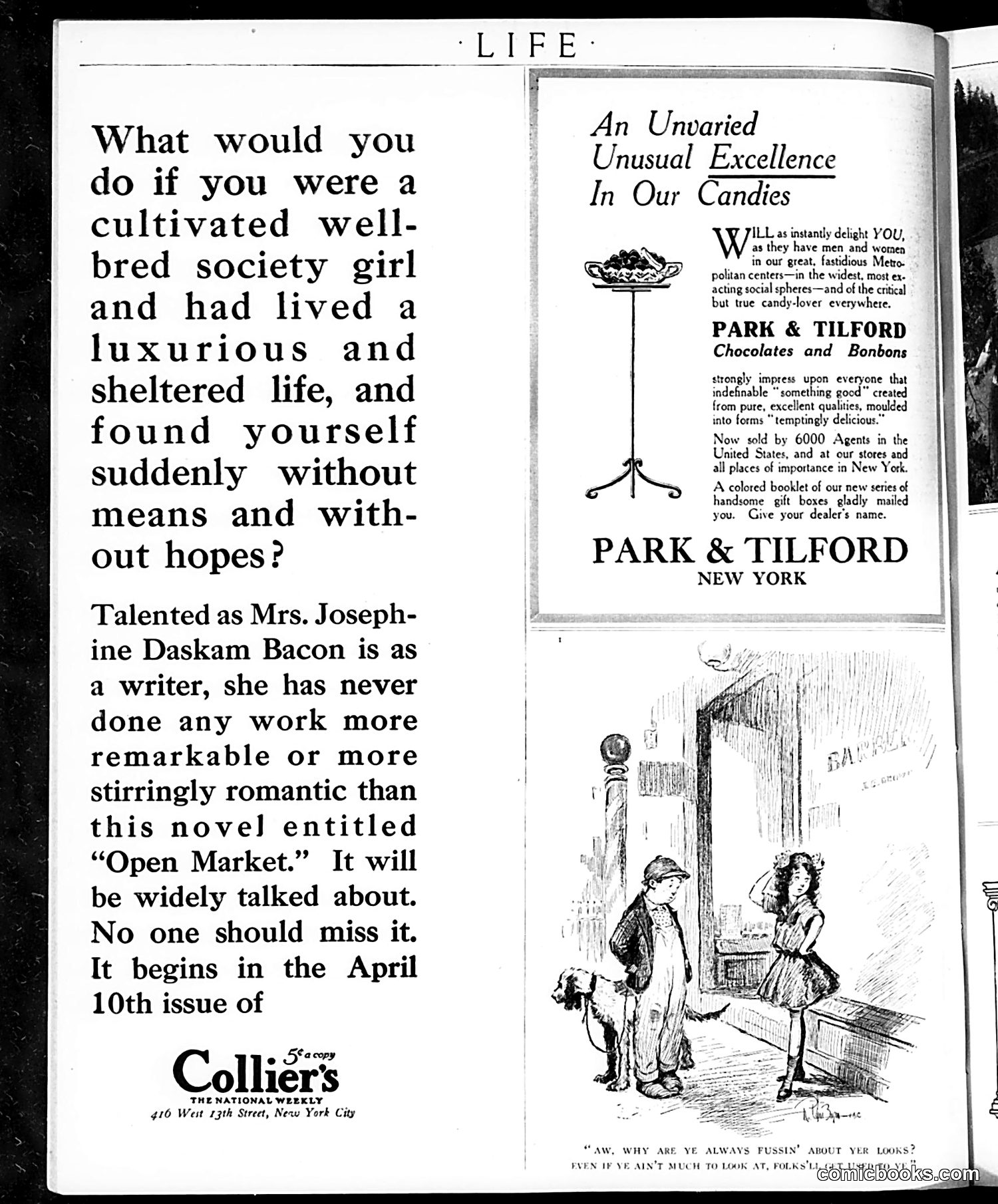
**Left Side - Advertisement/Editorial:** This promotes Josephine Daskam Bacon's novel "Open Market" (debuting in Collier's April 10th issue). The hook asks: what if a wealthy, sheltered society girl suddenly lost everything? The pitch frames this as her most "romantic" work—implying both literary merit and appeal to readers fascinated by upper-class downfall narratives. **Right Side - Cartoon:** The sketch depicts a working-class couple (identifiable by dialect and appearance). The man, apparently unshaven and rough, dismisses the woman's vanity about her looks with crude reassurance: essentially "don't worry about being pretty, people won't judge you anyway." **The Satire:** This juxtaposes starkly with the novel's premise. Where "Open Market" romanticizes genteel poverty for society girls, the cartoon mocks ordinary people's concerns about appearance—suggesting different class standards. The crude humor underscores that romance and dignity attach only to *cultivated* fallen women, not working-class ones.
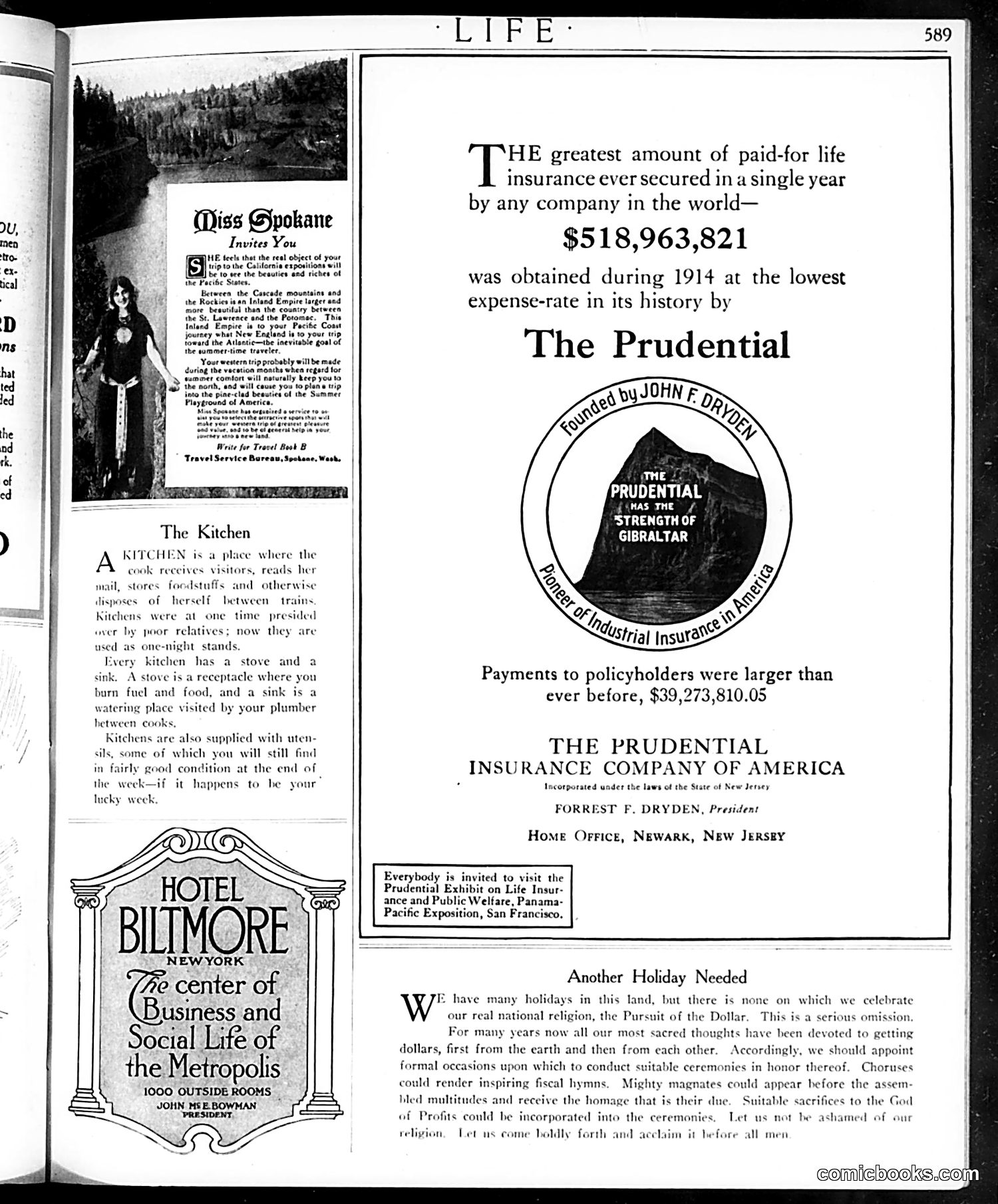
This page contains **no political cartoon**—it's primarily advertising and satirical editorial commentary. **The advertisements** promote travel to Spokane, the Hotel Biltmore in New York, and notably, The Prudential Insurance Company, which boasts securing $518 million in life insurance during 1914 at the lowest expense rate. **The satire** appears in the bottom article, "Another Holiday Needed." It mocks American capitalism by proposing a new national holiday celebrating "the Pursuit of the Dollar"—suggesting Americans have made wealth-accumulation their true religion. The piece sarcastically recommends formal ceremonies, "fiscal hymns," and magnates receiving "homage," with "sacrifices of Profits" incorporated into religious-style observances. The humor lies in treating profit-seeking as a sacred, organized religion rather than acknowledging it as such implicitly. It's a biting critique of American materialism and the elevation of commercial success above traditional values, presented with mock-reverent language that exposes the absurdity of this cultural priority.
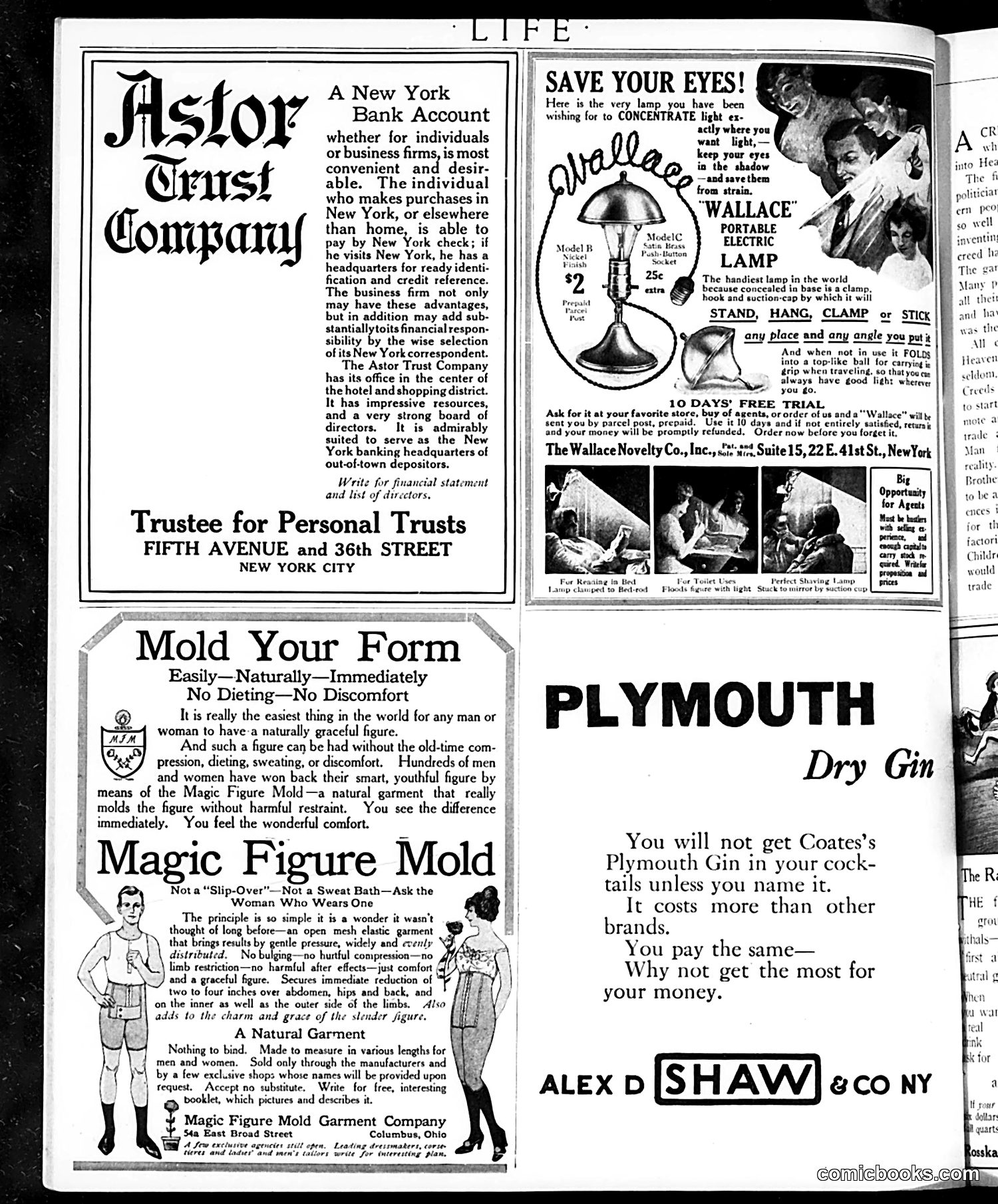
This page is primarily **advertising** rather than editorial satire or political commentary. It contains four distinct product advertisements: 1. **Astor Trust Company** — a New York bank promoting convenient financial services for out-of-town clients 2. **Magic Figure Mold** — a mail-order elastic corset/undergarment claiming to reduce body measurements without diet or exercise; targets both men and women seeking "graceful figures" 3. **Wallace Portable Electric Lamp** — a flexible desk lamp with clamp/suction-cup mounting, advertised as portable and versatile 4. **Plymouth Dry Gin** — a liquor advertisement emphasizing brand quality and premium pricing The page reflects early 20th-century consumer culture: financial services for the wealthy, beauty/body-shaping products (representing period standards), modern home conveniences, and alcohol advertising (pre-Prohibition or early Prohibition era). None contains political satire or cartoon commentary — it's purely commercial messaging typical of *Life* magazine's advertising content.
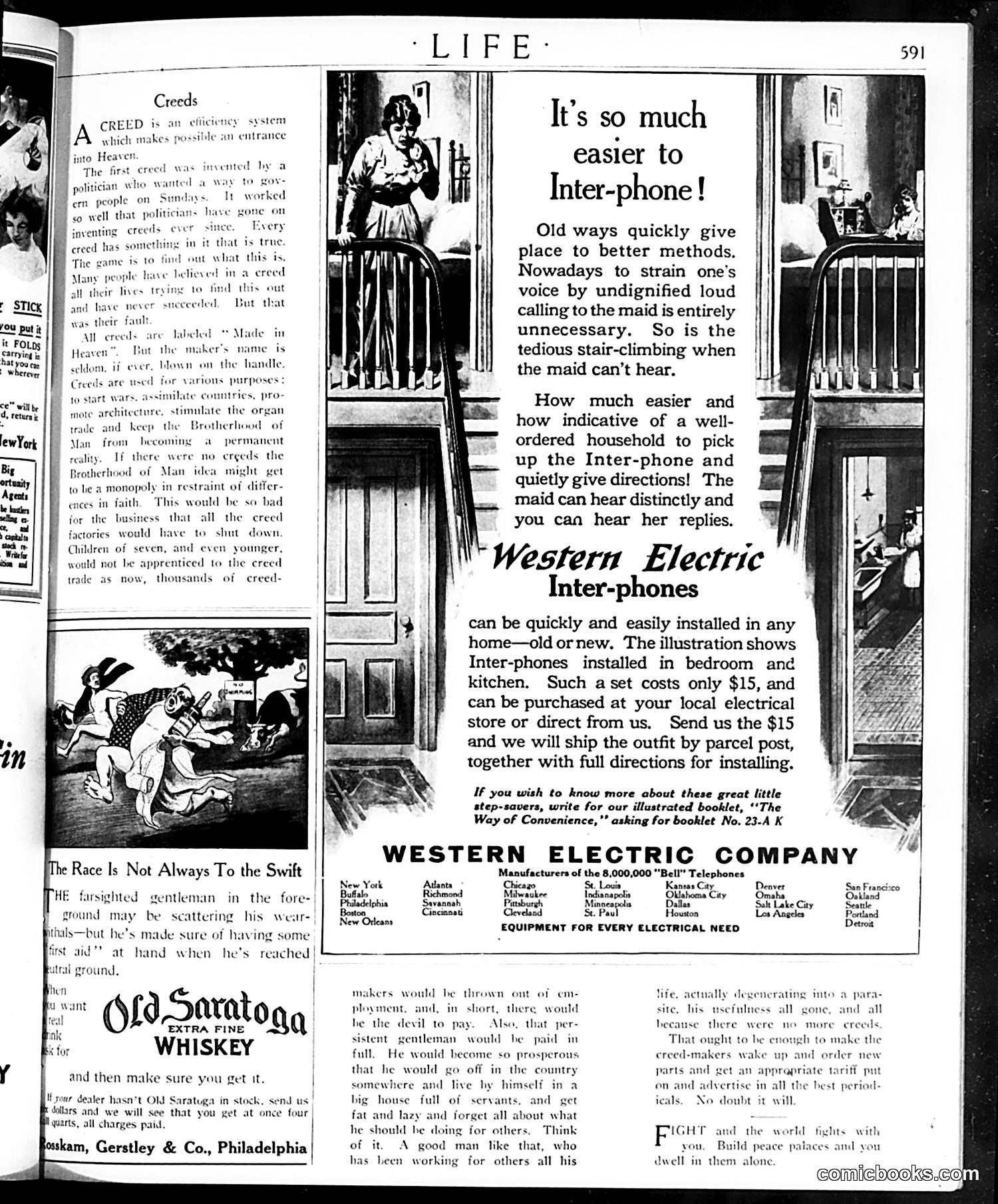
This page is primarily **advertising**, not political satire. The dominant content is a Western Electric Inter-phone advertisement (an early internal home telephone system), which occupies the right half of the page. The advertisement uses a practical sales pitch: it promotes inter-phones as labor-saving devices that eliminate the need for servants to climb stairs or shout for maids. The illustrated images show bedroom and kitchen installations. The price is $15, positioning this as accessible domestic technology. The left side contains editorial content: an essay on "Creeds" (discussing religious/philosophical systems) and an unrelated ad for Old Saratoga Whiskey. There's also a small illustration labeled "The Race Is Not Always To the Swift," which appears to show a gentleman ensuring he has "first aid" available—a generic lifestyle reference rather than pointed satire. The page reflects early 20th-century concerns: household convenience, servant management, and technological modernization for the home.
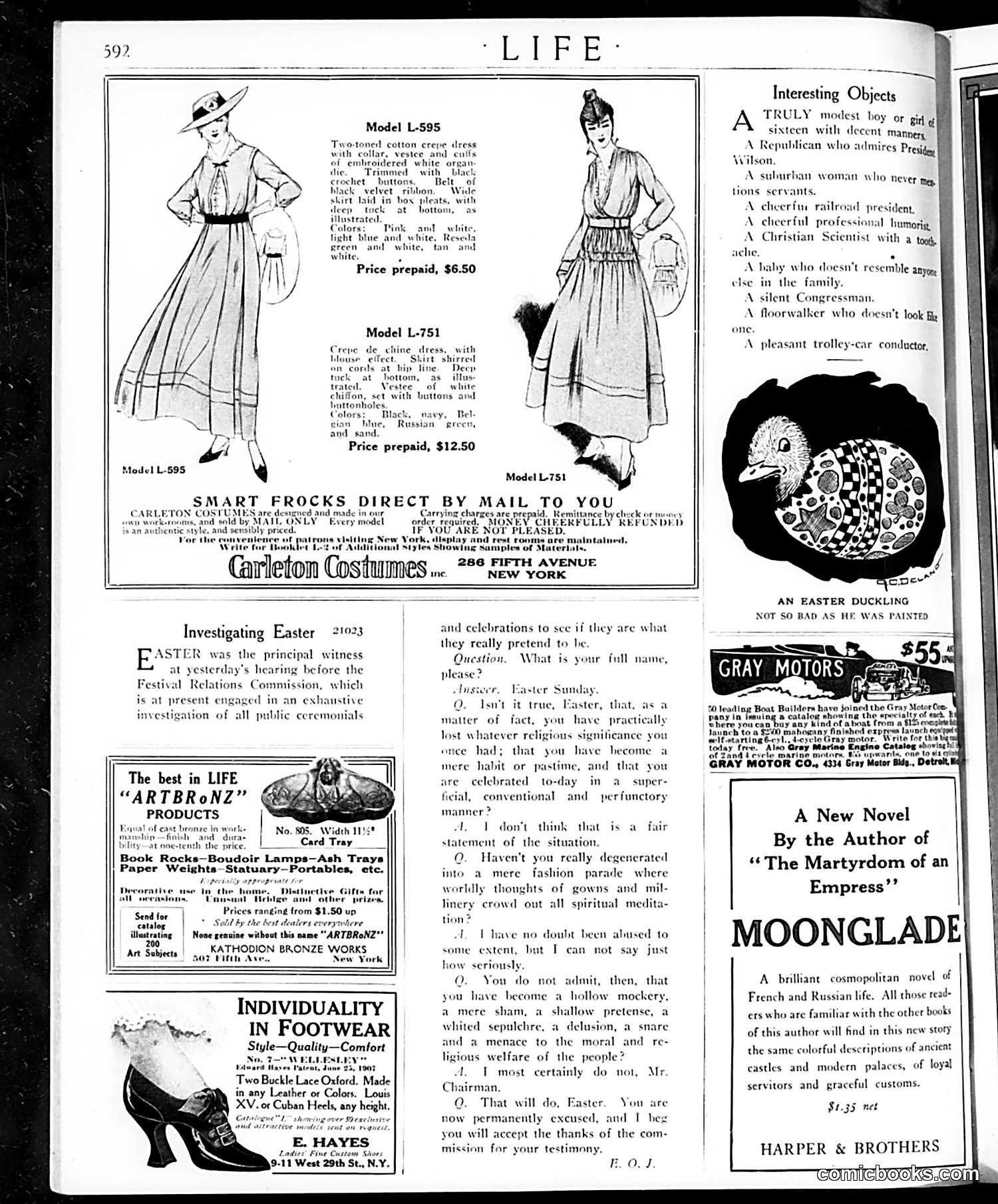
This page primarily consists of **advertisements and a satirical interview**, not political cartoons in the traditional sense. The main satirical content is "Investigating Easter"—a mock legal hearing where Easter itself is interrogated by the Festival Relations Commission. The interviewer challenges Easter's authenticity, suggesting it has devolved from religious observance into mere "fashion parade" and "hollow mockery" driven by commercial concerns (fashionable clothing, merchandise). Easter's defense—that while abused "to some extent," it hasn't lost all spiritual meaning—is unconvincing. The satire targets both **commercialization of religious holidays** and the **hypocrisy of celebrations that retain only superficial trappings** of their original purpose. The surrounding ads for women's dresses, motor boats, and other goods ironically reinforce this critique: Easter has become primarily a shopping occasion rather than spiritual observance. This reflects early-20th-century anxiety about American consumer culture overtaking traditional religious meaning.
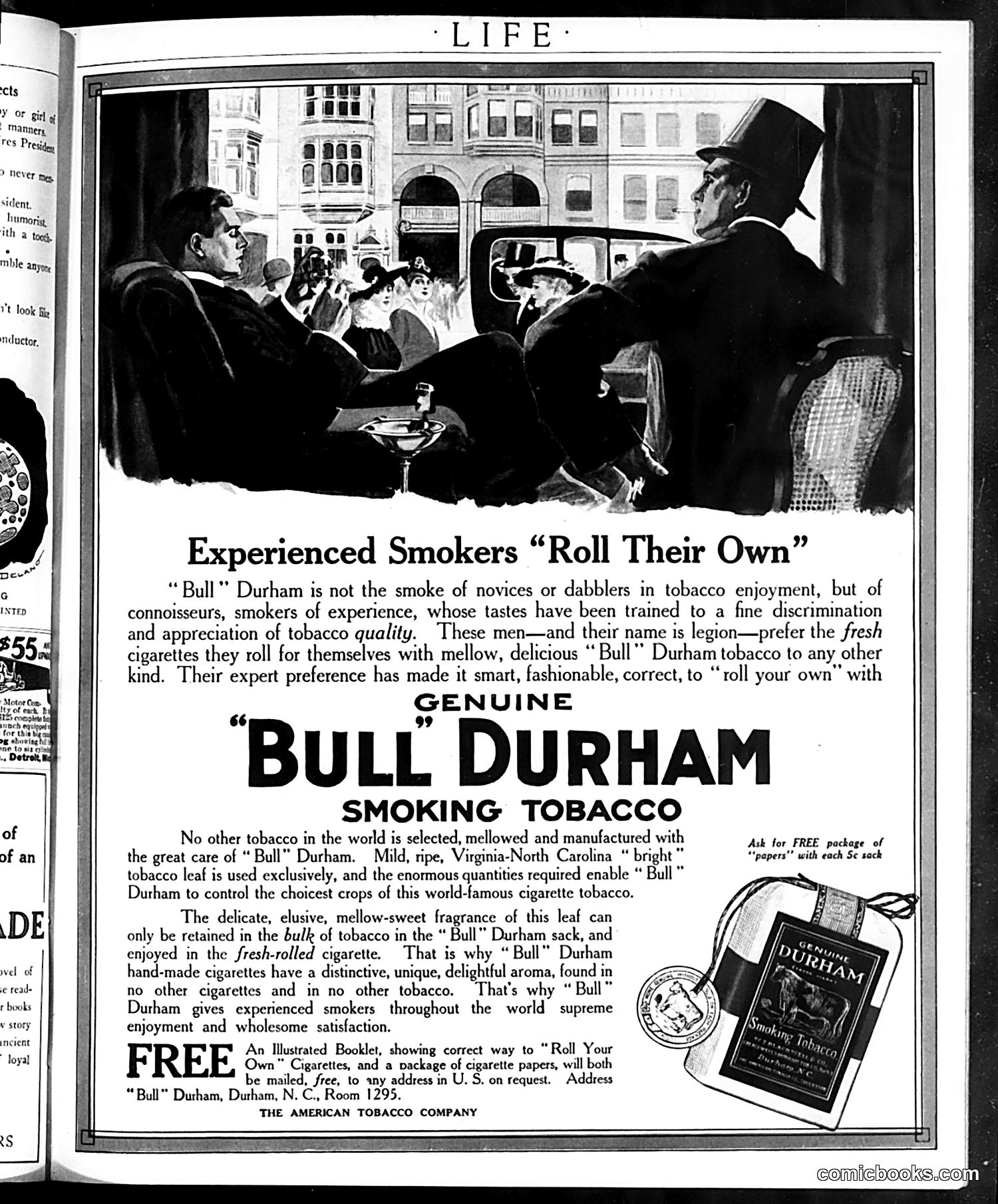
This is a **full-page advertisement**, not satire or political commentary. It promotes Bull Durham smoking tobacco to the "experienced smoker" market. The illustration shows two well-dressed men in a car or carriage, smoking cigarettes they've rolled themselves—depicting the aspirational lifestyle the product targets. The ad emphasizes that rolling your own cigarettes from bulk tobacco is "smart, fashionable, correct," positioning it as a mark of refined taste and connoisseurship rather than economy. The sales pitch claims Bull Durham's quality comes from exclusive use of Virginia-North Carolina tobacco leaf, and argues that hand-rolled cigarettes preserve the tobacco's "delicate, elusive" flavor better than mass-manufactured ones. A free offer promotes both an instructional booklet on rolling technique and complimentary cigarette papers, distributed from Durham, North Carolina. This reflects early 20th-century marketing that associated consumer products with sophistication and status.
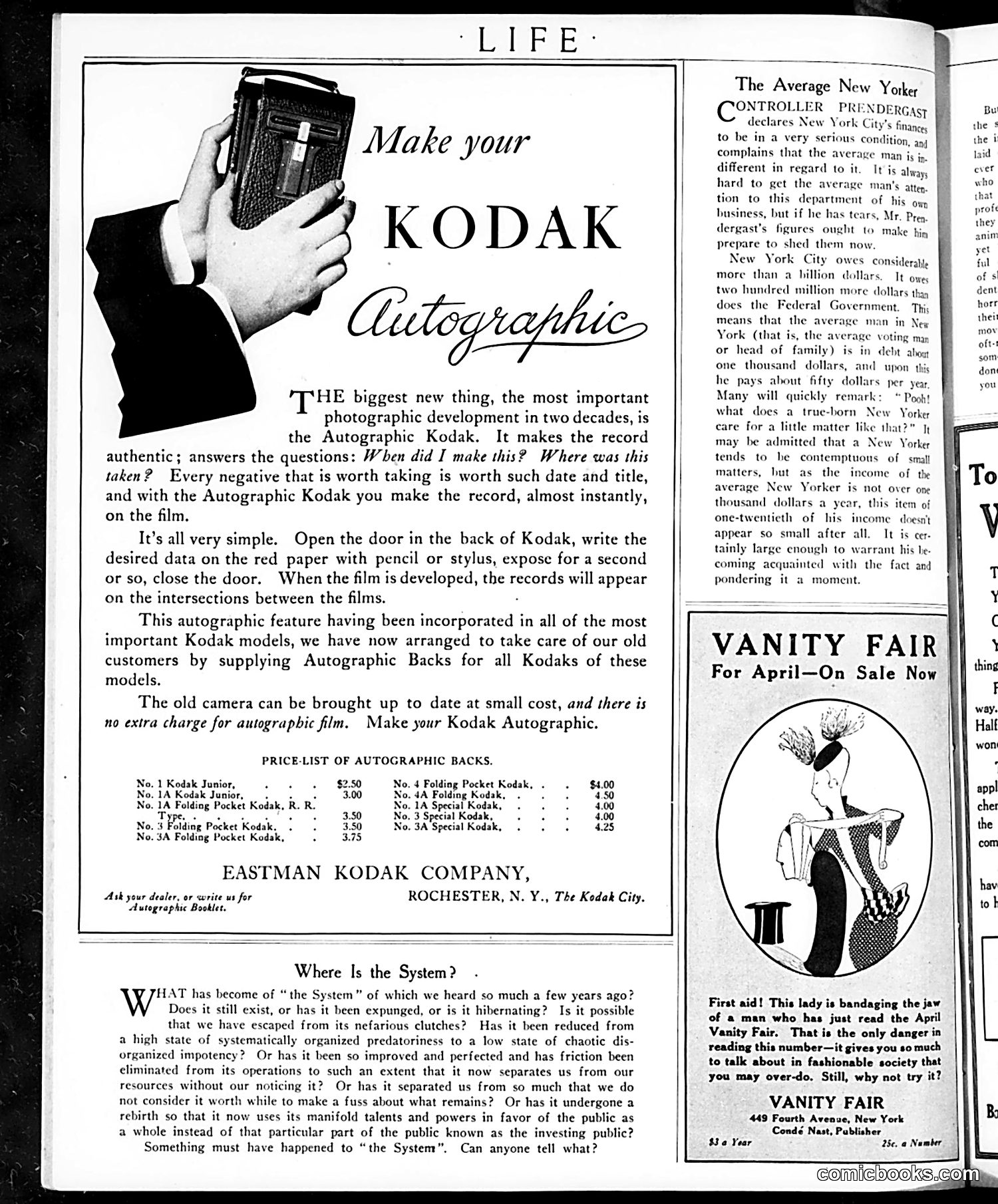
This page is primarily **advertising**, not satire or political commentary. The dominant content is a **Kodak advertisement** promoting the "Autographic" camera feature—a mechanism allowing photographers to write dates and locations directly onto film negatives. The ad emphasizes convenience and authenticity for personal record-keeping. Below the ad is a brief editorial column titled "Where Is the System?" This appears to reference **Progressive Era anti-trust concerns**, questioning whether "the System" (corporate monopolies and financial predation that were scandals a few years prior) still exists or has been reformed. The tone is sarcastic—suggesting either the System persists invisibly or Americans have simply stopped caring. The right column discusses **New York City's debt crisis**, noting average citizens each owe roughly $1,000 in municipal debt, though most remain indifferent. At bottom is a **Vanity Fair advertisement** for their April issue, with a cartoon of a woman bandaging a man's jaw after he read the magazine—a humorous exaggeration of its social commentary's impact. The page reflects early 20th-century concerns: corporate accountability, municipal finance, and satirical journalism as popular entertainment.
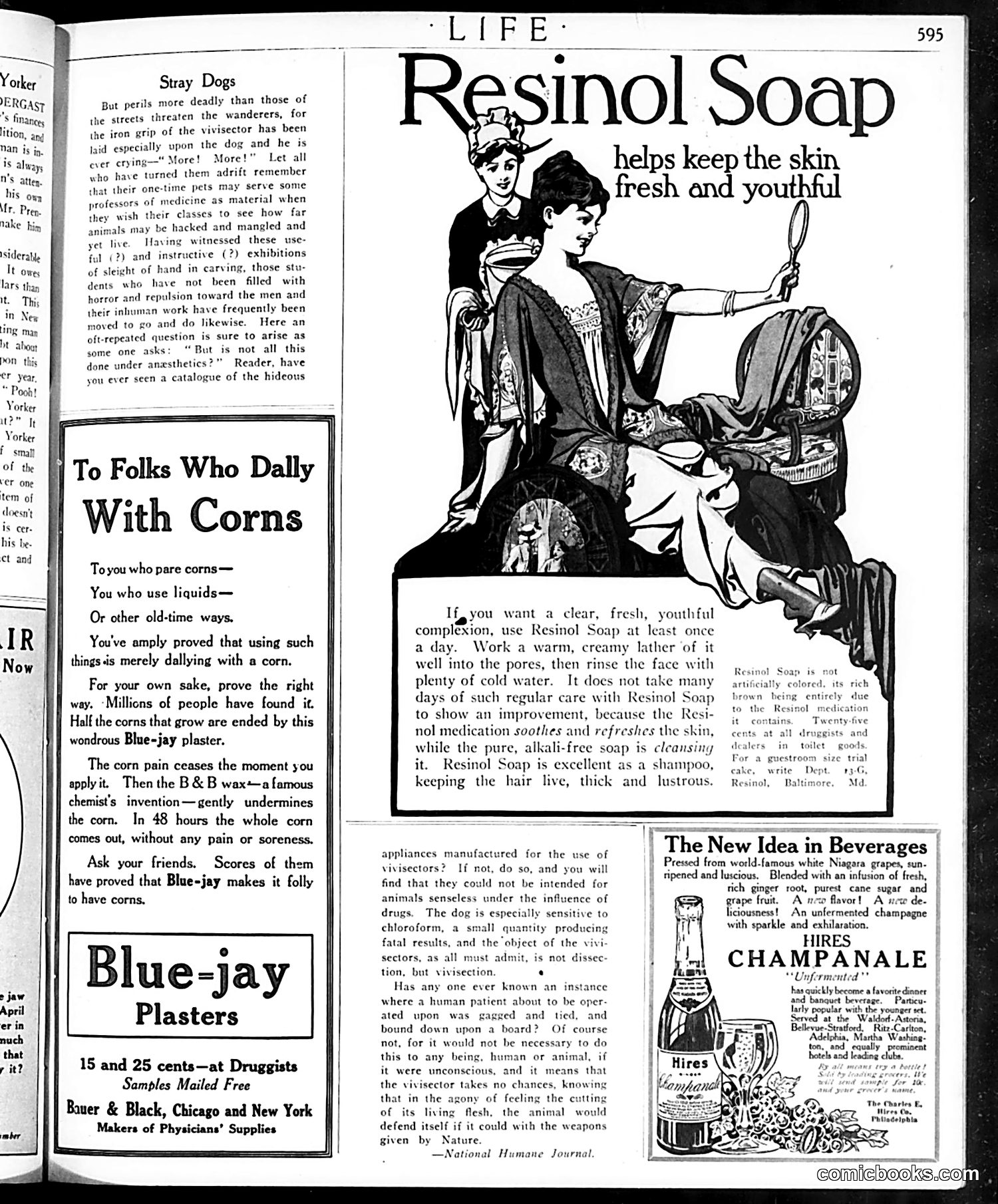
This page contains **no political cartoons**—it's primarily **advertisements and editorial content** typical of early 20th-century magazines. The main editorial piece, "Stray Dogs," is an **animal-welfare argument against vivisection** (live animal dissection). It argues that stray dogs face danger from medical professors who use them for classroom demonstrations. The author questions whether these procedures use anesthesia, citing the fact that animals are restrained—suggesting conscious suffering. The piece references the "National Humane Journal," indicating this reflects contemporary animal-rights activism. The advertisements include **Blue-jay Plasters** (corn treatments), **Resinol Soap** (beauty/skin care), and **Hires Champanale** (non-alcoholic beverage). These ads reflect consumer products marketed to middle-class Americans of the era, with typical period imagery and claims. The vivisection essay represents **progressive-era concerns** about medical ethics and animal treatment, movements that gained traction in the early 1900s.
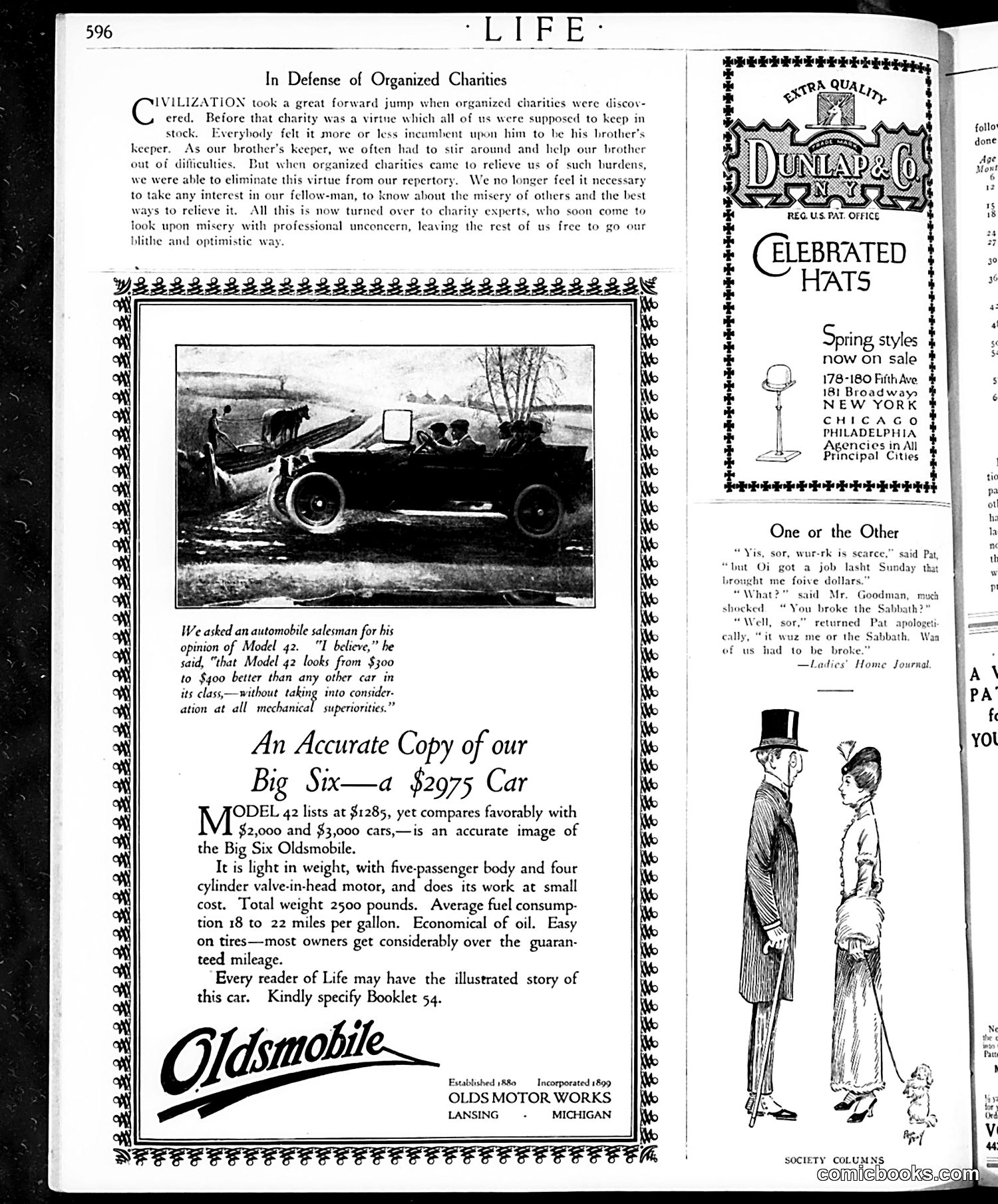
This page contains primarily **advertisements and humor**, not political cartoons. The main content is an **essay criticizing organized charities**, arguing that professionalized charity has made ordinary people less personally responsible for helping others. The author suggests we've outsourced morality to "experts" who view suffering with "professional unconcern," freeing the rest of us to remain "blithe and optimistic." The **humor section** ("One or the Other") is an Irish immigrant joke featuring "Pat," a stereotypical character speaking in exaggerated brogue. The punchline plays on the phrase "broke"—Pat broke the Sabbath (religious law) or went broke (financially)—suggesting poverty forces difficult moral choices. The page is dominated by **advertising**: Oldsmobile's Model 42 car, Dunlap & Co. hats, and other products typical of 1910s-era *Life* magazine content. The automobile ad ironically quotes a salesman claiming the car "looks" expensive despite being affordable—commentary on marketing over substance.
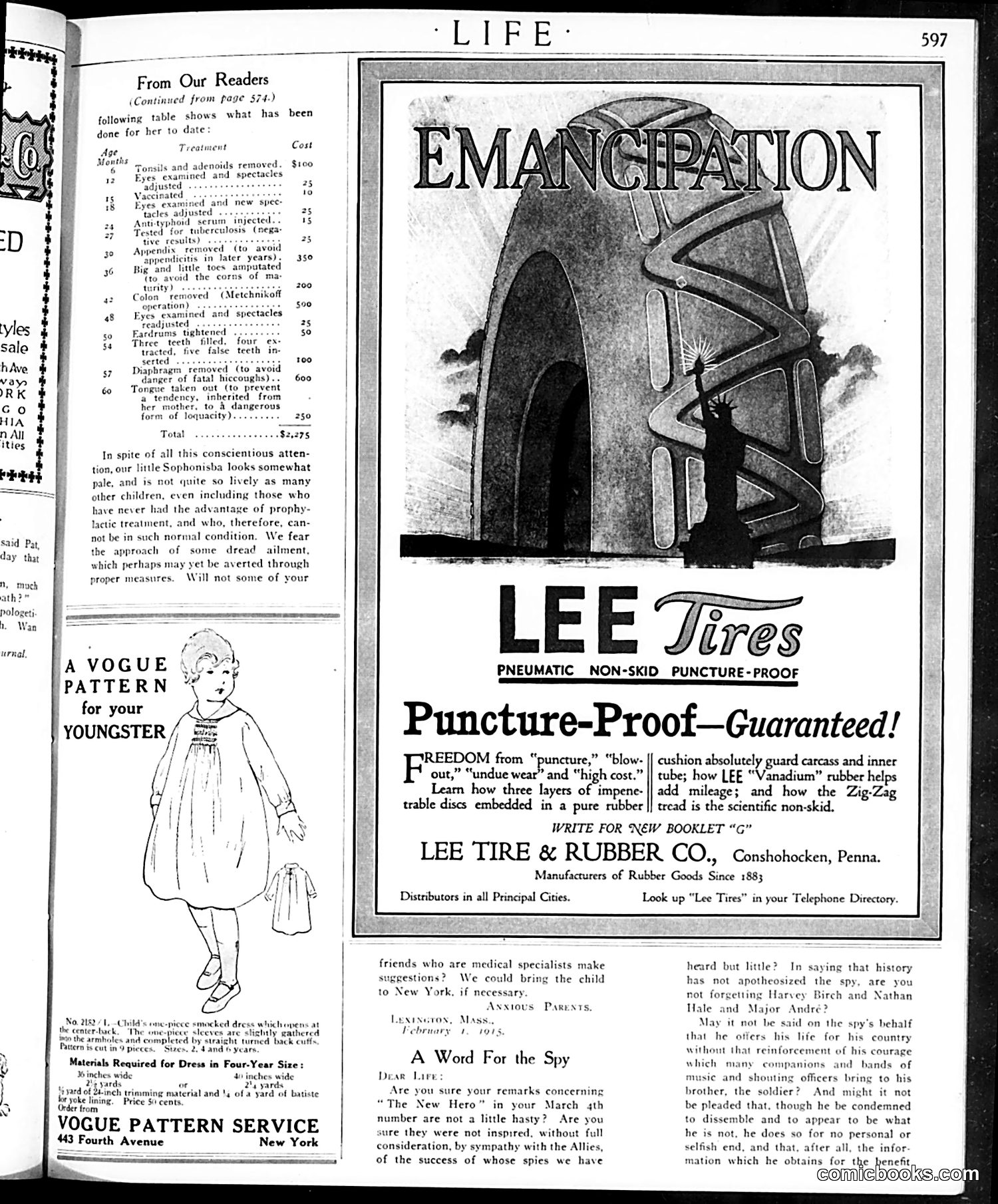
This page from *Life* magazine (February 1, 1915) contains satirical content about over-medicalization of children. **The Main Satire:** The left column presents "From Our Readers"—a letter from anxious parents describing their daughter Sophonisba's extensive medical treatments. The satire lies in the absurd accumulation: the child has undergone surgery for tonsils, appendix removal, toe amputation "to avoid corns," and other preventive procedures. Despite all this "prophylactic treatment," the child remains "pale" and "not quite so lively." The joke targets the era's excessive medical intervention and paranoid parents who subjected healthy children to unnecessary surgery under the guise of disease prevention. **Historical Context:** This reflects early 20th-century medical trends where preventive surgery was fashionable among the wealthy, and childhood ailments were treated aggressively. The satirical point: over-treatment can harm rather than help. **Other Content:** The page also features a Vogue dress pattern advertisement and a Lee Tires advertisement. A separate letter argues for the moral legitimacy of spies during wartime (likely referencing WWI tensions).
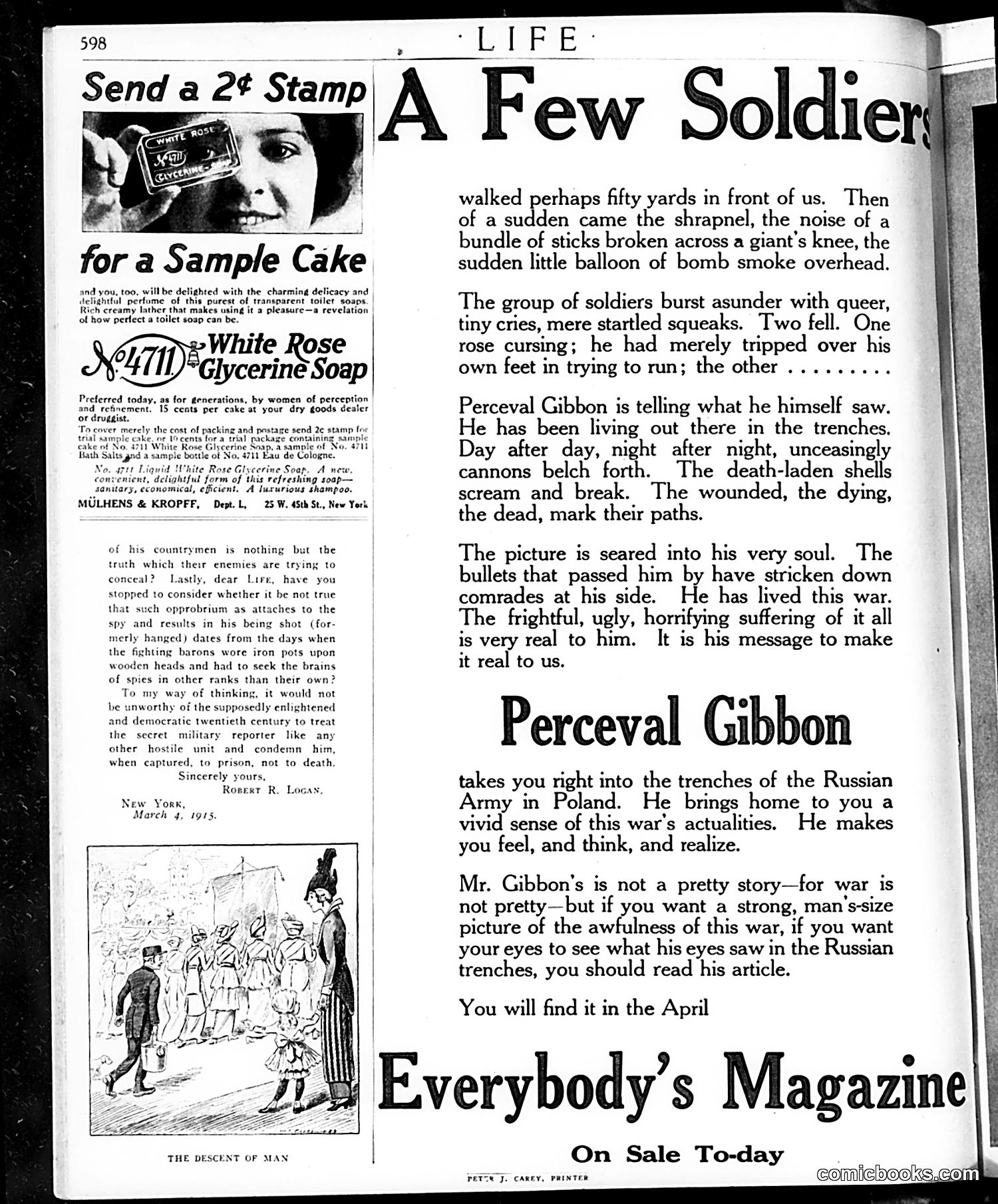
This page promotes an article by war correspondent **Perceval Gibbon** about his firsthand experiences in the **Russian trenches during World War I** (likely the Eastern Front in Poland). The accompanying illustration depicts soldiers in combat—figures reacting to shrapnel explosions, with some falling or scattering in panic. **The satire/purpose:** Life magazine frames Gibbon's account as an antidote to sanitized war reporting. The text emphasizes that his vivid, unglamorous eyewitness testimony—describing "frightful, ugly, horrifying suffering"—will make readers truly *understand* war's reality rather than accept official narratives. The juxtaposition with a genteel soap advertisement (left side) underscores the contrast: while commerce peddles comfort and refinement, Gibbon offers brutal truth about actual combat conditions. **Historical context:** This reflects 1915 American journalism beginning to question romantic war narratives as European trench warfare revealed its horrific scale.
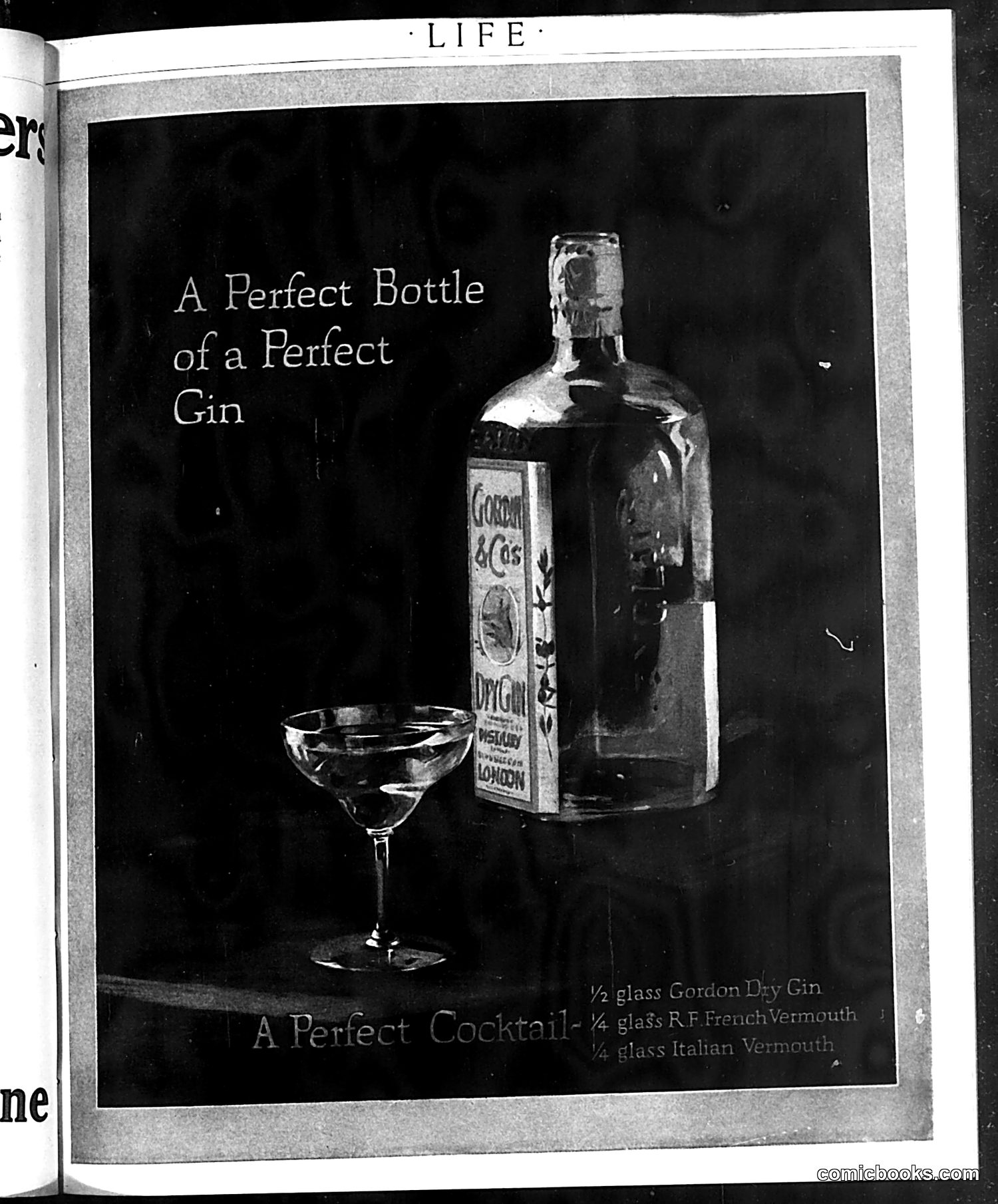
This is a **Gordon's Gin advertisement**, not political satire or a cartoon. The page features a product promotion from Life magazine styled as a lifestyle advertisement. The ad shows a bottle of Gordon's Dry Gin alongside a cocktail glass containing what appears to be a martini. The text presents a cocktail recipe labeled "A Perfect Cocktail," specifying proportions of Gordon Dry Gin, R.F. French Vermouth, and Italian Vermouth. This reflects the **pre-Prohibition or early post-Prohibition era** when alcohol advertising appeared regularly in mainstream magazines. The sophisticated presentation—elegant glassware, professional photography, refined typography—targets affluent readers interested in cocktail culture. There is no satire or political content; this is straightforward commercial advertising.
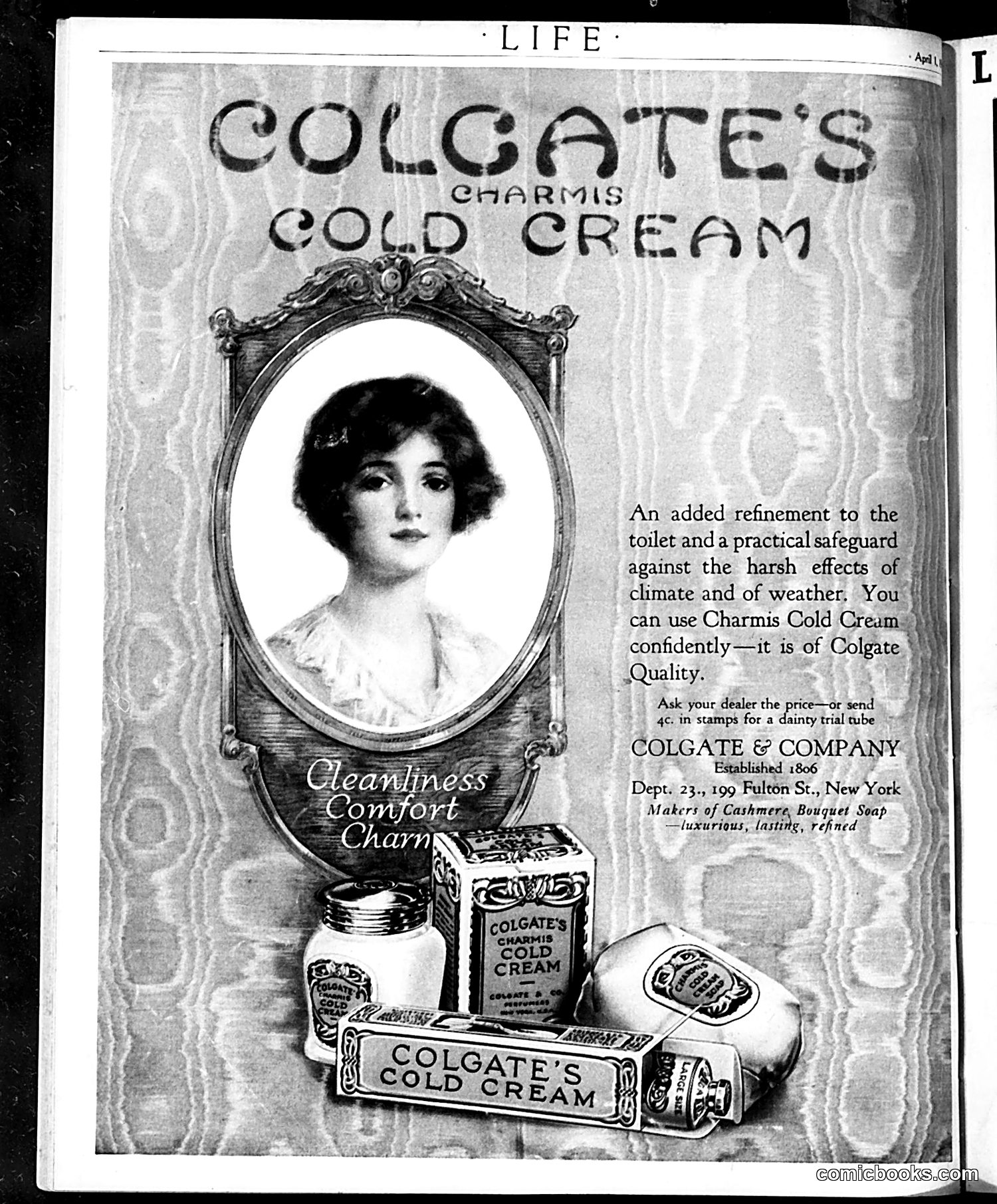
This is a **beauty product advertisement**, not political satire or a cartoon. It advertises Colgate's Charmis Cold Cream, positioned as skincare that protects against harsh weather. The page features a portrait of an elegant woman in 1920s style (short bobbed hair, refined appearance) framed ornately, accompanied by product images below. The text emphasizes the cream as a "practical safeguard" and "refinement to the toilet"—period language for personal grooming. The advertisement appeals to contemporary anxieties about maintaining beauty and complexion against environmental damage, while leveraging Colgate's established reputation (founded 1806). The offer of a trial tube for 4 cents made the product accessible. This represents typical early-20th-century advertising in *Life* magazine, blending aspirational imagery with practical consumer messaging—not satire or political commentary.