
Life, 1915-04-01 · page 32 of 72
Life — April 1, 1915 — page 32: what you’re looking at
What you’re looking at
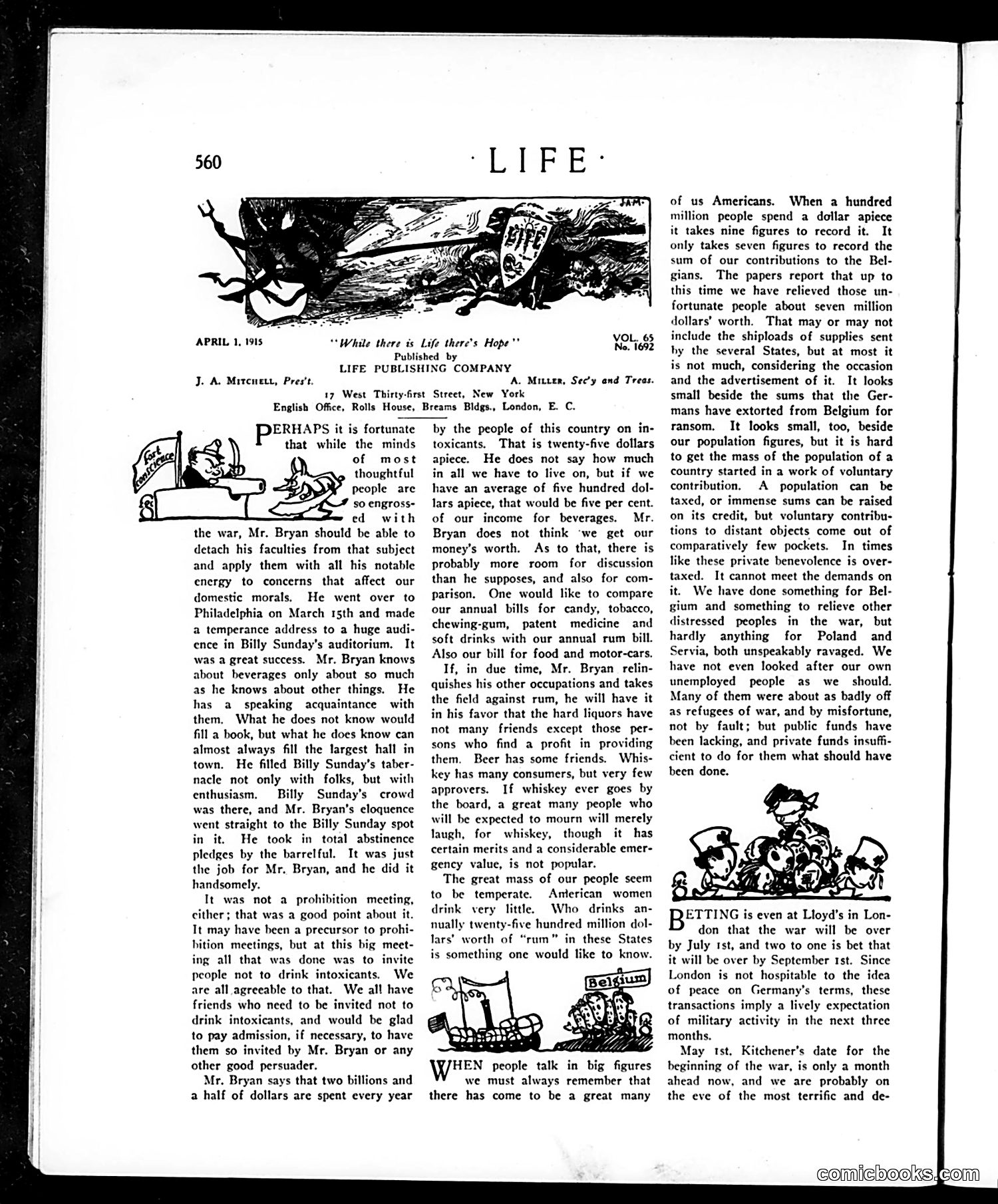
This page satirizes William Jennings Bryan's temperance crusade while America grapples with World War I. The article mocks Bryan for obsessing over prohibition—giving an impassioned speech at evangelist Billy Sunday's Philadelphia revival—while the nation faces far greater moral concerns. The satire's point: Bryan claims Americans waste $2.5 billion annually on alcohol, yet we've only contributed $7 million to Belgian war relief. Life's editors argue that lecturing about drink is trivial when civilians suffer in Europe. The cartoons (showing figures associated with alcohol) reinforce the contrast between Bryan's domestic moralizing and urgent international humanitarian needs. The piece implies Bryan's zealotry about personal virtue rings hollow when real suffering demands national attention—a critique of misplaced priorities during wartime.
📄 Transcribed text from this page (OCR, searchable)
Machine-transcribed from the original scan — historical spelling and the odd misread are preserved.
APRIL 1, 1915 “While there is Life there's Hope"* Published by LIFE PUBLISHING COMPANY J. A. Mitcnett, Pres’t. A. Muutr, Sec’y and Treas. 17 West Thirty-first Street, New York English Office, Rolls House, Breams Bldgs., London, E. C. ERHAPS it is fortunate that while the minds of most thoughtful people are 0 engross- ed with the war, Mr. Bryan should be able to detach his faculties from that subject and apply them with all his notable energy to concerns that affect our domestic morals, He went over to Philadelphia on March 15th and made a temperance address to a huge audi- ence in Billy Sunday’s auditorium. It was a great success. Mr. Bryan knows about beverages only about so much as he knows about other things. He has a_ speaking acquaintance with them. What he does not know would fill a book, but what he does know can almost always fill the largest hall in town. He filled Billy Sunday's taber- nacle not only with folks, but with enthusiasm. Billy Sunday's crowd was there, and Mr. Bryan's eloquence went straight to the Billy Sunday spot in it. He took in total abstinence pledges by the barrelful. It was just the job for Mr. Bryan, and he did it handsomely. It was not a prohibition meeting, cither; that was a good point about It may have been a precursor to prohi- hition meetings, but at this big meet- ing all that was done was to invite people not to drink intoxicants. We are all agreeable to that. We all have friends who need to be invited not to drink intoxicants, and would be glad to pay admission, if necessary, to have them so invited by Mr. Bryan or any other good persuader. Mr. Bryan says that two billions and a half of dollars are spent every year by the people of this country on in- toxicants. That is twenty-five dollars apiece. He does not say how much in all we have to live on, but if we have an average of five hundred dol- lars apiece, that would be five per cent. of our income for beverages. Mr. Bryan does not think ‘we get our money’s worth. As to that, there is probably more room for discussion than he supposes, and also for com- parison. One would like to compare our annual bills for candy, tobacco, chewing-gum, patent medicine and soft drinks with our annual rum bill. Also our bill for food and motor-cars. If, in due time, Mr. Bryan relin- quishes his other occupations and takes the field against rum, he will have it in his favor that the hard liquors have not many friends except those per- sons who find a profit in providing them. Beer has some friends. Whis- key has many consumers, but very few approvers. If whiskey ever goes by the board, a great many people who will be expected to mourn will merely laugh, for whiskey, though it has certain merits and a considerable emer- gency value, is not popular. The great mass of our people seem to be temperate. Anterican women drink very little. Who drinks an- nually twenty-five hundred million dol- lars' worth of “rum” in these States is something one would like to know. =. a \WHEN people talk in we must always remember that there has come to be a great many of us Americans. When a hundred million people spend a dollar apiece it takes nine figures to record it. It only takes seven figures to record the sum of our contributions to the Bel- gians. The papers report that up to this time we have relieved those un- fortunate people about seven million dollars’ worth. That may or may not include the shiploads of supplies sent by the several States, but at most it is not much, considering the occasion and the advertisement of it. It looks small beside the sums that the Ger- mans have extorted from Belgium for ransom. It looks small, too, beside our population figures, but it is hard to get the mass of the population of a country started in a work of voluntary contribution. A population can be taxed, or immense sums can be raised on its credit, but voluntary contribu- tions to distant objects come out of comparatively few pockets. In times like these private benevolence is over- taxed. It cannot meet the demands on it. We have done something for Bel- gium and something to relieve other distressed peoples in the war, but hardly anything for Poland and Servia, both unspeakably ravaged. We have not even looked after our own unemployed people as we should. Many of them were about as badly off as refugees of war, and by misfortune, not by fault; but public funds have been lacking, and private funds insuffi- cient to do for them what should have been done. ETTING is even at Lloyd’s in Lon- don that the war will be over by July rst, and two to one is bet that it will be over by September 1st. Since London is not hospitable to the idea of peace on Germany’s terms, these transactions imply a lively expectation of military activity in the next three months. May rst. Kitchener’s date for the beginning of the war, is only a month ahead now, and we are probably on the eve of the most terrific and de- comichooks,