
Life, 1915-04-01 · page 21 of 72
Life — April 1, 1915 — page 21: what you’re looking at
What you’re looking at
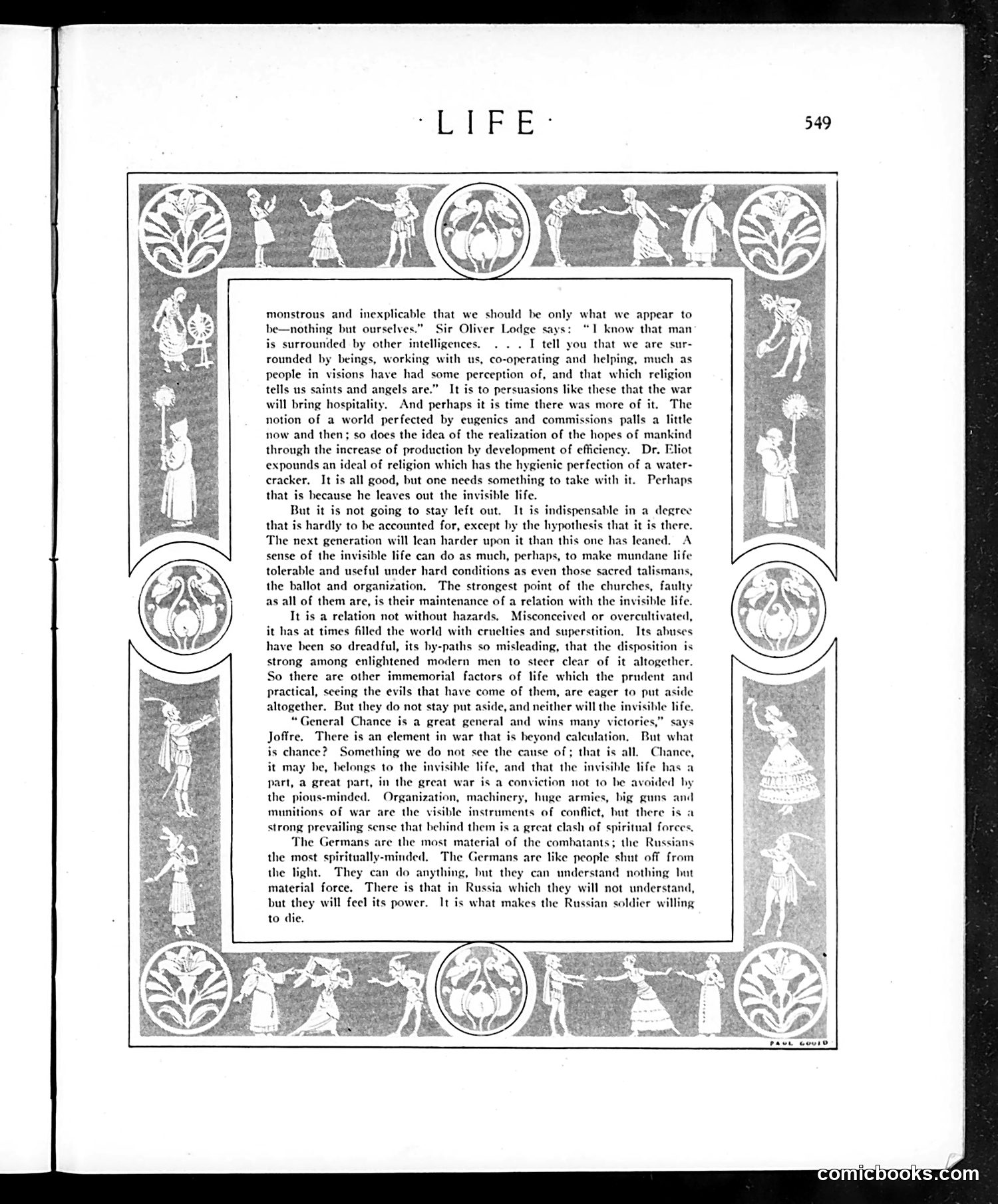
This page presents philosophical commentary on spirituality and warfare during World War I, featuring decorative classical borders with figures and ornaments. The text discusses how modern materialism and efficiency-focused thinking (represented by figures like "Dr. Eliot") neglect "the invisible life"—spiritual and intangible forces. The author argues that religion's strength lies in maintaining connection with the invisible/spiritual realm, despite historical abuses. The piece extends this framework to war itself, citing French General Joffre's observation that "chance" (unexplainable forces) influences military outcomes. The author suggests spiritual forces genuinely operate in the Great War. The conclusion draws a stark contrast: Germans represent pure materialism and cannot comprehend non-material forces, while Russians possess spiritual understanding that makes them willing to die—implying Russia's spiritual superiority gives it hidden strength. This reflects early WWI-era Western attitudes romanticizing Russian spirituality while portraying German culture as soulless and mechanical.
📄 Transcribed text from this page (OCR, searchable)
Machine-transcribed from the original scan — historical spelling and the odd misread are preserved.
monstrous and inexplicable that we should be only what we appear to be—nothing but ourselve: Sir Oliver Lodge say: 1 know that man is surrounded by other intelligences. . . . I tell you that we are sur- rounded by beings, working with us, co-operating and helping, much as people in visions have had some perception of, and that which religion tells us saints and angels are.” It is to persuasions like these that the war will bring hospitality. And perhaps it is time there was more of it. The notion of a world perfected by eugenics and commissions palls a little now and then; so does the idea of the realization of the hopes of mankind through the increase of production by development of efficiency. Dr. Eliot expounds an ideal of religion which has the hygienic perfection of a water- cracker. It is all good, but one needs something to take with it. Perhaps that is because he leaves out the invisible life. But it is not going to stay left out. It is indispensable in a degree that is hardly to be accounted for, except by the hypothesis that it is there. The next generation will lean harder upon it than this one has leaned. A sense of the invisible life can do as much, perhaps, to make mundane life tolerable and useful under hard conditions as even those sacred talismans, the ballot and organization, The strongest point of the churches, faulty as all of them are, is their maintenance of a relation with the invisible life. It is a relation not without hazards. Misconceived or overcultivated, it has at times filled the world with cruelties and superstition. Its abuses have been so dreadful, its by-paths so misleading, that the disposition is strong among enlightened modern men to steer clear of it altogether. So there are other immemorial factors of life which the prudent and practical, sceing the evils that have come of them, are eager to put aside altogether. But they do not stay put aside, and neither will the invisible life. “General Chance is a great general and wins many victories,” says Joffre, There is an element in war that is heyond calculation, But what is chance? Something we do not see the cause of ; that is all. Chance, it may be, belongs to the invisible life, and that the invisible life has a part, a great part, in the great war is a conviction not to be avoided hy the pious-minded. Organization, machinery, huge armies, big guns and munitions of war are the visible instruments of conflict, hut there is i strong prevailing sense that behind them is a great clash of spiritual forces, The Germans are the most material of the combatants; the Russians the most spiritually-minded. The Germans are like people shut off from the light. They can do anything, but they can understand nothing but material force. There is that in Russia which they will not understand, but they will feel its power. It is what makes the Russian soldier willing to die.