
Life, 1915-04-01 · page 30 of 72
Life — April 1, 1915 — page 30: what you’re looking at
What you’re looking at
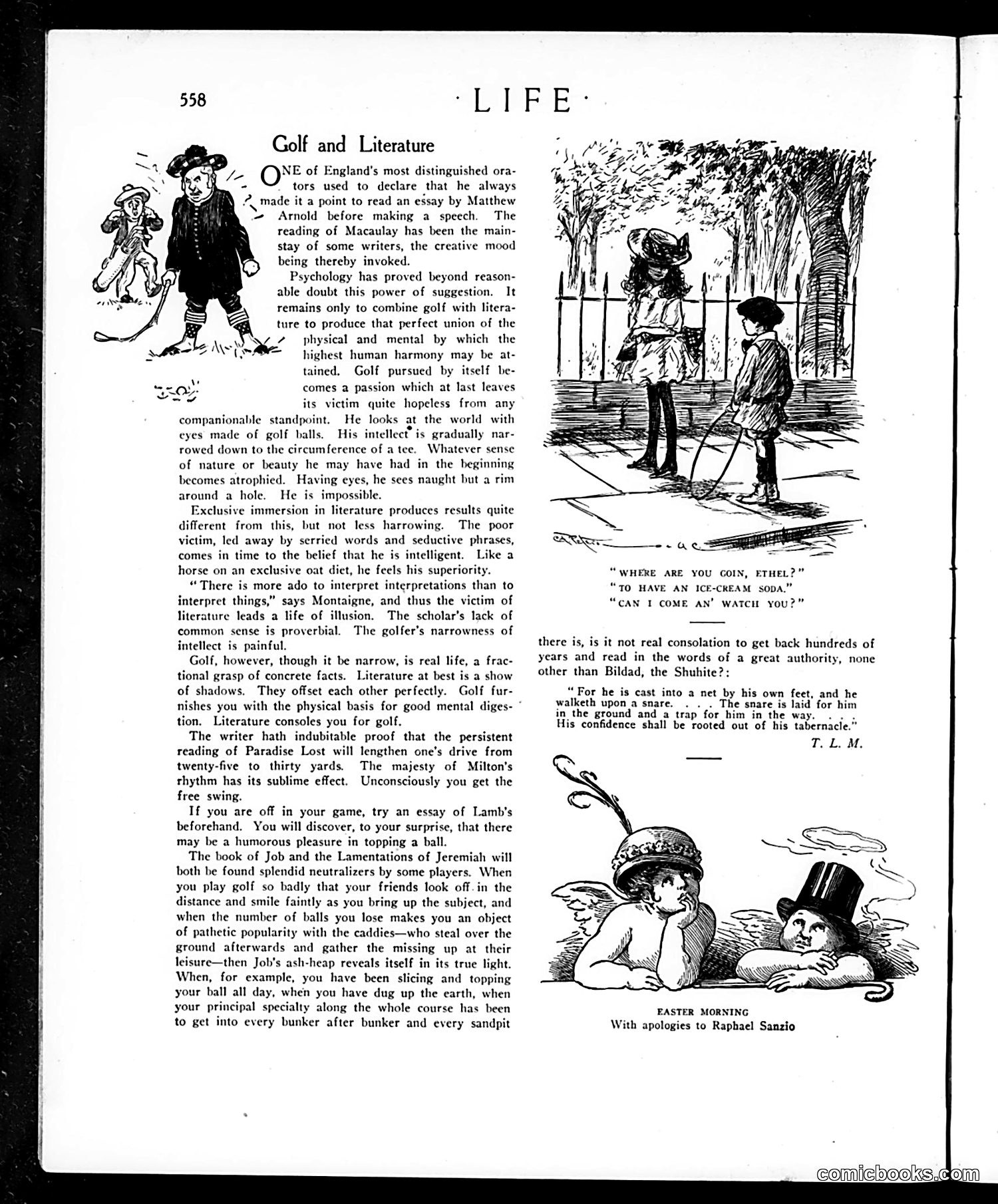
This essay satirizes two opposing intellectual extremes through the lens of golf. The author argues that exclusive devotion to *either* golf *or* literature produces mental damage: golf narrows one's mind to "the circumference of a tee," while literature produces delusional scholars who mistake verbosity for intelligence. The satire's main joke: these pursuits are *equally* absurd and limiting, yet perfectly complement each other. The essay proposes combining them—reading Milton improves one's golf swing; studying the Book of Job consoles you after terrible play. The cartoon at top depicts children discovering that even innocent leisure (ice cream) becomes complicated by social rules. The "Easter Morning" illustration below appears to be classical artwork, perhaps commenting on how high culture offers no real consolation either. The author (T.L.M.) mocks both the pretentious intellectual who reads to feel superior and the obsessed golfer equally.
📄 Transcribed text from this page (OCR, searchable)
Machine-transcribed from the original scan — historical spelling and the odd misread are preserved.
Golf and Literature O of England’s most distinguished ora- tors used to declare that he always made it a point to read an essay by Matthew Arnold before making a speech. The reading of Macaulay has been the main- stay of some writers, the creative mood being thereby invoked. Psychology has proved beyond reason- y able doubt this power of suggestion. It AN remains only to combine golf with litera- ture to produce that perfect union of the physical and mental by which the highest human harmony may be at- tained. Golf pursued by itself be- comes a passion which at last leaves its victim quite hopeless from any companionable standpoint. He looks at the world with eyes made of golf balls, His intellect” is gradually nar- rowed down to the circumference of a tee. Whatever sense of nature or beauty he may have had in the beginning becomes atrophied. Having eyes, he sees naught but a rim around a hole. He is impossible. Exclusive immersion in literature produces results quite different from this, but not less harrowing. The poor victim, led away by serried words and seductive phrases, comes in time to the belief that he is intelligent. Like a horse on an exclusive oat dict, he feels his superiority. “There is more ado to interpret interpretations than to ww 7 (ee interpret things,” says Montaigne, and thus the victim of literature leads a life of illusion. The scholar’s lack of common sense is proverbial. The golfer’s narrowness of intellect is painful. Golf, however, though it be narrow, is real life, a frac- tional grasp of concrete facts. Literature at best is a show of shadows. They offset each other perfectly. Golf fur- nishes you with the physical basis for good mental diges- ° tion. Literature consoles you for golf. The writer hath indubitable proof that the persistent reading of Paradise Lost will lengthen one’s drive from twenty-five to thirty yards. The majesty of Milton's rhythm has its sublime effect. Unconsciously you get the free swing. If you are off in your game, try an essay of Lamb's beforehand. You will discover, to your surprise, that there may be a humorous pleasure in topping a ball. The book of Job and the Lamentations of Jeremiah will both be found splendid neutralizers by some players. When you play golf so badly that your friends look off.in the distance and smile faintly as you bring up the subject, and when the number of balls you lose makes you an object of pathetic popularity with the caddies—who steal over the ground afterwards and gather the missing up at their leisure—then Job's ash-heap reveals itself in its true light. When, for example, you have been slicing and topping your ball all day, when you have dug up the earth, when your principal specialty along the whole course has been to get into every bunker after bunker and every sandpit “WHERE ARE YOU GOIN, ETHEL?” “TO HAVE AN ICE-CREAM SODA.” “CAN I COME AN’ WATCIE You?” there is, is it not real consolation to get back hundreds of years and read in the words of a great authority, none other than Bildad, the Shuhite “For he is cast into a net by his own feet, and he walketh upon a snare. The snare is laid for him in the ground and a trap for him in the way... . His confidence shall be rooted out of his tabernacie.” T.L.M. EASTER MORNING With apologies to Raphael Sanzio