
Life, 1915-04-01 · page 34 of 72
Life — April 1, 1915 — page 34: what you’re looking at
What you’re looking at
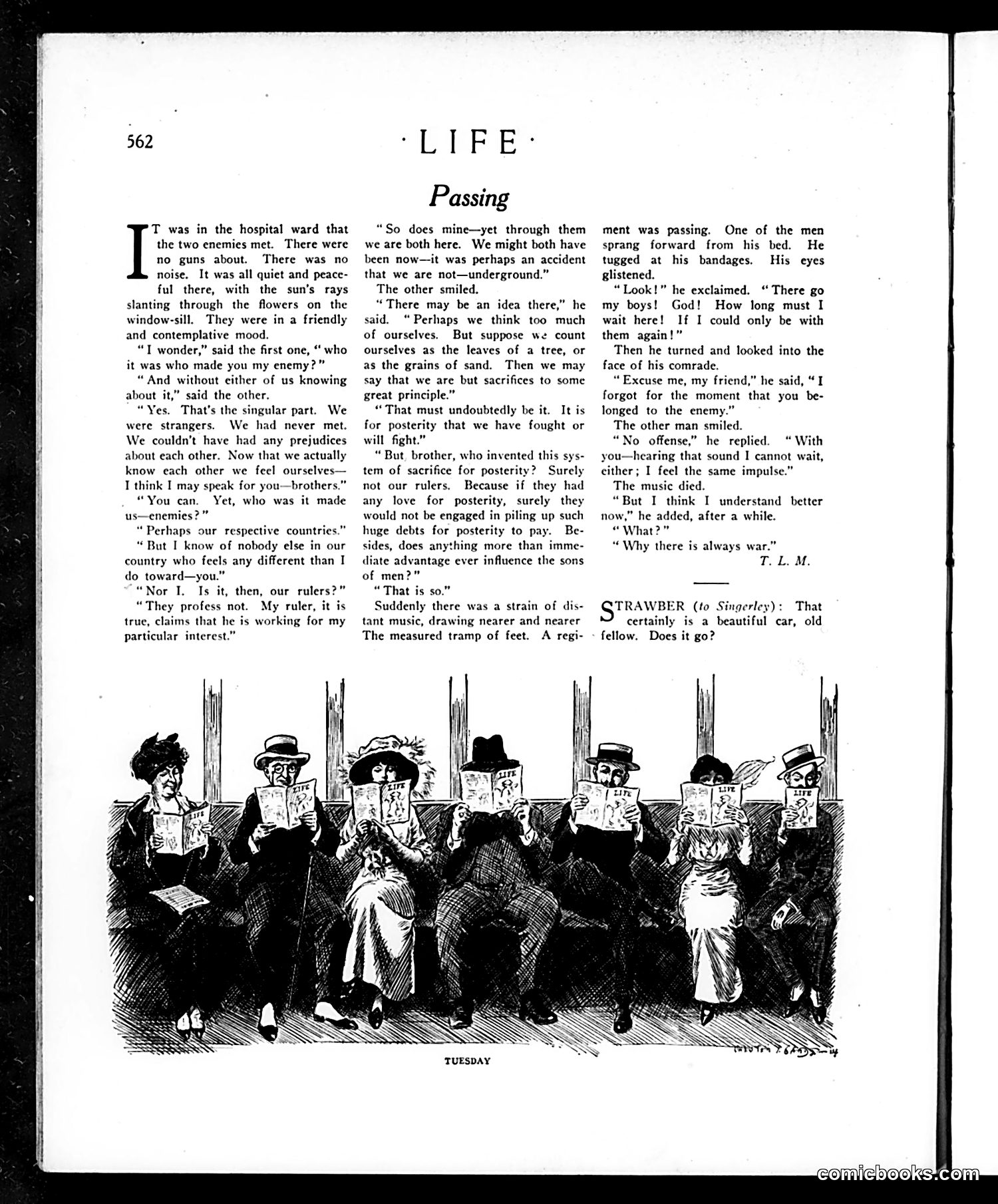
This page contains two distinct pieces: **The Story "Passing":** A dialogue between two wounded enemy soldiers in a hospital ward who realize they share common humanity and have no personal animosity. They philosophically debate whether their rulers or abstract "posterity" drove them to war. The satire's punch comes in the ending: when a military regiment marches past playing music, the patriotic impulse instantly overwhelms both men. Despite their reasoned conversation, they both forget their pacifist sentiments and yearn to rejoin their units. The author (T.L.M.) suggests war persists because emotional nationalism overrides rational thought—even among those who intellectually recognize its absurdity. **The Cartoon "Tuesday":** Shows a row of people reading "LIFE" magazine in what appears to be a waiting room or public space, likely depicting commuters or citizens casually consuming satirical commentary on current events. The juxtaposition critiques how easily propaganda and martial sentiment override anti-war sentiment among ordinary people.
📄 Transcribed text from this page (OCR, searchable)
Machine-transcribed from the original scan — historical spelling and the odd misread are preserved.
T was in the hospital ward that the two enemies met. There were no guns about. There was no noise. It was all quiet and peace- ful there, with the sun's rays slanting through the flowers on the window They were in a friendly and contemplative mood. “T wonder,” said the first one, “ who it was who made you my enemy?” “And without cither of us knowing about it,” said the other. “Yes. That's the singular part. We were strangers. We had never met. We couldn't have had any prejudices about each other. Now that we actually know each other we feel ourselves— I think I may speak for you—brothers.” “You can. Yet, who was it made us—enemies?” “Perhaps our respective countries.” “But I know of nobody else in our country who feels any different than I do toward—you.” “Nor I. Is it, then, our rulers?” “They profess not. My ruler, it is true, claims that he is working for my particular interest.” ‘LTP E™ Passing “So does mine—yet through them we are both here. We might both have been now—it was perhaps an accident that we are not—underground.” The other smiled. “There may be an idea there,” he said. “Perhaps we think too much of ourselves. But suppose we count ourselves as the leaves of a tree, or as the grains of sand. Then we may say that we are but sacrifices to some great principle.” “That must undoubtedly be it. It is for posterity that we have fought or will fight.” “But, brother, who invented this sys- tem of sacrifice for posterity? Surely not our rulers. Because if they had any love for posterity, surely they would not be engaged in piling up such huge debts for posterity to pay. Be- sides, does anything more than imme- diate advantage ever influence the sons of men?” “That is so.” Suddenly there was a strain of dis- tant music, drawing nearer and nearer The measured tramp of feet. A regi- ment was passing. One of the men sprang forward from his bed. He tugged at his bandages. His eyes glistened. “Look!” he exclaimed. “ There go my boys! God! How long must I wait here! If I could only be with them again!” Then he turned and looked into the face of his comrade. “Excuse me, my friend,” he said, “I forgot for the moment that you be- longed to the enemy.” The other man smiled. “No offense,” he replied. “ With you—hcaring that sound I cannot wait, cither; I feel the same impulse.” The music died. “But I think I understand better he added, after a while. “What?” “Why there is always war.” T. L. M. That TRAWBER (to Singerley): certainly is a beautiful car, old fellow. Does it go? TUESDAY