
Life, 1915-04-01 · page 33 of 72
Life — April 1, 1915 — page 33: what you’re looking at
What you’re looking at
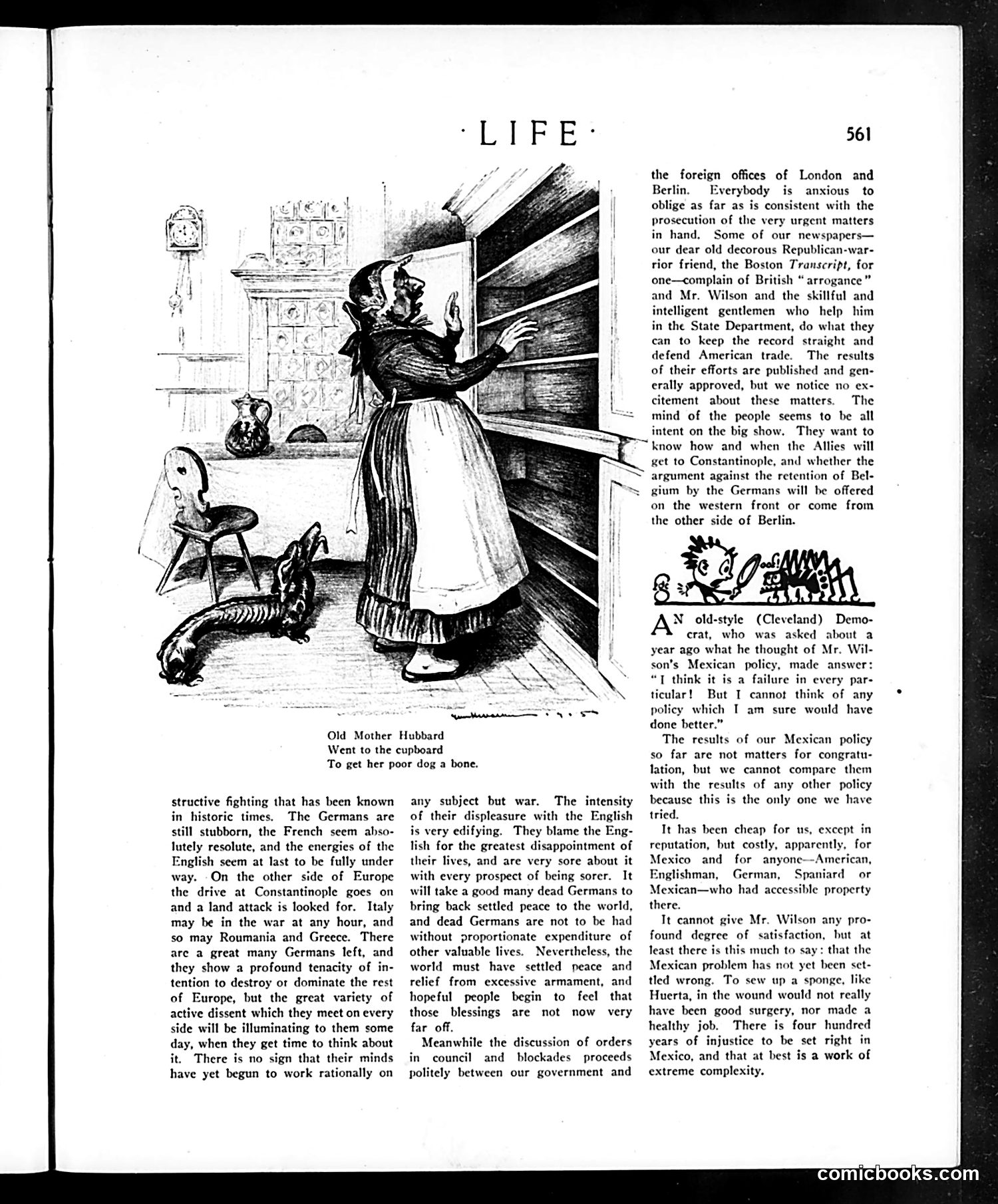
This page from *Life* magazine contains satirical commentary on two issues: World War I and President Wilson's Mexican policy. **The Illustration:** "Old Mother Hubbard" depicts a woman (likely representing America or a household) finding her cupboard bare—a metaphor for resource scarcity. The accompanying nursery rhyme suggests America cannot provide for its needs, probably referencing concerns about war's economic costs. **The Text:** The article criticizes American newspapers (notably the *Boston Transcript*) for complaining about British "arrogance" while praising Wilson's State Department efforts to defend American trade interests during WWI. It notes the public is more engaged with military developments than these diplomatic squabbles. The second section defends Wilson's Mexican policy—apparently controversial a year prior—arguing that while imperfect, it has at least not made things worse, unlike previous approaches. The writer emphasizes Mexico's historical injustices require complex solutions. The overall tone is cautiously supportive of Wilson's diplomacy while gently mocking public indifference to policy details.
📄 Transcribed text from this page (OCR, searchable)
Machine-transcribed from the original scan — historical spelling and the odd misread are preserved.
561 the foreign offices of London and Berlin. Everybody is anxious to oblige as far as is consistent with the prosecution of the very urgent matters in hand. Some of our newspapers— our dear old decorous Republican-war- rior friend, the Boston Transcript, for one—complain of British “ arrogance” and Mr. Wilson and the skillful and intelligent gentlemen who help him in the State Department, do what they can to keep the record straight and defend American trade. The results of their efforts are published and gen- erally approved, but we notice no ex- citement about these matters. The mind of the people seems to be all intent on the big show. They want to “know how and when the Allies will get to Constantinople, and whether the > argument against the retention of Bel- ~\ gium by the Germans will be offered Old Mother Hubbard Went to the cupboard To get her poor dog a bone. structive fighting that has been known in historic times, The Germans are still stubborn, the French seem abso- lutely resolute, and the energies of the English seem at last to be fully under way. On the other side of Europe the drive at Constantinople goes on and a land attack is looked for. Italy may be in the war at any hour, and so may Roumania and Greece. There are a great many Germans left, and they show a profound tenacity of in- tention to destroy or dominate the rest of Europe, but the great variety of active dissent which they meet on every side will be illuminating to them some day, when they get time to think about it. There is no sign that their minds have yet begun to work rationally on any subject but war. The intensity of their displeasure with the English is very edifying. They blame the Eng- lish for the greatest disappointment of their lives, and are very sore about it with every prospect of being sorer. It will take a good many dead Germans to bring back settled peace to the world, and dead Germans are not to be had without proportionate expenditure of other valuable lives. Nevertheless, the world must have settled peace and relief from excessive armament, and hopeful people begin to feel that those blessings are not now very far off. Meanwhile the discussion of orders in council and blockades proceeds politely between our government and on the western front or come from the other side of Berlin. N_ old-style (Cleveland) Demo- crat, who was asked about a year ago what he thought of Mr. Wil- son’s Mexican policy, made answer: “T think it is a failure in every par ticular!’ But I cannot think of any policy which T am sure would have done better.” The results of our Mexican policy so far are not matters for congratu- lation, but we cannot compare them with the results of any other policy because this is the only one we have tried. It has been cheap for us, except in reputation, but costly, apparently, for Mexico and for anyone—-American, Englishman, German, Spaniard or Mexican—who had accessible property there. Tt cannot give Mr. Wilson any pro- found degree of satisfaction, but at least there is this much to say: that the Mexican problem has not yet been sct- tled wrong. To sew up a sponge, like Huerta, in the wound would not really have been good surgery, nor made a healthy job. There is four hundred years of injustice to be set right in Mexico, and that at best is a work of extreme complexity. comicbooks.com