
Life, 1915-04-01 · page 20 of 72
Life — April 1, 1915 — page 20: what you’re looking at
What you’re looking at
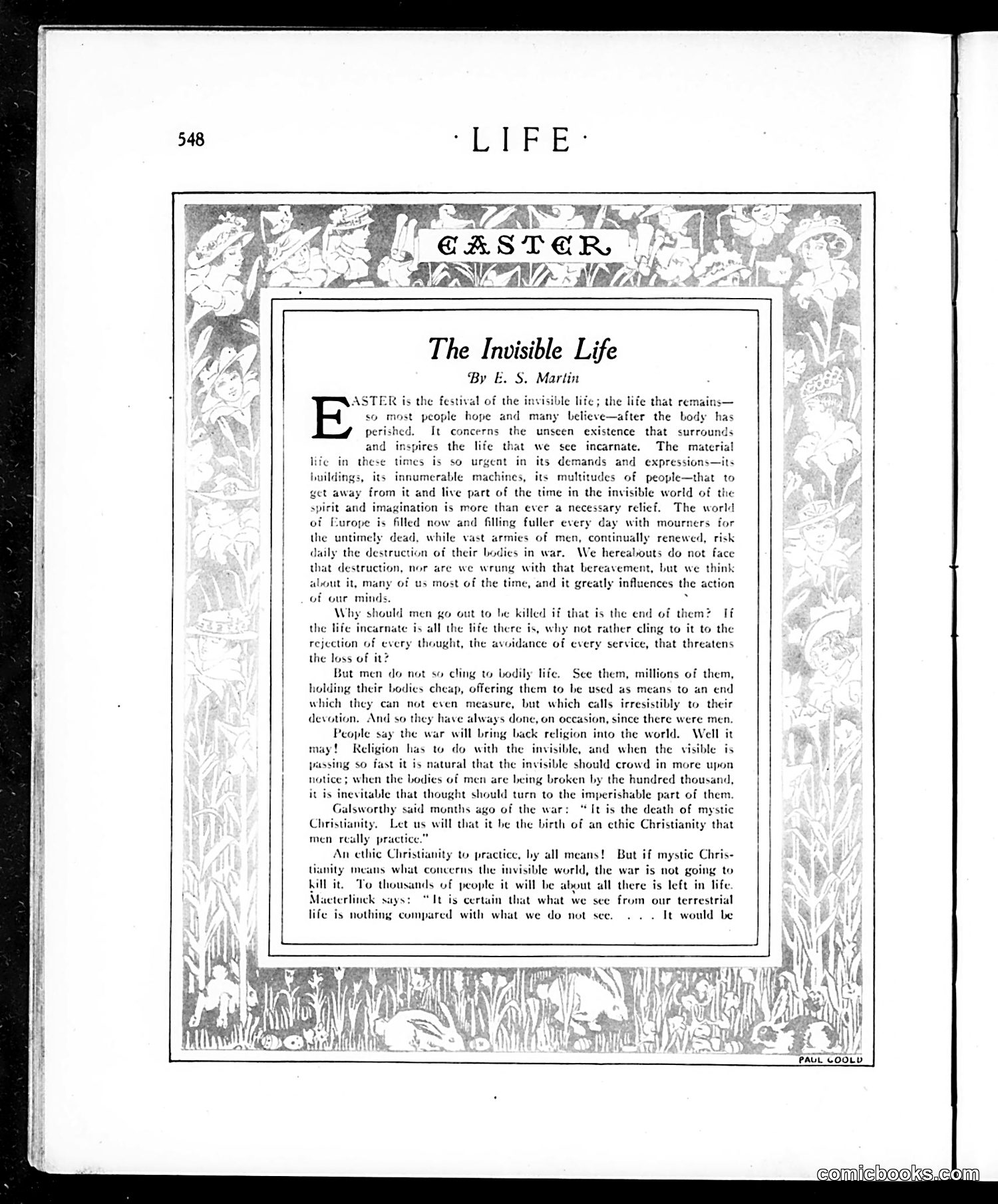
This is an editorial essay (not a cartoon) by E.S. Martin published in *Life* magazine around Easter, during World War I. The piece uses the holiday's spiritual significance to contemplate mortality and faith amid the war's massive casualties. Martin argues that widespread death in Europe has made the "invisible life"—the spiritual realm and afterlife—urgently relevant. He questions why men sacrifice their bodies for causes they cannot fully understand, yet observes they do so anyway, suggesting an innate human devotion to something beyond material existence. The essay references contemporary thinkers (Galsworthy, Maeterlinck) debating whether the war will revive religion. Martin distinguishes between "mystic Christianity" (concerned with the invisible/spiritual) and "ethic Christianity" (practical morality), suggesting the war's horrors paradoxically force people to contemplate spiritual rather than material life. The ornamental border and page design reflect *Life*'s sophisticated aesthetic approach to serious cultural commentary.
📄 Transcribed text from this page (OCR, searchable)
Machine-transcribed from the original scan — historical spelling and the odd misread are preserved.
EEF AE + oul AG CASTER > . ONO NE The Invisible Life By E. S. Martin ASTER is the festival of the invisible life; the life that remain: so most people hope and many believe—after the body has perished. It concerns the unseen existence that surrounds and inspires the life that we see incarnate. The material life in these times is so urgent in its demands and expressions—its buildings, its innumerable machines, its multitudes of people—that to get away from it and live part of the time in the invisible world of the spirit and imagination is more than ever a necessary relief. The world of Europe is filled now and filling fuller every day with mourners for the untimely dead, while vast armies of men, continually renewed, risk daily the destruction of their bodies in war. We herealbouts do not face that destruction, nor are we wrung with that bereavement, but we think about it, many of us most of the time, and it greatly influences the action of our minds. * Why should men go out to he killed if that is the end of then Tf the life incarnate is all the life there is, why not rather cling to it to the rejection of every thought, the avoidance of every service, that threatens the loss of it? But men do not so cling to bodily life. Sce them, millions of them, holding their bodics cheap, offering them to be used as means to an end which they can not even measure, but which calls irresistibly to their devotion, And so they have always done, on occasion, since there were men. People say the war will bring back religion into the world. Well it may! Religion has to do with the invisible, and when the visible is passing so fast it is natural that the invisible should crowd in more upon notice; when the Lodies of men are being broken by the hundred thousand, it is inevitable that thought should turn to the imperishable part of them. Galsworthy said months ago of the war: “It is the death of mystic Christianity. Let us will that it be the birth of an cthic Christianity that men really practic An ethic Christianity to practice, hy all means! But if mystic Chris- Uanity means what concerns the invisible world, the war is not going to Kill it, To thousands of people it will be about all there is left in life. Maceterlinek say “Tt is certain that what we see from our terrestrial life is nothing compared with what we do not see... . It would be PAUL COOLD