
Life, 1915-04-01 · page 40 of 72
Life — April 1, 1915 — page 40: what you’re looking at
What you’re looking at
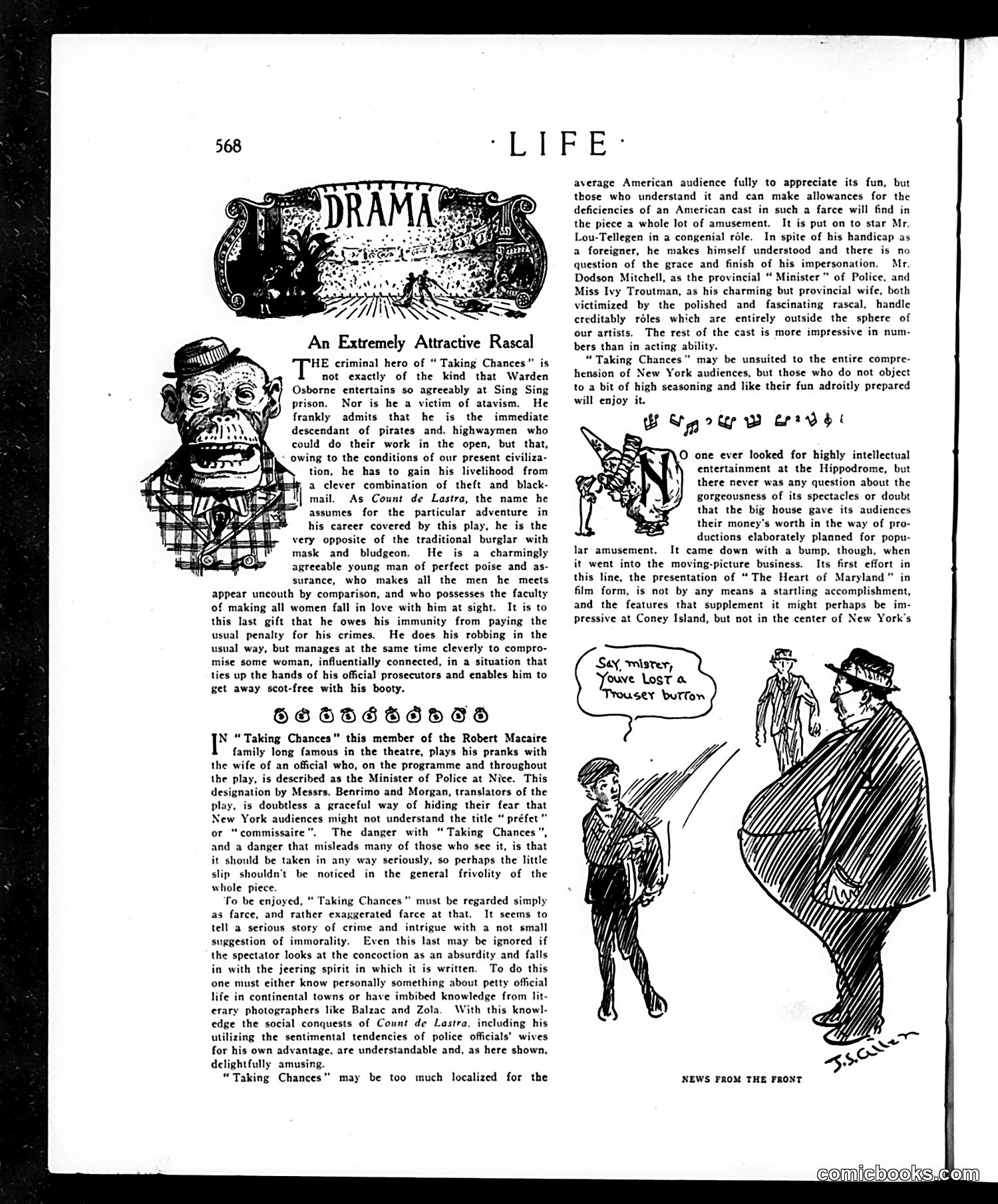
This page reviews the play "Taking Chances," starring Lou-Tellegen as Count de Lastra, a charming criminal who seduces the wife of a police official to escape prosecution. The critic explains the character is part of the "Robert Macaire family"—a theatrical tradition of clever rogues—descended from historical pirates and highwaymen. The accompanying cartoon shows a man who has lost a trouser button, approached by another figure. It illustrates the play's humor: the "rascal" uses seduction and blackmail against officials' wives to evade justice through their compromised positions. The review emphasizes this is *farce*, not serious drama, and warns American audiences may find it too "localized" (specifically French) without knowledge of continental official life. The satire targets how charm and manipulation—particularly of women—can corrupt law enforcement and justice.
📄 Transcribed text from this page (OCR, searchable)
Machine-transcribed from the original scan — historical spelling and the odd misread are preserved.
‘LIFE> An Extremely Attractive Rascal HE criminal hero of “ Taking Chances” is not exactly of the kind that Warden Osborne entertains so agreeably at Sing Sing prison. Nor is he a victim of atavism. He frankly admits that he is the immediate descendant of pirates and. highwaymen who could do their work in the open, but that, owing to the conditions of our present civiliza- tion, he has to gain his livelihood from =H a clever combination of theft and black- | mail. As Count de Lastro, the name he ~ assumes for the particular adventure in his career covered by this play, he is the very opposite of the traditional burglar with mask and bludgeon. He is a charmingly agreeable young man of perfect poise and as- surance, who makes all the men he meets appear uncouth by comparison, and who possesses the faculty of making all women fall in love with him at sight. It is to this last gift that he owes his immunity from paying the usual penalty for his crimes. He does his robbing in the usual way, but manages at the same time cleverly to compro- mise some woman, influentially connected, in a situation that ties up the hands of his official prosecutors and enables him to get away scot-free with his booty. ORG MORGROR CROROROMO) 'N “Taking Chances” this member of the Robert Macaire family long famous in the theatre, plays his pranks with the wife of an official who, on the programme and throughout the play, is described as the Minister of Police at Nice. This designation by Messrs. Benrimo and Morgan, translators of the play, is doubtless a graceful way of hiding their fear that New York audiences might not understand the title “ préfet” or “commissaire”. The danger with “Taking Chances”, and a danger that misleads many of those who see it, is that it should be taken in any way seriously, so perhaps the little slip shouldn't be noticed in the general frivolity of the whole piece. To be enjoyed, “ Taking Chances” must be regarded simply as farce, and rather exaggerated farce at that. It seems to tell a serious story of crime and intrigue with a not small suggestion of immorality. Even this last may be ignored if the spectator looks at the concoction as an absurdity and falls in with the jeering spirit in which it is written. To do this one must either know personally something about petty official life in continental towns or have imbibed knowledge from lit- erary photographers like Balzac and Zola. With this knowl- edge the social conquests of Count de Lastra. including his utilizing the sentimental tendencies of police officials’ wives for his own advantage, are understandable and, as here shown, delightfully amusing. “Taking Chances" may be too much localized for the average American audience fully to appreciate its fun, but those who understand it and can make allowances for the deficiencies of an American cast in such a farce will find in the piece a whole lot of amusement. It is put on to star Mr. Lou-Tellegen in a congenial role. In spite of his handicap as a foreigner, he makes himself understood and there is no question of the grace and finish of impersonation. Mr. Dodson Mitchell, as the provincial “ Minister” of Police, and Miss Ivy Troutman, as his charming but provincial wife, both victimized by the polished and fascinating rascal, handle creditably réles which are entirely outside the sphere of our artists. The rest of the cast is more impressive in num- bers than in acting ability. “Taking Chance: may be unsuited to the entire compre- hension of New York audiences, but those who do not object to a bit of high seasoning and like their fun adroitly prepared will enjoy it. BV grew areves O one ever looked for highly intellectual entertainment at the Hippodrome, but there never was any question about the gorgeousness of its spectacles or doubt that the big house gave its audiences their money’s worth in the way of pro- ductions elaborately planned for popu- lar amusement. It came down with a bump, though, when it went into the moving-picture business. Its first effort in this line, the presentation of “ The Heart of Maryland” in film form, is not by any means a startling accomplishment, and the features that supplement it might perhaps be i pressive at Coney Island, but not in the center of New York's Say, mister, Tone Lost a set buTTon NEWS FROM THE FRONT