
A complete issue · 40 pages · 1914
Life — December 10, 1914
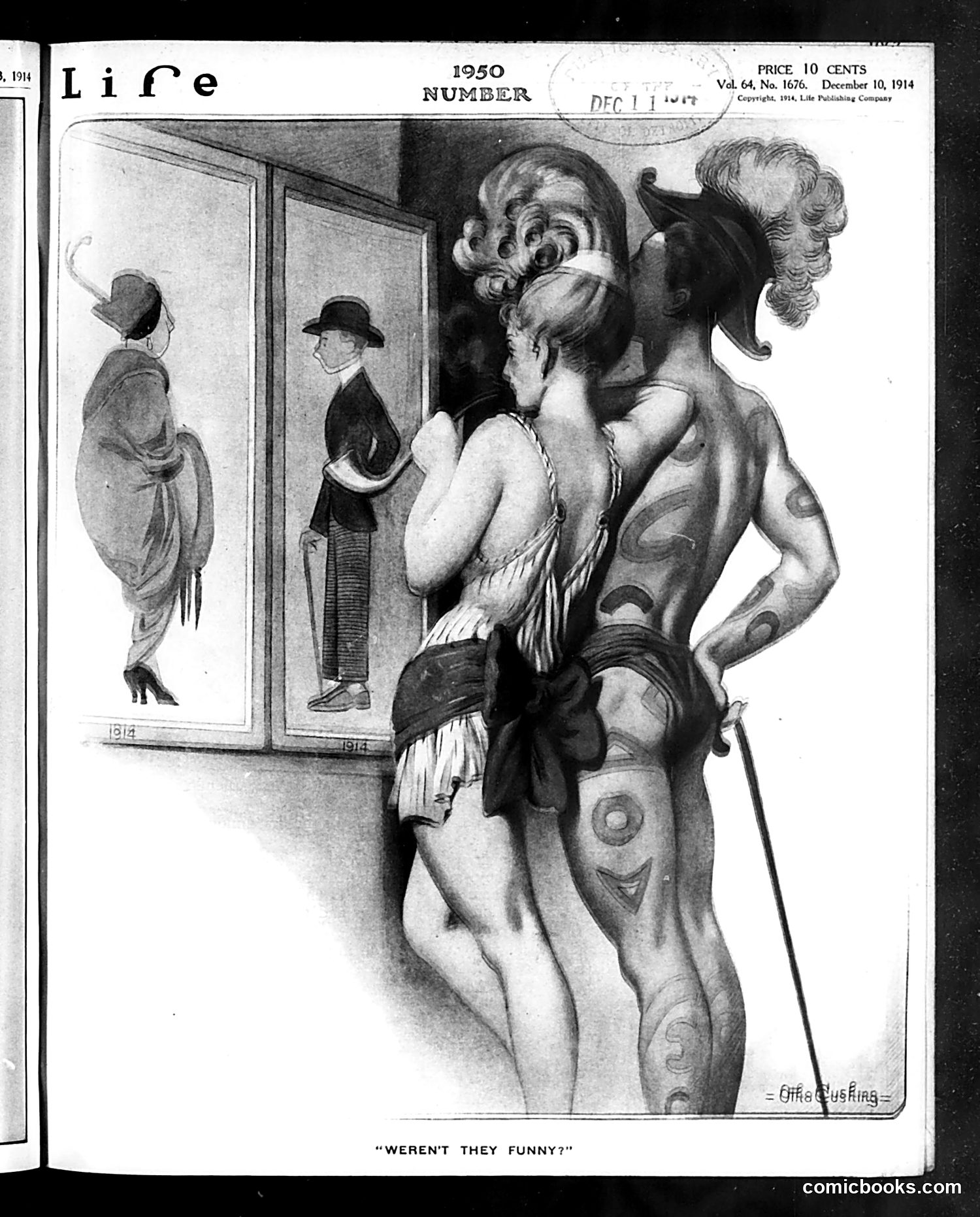
This Life magazine cover from December 10, 1914 presents a satirical commentary on social hypocrisy and changing morality. The image depicts classical nude or semi-nude figures (appearing to represent allegorical or mythological subjects) positioned as if observing well-dressed modern people through windows—the roles reversed from typical voyeurism. The title "Weren't They Funny?" suggests the satire: what was once considered acceptable artistic representation (classical nudity) is now scandalous, while contemporary society views such imagery as inappropriate. The cartoon critiques early-20th-century prudishness and the contradiction between society's acceptance of classical art versus its rejection of similar modern depictions. The elegantly dressed figures looking away represent contemporary social propriety and discomfort with the human form.
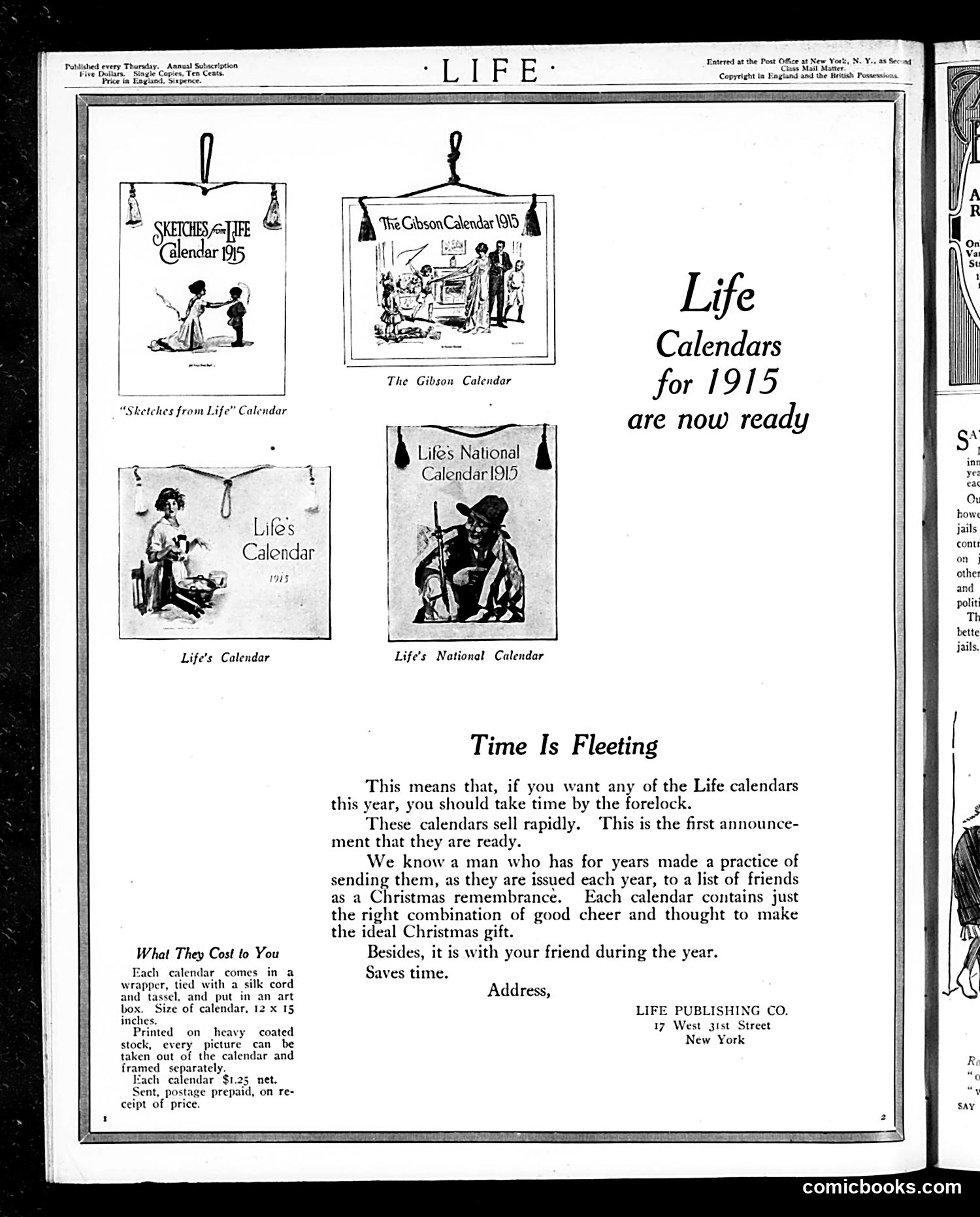
This page is primarily an **advertisement for Life magazine's 1915 calendars**, not political satire. It showcases four calendar designs available for purchase: 1. "Sketches from Life" Calendar 2. The Gibson Calendar (featuring Charles Dana Gibson's famous illustrations) 3. Life's Calendar 4. Life's National Calendar The ad emphasizes these as ideal Christmas gifts, priced at $1.25 each, delivered in decorative boxes with silk cords. The text stresses urgency ("Time Is Fleeting"), noting calendars "sell rapidly" and suggesting customers order immediately. The accompanying illustrations are decorative rather than satirical—they show the aesthetic appeal of each calendar design, featuring Gibson's characteristic artistic style popular during this era. This is essentially a holiday shopping promotion.
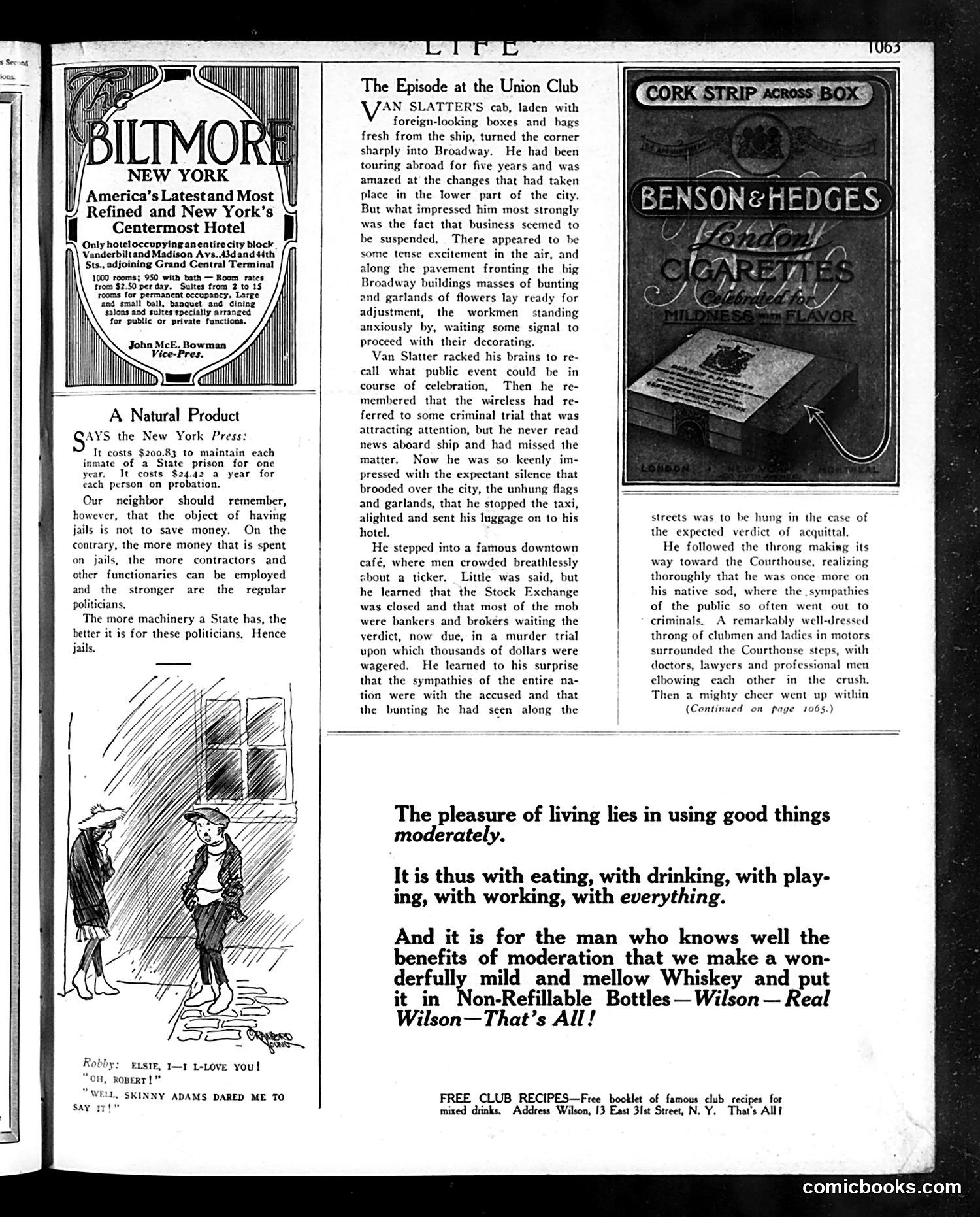
This page is primarily **advertising and editorial content** rather than political satire. The main elements are: 1. **Biltmore Hotel advertisement** (top left) - promoting a luxury New York hotel 2. **"A Natural Product" article** - discussing prison costs and criminology policy 3. **Small cartoon** (bottom left) - shows two figures in rain; one says "Fish, I-I-I love you!" and the other responds "Oh, Robert!" / "Well, skinny adams dared me to say it!" This is a mild romantic joke without political content. 4. **Wilson Whiskey advertisement** (center-right) - promoting moderate consumption of "Wilson Real Wilson" whiskey in non-refillable bottles, with philosophical text about moderation The page reflects **Prohibition-era messaging**, using appeals to moderation to market alcohol. The overall content mixes hotel promotion, social policy discussion, and liquor advertising typical of 1920s Life magazine.
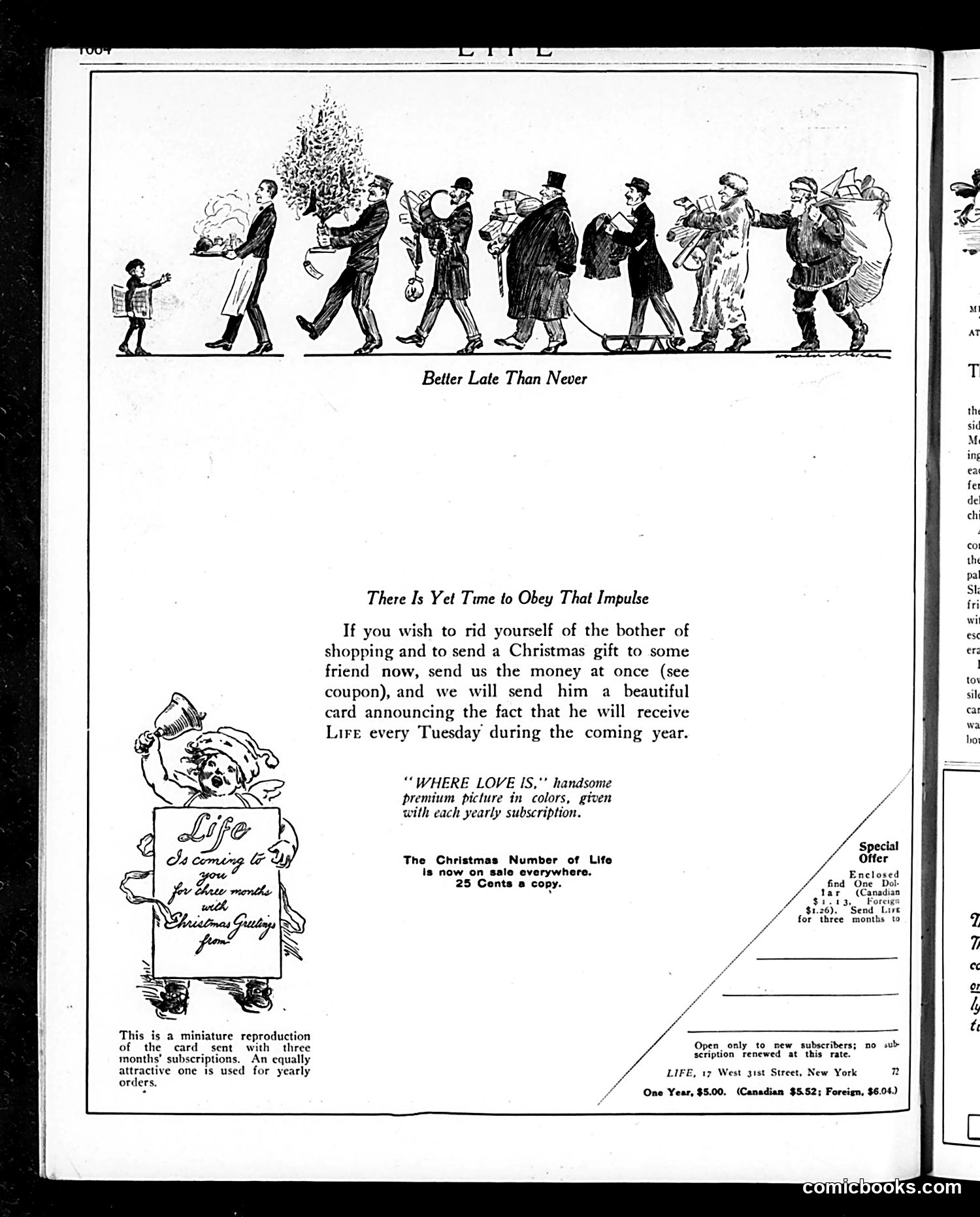
This page is primarily a **Christmas gift advertisement** for Life magazine subscriptions, not political satire. The top cartoon illustrates the phrase "Better Late Than Never" through a procession of men carrying increasingly elaborate Christmas gifts—progressing from a small boy with a simple present to men laden with large bundles, wreaths, and gift bags. The visual joke suggests that even tardy gift-givers eventually arrive with their presents. The advertisement below promotes giving a **Life subscription as a Christmas gift**: for one year ($5.00), recipients receive the magazine "every Tuesday" plus a greeting card. A decorative illustration shows a cherub or putto emerging from a gift box. The text emphasizes this solves holiday shopping hassles by sending money directly to Life's offices instead.
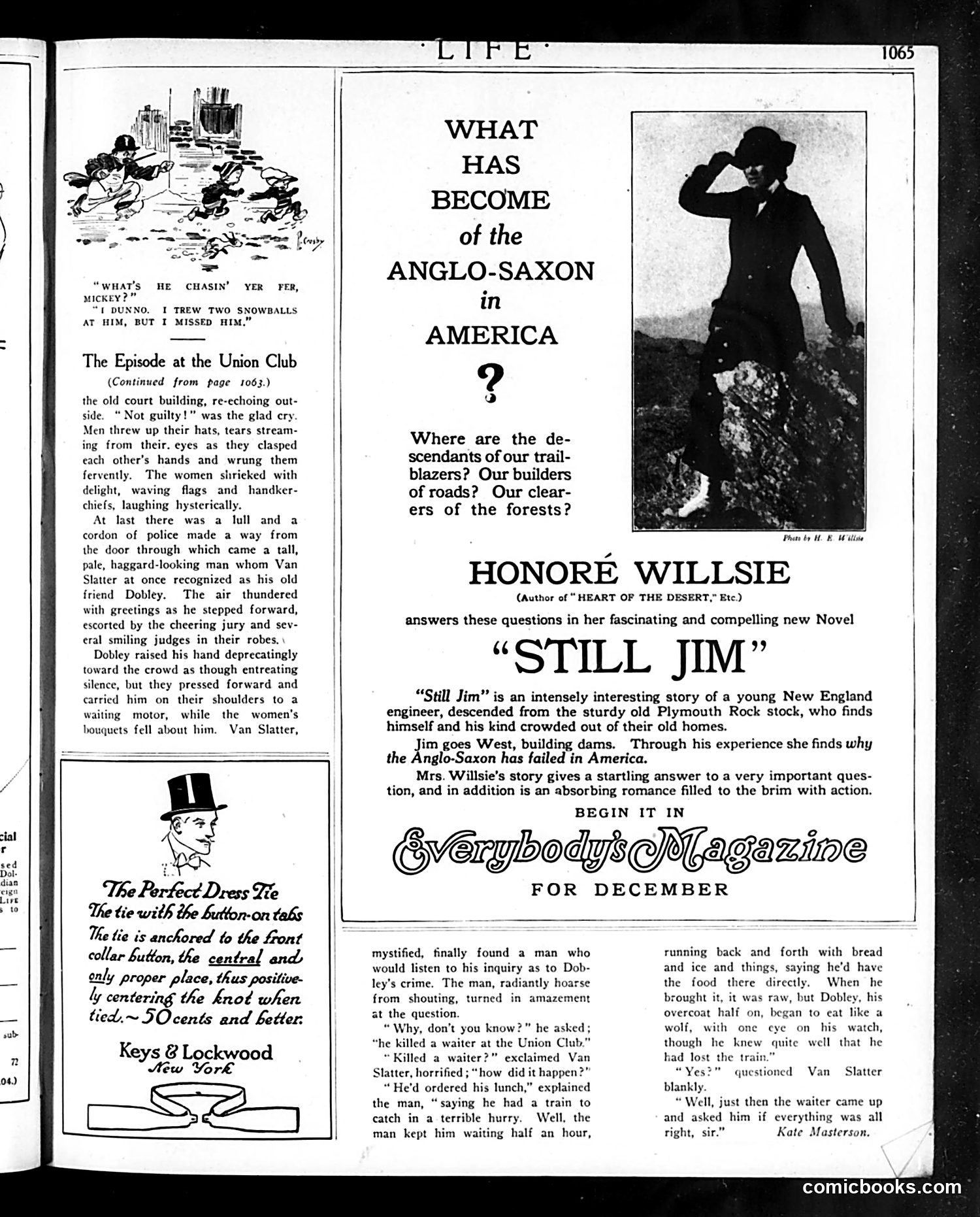
The left cartoon depicts a humorous domestic scene where a man chases a woman with snowballs, illustrating old-fashioned courtship behavior. The caption reads "What's he chasin' yer fer, Mickey?" with the response about throwing snowballs, suggesting playful winter romance. Below this is an advertisement for "The Perfect Dress Tie" by Keys & Lockwood (New York), emphasizing proper tie placement and centering—a practical men's fashion tip of the era. The main content advertises Honoré Willsie's novel "Still Jim," which apparently addresses concerns about the decline of Anglo-Saxon frontier virtues in America. The book promises to explain why "the Anglo-Saxon has failed in America" through a romance about a New England engineer. This reflects early 20th-century anxieties about national character and heritage.
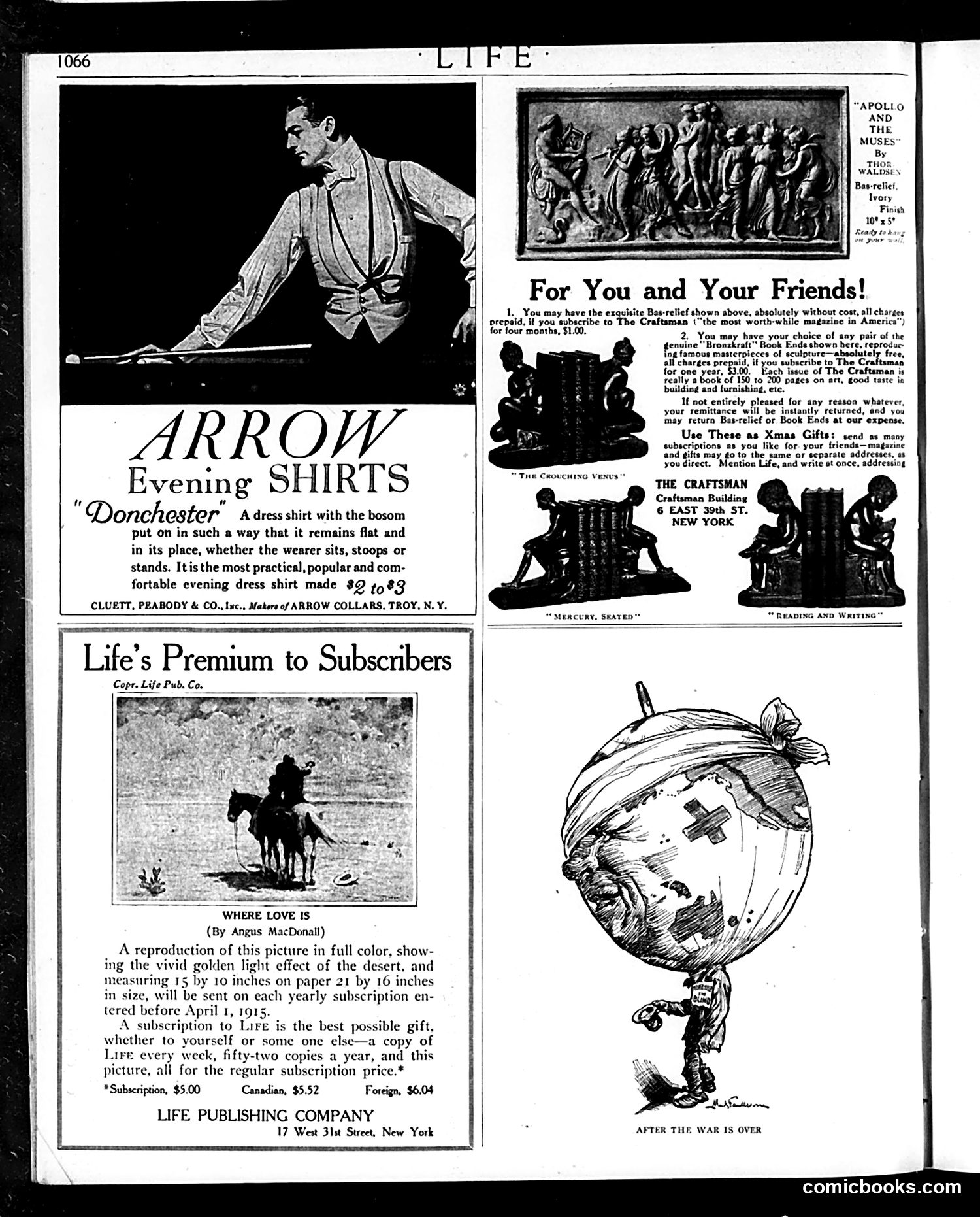
This page is primarily **advertising and subscription promotion** rather than political satire. The main content includes: 1. **Arrow Shirts advertisement** (left): Features an evening dress shirt called "Donchester" marketed to men 2. **Life Magazine subscriptions** (center-left): Promotes subscription benefits and a color art reproduction premium titled "Where Love Is" by Angus MacDonald, depicting a desert scene 3. **The Craftsman magazine promotion** (right): Advertises art book subscriptions with classical relief imagery 4. **Cartoon** (bottom-right): Titled "After the War is Over," shows a figure riding or clinging to a large bomb or projectile with a cross marked on it The bomb cartoon likely references **World War I** (ongoing or recently ended) with dark humor about post-war consequences, though the exact satirical point remains somewhat unclear without additional context.
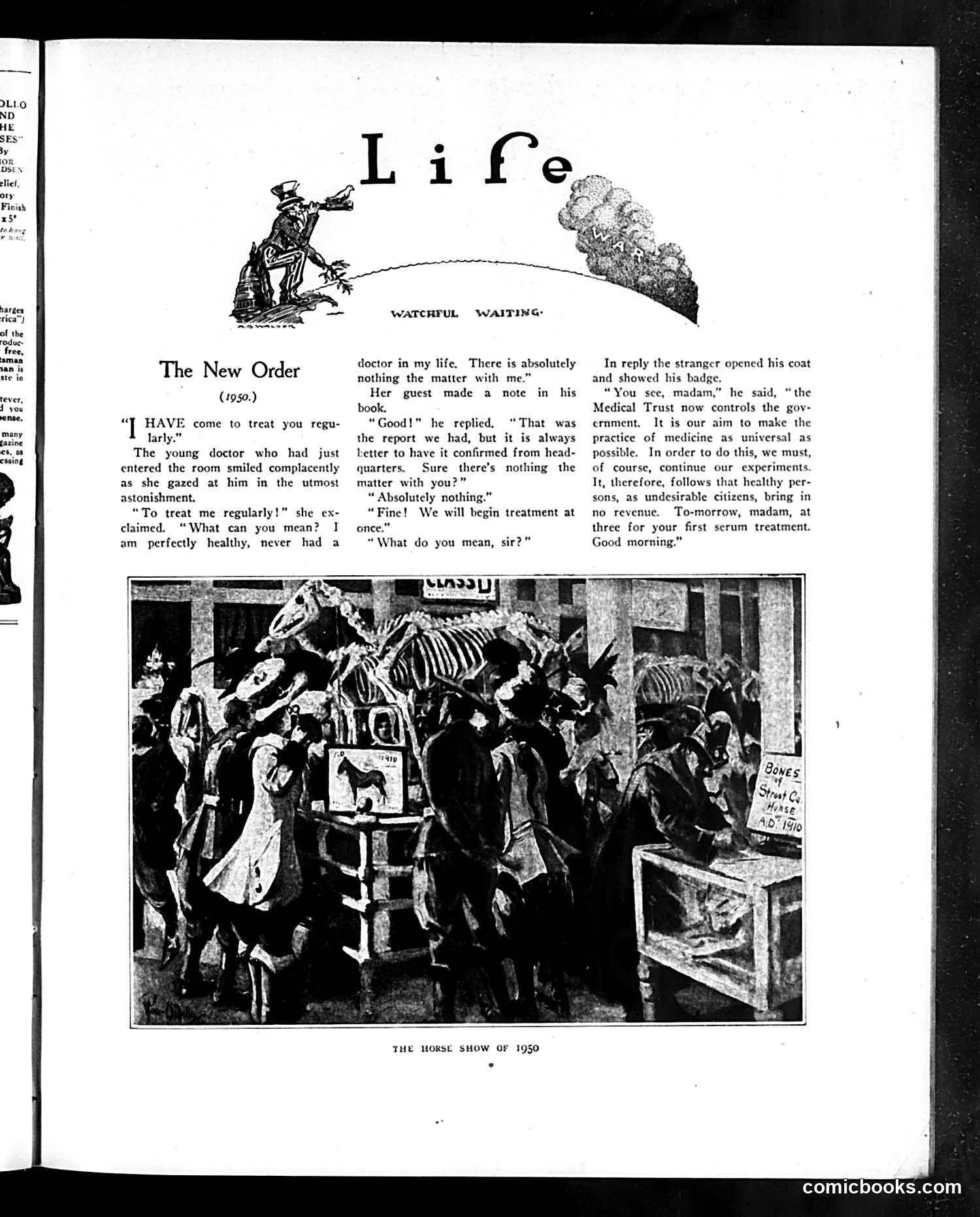
This page satirizes post-WWI social reforms, specifically the "Medical Trust" movement advocated by progressives. The dialogue depicts a young doctor treating a wealthy patient who initially refuses care, then learns the doctor must serve "desirable citizens" and bring "no revenue" — mocking the contradiction between socialist ideals and practical implementation. The accompanying illustration ("The Horse Show of 1920") depicts a chaotic scene with skeleton horses, suggesting the satire extends to the absurdity of implementing these new social orders. The skeletons imply that such reforms would result in economic or social "death." The magazine ridicules both progressive healthcare reform and the wealthy's resistance to redistribution of medical services, presenting the "New Order" as fundamentally impractical and ridiculous.
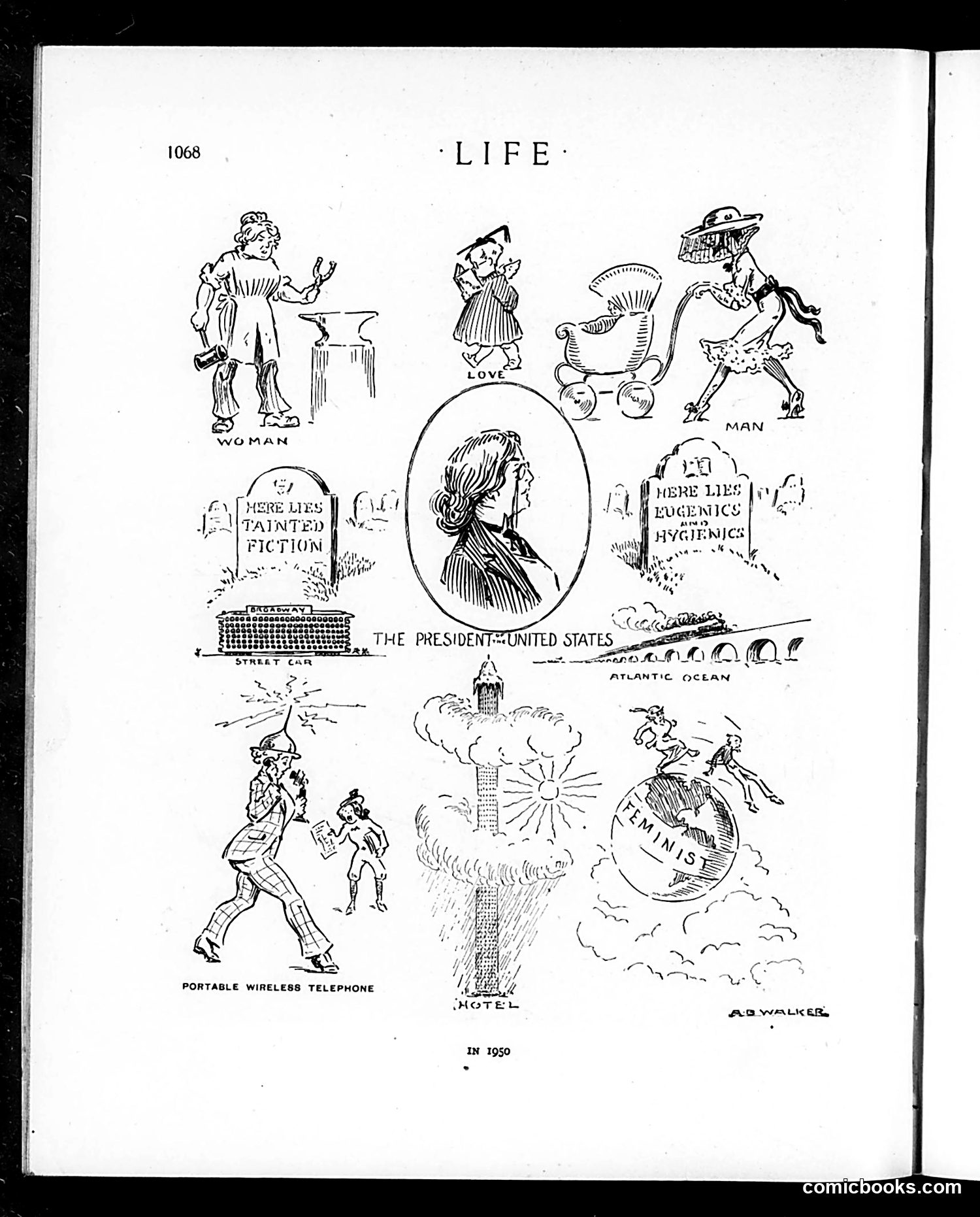
This satirical cartoon from *Life* magazine depicts predictions for "Life in 1950." The central portrait appears to be of a U.S. President, flanked by gravestones labeled "Here Lies Patriotic Fiction" and "Here Lies Eugenics and Hygienics"—suggesting satire about the death of certain ideologies or beliefs. Surrounding this are fantastical predictions: a "Woman" with exaggerated features, "Love" with a baby carriage, a "Man" in cowboy attire, a "Portable Wireless Telephone," a tall "Hotel," and a sphere labeled "Feminism." The artist (A.G. Walker, per signature) satirizes both utopian technological optimism and contemporary social anxieties about gender roles, feminism, and American identity—mocking predictions of future progress while questioning whether such changes are desirable.
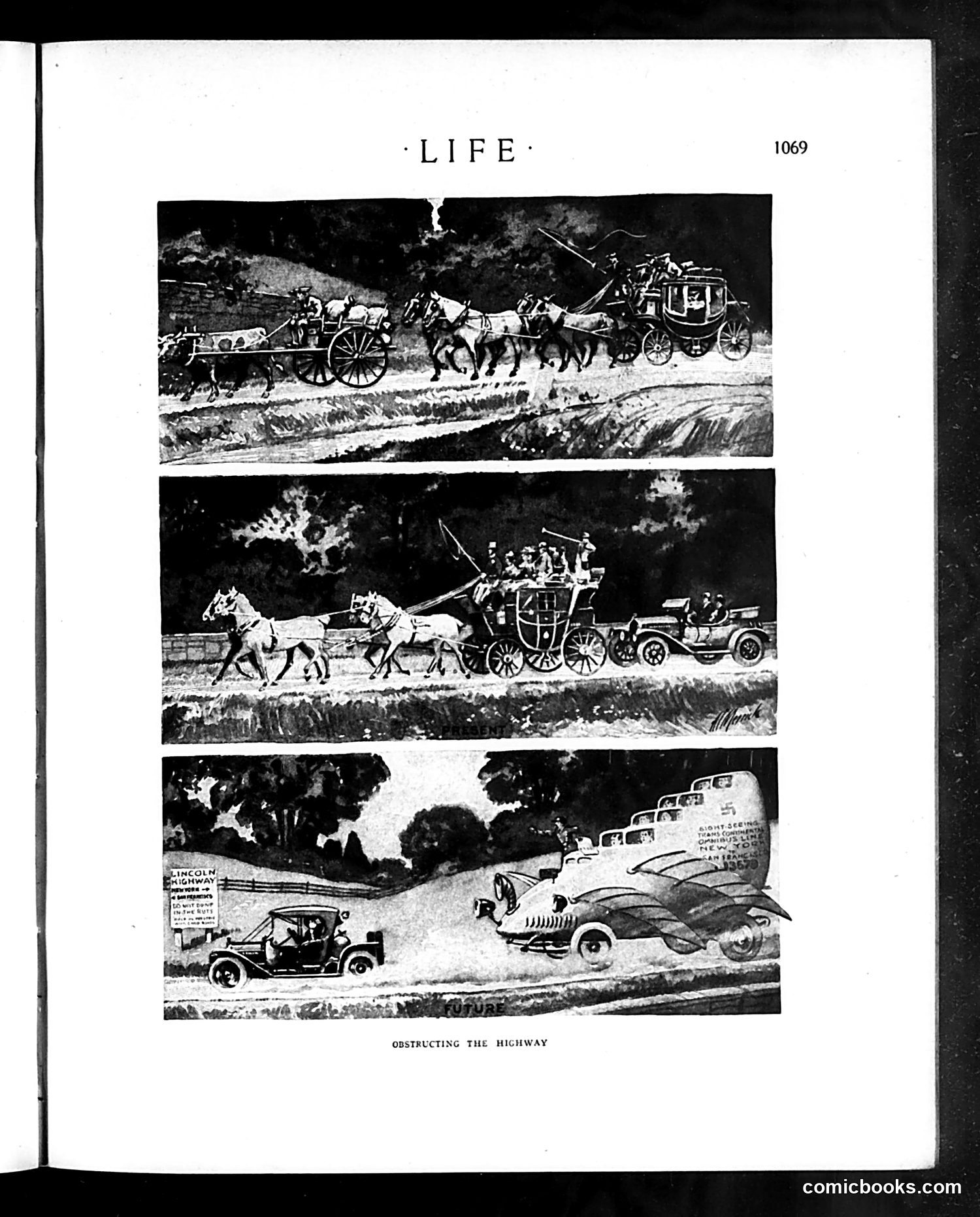
This page from *Life* magazine presents three sequential illustrations satirizing the evolution of road obstructions. The top two panels show horse-drawn carriages and coaches blocking early roads—historical examples of traffic impediment. The bottom panel depicts modern automobiles of the 1920s-30s era similarly obstructing a highway, with a sign reading "Lincoln" visible. The satire's point: despite technological progress from horse-carriages to motor vehicles, human behavior remains unchanged—people still obstruct traffic through poor driving practices or road management. The caption "Obstructing the Highway" underscores that the fundamental problem persists across centuries, merely with updated vehicles. This reflects contemporary frustrations with increasingly common automobile congestion as car ownership expanded dramatically during this era.
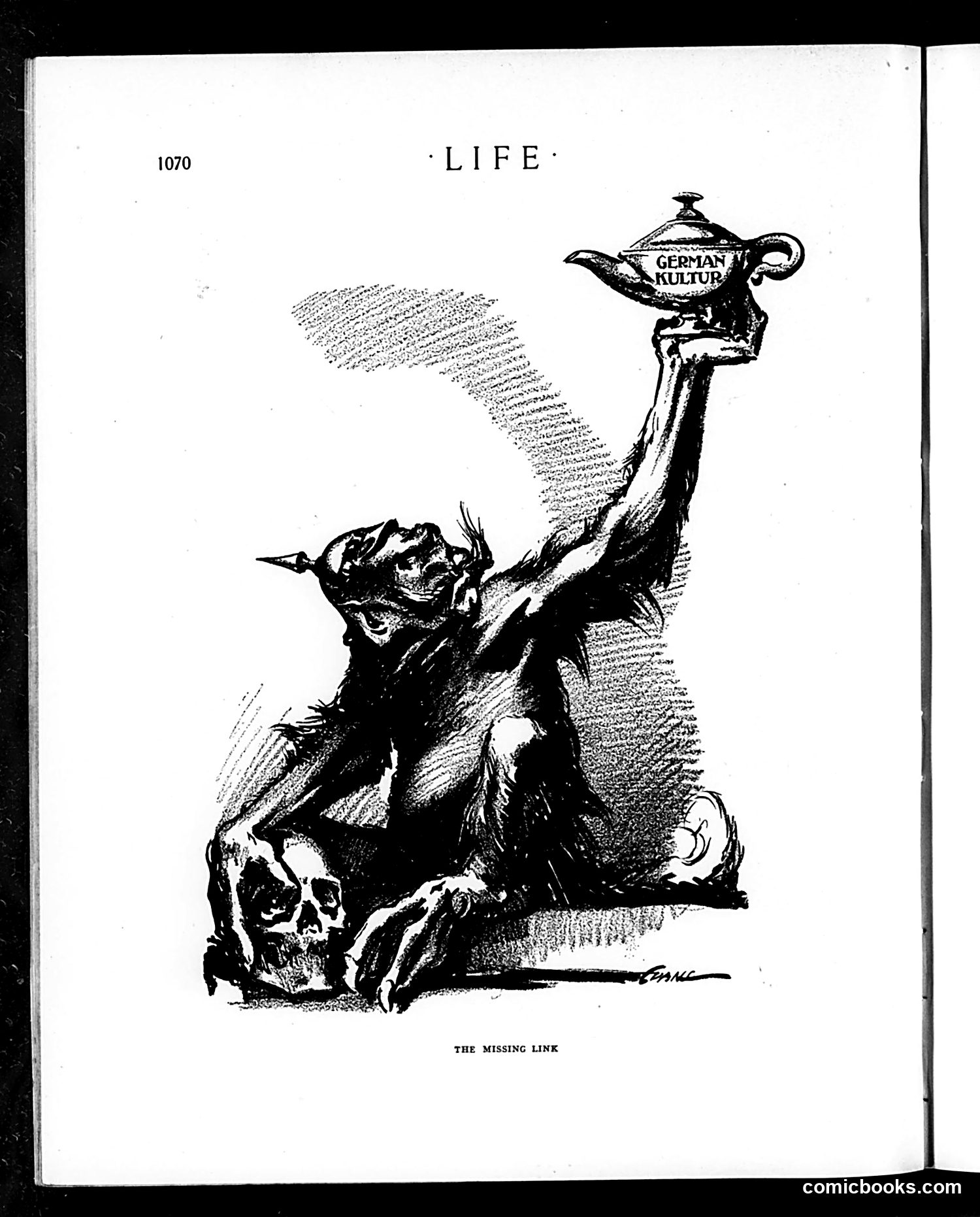
This is a dramatic dialogue between an elderly man (labeled "E.M.") and a young college student. The satire critiques the student's socialist ideology and apparent ingratitude toward his father. The father accuses the son of irresponsibility—having accumulated college bills while displaying no sense of duty to repay them. The son responds by invoking broader sociological and economic arguments, suggesting individual debt is merely part of a larger systemic problem. The satire mocks the young man as a "knight of the new propaganda"—someone who adopts fashionable leftist rhetoric to justify personal irresponsibility. The piece suggests this student represents a type: college radicals who embrace socialist ideology while avoiding practical obligations to their parents. The humor targets early 20th-century college socialism and generational conflict.
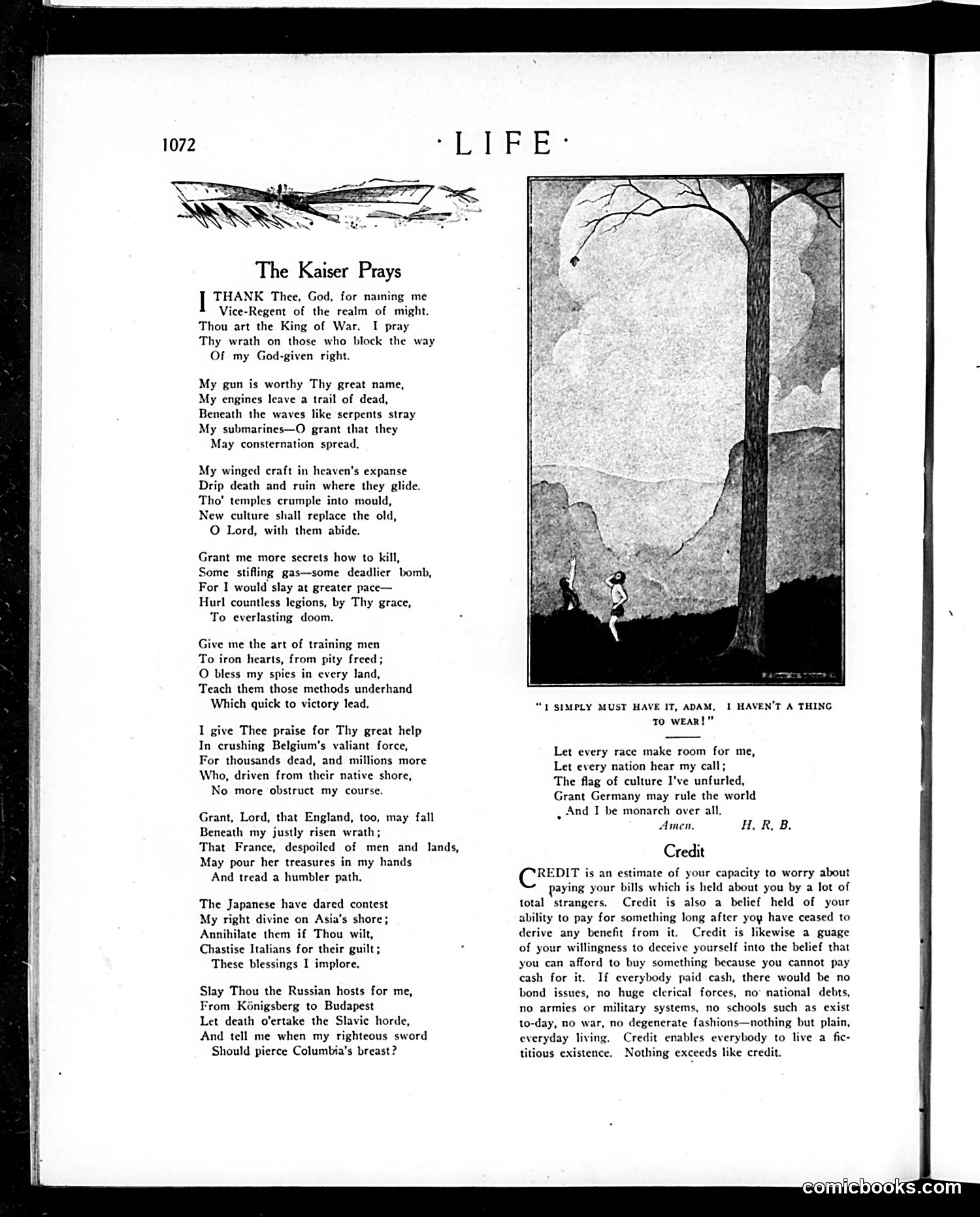
This page contains "The Kaiser Prays," a satirical poem attributed to H.R.B., attacking German Kaiser Wilhelm II during World War I. The prayer mockingly portrays the Kaiser thanking God for military power—guns, engines, submarines, and aircraft—while praying for more destructive weapons and conquest of enemies including England, France, Japan, and Russia. The accompanying illustration shows two figures beneath a large tree, likely representing innocent civilians dwarfed by the scale of militarism. The satire works by inverting religious devotion into worship of war machinery and imperial ambition. This American publication uses the prayer format to expose what it presents as the Kaiser's actual values: military domination disguised as divine will.
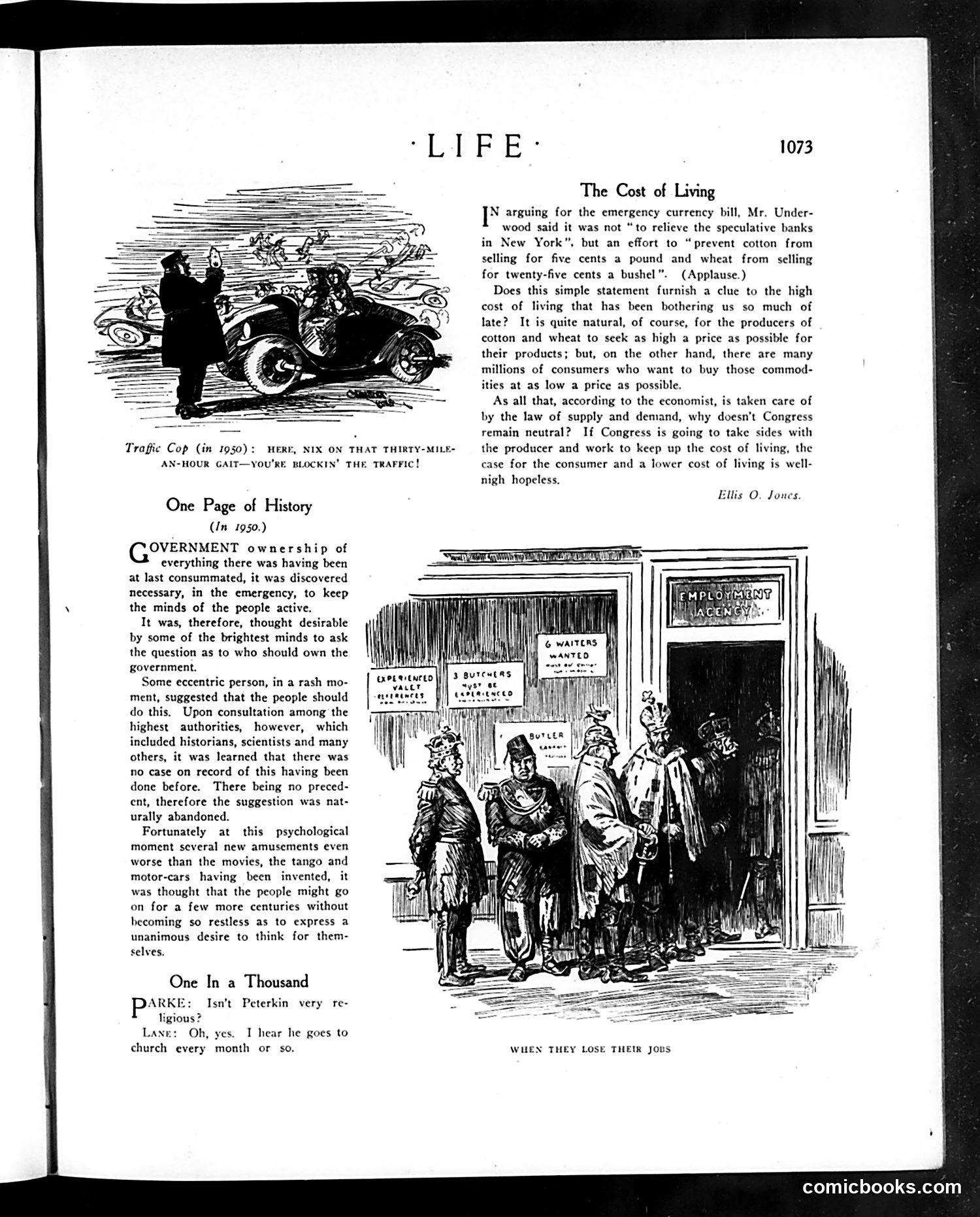
This page satirizes early 20th-century economic and political debates about the cost of living. The top cartoon, "Traffic Cop (in 1950)," humorously predicts future traffic congestion from automobiles—treating the then-new invention as a source of social chaos. The main article, "One Page of History," mocks government consideration of ownership solutions during an economic emergency, suggesting such ideas are unprecedented and impractical. The cartoon "When They Lose Their Jobs" depicts unemployed workers at an employment office, illustrating the human consequence of economic hardship. The dialogue snippet "One in a Thousand" jokes about religious devotion during hard times. Together, these pieces critique both government overreach and economic inequality affecting working people.
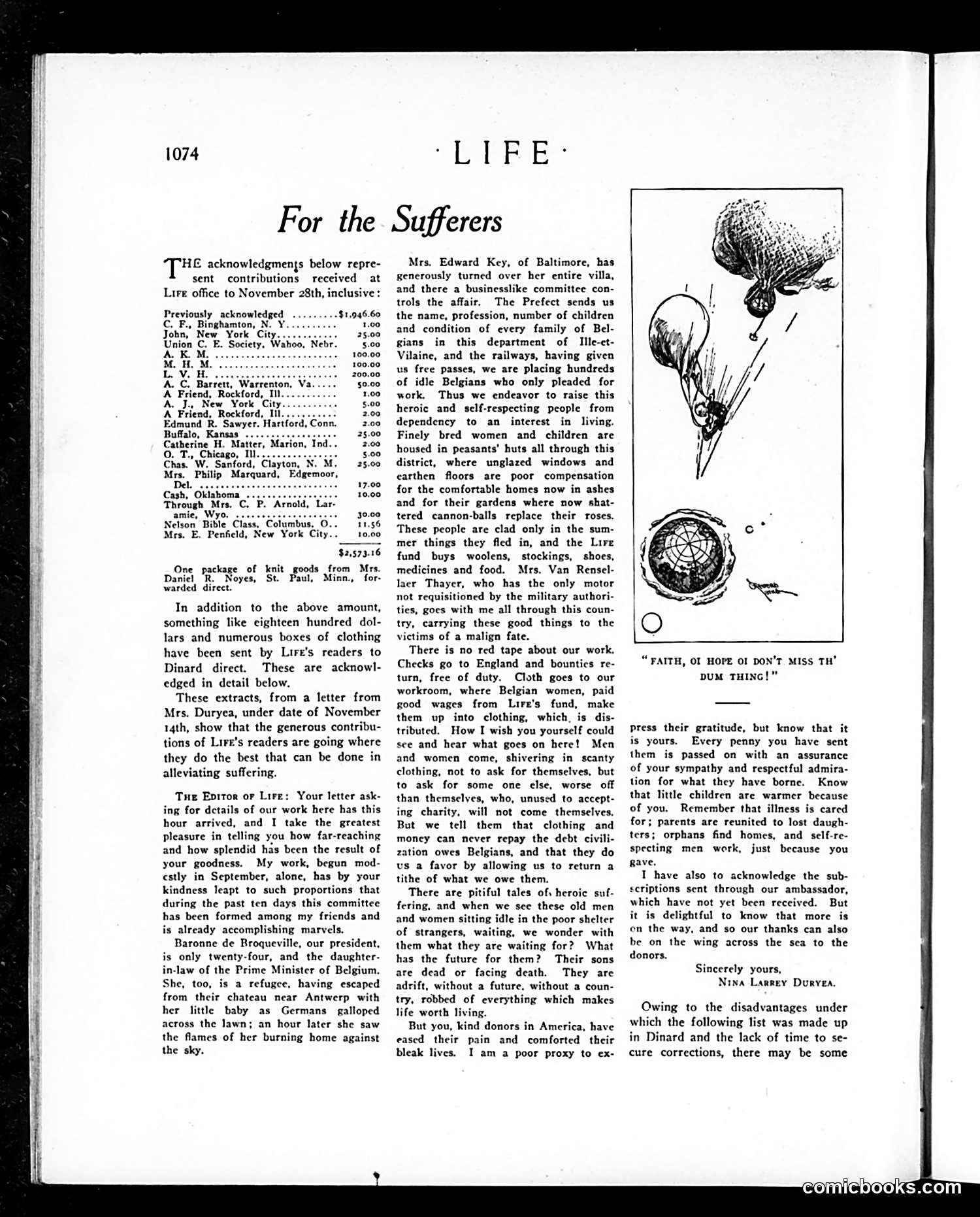
This page documents charitable contributions to Life magazine's relief fund for Belgian refugees during World War I. The text describes Mrs. Edward Ker's villa in Baltimore serving as a headquarters for aid distribution to Belgian families displaced by the war. The small illustration in the upper right appears to show dried beans or legumes, likely representing food donations. Below it is a circular object, possibly a coin or monetary contribution symbol. The cartoon caption—"FAITH, OI HOPE OI DON'T MISS TH' DUM THING!"—uses Irish dialect humor (characteristic of early-1900s Life magazine satire) to make light of the relief efforts, though the overall page's serious tone emphasizes the genuine humanitarian crisis facing Belgian civilians.
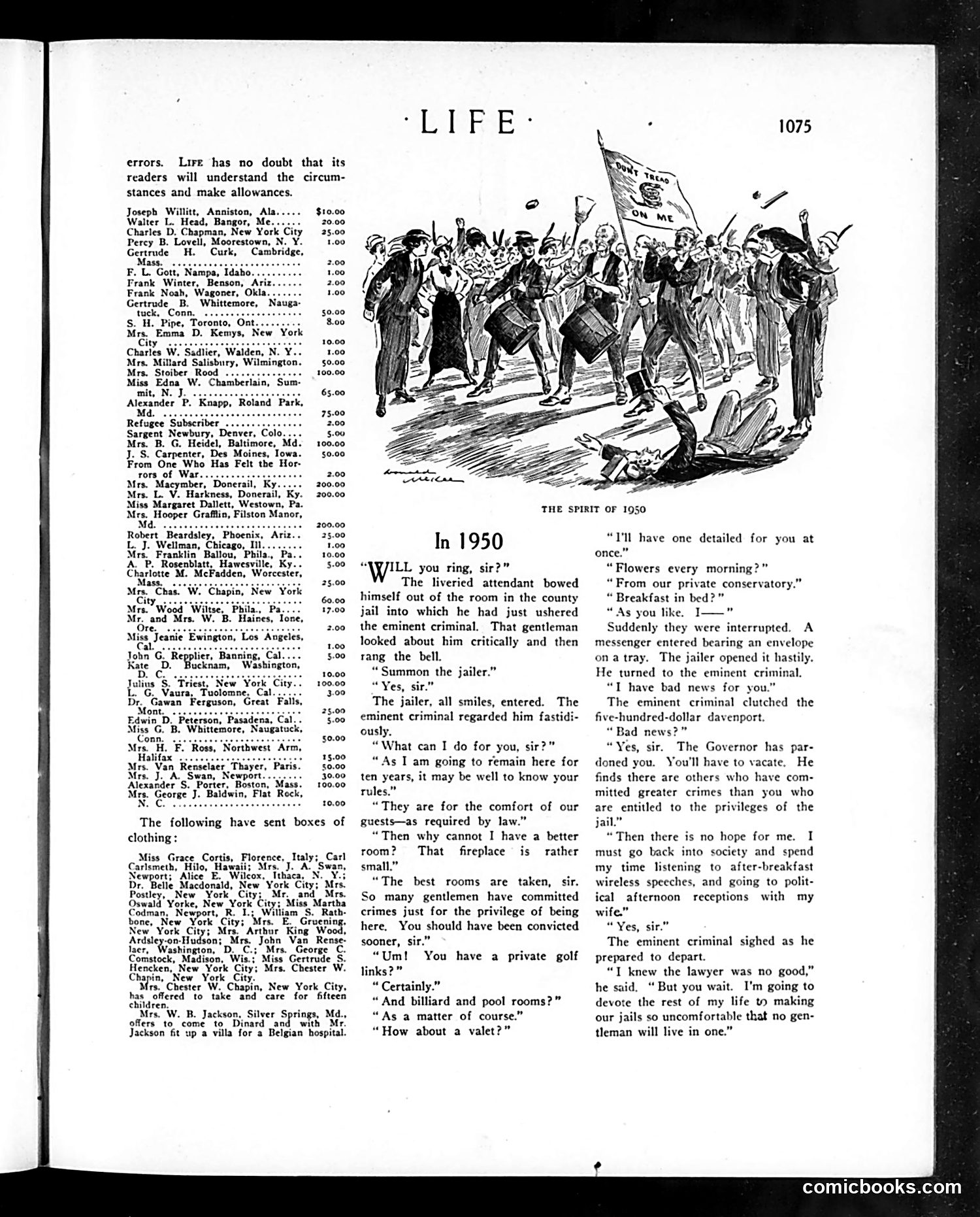
This satirical story mocks the luxurious conditions afforded wealthy or prominent criminals in jail. An "eminent criminal" is treated like a hotel guest by an obsequious staff—the jailer addresses him as "sir" and accommodates requests for better rooms, private golf links, billiard rooms, valets, and flowers. The joke's twist: the criminal is devastated when the Governor *pardons* him, forcing him to leave these cushy accommodations. He must return to ordinary society while others "who have committed greater crimes" take his place in prison's comparative comfort. The satire targets class inequality in the justice system—suggesting that wealth and status allow privileged criminals to serve sentences more pleasantly than free citizens live, and that truly serious criminals (implicitly wealthy/powerful) occupy the system's best accommodations. It's a biting commentary on corruption and unequal justice.
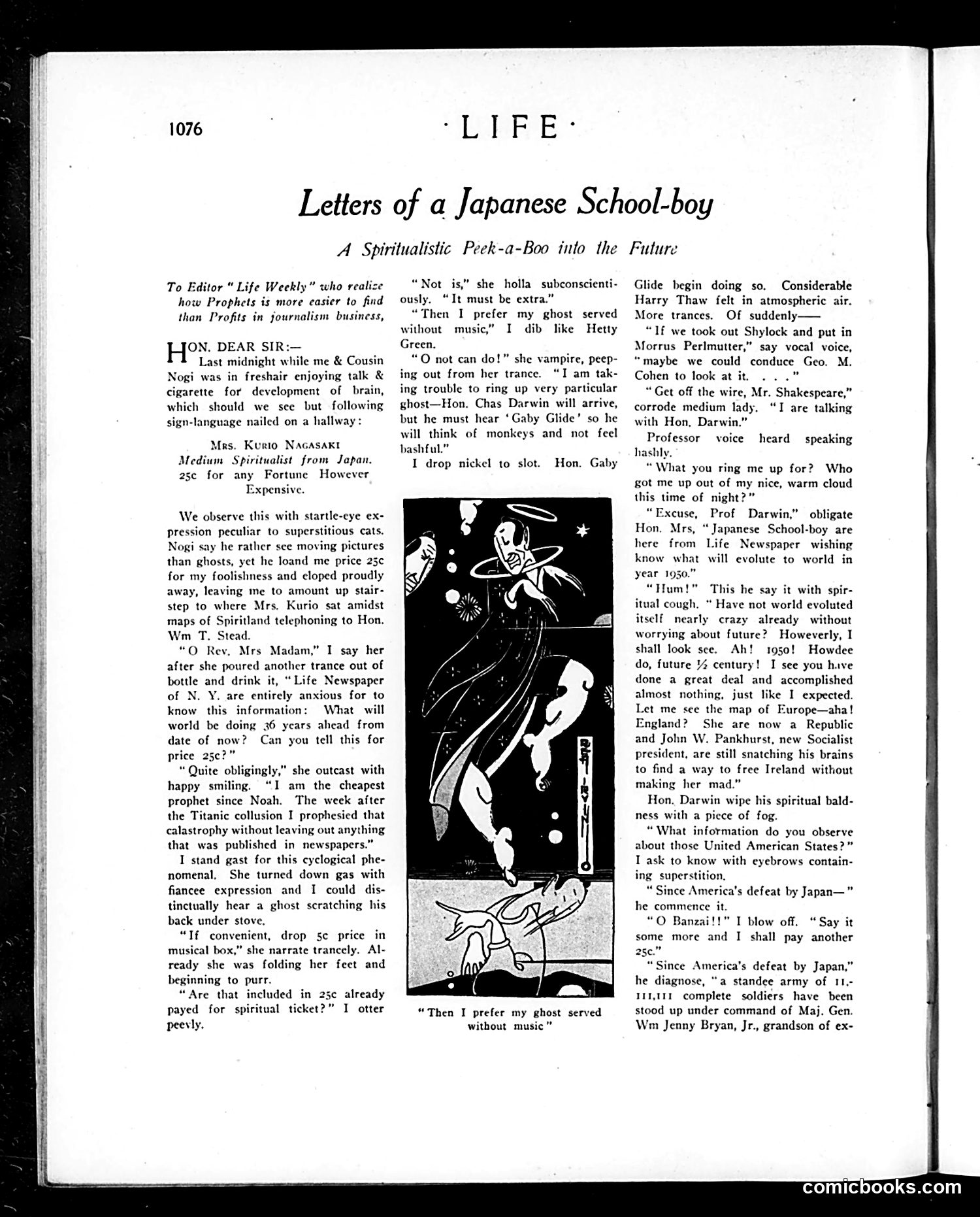
This 1910s satirical piece mocks both spiritualism and anti-Japanese sentiment through a deliberately fractured narrative voice—a Japanese character with broken English who visits a fraudulent medium. **The Setup:** A Japanese schoolboy seeks a fortune-teller's prediction about the world 36 years hence (around 1950). **The Satire:** The medium is exposed as a charlatan who: - Charges extra for "ghost music" - Conjures Charles Darwin (oddly discussing Shakespeare and modern theatrical figures) - Makes laughably vague predictions (England becomes a Socialist republic; Ireland remains troubled) **The Punchline & Politics:** When Darwin predicts "America's defeat by Japan," the schoolboy excitedly offers more money—satirizing both American fears of Japanese military power and suggesting the medium preys on contemporary anxieties. The broken English narration itself is the joke's vehicle: the character's malapropisms ("cyclogical phenomenal," "otter peevly") mock both fortune-telling pretense and ethnic stereotyping, while the eager anticipation of America's defeat reflects genuine 1910s concerns about rising Japanese power.
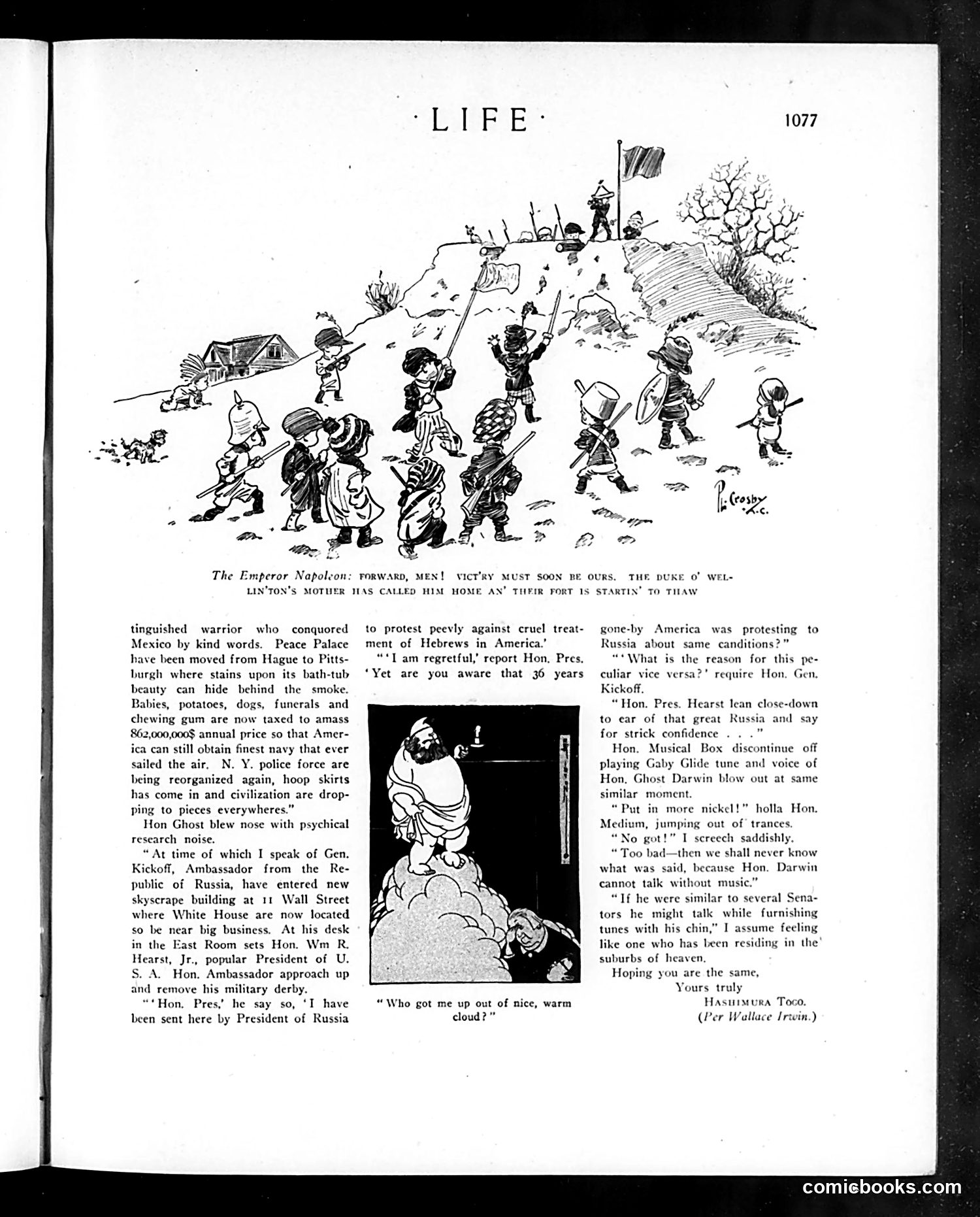
This page combines a children's illustration with absurdist political commentary, likely from the early 1900s. **The Cartoon:** Shows children playing soldiers on a hill, captioned as "The Emperor Napoleon," mocking militarism through innocent play-acting. **The Text:** Written in deliberately broken English (likely parodying Russian speech patterns), it presents a fictional diplomatic exchange between Russian Ambassador "Gen. Kickoff" and U.S. President William Randolph Hearst Jr. The Russian protests American mistreatment of Hebrew immigrants, but Hearst responds by pointing out America previously protested Russia's identical policies—exposing hypocritical double standards in international relations and human rights rhetoric. **The Satire:** Life ridicules American foreign policy as morally inconsistent and performative. The absurdist tone (musical boxes, psychical research, taxes on chewing gum) emphasizes the magazine's view that political posturing is fundamentally ridiculous. The joke hinges on exposing how nations conveniently forget their own criticisms when convenient.
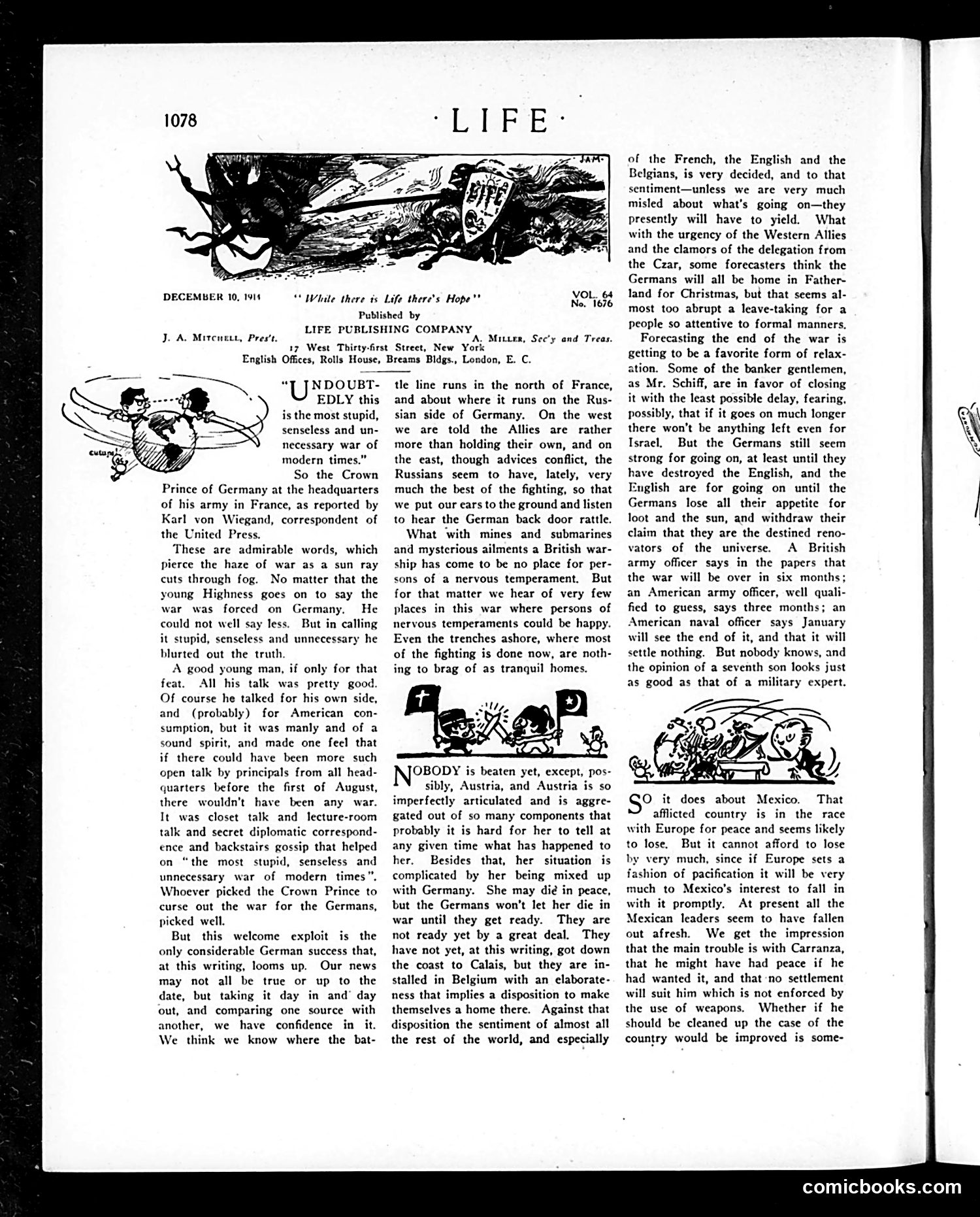
This editorial page comments on a statement attributed to Germany's Crown Prince criticizing the war as "stupid, senseless and unnecessary." Life's editor praises this candor as refreshingly honest, arguing that such open diplomatic conversation *before* August 1914 might have prevented the conflict entirely. Instead, "closet talk and lecture-room talk and secret diplomatic correspondence" led to war. The page then surveys the military situation: the Allies hold their own in western France; Russians fare better in the east; Germany controls Belgium but hasn't reached Calais. Austria-Hungary is fragmented and dependent on Germany. The cartoons (small illustrations) appear to mock the various combatants' situations, though their specific details are unclear in this reproduction. The piece reflects American neutrality-era skepticism about war's necessity and European diplomacy's failures—a common Life perspective in late 1914.
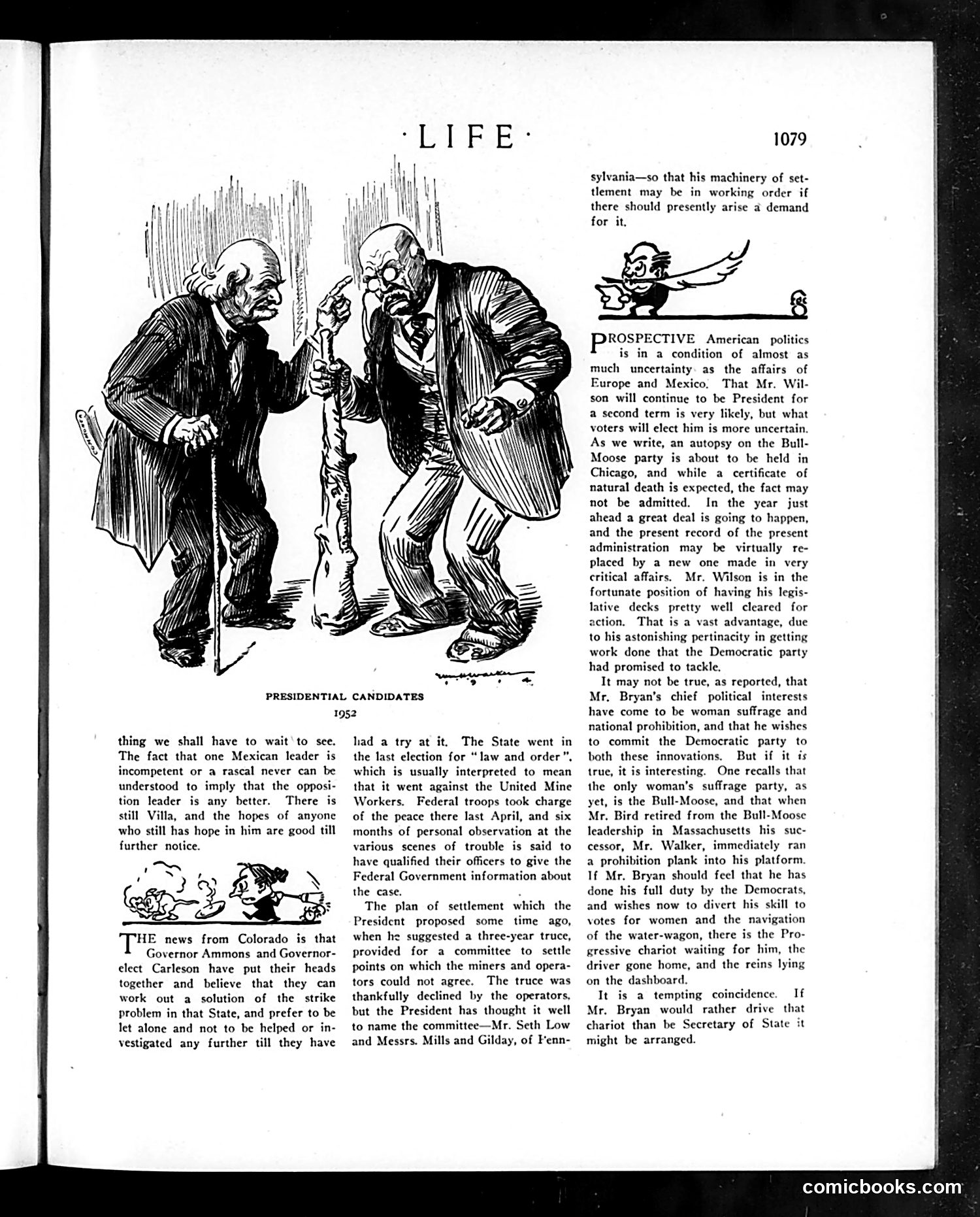
The main cartoon labeled "Presidential Candidates 1952" depicts two elderly, grotesque figures in suits examining or arguing over what appears to be a skeletal or decrepit object—likely representing the competing interests of political factions or the deteriorated state of candidates themselves. The accompanying text discusses American politics with uncertainty comparable to Europe and Mexico. It focuses on President Wilson's likely reelection, the impending "autopsy" of Theodore Roosevelt's Bull-Moose Party (a third party that split Republican votes in 1912), and speculation about William Jennings Bryan's political future. The satire suggests that established political figures are aging relics, and that Bryan might be better suited abandoning Democratic politics for progressive causes like women's suffrage and prohibition—presented humorously as leaving the Democratic "chariot" with "reins lying on the dashboard." The cartoon mocks the candidates as worn-out, self-interested figures squabbling over political machinery rather than genuine leadership.
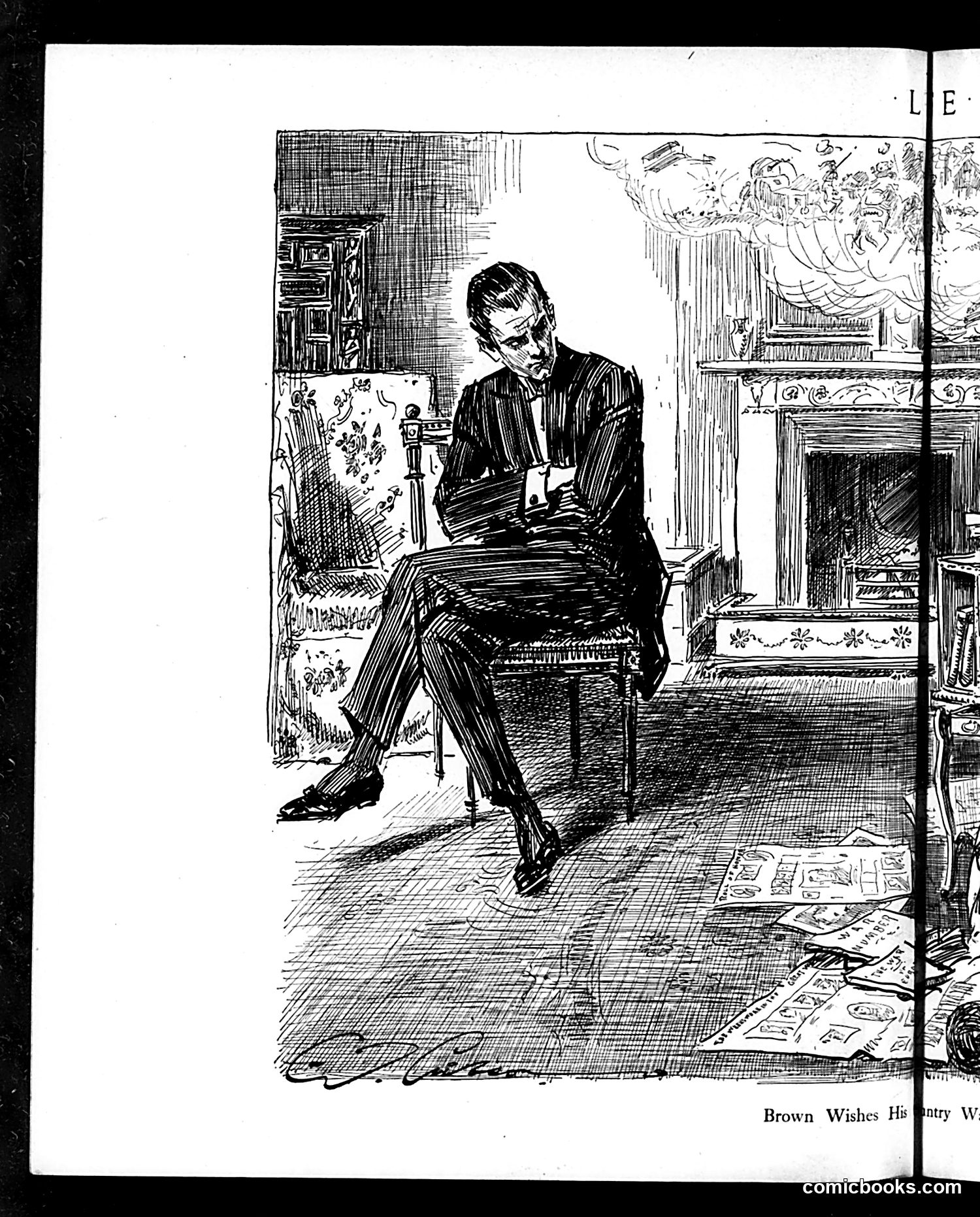
This is a sketch-style illustration showing a man in a pinstriped suit sitting alone in an ornate interior room, appearing contemplative or troubled. The partial caption reads "Brown Wishes His" but is cut off, making the complete reference unclear. Without the full caption or additional context, I cannot definitively identify who "Brown" is or what he wishes. The illustration's style suggests this is satirical commentary on a specific historical figure or political situation from Life magazine's era, but the incomplete text prevents me from accurately explaining the satire's specific target or meaning to a modern reader. The formal setting and solitary pose suggest commentary on power, regret, or isolation.
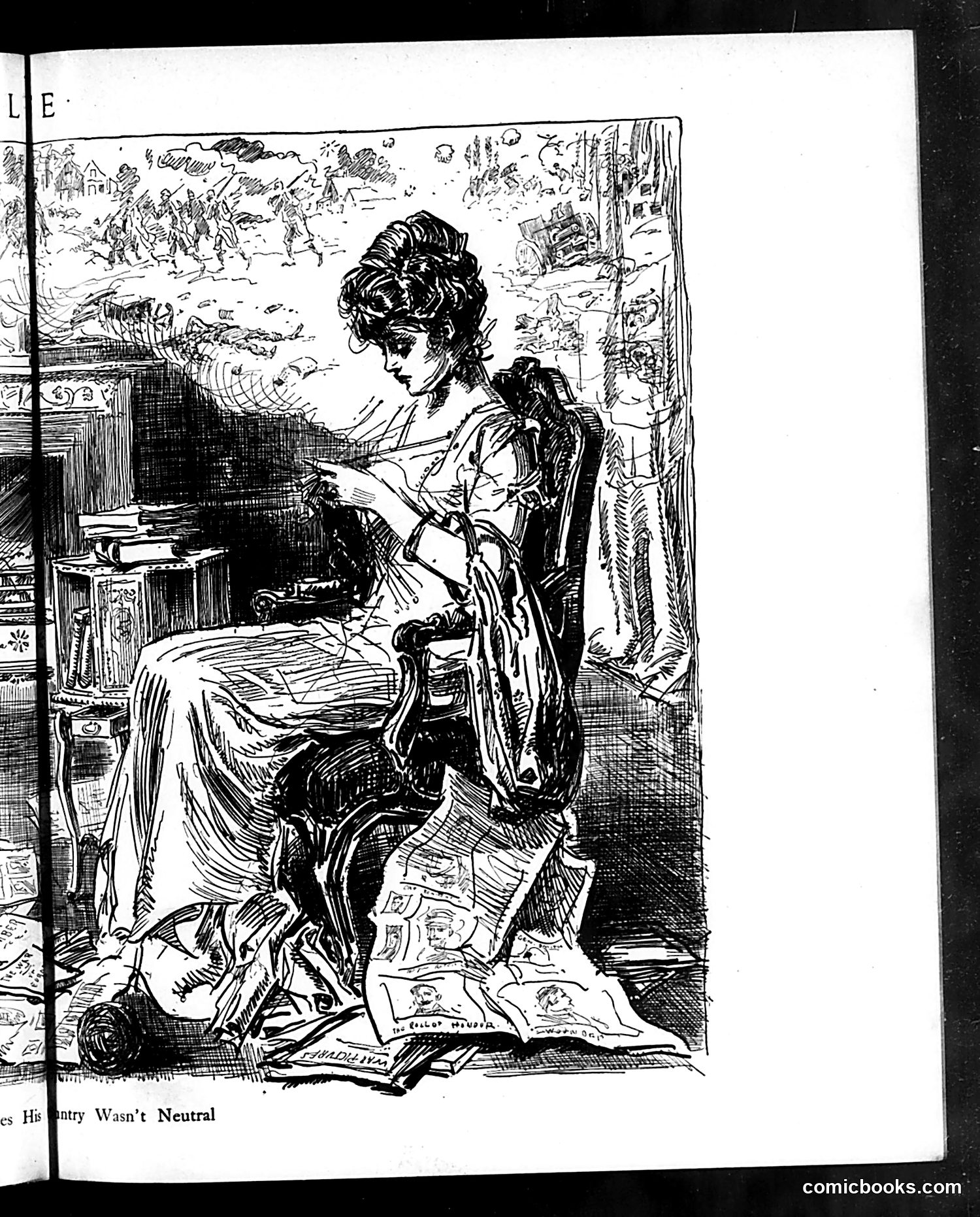
This page shows a sketch of a woman seated at a desk or table, writing or working on documents. Papers are scattered around her, and through the window behind her, military activity is visible—soldiers, weapons, and what appears to be wartime scenes. The caption reads "ntry Wasn't Neutral" (likely "Country Wasn't Neutral"). This appears to be a satirical commentary on American neutrality claims, probably during World War I or the interwar period. The woman likely represents America or a neutral nation, but the evidence of military preparation visible through her window suggests the country's actual involvement contradicts its stated neutral position. The satire points out the hypocrisy between official neutrality declarations and behind-the-scenes military activities or support.
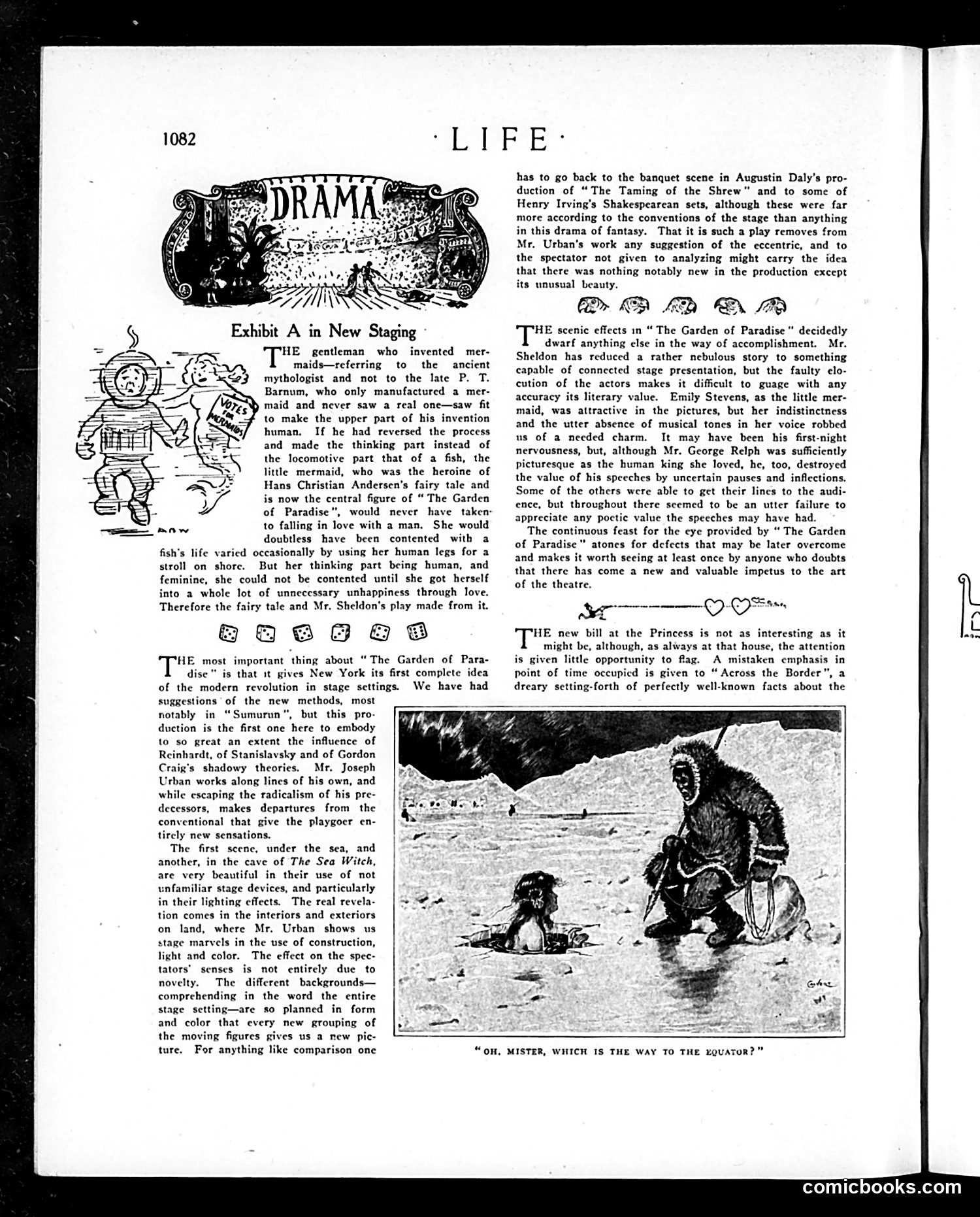
This page reviews "The Garden of Paradise," a theatrical production featuring innovative stage design by Joseph Urban. The small cartoon at top left illustrates the fairy tale's premise: a mermaid with human upper body and fish tail, whose human capacity for emotion (rather than animal instinct) drives the plot—she falls in love and suffers. The review praises Urban's revolutionary scenic design, comparing it favorably to earlier productions by Augustin Daly and Henry Irving. However, it sharply criticizes the actors' performances, particularly Emily Stevens (the mermaid) and George Relph, for poor diction and inability to deliver their lines effectively to the audience. The photograph shows what appears to be a desert or beach scene from the production. The caption—"Oh, Mister, Which Is the Way to the Equator?"—suggests comedic staging within the fantastical narrative.
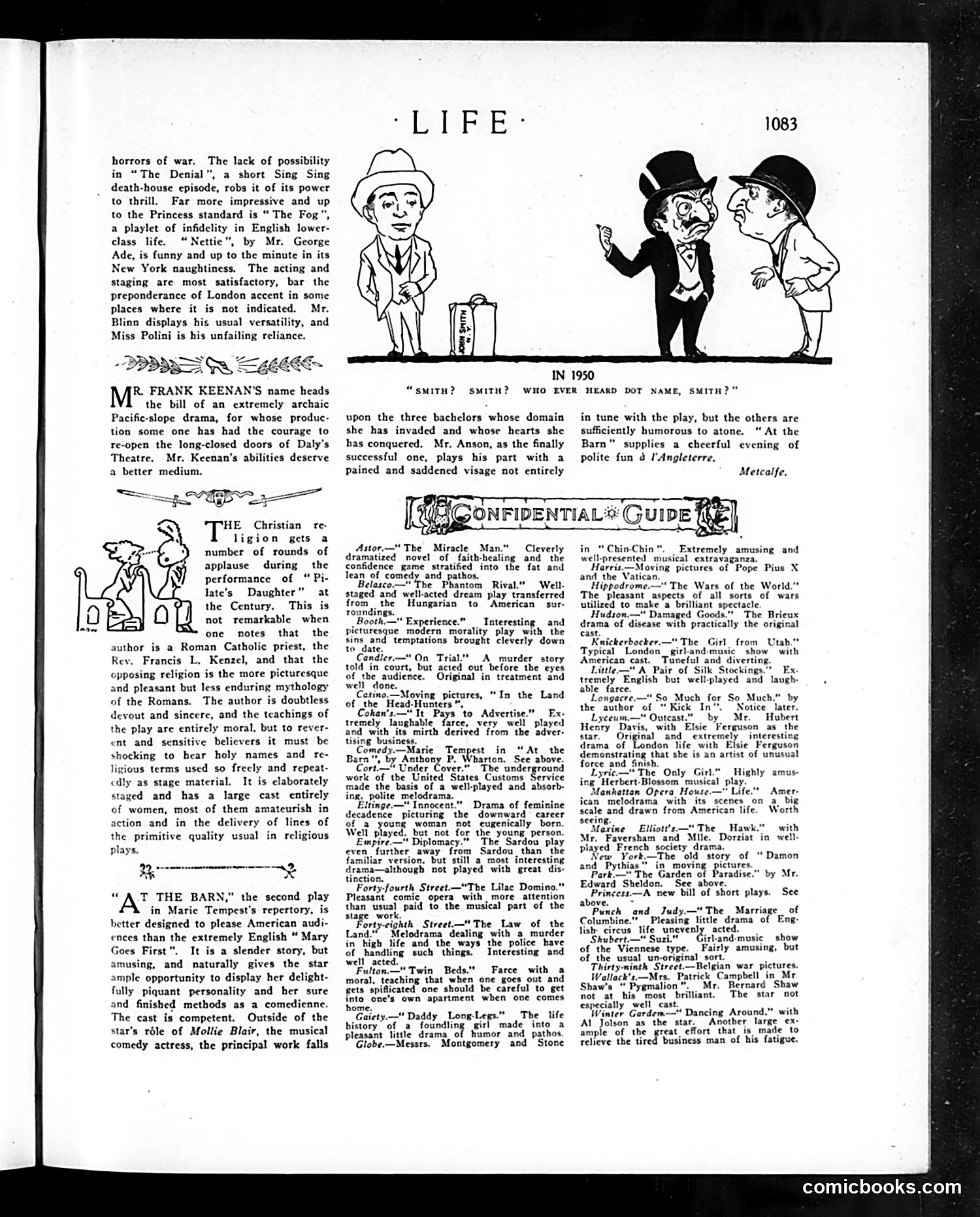
This page reviews theatrical productions on Broadway. The cartoon at top satirizes the commonness of the surname "Smith"—two men in bowler hats exclaim "Smith? Smith? Who ever heard dot name, Smith?" to a third man with a suitcase, mocking how unremarkable the name is. The reviews discuss various plays, including Marie Tempest's comedies ("At the Barn," "Mary Goes First") and dramas like "The Miracle Man" (faith-healing con game), "On Trial" (innovative courtroom drama), and religiously-themed plays. The text notes controversies around a priest-authored play featuring Roman Catholic imagery. The "Confidential Guide" section provides brief theater recommendations, evaluating acting quality, originality of plot, and appropriateness for audiences. The overall tone is theatrical criticism aimed at educated New York audiences seeking entertainment recommendations.
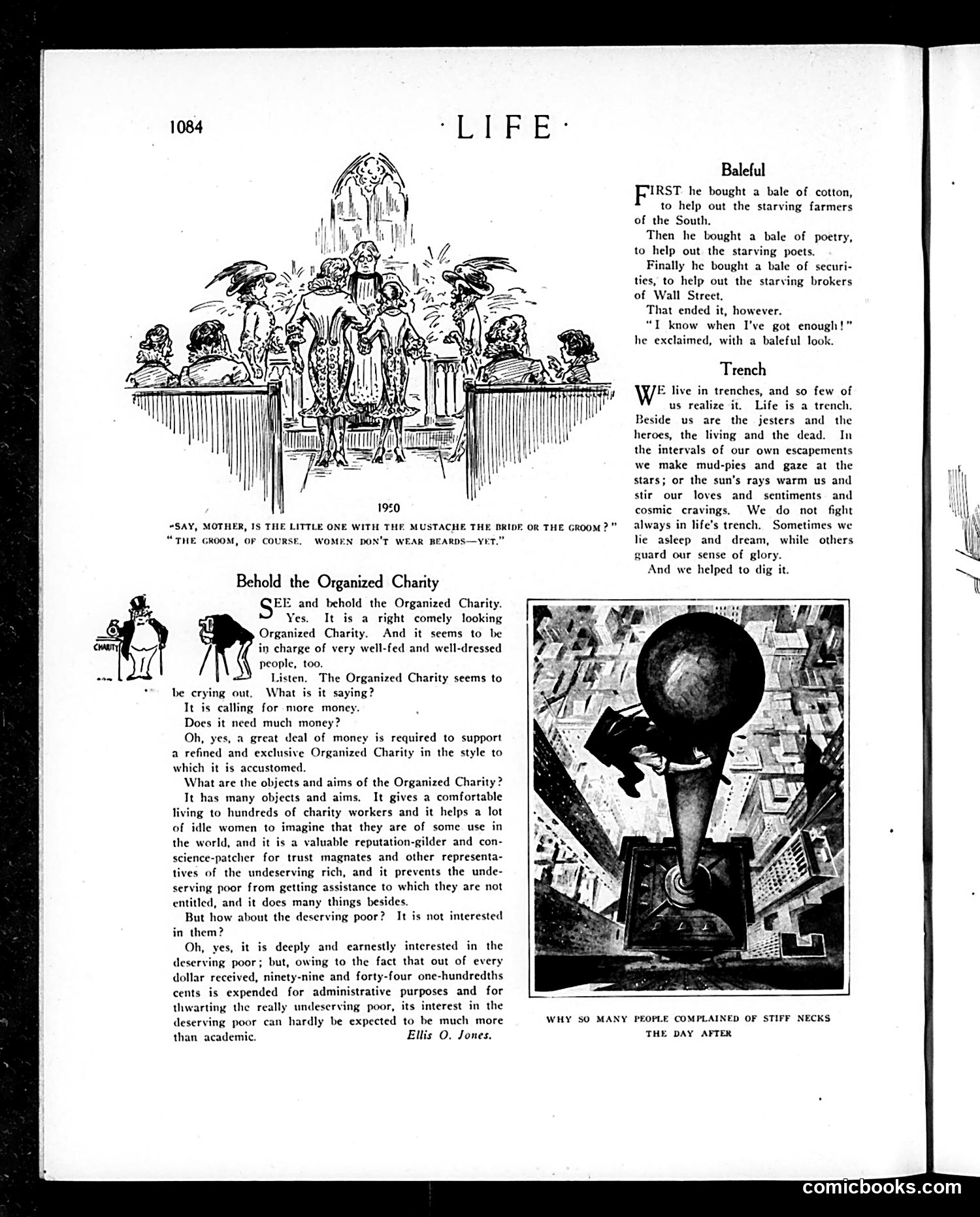
This page contains three distinct satirical pieces critiquing American social and economic issues: **"Baleful"** mocks wealthy philanthropists who spread charitable giving across cotton farmers, poets, and Wall Street brokers—appearing virtuous while ultimately helping themselves. The phrase "I know when I've got enough!" suggests self-serving limits to generosity. **"Trench"** uses WWI imagery (referencing the ongoing or recent Great War) metaphorically—life itself is a trench where people distract themselves with trivialities while experiencing cosmic yearning. "And we helped to dig it" implies complicity in modern suffering. **"Behold the Organized Charity"** is a scathing critique of institutional charity organizations, alleging that 99.44% of donations fund administrative overhead rather than helping the deserving poor. The satire targets "well-fed" charity administrators and wealthy donors seeking reputation-laundering ("reputation-gilder...for trust magnates"), while suggesting organized charity actually *prevents* aid to the truly needy. The bottom photo caption about "stiff necks" appears unrelated humor about physical discomfort.
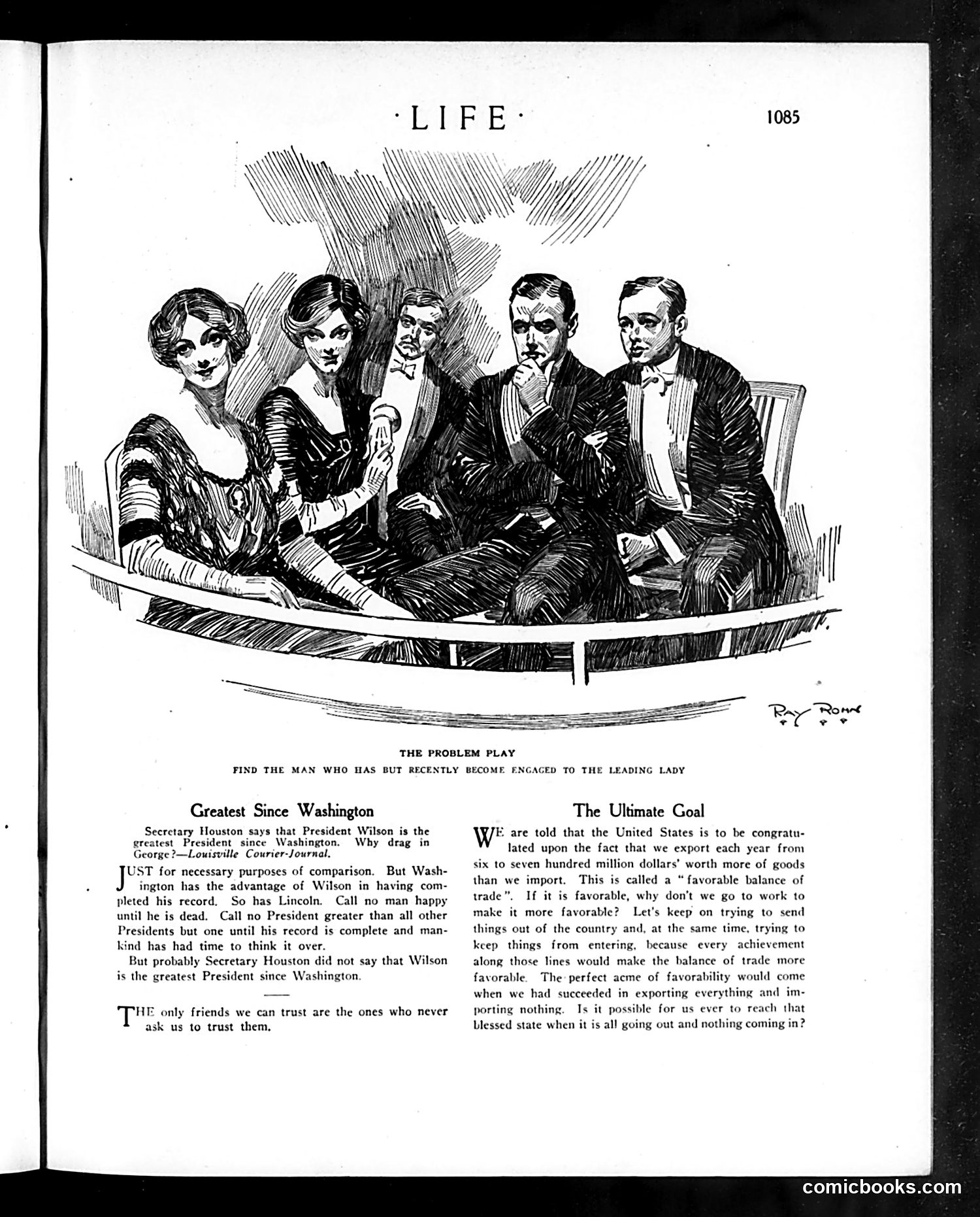
This page combines a visual puzzle with political commentary from the Wilson era (likely 1910s). **The cartoon** shows five well-dressed people in a theater box, captioned as a "problem play" where readers must identify which man recently became engaged to the leading lady—a parlor game format popular in period magazines. **The text below contains two satirical pieces:** 1. **"Greatest Since Washington"** mocks Secretary of the Interior Franklin K. Houston for calling President Wilson the greatest president since Washington. The author argues this is premature—you can't judge a president's legacy until his record is complete and history has perspective. It's a veiled criticism of Wilson's administration. 2. **"The Ultimate Goal"** sarcastically critiques American trade policy obsession with "favorable balance of trade" (exporting more than importing). The satire suggests this logic taken to its extreme would mean exporting *everything* and importing *nothing*—an impossibility that exposes the absurdity of the economic goal. Both pieces use humor to challenge contemporary political and economic assumptions.
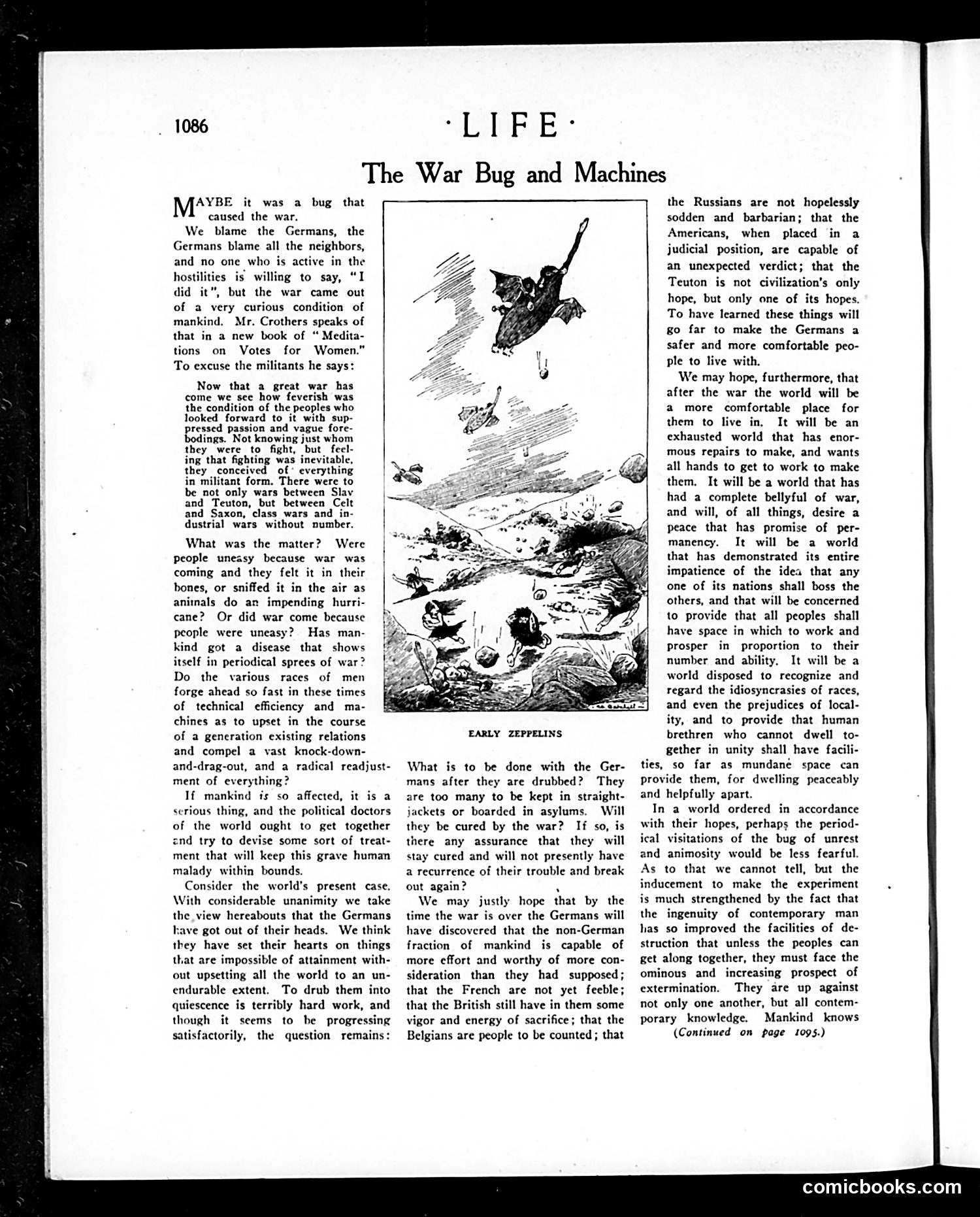
This article uses the metaphor of disease to explain World War I's origins. The author (Samuel McChord Crothers, referenced in the text) proposes that rapid industrialization and social upheaval have created psychological "fever" among nations, making war seem inevitable. The illustration labeled "Early Zeppelins" depicts German airships—contemporary weapons of terror that symbolize technological warfare's unprecedented destructiveness. This visual reinforces the article's argument that modern machines have transformed conflict into something more devastating and impersonal than previous wars. The text positions Germany as a nation mentally "out of its heads" requiring treatment, while arguing that post-war peace demands all nations recognize each other's worth equally—rejecting German supremacy ideology. The article reflects American perspective during WWI, mixing hope that military defeat might "cure" German aggression with anxiety about maintaining lasting peace through mutual respect rather than domination.
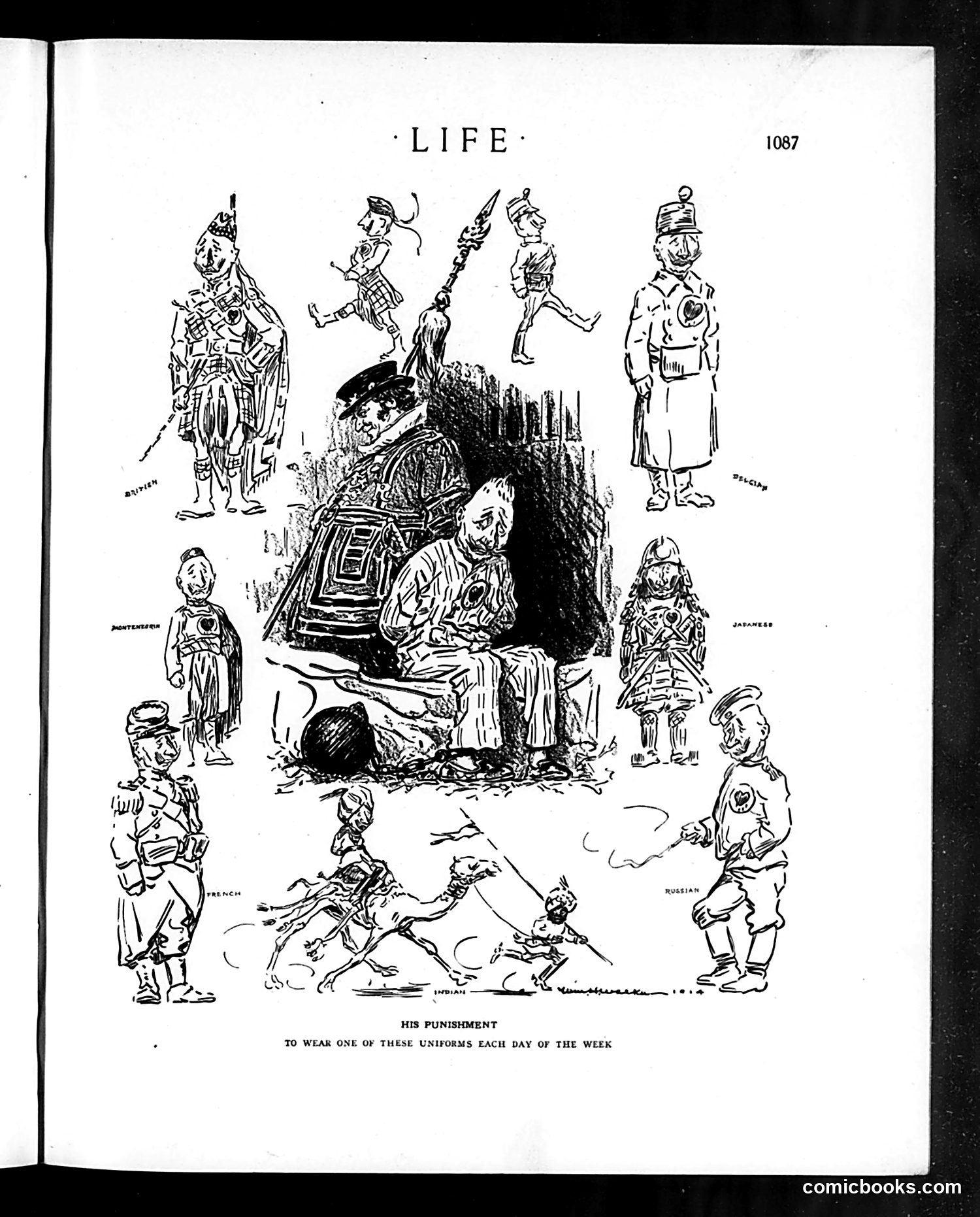
This Life magazine cartoon satirizes militarism and international conflict, likely from the early 20th century. The central figure—a military officer or political leader—is surrounded by soldiers and military uniforms labeled with different nationalities: Russian, French, German, Japanese, and others. The caption reads: "HIS PUNISHMENT: TO WEAR ONE OF THESE UNIFORMS EACH DAY OF THE WEEK." The satire suggests that military leaders or warmongers are condemned to experience the consequences of their own militaristic policies by being forced to wear different nations' uniforms daily. This critiques the proliferation of militarism across multiple countries and implies that those promoting warfare should suffer its burdens themselves. The cartoon appears to comment on pre-WWI or inter-war period military tensions and nationalism.
This is a book review section from *Life* magazine (page 1088), featuring literary criticism of contemporary works. The page contains no political cartoons—it's primarily text reviewing novels. The reviews discuss: 1. **H.G. Wells's "The Wife of Sir Isaac Harman"**—described as a semi-autobiographical story exploring the tension between an awakening feminist woman, her conservative husband, and an idealistic dilettante reformer. The reviewer uses this as social commentary on contemporary gender and class dynamics. 2. **Jules Romains's "Mort de Quelqu'un"** (translated as "The Death of a Nobody")—a French literary work about an ordinary man whose death suddenly matters to people who ignored him in life. 3. **Gertrude Atherton's "Perch of the Devil"**—set in Montana during a mining boom, exploring how sudden wealth transforms a pioneer community. The reviewer praises Atherton's character development. The tone is characteristic of early 20th-century literary journalism: witty, digressive, and intellectually playful rather than purely informative.
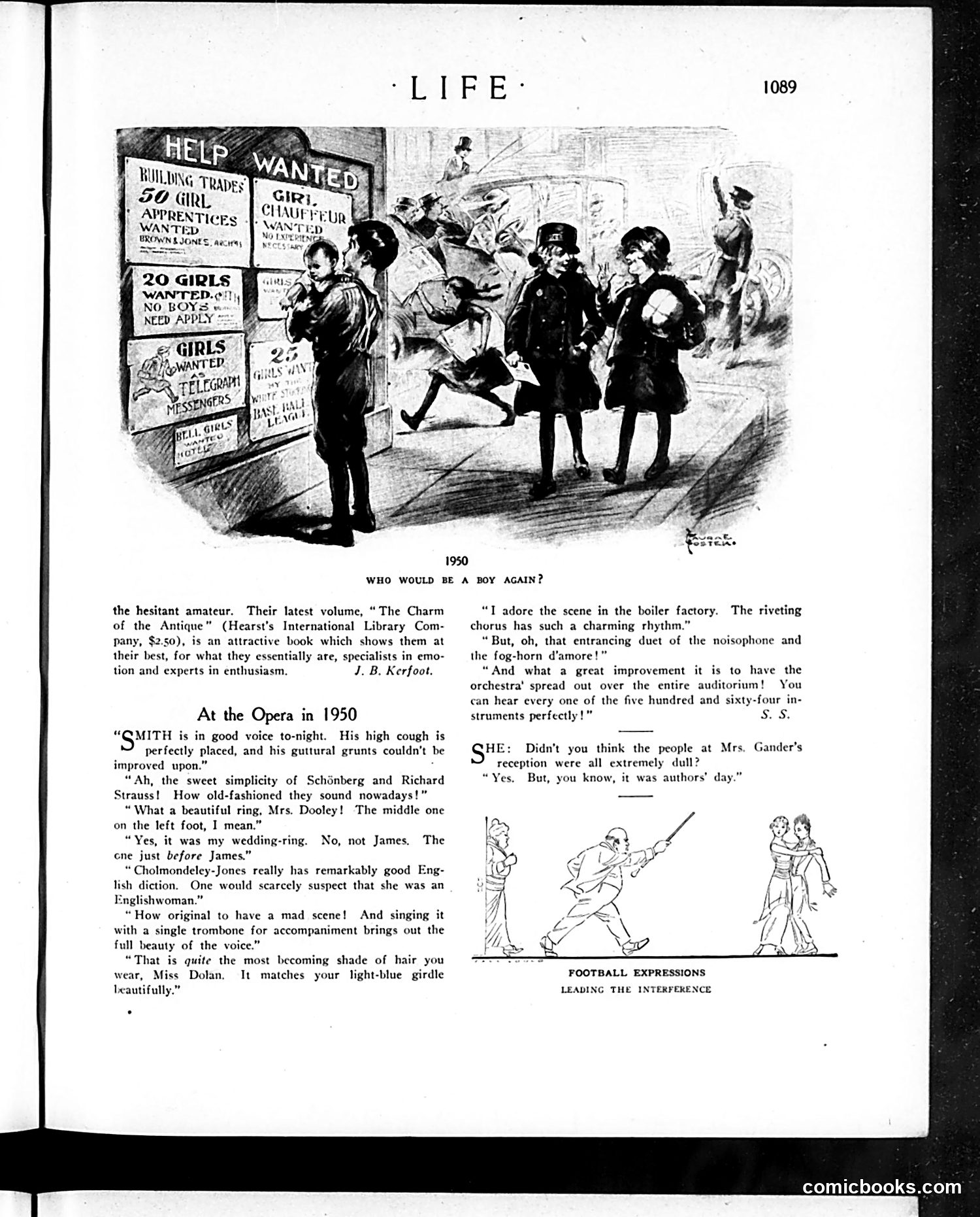
The top cartoon satirizes wartime labor shortages. A street wall displays multiple "Help Wanted" signs desperately seeking girl workers for various trades—building apprentices, telegraph messengers, etc.—while explicitly stating "No Boys Need Apply." The joke's title asks rhetorically: who would want to be a boy in 1950, when girls are suddenly in such high demand for jobs traditionally reserved for men? This reflects post-WWII anxieties about gender roles. During the war, women entered the workforce en masse. By 1950, some industries still needed female labor, creating a reversal of typical employment discrimination—the page humorously treats this as emasculating for men. The lower content mocks pretentious opera-goers in 1950, imagining absurdly avant-garde performances (noisophone duets, riveting choruses in boiler factories, orchestras scattered throughout auditoriums) while audiences offer vapid, affected praise. It satirizes both modernist artistic pretension and the shallow social performance of attending "cultured" events.
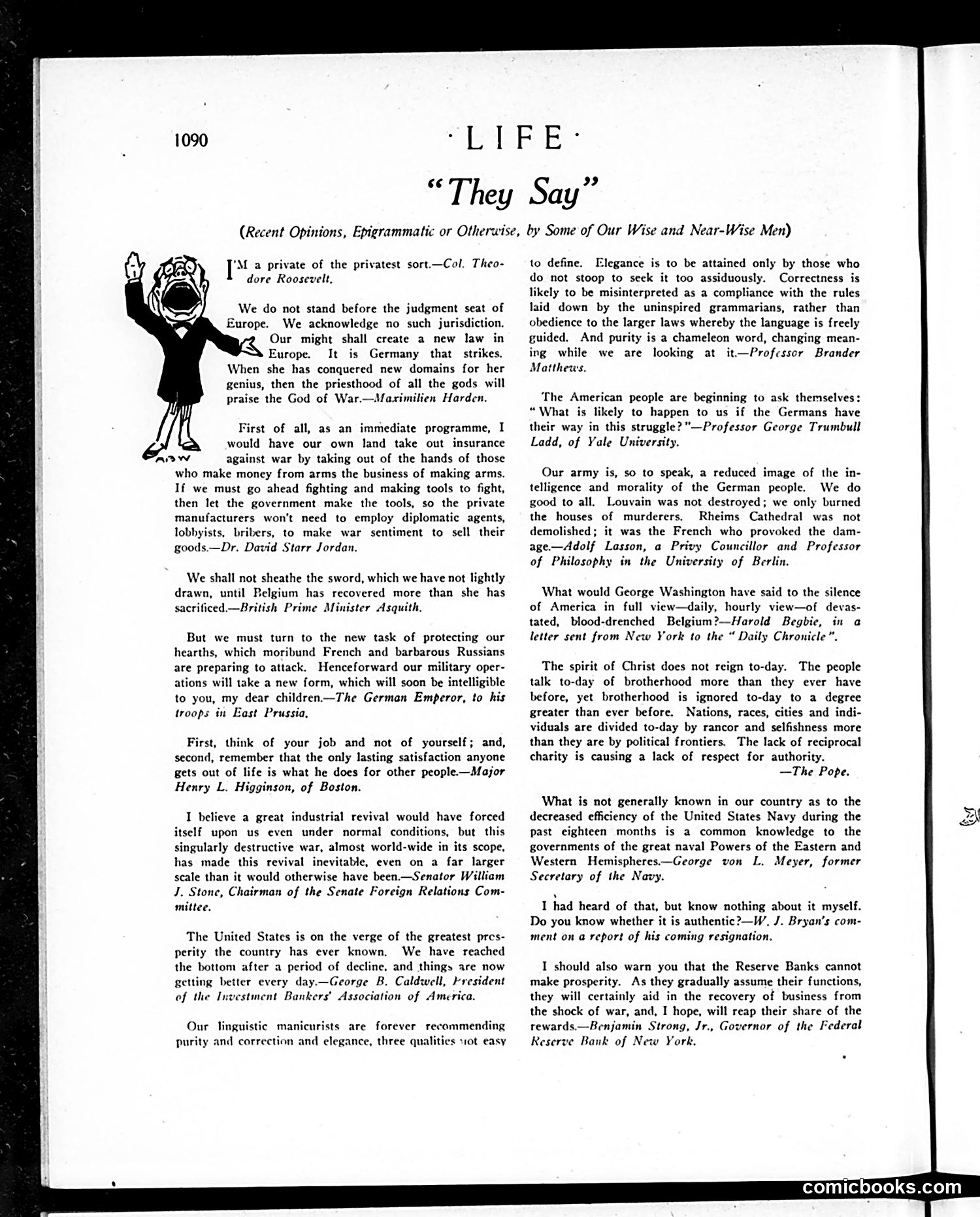
This page collects quotations attributed to prominent figures during World War I, presenting them as satire. The caricature shows a militaristic German figure, likely representing German imperial authority. The satire works by juxtaposing **German justifications for war** (attributed to Kaiser Wilhelm II, philosopher Adolf Lasson, and propagandist Maximilien Harden) against **American and Allied voices** (Theodore Roosevelt, British PM Asquith, Yale professor George Trumbull Ladd). German quotes defend destruction of Belgium and churches as necessary; some quotes appear fabricated or exaggerated to seem absurd. American quotes advocate restraint, pacifism, or moral concern about German aggression. The humor is biting: Life presents Germans as morally corrupt warmongers while positioning American figures as voices of reason. The page ridicules German claims of moral superiority while their actions contradict those claims—a classic propaganda technique turned against Germany during America's pre-WWI period.
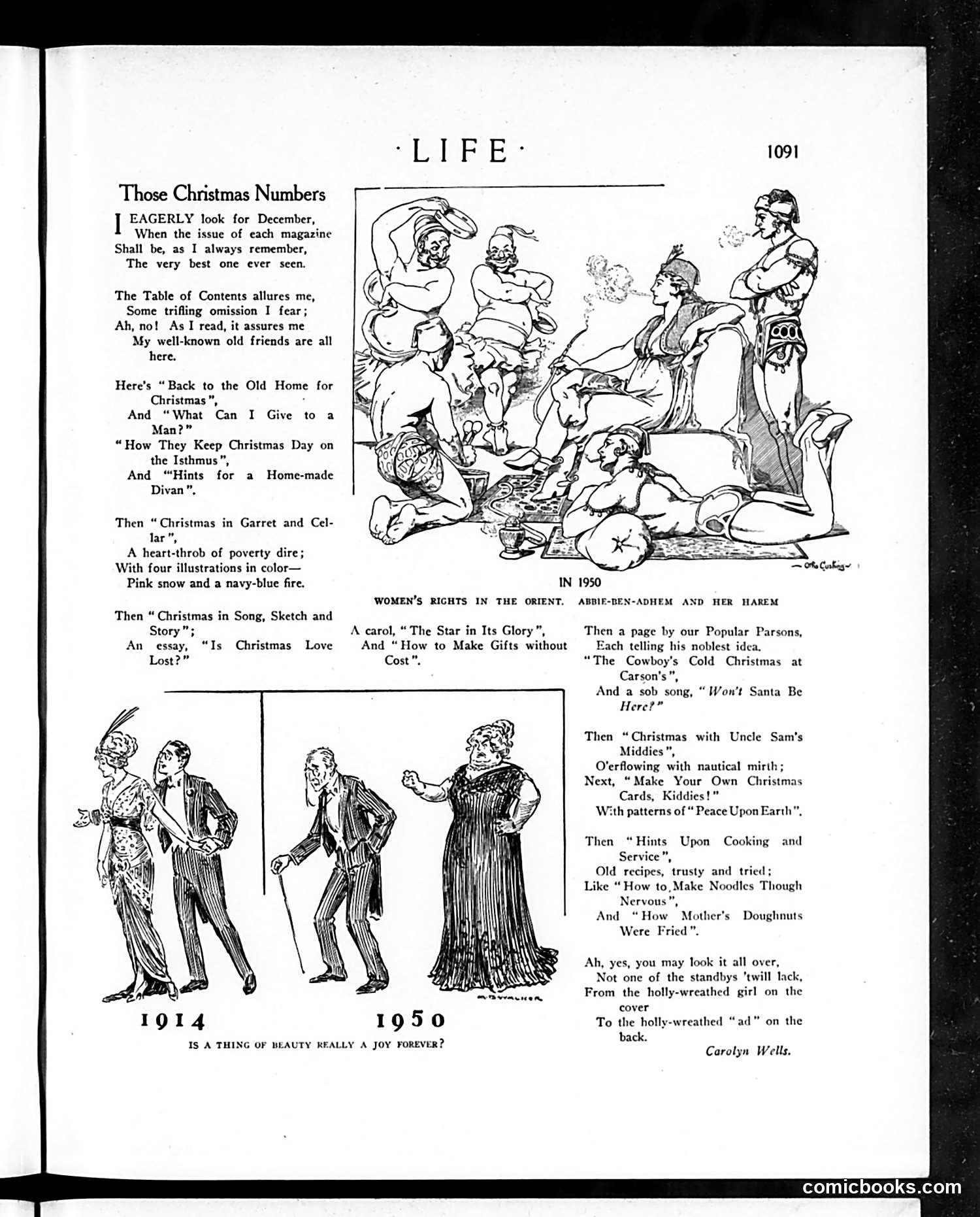
This Life magazine page satirizes the predictable formula of Christmas issues in magazines. The poem by Carolyn Wells mocks how December issues recycled identical content year after year: sentimental stories ("Back to the Old Home for Christmas"), poverty narratives with colored illustrations, carols, recipes, and serviceable advice columns. The comparison cartoon labeled "1914" versus "1950" shows fashion changing dramatically over 36 years—yet the magazine's Christmas content remained static. This is the joke: while society and styles evolve, magazines mechanically repeated the same hackneyed stories and features, assuming readers would never notice. The upper illustration depicts "Women's Rights in the Orient," likely referencing Abbie-ben-Adhem and her harem, appearing to comment on exotic or orientalist content popular in that era's magazines. The satire targets magazine publishers' creative laziness and readers' willing suspension of disbelief in accepting recycled holiday content annually.
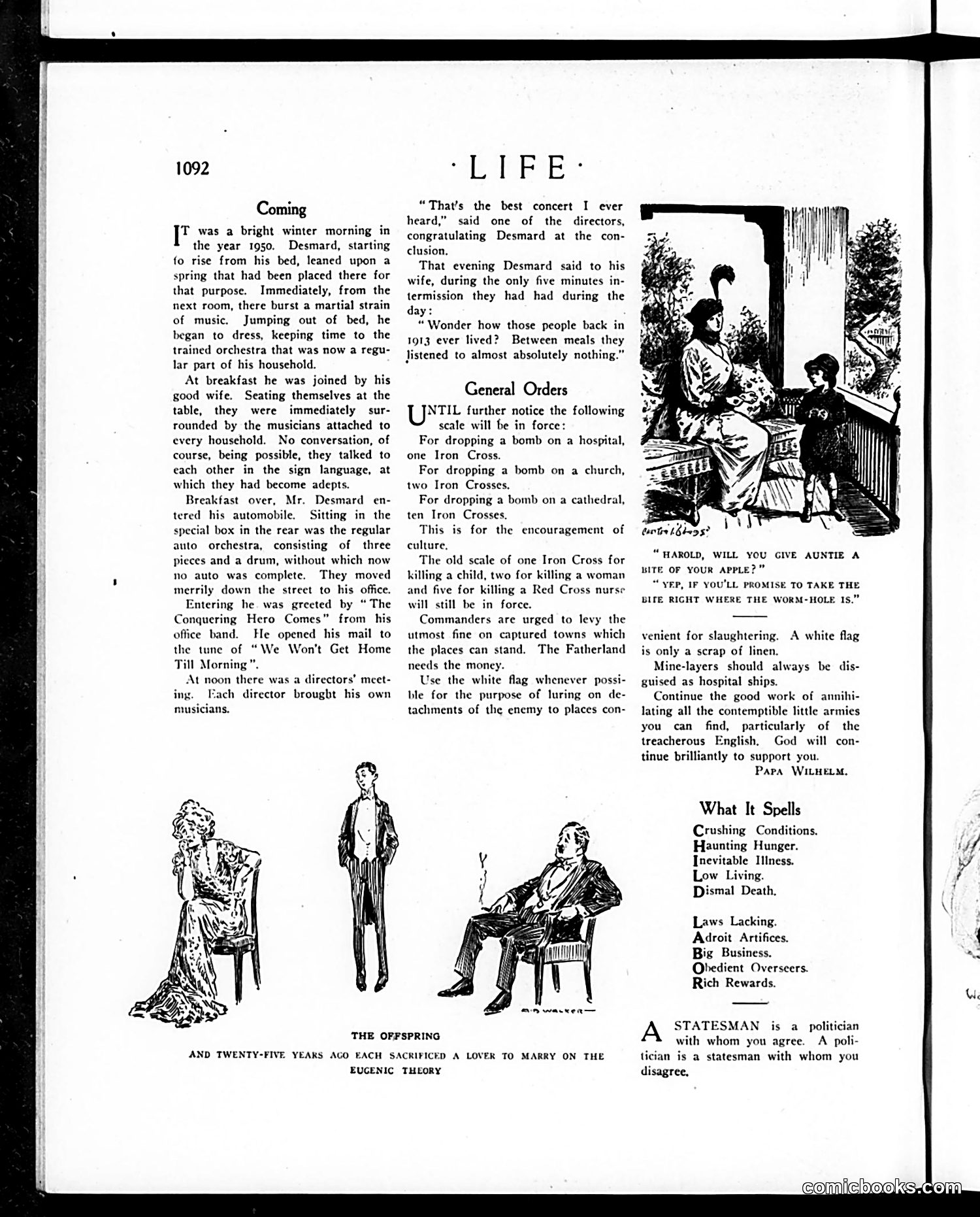
This 1913 Life magazine page contains multiple satirical pieces critiquing contemporary issues: **"Coming"** (top): A futuristic 1950 scenario mocking the era's obsession with music and constant entertainment. The joke is that households employ full orchestras for every activity—breakfast, commuting, office work—making normal life impossible. The final quip reveals the satire's target: people in 1913 "listened to almost absolutely nothing" between meals, suggesting modern life is becoming unbearably over-stimulated. **"General Orders"**: Dark satire mocking German militarism and the church-bombing campaigns of World War I. It presents a brutal "scale" rewarding destruction of hospitals, churches, and cathedrals with Iron Crosses—inverting military honor. The sarcastic "encouragement of culture" highlights the hypocrisy of destroying cultural institutions while claiming civilization. **"The Offspring"**: A eugenic theory cartoon showing two women whose past lovers were "sacrificed" for eugenic marriage purposes. The child's worm-hole apple joke suggests the genetic experiment produced questionable results—dark commentary on eugenics pseudoscience.
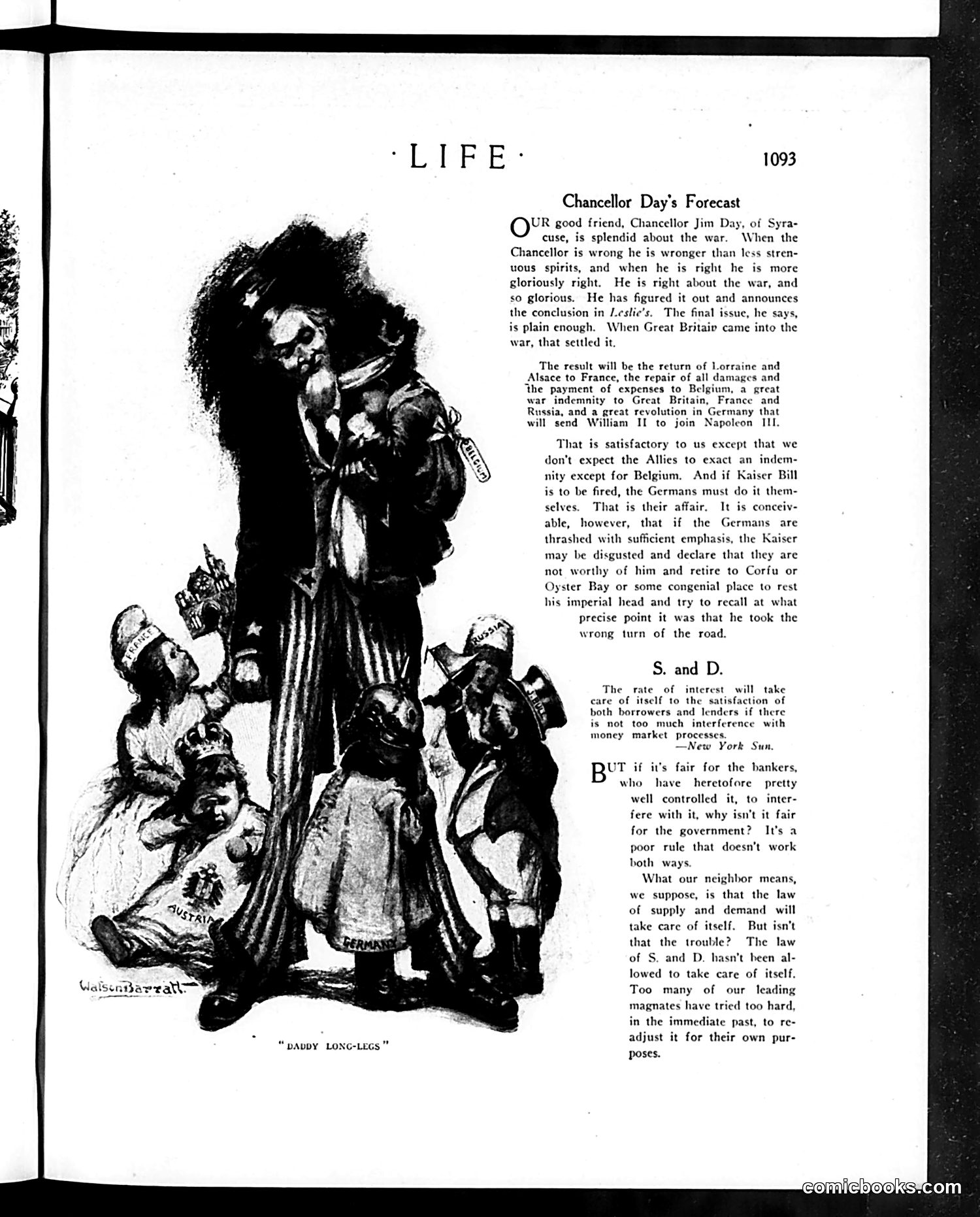
The cartoon depicts **Britannia** (tall female figure representing Great Britain) supporting smaller figures labeled **Austria**, **Germany**, and others—likely Allied nations or those affected by WWI. The title "Daddy Long-Legs" sarcastically compares Britain's protective role to a benevolent father figure. The accompanying text critiques **Chancellor Jim Day of Syracuse**, who predicted in *Leslie's* magazine that Britain's entry into WWI would decisively end the conflict, with results including German reparations, territorial restoration to France, and Kaiser Wilhelm II's abdication or exile. The article's tone is skeptical—accepting Day's war predictions while doubting his specific optimistic outcomes (particularly regarding reparations and the Kaiser's removal). A secondary piece mocks the *New York Sun's* claim that free-market "supply and demand" should govern war-loan interest rates without government interference, arguing this logic should apply equally to banking or any sector. The satire targets both overconfident war predictions and the hypocrisy of wealthy financiers claiming to oppose government regulation while having historically manipulated markets themselves.
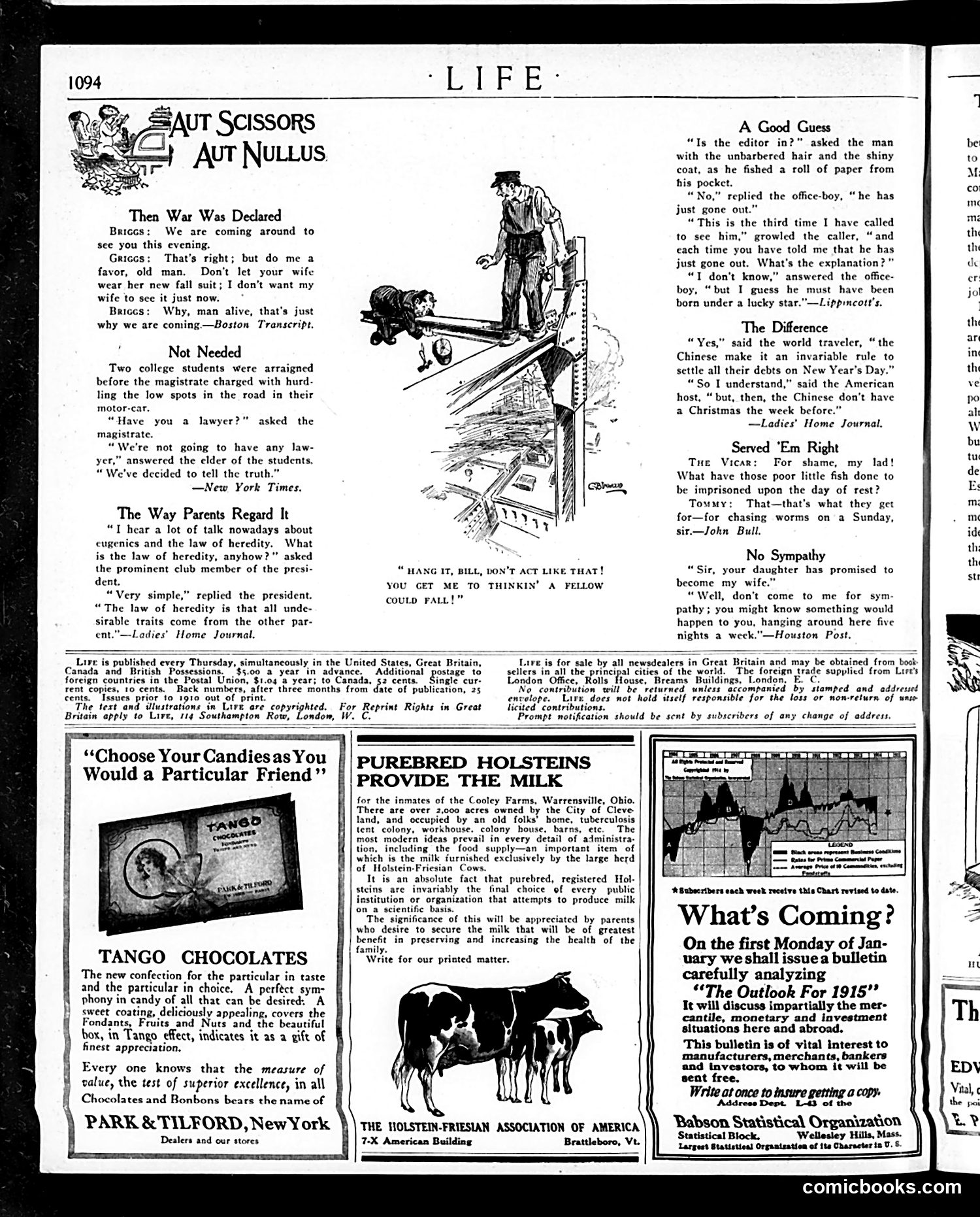
This page contains six brief humorous anecdotes typical of *Life* magazine's satirical style: **"Then War Was Declared"** mocks social vanity—a man warns his friend not to wear his wife's new outfit to avoid comparison with his own wife's wardrobe. **"Not Needed"** jokes about youthful arrogance: college students in legal trouble dismiss needing a lawyer because they'll "tell the truth," implying truth-telling is irrelevant in legal proceedings. **"The Way Parents Regard It"** satirizes parental psychology—the heredity "law" that any undesirable trait in children comes from "the other parent," not one's own side. The main cartoon shows a man on a ladder cautioning "Bill" against acting carelessly, lest he fall—a visual gag about workplace safety or foolish behavior. Additional jokes mock dating rejection, Chinese New Year traditions versus American Christmas excess, and a vicar's complaint about fishing on Sunday. The page emphasizes *Life*'s focus on domestic comedy and social observation rather than political satire. The accompanying advertisements (Tango Chocolates, Holstein cattle) are period commercial matter.
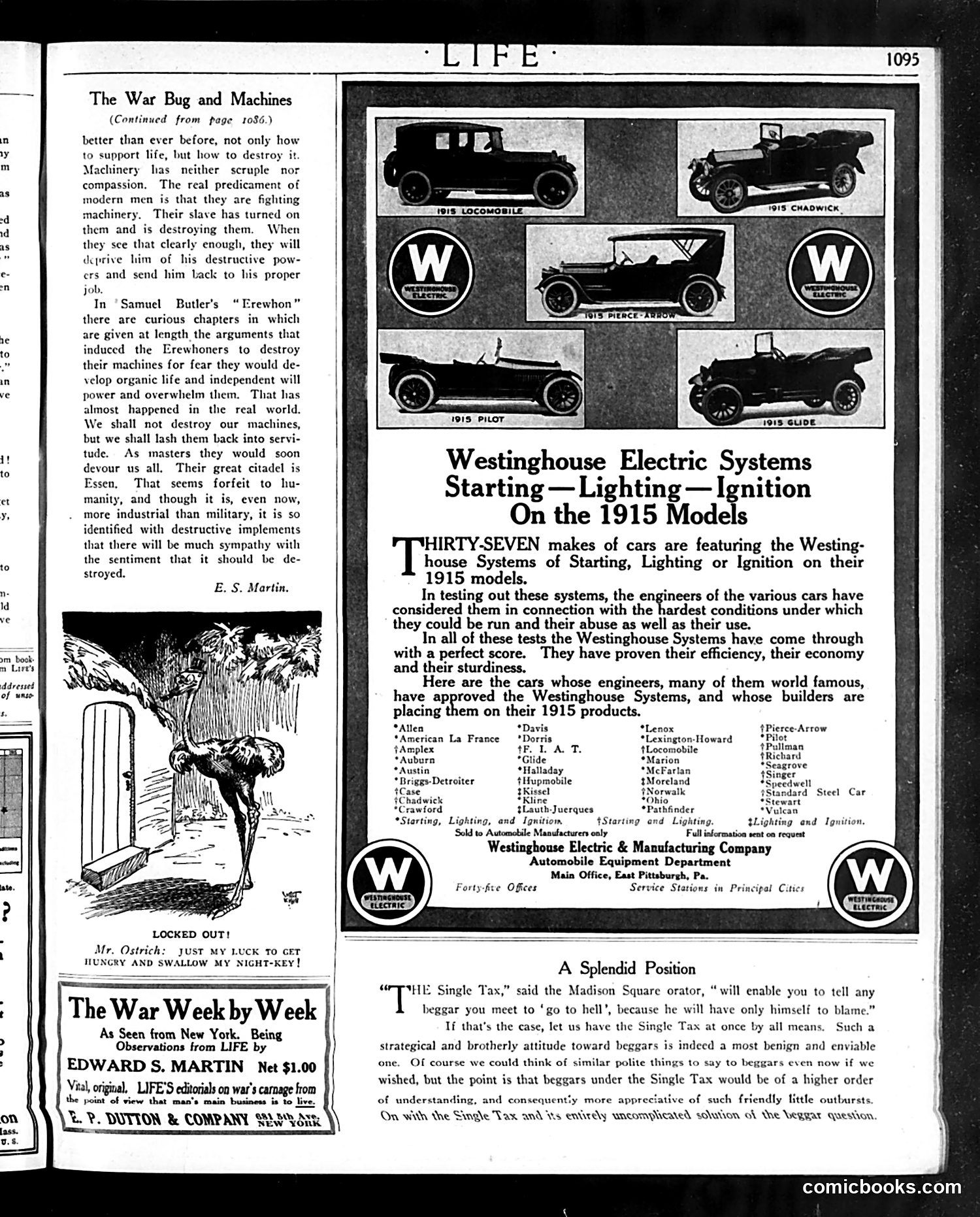
**Main Content:** The page is primarily an **advertisement for Westinghouse Electric Systems** (automotive electrical components), featuring images of 1915 car models and listing 37 automobile manufacturers using their products. **Left Column - Editorial Content:** E.S. Martin's essay "The War Bug and Machines" argues that modern warfare has made machines themselves dangerous—they've become "masters" rather than servants. He references Samuel Butler's *Erewhon*, a satirical novel where a fictional society destroyed machines fearing they'd develop independent will. Martin warns that Germany's industrial center at Essen has become so identified with destructive warfare that destroying it would have public sympathy. The piece reflects **WWI-era anxieties about industrialization and mechanized warfare**. **Cartoon:** A small illustration shows an ostrich locked out, having swallowed its night-key—a visual pun on the phrase "locked out," typical of Life's satirical humor. **Bottom Section:** A brief commentary on the "Single Tax" proposal—a reformist economic theory—sardonically suggesting it would justify telling poor people to "go to hell."
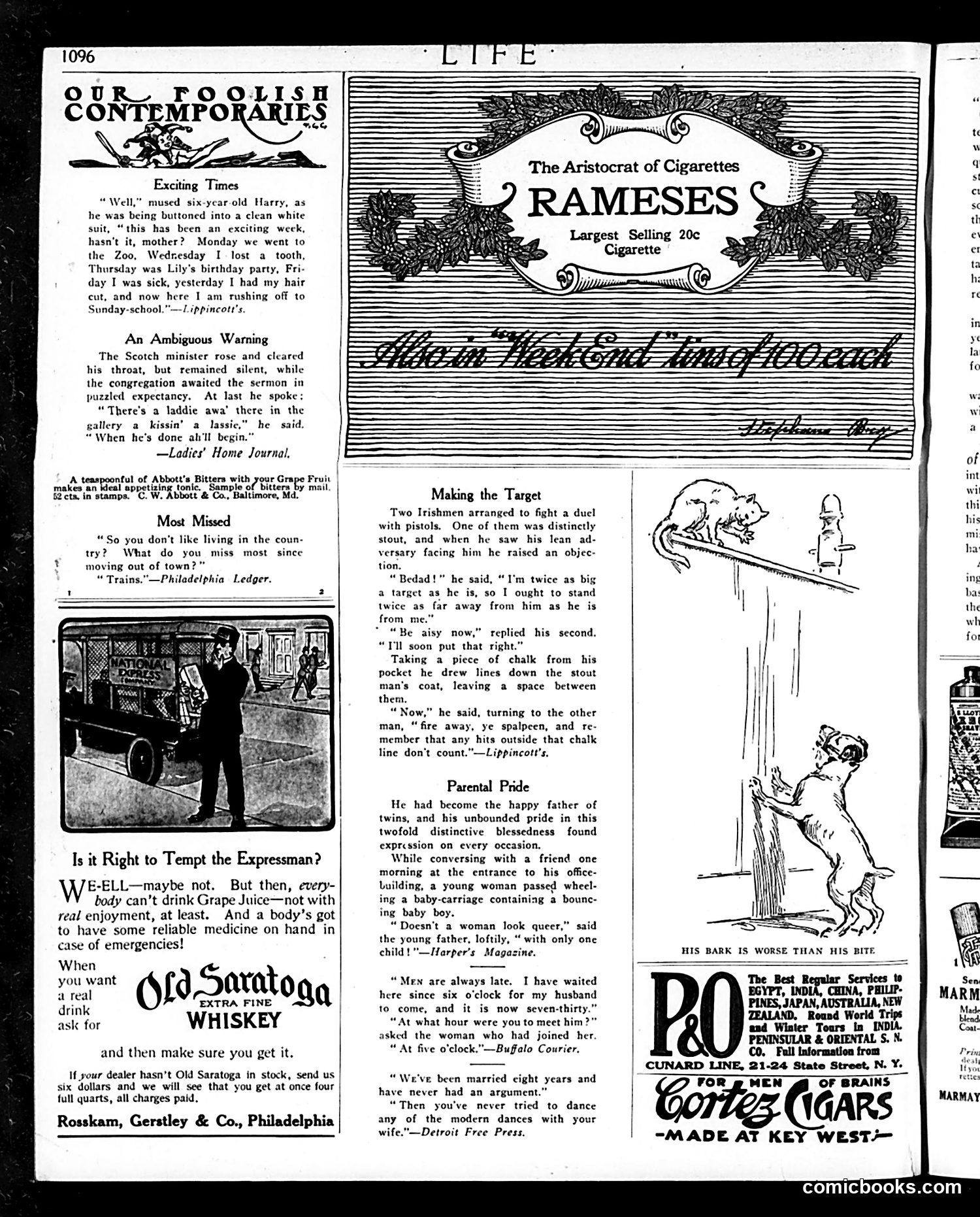
This page contains **humorous anecdotes and advertisements** rather than political cartoons. The content reflects early-20th-century American humor: **"Exciting Times"** satirizes how children find mundane activities (losing teeth, haircuts) as thrilling as major events. **"An Ambiguous Warning"** plays on a Scottish minister's awkward announcement—he's alerting the congregation to improper behavior in the gallery but leaves his sentence unfinished, creating comic ambiguity. **"Most Missed"** jokes that a man moving from city to country misses trains most—a commentary on rural isolation versus urban convenience. **"Making the Target"** presents Irish stereotypes in a duel anecdote where the second uses chalk to "level" the playing field for a heavier opponent—absurdist humor. **"Parental Pride"** mocks a new father's smugness about having twins while dismissing mothers with single children. The page is primarily **advertising-driven**, featuring liquor (Old Saratoga Whiskey), cigarettes (Rameses), and shipping lines—typical of Life's commercial model. The humor reflects period attitudes toward gender, ethnicity, and social class.
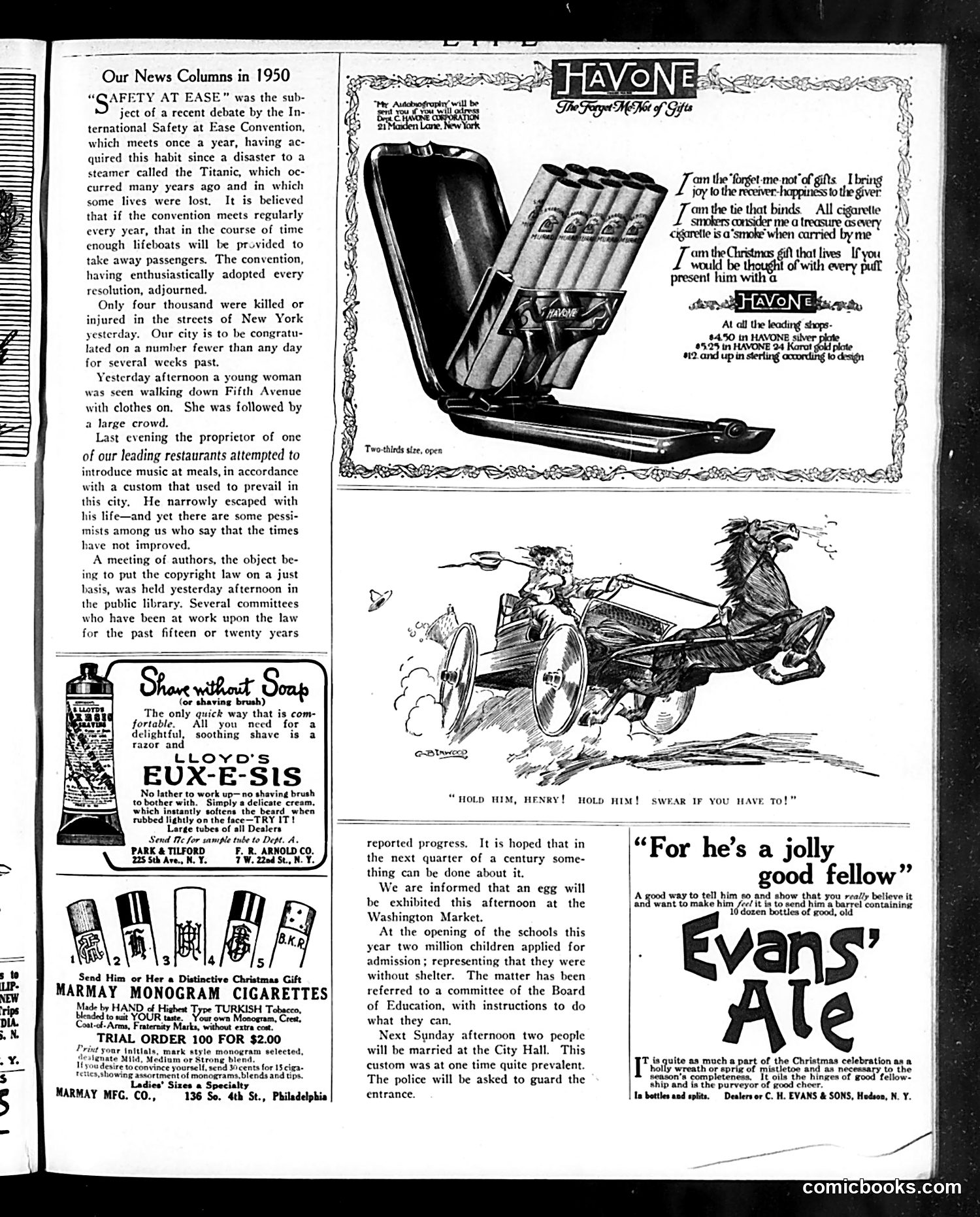
This page combines news satire with period advertisements. The left column mocks contemporary anxieties through absurdist commentary—treating the Titanic disaster as a reason for endless safety conferences, noting "only four thousand" injured in NYC streets as progress, and sardonically reporting a woman wearing clothes on Fifth Avenue as newsworthy. The cartoon below depicts a man (labeled "Henry") struggling to control a rearing horse, captioned "HOLD HIM, HENRY! HOLD HIM! SWEAR IF YOU HAVE TO!"—likely satirizing public hysteria or loss of control over social circumstances, though the specific reference remains unclear. The page is primarily advertising: cigarette brands, shaving cream, and Evans' Ale emphasize consumer products as solutions or gifts for the modern American man. The ads reflect 1950 consumer culture, while the satire undercuts optimism about urban "progress" and safety improvements.
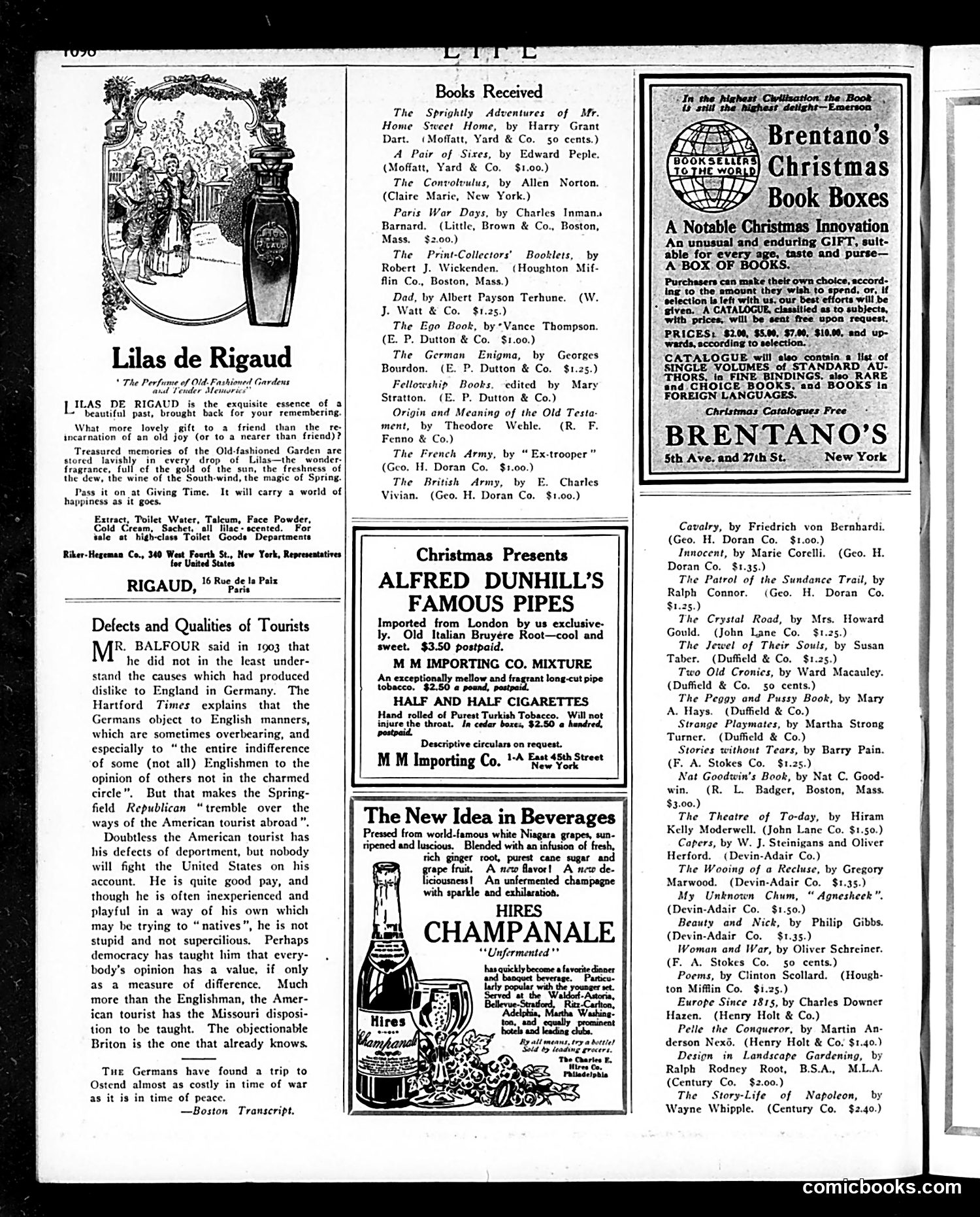
This page is primarily **advertising and book reviews**, not political satire. The main content includes: **Left side:** An advertisement for Lilas de Rigaud perfume, emphasizing nostalgic "old-fashioned garden" appeals typical of early 1900s luxury marketing. **Center/Right:** A section titled "Defects and Qualities of Tourists" discussing Anglo-German cultural friction (circa 1903). The text defends American tourists against criticism, noting they may be "inexperienced and playful" but not "stupid and supercilious"—a mild commentary on American travelers' reputation abroad. **Remainder:** Standard book listings, holiday gift advertisements (Brentano's Christmas book boxes, Dunhill pipes, champagne), and product announcements. **No significant political cartoons appear** on this page. The content reflects pre-WWI attitudes toward international relations and consumer culture, with advertisements dominating the layout. The "tourist" discussion offers gentle commentary on national stereotypes rather than sharp satire.
This is primarily a **book advertisement** rather than political satire. John Ames Mitchell, editor of *Life* magazine, published a novel titled "Pandora's Box" about two lovers. The ad promotes it as a pleasurable read, priced at fifty cents, available through bookstores or direct from publisher Grosset & Dunlap. The only visual element is an illustration of the book's cover, showing the mythological Pandora's Box. The advertisement uses self-referential humor typical of *Life*'s style—the magazine's own editor is pitching his romantic novel to readers, with the implication that his intimate knowledge of the characters makes the book worthwhile. There's no obvious political commentary; this appears to be commercial promotion disguised as editorial content, common practice in early 20th-century publications.
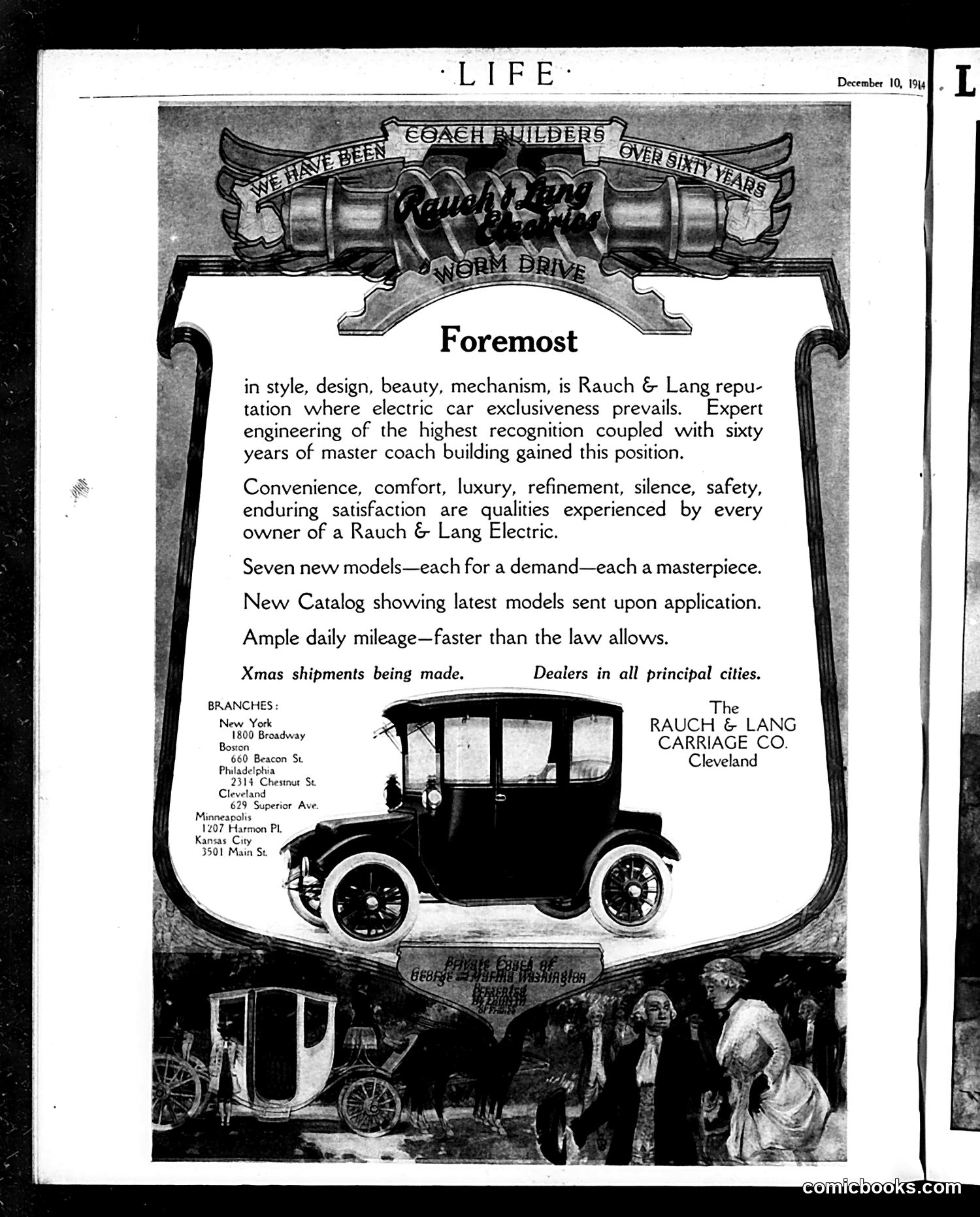
This is a **full-page advertisement**, not a political cartoon. It promotes the Rauch & Lang Electric Carriage Company, based in Cleveland. The ad emphasizes the exclusivity and luxury of electric automobiles—a technology that competed with gasoline cars in the early 1900s. Key selling points include silence, safety, comfort, and refinement. The phrase "faster than the law allows" is a humorous boast about performance. The bottom illustration shows an early electric vehicle on display at what appears to be a public exhibition or fair, with well-dressed spectators examining it. This reflects how electric cars were marketed as sophisticated, upscale products for affluent buyers—particularly appealing to women, since they required no hand-crank starting and were cleaner than gasoline vehicles. The extensive branch listings indicate Rauch & Lang's national reach during this period of automotive competition, before gasoline engines ultimately dominated the market.