
Life, 1914-12-10 · page 22 of 40
Life — December 10, 1914 — page 22: what you’re looking at
What you’re looking at
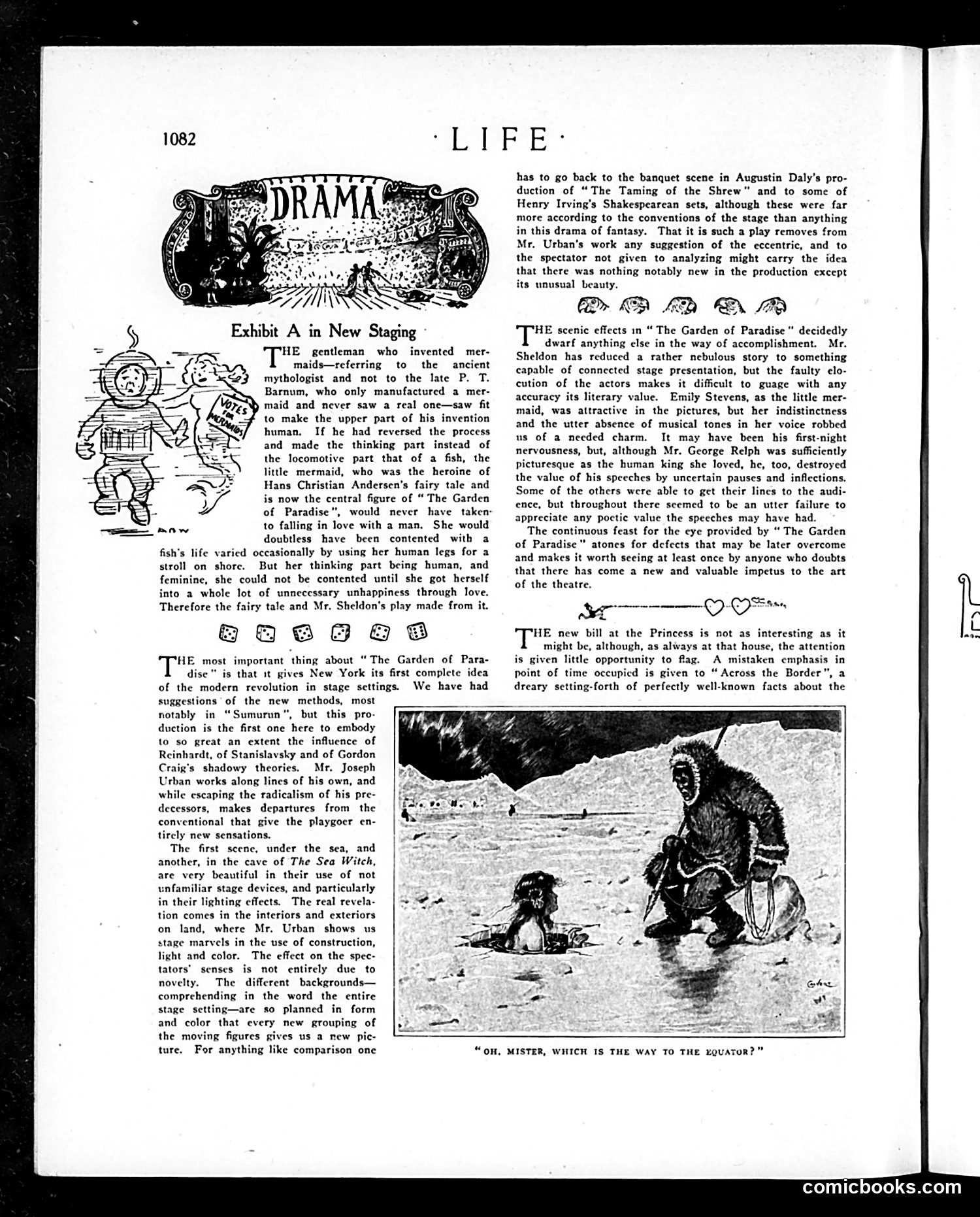
This page reviews "The Garden of Paradise," a theatrical production featuring innovative stage design by Joseph Urban. The small cartoon at top left illustrates the fairy tale's premise: a mermaid with human upper body and fish tail, whose human capacity for emotion (rather than animal instinct) drives the plot—she falls in love and suffers. The review praises Urban's revolutionary scenic design, comparing it favorably to earlier productions by Augustin Daly and Henry Irving. However, it sharply criticizes the actors' performances, particularly Emily Stevens (the mermaid) and George Relph, for poor diction and inability to deliver their lines effectively to the audience. The photograph shows what appears to be a desert or beach scene from the production. The caption—"Oh, Mister, Which Is the Way to the Equator?"—suggests comedic staging within the fantastical narrative.
📄 Transcribed text from this page (OCR, searchable)
Machine-transcribed from the original scan — historical spelling and the odd misread are preserved.
go eb) al oa Exhibit A in New Staging HE gentleman who invented mer- maids—referring to the ancient mythologist and not to the late P. T. Barnum, who only manufactured a mer- maid and never saw a real one—saw fit to make the upper part of his invention human. If he had reversed the process and made the thinking part instead of the locomotive part that of a fish, the little mermaid, who was the heroine of Hans Christian Andersen's fairy tale and is now the central figure of “ The Garden of Paradise", would never have taken- to falling in love with a man, She would doubtless have been contented with a fish's life varied occasionally by using her human legs for a stroll on shore. But her thinking part being human, and feminine, she could not be contented until she got herself into a whole lot of unnecessary unhappiness through love. Therefore the fairy tale and Mr. Sheldon's play made from it. 8H eaes HE most important thing about “The Garden of Para- dise" is that it gives New York its first complete idea of the modern revolution in stage settings. We have had suggestions of the new methods, most has to go back to the banquet scene in Augustin Daly’s pro- duction of “The Taming of the Shrew" and to some of Henry Irving’s Shakespearean sets, although these were far more according to the conventions of the stage than anything this drama of fantasy. That it is such a play removes from Mr. Urban’s work any suggestion of the eccentric, and to the spectator not given to analyzing might carry the idea that there was nothing notably new in the production except its unusual beauty. 'HE scenic effects in “ The Garden of Paradise" decidedly dwarf anything else in the way of accomplishment. Mr. Sheldon has reduced a rather nebulous story to something capable of connected stage presentation, but the faulty elo- cution of the actors makes it difficult to guage with any accuracy its literary value. Emily Stevens, as the little mer- maid, was attractive in the pictures, but her indistinctness and the utter absence of musical tones in her voice robbed us of a necded charm. It may have been his first-night nervousness, but, although Mr. George Relph was sufficiently picturesque as the human king she loved, he, too, destroyed the value of his speeches by uncertain pauses and inflections. Some of the others were able to get their lines to the audi- ence, but throughout there seemed to be an utter failure to appreciate any poctic value the speeches may have had. The continuous feast for the eye provided by “ The Garden of Paradise" atones for defects that may be later overcome and makes it worth seeing at least once by anyone who doubts that there has come a new and valuable impetus to the art of the theatre. A’ ana COS s+5 HE new bill at the Princess is not as interesting as it might be, although, as always at that house, the attention is given little opportunity to flag. A mistaken emphasis in point of time occupied is given to “Across the Border”, a dreary setting-forth of perfectly well-known facts about the notably in “Sumurun”, but this pro- duction is the first one here to embody to so great an extent the influence of Reinhardt, of Stanislavsky and of Gordon Craig's shadowy theories. Mr. Joseph Urban works along lines of his own, and while escaping the radicalism of his pre- decessors, makes departures from the conventional that give the playgoer en- tirely new sensations. The first scene, under the sea, and another, in the cave of The Sea Witch, are very beautiful in their use of not unfamiliar stage devices, and particularly in their lighting effects. The real revela- tion comes in the interiors and exteriors on land, where Mr. Urban shows us stage marvels in the use of construction, light and color. The effect on the spec- tators’ senses is not entirely due to novelty. The different backgrounds— comprehending in the word the entire stage setting—are so planned in form and color that every new grouping of the moving figures gives us a new pic- ture, For anything like comparison one “OH, MISTER, WHICH 18 THE WAY To THE ZQUATOR?” comicbooks.com by en