
Life, 1914-12-10 · page 13 of 40
Life — December 10, 1914 — page 13: what you’re looking at
What you’re looking at
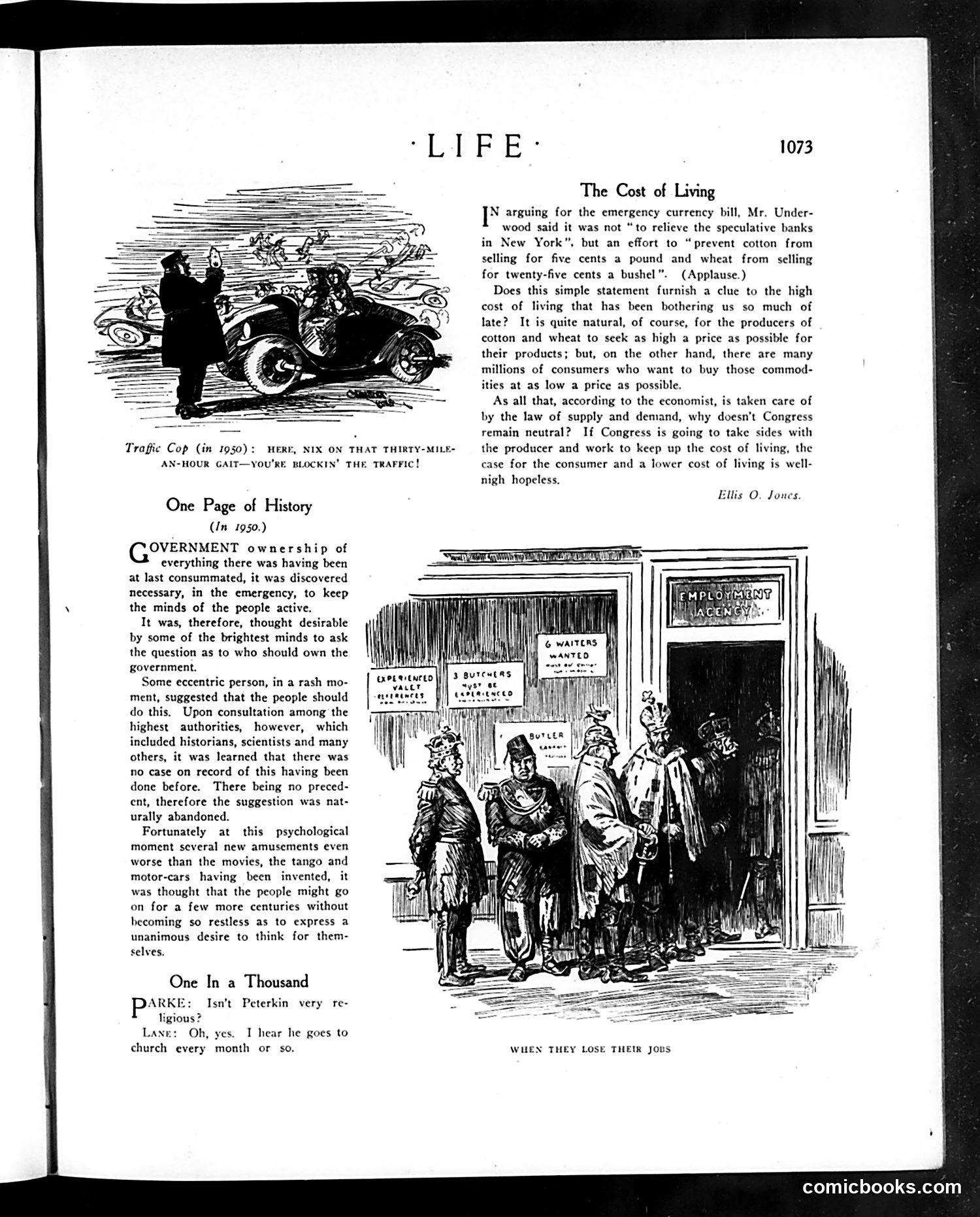
This page satirizes early 20th-century economic and political debates about the cost of living. The top cartoon, "Traffic Cop (in 1950)," humorously predicts future traffic congestion from automobiles—treating the then-new invention as a source of social chaos. The main article, "One Page of History," mocks government consideration of ownership solutions during an economic emergency, suggesting such ideas are unprecedented and impractical. The cartoon "When They Lose Their Jobs" depicts unemployed workers at an employment office, illustrating the human consequence of economic hardship. The dialogue snippet "One in a Thousand" jokes about religious devotion during hard times. Together, these pieces critique both government overreach and economic inequality affecting working people.
📄 Transcribed text from this page (OCR, searchable)
Machine-transcribed from the original scan — historical spelling and the odd misread are preserved.
“LIF E- Trafic Cop (in 1950): Were, NIX ON THAT THIRTY-MILE- AN-HOUR GAIT—YOU'RE BLOCKIN’ THE TRAFFIC! One Page of History (In 1950.) GOVERNMENT ownership of everything there was having been at last consummated, it was discovered necessary, in the emergency, to keep the minds of the people active. It was, therefore, thought desirable by some of the brightest minds to ask the question as to who should own the government. Some eccentric person, in a rash mo- ment, suggested that the people should do this. Upon consultation among the highest authorities, however, which included historians, scientists and many others, it was learned that there was no case on record of this having been done before. There being no preced- ent, therefore the suggestion was nat- urally abandoned. Fortunately at this psychological moment several new amusements even worse than the movies, the tango and motor-cars having been invented, it was thought that the people might go on for a few more centuries without becoming so restless as to express a unanimous desire to think for them- selves, One In a Thousand P RKE: Isn't Peterkin very re- ligious? Laxe: Oh, yes. I hear he goes to church every. month or so. 1073 The Cost of Living IX arguing for the emergency currency bill, Mr. Under- wood said it was not “to relieve the speculative banks in New York”, but an effort to “prevent cotton from selling for five cents a pound and wheat from selling for twenty-five cents a bushel”. (Applause.) Does this simple statement furnish a clue to the high cost of living that has been bothering us so much of late? It is quite natural, of course, for the producers of cotton and wheat to seek as high a price as possible for their products; but, on the other hand, there are many ilions of consumers who want to buy those commod- ities at as low a price as possible, As all that, according to the economist, is taken care of by the law of supply and demand, why doesn’t Congress remain neutral? If Congress is going to take sides with the producer and work to keep up the cost of living, the case for the consumer and a lower cost of living is well- nigh hopeless. Ellis O. Jones. WHEN THEY LOSE THEIR Jovs comicbooks.com