
Life, 1914-12-10 · page 23 of 40
Life — December 10, 1914 — page 23: what you’re looking at
What you’re looking at
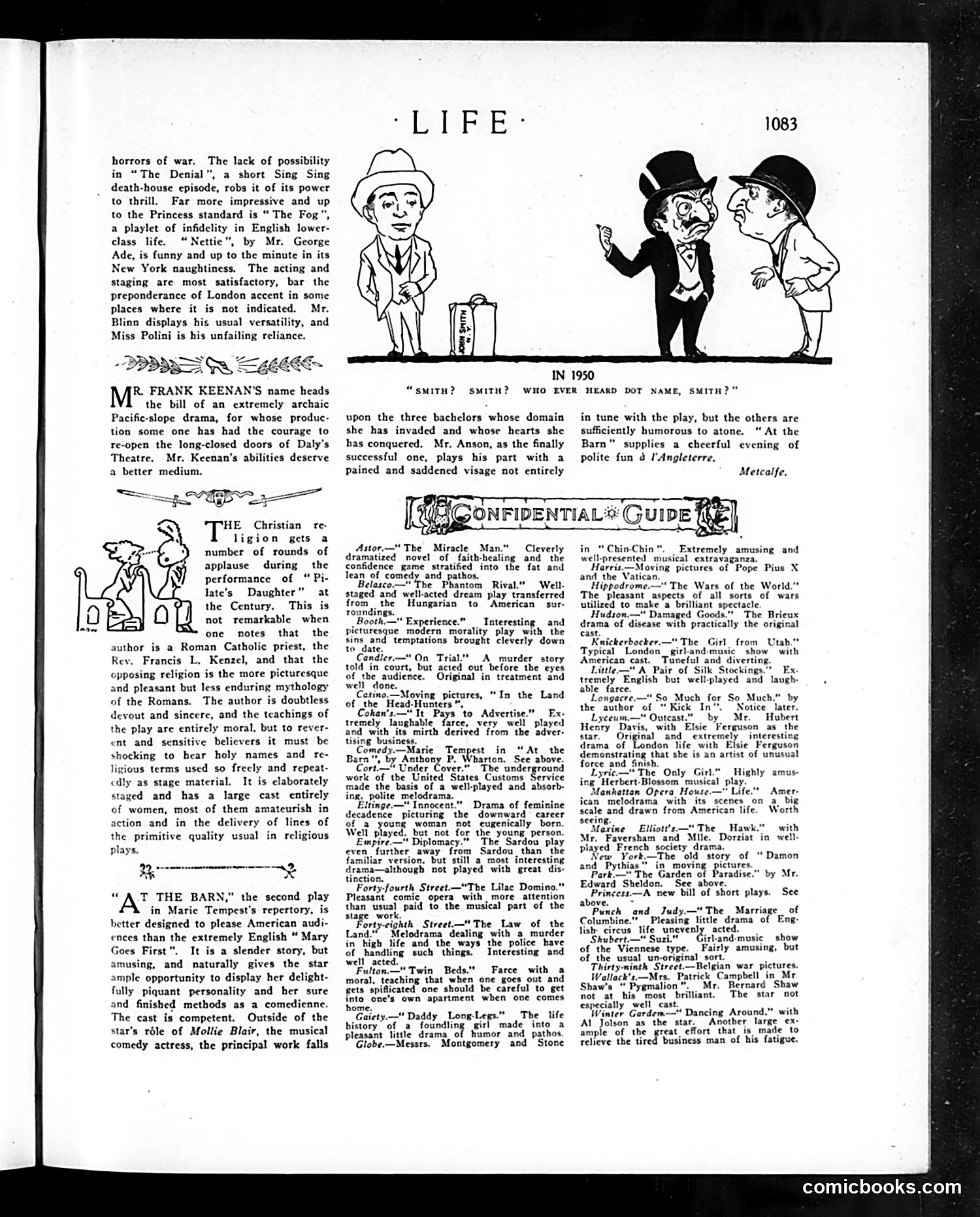
This page reviews theatrical productions on Broadway. The cartoon at top satirizes the commonness of the surname "Smith"—two men in bowler hats exclaim "Smith? Smith? Who ever heard dot name, Smith?" to a third man with a suitcase, mocking how unremarkable the name is. The reviews discuss various plays, including Marie Tempest's comedies ("At the Barn," "Mary Goes First") and dramas like "The Miracle Man" (faith-healing con game), "On Trial" (innovative courtroom drama), and religiously-themed plays. The text notes controversies around a priest-authored play featuring Roman Catholic imagery. The "Confidential Guide" section provides brief theater recommendations, evaluating acting quality, originality of plot, and appropriateness for audiences. The overall tone is theatrical criticism aimed at educated New York audiences seeking entertainment recommendations.
📄 Transcribed text from this page (OCR, searchable)
Machine-transcribed from the original scan — historical spelling and the odd misread are preserved.
horrors of war. The lack of possibility in “The Denial”, a short Sing Sing death-house episode, robs it of its power to thrill. Far more impressive and up to the Princess standard is “ The Fog”, a playlet of infidelity in English lower- class life. “Nettie”, by Mr. George Ade, is funny and up to the minute in its New York naughtiness, The acting and Staging are most satisfactory, bar the preponderance of London accent in some places where it is not indicated. Mr. Blinn displays his usual versatility, and Miss Polini is his unfailing reliance. R. FRANK KEENAN'’S name heads the bill of an extremely archaic Pacific-slope drama, for whose produc- tion some one has had the courage to re-open the long-closed doors of Daly's Theatre. Mr. Keenan's abilities deserve a better medium. ‘ian ligion gets a number of rounds of applause during the performance of “ Pi- late’s Daughter” at the Century, This is not remarkable when one notes that the hor is a Roman Catholic priest, the Rev. Francis L. Kenzel, and that the opposing religion is the more picturesque and pleasant but less enduring mythology of the Romans. The author is doubtless devout and sincere, and the teachings of the play are entirely moral, but to rever- ent and sensitive believers it must be shocking to hear holy names and re- ligious terms used so frecly and repeat- cdly as stage material. It is elaborately staged and has a large cast entirely of women, most of them amateurish in action and in the delivery of lines of the primitive quality usual in religious plays. ee, s T THE BARN,” the second play in Marie Tempest’s repertory, is better designed to please American audi- ences than the extremely English “ Mary Goes First”. It is a slender story, but amusing, and naturally gives the star ample opportunity to display her delight- fully piquant personality and her sure and finished methods as a comedienne. The cast is competent. Outside of the star's réle of Mollie Blair, the musical comedy actress, the principal work falls IN 1950 SMITH? upon the three bachelors whose domain she has invaded and whose hearts she has conquered. Mr. Anson, as the finally successful one, plays his part with a pained and saddened visage not entirely Astor.—" The Miracle Mai Cleverly dramatized novel of faith-healing and the confidence game stratified into the fat and Jean of comedy and pathos. Belasco.—" The Phantom Rival.” Well. staged and well-acted dream play transferred from the Hungarian to American sur- roundings. _Booth.—" Experience.” Interesting and picturesque modern morality play with the sins and temptations brought cleverly down 0 date. Candier.—“ On Trial.” A murder story told in court, but acted out before the eyes of the audience. Original in treatment and well done. Moving pictures, “In the Land |-Hunters ". Tt Pays ‘to Advertise.” Ex- tremely laughable farce, very well played and with its mirth derived from the adver- Using business. Comedy.—Marie | Tempest in “At, the Barn", by Anthony P. Wharton, See above. ‘Cort:-—" Under Cover.” The underground work of the United States Customs Service made the basis of a well-played and absorb- ing, polite melodrama. Eltinge.—" Innocent.” Drama of feminine decadence picturing the downward career of a young woman not eugenically born. Well played, but not for the young person. Empire-—" Diplomacy.” The Sardou play even further away from Sardou than the familiar version, but still a most interesting drama—although not played with great dis- tinction. Forty-fourth Street.—“The Lilac Domino.” Pleasant comic opera with more attention than usual paid to the musical part of the stage work. eighth Street—“The Law of the Melodrama dealing with a murder in high life and the ways the police have of handling such things. Interesting and well acted. . Fulton.—" Twin Beds." Farce with a moral, teaching that when one goes out and gets spiflicated one should be careful to get into one's own apartment when one comes home. 2 Gaiety.—" Daddy Long-Legs.” The life history of a foundling girl made into a pleasant little drama of humor and pathos Globe.—Messrs. Montgomery and Stone WHO EVER HEARD DOT NAME, SMITH?” in tune with the play, but the others are sufficiently humorous to atone. “ At the Barn” supplies a cheerful evening of polite fun d J’Angleterre, Metcalfe. ONFIDENTIAL* GUIDE in “Chin-Chin”. Extremely amusing and well-presented musical extravaganza. Harris.—Moving pictures of Pope Pius X and the Va Hippodrome." The Wars of the World."* The pleasant aspects of all sorts of wars utilized to make a brilliant spectacle. Hudson.—" Damaged Goods.” The Brieux drama of disease with practically the original be Girl from Utab."* London girl-and-music show with American cast. Tuneful and diverting. Little —" A Pair of Silk Stockings.” Ex: tremely English but well-played and laugh- able farce. Longacre, So} by the author of Notice later. Lyceum.—" Outeast. y Mr. Hubert Henry Davis, with Elsie Ferguson as the star. Original and extremely interesting drama of London life with Elsie Ferguson demonstrating that she is an artist of unusual force and finish. Lyric.—" The Only Girl.” Highly amus- ing “Herbert-Blossom musical play. ‘Manhottan Opera House.—" Life.” Amer- ican melodrama with its scenes on a, big scale and drawn from American life. Worth seeing. Marine Elltiott’s—" The Hawk.” with Mr. Faversham and Mile. Dorziat in well- played French society drama. New York.—The old story of “Damon and Pythias” in moving pictures Park.— The Garden of Paradise.” by Mr. Edward Sheldon. See above. Princess.—A new bill of short plays. bove. = ay panch and Judy.—" The Marriage of Pleasing little drama of Eng- See Columbine.” lish; circus tife unevenly, acted. Shubdert—" Suzi.” — Girl-and-music show of the Viennese type. Fairly amusing, but of the usual un-original sort. : Thirty-ninth Street.—Belgian war pictures. Wellack's.—Mrs. Patrick Campbell in Mr Shaw's “ Pygmalion”. Mr. Bernard Shaw not at his most brilliant. The star ‘especially well. cast. ss Winter Gardem—* Dancing Around,” with Al Jolson as the star. Another large ex- ample of the great effort that is made to relieve the tired business man of his fatigue. not comicbooks.com