
Life, 1914-12-10 · page 33 of 40
Life — December 10, 1914 — page 33: what you’re looking at
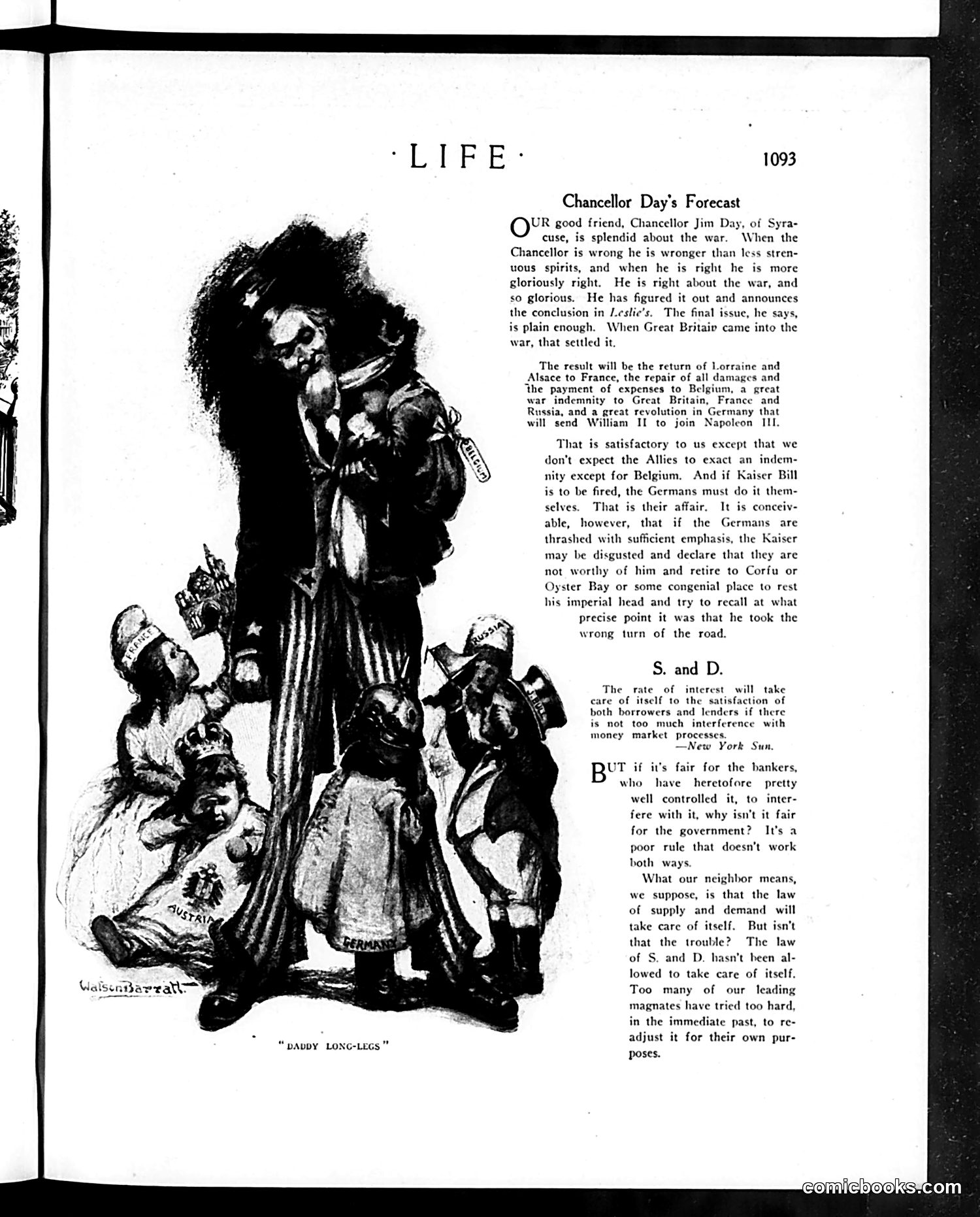
What you’re looking at
The cartoon depicts **Britannia** (tall female figure representing Great Britain) supporting smaller figures labeled **Austria**, **Germany**, and others—likely Allied nations or those affected by WWI. The title "Daddy Long-Legs" sarcastically compares Britain's protective role to a benevolent father figure. The accompanying text critiques **Chancellor Jim Day of Syracuse**, who predicted in *Leslie's* magazine that Britain's entry into WWI would decisively end the conflict, with results including German reparations, territorial restoration to France, and Kaiser Wilhelm II's abdication or exile. The article's tone is skeptical—accepting Day's war predictions while doubting his specific optimistic outcomes (particularly regarding reparations and the Kaiser's removal). A secondary piece mocks the *New York Sun's* claim that free-market "supply and demand" should govern war-loan interest rates without government interference, arguing this logic should apply equally to banking or any sector. The satire targets both overconfident war predictions and the hypocrisy of wealthy financiers claiming to oppose government regulation while having historically manipulated markets themselves.
📄 Transcribed text from this page (OCR, searchable)
Machine-transcribed from the original scan — historical spelling and the odd misread are preserved.
“DADDY LONG-LEGS” ‘LIF E* 1093 Chancellor Day's Forecast O R good friend, Chancellor Jim Day, of Syra- cuse, is splendid about the war. When the Chancellor is wrong he is wronger than less stren- uous spirits, and when he is right he is more gloriously right. He is right about the war, and so glorious. He has figured it out and announces the conclusion in Leslie’s. The final issue, he says, is plain enough. When Great Britaiv came into the war, that settled it, The result will be the return of Lorraine and Alsace to France, the repair of all damages and the payment of expenses to Belgium, a great war indemnity to Great Britain, France and Russia, and a great revolution in Germany that will send William II to join Napoleon III. That is satisfactory to us except that we don't expect the Allies to exact an indem- nity except for Belgium. And if Kaiser Bill is to be fired, the Germans must do it them- selves. That is their affair, It is conce able, however, that if the Germans are thrashed with sufficient emphasis, the Kaiser may be disgusted and declare that they are not worthy of him and retire to Corfu or Oyster Bay or some congenial place to rest his imperial head and try to recall at what precise point it was that he took the wrong turn of the road. S. and D. The rate of interest will take care of itself to the satisfaction of both borrowers and lenders if there is not too much interference with money market processes. —New York Sun. UT if it’s fair for the bankers, who © heretofore pretty well controlled it, to inter- fere with it, why isn’t it fair for the government? It’s a poor rule that doesn’t work both ways. What our neighbor means, we suppose, is that the law of supply and demand will take care of itself. But isn't that the trouble? The law of S. and D. hasn't been al- lowed to take care of itself. Too many of our leading magnates have tried too hard, in the immediate past, to re- adjust it for their own pur- poses.