
Life, 1914-12-10 · page 26 of 40
Life — December 10, 1914 — page 26: what you’re looking at
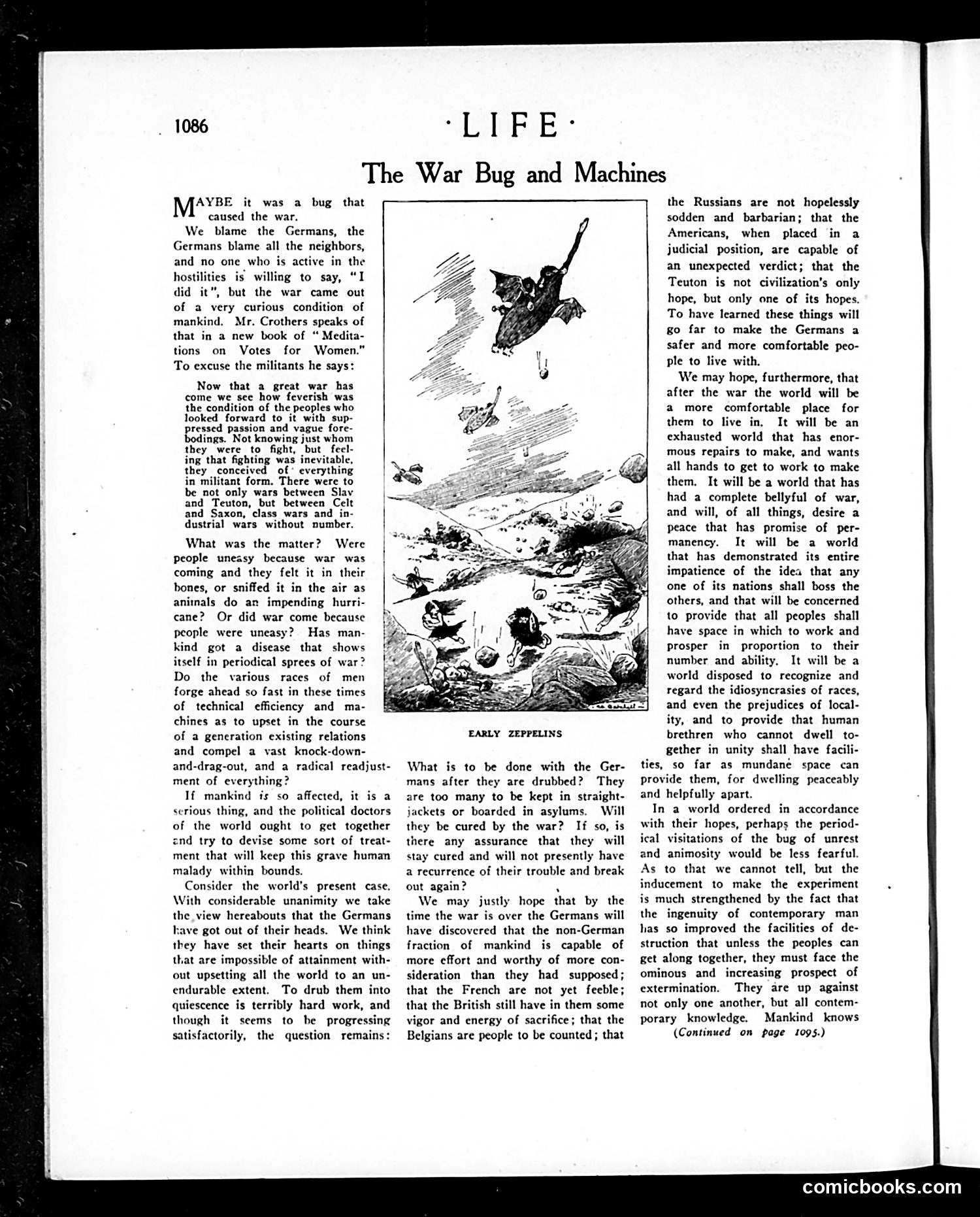
What you’re looking at
This article uses the metaphor of disease to explain World War I's origins. The author (Samuel McChord Crothers, referenced in the text) proposes that rapid industrialization and social upheaval have created psychological "fever" among nations, making war seem inevitable. The illustration labeled "Early Zeppelins" depicts German airships—contemporary weapons of terror that symbolize technological warfare's unprecedented destructiveness. This visual reinforces the article's argument that modern machines have transformed conflict into something more devastating and impersonal than previous wars. The text positions Germany as a nation mentally "out of its heads" requiring treatment, while arguing that post-war peace demands all nations recognize each other's worth equally—rejecting German supremacy ideology. The article reflects American perspective during WWI, mixing hope that military defeat might "cure" German aggression with anxiety about maintaining lasting peace through mutual respect rather than domination.
📄 Transcribed text from this page (OCR, searchable)
Machine-transcribed from the original scan — historical spelling and the odd misread are preserved.
| bed eo The War Bug and Machines AYBE it was a bug that caused the war, We blame the Germans, the Germans blame all the neighbors, and no one who is active in the hostilities is willing to say, “I did it”, but the war came out of a very curious condition of mankind, Mr. Crothers speaks of that in a new book of “ Medita- tions on Votes for Women.” To excuse the militants he says: Now that a great war has come we see how feverish was the condition of the peoples who looked forward to it with sup- pressed passion and vague fore- bodings. Not knowing just whom they were to fight, but feel- ing that fighting was inevitable, they conceived of: everything in militant form. There were to be not only wars between Slav and Teuton, but between Celt and Saxon, class wars and in- dustrial wars without number. What was the matter? Were people uneasy because war was coming and they felt it in their bones, or sniffed it in the air as animals do an impending hurri- cane? Or did war come because people were uneasy? Has man- kind got a disease that shows itself in periodical sprees of war? Do the various races of men forge ahead so fast in these times of technical efficiency and ma- chines as to upset in the course of a generation existing relations and compel a vast knock-down- and-drag-out, and a radical readjust- ment of everything? If mankind is so affected, it is a serious thing, and the political doctors of the world ought to get together znd try to devise some sort of treat- ment that will keep this grave human malady within bounds. Consider the world’s present case. With considerable unanimity we take the view hereabouts that the Germans have got out of their heads. We think they have set their hearts on things that are impossible of attainment with- out upsetting all the world to an un- endurable extent. To drub them into quiescence is terribly hard work, and though it seems to be progressing satisfactorily, the question remains: EARLY ZEPPELINS What is to be done with the Ger- mans after they are drubbed? They are too many to be kept in straight- jackets or boarded in asylums. Will they be cured by the war? If so, is there any assurance that they will stay cured and will not presently have a recurrence of their trouble and break out again? a We may justly hope that by the time the war is over the Germans will have discovered that the non-German fraction of mankind is capable of more effort and worthy of more con- sideration than they had supposed; that the French are not yet feeble; that the British still have in them some vigor and energy of sacrifice; that the Belgians are people to be counted; that the Russians are not hopelessly sodden and barbarian; that the Americans, when placed in a judicial position, are capable of an unexpected verdict; that the Teuton is not civilization’s only hope, but only one of its hopes. To have learned these things will go far to make the Germans a safer and more comfortable peo- ple to live with. We may hope, furthermore, that after the war the world will be a more comfortable place for them to live in. It will be an exhausted world that has enor- mous repairs to make, and wants all hands to get to work to make them, It will be a world that has had a complete bellyful of war, and will, of all things, desire a peace that has promise of per- manency. It will be a world that has demonstrated its entire impatience of the idea that any one of its nations shall boss the others, and that will be concerned to provide that all peoples shall have space in which to work and prosper in proportion to their number and ability, It will be a world disposed to recognize and regard the idiosyncrasies of races, and even the prejudices of local- ity, and to provide that human brethren who cannot dwell to- gether in unity shall have facili- ties, so far as mundane space can provide them, for dwelling peaceably and helpfully apart. In a world ordered in accordance with their hopes, perhaps the period- ical visitations of the bug of unrest and animosity would be less fearful. As to that we cannot tell, but the inducement to make the experiment is much strengthened by the fact that the ingenuity of contemporary man has so improved the facilities of de- struction that unless the peoples can get along together, they must face the ominous and increasing prospect of extermination. They are up against not only one another, but all contem- porary knowledge. Mankind knows (Continued on page 1095.) comicbooks.com