
Life, 1914-12-10 · page 19 of 40
Life — December 10, 1914 — page 19: what you’re looking at
What you’re looking at
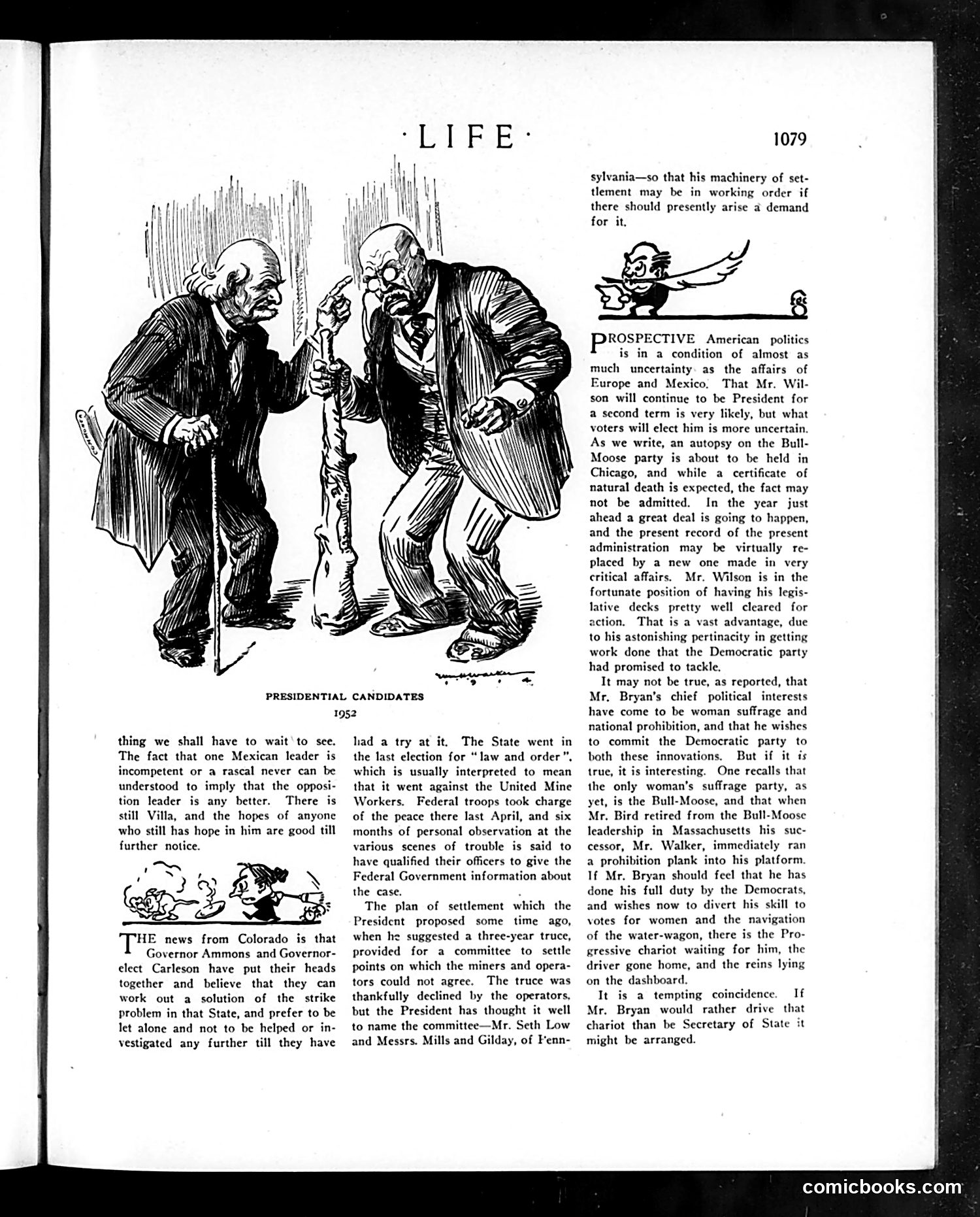
The main cartoon labeled "Presidential Candidates 1952" depicts two elderly, grotesque figures in suits examining or arguing over what appears to be a skeletal or decrepit object—likely representing the competing interests of political factions or the deteriorated state of candidates themselves. The accompanying text discusses American politics with uncertainty comparable to Europe and Mexico. It focuses on President Wilson's likely reelection, the impending "autopsy" of Theodore Roosevelt's Bull-Moose Party (a third party that split Republican votes in 1912), and speculation about William Jennings Bryan's political future. The satire suggests that established political figures are aging relics, and that Bryan might be better suited abandoning Democratic politics for progressive causes like women's suffrage and prohibition—presented humorously as leaving the Democratic "chariot" with "reins lying on the dashboard." The cartoon mocks the candidates as worn-out, self-interested figures squabbling over political machinery rather than genuine leadership.
📄 Transcribed text from this page (OCR, searchable)
Machine-transcribed from the original scan — historical spelling and the odd misread are preserved.
PRESIDENTIAL CANDIDATES 1952 thing we shall have to wait'to see. The fact that one Mexican leader is incompetent or a rascal never can be understood to imply that the opposi- tion leader is any better. There is still Villa, and the hopes of anyone who still has hope in him are good till further notice. i 'HE news from Colorado is that Governor Ammons and Governor- elect Carleson have put their heads together and believe that they can work out a solution of the strike problem in that State, and prefer to be let alone and not to be helped or in- vestigated any further till they have lad a try at it. The State went in the last election for “law and order”, which is usually interpreted to mean that it went against the United Mine Workers. Federal troops took charge of the peace there last April, and six months of personal observation at the various scenes of trouble is said to have qualified their officers to give the Federal Government information about the case. ‘ The plan of settlement which the President proposed some time ago, when he suggested a three-year truce, provided for a committee to settle points on which the miners and opera- tors could not agree. The truce was thankfully declined by the operators, but the President has thought it well to name the committee—Mr. Seth Low and Messrs. Mills and Gilday, of Fenn- 1079 sylvania—so that his machinery of set- tlement may be in working order if there should presently arise a demand for it, PROSPECTIVE American politics is in a condition of almost as much uncertainty. as the affairs of Europe and Mexico, That Mr. Wil- son will continue to be President for a second term is very likely, but what voters will elect him is more uncertain. As we write, an autopsy on the Bull- Moose party is about to be held in Chicago, and while a certificate of natural death is expected, the fact may not be admitted. In the year just ahead a great deal is going to happen, and the present record of the present administration may be virtually re- placed by a new one made in very critical affairs. Mr. Wilson is in the fortunate position of having his legis- lative decks pretty well cleared for action, That is a vast advantage, due to his astonishing pertinacity in getting work done that the Democratic party had promised to tackle, It may not be true, as reported, that Mr. Bryan's chief political interests have come to be woman suffrage and national prohibition, and that he wishes to commit the Democratic party to both these innovations. But if it is true, it is interesting. One recalls that the only woman's suffrage party, as yet, is the Bull-Moose, and that when Mr. Bird retired from the Bull-Moose leadership in Massachusetts his suc- cessor, Mr. Walker, immediately ran a prohibition plank into his platform. If Mr. Bryan should feel that he has done his full duty by the Democrats, and wishes now to divert his skill to votes for women and the navigation of the water-wagon, there is the Pro- gressive chariot waiting for him, the driver gone home, and the reins lying on the dashboard. It is a tempting coincidence. If Mr. Bryan would rather drive that chariot than be Secretary of State it might be arranged. comicbooks.com