
Life, 1914-12-10 · page 24 of 40
Life — December 10, 1914 — page 24: what you’re looking at
What you’re looking at
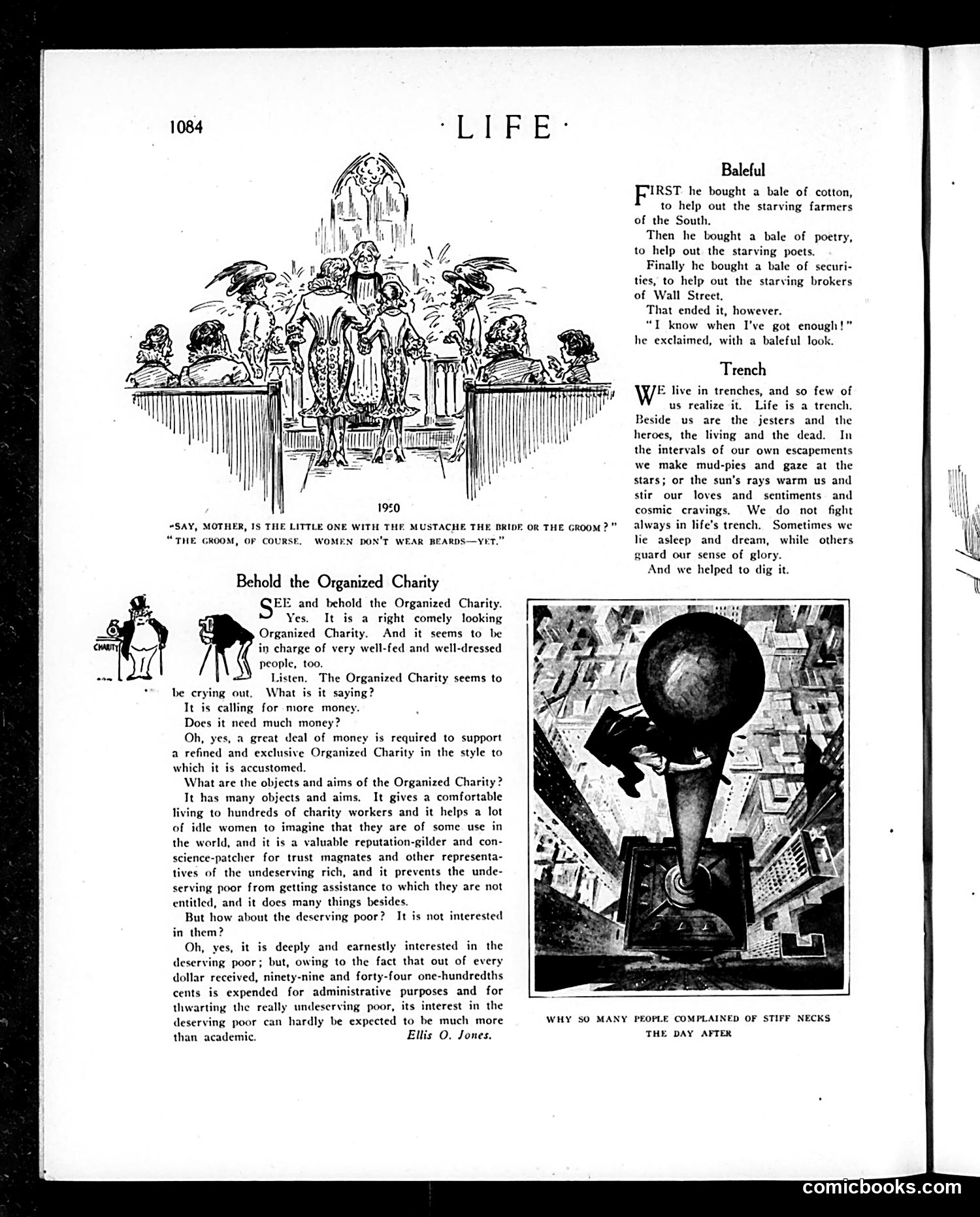
This page contains three distinct satirical pieces critiquing American social and economic issues: **"Baleful"** mocks wealthy philanthropists who spread charitable giving across cotton farmers, poets, and Wall Street brokers—appearing virtuous while ultimately helping themselves. The phrase "I know when I've got enough!" suggests self-serving limits to generosity. **"Trench"** uses WWI imagery (referencing the ongoing or recent Great War) metaphorically—life itself is a trench where people distract themselves with trivialities while experiencing cosmic yearning. "And we helped to dig it" implies complicity in modern suffering. **"Behold the Organized Charity"** is a scathing critique of institutional charity organizations, alleging that 99.44% of donations fund administrative overhead rather than helping the deserving poor. The satire targets "well-fed" charity administrators and wealthy donors seeking reputation-laundering ("reputation-gilder...for trust magnates"), while suggesting organized charity actually *prevents* aid to the truly needy. The bottom photo caption about "stiff necks" appears unrelated humor about physical discomfort.
📄 Transcribed text from this page (OCR, searchable)
Machine-transcribed from the original scan — historical spelling and the odd misread are preserved.
Baleful First. he bought a bale of cotton, to help out the starving farmers of the South. Then he bought a bale of poetry, to help out the starving poets. Finally he bought a bale of securi- ties, to help out the starving brokers of Wall Street, That ended it, however. “IT know when I’ve got enough!” he exclaimed, with a baleful look. Trench E live in trenches, and so few of us realize it. Life is a trench. Beside us are the jesters and the heroes, the living and the dead. In the intervals of our own escapements we make mud-pies and gaze at the wit stars; or the sun’s rays warm us and stir our loves and sentiments and i cosmic cravings. We do not fight SAY, MOTHER, 1S THE LITTLE ONE WITH THE MUSTACHE THE BRIDE OR THE Groom?” always in life’s trench. Sometimes we if “THE GROOM, OF COURSE, WOMEN DON'T WEAR REARDS—YET.” lie asleep and dream, while others \ { guard our sense of glory. : And we helped to dig it. Behold the Organized Charity ~ EE and behold the Organized Charity. ra Yes. It is a right comely looking Organized Charity. And it seems to be Coan in charge of very well-fed and well-dressed f if people, too. os Listen. The Organized Charity seems to be crying out, What is it saying? It is calling for more money. Does it need much money? Oh, yes, a great deal of money is required to support a refined and exclusive Organized Charity in the style to which it is accustomed. What are the objects and aims of the Organized Charity? It has many objects and aims. It gives a comfortable living to hundreds of charity workers and it helps a lot of idle women to imagine that they are of some use in the world, and it is a valuable reputation-gilder and con- science-patcher for trust magnates and other representa- tives of the undeserving rich, and it prevents the unde- serving poor from getting assistance to which they are not entitled, and it does many things besides. But how about the deserving poor? It is not interested in them? Oh, yes, it is deeply and earnestly interested in the deserving poor; but, owing to the fact that out of every dollar received, ninety-nine and forty-four one-hundredths cents is expended for administrative purposes and for thwarting the really undeserving poor, its interest in the deserving poor can hardly be expected to be much more WHY SO MANY PEOPLE COMPLAINED OF STIFF NECKS than academic. Ellis O. Jones, THE DAY AFTER comicbooks.com