
Life, 1914-12-10 · page 11 of 40
Life — December 10, 1914 — page 11: what you’re looking at
What you’re looking at
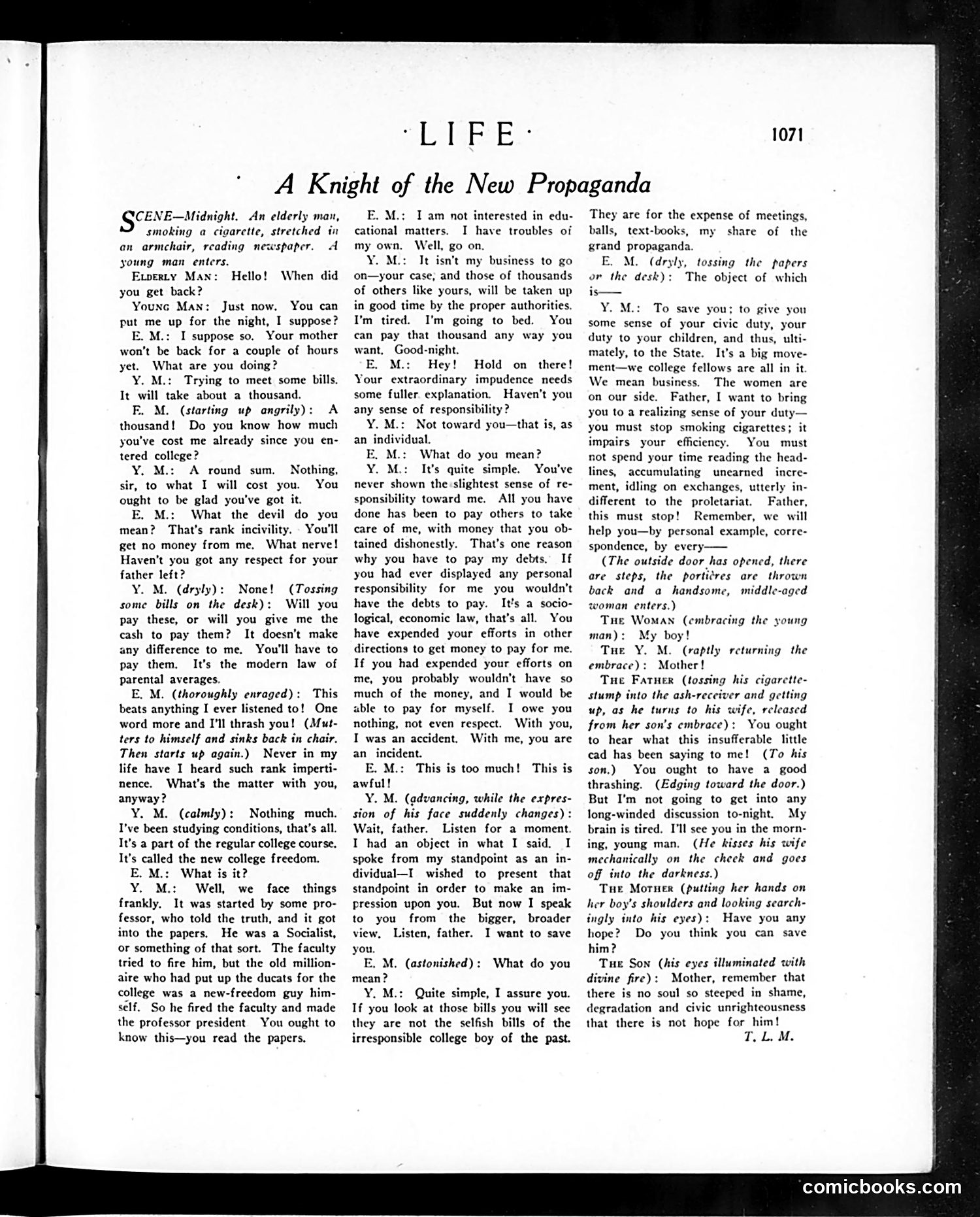
This is a dramatic dialogue between an elderly man (labeled "E.M.") and a young college student. The satire critiques the student's socialist ideology and apparent ingratitude toward his father. The father accuses the son of irresponsibility—having accumulated college bills while displaying no sense of duty to repay them. The son responds by invoking broader sociological and economic arguments, suggesting individual debt is merely part of a larger systemic problem. The satire mocks the young man as a "knight of the new propaganda"—someone who adopts fashionable leftist rhetoric to justify personal irresponsibility. The piece suggests this student represents a type: college radicals who embrace socialist ideology while avoiding practical obligations to their parents. The humor targets early 20th-century college socialism and generational conflict.
📄 Transcribed text from this page (OCR, searchable)
Machine-transcribed from the original scan — historical spelling and the odd misread are preserved.
sEGESEs: A Knight of the New Propaganda 'CENE—Midnight. An elderly man, smoking a cigarette, stretched in an armchair, reading newspaper. A young man enters. Evperty Man: you get back? Younc Man: Just now. You can put me up for the night, I suppose? E. M.: I suppose so. Your mother won't be back for a couple of hours yet. What are you doing? Y. M.: Trying to meet some bills. It will take about a thousand. F. M. (starting up angrily): A thousand! Do you know how much you've cost me already since you en- tered college? Y. M.: A round sum. sir, to what I will cost you. ought to be glad you've got it. E. M.: What the devil do you mean? That's rank incivility. You'll get no money from me, What nerve! Haven't you got any respect for your father left? Y. M. (dryly): None! (Tossing some bills on the desk): Will you pay these, or will you give me the cash to pay them? It doesn’t make any difference to me. You'll have to pay them, It’s the modern law of parental averages. E. M. (thoroughly enraged): This beats anything I ever listened to! One word more and I'll thrash you! (Afut- ters to himself and sinks back in chair. Then starts up again.) Never in my life have I heard such rank imperti- nence. What's the matter with you, anyway? Y. M. (calmly): Nothing much. I've been studying conditions, that’s all. It's a part of the regular college course. It’s called the new college freedom. E. M.: What is it? Y. M.: Well, we face things frankly. It was started by some pro- fessor, who told the truth, and it got into the papers. He was a Socialist, or something of that sort. The faculty tried to fire him, but the old million- aire who had put up the ducats for the college was a new-freedom guy him- self. So he fired the faculty and made the professor president You ought to know this—you read the papers. Hello!’ When did Nothing, You E. M.: I am not interested in edu- cational matters. I have troubles of my own. Well, go on. Y. M.: It isn't my business to go on—your case, and those of thousands of others like yours, will be taken up in good time by the proper authorities. I'm tired. I'm going to bed. You can pay that thousand any way you want, Good-night. E, M.: Hey! Hold on there! Your extraordinary impudence needs some fuller explanation. Haven't you any sense of responsibility ? Y.M Not toward you—that is, as an individual. E, M.: What do you mean? Y. M.: It’s quite simple. You've never shown the slightest sense of re- sponsibility toward me. All you have done has been to pay others to take care of me, with money that you ob- tained dishonestly. That's one reason why you have to pay my debts, If you had ever displayed any personal responsibility for me you wouldn't have the debts to pay. It's a socio- logical, economic law, that’s all. You have expended your efforts in other directions to get money to pay for me. If you had expended your efforts on me, you probably wouldn't have so much of the money, and I would be able to pay for myself. I owe you nothing, not even respect. With you, I was an accident. With me, you are an incident. E. M.: This is too much! awful! Y. M. (advancing, while the expres- sion of his face suddenly changes): Wait, father. Listen for a moment. I had an object in what I said. I spoke from my standpoint as an in- dividual—I_ wished to present that standpoint in order to make an im- pression upon you. But now I speak to you from the bigger, broader view, Listen, father. I want to save you E. M. (astonished): mean? Y. M.: Quite simple, I assure you. Tf you look at those bills you will see they are not the selfish bills of the irresponsible college boy of the past. This is What do you They are for the expense of meetings, balls, text-books, my share of grand propaganda. E. M. (dryly, or the desk) is— Y. M.: To save you; to give you some sense of your ic duty, your duty to your children, and thus, ulti- mately, to the State. It’s a big move- ment—we college fellows are all in it We mean business. The women are on our side. Father, I want to bring you to a realizing sense of your duty. you must stop smoking cigarettes; it impairs your efficiency. You must not spend your time reading the head- lines, accumulating unearned incre- ment, idling on exchanges, utterly in- different to the proletariat. Father, this must stop! Remember, we will help you—by personal example, corre- spondence, by every-— (The outside door has opened, there are steps, the porticres are thrown back and a handsome, middle-aged woman enters.) Tue Woman (embracing the young man): My boy! Tue Y. M. (raptly returning the embrace): Mother! Tue Fatuer (tossing his cigarctte- stump into the ash-receiver and getting up, as he turns to his wife, released from her son’s embrace): You ought to hear what this insufferable little cad has been saying to me! (To his son.) You ought to have a good thrashing. (Edging toward the door.) But I’m not going to get into any long-winded discussion to-night. My brain is tired. I'll see you in the morn- ing, young man, (He kisses his wife mechanically on the cheek and goes off into the darkness.) Tue Moruer (putting her hands on her boy’s shoulders and looking search- ingly into his eyes): Have you any hope? Do you think you can save him? Tue Son (his eyes illuminated with divine fire): Mother, remember that there is no soul so steeped in shame, degradation and civic unrighteousness that there is not hope for him! T. L. M. the tossing the papers The object of which comicbooks.com