
Life, 1914-12-10 · page 30 of 40
Life — December 10, 1914 — page 30: what you’re looking at
What you’re looking at
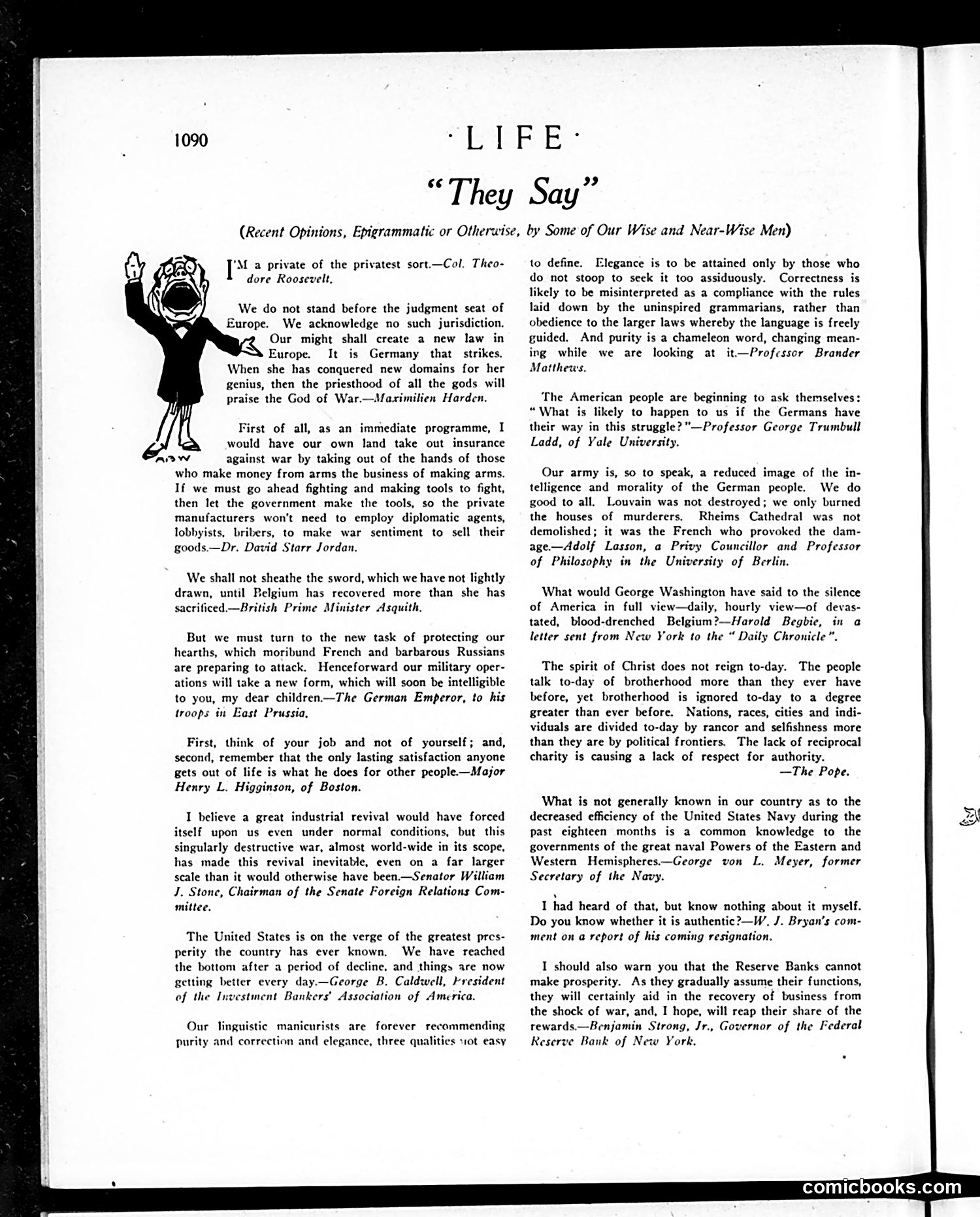
This page collects quotations attributed to prominent figures during World War I, presenting them as satire. The caricature shows a militaristic German figure, likely representing German imperial authority. The satire works by juxtaposing **German justifications for war** (attributed to Kaiser Wilhelm II, philosopher Adolf Lasson, and propagandist Maximilien Harden) against **American and Allied voices** (Theodore Roosevelt, British PM Asquith, Yale professor George Trumbull Ladd). German quotes defend destruction of Belgium and churches as necessary; some quotes appear fabricated or exaggerated to seem absurd. American quotes advocate restraint, pacifism, or moral concern about German aggression. The humor is biting: Life presents Germans as morally corrupt warmongers while positioning American figures as voices of reason. The page ridicules German claims of moral superiority while their actions contradict those claims—a classic propaganda technique turned against Germany during America's pre-WWI period.
📄 Transcribed text from this page (OCR, searchable)
Machine-transcribed from the original scan — historical spelling and the odd misread are preserved.
RAB “They Say” (Recent Opinions, Epigrammatic or Otherwise, by Some of Our Wise and Near-Wise Men) I™ a private of the privatest sort.—Col. Theo- dore Roosevelt, We do not stand before the judgment seat of Europe. We acknowledge no such jurisdiction. Our might shall create a new law in Europe. It is Germany that strikes, When she has conquered new domains for her genius, then the priesthood of all the gods will praise the God of War.—Maximilien Harden. First of all, as an immediate programme, I would have our own land take out insurance te had against war by taking out of the hands of those who make money from arms the business of making arms. If we must go ahead fighting and making tools to fight, then let the government make the tools, so the private manufacturers won't need to employ diplomatic agents, lobbyists, bribers, to make war sentiment to sell their goods.—Dr. David Starr Jordan. We shall not sheathe the sword, which we have not lightly drawn, until Belgium has recovered more than she has sacrificed.—British Prime Minister Asquith. But we must turn to the new task of protecting our hearths, which moribund French and barbarous Russians are preparing to attack. Henceforward our military oper- ations will take a new form, which will soon be intelligible to you, my dear children.—The German Emperor, to his troops in East Prussia, First, think of your job and not of yourself; and, second, remember that the only lasting satisfaction anyone gets out of life is what he does for other people.—Major Henry L. Higginson, of Boston. I believe a great industrial revival would have forced itself upon us even under normal conditions, but this singularly destructive war, almost world-wide in its scope, has made this revival inevitable, even on a far larger scale than it would otherwise have been.—Senator William J. Stone, Chairman of the Senate Foreign Relations Com- mittee. The United States is on the verge of the greatest pres- perity the country has ever known. We have reached the bottom after a period of decline, and things are now getting better every day.—George B. Caldwell, kresident of the Investment Bankers’ Association of America. Our linguistic manicurists are forever recommending purity and correction and elegance, three qualities sot easy to define. Elegance is to be attained only by those who do not stoop to seek it too assiduously. Correctness is likely to be misinterpreted as a compliance with the rules laid down by the uninspired grammarians, rather than obedience to the larger laws whereby the language is freely guided. And purity is a chameleon word, changing mean- ing while we are looking at it—Professor Brander Matthews. The American people are beginning to ask themselves: “What is likely to happen to us if the Germans have their way in this struggle? "—Professor George Trumbull Ladd, of Yale University. Our army is, so to speak, a reduced image of the in- telligence and morality of the German people. We do good to all. Louvain was not destroyed; we only burned the houses of murderers. Rheims Cathedral was not demolished; it was the French who provoked the dam- age—Adolf Lasson, a Privy Councillor and Professor of Philosophy in the University of Berlin. What would George Washington have said to the silence of America in full view—daily, hourly view—of devas- tated, blood-drenched Belgium?—Harold Begbie, in a letter sent from New York to the “ Daily Chronicle”. The spirit of Christ does not reign to-day. The people talk to-day of brotherhood more than they ever have before, yet brotherhood is ignored to-day to a degree greater than ever before. Nations, races, cities and indi- viduals are divided to-day by rancor and selfishness more than they are by political frontiers, The lack of reciprocal charity is causing a lack of respect for authority. —The Pope. What is not generally known in our country as to the decreased efficiency of the United States Navy during the past eighteen months is a common knowledge to the governments of the great naval Powers of the Eastern and Western Hemispheres.—George von L. Meyer, former Secretary of the Navy. I had heard of that, but know nothing about it myself. Do you know whether it is authentic?—W, J. Bryan’s com- ment on a report of his coming resignation. I should also warn you that the Reserve Banks cannot make prosperity. As they gradually assume their functions, they will certainly aid in the recovery of business from the shock of war, and, I hope, will reap their share of the rewards.—Benjamin Strong, Jr., Governor of the Federal Reserve Bank of New York. comicbooks.com