
Life, 1914-12-10 · page 28 of 40
Life — December 10, 1914 — page 28: what you’re looking at
What you’re looking at
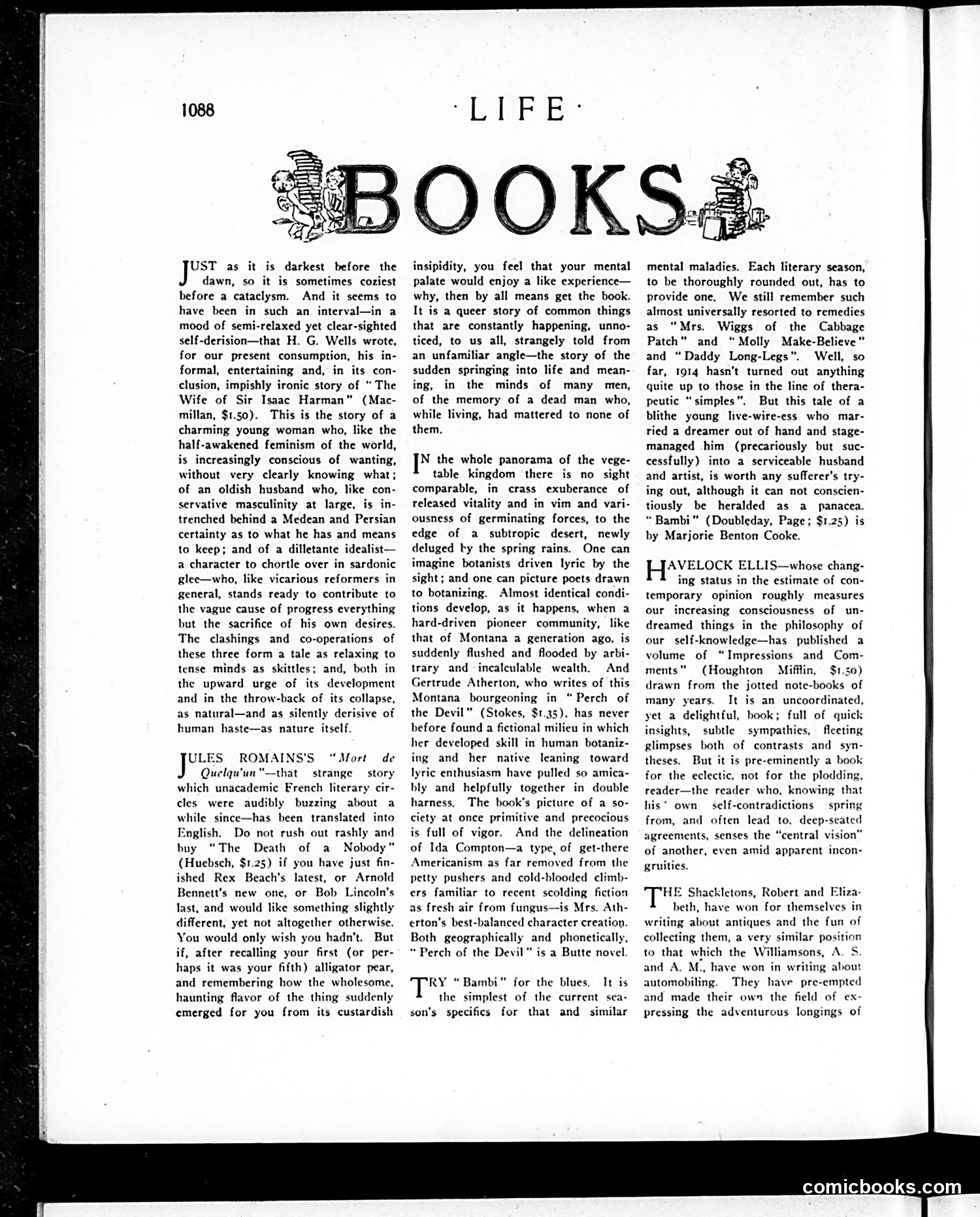
This is a book review section from *Life* magazine (page 1088), featuring literary criticism of contemporary works. The page contains no political cartoons—it's primarily text reviewing novels. The reviews discuss: 1. **H.G. Wells's "The Wife of Sir Isaac Harman"**—described as a semi-autobiographical story exploring the tension between an awakening feminist woman, her conservative husband, and an idealistic dilettante reformer. The reviewer uses this as social commentary on contemporary gender and class dynamics. 2. **Jules Romains's "Mort de Quelqu'un"** (translated as "The Death of a Nobody")—a French literary work about an ordinary man whose death suddenly matters to people who ignored him in life. 3. **Gertrude Atherton's "Perch of the Devil"**—set in Montana during a mining boom, exploring how sudden wealth transforms a pioneer community. The reviewer praises Atherton's character development. The tone is characteristic of early 20th-century literary journalism: witty, digressive, and intellectually playful rather than purely informative.
📄 Transcribed text from this page (OCR, searchable)
Machine-transcribed from the original scan — historical spelling and the odd misread are preserved.
UST as it is darkest before the dawn, so it is sometimes coziest before a cataclysm. And it seems to have been in such an interval—in a mood of semi-relaxed yet clear-sighted self-derision—that H. G. Wells wrote, for our present consumption, his in- formal, entertaining and, in its con- clusion, impishly ironic story of “ The Wife of Sir Isaac Harman” (Mac- millan, $1.50). This is the story of a charming young woman who, like the half-awakened feminism of the world, is increasingly conscious of wanting, without very clearly knowing what; of an oldish husband who, like con- servative masculinity at large, is in- trenched behind a Medean and Persian certainty as to what he has and means to keep; and of a dilletante idealist— a character to chortle over in sardonic glee—who, like vicarious reformers in general, stands ready to contribute to the vague cause of progress everything but the sacrifice of his own desires. The clashings and co-operations of these three form a tale as relaxing to tense minds as skittles; and, both in the upward urge of its development and in the throw-back of its collapse, as natural—and as silently derisive of human haste—as nature itself. ULES ROMAINS'S “Mort de Quelqu’'un"—that strange — story which unacademic French literary cir- cles were audibly buzzing about a while since—has been translated into English. Do not rush out rashly and buy “The Death of a Nobody” (Huebsch, $1.25) if you have just fin- ished Rex Beach's latest, or Arnold Bennett's new one, or Bob Lincoln's last, and would like something slightly different, yet not altogether otherwise. You would only wish you hadn't. But if, after recalling your first (or per- haps it was your fifth) alligator pear, and remembering how the wholesome, haunting flavor of the thing suddenly emerged for you from its custardish “LUPE - OOKS. insipidity, you feel that your mental palate would enjoy a like experience— why, then by all means get the book. It is a queer story of common things that are constantly happening, unno- ticed, to us all, strangely told from an unfamiliar angle—the story of the sudden springing into life and mean- ing, in the minds of many men, of the memory of a dead man who, while living, had mattered to none of them. IX the whole panorama of the vege- table kingdom there is no sight comparable, in crass exuberance of released vitality and in vim and vari- ousness of germinating forces, to the edge of a subtropic desert, newly deluged by the spring rains. One can imagine botanists driven lyric by the sight; and one can picture poets drawn to botanizing. Almost identical condi- tions develop, as it happens, when a hard-driven pioneer community, like that of Montana a generation ago, is suddenly flushed and flooded by arbi- trary and incalculable wealth. And Gertrude Atherton, who writes of this Montana bourgeoning in “Perch of the Devil” (Stokes, $1.35), has never before found a fictional milieu in which her developed skill in human botaniz- ing and her native leaning toward lyric enthusiasm have pulled so amica- bly and helpfully together in double harness, The book's picture of a so- ciety at once primitive and precocious is full of vigor. And the delineation of Ida Compton—a type, of get-there Americanism as far removed from the petty pushers and cold-blooded climb- ers familiar to recent scolding fiction as fresh air from fungus—is Mrs. Ath- erton’s best-balanced character creation. Both geographically and phoneticall “ Perch of the Devil” is a Butte novel. RY “Bambi” for the blues. It is the simplest of the current sea- son's specifics for that and similar mental maladies. Each literary season, to be thoroughly rounded out, has to provide one, We still remember such almost universally resorted to remedies as “Mrs. Wiggs of the Cabbage Patch” and “Molly Make-Believe” and “Daddy Long-Legs”. Well, so far, 1914 hasn't turned out anything quite up to those in the line of thera- peutic “simples”. But this tale of a blithe young live-wire-ess who mar- ried a dreamer out of hand and stage- managed him (precariously but suc- cessfully) into a serviceable husband and artist, is worth any sufferer’s try- ing out, although it can not conscien- tiously be heralded as a panacea. “Bambi” (Doubleday, Page; $1.25) is by Marjorie Benton Cooke. AVELOCK ELLIS—whose chang- ing status in the estimate of con- temporary opinion roughly measures our increasing consciousness of un- dreamed things in the philosophy of our self-knowledge—has published a volume of “Impressions and Com- ments” (Houghton Mifflin, $1.50) drawn from the jotted note-books of many years. It is an uncoordinated, yet a delightful, book; full of quick insights, subtle sympathies, fleeting glimpses both of contrasts and syn- theses. But it is pre-eminently a book for the eclectic, not for the plodding, reader—the reader who, knowing that his* own self-contradictions — spring from, and often lead to, deep-seated reements, senses the “central vision” of another, even amid apparent incon- gruities. HE Shackletons, Robert and Eliza- beth, have won for themselves in writing about antiques and the fun of collecting them, a very similar position to that which the William ALS. and A, M:, have won in writing about automobiling. They have pre-empted and made their own the field of ex- pressing the adventurous longings of