
Life, 1914-12-10 · page 14 of 40
Life — December 10, 1914 — page 14: what you’re looking at
What you’re looking at
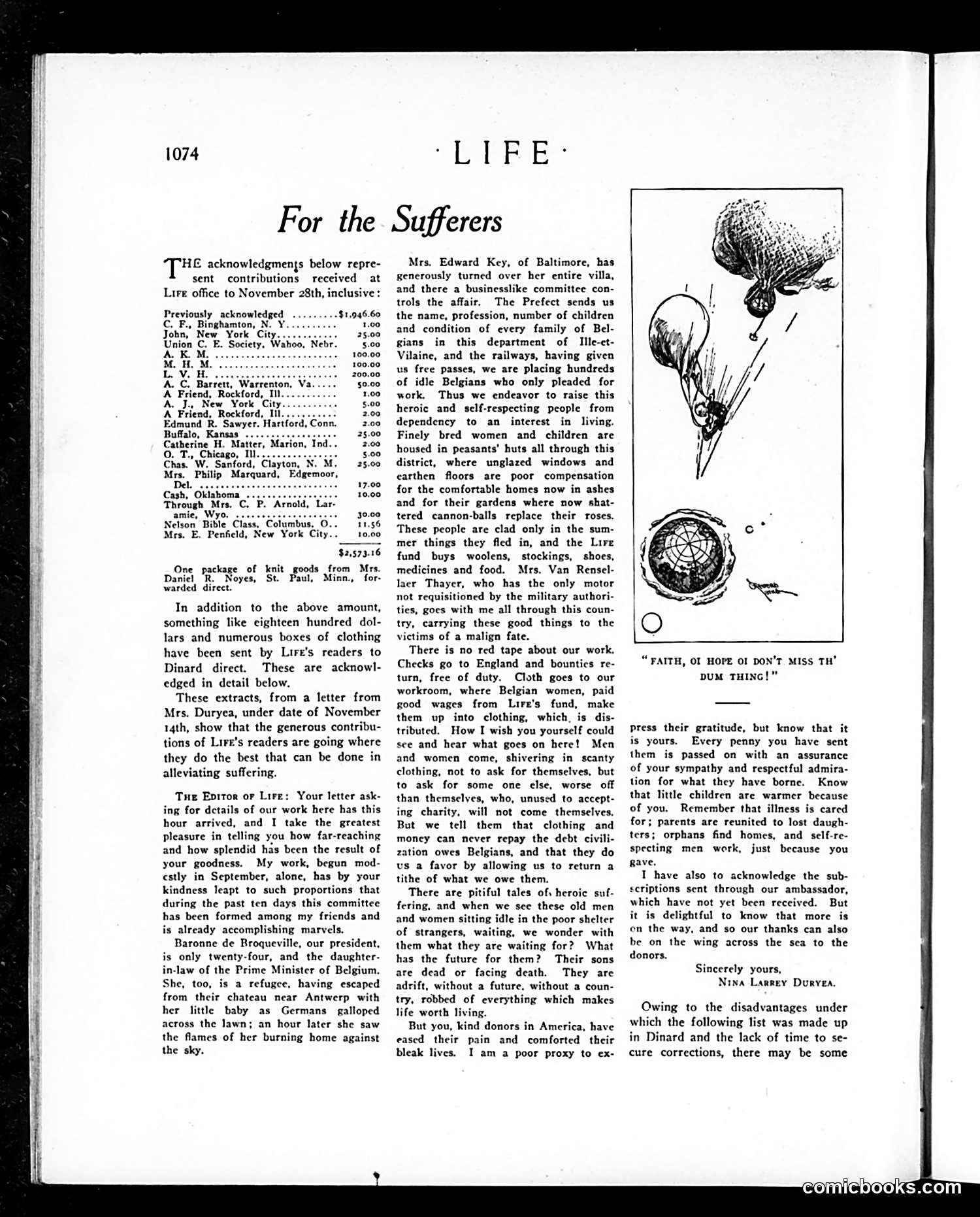
This page documents charitable contributions to Life magazine's relief fund for Belgian refugees during World War I. The text describes Mrs. Edward Ker's villa in Baltimore serving as a headquarters for aid distribution to Belgian families displaced by the war. The small illustration in the upper right appears to show dried beans or legumes, likely representing food donations. Below it is a circular object, possibly a coin or monetary contribution symbol. The cartoon caption—"FAITH, OI HOPE OI DON'T MISS TH' DUM THING!"—uses Irish dialect humor (characteristic of early-1900s Life magazine satire) to make light of the relief efforts, though the overall page's serious tone emphasizes the genuine humanitarian crisis facing Belgian civilians.
📄 Transcribed text from this page (OCR, searchable)
Machine-transcribed from the original scan — historical spelling and the odd misread are preserved.
LVEF E For the Sufferers TRE acknowledgments below repre- sent contributions received at Lire office to November 28th, inclusive : Previously acknowledged C. F., Binghamton, N. Y John, New York City. Union C. E. Society, Wahoo, +$1,946.60 A. C. Barrett, Warrenton, A Friend, Rockford, I. A. J, New York City. A Friend, Rockford, Il. Edmund R. Sawyer. Hartford, Cone. Buffalo, Kansas .. Catherine H. Matter, Marion, ind. ©. T., Chicago, Ill.. Chas. W. Sanford, Clayton, N. Mra Philip Marquard, Falgemoor, cash Otlaboma 5 Through Mrs. C. P. Arnold, Lar- amie, Wyo. . seeeee Nelson Bible. Class, Columba: Mrs. E. Penfield, New York City. 10.00 30.00 11.56 10.00 $2,573.16 One package of knit goods from Mrs Daniel R. Noyes, aul, Minn., for- warded direct. In addition to the above amount, something like cightecen hundred dol- lars and numerous boxes of clothing have been sent by Lire’s readers to Dinard direct. These are acknowl- edged in detail below. These extracts, from a letter from Mrs. Duryea, under date of November 14th, show that the generous contribu- tions of Lire’s readers are going where they do the best that can be done in alleviating suffering. Tne Eprtor or Lire: Your letter ask- ing for details of our work here has this hour arrived, and I take the greatest pleasure in telling you how far-reaching and how splendid has been the result of your goodness. My work, begun mod- cstly in September, alone, has by your kindness leapt to such proportions that during the past ten days this committee has been formed among my friends and is already accomplishing marvels. Baronne de Broqueville, our president, is only twenty-four, and the daughter- in-law of the Prime Minister of Belgium. She, too, is a refugee, having escaped from their chateau near Antwerp with her little baby as Germans galloped across the lawn; an hour later she saw the flames of her burning home against the sky. Mrs, Edward Key, of Baltimore, has generously turned over her entire villa, and there a businesslike committee con- trols the affair, The Prefect sends us the name, profession, number of children and condition of every family of Bel- gians in this department of IlIle-ct- Vilaine, and the railways, having given us free passes, we are placing hundreds of idle Belgians who only pleaded for work, Thus we endeavor to raise this heroic and self-respecting people from dependency to an interest in living. Finely bred women and children are housed in peasants’ huts all through this district, where unglazed windows and earthen floors are poor compensation for the comfortable homes now in ashes and for their gardens where now shat- tered cannon-balls replace their roses. These people are clad only in the sum- mer things they fled in, and the Lire fund buys woolens, stockings, shoes, medicines and food. Mrs. Van Rensel- laer Thayer, who has the only motor not requisitioned by the military authori- ties, goes with me all through this coun- try, carrying these good things to the victims of a malign fate. There is no red tape about our work. Checks go to England and bounties re- turn, free of duty. Cloth goes to our workroom, where Belgian women, paid good wages from Lire's fund, make them up into clothing, which, is dis- tributed. How I wish you yourself could see and hear what goes on here! Men and women come, shivering in scanty clothing, not to ask for themselves, but to ask for some one else, worse off than themselves, who, unused to accept- ing charity, will not come themselves. But we tell them that clothing and money can never repay the debt civili- zation owes Belgians, and that they do vs a favor by allowing us to return a tithe of what we owe them. There are pitiful tales of, heroic suf- fering, and when we see these old men and women sitting idle in the poor shelter of strangers, waiting, we wonder with them what they are waiting for? What has the future for them? Their sons are dead or facing death. They are adrift, without a future, without a coun- try, robbed of everything which makes life worth living. But you, kind donors in America, have eased their pain and comforted their bleak lives. I am a poor proxy to ex- “ FAITH, OI HOPE OI DON’T MISS TH’ DUM THING!” Press their gratitude, but know that it is yours. Every penny you have sent them is passed on with an assurance of your sympathy and respectful admira- tion for what they have borne. Know that little children are warmer because of you. Remember that illness is cared for; parents are reunited to lost daugh- ters; orphans find homes, and self-re- specting men work, just because you gave. I have also to acknowledge the sub- scriptions sent through our ambassador, which have not yet been received. But it is delightful to know that more is en the way, and so our thanks can also be on the wing across the sca to the donors, Sincerely yours, Niwa Larrey Duryea. Qwing to the disadvantages under which the following list was made up in Dinard and the lack of time to se- cure corrections, there may be some