
A complete issue · 48 pages · 1914
Life — September 17, 1914
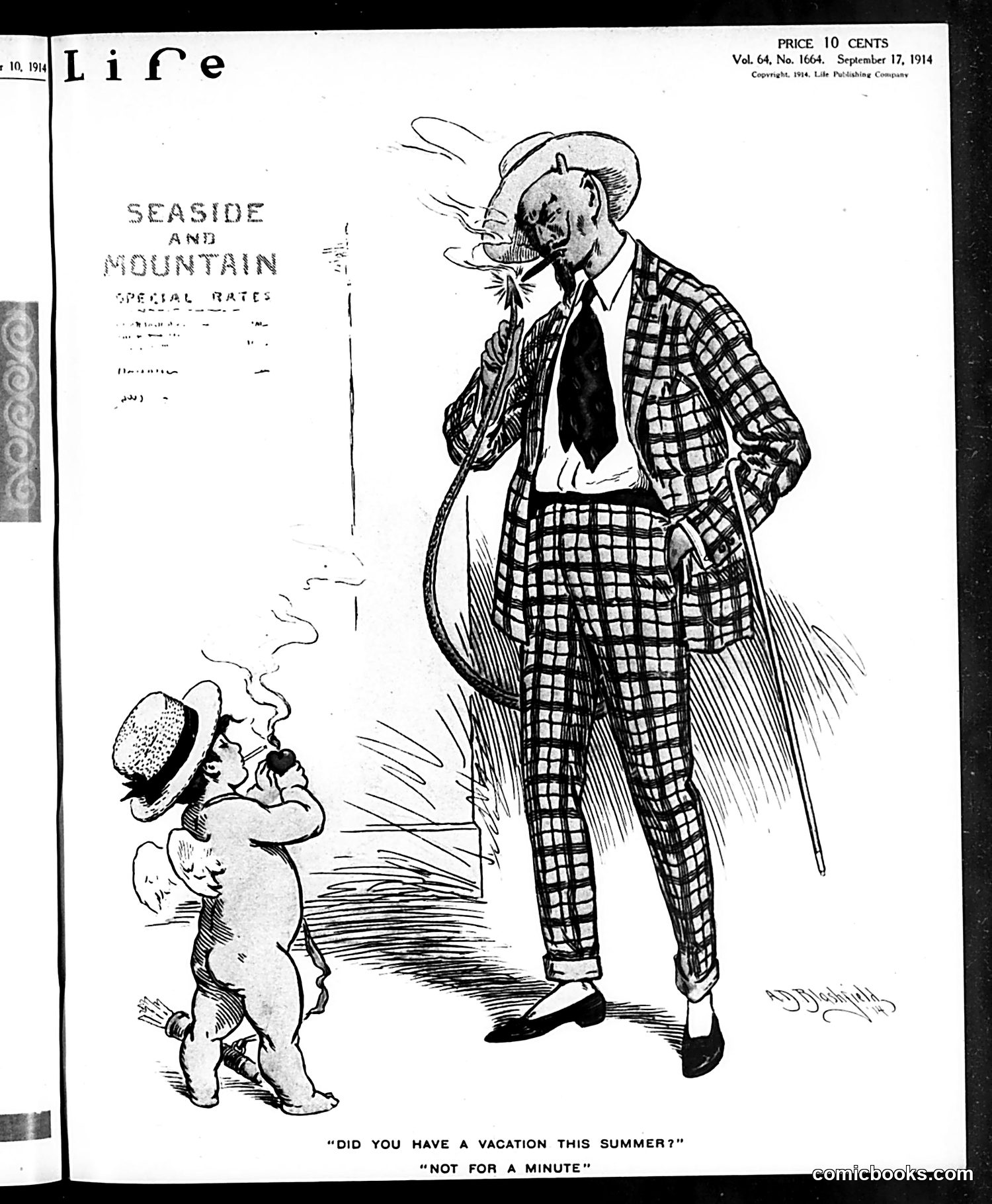
This cartoon depicts a well-dressed man in a checkered suit and straw hat towering over a small child. The man is holding what appears to be a snake or rope. The caption reads: "DID YOU HAVE A VACATION THIS SUMMER?" / "NOT FOR A MINUTE" The satire targets wealthy Americans who took seaside and mountain vacations while implying their children received no break or relief. The advertisement text on the left ("SEASIDE AND MOUNTAIN SPECIAL RATES") reinforces the joke—vacation opportunities were available to the affluent, yet their children apparently saw none of the benefits. The exaggerated size difference emphasizes the power dynamic and suggests parental neglect or exploitation during the leisure season. This reflects broader 1914 social commentary on class disparities and family values among the privileged.
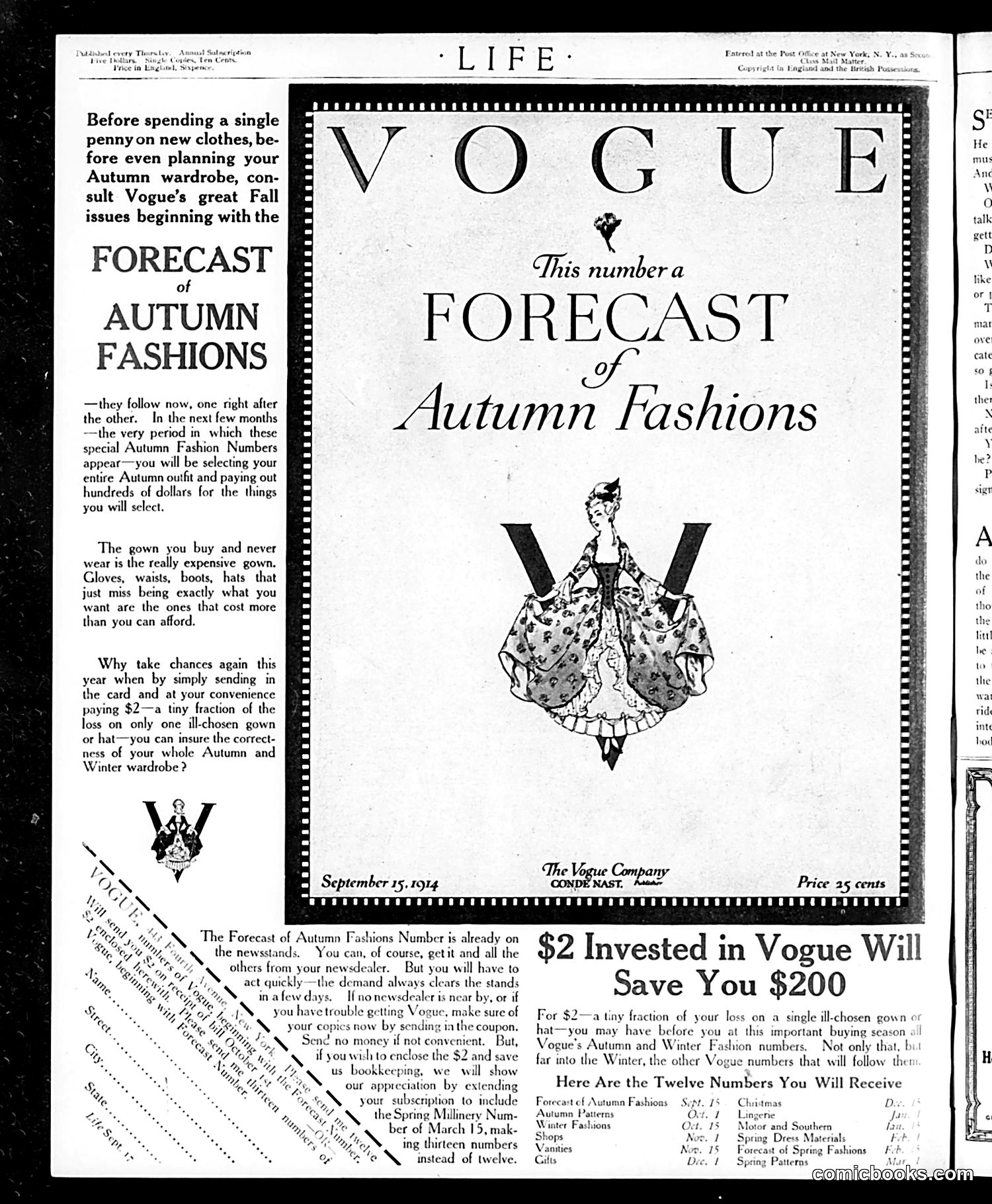
This page is primarily **advertising, not satire**. It promotes Vogue's "Forecast of Autumn Fashions" issue (September 15, 1914) for 25 cents. The central illustration depicts a fashionable woman in an elaborate autumn dress with a large V-shaped neckline and patterned fabric—representative of 1914 high fashion. The left column's text is a sales pitch: for $2 (paid to Life magazine), subscribers can receive Vogue's upcoming Fashion Numbers, supposedly saving $200 by making informed wardrobe choices rather than purchasing expensive ill-fitting garments. The pitch emphasizes that proper fashion guidance prevents costly mistakes. This represents early 20th-century magazine cross-promotion and consumer marketing aimed at women interested in fashion, not political commentary or satire.
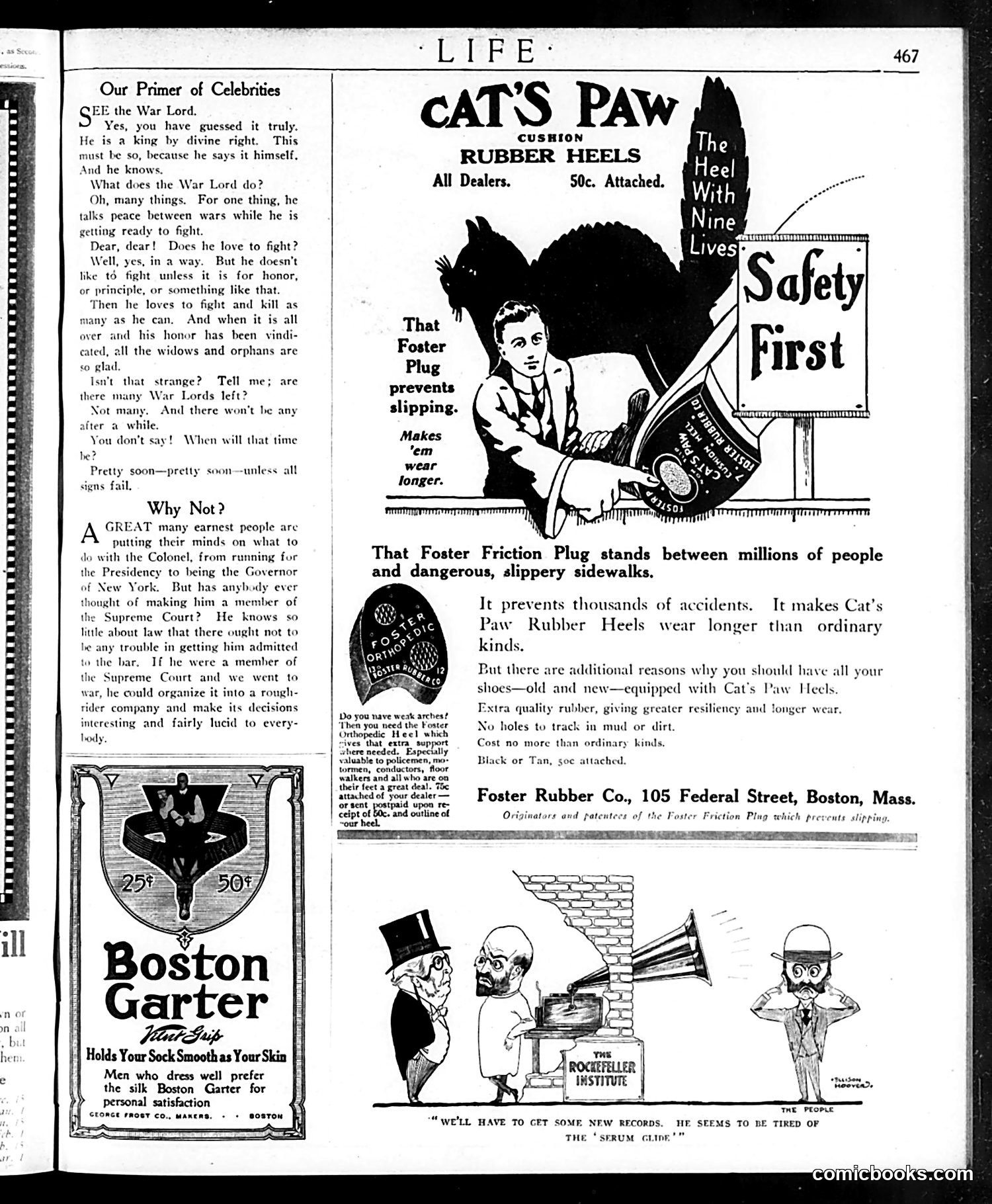
**Top Section - "Our Primer of Celebrities":** This satirical text discusses "the War Lord" (likely a political figure, possibly related to WWI-era leadership). The piece mocks those in power who discuss peace while preparing for war, questioning their motives and the propriety of their decisions. It suggests such figures lack genuine justification for military action beyond honor. **"Why Not?" Section:** Critiques earnest citizens focusing on Colonel [Roosevelt?] and the Governor of New York, sarcastically noting their concern about Supreme Court appointments and judicial oversight. **Bottom Cartoon:** A satire showing two men (possibly politicians) at "The Rockefeller Institute," with one saying they need "new records" because someone is "tired of the 'serum glide'"—likely mocking institutional pretensions or scientific claims. The page primarily contains product advertisements (Boston Garter, Cat's Paw Rubber Heels).
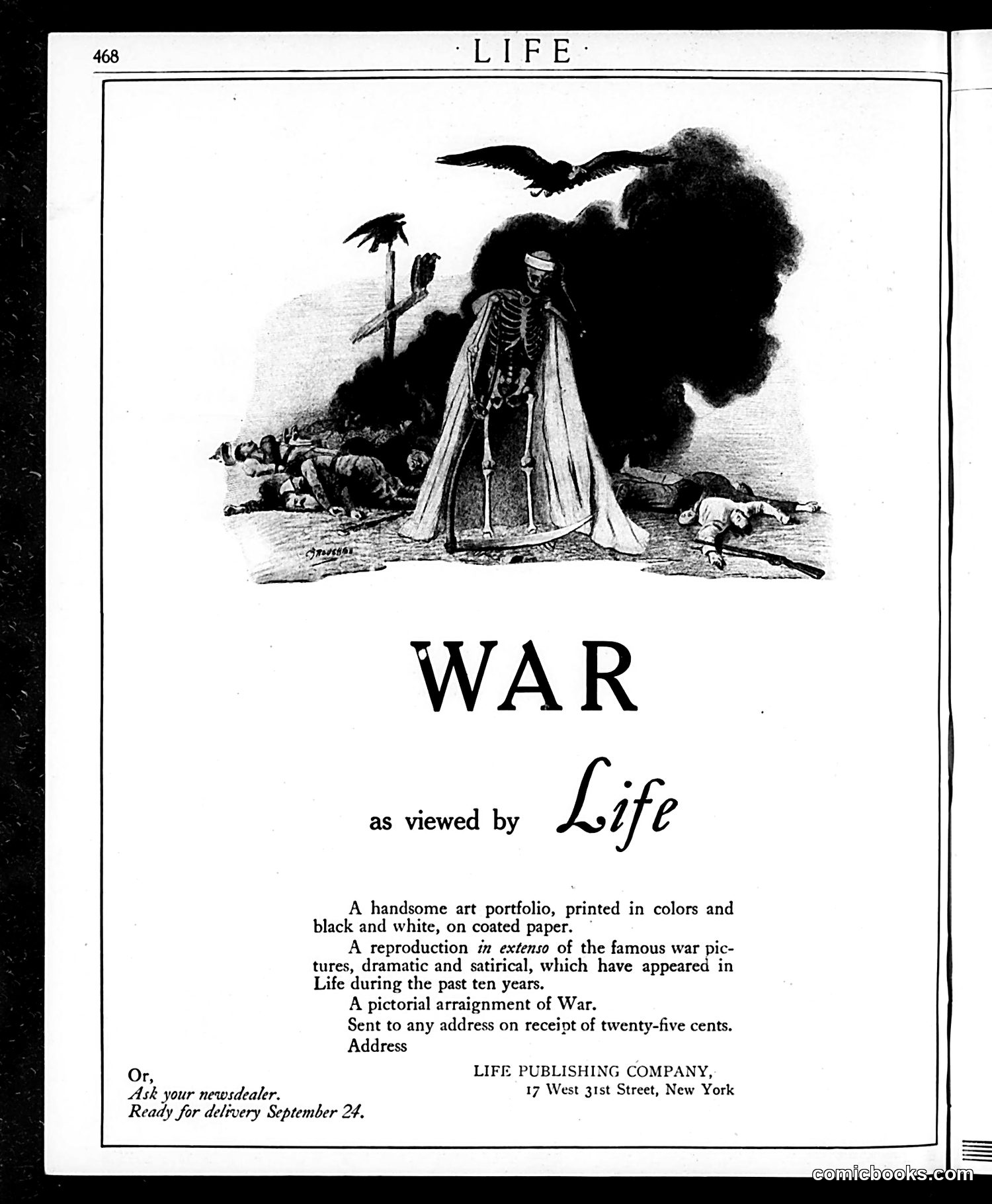
This is an advertisement for an art portfolio titled "War as Viewed by Life." The image depicts a skeletal, cloaked figure of Death standing amid a battlefield scattered with corpses and destruction. Ravens circle overhead, while smoke billows in the background—a traditional memento mori visualization of war's devastation. The portfolio reproduces satirical and dramatic war illustrations that appeared in Life magazine over the previous decade. Life Publishing Company sold it for twenty-five cents, positioning anti-war artistic commentary as a commercial product. The timing—noted as "Ready for delivery September 24"—suggests this coincided with World War I's active period, when American publications increasingly depicted war's horrors through allegorical imagery.
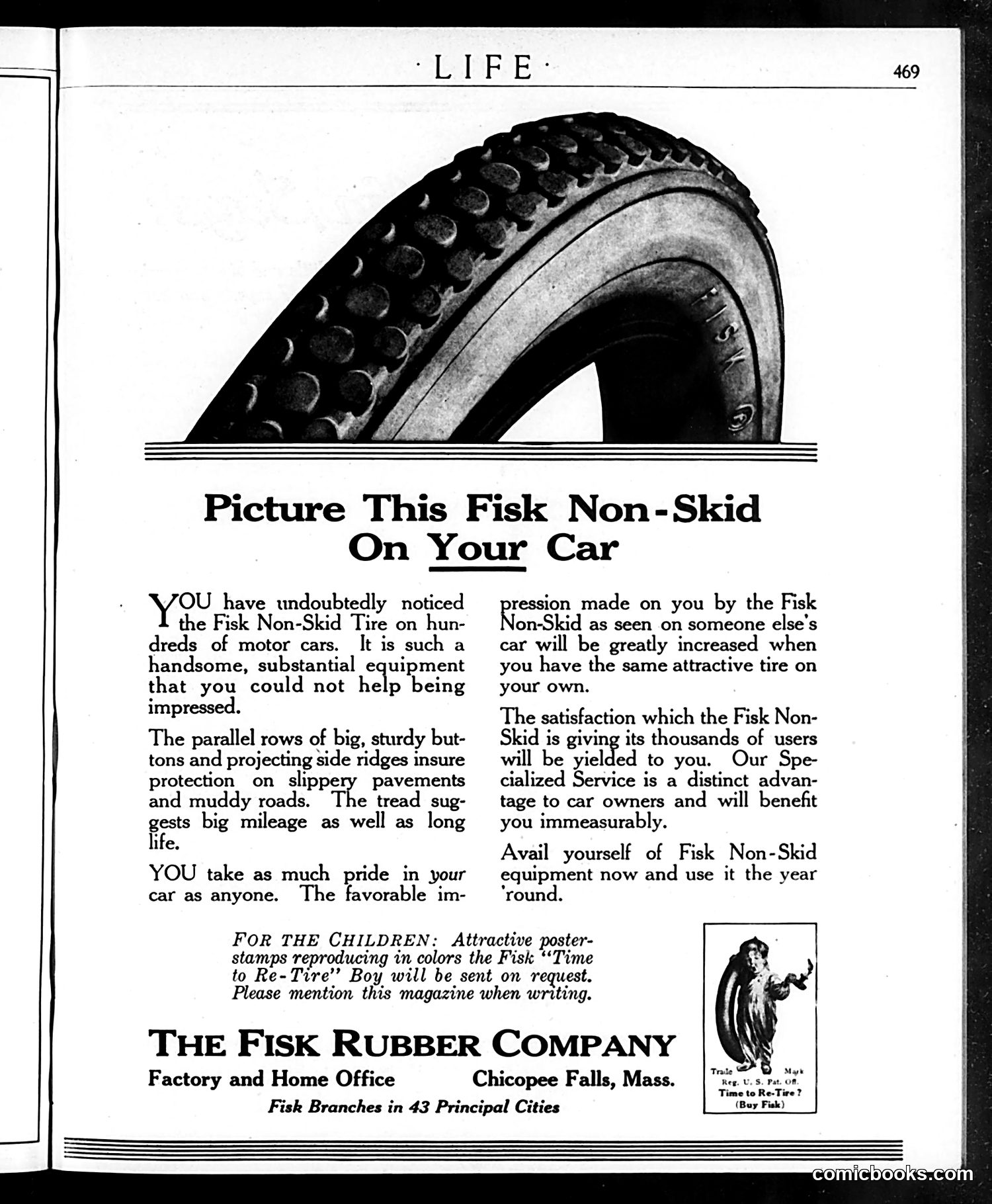
This is **not a political cartoon or satire** — it's a straightforward **advertisement** for Fisk Rubber Company tires, specifically their "Non-Skid" model. The page features a product photograph of a Fisk tire showing its distinctive tread pattern. The ad copy appeals to car owners' pride in their vehicles, emphasizing the tire's practical benefits: superior traction on slippery roads, durability, and long mileage. The only humorous element is a small cartoon mascot in the bottom right corner — the "Fisk Boy," the company's trademark character holding what appears to be a tire. A promotional offer mentions poster-stamps for children featuring this character. This represents early 1900s automotive advertising aimed at establishing brand prestige and consumer loyalty.
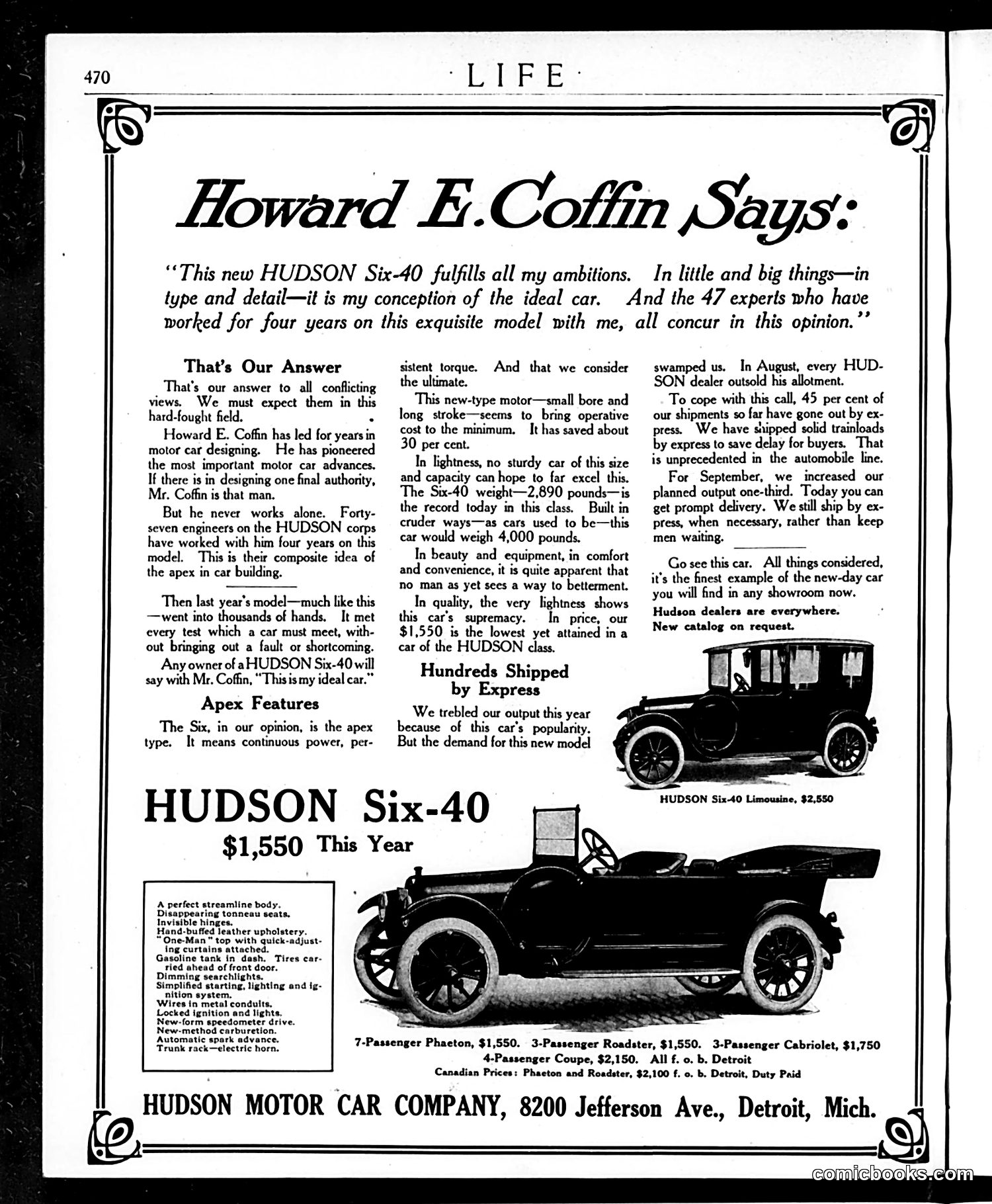
This page is **primarily an advertisement**, not satire or political commentary. It's a Hudson Motor Car Company ad for their Six-40 model, priced at $1,550. The "Howard E. Coffin Says" testimonial quotes the car's chief designer endorsing his own product—a standard advertising technique. Coffin claims 47 experts worked on the vehicle and that it represents "the ideal car." The ad emphasizes practical features: lightweight construction (2,890 pounds), fuel efficiency, and affordability compared to competitors weighing 4,000 pounds. The multiple car illustrations show different body styles available (limousine, phaeton, roadster, coupe, cabriolet). There is **no apparent political satire** here—this is straightforward early 1910s automotive marketing using celebrity endorsement and technical specifications to attract buyers.
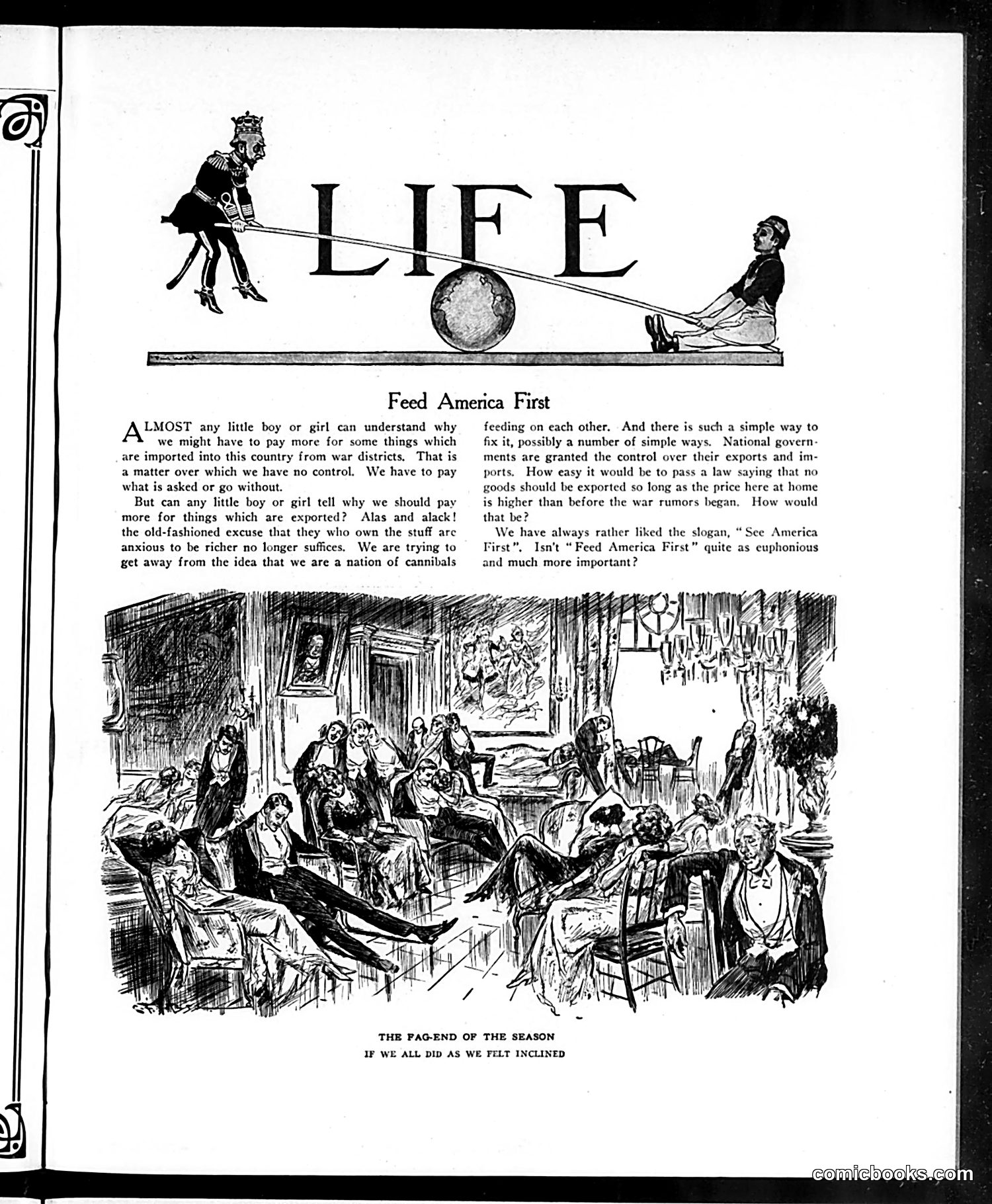
This satirical piece critiques American trade policy during or after World War I. The top illustration shows a seesaw labeled "LIFE," with a wealthy figure (likely representing American business interests or aristocracy) on one end and a common person on the other, balanced on a globe—suggesting unequal global economic power. The article argues against paying higher prices for imported goods while American citizens struggle. It questions why domestic prices should remain elevated to benefit exports when "national governments are granted the control over their exports." The lower sketch depicts wealthy socialites at leisure, captioned "The Fag-End of the Season / If We All Did As We Felt Inclined," sarcastically contrasting privileged indifference with ordinary Americans' economic hardship. The satire advocates prioritizing American working-class welfare over elite interests.
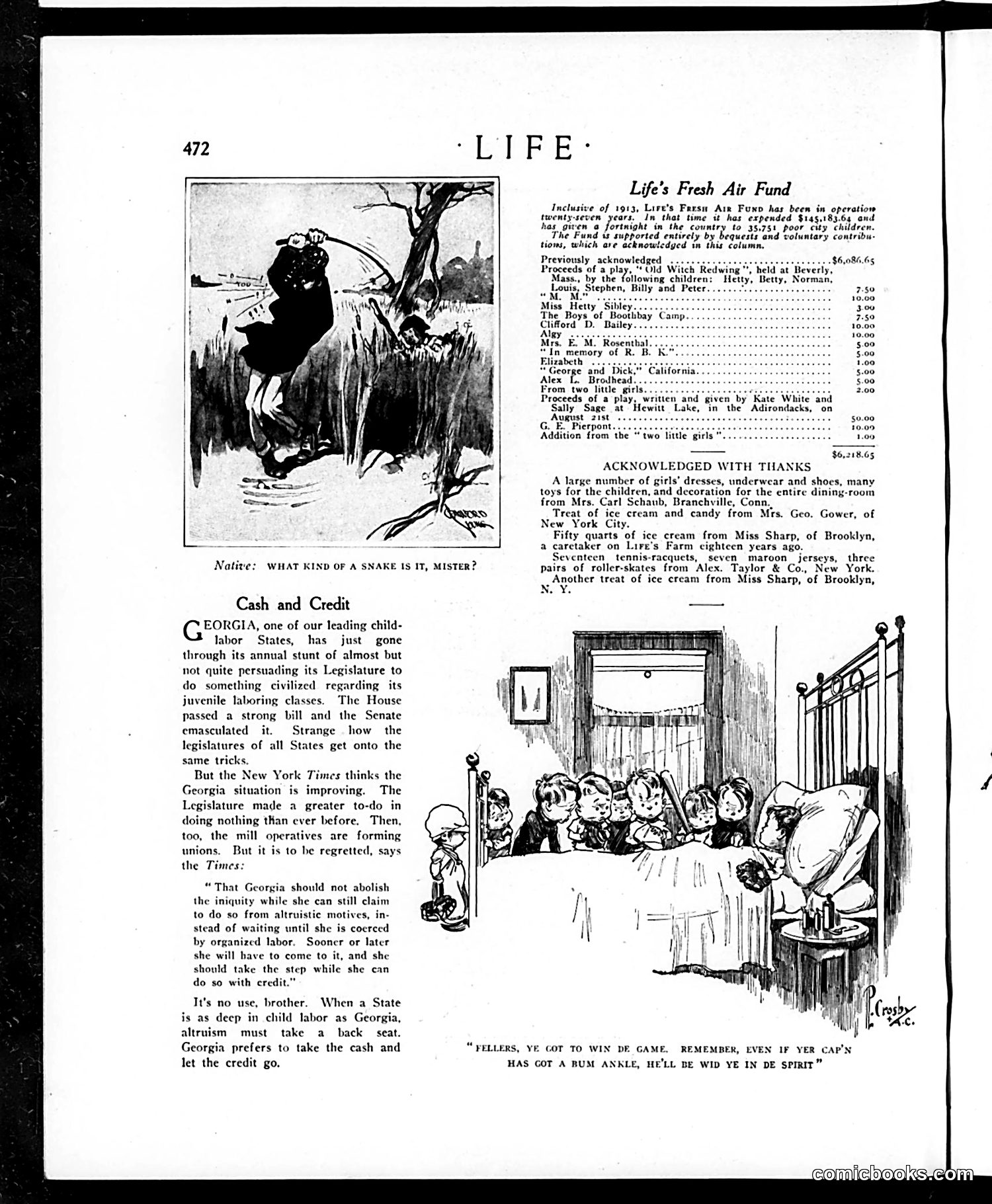
**Top Illustration:** "What Kind of a Snake is It, Mister?" depicts a figure in period clothing examining a snake by water. The exact historical reference is unclear without additional context. **Main Article - "Cash and Credit":** Satirizes Georgia's child labor practices. The text criticizes Georgia's Legislature for resisting child-labor regulations, suggesting the state uses legislative "tricks" to avoid reform. The New York *Times* is quoted arguing Georgia should abolish child labor rather than delay through procedural tactics. The satire's point: Georgia prioritizes "cash" (economic benefit from child labor) over moral "credit" (doing the right thing), and must eventually face reform regardless. **Bottom Cartoon:** Shows children in what appears to be a dormitory or institution, with a caption about winning a game and competitive spirit, likely commenting on institutional child care.
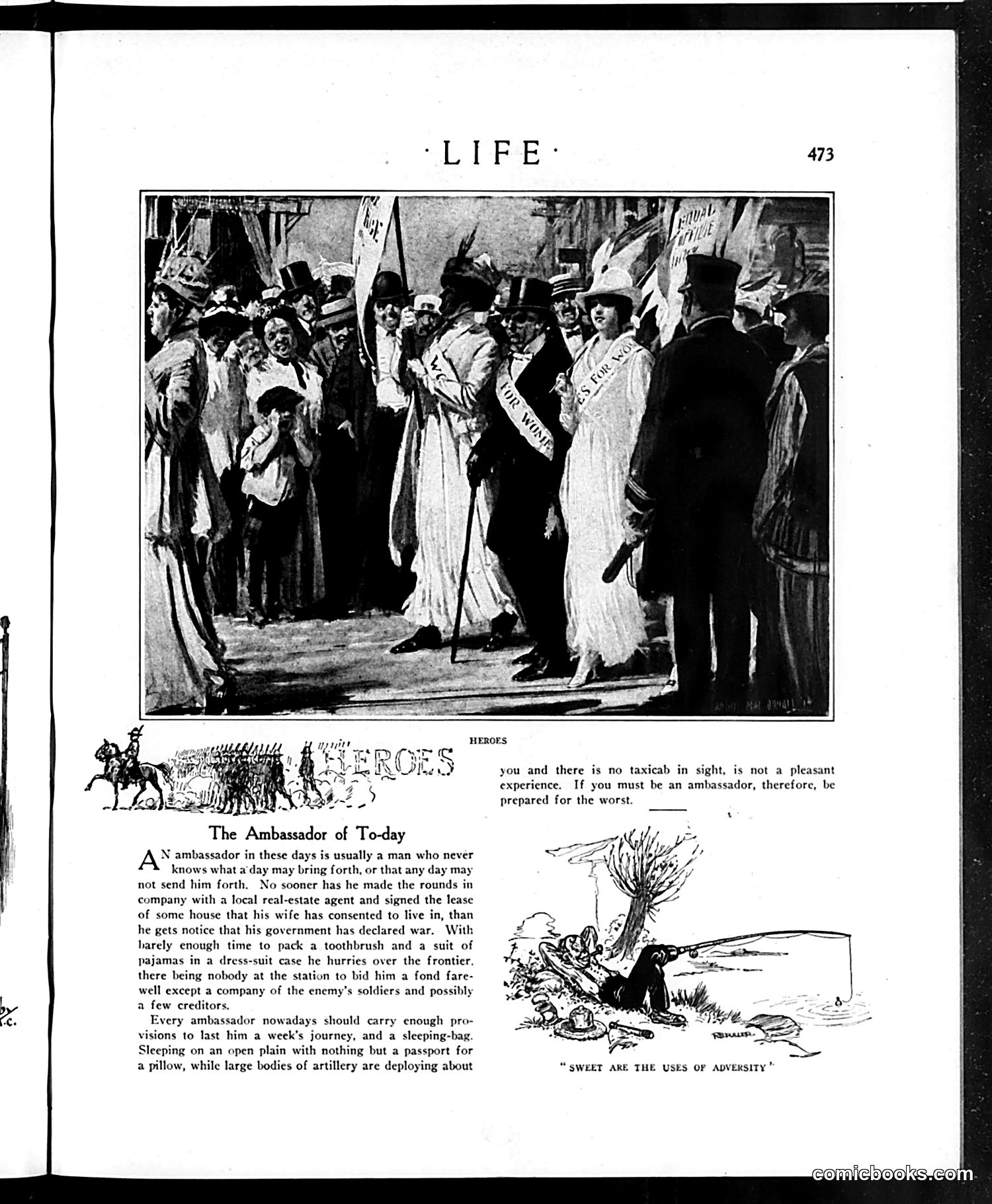
This satirical piece mocks modern diplomats during wartime (likely WWI era, given the context). The top illustration depicts a formal diplomatic procession with banners and officials in formal dress. The text humorously describes how an ambassador today has little warning before war breaks out—he must suddenly flee a posting he's just settled into, leaving behind a signed lease and his wife's new home. The satire emphasizes the ambassador's lack of control and preparation. The bottom illustration, captioned "Sweet are the uses of adversity," shows a soldier in distress, suggesting that wartime hardship affects more than just diplomats. The joke contrasts the ambassador's cushy lifestyle with soldiers' actual suffering in conflict.
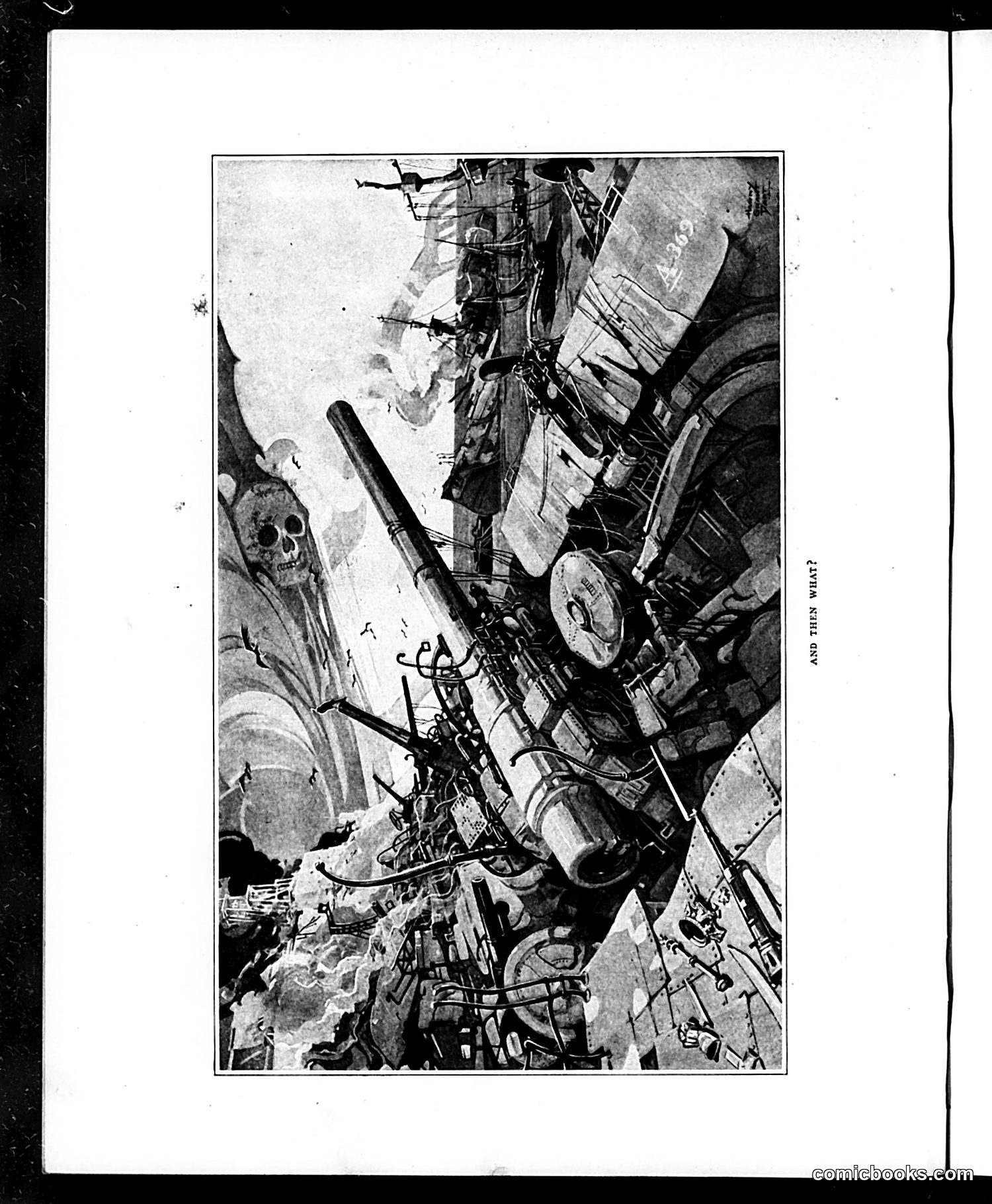
This appears to be a political cartoon from Life magazine, though the image is rotated and difficult to parse clearly in its current orientation. The visible text reads "AND THEN WHAT?" on the right margin. The illustration depicts what appears to be a chaotic wartime or military scene with ships, weaponry, and skeletal imagery (a skull is visible), suggesting themes of death and destruction. The composition and imagery strongly suggest this is anti-war or anti-militarism satire, likely from the World War I or interwar period, given Life magazine's active satirical commentary on such topics. However, without being able to identify specific caricatured figures or read additional caption text, I cannot definitively state which political figures or specific events this cartoon references. The "And then what?" caption suggests it's questioning the consequences or endpoint of military conflict.
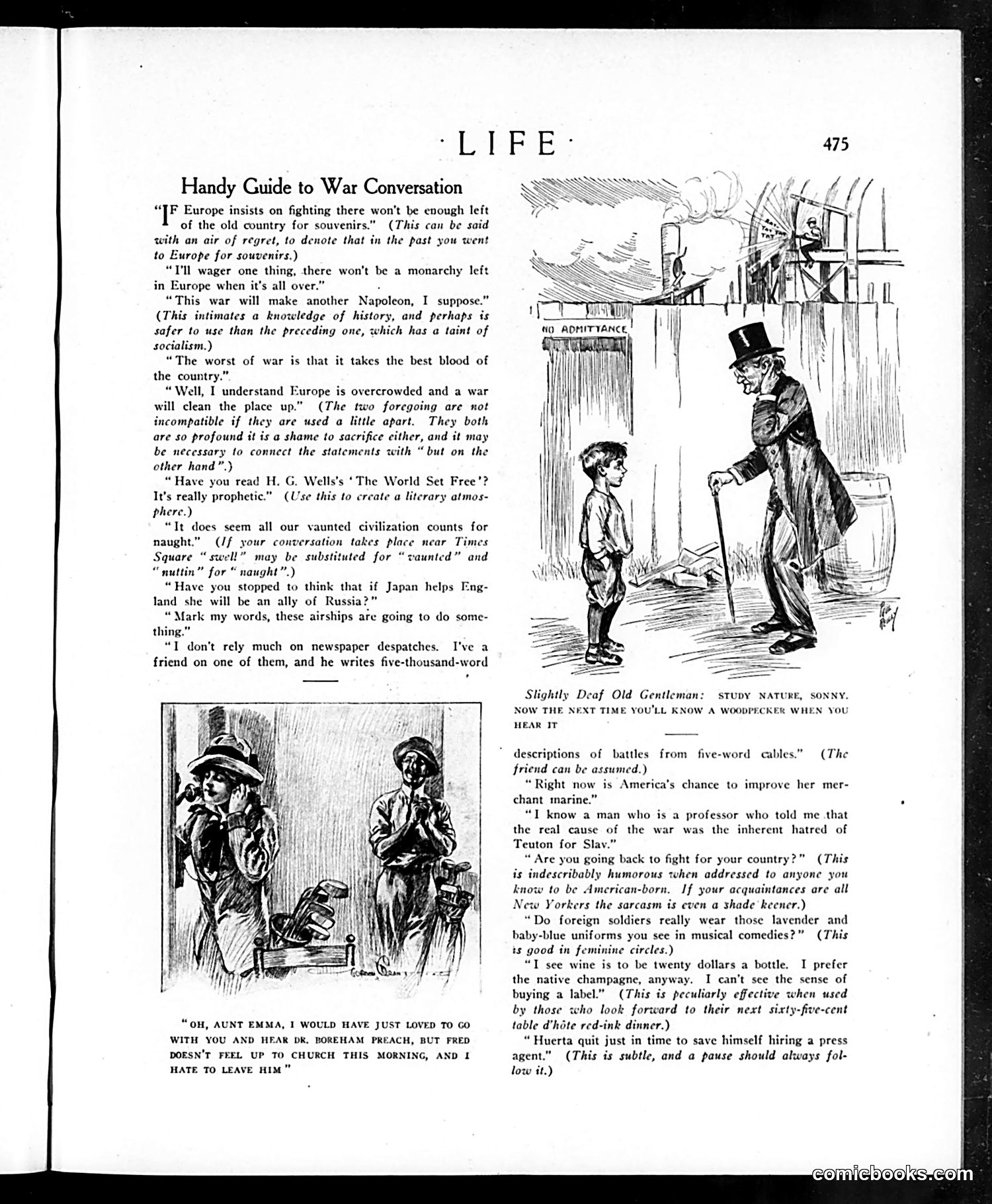
This page satirizes WWI-era conversations about the war's justifications and consequences. The "Handy Guide to War Conversation" mocks vapid talking points—politicians and socialites recycling hollow arguments about European overcrowding, Japan's role, and civilization's progress through bloodshed. The two cartoon illustrations depict social interactions where these platitudes are exchanged. One shows an elderly gentleman (likely representing the older generation who won't fight) lecturing a young boy, embodying the disconnect between those promoting war and those sacrificing lives. The satire targets the superficiality of war discourse: abstract rhetoric about "progress" masking brutal human cost. The editorial voice criticizes both newspaper propaganda and armchair strategists who discuss geopolitics while insulated from consequences. This reflects growing American skepticism about WWI justifications.
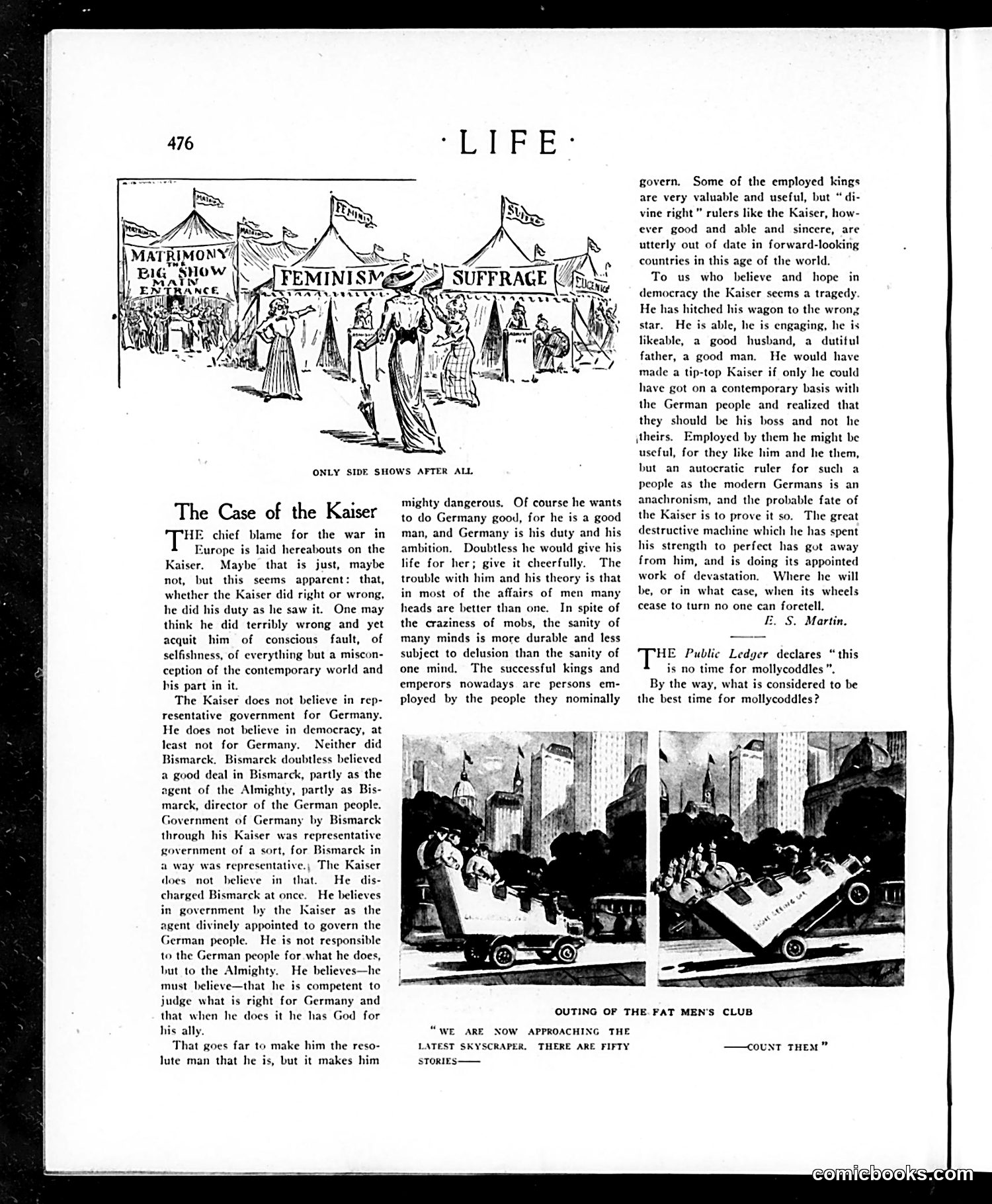
The main cartoon depicts a circus or carnival tent labeled with women's issues: "Matrimony," "Big Show," "Feminism," and "Suffrage." The caption reads "Only Side Shows After All," suggesting the artist dismisses these movements as mere entertainment rather than serious concerns. The accompanying article, "The Case of the Kaiser," criticizes German Emperor Wilhelm II's authoritarian rule, arguing he wrongly blames others for Germany's troubles while refusing representative government. The author contends the Kaiser's absolute power and belief in divine appointment make him unfit to govern, particularly in the modern democratic age. The two photographs below show the "Fat Man's Club" on an outing, with humorous captions about counting skyscrapers, apparently satirizing leisure activities.
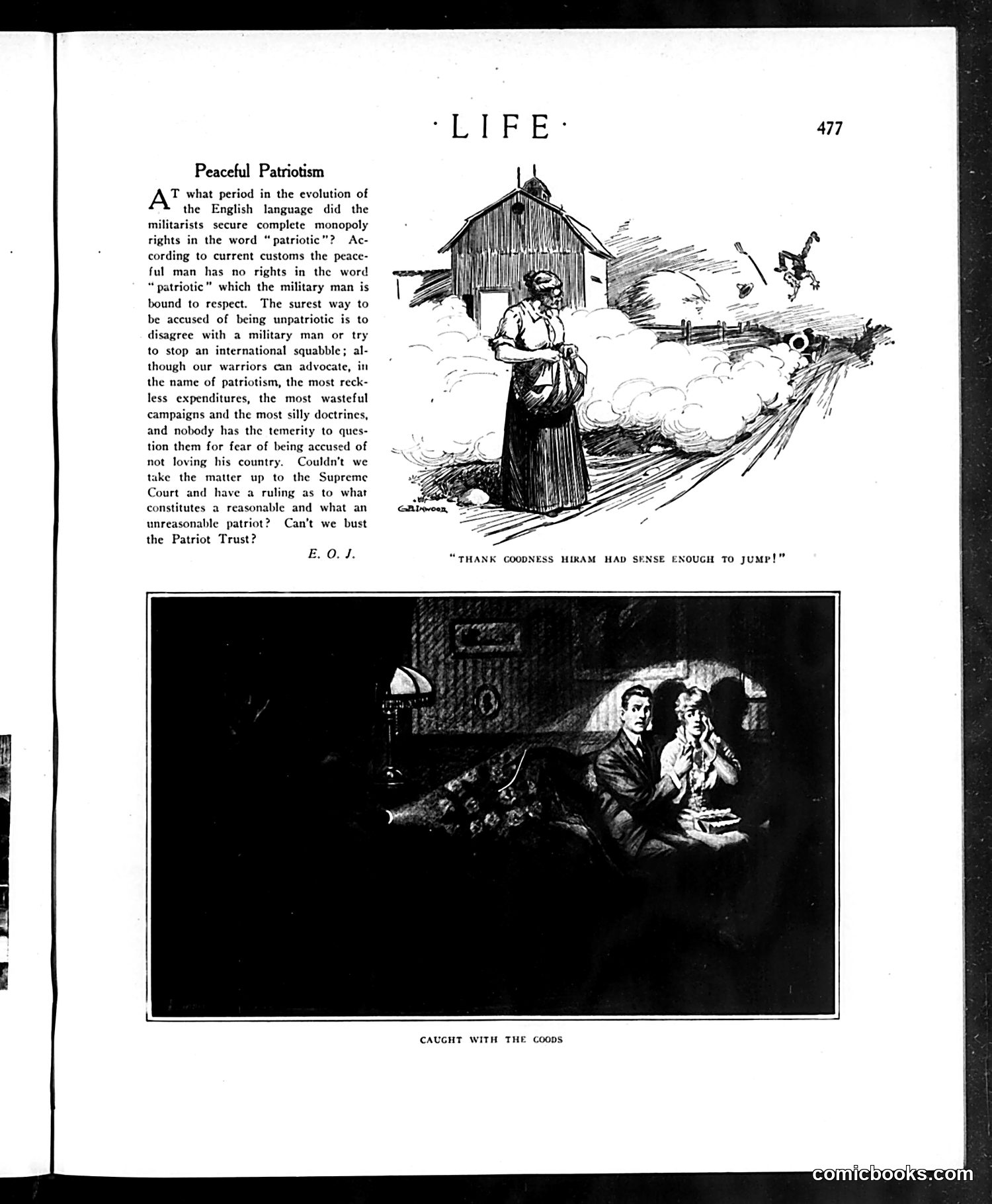
**"Peaceful Patriotism"** (top essay) argues that peacetime citizens shouldn't face accusations of being "unpatriotic" for questioning military decisions or advocating for less military spending. The author (signed E.O.J.) contends that disagreeing with the military doesn't equal disloyalty, and proposes the Supreme Court should define what constitutes "reasonable patriotism." **Top cartoon**: Shows a woman near a farmhouse with a runaway horse, captioned "Thank goodness Hiram had sense enough to jump!" — likely satirizing rural/agricultural life during wartime. **Bottom cartoon** titled "Caught with the Goods": Two men in darkness appear caught in criminal activity, satirizing wartime black-market or profiteering activities, a common concern during military conflicts. The page critiques both unquestioned militarism and wartime corruption.
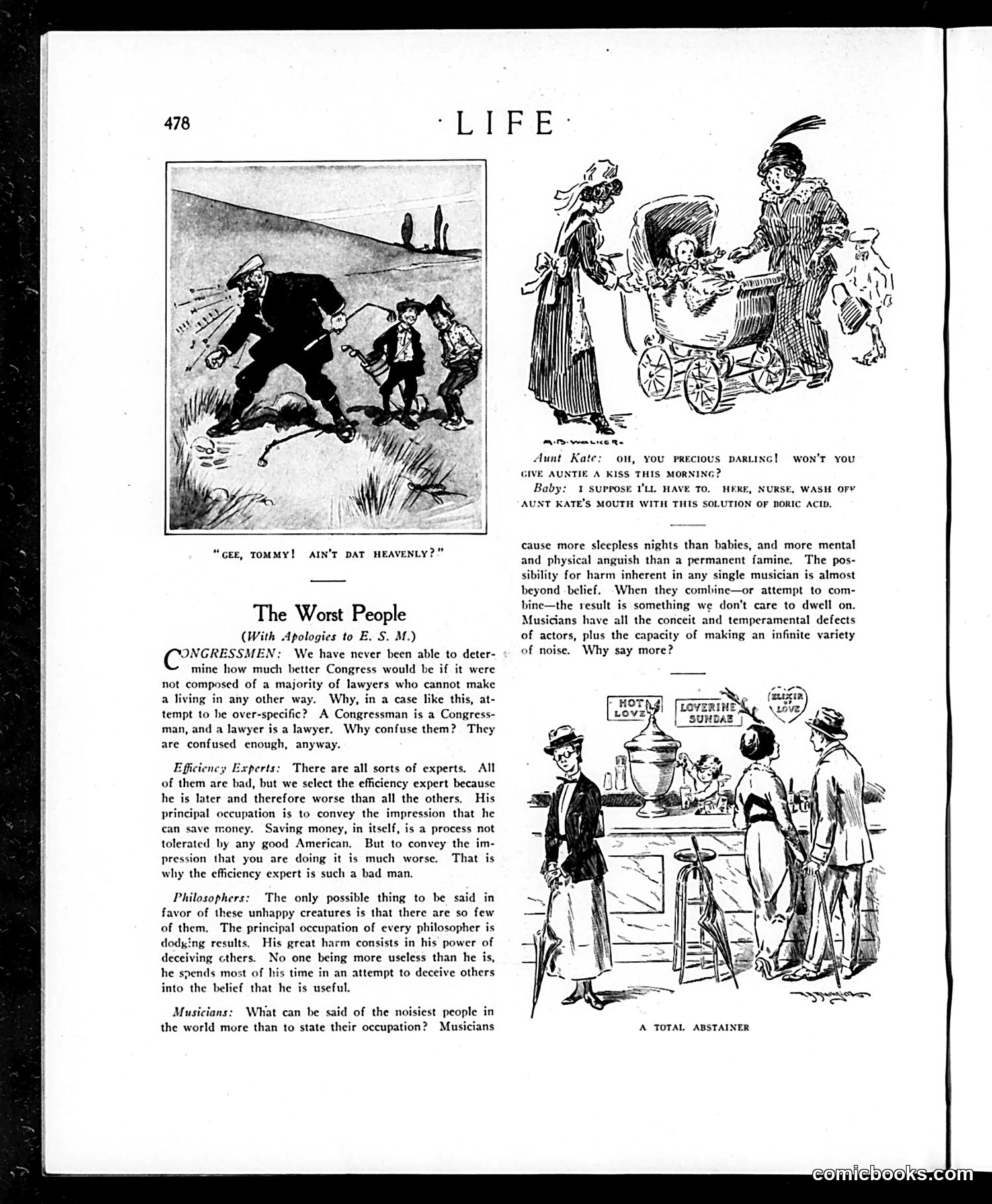
This page satirizes various "useless" professions through exaggerated character sketches. The headings—**Congressmen, Efficiency Experts, Philosophers, and Musicians**—each receive mocking critiques of their societal contributions. The text argues these groups cause more harm than good: congressmen confuse their roles, efficiency experts deceive people about saving money, philosophers waste time dodging results, and musicians are simply "noisy." The accompanying cartoons illustrate these points humorously. The bottom cartoon labeled "A Total Abstainer" shows what appears to be a social gathering, likely making a separate joke (unclear from context alone). This reflects early-20th-century American skepticism toward both institutional authority and expert culture—a common Life magazine theme mocking pretension and uselessness among educated elites.
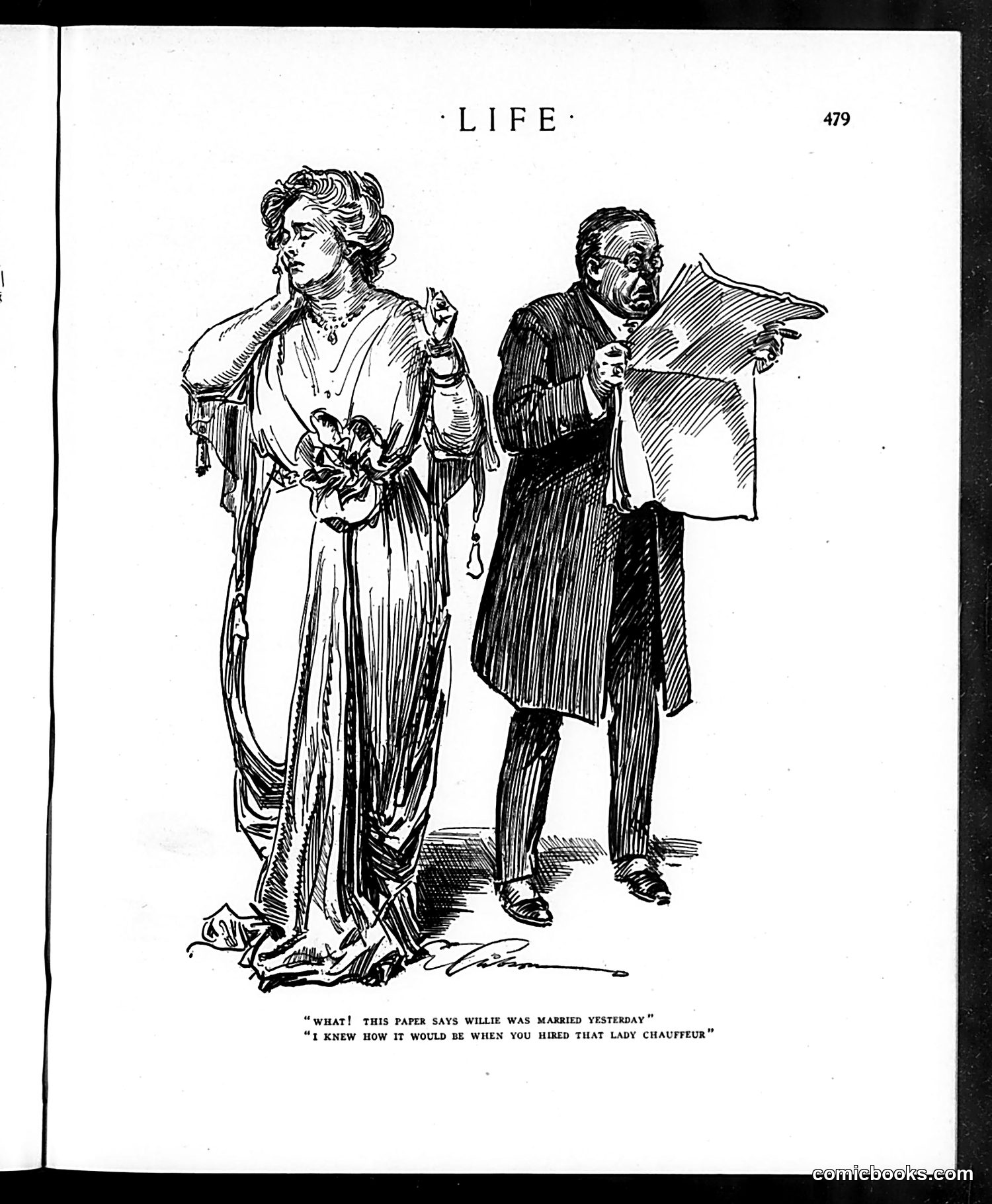
This is a single-panel cartoon from Life magazine (page 479) depicting two figures: a fashionably dressed woman on the left and a man in formal attire on the right holding a newspaper. The caption reads: "What! This paper says Willie was married yesterday" / "I knew how it would be when you hired that lady chauffeur" The joke hinges on a social scandal: the man's employee—a female chauffeur—apparently eloped with someone named Willie, and the man blames himself for hiring her. The satire targets early-20th-century class anxieties about "new women" in unconventional jobs. Hiring a female chauffeur (considered risqué) apparently led to moral complications. The woman's shocked expression and elaborate dress contrast with the man's dismay, emphasizing the social impropriety implied by the situation.
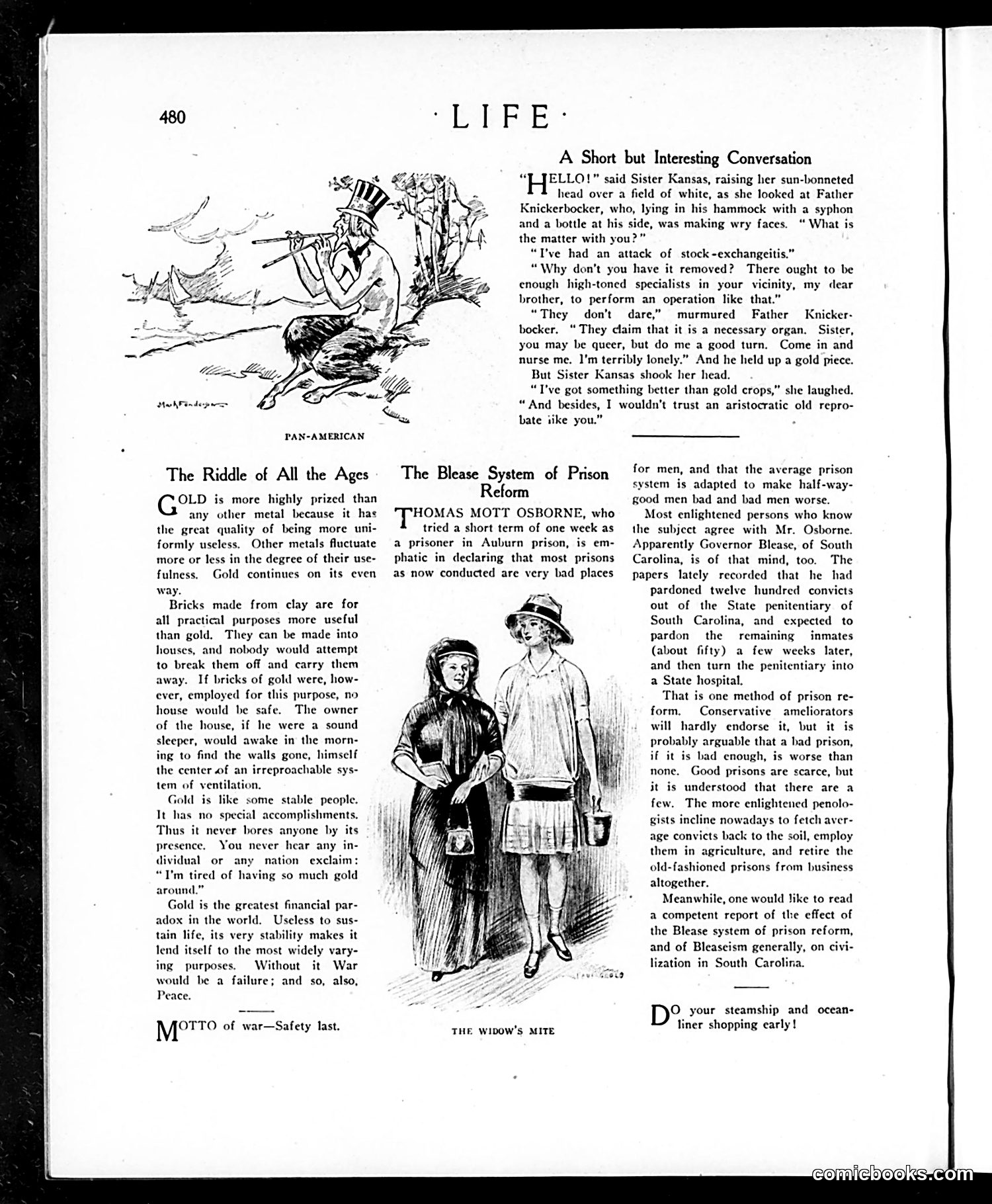
This page contains three distinct pieces of satire: **"A Short but Interesting Conversation"** depicts "Sister Kansas" (representing rural/agricultural America) conversing with "Father Knickerbocker" (representing New York/urban finance). Knickerbocker suffers from "stock-exchangeitis"—a satirical disease representing financial speculation and market instability. Kansas, more prosperous from crops, refuses his gold and aristocratic pretensions, mocking urban elites' dependence on unstable financial systems. **"The Riddle of All the Ages"** is a philosophical essay praising gold's paradoxical uselessness—it serves no practical purpose yet remains universally valued. The satire critiques society's obsession with an inherently worthless metal while ignoring truly useful materials like brick. **"The Blease System of Prison Reform"** discusses Governor Cole Blease of South Carolina's controversial approach: mass pardoning convicts (1,200+) rather than reforming prisons. The article presents this as either radical prison abolition or acknowledgment that bad prisons are worse than none—though reform advocates prefer agricultural rehabilitation over traditional incarceration. All three pieces satirize American society's values and contradictions.
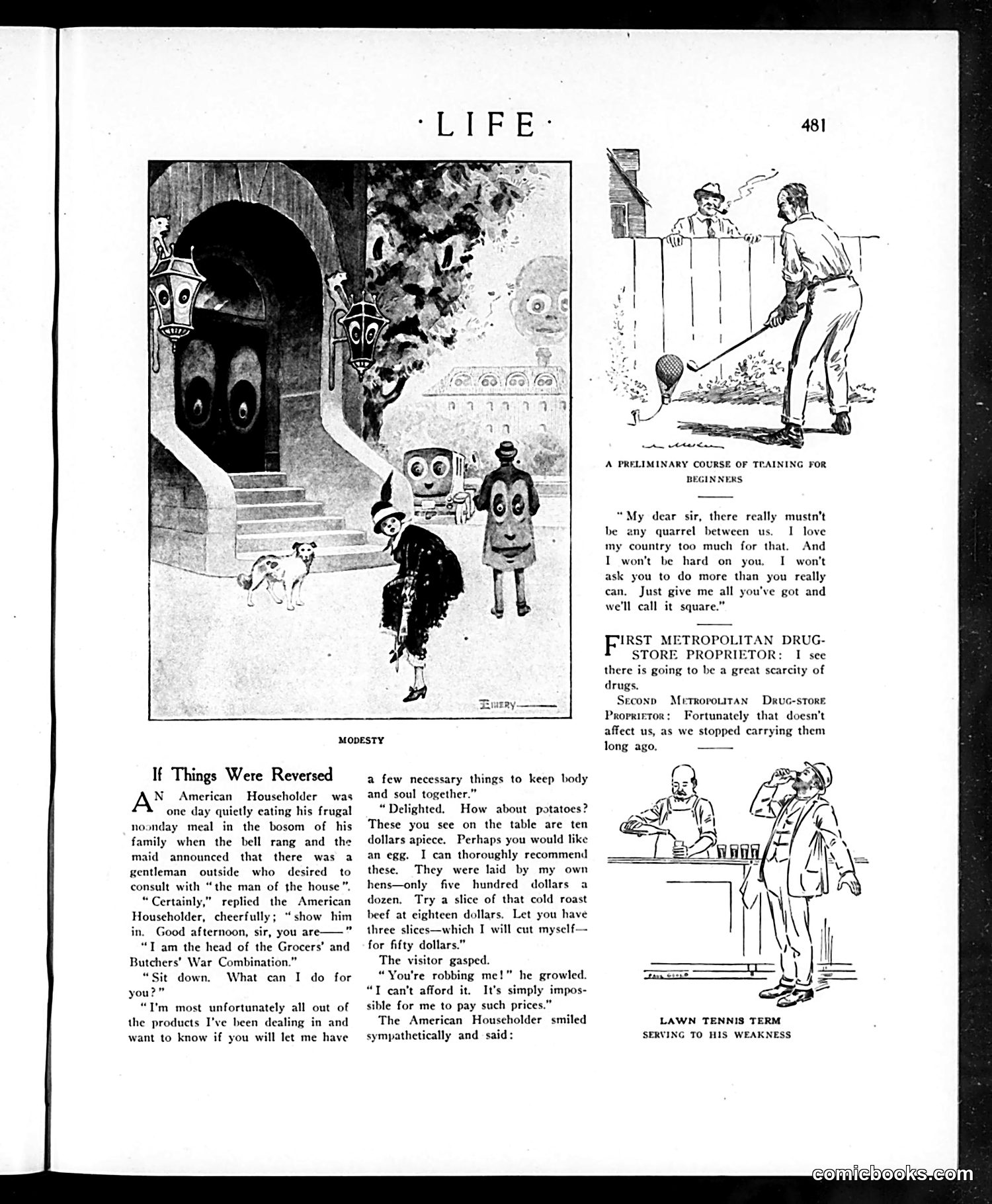
**"If Things Were Reversed"** satirizes wartime profiteering and price-gouging. A grocer/butcher cartel representative visits a householder seeking food credit. The householder reverses roles, demanding extortionate prices (potatoes at $10 each, eggs at $500/dozen, roast beef at $50 for three slices). The satire suggests that just as grocers exploited consumers through inflated wartime prices, consumers would exploit grocers if positions were reversed. The householder's final line—"Just give me all you've got and we'll call it square"—mirrors predatory merchant practices of the era. The page also includes lighter cartoons: "A Preliminary Course of Training for Beginners" (golf instruction), and "Lawn Tennis Term Serving to His Weakness" (sporting humor). A brief drugstore joke references wartime shortages. The content reflects WWI-era concerns about merchant monopolies and price controls during scarcity.
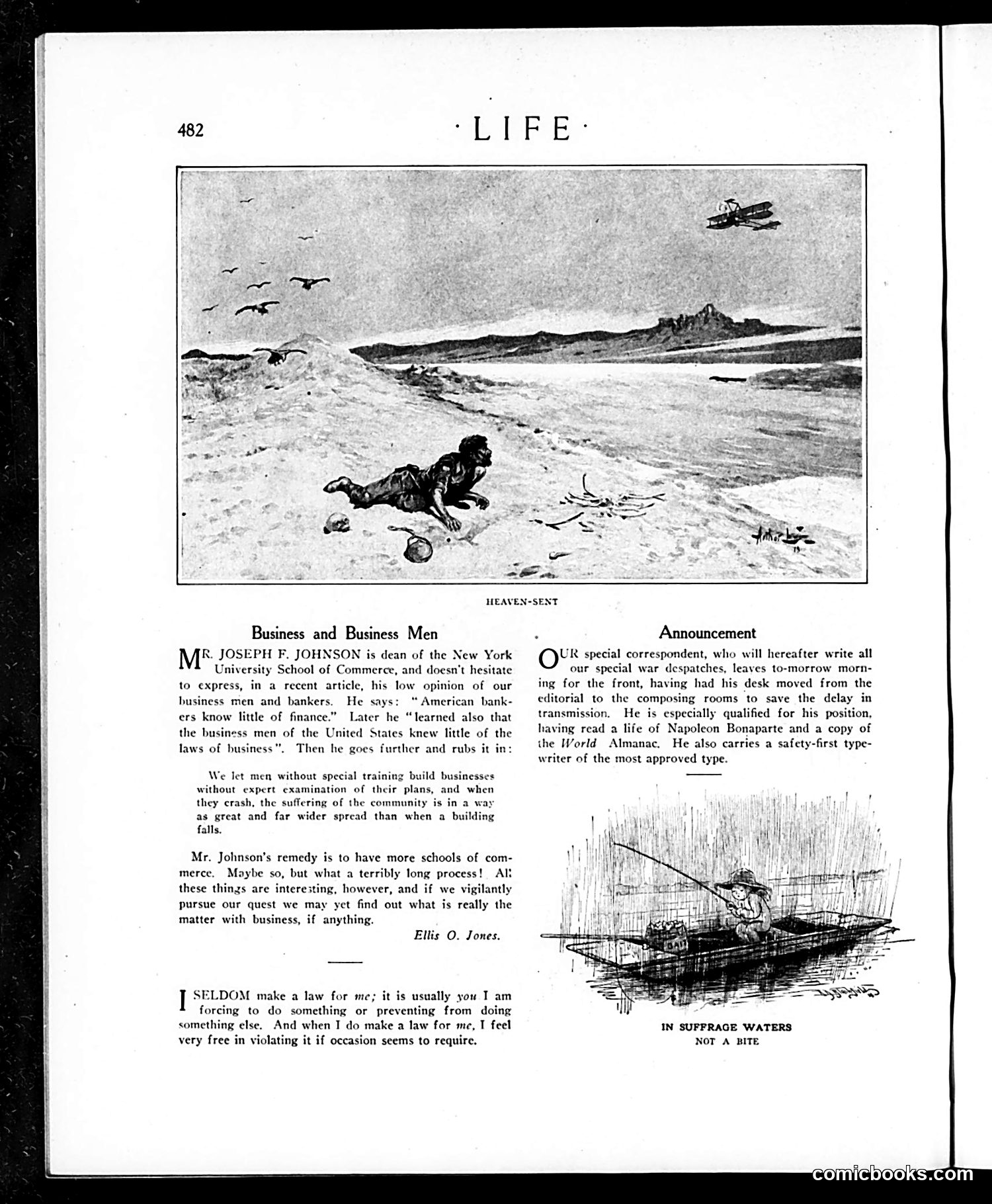
This Life magazine page contains social commentary and satire from the WWI era. **"Business and Business Men"** critiques Joseph F. Johnson, dean of NYU's Commerce School, who publicly criticized American bankers and businessmen as ignorant of finance and business law. The author Ellis O. Jones sarcastically agrees that Johnson's solution—more business schools—seems "a terribly long process," implying the real problems with American business run deeper than education can fix. **"Heaven-Sent"** (top illustration) appears to show a soldier under fire, with an airplane overhead and birds flying—likely commenting on military incompetence or the chaos of modern warfare. **"In Suffrage Waters—Not a Bite"** (bottom illustration) is a joke about women's suffrage activism. The fishing metaphor suggests suffragettes are "fishing" for political rights but "not getting a bite"—meaning their efforts yield no results. This reflects contemporary skepticism about the women's suffrage movement (which succeeded in the U.S. in 1920, shortly after this publication). **"Announcement"** satirizes war correspondents as unqualified, needing only Napoleon books and an "Almanac" to report from the front.
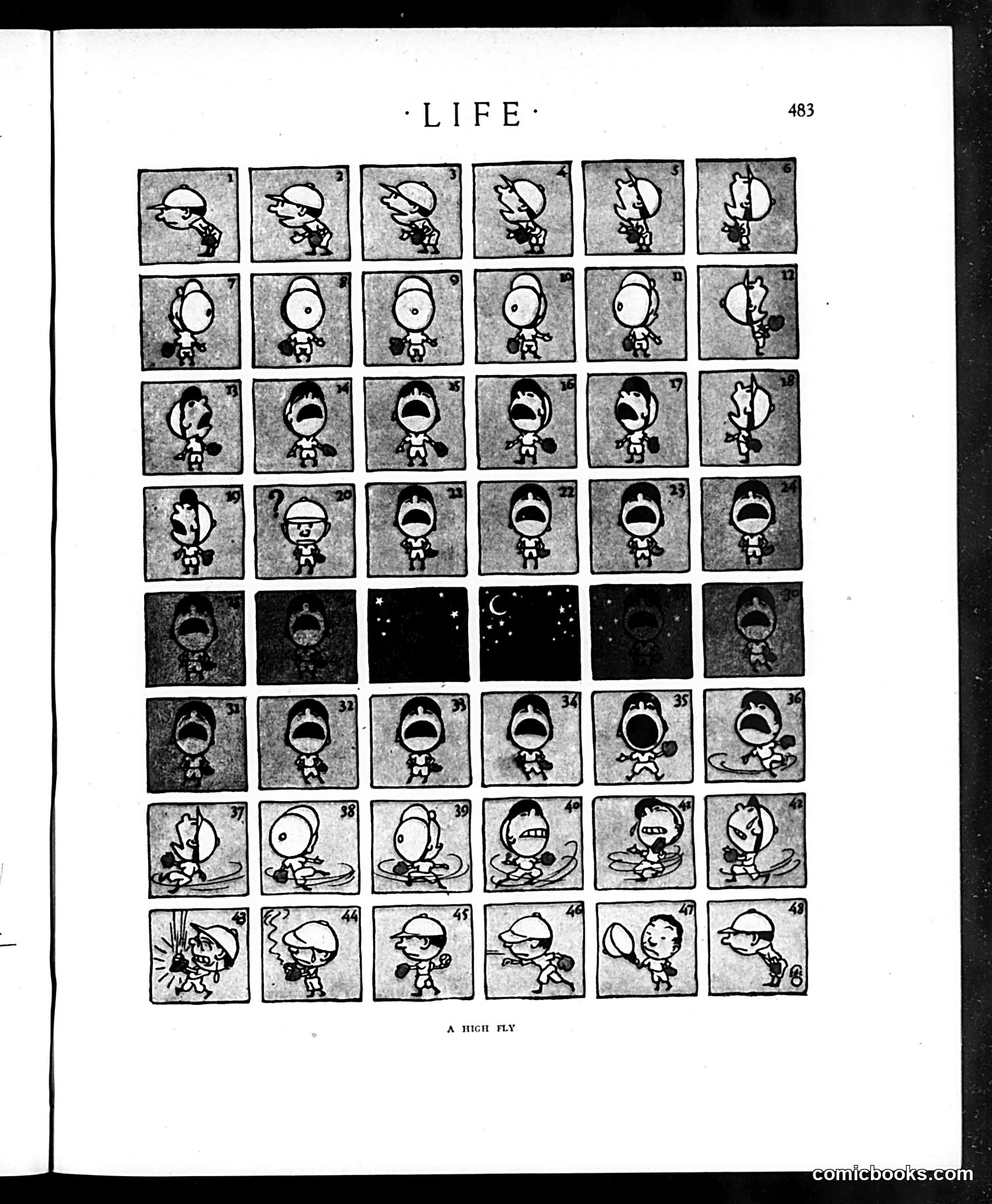
This is a sequential comic strip showing a small character attempting to catch a ball or object. The strip progresses through approximately 49 numbered panels across eight rows. The narrative appears to show the character's escalating efforts and failures—starting with attempts to catch the object, progressing through various comedic mishaps, and culminating in increasingly frantic or chaotic scenes. The middle panels show the character at night (indicated by the dark panels with stars and moon), suggesting the action continues across day and night. The title "A High Fly" suggests this depicts someone chasing or trying to catch something that keeps eluding them—likely a baseball reference given the era's context. The humor derives from the mounting absurdity and physical comedy of repeated failure across the extended sequence.
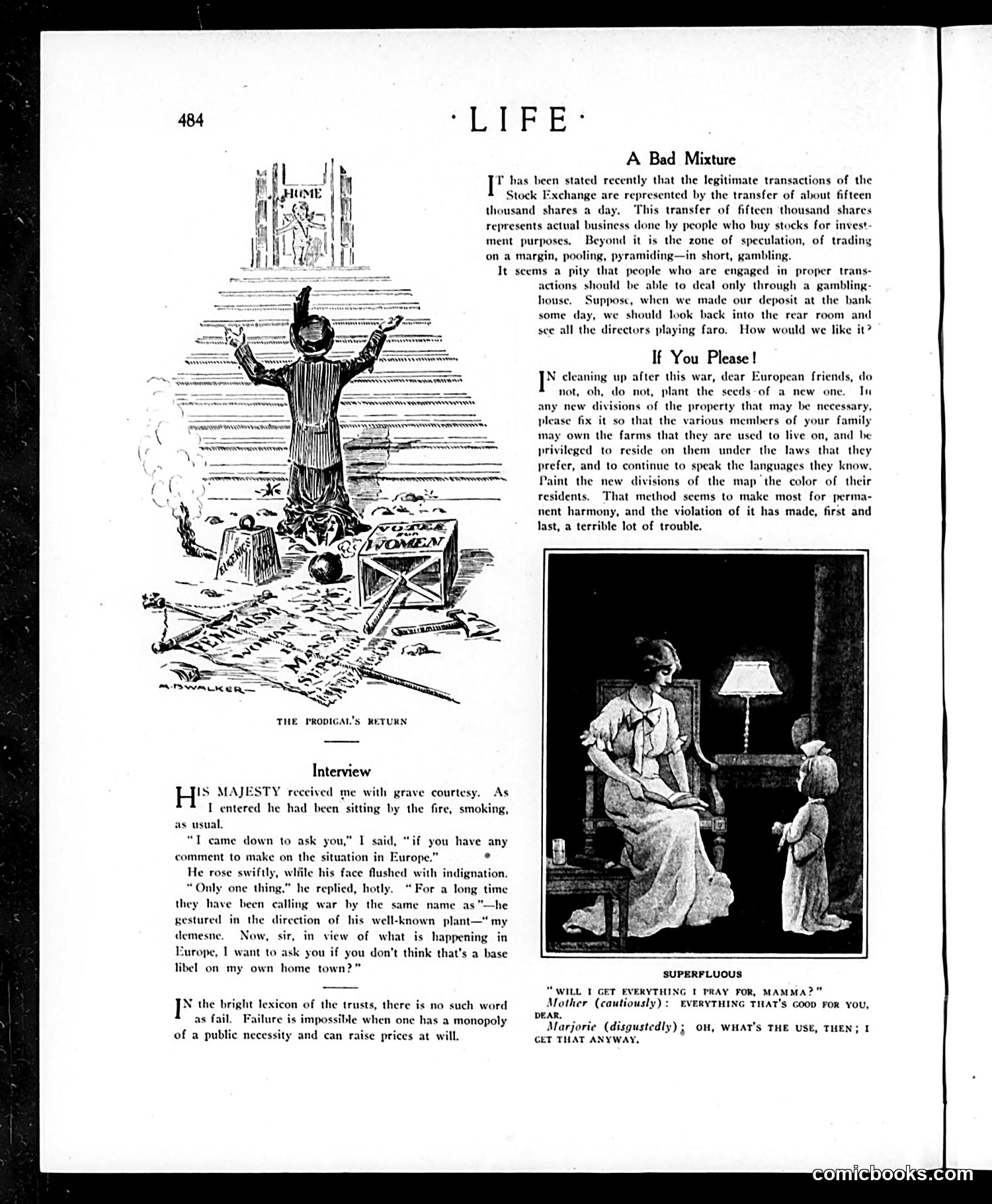
**"The Prodigal's Return"** (left cartoon): Shows a figure emerging from destruction labeled "JUNE" (likely June 1918, end of WWI), arms raised triumphantly above rubble marked "WOMEN." The satire criticizes how war profiteers and speculators celebrated while civilians—particularly women—suffered the war's devastation. **"A Bad Mixture"** (text): Criticizes the Stock Exchange for mixing legitimate investment (15,000 shares daily) with rampant speculation, margin trading, and gambling. The banking analogy—depositors wouldn't tolerate directors playing faro in the bank's rear room—argues that allowing speculation through legitimate institutions corrupts them. **"If You Please!"** (text): Post-WWI plea to European nations: redraw boundaries respecting existing property ownership, residence laws, and language preferences to prevent future conflicts born from imposed divisions. **"Interview" and "Superfluous"** (bottom): Brief satirical pieces on wealth, privilege, and children's expectations—minor commentaries on post-war social attitudes.
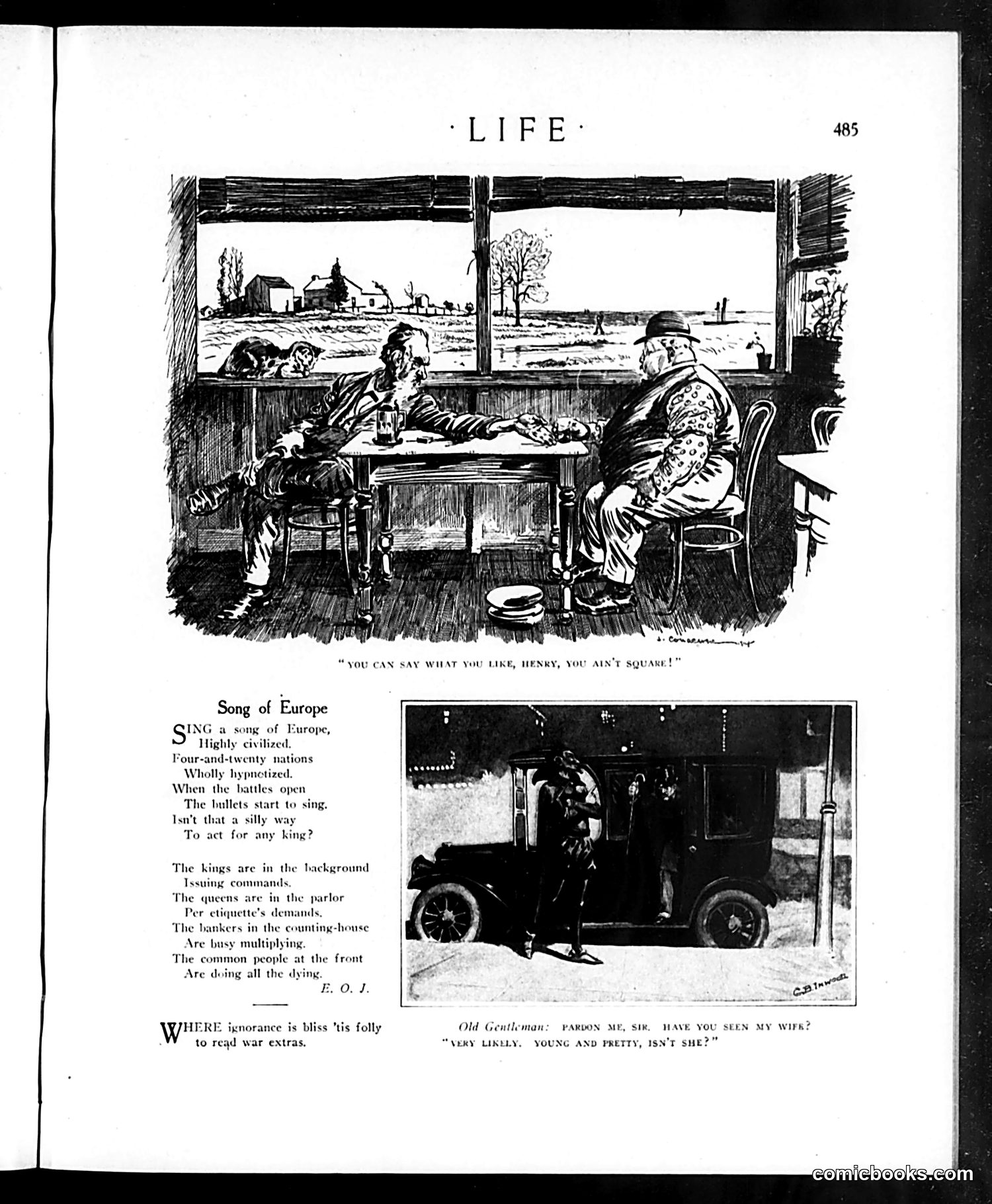
This page contains WWI-era satire criticizing the war's social hierarchy and its human cost. **Top cartoon:** Two men in a rural setting discuss the war. The speaker asserts freedom of speech ("You can say what you like, Henry, you ain't square"), suggesting open debate about the conflict was considered patriotic loyalty. **"Song of Europe" poem:** A scathing critique of wartime social order. It mocks how kings command from safety while "common people at the front are doing all the dying." Queens maintain etiquette, bankers profit ("busy multiplying"), and soldiers die—exposing the disparity between rulers and the working-class soldiers bearing the war's actual cost. **Bottom cartoon:** An older gentleman seeks his missing wife; another man assumes she's young and pretty. The caption ironically references the previous poem's theme: while aristocrats and wealthy pursue leisure, ordinary people lose family members to war. Together, the page satirizes the hypocrisy of wealthy leadership profiting from conflict while ordinary citizens suffer the consequences.
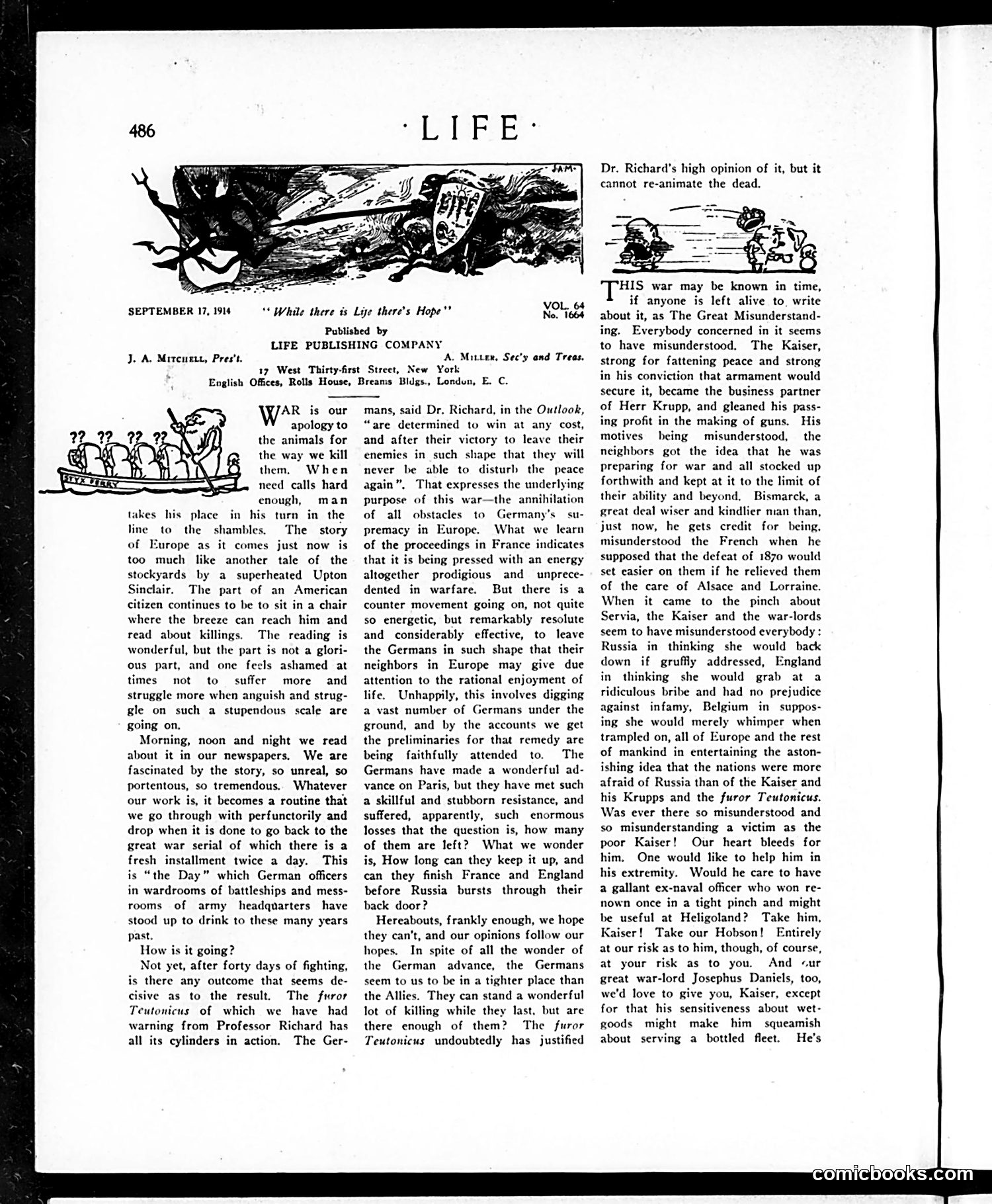
This editorial page comments on the early weeks of World War I (which began in August 1914). The cartoons—showing soldiers in a boat and marching figures—illustrate the article's grim tone comparing warfare to slaughterhouses. The text critiques German war aims, citing "Dr. Richard" (likely a contemporary expert) on German determination to win "at any cost" and eliminate European rivals. The author notes Germany's "wonderful advance on Paris" met fierce Allied resistance, questioning German sustainability: "are there enough of them?" The piece expresses American anxiety about prolonged conflict, particularly whether Russia might attack Germany's rear. The title—"While there is Life there's Hope"—ironically frames the war as a brutal industrial process. The concluding point is darkly pragmatic: German military doctrine ("furor Teutonicus") cannot resurrect the dead, suggesting the war's horrific human cost will ultimately defeat even Germany's determination.
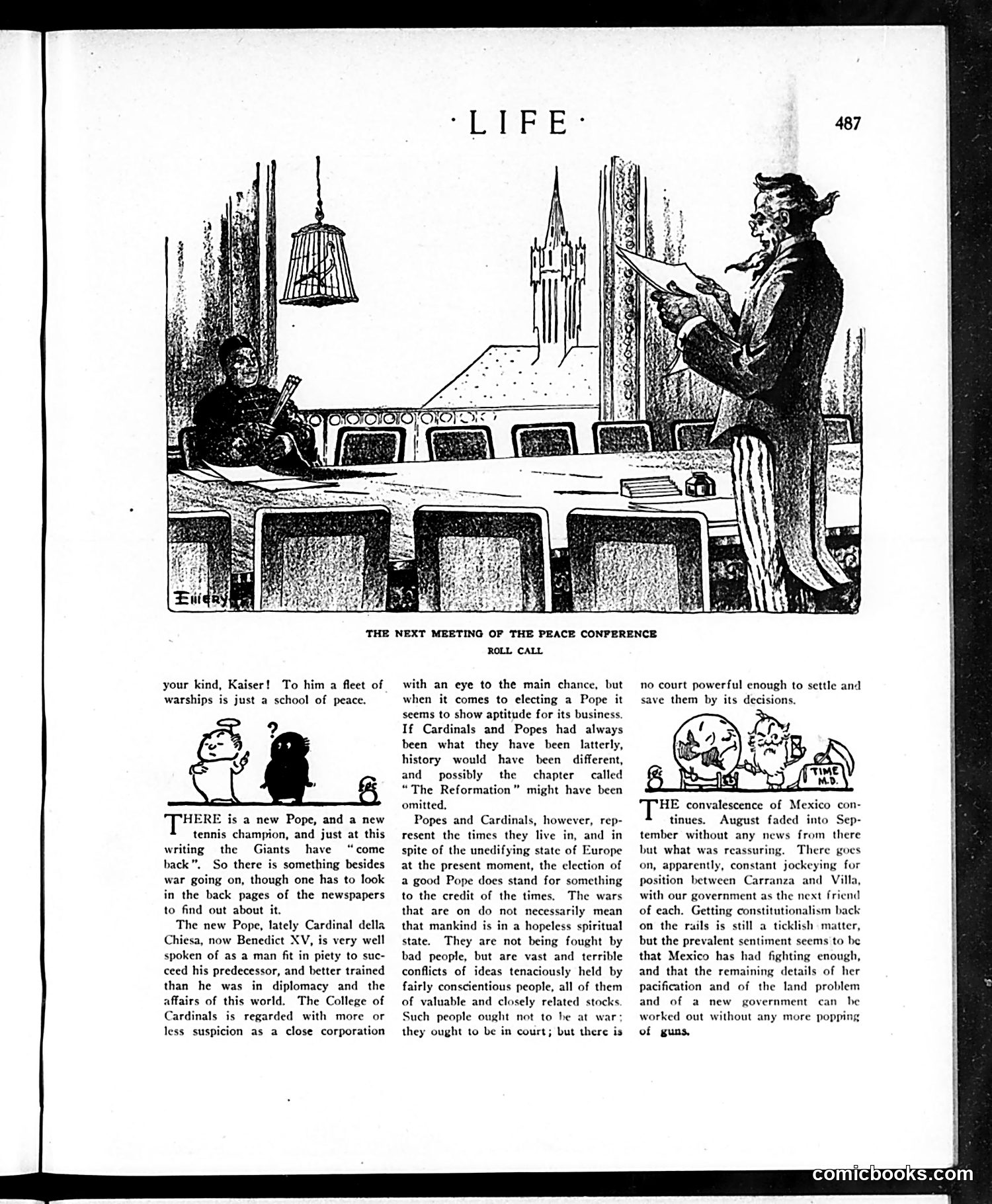
This page contains two separate satirical pieces from the WWI era (circa 1914-1915, based on references to a new Pope and Mexico's ongoing instability). **Top cartoon**: "The Next Meeting of the Peace Conference" mocks Kaiser Wilhelm II's claims of peaceful intent. The visual shows the Kaiser at a peace conference table while holding what appears to be a military document, with the caption sardonically suggesting his "fleet of warships is just a school of peace"—meaning his actions contradict his words about seeking peace. **Main article**: Discusses the election of Pope Benedict XV (Cardinal della Chiesa), arguing that good leadership matters even amid war. It reflects contemporary American anxiety about whether Europe's conflict represents moral failure or conscientious disagreement between worthy peoples. **"Roll Call" section**: Updates readers on Mexico's political situation under Carranza and Villa, expressing cautious optimism that fighting has ceased and constitutional governance can resume without further violence. The overall tone reflects American neutrality-era concerns: skepticism of warring powers' sincerity, hope for institutional stability, and interest in international affairs.
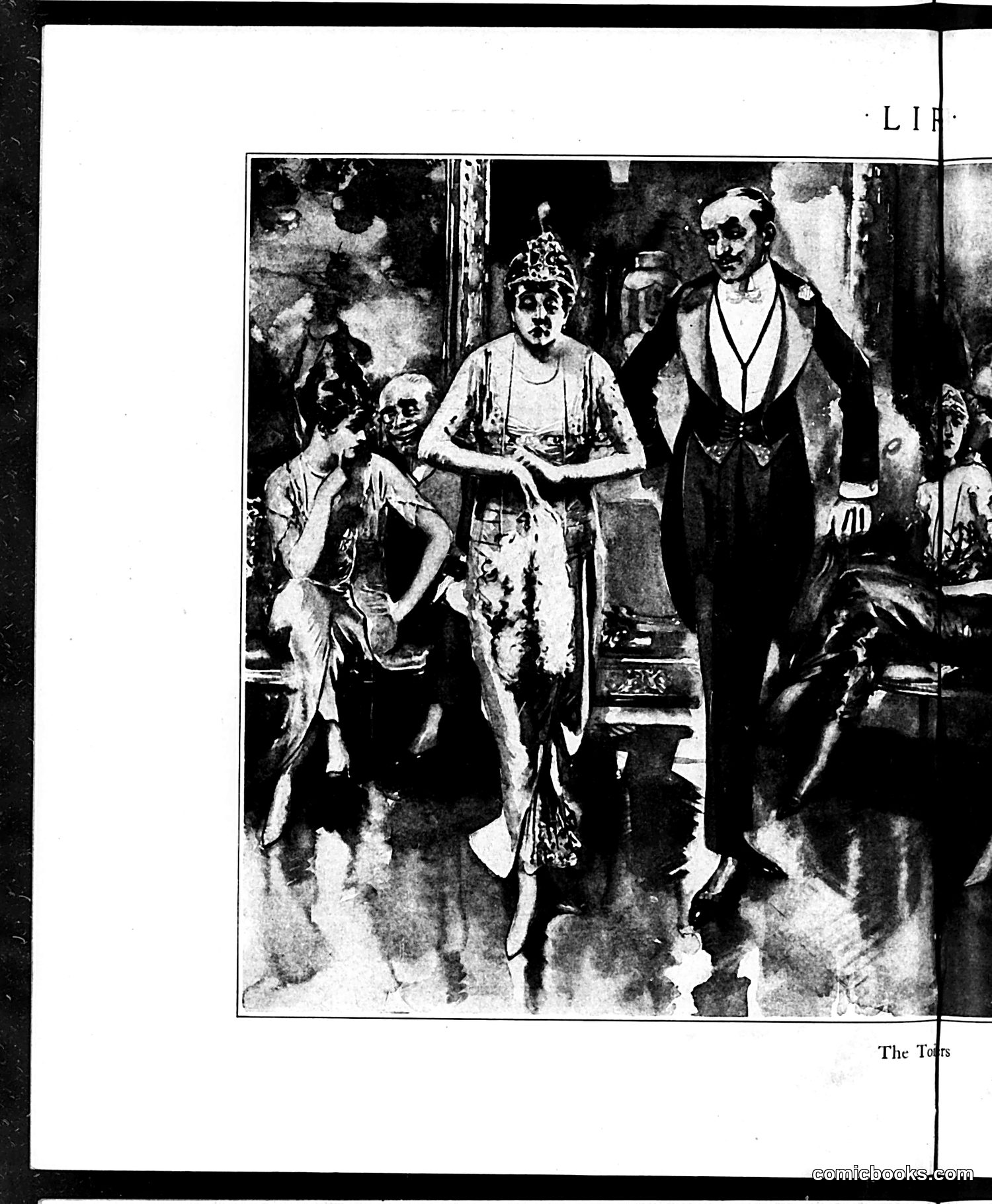
This appears to be a scene from a theatrical or operatic production, likely depicting a dramatic moment of entrapment or predicament—suggested by the caption "The Toils" (meaning snares or traps). The image shows multiple figures in period costume: a central figure in classical/mythological dress appears distressed or trapped, surrounded by other elaborately dressed characters in what seems to be an interior palace or temple setting. The formal dress and theatrical staging suggest this references a classical drama or opera. Without the magazine's date or additional context visible, I cannot identify which specific production this illustrates. The scene's composition and the caption suggest satire about being caught in difficult circumstances, possibly with social or political undertones typical of *Life* magazine's satirical approach, but the exact reference remains unclear from this page alone.
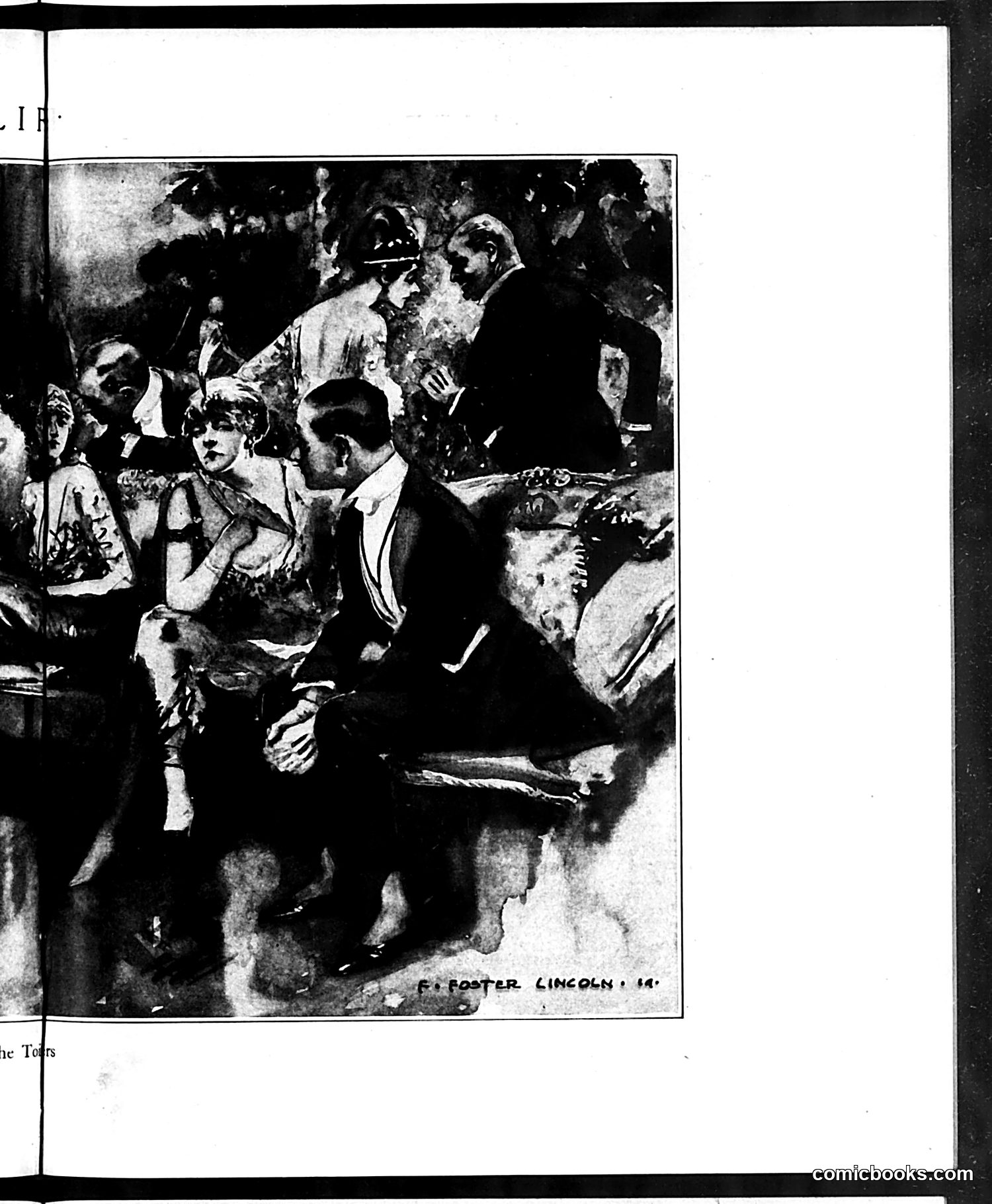
This appears to be a formal social gathering or reception from the early 20th century, based on the clothing and photographic style. The caption reads "F.I. FOSTER LINCOLN-14," indicating this is photograph 14 from F.I. Foster's Lincoln collection. The image shows well-dressed men and women in formal attire at what appears to be an indoor event. Without additional context or visible satirical elements in the image itself, I cannot definitively identify specific political figures or determine the intended satire. The photo documents a social scene, but the OCR text provides minimal context. To properly explain the cartoon's meaning and political commentary for a modern reader, I would need clearer text, captions, or visible satirical elements identifying the specific figures or event being referenced.
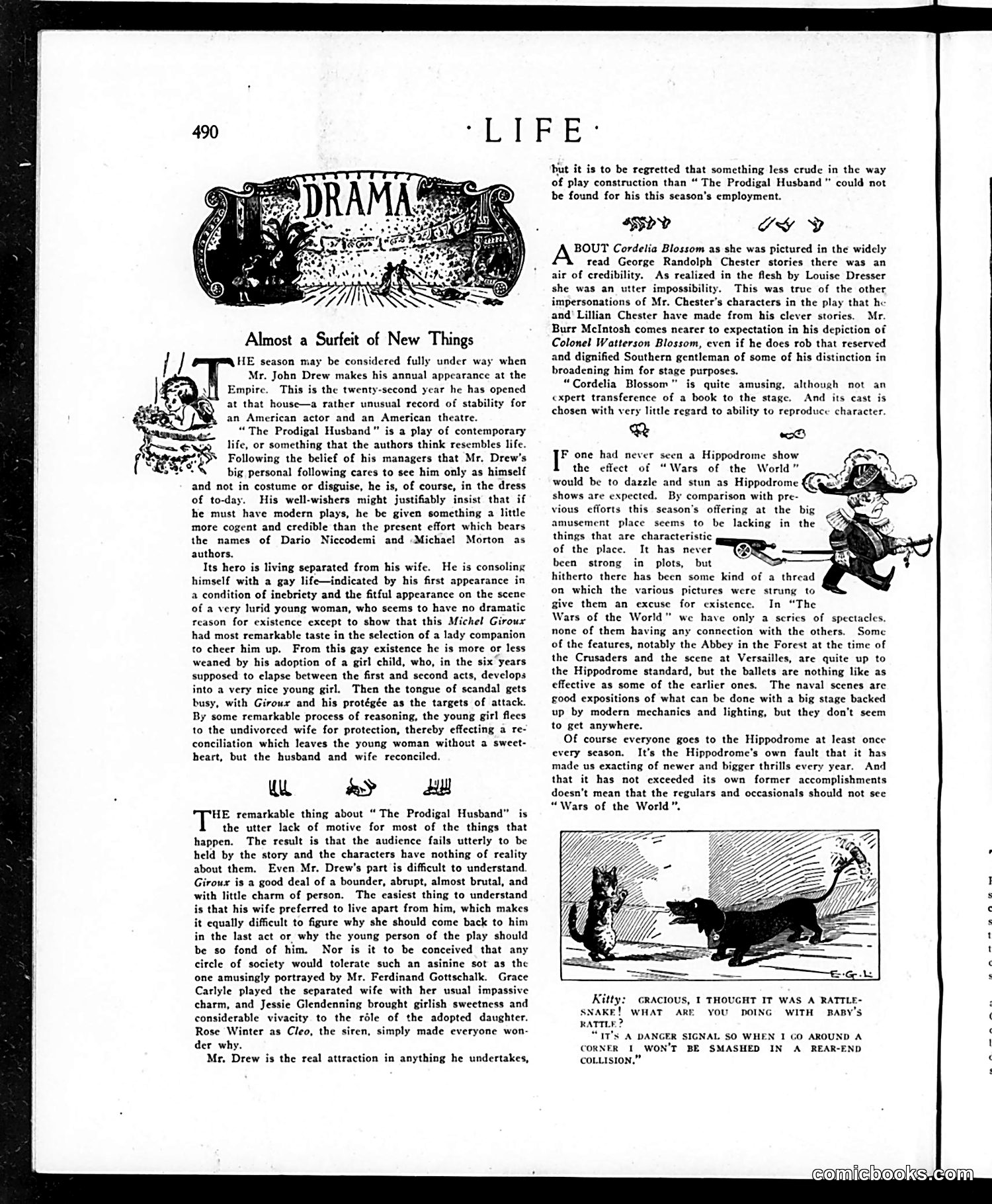
This page reviews two Broadway productions from the early 1900s featuring established actors of the era. **"The Prodigal Husband"** stars John Drew (in his 22nd season at the Empire Theatre), playing a contemporary character—a separated man living a dissolute lifestyle who adopts a child and is eventually reconciled with his wife. The critic harshly judges the play as poorly constructed with unmotivated plot developments and characters lacking believability. Drew himself is praised as the attraction, but the reviewer regrets he wasn't given better material. **"Cordelia Blossom"** (adapted from George Randolph Chester stories) features Louise Dresser. The critic finds her portrayal unconvincing compared to how the character appeared in the original stories, though Burr McIntosh's performance as Colonel Watterson Blossom is deemed more successful. The reviews are dismissive of both plays' dramatic quality while acknowledging the actors' star power as their main appeal.
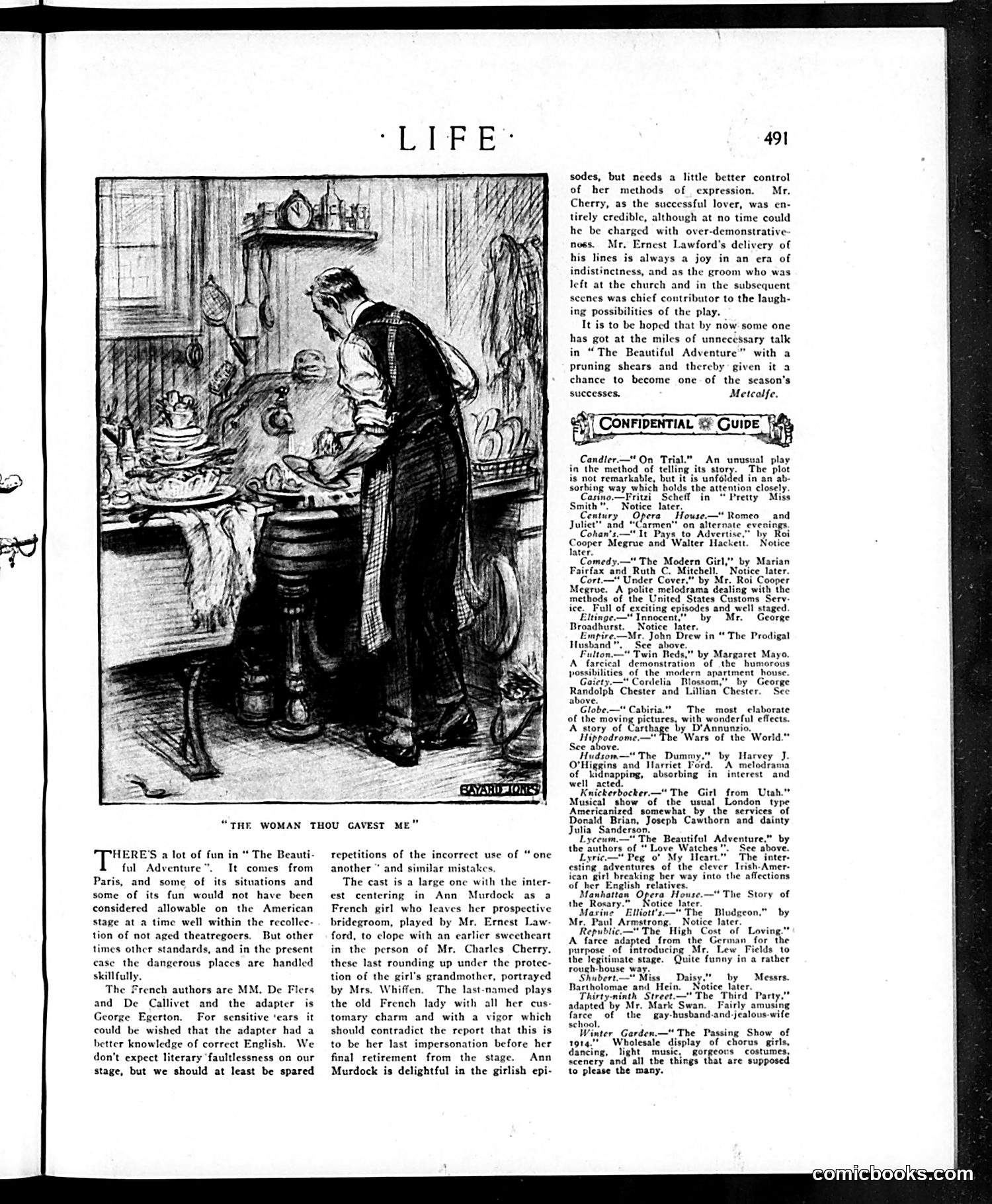
This page reviews "The Beautiful Adventure," a French play adapted for American audiences. The illustration shows a domestic scene—likely depicting the play's central plot about a woman choosing between suitors. The review praises the cast, particularly Ann Murdock (the French girl), Ernest Lawford (the jilted groom), and Charles Cherry (her former lover). Mrs. Whiffen earns special commendation for her grandmother role. The critic notes the play contains situations formerly considered unsuitable for American theater but now acceptable ("other times other standards"). However, he critiques the adapter's English grammar and suggests the script needs editing—it contains unnecessary dialogue that should be "pruned" to help it become a season's success. The remainder lists current theatrical offerings, mixing stage productions with moving pictures like "Cabiria."
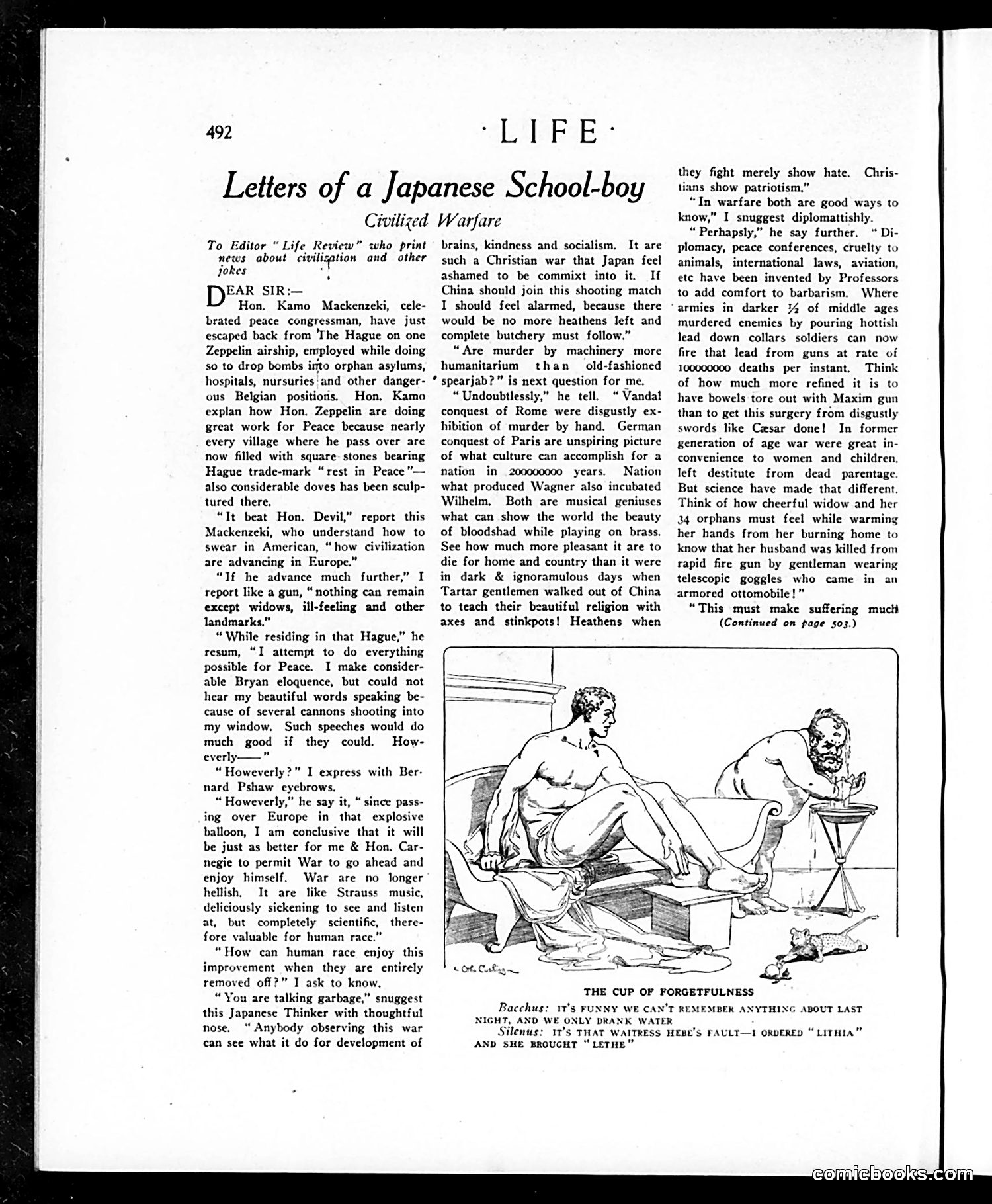
This satirical piece mocks the hypocrisy of claiming World War I represents "civilized" progress. A Japanese correspondent describes meeting Hon. Kamo Mackenzeki, a peace advocate who paradoxically bombs orphanages from a Zeppelin while praising warfare's "scientific" humanity. The satire exposes the era's contradictions: characters argue that machine guns are more "refined" than swords, that Wagner and German culture justify brutality, and that Christian warfare is superior to "heathen" combat. They celebrate how modern artillery kills more efficiently while claiming this benefits humanity's moral development. The accompanying cartoon, "The Cup of Forgetfulness," depicts mythological figures unable to remember events—symbolizing society's convenient amnesia about war's actual horrors. The piece ridicules how Western powers rationalized industrial-scale killing during WWI using pseudo-intellectual arguments about progress, civilization, and Christian values—all transparently absurd.
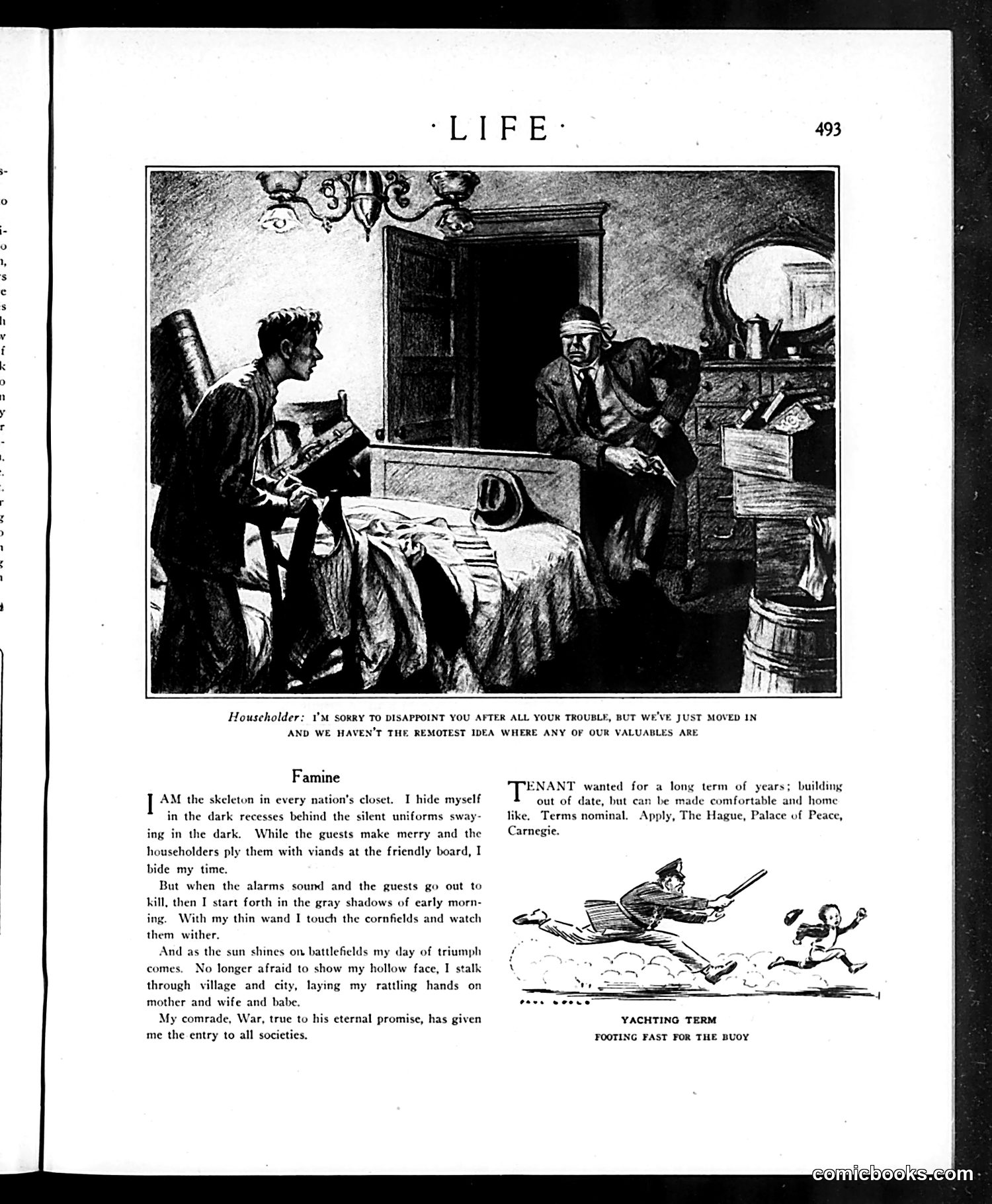
**Top Cartoon:** A householder apologizes to a burglar, explaining they just moved in and don't know where valuables are. This is a visual joke about the inconvenience of moving. **"Famine" Essay:** A personified allegory where Famine speaks as "the skeleton in every nation's closet"—a hidden shame. The piece explicitly connects Famine to War, stating they are "comrades." Famine claims War grants it access to all societies, appearing during armed conflicts to devastate crops and kill civilians (mothers, wives, children). This is anti-war commentary: the essay argues that war inevitably produces famine as a companion catastrophe, making both inseparable consequences of militarism. **Housing Advertisement:** A rental listing describes a building as "out of date" but improvable, with "nominal" terms. It's addressed to "The Hague, Palace of Peace, Carnegie"—satirizing international peace institutions as potential tenants for Famine itself, suggesting these organizations have failed to prevent war-caused suffering. **"Yachting Term" Cartoon:** A small humorous illustration, likely a pun about nautical terminology.
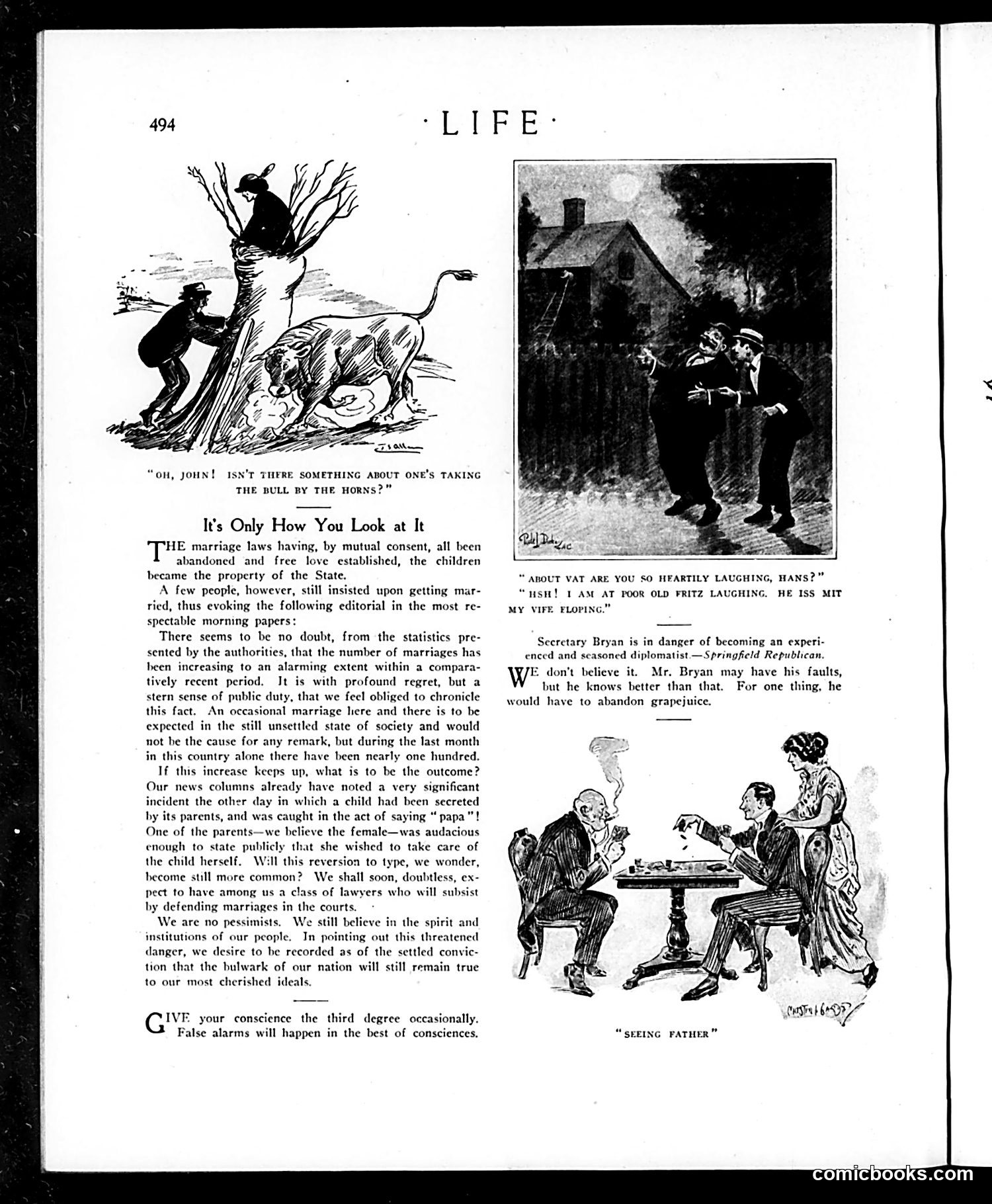
This page satirizes early 20th-century anxieties about radical social changes. The main article presents a dystopian scenario where marriage has been abolished and replaced with state-controlled child-rearing and "free love"—imagining a future society so horrified by the *return* of traditional marriage that newspapers editorialize against it as a dangerous trend. The cartoons support this inversion satire: 1. **Top left**: A man struggles with a bucking cow while another suggests "taking the bull by the horns"—a visual pun mocking impractical advice. 2. **Top right**: German immigrants (indicated by dialect: "vat," "iss") find humor in a friend's wife "eloping"—suggesting marital instability as comedy. 3. **Bottom**: "Seeing Father" depicts a child finally meeting his father, implying absent fathers were common enough to be noteworthy. The reference to Secretary Bryan and "grapejuice" mocks his well-known temperance stance. Overall, the page expresses conservative alarm about loosening moral standards and family dissolution.
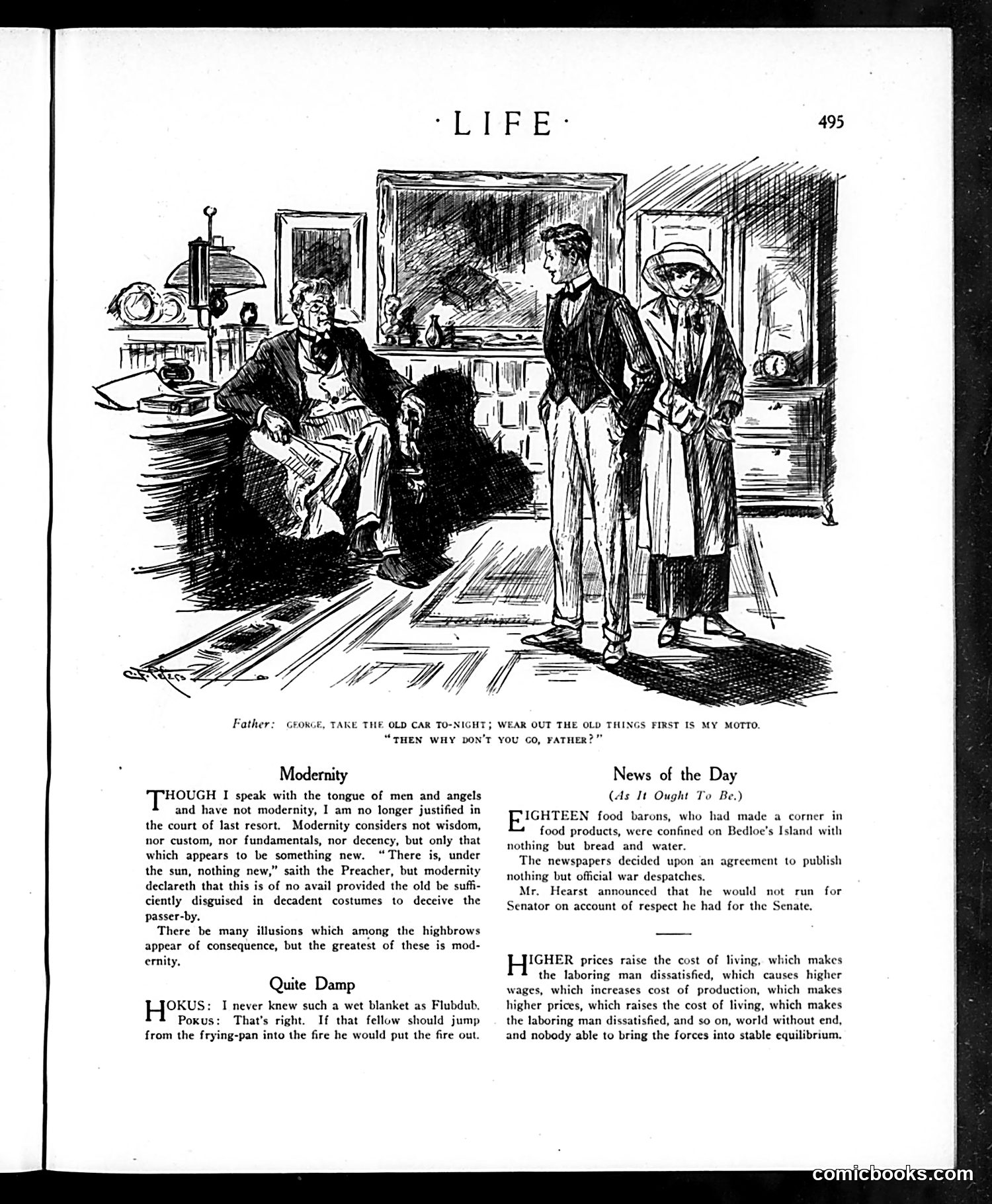
The main cartoon satirizes parental hypocrisy: a father advises his son George to "wear out the old things first," yet when asked why he doesn't follow his own motto by using the old car, he has no answer. The joke exposes the double standard of preaching thrift while avoiding personal sacrifice. The "Modernity" essay criticizes contemporary obsession with newness for its own sake, arguing that modern society values superficial novelty over genuine wisdom or fundamentals—essentially attacking 1920s consumer culture. "News of the Day" presents wishful satire: imaginary scenarios where food monopolists face consequences (bread and water confinement), newspapers exercise restraint, and William Randolph Hearst shows Senate respect. These are clearly fantasies mocking the actual behavior of these powerful figures. The final economic note describes inflation's vicious cycle: rising prices → worker dissatisfaction → wage demands → higher production costs → higher prices again—a timeless critique of economic instability still relevant today.
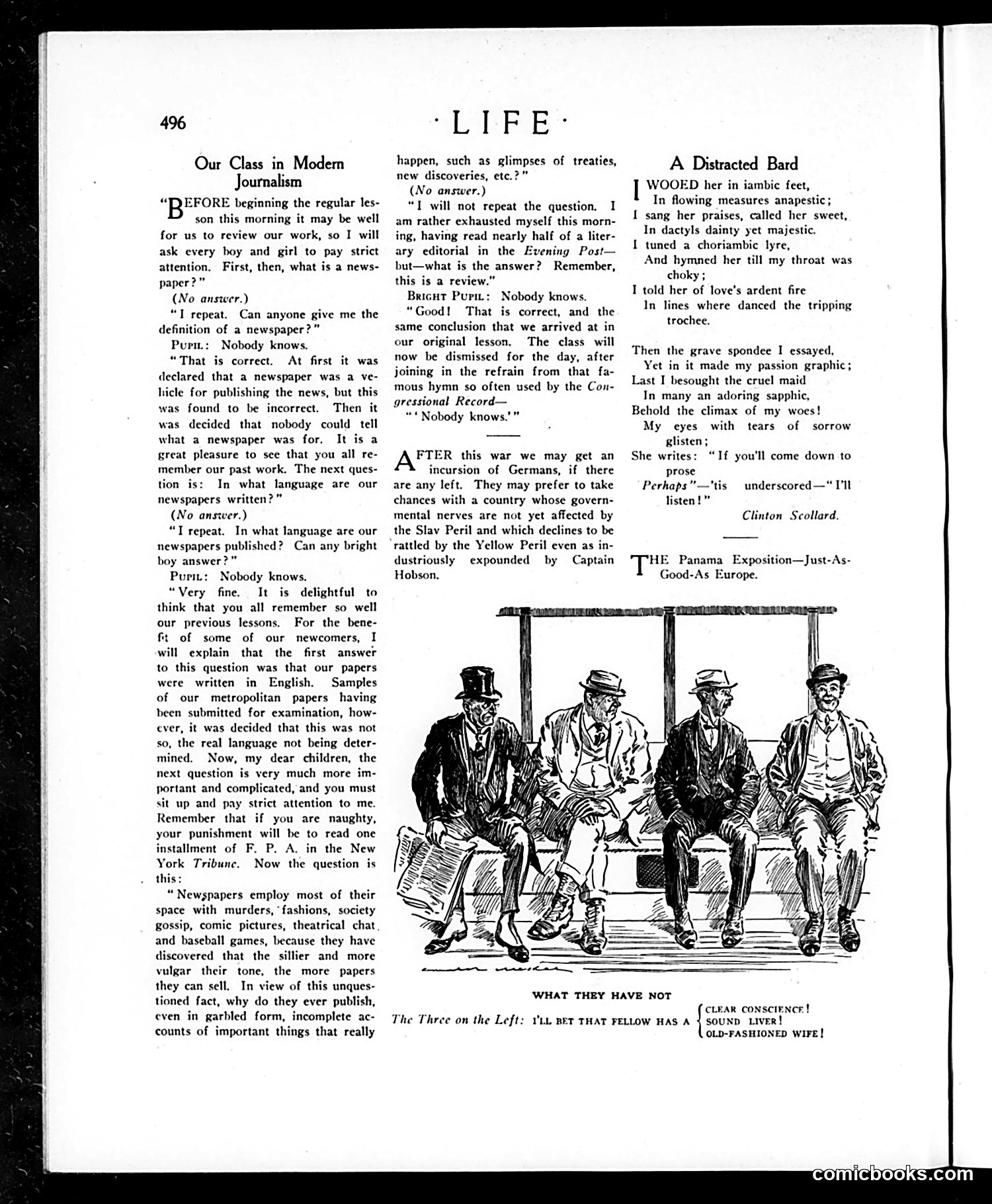
This page contains satirical commentary on American newspapers and journalism. The main piece, "Our Class in Modern Journalism," uses a mock-classroom format to criticize newspapers for prioritizing sensationalism (murders, gossip, comic pictures, baseball) over substantive news about treaties and discoveries. The repeated answer "Nobody knows" becomes a running joke—suggesting the newspaper industry itself cannot justify its own editorial priorities. The satire targets newspapers' cynical calculation that vulgar, silly content sells better than serious reporting. The reference to F.P.A. in the *New York Tribune* is an actual contemporary literary columnist. The bottom illustration shows four men on a bench discussing someone's morality, with one declaring "I'll bet that fellow has a CLEAR CONSCIENCE! SOUND LIVER! OLD-FASHIONED WIFE!"—likely mocking simplistic character judgments of the era. The page critiques press irresponsibility through humor rather than direct argument.
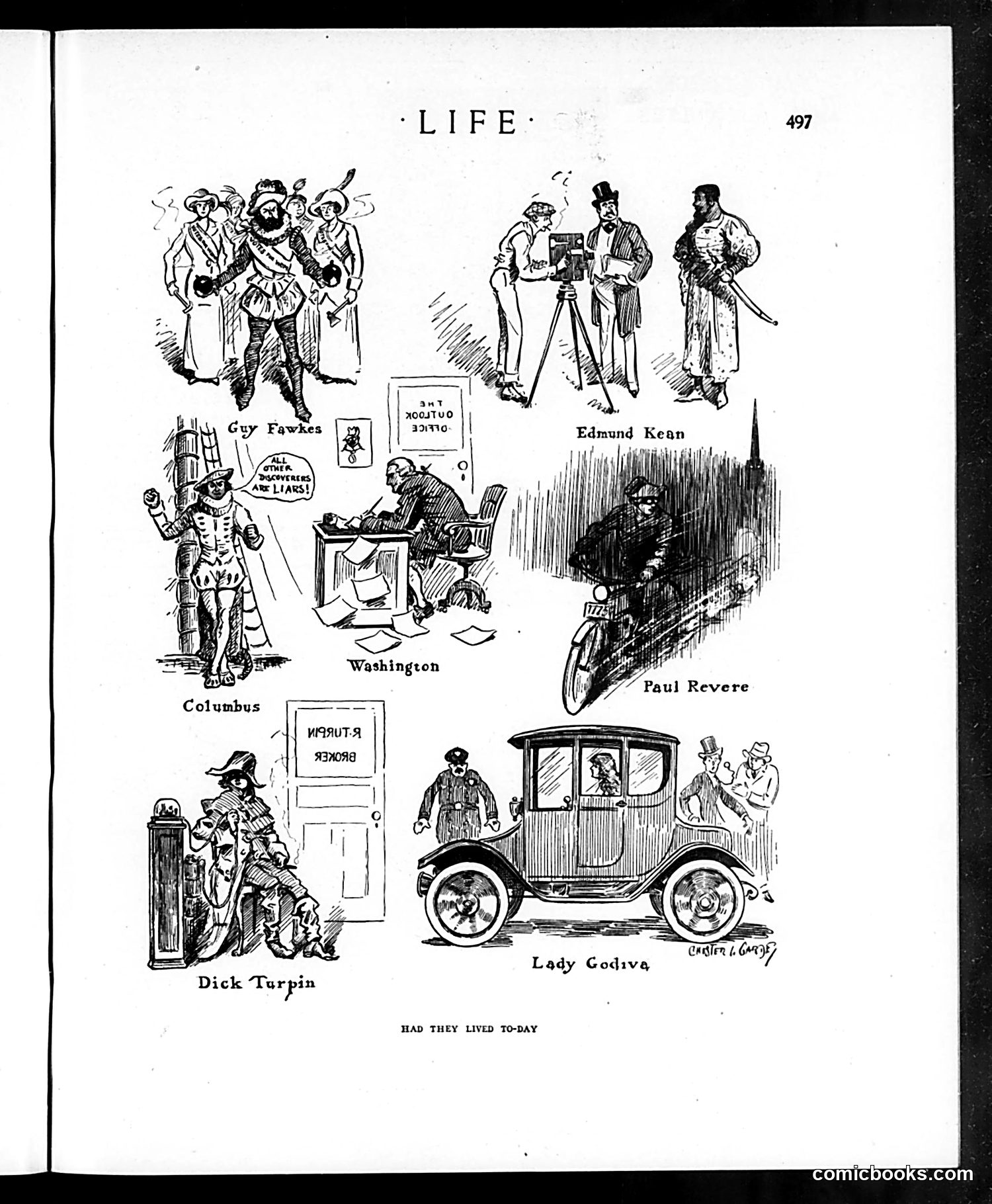
This satirical page imagines famous historical figures in modern (early 20th-century) contexts. The title promises anachronistic humor by placing them in contemporary situations. **Identifiable figures:** - **Guy Fawkes** (gunpowder plot conspirator) - depicted with explosives - **Columbus** - shown as explorer/navigator - **Washington** - portrayed at a desk, likely satirizing his role - **Dick Turpin** (legendary highwayman) - shown with period crime imagery - **Edmund Kean** (famous Shakespearean actor) - **Paul Revere** (American revolutionary) - on a motorcycle instead of horseback - **Lady Godiva** - riding in a modern automobile The joke updates their historical identities to modern equivalents: Revere trades his horse for a motorcycle; Godiva's legendary naked ride becomes a car ride. This reflects Life magazine's humor about technological progress and social change in the early 1900s.
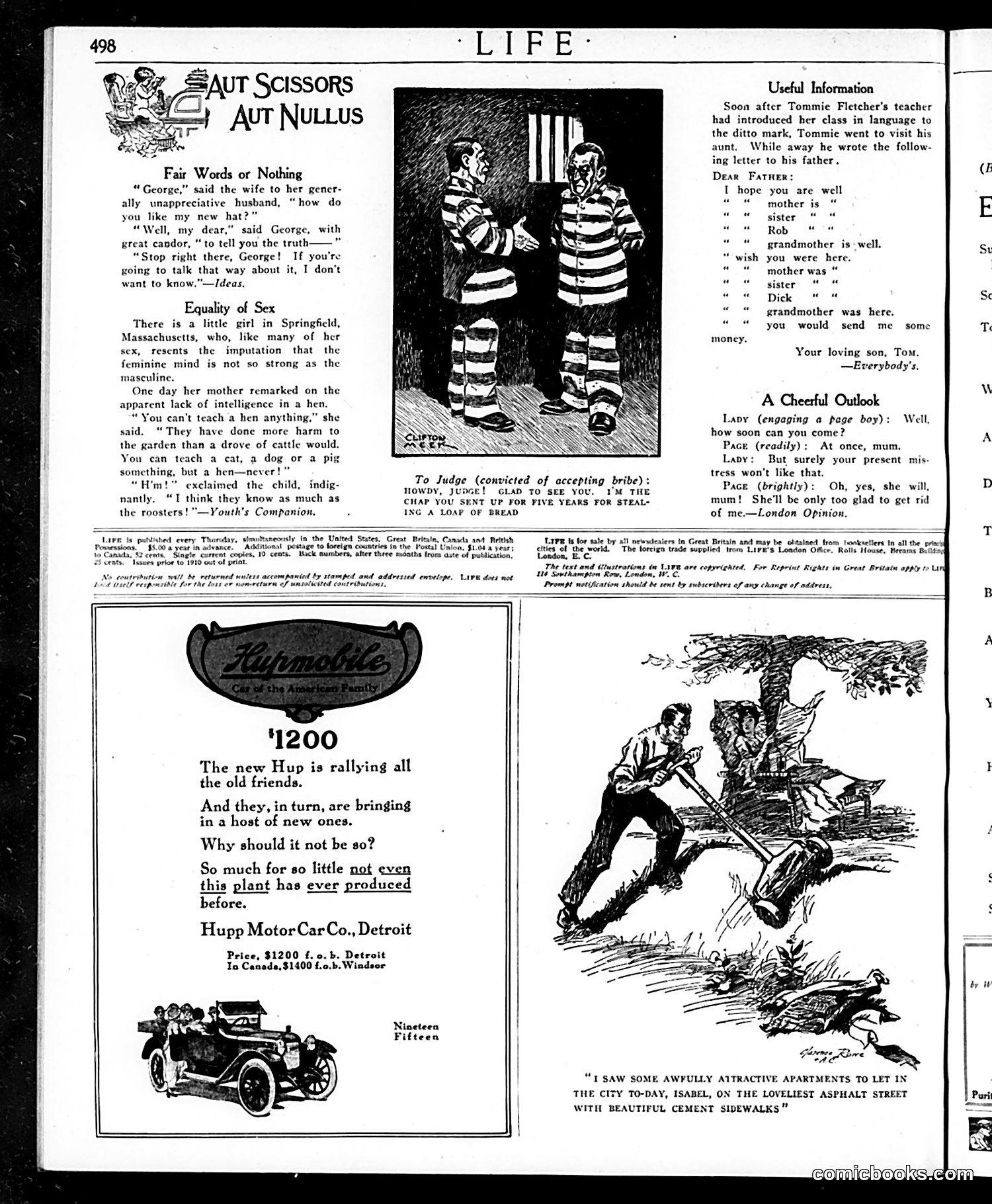
This page from *Life* magazine combines humor pieces with advertising, typical of the publication's format. **"Fair Words or Nothing"** satirizes marital dynamics: a husband's attempt at honest criticism is shut down by his wife, who demands flattery rather than truth—mocking both spousal communication and feminine vanity. **"Equality of Sex"** defends female intelligence through anecdote: a Springfield girl protests her mother's dismissal of hens' intelligence by noting roosters aren't smarter, asserting women's mental equality to men—a dig at prevailing sexism. **"To Judge"** appears to depict a convict visiting a judge who accepted a bribe to sentence him for stealing bread—satirizing judicial corruption and disproportionate punishment for poverty. **Advertisements** include the Hupp Motor Car Company ('1200 model) and an illustration of romantic recreation, emphasizing consumer goods and leisure. The illustration captioned about "attractive apartments" on asphalt streets satirizes real-estate marketing's absurd emphasis on mundane details over actual livability. Overall, the page targets hypocrisy, gender prejudice, and institutional corruption through gentle satire.
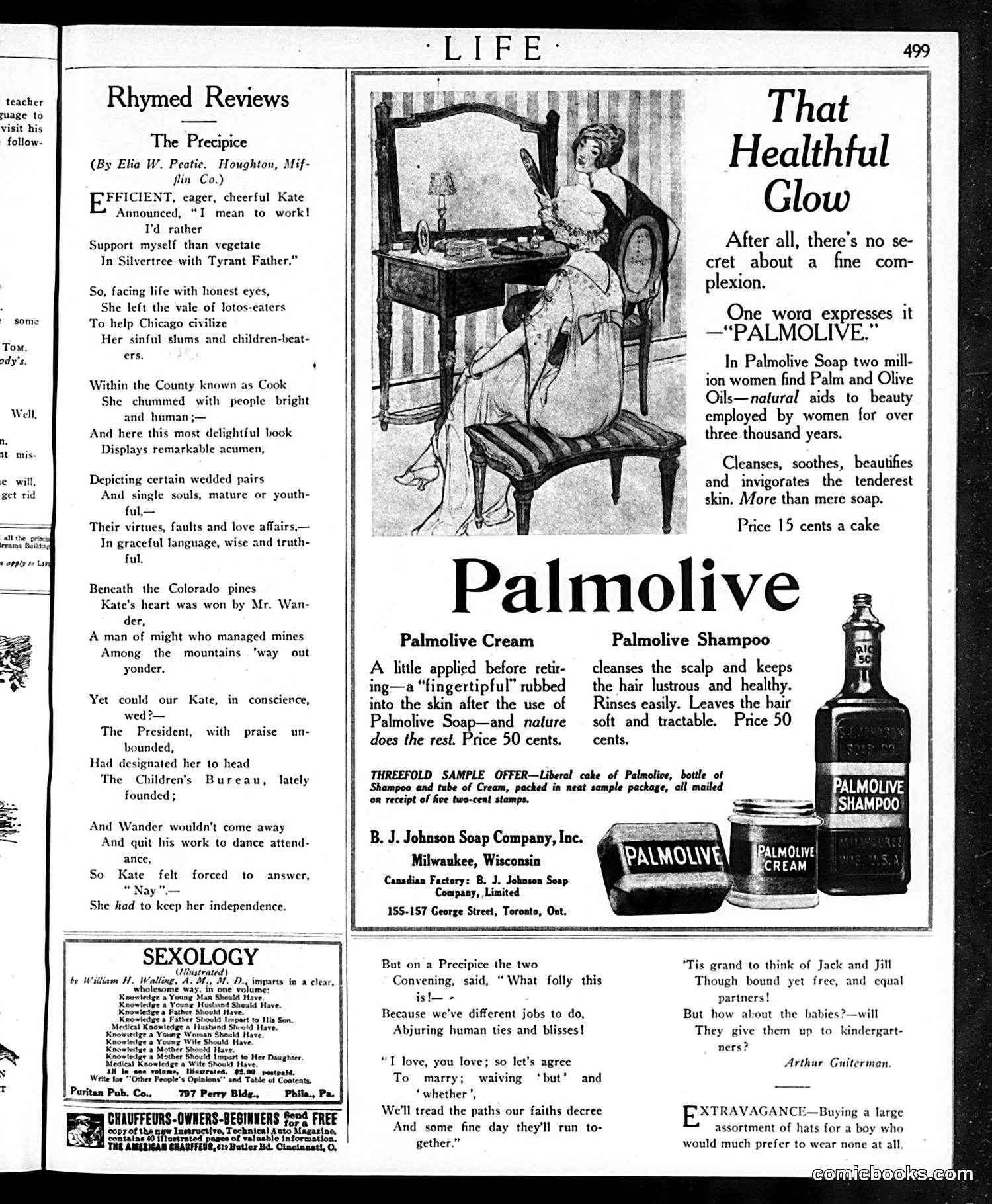
This page mixes literary review, advertising, and light social commentary typical of Life magazine's satirical format. **"The Precipice" Review:** A poem reviewing Elia Peattie's novel about an independent woman named Kate who leaves home to work in Chicago's slums and lead the Children's Bureau. The review celebrates her moral independence—she refuses to marry a mine owner because she won't abandon her professional duties. The satire appears gentle: modern readers might miss that women holding professional positions was itself controversial. **The Advertisement:** Palmolive Soap dominates the right side—a major commercial feature typical of the era. The "healthful glow" messaging represents early 20th-century beauty marketing emphasizing natural ingredients (palm and olive oils). **Arthur Guiterman's "Jill" Poem:** A brief satirical piece mocking couples who delay marriage and children for equality principles, ending with the practical question: "But how about the babies?" The satire targets idealistic modern relationships. The page reflects Progressive Era debates about women's work, marriage, and independence.
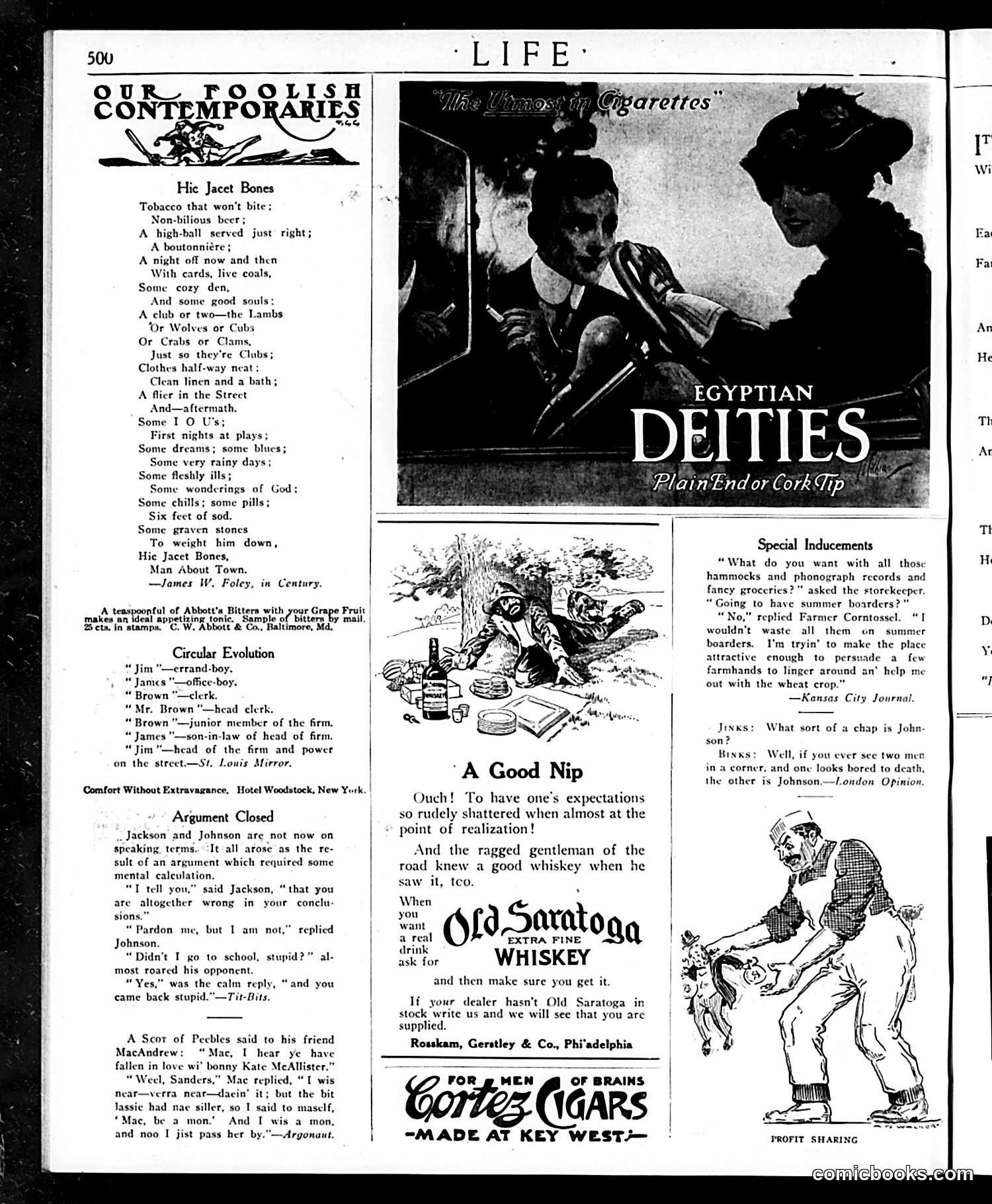
This page is primarily **advertising and light humor**, not political satire. The content includes: **"Hic Jacet Bones"** — A satirical poem about a "Man About Town" listing life's pleasures (tobacco, whiskey, clubs, romance) before death ("Six feet of sod"). It's social satire mocking the shallow pursuits of urban gentlemen, not political commentary. **Other humor sections** present brief jokes about social climbing ("Circular Evolution" shows a man's rise through a firm), romance, and Scottish dialect humor—typical period magazine filler. **The advertisements** dominate: Egyptian Deities cigarettes, Old Saratoga whiskey, and Cortez cigars. The "Profit Sharing" cartoon shows a man being chased by a dog—likely an ad or unrelated joke. **Context for modern readers**: This reflects early 20th-century male-focused humor celebrating drinking, smoking, and nightlife as markers of sophistication. The ads normalize these vices to "men of brains." There's no evident political meaning—it's commercial content dressed as entertainment.
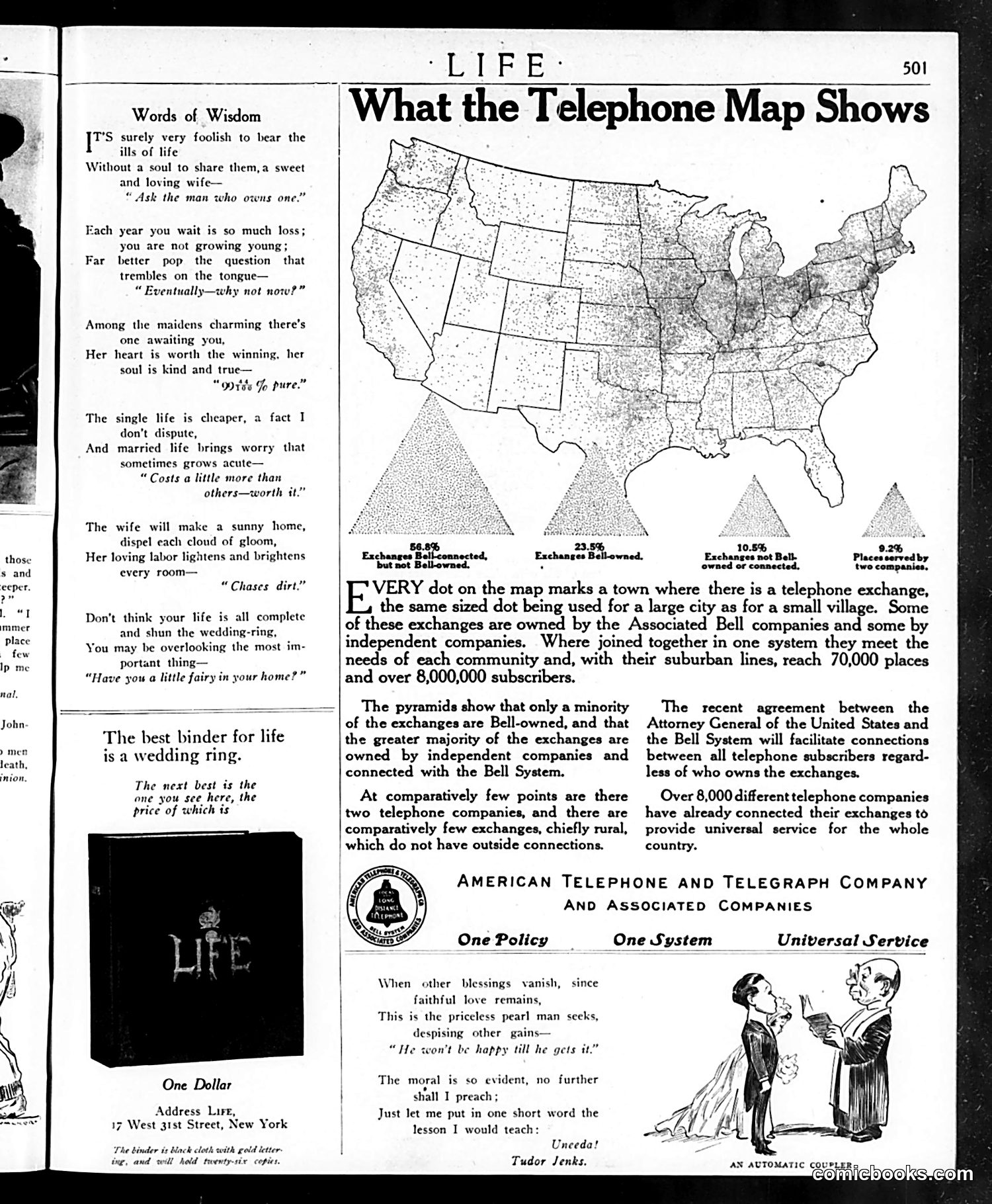
This page combines two separate advertisements disguised as content. **Left side:** A marriage-promotion piece by Tudor Jenks uses marriage quotations ("Ask the man who owns one," "Eventually—why not now?") to advocate for matrimony. It's accompanied by an ad for Life magazine's binding service (selling a dollar binder to hold 26 copies). The satire here is gentle—poking fun at male reluctance to marry by using folksy testimonial language mimicking product advertising. **Right side:** An American Telephone and Telegraph Company advertisement presents a map showing telephone exchange distribution across the U.S., with pyramids indicating ownership percentages. The text argues that despite independent companies operating many exchanges, Bell's unified system provides superior "universal service" to 70,000 places and 8 million subscribers. The recent Attorney General agreement mentioned legitimized Bell's near-monopoly by mandating interconnection standards—presented here as consumer benefit rather than antitrust enforcement. The cartoon of "automatic couplers" (telephone connectors) reinforces the interconnection message. This is essentially corporate advertising masquerading as neutral information.
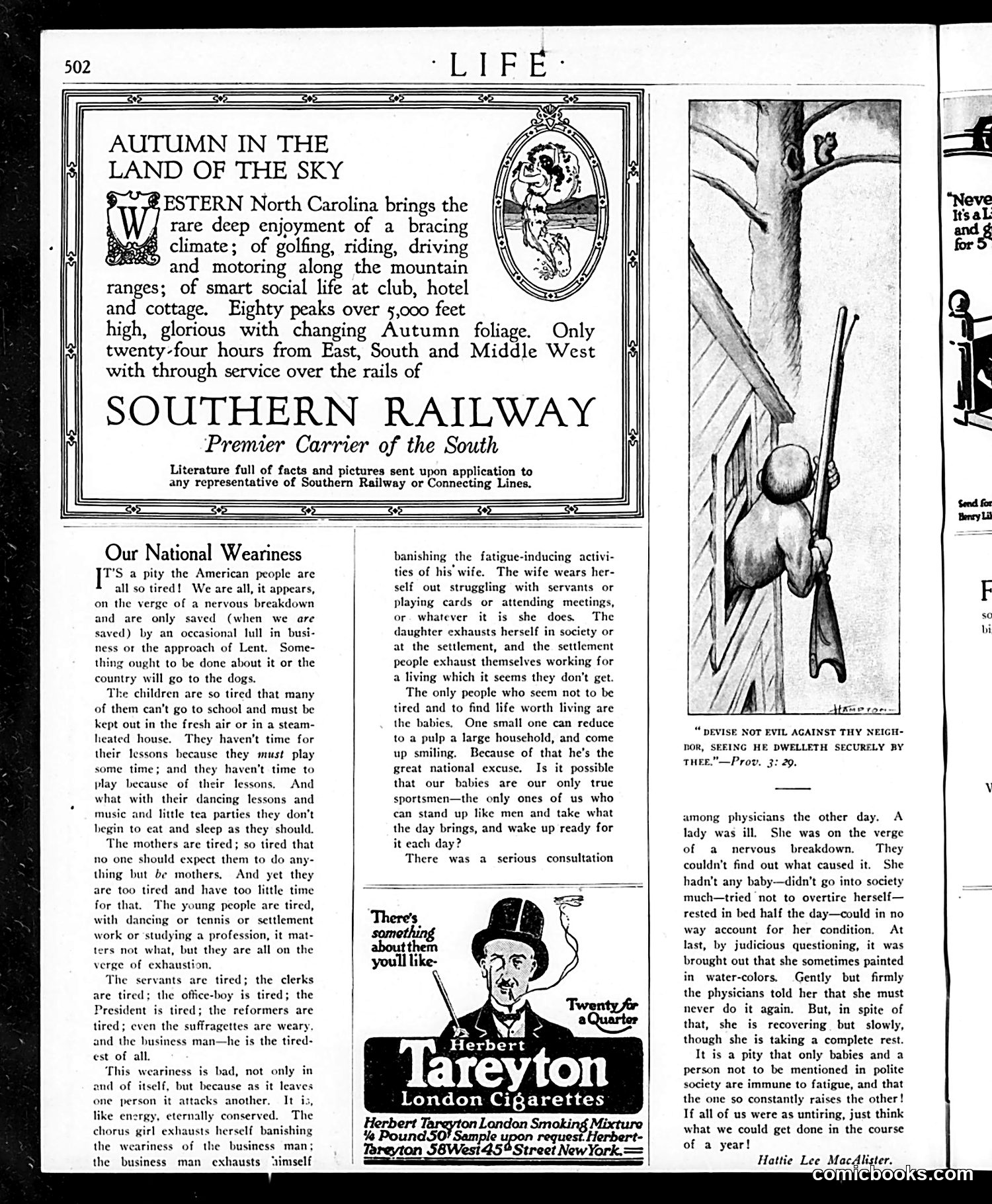
This page contains a satirical essay titled "Our National Weariness" that critiques widespread exhaustion in American society. The author sarcastically observes that nearly everyone—children, mothers, servants, office workers, the President, reformers, suffragettes, and businessmen—claims to be exhausted and overworked. The satire's central irony is that fatigue spreads contagiously: "like energy, eternally conserved," it passes from one person to another. The author notes that only babies seem immune, happily energetic despite their chaotic households. The piece culminates in mocking a case where physicians diagnosed a woman's nervous breakdown as caused by water-color painting—suggesting that doctors reflexively blame whatever activity patients enjoy, rather than addressing deeper causes. The ad for Herbert Tareyton London Cigarettes appears unrelated to the editorial content.
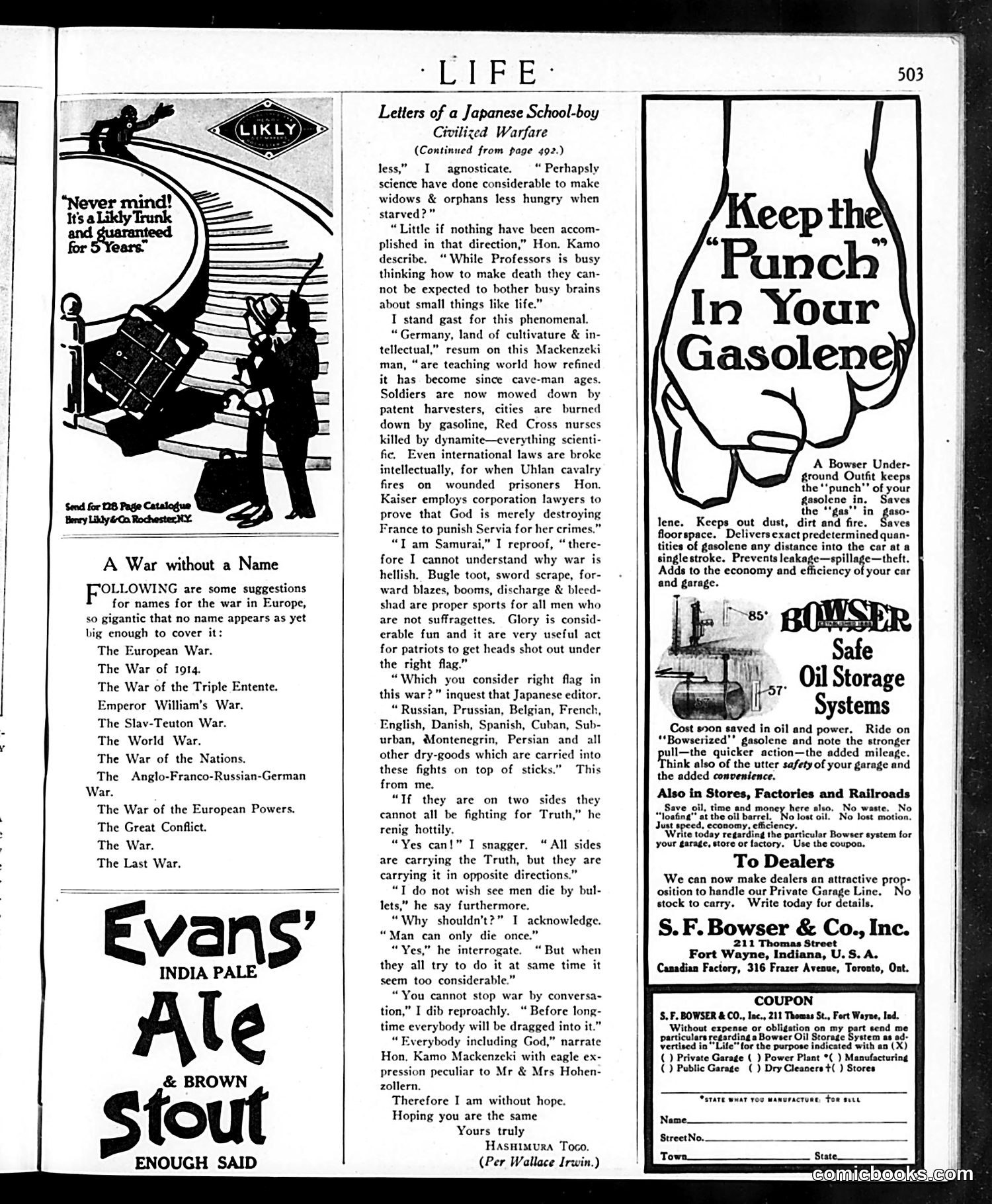
This page from *Life* magazine (pre-1923, thus public domain) contains two distinct items: **"A War Without a Name"** (left): A satirical list suggesting names for World War I, which at the time of publication had no settled designation. The humor lies in the absurd proliferation of proposed titles—each reflecting different perspectives on the conflict's scope and nature. The implication is that the war's unprecedented scale defies simple naming. **"Letters of a Japanese School-boy: Civilized Warfare"** (center): A satirical column by Wallace Irwin featuring broken English dialogue between a Japanese character and a European editor. The satire targets the contradiction between claims of "civilization" and modern warfare's mechanized brutality—soldiers "mowed down by patent harvesters," cities burned by gasoline, Red Cross nurses killed by dynamite. The joke exposes how industrial technology has made war simultaneously more efficient and more horrific, undermining pretenses of civilized conduct. Both pieces critique World War I's unprecedented scale and mechanized violence as fundamentally uncivilized, despite claims otherwise.
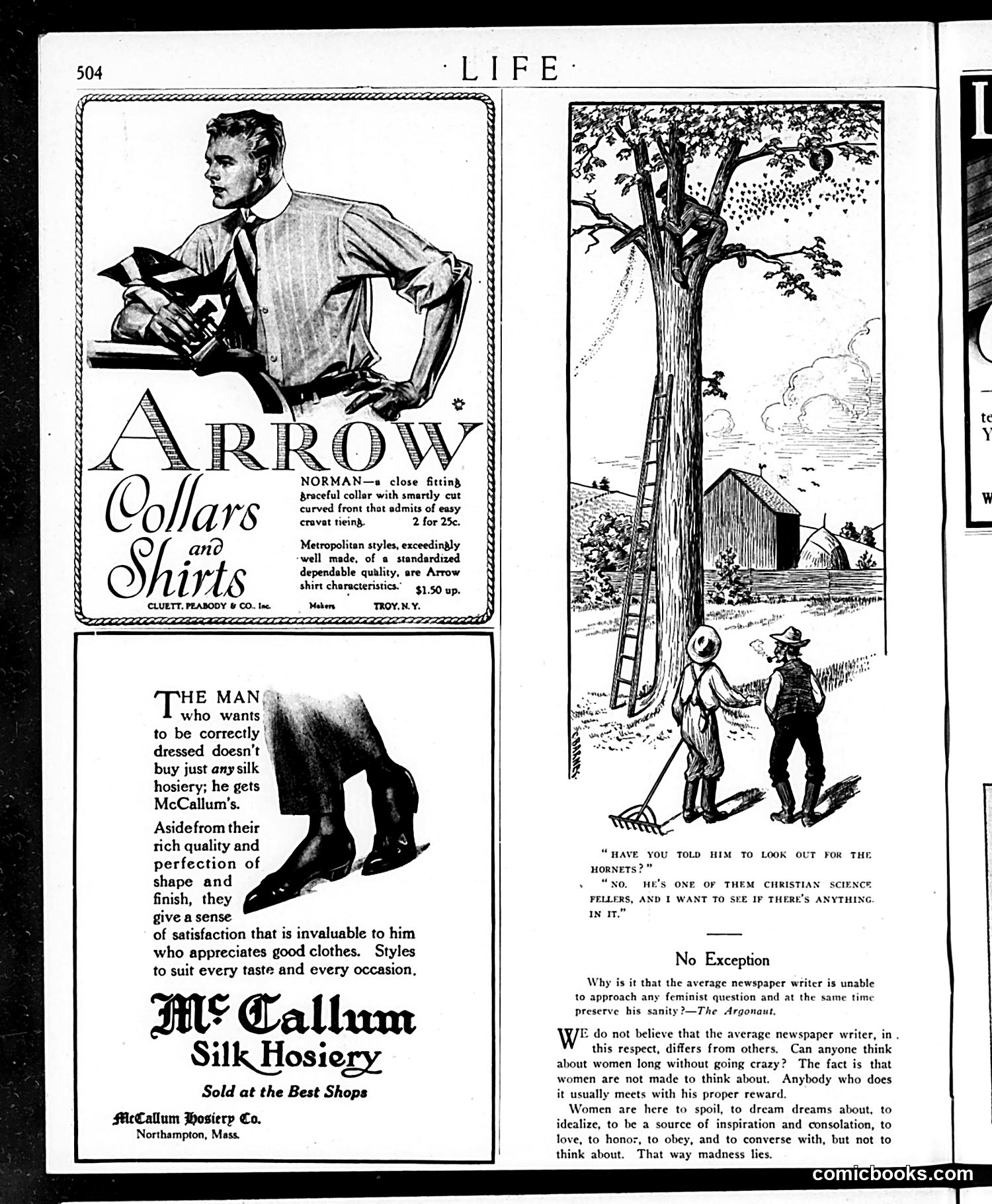
This page contains **advertisements** (Arrow Collars/Shirts, McCallum's Silk Hosiery) and **satirical editorial content**. The cartoon depicts two men observing someone climbing a tall tree to investigate hornets' nests. One explains the climber is a Christian Scientist, adding he wants to "see if there's anything in it"—a joke mocking Christian Science's faith-healing claims by suggesting the test will be painful, thus disproving the religion's efficacy. Below, an article titled "No Exception" satirizes newspaper writers' inability to discuss feminism rationally. The piece sarcastically argues women shouldn't be subjects of serious thought—they exist to be "spoiled," idealized, and obeyed, not intellectually engaged with. This is **satirical mockery** of anti-feminist attitudes: by pushing the sexist logic to absurd extremes ("madness lies" in thinking about women), the author exposes how irrational such views are. The satire targets both the Argonaut publication and broader misogynistic discourse of the era.
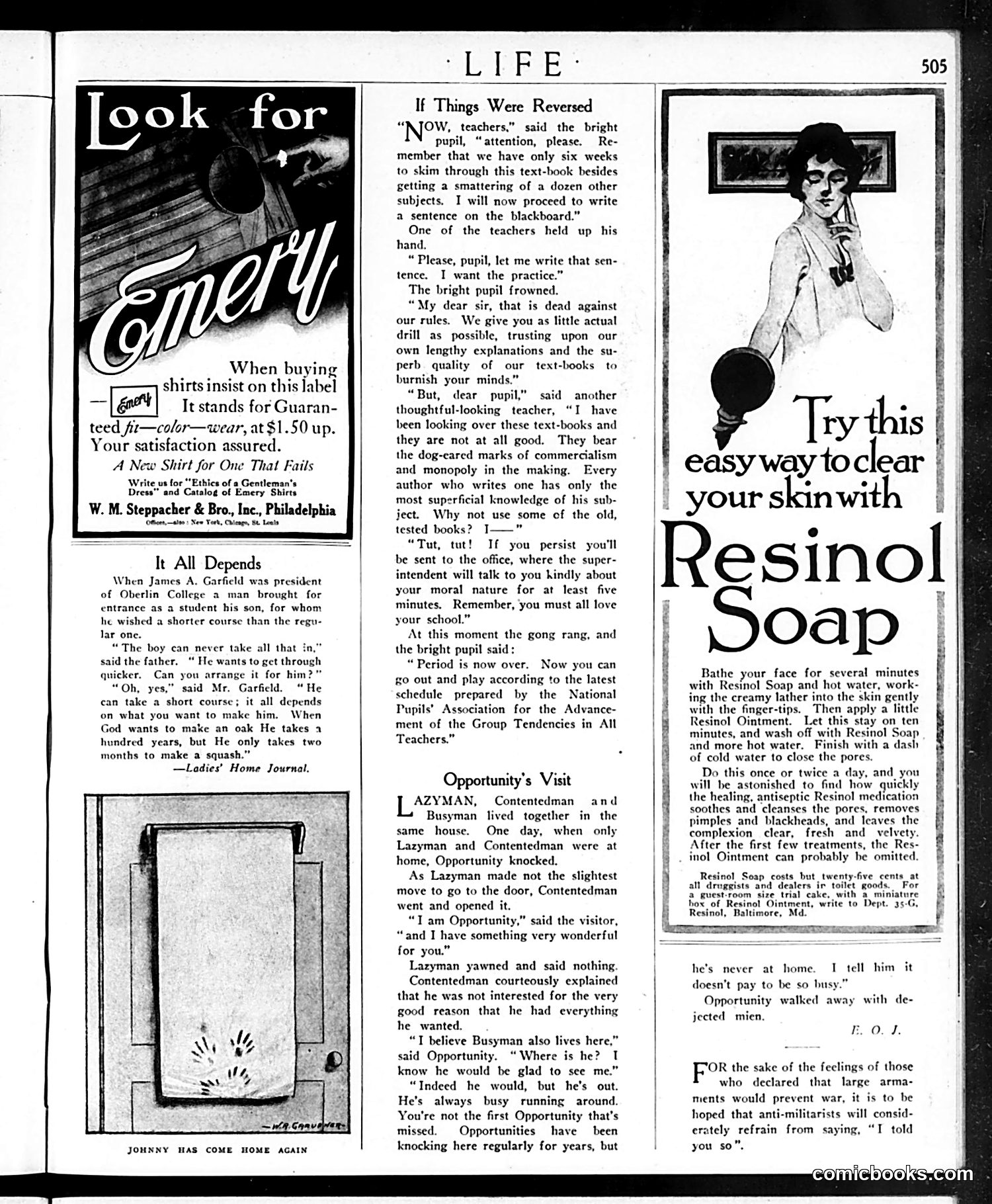
This page contains three satirical pieces targeting early 20th-century American institutions: **"If Things Were Reversed"** inverts the typical student-teacher relationship. A bright pupil lectures apathetic teachers who cite "rules" against actual practice and defend mediocre textbooks marked by "commercialism and monopoly." The satire critiques progressive education's emphasis on passive learning through textbooks over hands-on instruction, and suggests teachers themselves resist practical engagement. **"It All Depends"** recounts an anecdote about James A. Garfield (U.S. President and Oberlin College administrator) explaining that educational outcomes depend entirely on goals—God takes 100 years to make an oak but only two months for a squash. The joke implies hasty education produces inferior results. **"Opportunity's Visit"** uses allegorical characters (Lazyman, Contentedman, Busyman) to mock different responses to opportunity. Only Busyman engages with it; the others reject it through complacency or apathy. The satire suggests most people squander chances for advancement. The remaining content consists of period advertisements for Emery shirts and Resinol Soap.
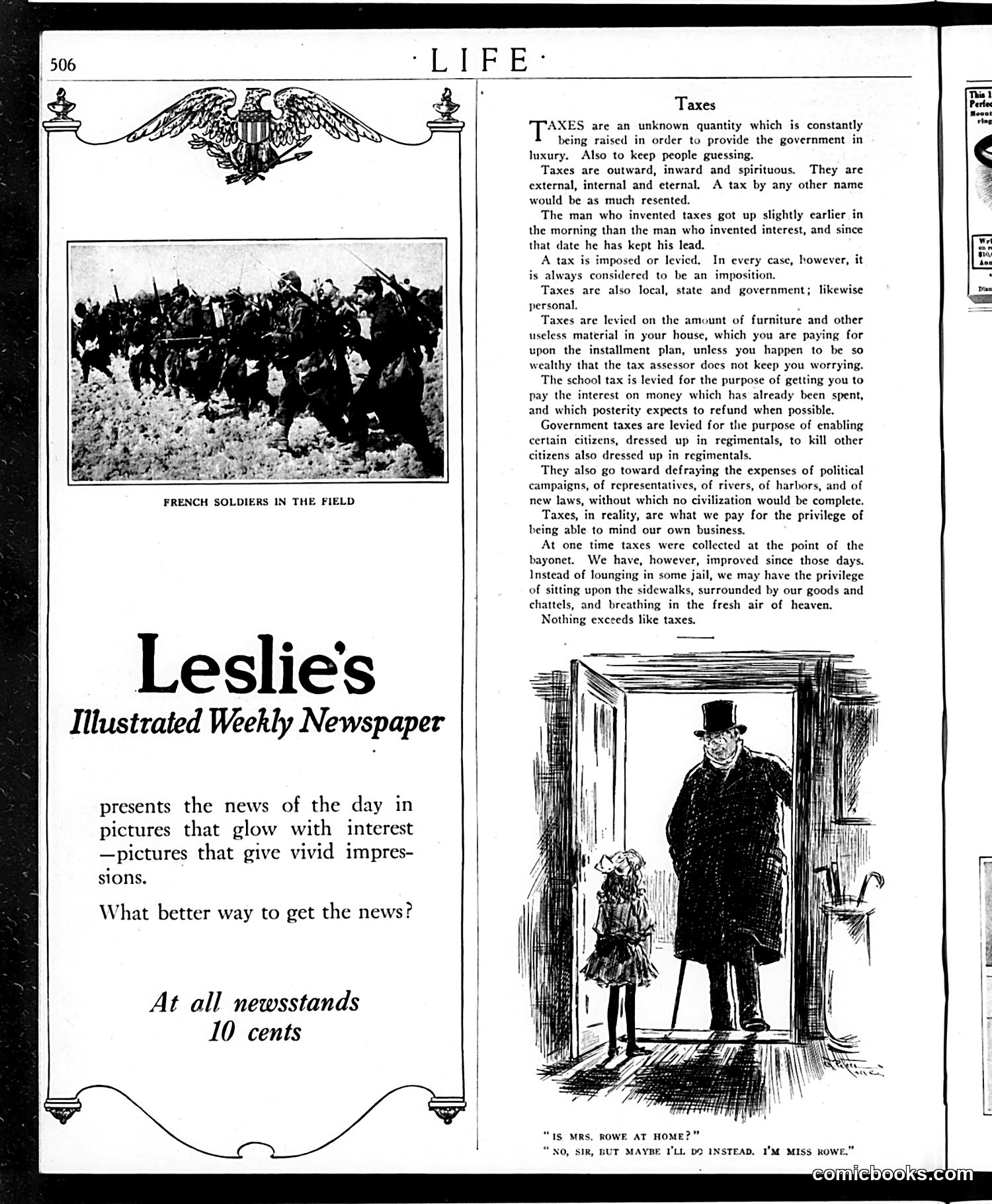
This page contains satirical commentary on taxation paired with period advertisements and a cartoon. **The "Taxes" Essay**: A biting critique of government taxation as an endless, inescapable burden. The author sardonically defines taxes as "unknown," "external, internal and eternal," mocking their complexity and inevitability. Key complaints include: taxes fund government luxury, are levied on household possessions people are still paying for, fund schools to repay previous debt, and enable military spending ("dressed up in regimentals, to kill other citizens"). The darkly humorous closing—that taxes replaced bayonet collection but now force citizens to sit homeless on sidewalks—suggests taxation amounts to legalized dispossession. The phrase "Nothing exceeds like taxes" parodies the saying "Nothing succeeds like success." **The Cartoon**: Shows a well-dressed man at a doorway asking for "Mrs. Rowe"; a young girl answers she's unavailable but volunteers herself as substitute. The humor is suggestive—implying an affair—though the full caption is cut off. **Historical Context**: This likely dates to the Progressive Era when tax debates were contentious, possibly referencing wartime military spending.
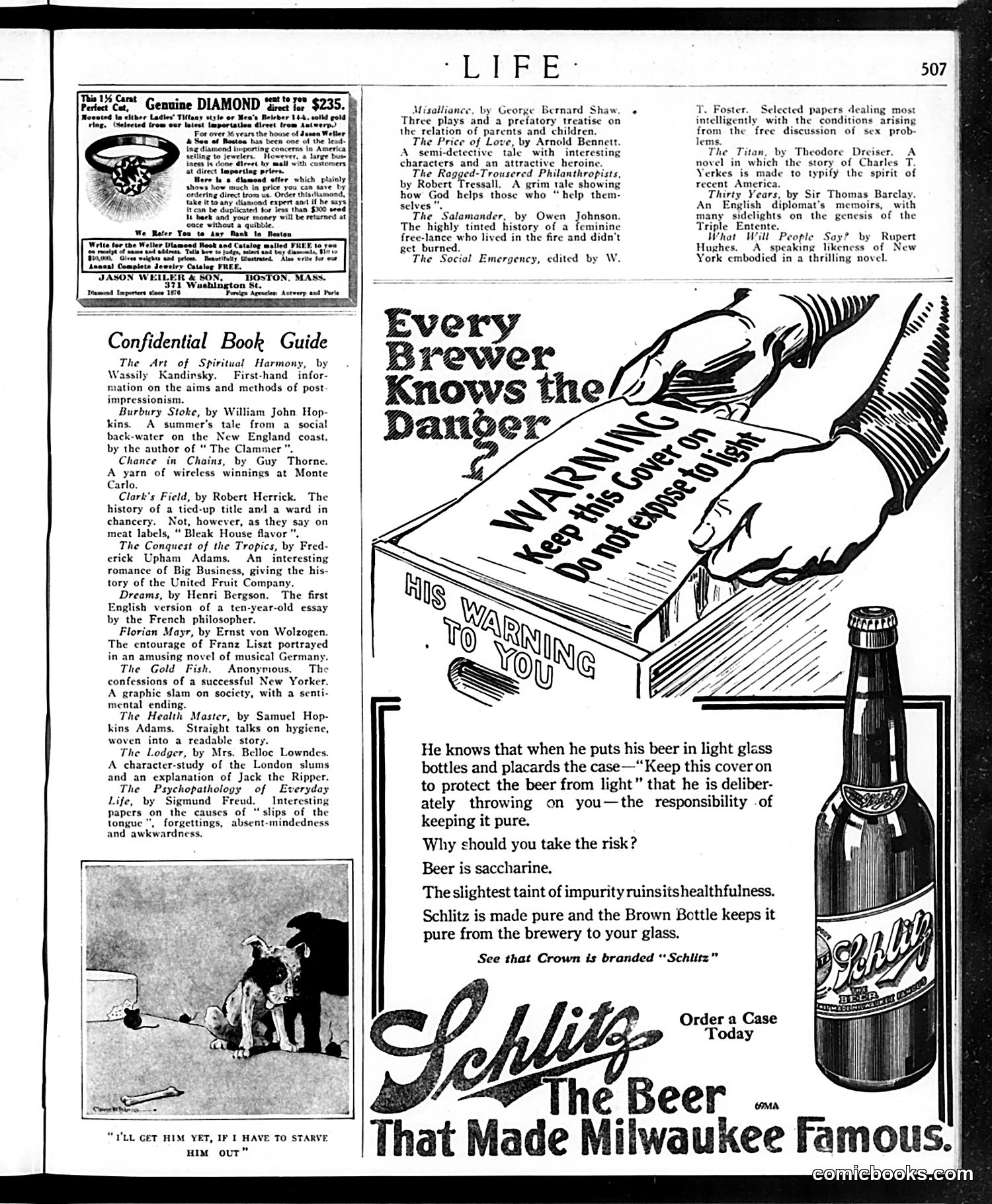
This page combines book reviews with a **Schlitz beer advertisement** that uses fear-based marketing typical of early 1900s advertising. ## The Advertisement (Right Side) The large ad warns brewers about beer spoilage from light exposure. It shows a hand placing a warning label on a beer case, with text declaring "Every Brewer Knows the Danger" of light damaging beer. The copy explains that Schlitz uses brown bottles to protect beer "purity" from brewery to glass, positioning the brown bottle as a safeguard against contamination. **The satirical point**: This appears to be *Life* magazine sardonically presenting Schlitz's overwrought health claims—framing beer (which is "saccharine") as a purity concern requiring special protective measures. The dramatic warning language mocks the exaggerated marketing tactics brewers used to differentiate products. ## The Left Cartoon A small illustration captioned "I'LL GET HIM YET, IF I HAVE TO STARVE HIM OUT" shows what appears to be a confrontational scene, though details are unclear from the image quality. The page is primarily a book guide and advertisement rather than political satire.
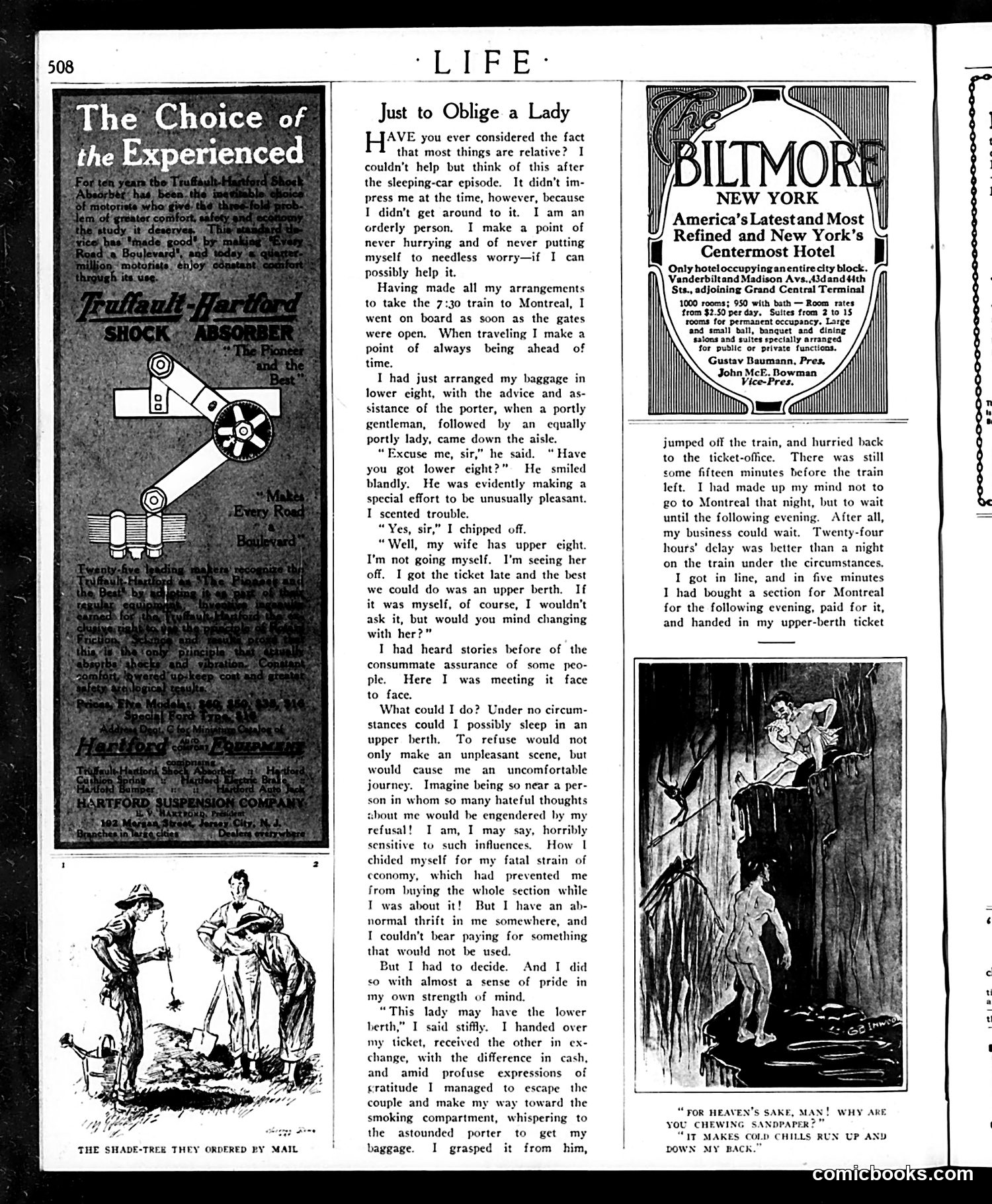
This page presents a humorous essay about social obligation and class anxiety in early 20th-century train travel. The narrator, portrayed as fastidiously orderly and economical, has booked a lower berth on a Montreal-bound train. A portly gentleman requests he surrender it to his wife, who has only an upper berth. Despite the discomfort and inconvenience, the narrator—paralyzed by social sensitivity and fear of appearing ungracious—agrees, paying the difference. However, his resentment at being manipulated ultimately triumphs over his need to avoid discomfort: he abandons the trip entirely, books a different section for the next evening, and avoids the awkward journey. The satire targets the narrator's excessive politeness and self-consciousness, which allows him to be exploited by brazenly entitled travelers. The accompanying illustrations depict scenes of train travel inconvenience and social awkwardness typical of the era.
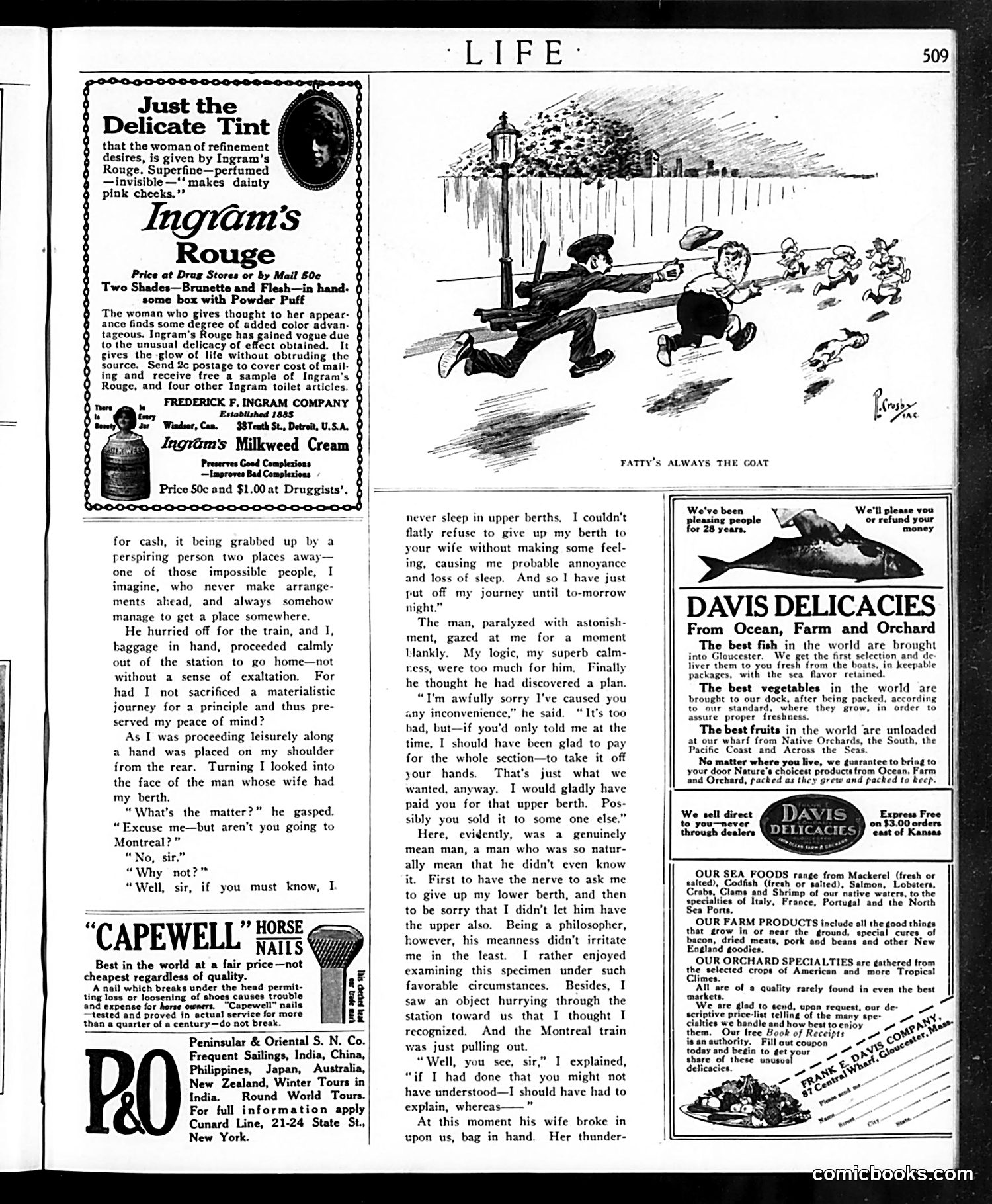
This cartoon satirizes a common domestic annoyance: a man lying prone while children on tricycles and scooters chase him. The title "Fatty's Always the Goat" uses "goat" in the period slang sense of "scapegoat" or victim—suggesting an overweight man is perpetually the target of mischief or ridicule. The humor relies on physical comedy and social observation typical of early 20th-century Life magazine. The corpulent man's vulnerable position and passive acceptance of the children's pursuit mocks both his size and his haplessness. The satire is gentle and character-based rather than political—poking fun at a recognizable social type: the out-of-shape, beleaguered figure who becomes an easy target. The surrounding advertisements (beauty products, shipping lines, delicacies) suggest this was aimed at an affluent, leisured readership amused by such observations of everyday foibles.
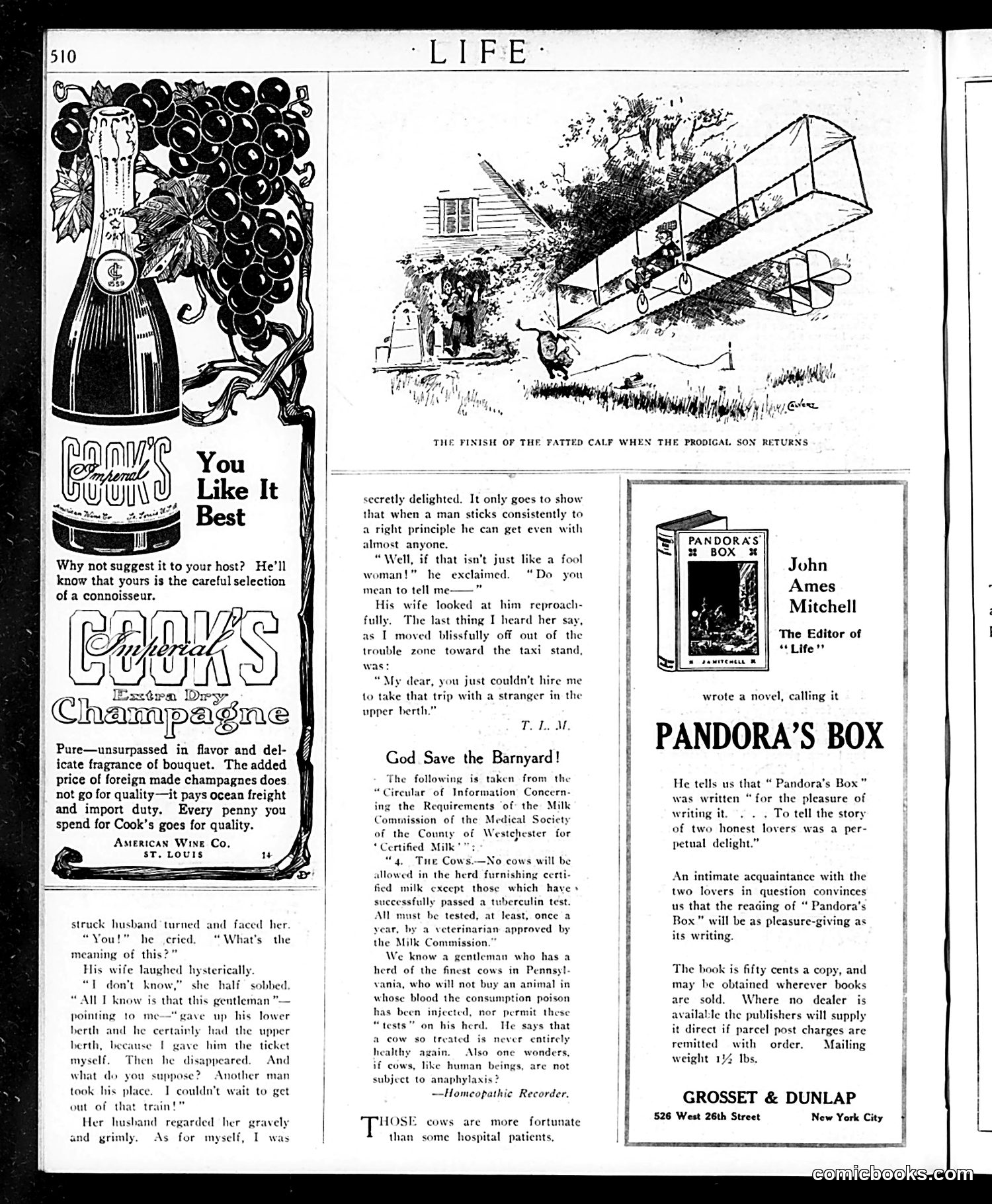
This page mixes advertisements with humorous short stories typical of early 20th-century Life magazine. **The Main Story** ("God Save the Barnyard!") satirizes bureaucratic overregulation. It discusses milk certification requirements mandating tuberculin testing of dairy cows. The author quotes a Pennsylvania farmer who refuses these tests, arguing they harm cow health and questioning whether cows suffer "anaphylaxis" (allergic shock) like humans. The closing line—"Those cows are more fortunate than some hospital patients"—suggests ironic social commentary: cows receive more regulatory health protection than vulnerable hospital patients do. **The Train Anecdote** (bylined T.L.M.) humorously depicts marital discord when a wife discovers a stranger (the narrator) occupied a train berth meant for her. Her husband's angry reaction contrasts with the narrator's amusement at how "sticking to principle" created chaos. The joke mocks both masculine pride and the absurdity of rigid social conventions. The page also advertises Cook's Champagne and promotes John Ames Mitchell's novel *Pandora's Box*.
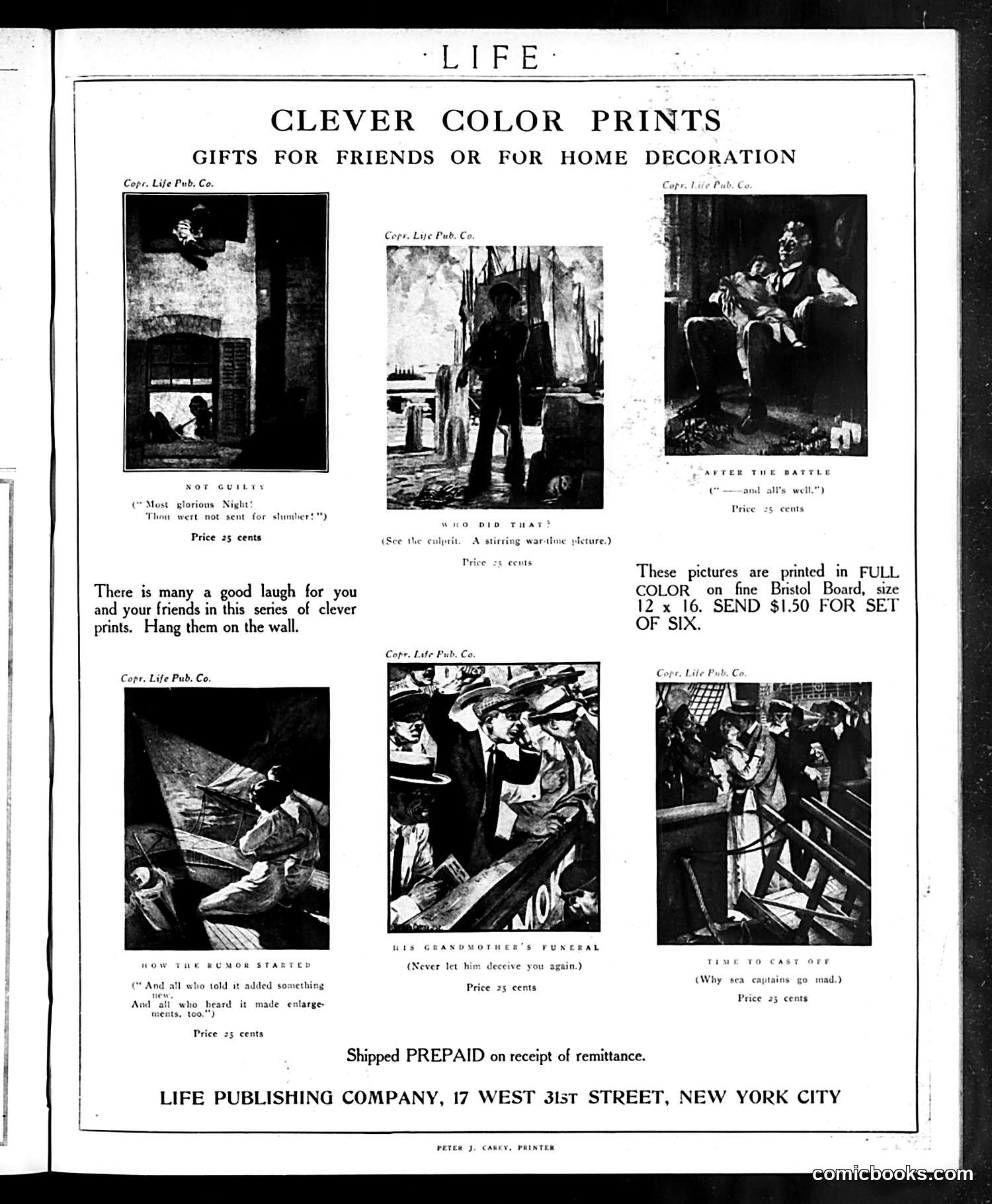
This is primarily a **product advertisement** for colored comic prints sold by Life Publishing Company, not political satire. The page advertises six humorous prints available individually (25 cents each) or as a complete set ($1.50). The visible print titles suggest comedic domestic and social situations typical of early 20th-century humor: - "Not Guilty" (a domestic quarrel scene) - "Who Did That?" (appears to be a wartime picture) - "After the Battle" (couples reconciliation) - "How the Rumor Started" (social embarrassment) - "His Grandmother's Funeral" (dark comedy about deception) - "Time to Cast Off" (nautical humor) The humor relies on relatable scenarios—marital discord, gossip, social mishaps—rather than political commentary. The prints were marketed as affordable wall decorations and gifts, capitalizing on Life's reputation for accessible humor. No specific political figures or events are referenced; this is commercial entertainment advertising.
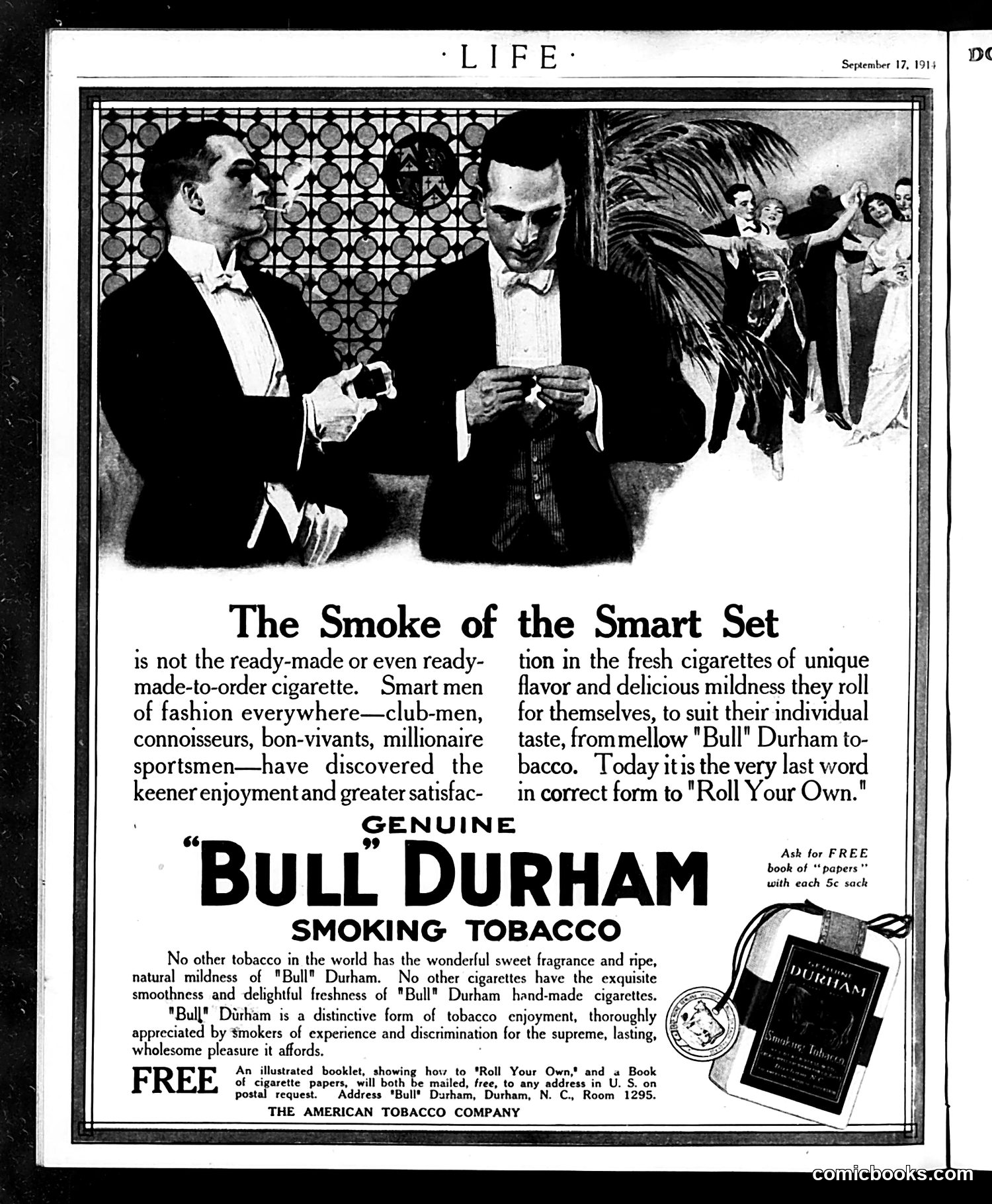
This is primarily a **cigarette advertisement**, not political satire. It promotes "Bull" Durham rolling tobacco by appealing to early-20th-century class aspirations. The ad depicts well-dressed men in formal attire—"club-men, connoisseurs, bon-vivants, millionaire sportsmen"—to suggest that rolling your own cigarettes from Bull Durham tobacco is the mark of sophistication and refined taste. The image on the right shows celebratory figures, implying social approval. The central joke/marketing pitch: hand-rolled cigarettes are superior to factory-made ones, positioning DIY tobacco rolling as a status symbol among the wealthy and fashionable. The ad offers free rolling papers and instruction booklets to encourage this practice. For modern readers, this reflects a period when mass-production was viewed skeptically by the elite, and personal craftsmanship signaled higher social standing—an irony, since Bull Durham was itself a mass-produced product selling *materials* for customization.