
Life, 1914-09-17 · page 11 of 48
Life — September 17, 1914 — page 11: what you’re looking at
What you’re looking at
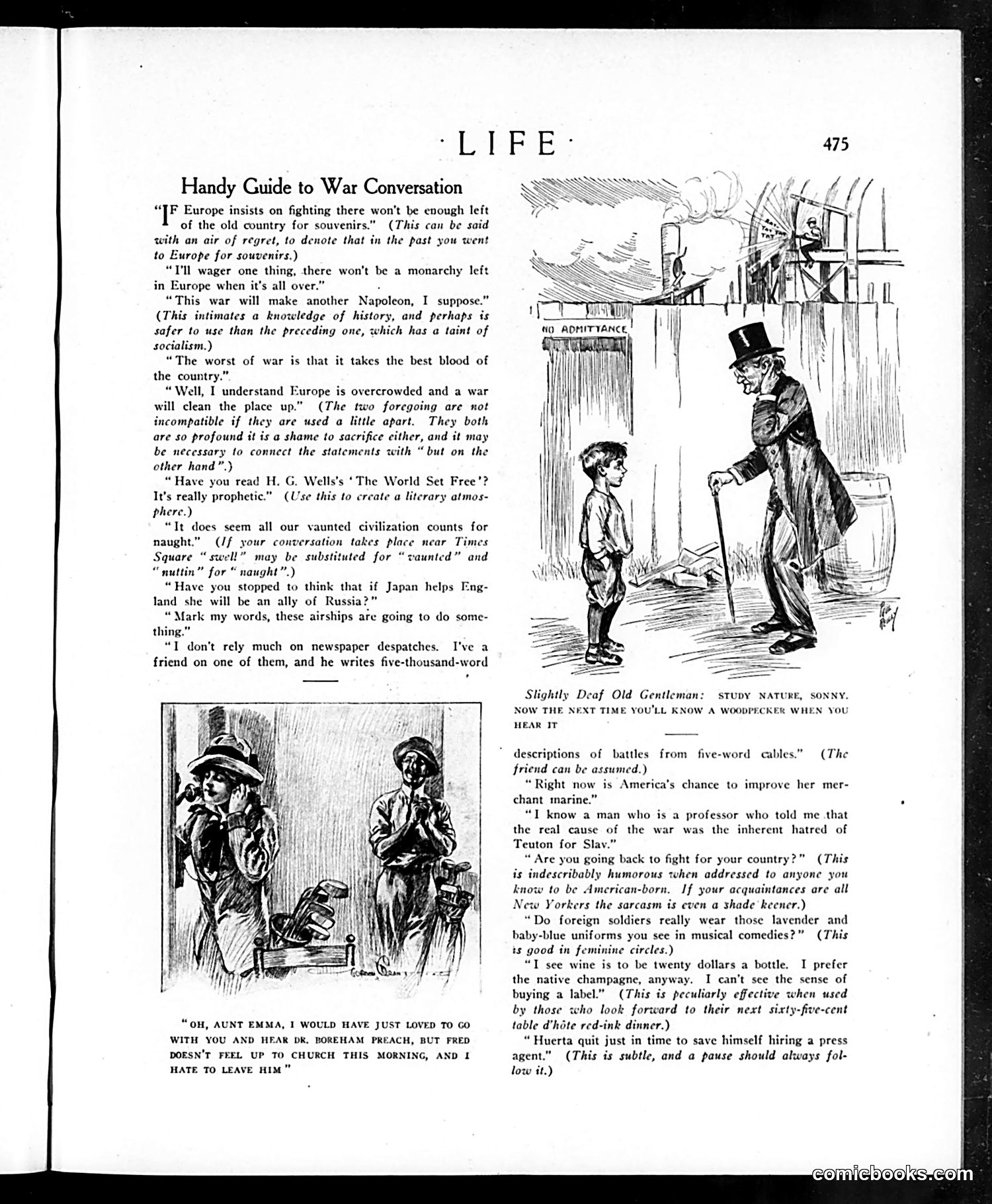
This page satirizes WWI-era conversations about the war's justifications and consequences. The "Handy Guide to War Conversation" mocks vapid talking points—politicians and socialites recycling hollow arguments about European overcrowding, Japan's role, and civilization's progress through bloodshed. The two cartoon illustrations depict social interactions where these platitudes are exchanged. One shows an elderly gentleman (likely representing the older generation who won't fight) lecturing a young boy, embodying the disconnect between those promoting war and those sacrificing lives. The satire targets the superficiality of war discourse: abstract rhetoric about "progress" masking brutal human cost. The editorial voice criticizes both newspaper propaganda and armchair strategists who discuss geopolitics while insulated from consequences. This reflects growing American skepticism about WWI justifications.
📄 Transcribed text from this page (OCR, searchable)
Machine-transcribed from the original scan — historical spelling and the odd misread are preserved.
VERVE Handy Guide to War Conversation “IF Europe insists on fighting there won't be enough left of the old country for souvenirs.” (This can be said with an air of regret, to denote that in the past you went to Europe for souvenirs.) “T'll wager one thing, there won't be a monarchy left in Europe when it's all over.” : “This war will make another Napoleon, I suppose.” (This intimates a knowledge of history, and perhaps is safer to use than the preceding one, which has a taint of socialism.) “The worst of war is that it takes the best blood of the country.” “Well, I understand Europe is overcrowded and a war will clean the place up.” (The two foregoing are not incompatible if they are used a little apart. They both are so profound it is a shame to sacrifice either, and it may be necessary to connect the statements with “but on the other hand”.) “Have you read H. G. Wells’s ‘The World Set Free’? It’s really prophetic.” (Use this to create a literary atmos- phere.) “Tt does seem all our vaunted civilization counts for naught.” (Jf your conversation takes place near Times Square “swell” may be substituted for “vaunted” and “nuttin” for “ naught”.) “Have you stopped to think that if Japan helps Eng- land she will be an ally of Russia?” “Mark my words, these airships are going to do some- thing.” “I don't rely much on newspaper despatches. I've a friend on one of them, and he writes five-thousand-word “OH, AUNT EMMA, I WOULD HAVE JUST LOVED TO GO WITH YOU AND HEAR DR. BOREHAM PREACH, BUT FRED DOESN'T FEEL UP TO CHURCH THIS MORNING, AND I HATE TO LEAVE HIM” Slightly Deaf Old Gentleman: NOW THE NEXT TIME YOU'LL KNOW A WOODPECKER WHEN YOU HEAR IT STUDY NATURE, SONNY. descriptions of battles from five-word cables.” (The friend can be assumed.) “Right now is America’s chance to improve her mer- chant marine.” “I know a man who is a professor who told me that the real cause of the war was the inherent hatred of Teuton for Slav.” “ Are you going back to fight for your country?” (This is indescribably humorous when addressed to anyone you know to be American-born. If your acquaintances are all New Yorkers the sarcasm is even a shade keener.) Do foreign soldiers really wear those lavender and baby-blue uniforms you see in musical comedies?” (This ts good in feminine circles.) “T see wine is to be twenty dollars a bottle. I prefer the native champagne, anyway. I can't sce the sense of buying a label.” (This is peculiarly effective when used by those who look forward to their next sixty-five-cent table d’héte red-ink dinner.) “ Huerta quit just in time to save himself hiring a press agent.” (This is subtle, and a pause should always fol- low it.)