
Life, 1914-09-17 · page 42 of 48
Life — September 17, 1914 — page 42: what you’re looking at
What you’re looking at
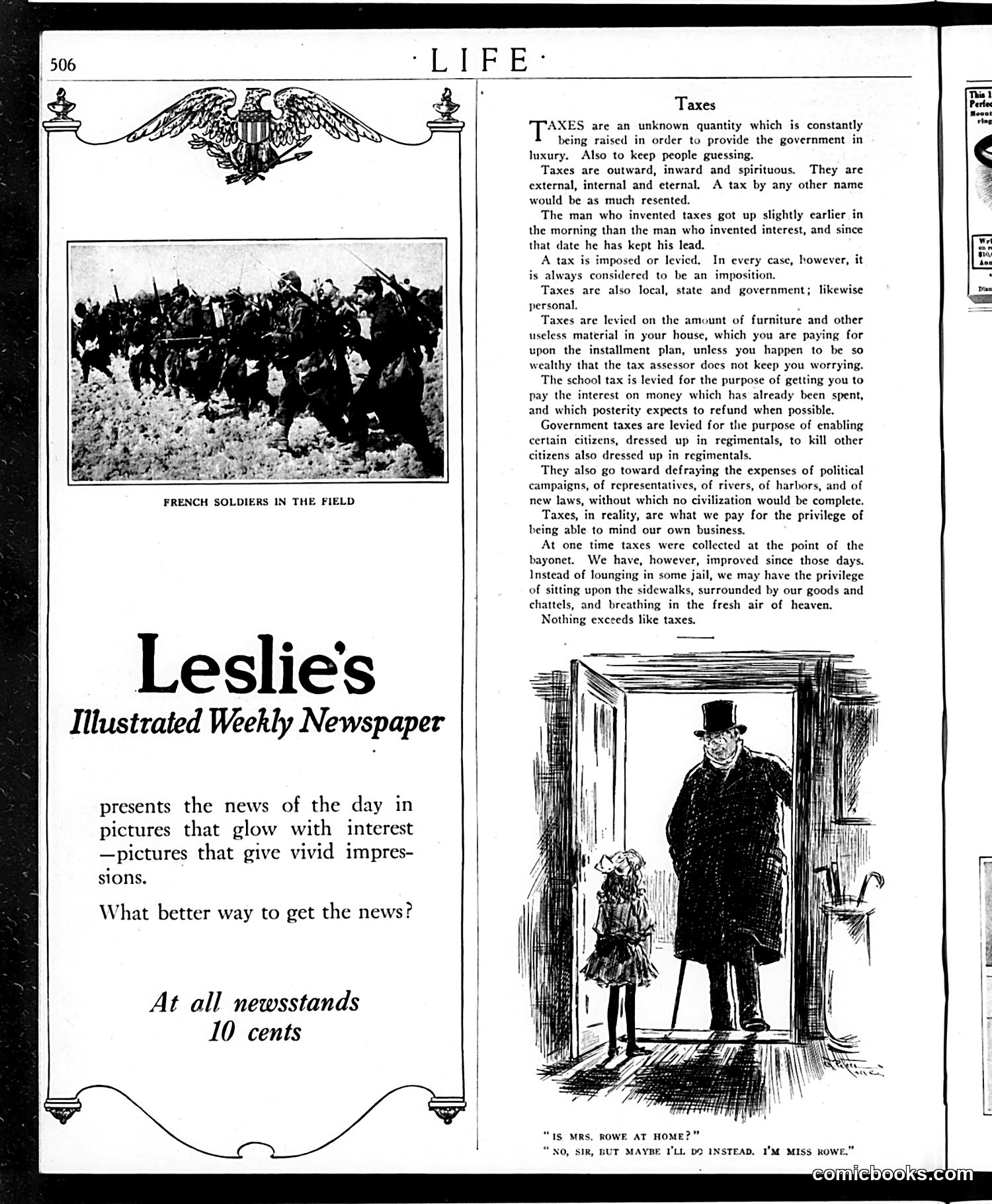
This page contains satirical commentary on taxation paired with period advertisements and a cartoon. **The "Taxes" Essay**: A biting critique of government taxation as an endless, inescapable burden. The author sardonically defines taxes as "unknown," "external, internal and eternal," mocking their complexity and inevitability. Key complaints include: taxes fund government luxury, are levied on household possessions people are still paying for, fund schools to repay previous debt, and enable military spending ("dressed up in regimentals, to kill other citizens"). The darkly humorous closing—that taxes replaced bayonet collection but now force citizens to sit homeless on sidewalks—suggests taxation amounts to legalized dispossession. The phrase "Nothing exceeds like taxes" parodies the saying "Nothing succeeds like success." **The Cartoon**: Shows a well-dressed man at a doorway asking for "Mrs. Rowe"; a young girl answers she's unavailable but volunteers herself as substitute. The humor is suggestive—implying an affair—though the full caption is cut off. **Historical Context**: This likely dates to the Progressive Era when tax debates were contentious, possibly referencing wartime military spending.
📄 Transcribed text from this page (OCR, searchable)
Machine-transcribed from the original scan — historical spelling and the odd misread are preserved.
Taxes Tate are an unknown quantity which is constantly being raised in order to provide the government in luxury. Also to keep people guessing. Taxes are outward, inward and spirituous. They are external, internal and eternal. A tax by any other name would be as much resented. The man who invented taxes got up slightly earlier in the morning than the man who invented interest, and since that date he has kept his lead. A tax is imposed or levied. In every case, however, it is always considered to be an imposition. Taxes are also local, state and government; likewise personal. Taxes are levied on the amount of furniture and other useless material in your house, which you are paying for upon the installment plan, unless you happen to be so wealthy that the tax assessor docs not keep you worrying. The school tax is levied for the purpose of getting you to pay the interest on money which has already been spent, and which posterity expects to refund when possible. Government taxes are levied for the purpose of enabling certain citizens, dressed up in regimentals, to kill other citizens also dressed up in regimentals. They also go toward defraying the expenses of political campaigns, of representatives, of rivers, of harbors, and of FRENCH SOLDIERS IN THE FIELD new laws, without which no civilization would be complete. Taxes, in reality, are what we pay for the privilege of being able to mind our own business. At one time taxes were collected at the point of the bayonet. We have, however, improved since those days. Instead of lounging in some jail, we may have the privilege of sitting upon the sidewalks, surrounded by our goods and chattels, and breathing in the fresh air of heaven. Nothing exceeds like taxes, Leslie's Illustrated Weekly Newspaper presents the news of the day in pictures that glow with interest —pictures that give vivid impres- sions. What better way to get the news? At all newsstands 10 cents “Is MRS, ROWE AT HOME?” “NO, SIR, BUT MAYBE I'LL DO INSTEAD, I'M