
Life, 1914-09-17 · page 16 of 48
Life — September 17, 1914 — page 16: what you’re looking at
What you’re looking at
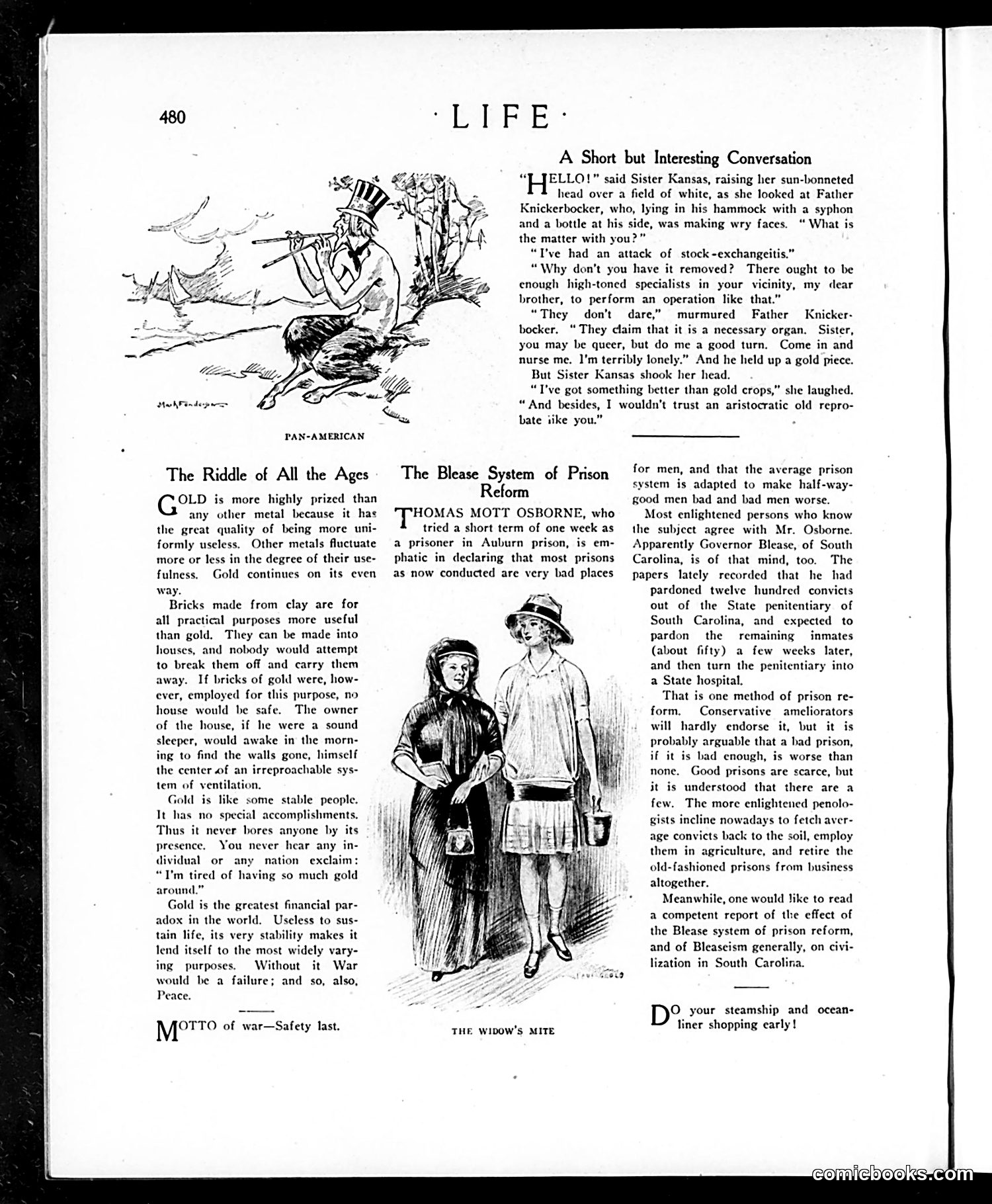
This page contains three distinct pieces of satire: **"A Short but Interesting Conversation"** depicts "Sister Kansas" (representing rural/agricultural America) conversing with "Father Knickerbocker" (representing New York/urban finance). Knickerbocker suffers from "stock-exchangeitis"—a satirical disease representing financial speculation and market instability. Kansas, more prosperous from crops, refuses his gold and aristocratic pretensions, mocking urban elites' dependence on unstable financial systems. **"The Riddle of All the Ages"** is a philosophical essay praising gold's paradoxical uselessness—it serves no practical purpose yet remains universally valued. The satire critiques society's obsession with an inherently worthless metal while ignoring truly useful materials like brick. **"The Blease System of Prison Reform"** discusses Governor Cole Blease of South Carolina's controversial approach: mass pardoning convicts (1,200+) rather than reforming prisons. The article presents this as either radical prison abolition or acknowledgment that bad prisons are worse than none—though reform advocates prefer agricultural rehabilitation over traditional incarceration. All three pieces satirize American society's values and contradictions.
📄 Transcribed text from this page (OCR, searchable)
Machine-transcribed from the original scan — historical spelling and the odd misread are preserved.
TT RSE * A Short but Interesting Conversation “LJELLO!” said Sister Kansas, raising her sun-bonneted head over a field of white, as she looked at Father Knickerbocker, who, lying in his hammock with a syphon and a bottle at his side, was making wry faces. “ What is the matter with you?” “I've had an attack of stock -exchangeitis. “Why don't you have it removed? There ought to be enough high-toned specialists in your vicinity, my dear brother, to perform an operation like that.” “They don’t dare,” murmured Father — Knicker- bocker, “ They claim that it is a necessary organ. Sister, you may be queer, but do me a good turn. Come in and nurse me. 1'm terribly lonely.” And he held up a gold piece. But Sister Kansas shook her head. “T've got something better than gold crops,” she laughed. PAN-AMERICAN The Riddle of All the Ages OLD is more highly prized than any other metal because it has the great quality of being more uni- formly useless, Other metals fluctuate more or less in the degree of their use- fulness, Gold continues on its even way. Bricks made from clay are for all practical purposes more useful than gold. They can be made into houses, and nobody would attempt to break them off and carry them away. If bricks of gold were, how- ever, employed for this purpose, no house would be safe. The owner of the house, if he were a sound sleeper, would awake in the morn- ing to find the walls gone, himself the center of an irreproachable sys- tem of ventilation, Gold is like some stable people. It has no special accomplishments. Thus it never bores anyone by its presence, You never hear any in- dividual or any nation exclaim: “I'm tired of having so much gold around.” Gold is the greatest financial par- adox in the world. Useless to sus- t life, its very stability makes it lend itself to the most widely vary- ing purposes. Without it War would be a failure; and so, also, Peace. Morre of war—Safety last. “And besides, I wouldn't trust an aristocratic old repro- Date iike you.” The Blease System of Prison Reform 'HOMAS MOTT OSBORNE, who tried a short term of one week as a prisoner in Auburn prison, is em- phatic in declaring that most prisons as now conducted are very bad places THE WIDOW'S MITE for men, and that the average prison system is adapted to make half-way- good men bad and bad men worse. Most enlightened persons who know the subject agree with Mr. Osborne. Apparently Governor Blease, of South Carolina, is of that mind, too. The Papers lately recorded that he had pardoned twelve hundred convicts out of the State penitentiary of South Carolina, and expected to pardon the remaining inmates (about fifty) a few weeks later, and then turn the penitentiary into a State hospital, That is one method of prison re- form. Conservative ameliorators will hardly endorse it, but it is probably arguable that a bad prison, if it is bad enough, is worse than none, Good prisons are scarce, but it is understood that there are a few. The more enlightened penolo- gists incline nowadays to fetch aver- age convicts back to the soil, employ them in agriculture, and retire the old-fashioned prisons from business altogether. Meanwhile, one would like to read a competent report of the effect of the Blease system of prison reform, and of Bleascism generally, on civ lization in South Caroli O your steamship and ocean- liner shopping carly!