
Life, 1914-09-17 · page 26 of 48
Life — September 17, 1914 — page 26: what you’re looking at
What you’re looking at
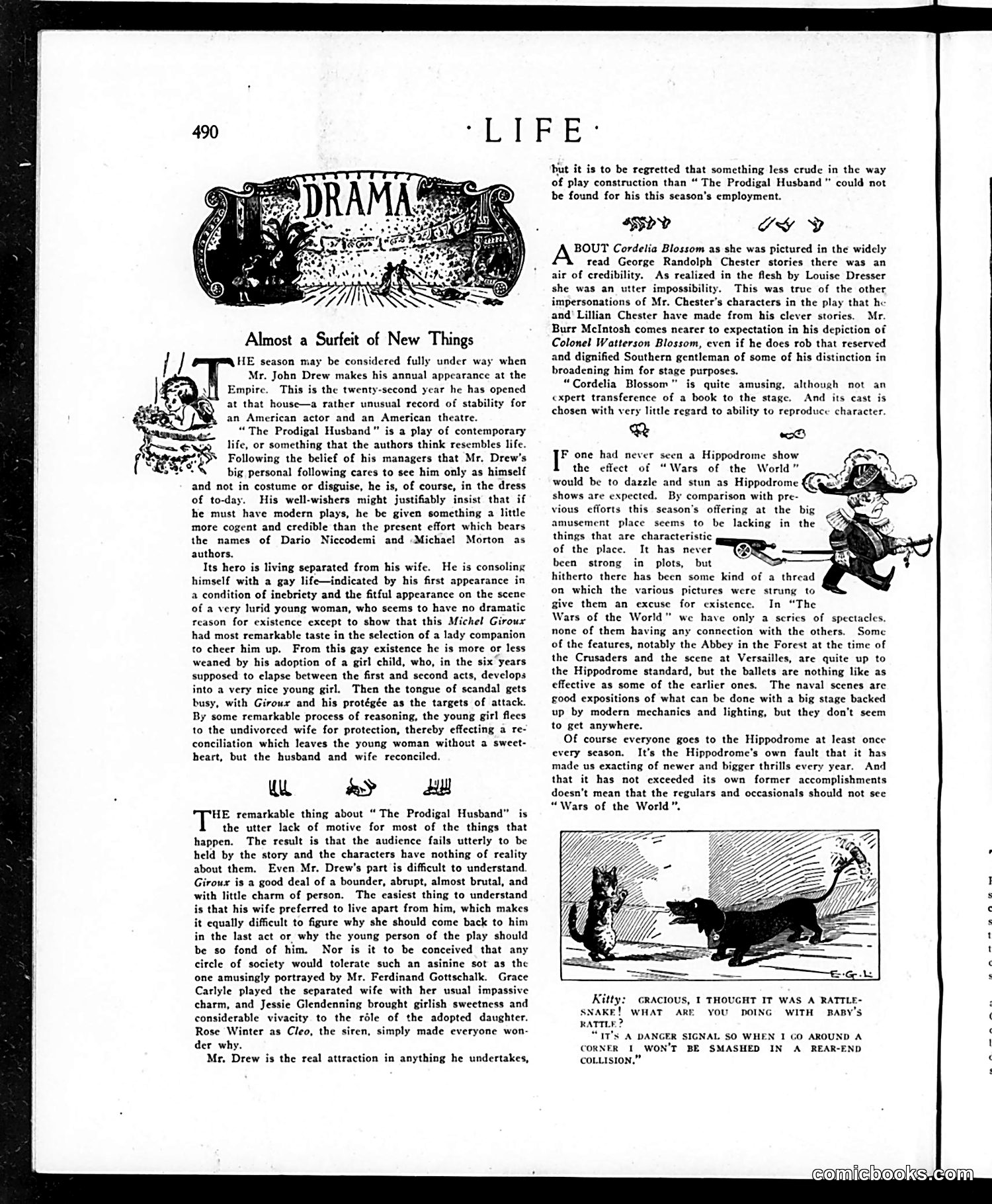
This page reviews two Broadway productions from the early 1900s featuring established actors of the era. **"The Prodigal Husband"** stars John Drew (in his 22nd season at the Empire Theatre), playing a contemporary character—a separated man living a dissolute lifestyle who adopts a child and is eventually reconciled with his wife. The critic harshly judges the play as poorly constructed with unmotivated plot developments and characters lacking believability. Drew himself is praised as the attraction, but the reviewer regrets he wasn't given better material. **"Cordelia Blossom"** (adapted from George Randolph Chester stories) features Louise Dresser. The critic finds her portrayal unconvincing compared to how the character appeared in the original stories, though Burr McIntosh's performance as Colonel Watterson Blossom is deemed more successful. The reviews are dismissive of both plays' dramatic quality while acknowledging the actors' star power as their main appeal.
📄 Transcribed text from this page (OCR, searchable)
Machine-transcribed from the original scan — historical spelling and the odd misread are preserved.
oe ol gle Almost a Surfeit of New Things HE season may be considered fully under way when Mr. John Drew makes his annual appearance at the Empire. This is the twenty-second year he has opened at that house—a rather unusual record of stability for an American actor and an American theatre. “The Prodigal Husband” is a play of contemporary ‘<\cx)__ life, or something that the authors think resembles life. eer Following the belief of his managers that Mr, Drew’s big personal following cares to see him only as himself and not in costume or disguise, he is, of course, in the dress of to-day. His well-wishers might justifiably insist that if he must have modern plays, he be given something a little more cogent and credible than the present effort which bears the names of Dario Niccodemi and Michael Morton as authors. Its hero is living separated from his wife. He is consoling himself with a gay life—indicated by his first appearance in a condition of inebriety and the fitful appearance on the scene of a very lurid young woman, who seems to have no dramatic reason for existence except to show that this Michel Giroux had most remarkable taste in the selection of a lady companion to cheer him up. From this gay existence he is more or less weaned by his adoption of a girl child, who, in the six years supposed to elapse between the first and second acts, develops into a very nice young girl. Then the tongue of scandal gets busy, with Giroux and his protégée as the targets of attack. By some remarkable process of reasoning, the young girl flecs to the undivorced wife for protection, thereby effecting a re- conciliation which leaves the young woman without a sweet- heart, but the husband and wife reconciled. Ku ey du HE remarkable thing about “The Prodigal Husband” is the utter lack of motive for most of the things that happen. The result is that the audience fails utterly to be held by the story and the characters have nothing of reality about them. Even Mr. Drew's part is difficult to understand. Giroux is a good deal of a bounder, abrupt, almost brutal, and with little charm of person. The easiest thing to understand is that his wife preferred to live apart from him, which makes it equally difficult to figure why she should come back to him in the last act or why the young person of the play should be so fond of him. Nor is it to be conceived that any circle of society would tolerate such an asinine sot as the one amusingly portrayed by Mr. Ferdinand Gottschalk. Grace Carlyle played the separated wife with her usual impassive charm, and Jessie Glendenning brought girlish sweetness and considerable vivacity to the réle of the adopted daughter. Rose Winter as Cleo, the siren, simply made everyone won- der why. Mr. Drew is the real attraction in anything he undertakes, hut it is to be regretted that something less crude in the way of play construction than “ The Prodigal Husband " could not be found for his this season's employment. *SOV Gy DY BOUT Cordelia Blossom as she was pictured in the widely read George Randolph Chester stories there was an air of credibility. As realized in the flesh by Louise Dresser she was an utter impossibility. This was truc of the other impersonations of Mr. Chester's characters in the play that he and’ Lillian Chester have made from his clever stories. Mr. Burr McIntosh comes nearer to expectation in his depiction of Colonel Watterson Blossom, even if he does rob that reserved and dignified Southern gentleman of some of his distinction in broadening him for stage purposes. “Cordelia Blossom” is quite amusing, although not an cxpert transference of a book to the stage. And its cast is chosen with very little regard to ability to reproduce character. R <3 F one had never seen a Hippodrome show the effect of “Wars of the World” would be to dazzle and stun as Hippodrome shows are expected. By comparison with pre- vious efforts this season's offering at the big amusement place seems to be lacking in the things that are characteristic of the place. It has never been strong in plots, but hitherto there has been some kind of a thread on which the various pictures were strung to give them an excuse for existence. In “The Wars of the World" we have only a scries of spectacles. none of them having any connection with the others. Some of the features, notably the Abbey in the Forest at the time of the Crusaders and the scene at Versailles, are quite up to the Hippodrome standard, but the ballets are nothing like as effective as some of the earlier ones, The naval scenes are good expositions of what can be done with a big stage backed up by modern mechanics and lighting, but they don't seem to get anywhere. Of course everyone goes to the Hippodrome at least once every season. It's the Hippodrome’s own fault that it has made us exacting of newer and bigger thrills every year. And that it has not exceeded its own former accomplishments doesn’t mean that the regulars and occasionals should not see “Wars of the World”. Kitty: GRacious, I THOUGHT IT WAS A RATTLE- SNAKE! WHAT ARE YOU DOING WITH BABY’S ‘SA DANGER SIGNAL SO WHEN I GO AROUND A ER I WON'T BE SMASHED IN A REAR-END COLLISION.”