
Life, 1914-09-17 · page 44 of 48
Life — September 17, 1914 — page 44: what you’re looking at
What you’re looking at
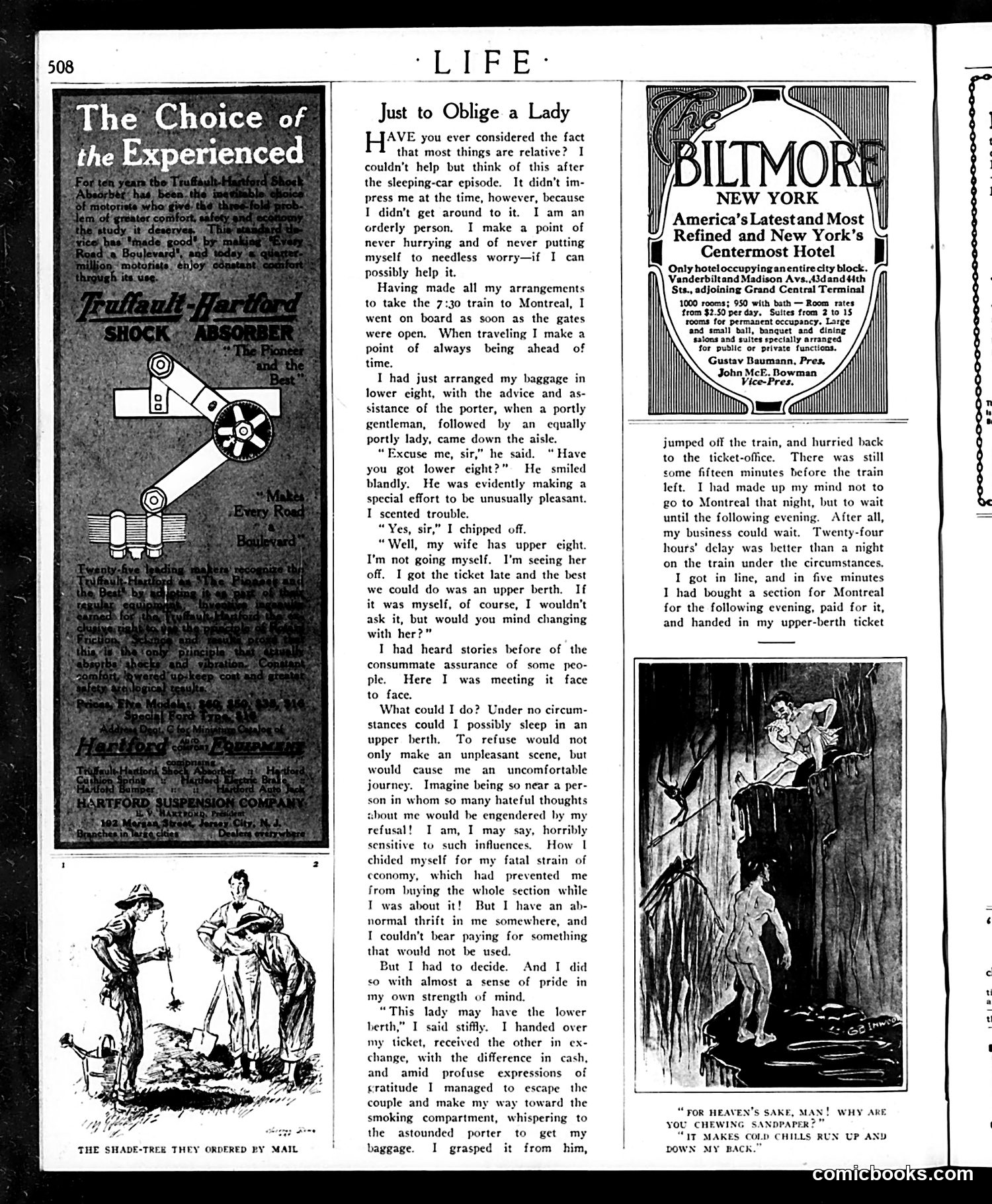
This page presents a humorous essay about social obligation and class anxiety in early 20th-century train travel. The narrator, portrayed as fastidiously orderly and economical, has booked a lower berth on a Montreal-bound train. A portly gentleman requests he surrender it to his wife, who has only an upper berth. Despite the discomfort and inconvenience, the narrator—paralyzed by social sensitivity and fear of appearing ungracious—agrees, paying the difference. However, his resentment at being manipulated ultimately triumphs over his need to avoid discomfort: he abandons the trip entirely, books a different section for the next evening, and avoids the awkward journey. The satire targets the narrator's excessive politeness and self-consciousness, which allows him to be exploited by brazenly entitled travelers. The accompanying illustrations depict scenes of train travel inconvenience and social awkwardness typical of the era.
📄 Transcribed text from this page (OCR, searchable)
Machine-transcribed from the original scan — historical spelling and the odd misread are preserved.
The Choice of "the Experienced THE SHADE-TREE THEY ORDERED BY MAIL ‘LIFE: Just to Oblige a Lady AVE you ever considered the fact that most things are relative? I couldn't help but think of this after the sleeping-car episode. It didn’t im- press me at the time, however, because I didn’t get around to it. I am an orderly person. I make a point of never hurrying and of never putting myself to needless worry—if I can possibly help it. Having made all my arrangements to take the 7:30 train to Montreal, I went on board as soon as the gates were open, When traveling I make a point of always being ahead of time. I had just arranged my baggage in lower cight, with the advice and as- sistance of the porter, when a portly gentleman, followed by an equally portly lady, came down the aisle. “Excuse me, sir,” he said. “ Have you got lower eight?” He smiled blandly. He was evidently making a special effort to be unusually pleasant. I scented trouble. “Yes, sir,” I chipped off. “Well, my wife has upper eight. I'm not going myself. I'm seeing her off. I got the ticket late and the best we could do was an upper berth. If it was myself, of course, I wouldn't ask it, but would you mind changing with her?” I had heard stories before of the consummate assurance of some peo- ple. Here I was meeting it face to face. What could I do? Under no circum- stances could I possibly sleep in an upper berth, To refuse would not only make an unpleasant scene, but would cause me an uncomfortable journey, Imagine being so near a per- son in whom so many hateful thoughts shout me would be engendered by my refusal! I am, I may say, horribly sensitive to such influences. How 1 chided myself for my fatal strain of cconomy, which had prevented me from buying the whole section while T was about it! But I have an ab- normal thrift in me somewhere, and I couldn't bear paying for something that would not be used. But I had to decide. And I did so with almost a sense of pride in my own strength of mind. “This lady may have the lower berth,” I said stiffly. I handed over my ticket, received the other in ex- change, with the difference in cash, and amid profuse expressions of gratitude I managed to escape the couple and make my way toward the smoking compartment, whispering to the astounded porter to get my baggage. I grasped it from him, ll i wl NEW YORK Y America’s Latestand Most Refined and New York’s [| Centermost Hotel J Only hotel occupying anentirecity block. Vanderbiltand Madison Avs.43dand 4th Sts., adjoining Grand Central Terminal 1000 rooms; 950 with bath — Room rates from $2.50 per day, Suites from 2 to 15 rooms for permanent occupancy. Large and small ball, banquet and dining salons and suites specially arranged for public or private functions, Gustav Baumann, Pres, John McE. Bowman Vice-Pres, jumped off the train, and hurried back to the ticket-office. There was still some fifteen minutes before the train left. I had made up my mind not to go to Montreal that night, but to wait until the following evening. After all, my business could wait. Twenty-four hours’ delay was better than a night on the train under the circumstances, I got in line, and in five minutes I had bought a section for Montreal for the following evening, paid for it, and handed in my upper-berth ticket