
Life, 1914-09-17 · page 32 of 48
Life — September 17, 1914 — page 32: what you’re looking at
What you’re looking at
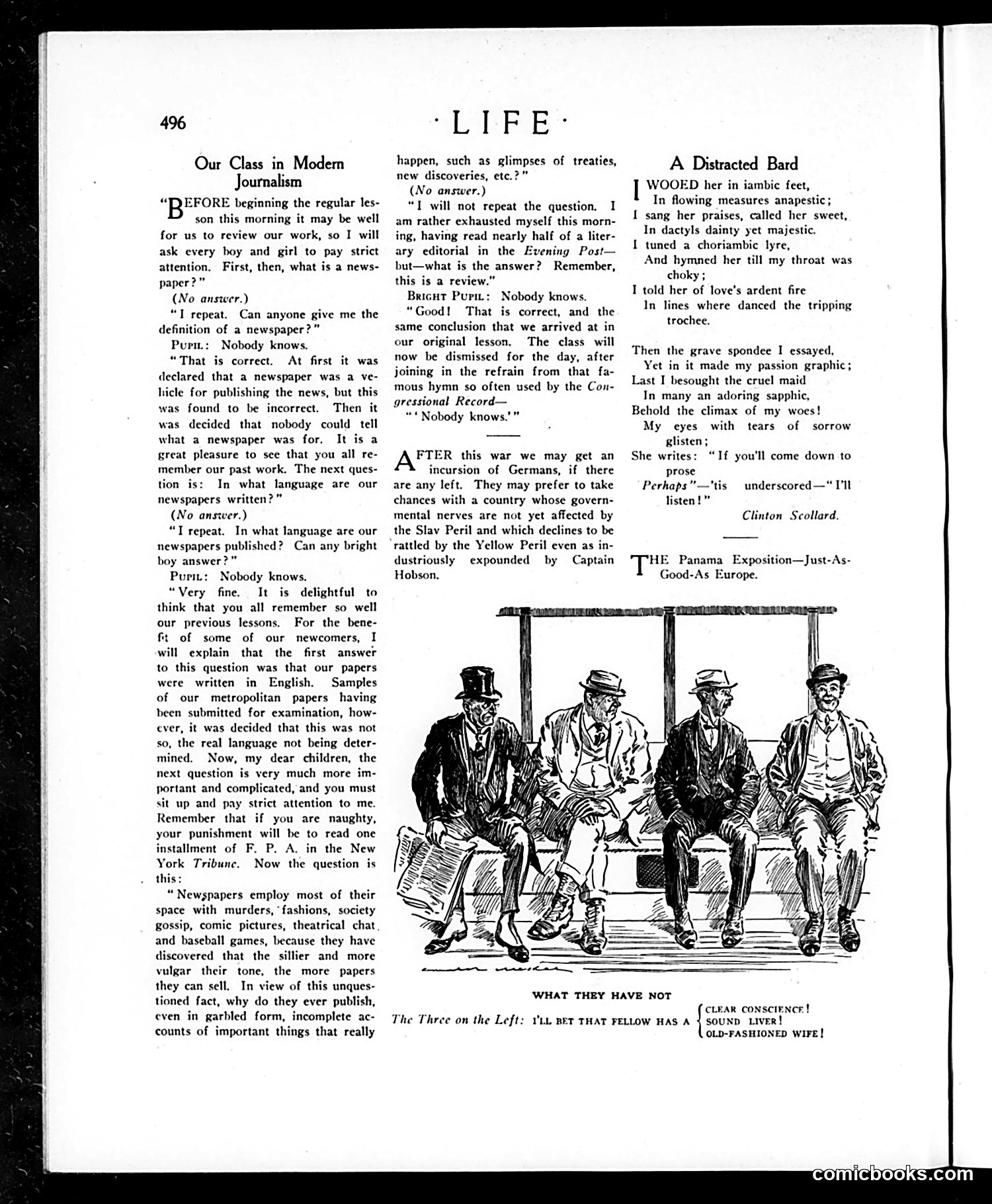
This page contains satirical commentary on American newspapers and journalism. The main piece, "Our Class in Modern Journalism," uses a mock-classroom format to criticize newspapers for prioritizing sensationalism (murders, gossip, comic pictures, baseball) over substantive news about treaties and discoveries. The repeated answer "Nobody knows" becomes a running joke—suggesting the newspaper industry itself cannot justify its own editorial priorities. The satire targets newspapers' cynical calculation that vulgar, silly content sells better than serious reporting. The reference to F.P.A. in the *New York Tribune* is an actual contemporary literary columnist. The bottom illustration shows four men on a bench discussing someone's morality, with one declaring "I'll bet that fellow has a CLEAR CONSCIENCE! SOUND LIVER! OLD-FASHIONED WIFE!"—likely mocking simplistic character judgments of the era. The page critiques press irresponsibility through humor rather than direct argument.
📄 Transcribed text from this page (OCR, searchable)
Machine-transcribed from the original scan — historical spelling and the odd misread are preserved.
496 Our Class in Modern Journalism ‘B ORE beginning the regular les- son this morning it may be well for us to review our work, so I will ask every boy and girl to pay strict attention. First, then, what is a news- paper?” (No answer.) “T repeat. Can anyone give me the definition of a newspaper?” Purt.: Nobody knows. “That is correct. At first it was declared that a newspaper was a ve- hicle for publishing the news, but this was found to be incorrect. Then it was decided that nobody could tell what a newspaper was for. It is a great pleasure to see that you all re- member our past work. The next ques- tion is: In what language are our newspapers written?” (No answer.) “T repeat. In what language are our newspapers published? Can any bright boy answer?” Purit: Nobody knows, “Very fine. It is delightful to think that you all remember so well our previous lessons. For the bene- ft of some of our newcomers, I will explain that the first answer to this question was that our papers were written in English. Samples of our metropolitan papers having been submitted for examination, how- ever, it was decided that this was not so, the real language not being deter- mined. Now, my dear children, the next question is very much more im- portant and complicated, and you must sit up and pay strict attention to me. Remember that if you are naughty, your punishment will be to read one installment of F. P. A. in the New York Tribune. Now the question is this: “Newspapers employ most of their space with murders, ‘fashions, society gossip, comic pictures, theatrical chat and baseball games, because they have discovered that the sillier and more vulgar their tone, the more papers they can sell. In view of this unques- tioned fact, why do they ever publish, even in garbled form, incomplete ac- counts of important things that really “bslrae happen, such as glimpses of treaties, new discoveries, etc.?” (No answer.) “T will not repeat the question. I am rather exhausted myself this morn- ing, having read nearly half of a liter- ary editorial in the Evening Post— but—what is the answer? Remember, this is a review.” Bricut Purit: Nobody knows. “Good! That is correct, and the same conclusion that we arrived at in our original lesson, The class will now be dismissed for the day, after joining in the refrain from that fa- mous hymn so often used by the Con- gressional Record— “* Nobody knows.’” FTER this war we may get an incursion of Germans, if there are any left. They may prefer to take chances with a country whose govern- mental nerves are not yet affected by the Slav Peril and which declines to be rattled by the Yellow Peril even as in- dustriously expounded by Captain Hobson, A Distracted Bard WOOED her in iambic feet, In flowing measures anapestic; I sang her praises, called her sweet, In dactyls dainty yet majestic. I tuned a choriambic lyre, And hymned her till my throat was choky ; I told her of love's ardent fire In lines where danced the tripping trochee. Then the grave spondee I essayed, Yet in it made my passion graphic; Last I besought the cruel maid In many an adoring sapphic, Behold the climax of my woes! My eyes with tears of sorrow glisten; She writes: prose Perhaps” —"tis listen!” “If you'll come down to underscored —" I'll Clinton Scollard. Panama Exposition—Just-As- Good-As Europe. WHAT THEY HAVE NOT CLEAR CONSCIENCE! The Three on the Left: 1't, BET THAT FELLOW HAS A {xn Liver! OLD-FASHIONED WIFE!