
Life, 1914-09-17 · page 18 of 48
Life — September 17, 1914 — page 18: what you’re looking at
What you’re looking at
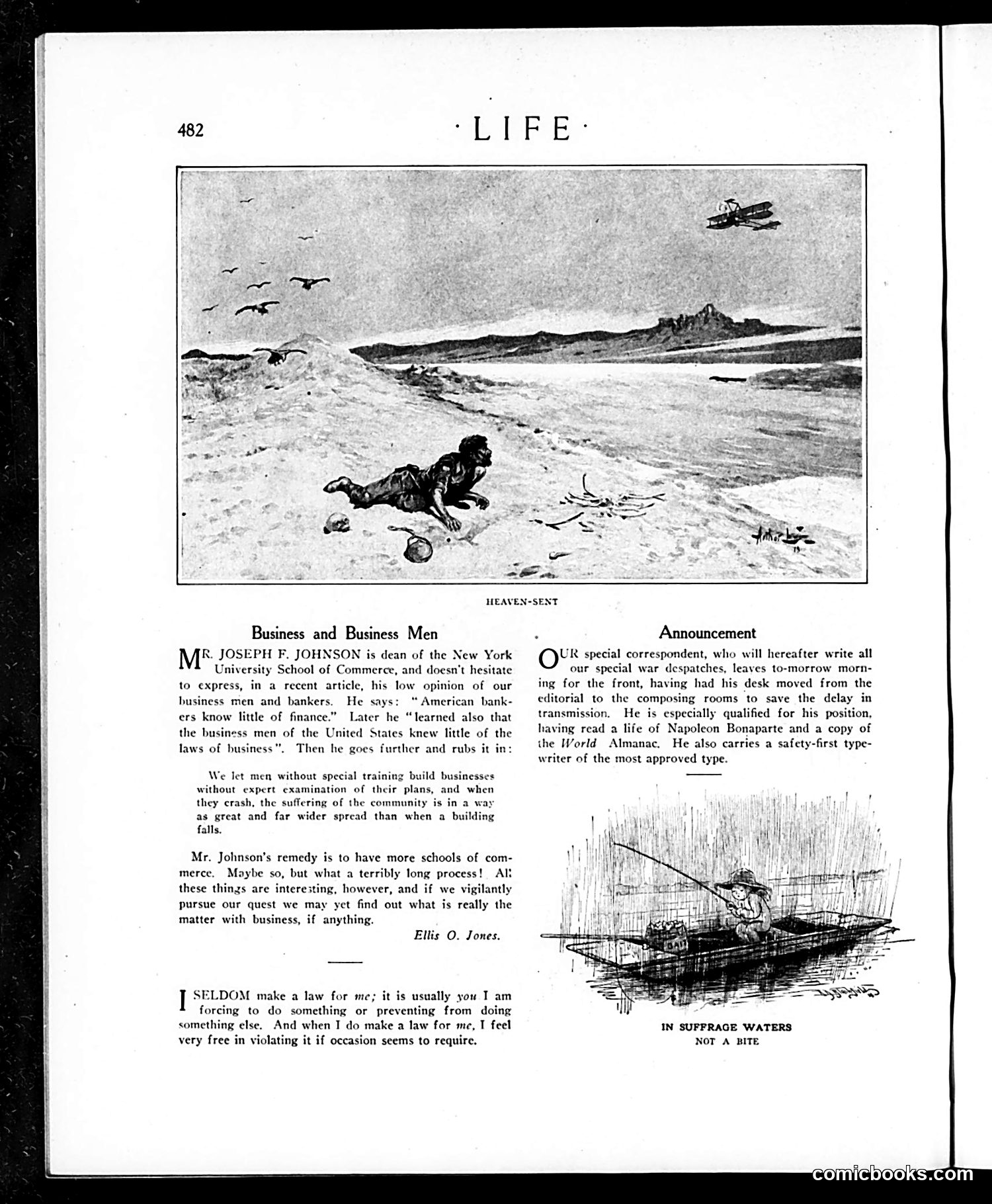
This Life magazine page contains social commentary and satire from the WWI era. **"Business and Business Men"** critiques Joseph F. Johnson, dean of NYU's Commerce School, who publicly criticized American bankers and businessmen as ignorant of finance and business law. The author Ellis O. Jones sarcastically agrees that Johnson's solution—more business schools—seems "a terribly long process," implying the real problems with American business run deeper than education can fix. **"Heaven-Sent"** (top illustration) appears to show a soldier under fire, with an airplane overhead and birds flying—likely commenting on military incompetence or the chaos of modern warfare. **"In Suffrage Waters—Not a Bite"** (bottom illustration) is a joke about women's suffrage activism. The fishing metaphor suggests suffragettes are "fishing" for political rights but "not getting a bite"—meaning their efforts yield no results. This reflects contemporary skepticism about the women's suffrage movement (which succeeded in the U.S. in 1920, shortly after this publication). **"Announcement"** satirizes war correspondents as unqualified, needing only Napoleon books and an "Almanac" to report from the front.
📄 Transcribed text from this page (OCR, searchable)
Machine-transcribed from the original scan — historical spelling and the odd misread are preserved.
MEAVEN-SENT Business and Business Men R. JOSEPH F, JOHNSON is dean of the New York University School of Commerce, and doesn’t hesitate to express, in a recent article, his low opinion of our business men and bankers. He says: “American bank- ers know little of finance: Later he “learned also that the business men of the United States knew little of the laws of business". Then he goes further and rubs it in: We let men without special training build businesses without expert examination of their plans, and when they crash, the suffering of the community is in a way as great and far wider spread than when a building falls. Mr. Johnson’s remedy is to have more schools of com- merce. Maybe so, but what a terribly long process! Alt these things are interesting, however, and if we vigilantly pursue our quest we may yet find out what is really the matter with business, if anything. Ellis O. Jones. I LDOM make a law for me; it is usually you T am forcing to do something or preventing from doing something else. And when I do make a law for me, I feel very free in violating it if occasion seems to require. Announcement ov special correspondent, who will hereafter write all our special war despatches, leaves to-morrow morn- ing for the front, having had his desk moved from the editorial to the composing rooms to save the delay in transmission, He is especially qualified for his position, having read a life of Napoleon Bonaparte and a copy of the World Almanac. He also carries a safety-first type- writer of the most approved type. IN SUFFRAGE WATERS NOT A BITE