
Life, 1914-09-17 · page 20 of 48
Life — September 17, 1914 — page 20: what you’re looking at
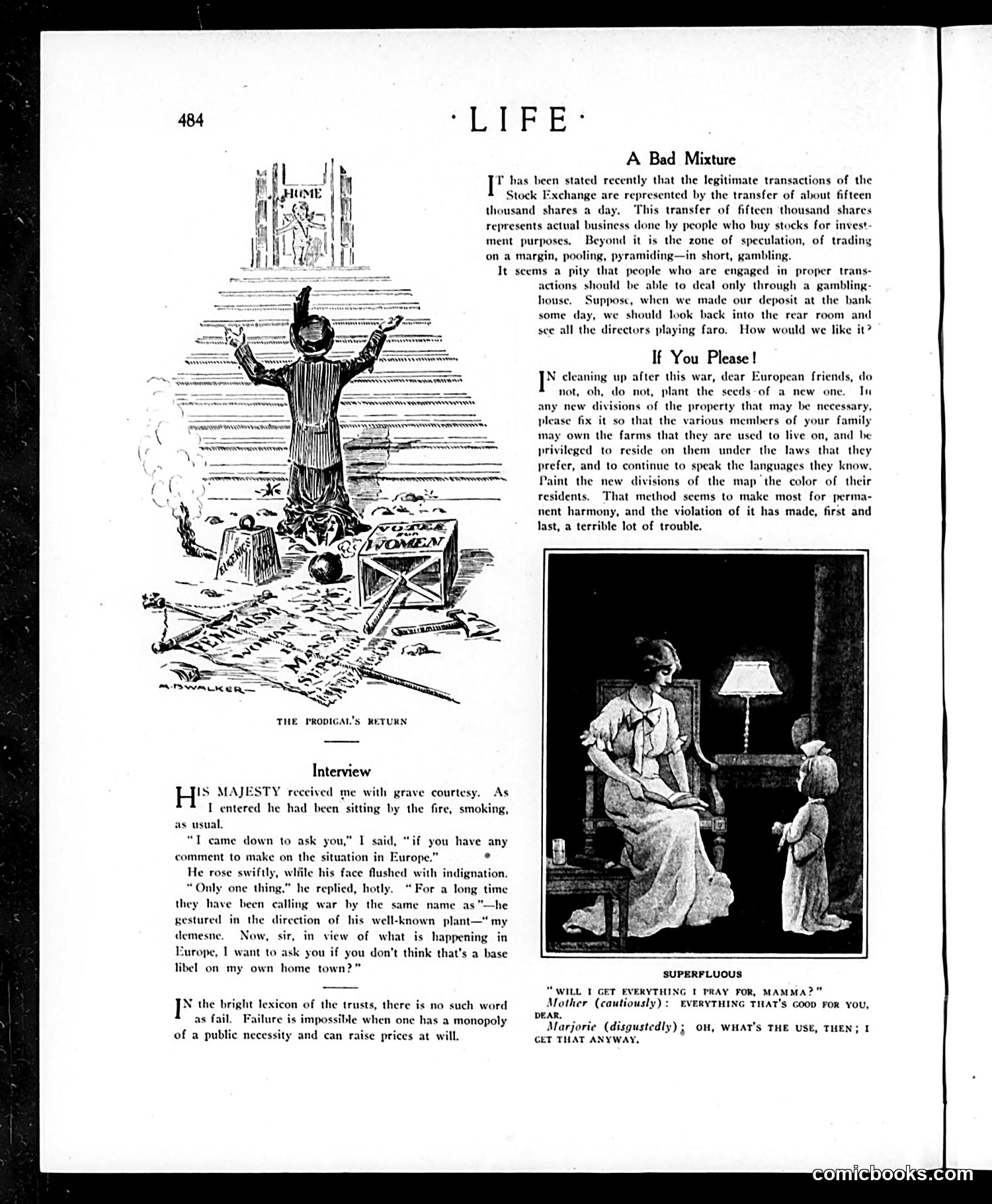
What you’re looking at
**"The Prodigal's Return"** (left cartoon): Shows a figure emerging from destruction labeled "JUNE" (likely June 1918, end of WWI), arms raised triumphantly above rubble marked "WOMEN." The satire criticizes how war profiteers and speculators celebrated while civilians—particularly women—suffered the war's devastation. **"A Bad Mixture"** (text): Criticizes the Stock Exchange for mixing legitimate investment (15,000 shares daily) with rampant speculation, margin trading, and gambling. The banking analogy—depositors wouldn't tolerate directors playing faro in the bank's rear room—argues that allowing speculation through legitimate institutions corrupts them. **"If You Please!"** (text): Post-WWI plea to European nations: redraw boundaries respecting existing property ownership, residence laws, and language preferences to prevent future conflicts born from imposed divisions. **"Interview" and "Superfluous"** (bottom): Brief satirical pieces on wealth, privilege, and children's expectations—minor commentaries on post-war social attitudes.
📄 Transcribed text from this page (OCR, searchable)
Machine-transcribed from the original scan — historical spelling and the odd misread are preserved.
“PEE * A Bad Mixture T has been stated recently that the legitimate transactions of the Stock Exchange are represented by the transfer of about fifteen thousand shares a day. his transfer of fifteen thousand shares represents actual business done by people who buy stocks for invest- ment purposes, Beyond it is the zone of speculation, of trading on a margin, pooling, pyramiding—in short, gambling. It seems a pity that people who are engaged in proper trans- actions should be able to deal only through a gambling house. Suppose, when we made our deposit at the bank some day, we should look back into the rear room and see all the directors playing faro. How would we like it? If You Please! N cleaning up after this war, dear European friends, do not, oh, do not, plant the seeds of a new one. In any new divisions of the property that may be necessary, please fix it so that the various members of your family own the farms that they are used to live on, and be privileged to reside on them under the laws that they prefer, and to continue to speak the languages they know, int the new divisions of the map the color of their residents. That method seems to make most for perma- nent harmony, and the violation of it has made, first and last, a terrible lot of trouble. THE PRODIG. Interview MAJESTY received me with grave courtesy, As I entered he had been sitting by the fire, smoking, as usual, “T came down to ask you,” I said, “if you have any comment to make on the situation in Europe.” ° He rose swiftly, wliile his face flushed with indignation. “Only one thing,” he replied, hotly. “For a long time they have been calling war by the same name as"—he gestured in the direction of his well-known plant— my demesne. Now, sir, in view of what is happening in Europe, 1 want to ask you if you don’t think that’s a base ibe ow own?” libel on my own home town? SUPERFLUOUS “WILL I GET EVERYTHING I PRAY FOR, MAMMA?” | the bright lexicon of the trusts, there is no such word Mother (cautiously): EVERYTHING THAT'S GooD FOR YoU, ilure is impossible when one has PEN 9.35 : ; . fF when one has a monopoly Marjorie (disgustedly) ; OH, WHAT's THE USE, THEN; 1 of a public necessity and can raise prices at will. CET THAT ANYWAY, as fail.