
Life, 1914-09-17 · page 22 of 48
Life — September 17, 1914 — page 22: what you’re looking at
What you’re looking at
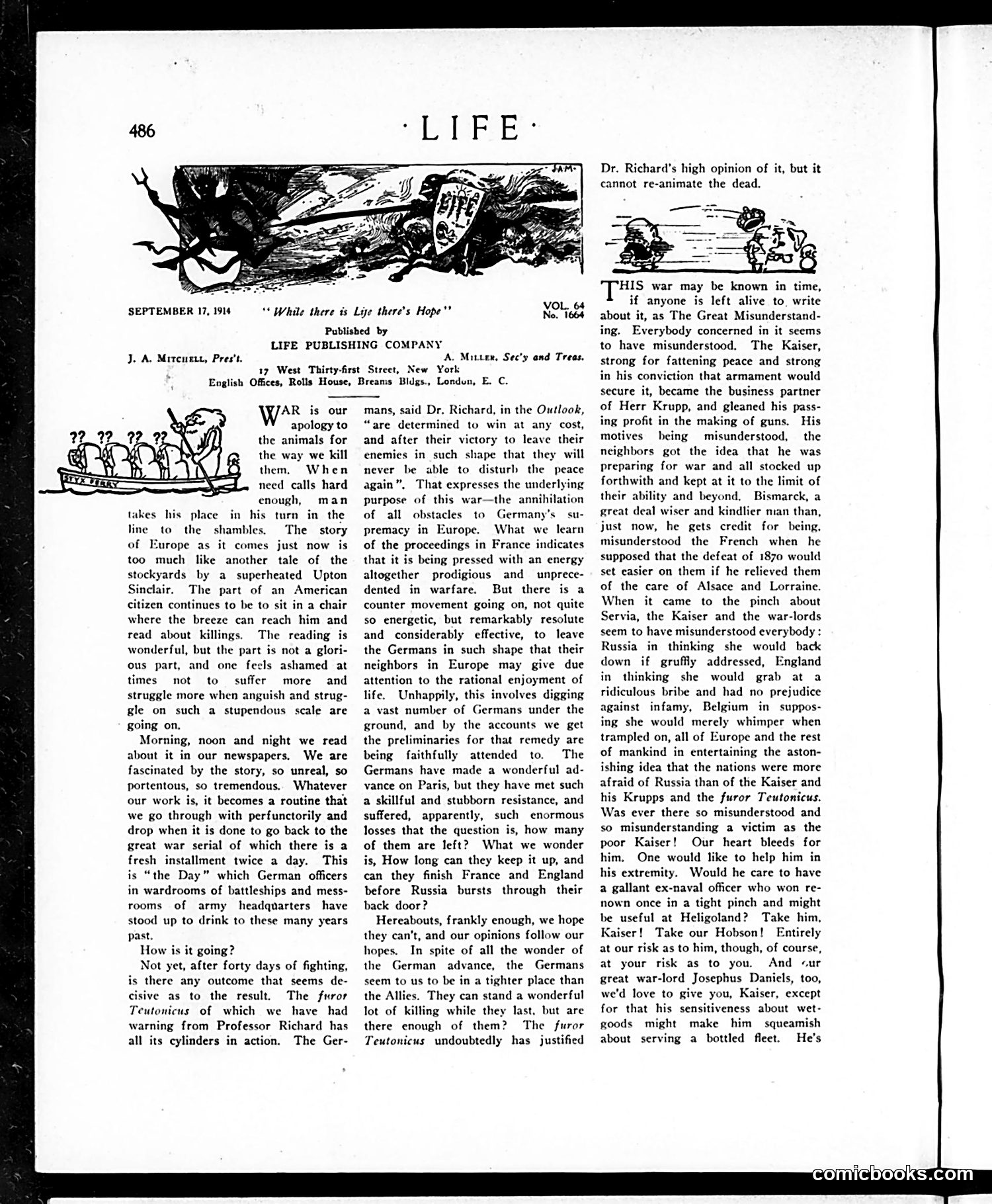
This editorial page comments on the early weeks of World War I (which began in August 1914). The cartoons—showing soldiers in a boat and marching figures—illustrate the article's grim tone comparing warfare to slaughterhouses. The text critiques German war aims, citing "Dr. Richard" (likely a contemporary expert) on German determination to win "at any cost" and eliminate European rivals. The author notes Germany's "wonderful advance on Paris" met fierce Allied resistance, questioning German sustainability: "are there enough of them?" The piece expresses American anxiety about prolonged conflict, particularly whether Russia might attack Germany's rear. The title—"While there is Life there's Hope"—ironically frames the war as a brutal industrial process. The concluding point is darkly pragmatic: German military doctrine ("furor Teutonicus") cannot resurrect the dead, suggesting the war's horrific human cost will ultimately defeat even Germany's determination.
📄 Transcribed text from this page (OCR, searchable)
Machine-transcribed from the original scan — historical spelling and the odd misread are preserved.
SEPTEMBER 17, 1914 ‘* While there is Lie there’s Hope"’ Published by LIFE PUBLISHING COMPANY J. A. Mitcuett, Pres’t. ‘AR is our apology to the animals for the way we kill them. When need calls hard enough, man takes his place in his turn in’ the line to the shambles, The story of Europe as it comes just now is too much like another tale of the stockyards by a superheated Upton Sinclair. The part of an American citizen continues to be to sit in a chair where the breeze can reach him and read about killings. The reading is wonderful, but the part is not a glori- ous part, and one feels ashamed at times not to suffer more and struggle more when anguish and strug- gle on such a stupendous scale are going on, Morning, noon and night we read about it in our newspapers, We are fascinated by the story, so unreal, so Portentous, so tremendous. Whatever our work is, it becomes a routine that we go through with perfunctorily and drop when it is done to go back to the great war serial of which there is a fresh installment twice a day. This is “the Day” which German officers in wardrooms of battleships and mess- rooms of army headquarters have stood up to drink to these many years past. How is it going? Not yet, after forty days of fighting, is there any outcome that seems de- cisive as to the result. The furor Teutonicus of which we have had warning from Professor Richard has all its cylinders in action. The Ger- A. Mitter, Sec’y and Treas. 17 West Thirty-first Street, New York English Offices, Rolls House, Breams Bldgs., London, E. C. mans, said Dr. Richard, in the Outlook, “are determined to win at any cost, and after their victory to leave their enemies in such shape that they will never be able to disturb the peace again”, That expresses the underlying purpose of this war—the annihilation of all obstacles to Germany's su- premacy in Europe. What we learn of the proceedings in France indicates that it is being pressed with an energy altogether prodigious and unprece- dented in warfare. But there is a counter movement going on, not quite so energetic, but remarkably resolute and considerably effective, to leave the Germans in such shape that their neighbors in Europe may give due attention to the rational enjoyment of life. Unhappily, this involves digging a vast number of Germans under the ground, and by the accounts we get the preliminaries for that remedy are being faithfully attended to. The Germans have made a wonderful ad- vance on Paris, but they have met such a skillful and stubborn resistance, and suffered, apparently, such enormous losses that the question is, how many of them are left? What we wonder is, How long can they keep it up, and can they finish France and England before Russia bursts through their back door? Hereabouts, frankly enough, we hope they can’t, and our opinions follow our hopes. In spite of all the wonder of the German advance, the Germans seem to us to be in a tighter place than the Allies. They can stand a wonderful lot of killing while they last, but are there enough of them? The furor Teutonicus undoubtedly has justified Dr. Richard's high opinion of it, but it cannot re-animate the dead. 7pes. war may be known in time, if anyone is left alive to. write about it, as The Great Misunderstand- ing. Everybody concerned in it seems to have misunderstood. The Kaiser, strong for fattening peace and strong in his conviction that armament would secure it, became the business partner of Herr Krupp, and gleaned his pass- ing profit in the making of guns. His motives being misunderstood, the neighbors got the idea that he was preparing for war and all stocked up forthwith and kept at it to the limit of their ability and beyond, Bismarck, a great deal wiser and kindlier man than, just now, he gets credit for being, misunderstood the French when he supposed that the defeat of 1870 would set easier on them if he relieved them of the care of Alsace and Lorraine. When it came to the pinch about Servia, the Kaiser and the war-lords seem to have misunderstood everybody : Russia in thinking she would back down if gruffly addressed, England in thinking she would grab at a ridiculous bribe and had no prejudice against infamy, Belgium in suppos- ing she would merely whimper when trampled on, all of Europe and the rest of mankind in entertaining the aston- ishing idea that the nations were more afraid of Russia than of the Kaiser and his Krupps and the furor Teutonicus. Was ever there so misunderstood and so misunderstanding a victim as the poor Kaiser! Our heart bleeds for him. One would like to help him in his extremity. Would he care to have a gallant ex-naval officer who won re- nown once in a tight pinch and might be useful at Heligoland? Take him, Kaiser! Take our Hobson! Entirely at our risk as to him, though, of course, at your risk as to you. And cur great war-lord Josephus Daniels, too, we'd love to give you, Kaiser, except for that his sensitiveness about wet- goods might make him squeamish about serving a bottled fleet. He's