
Life, 1914-09-17 · page 27 of 48
Life — September 17, 1914 — page 27: what you’re looking at
What you’re looking at
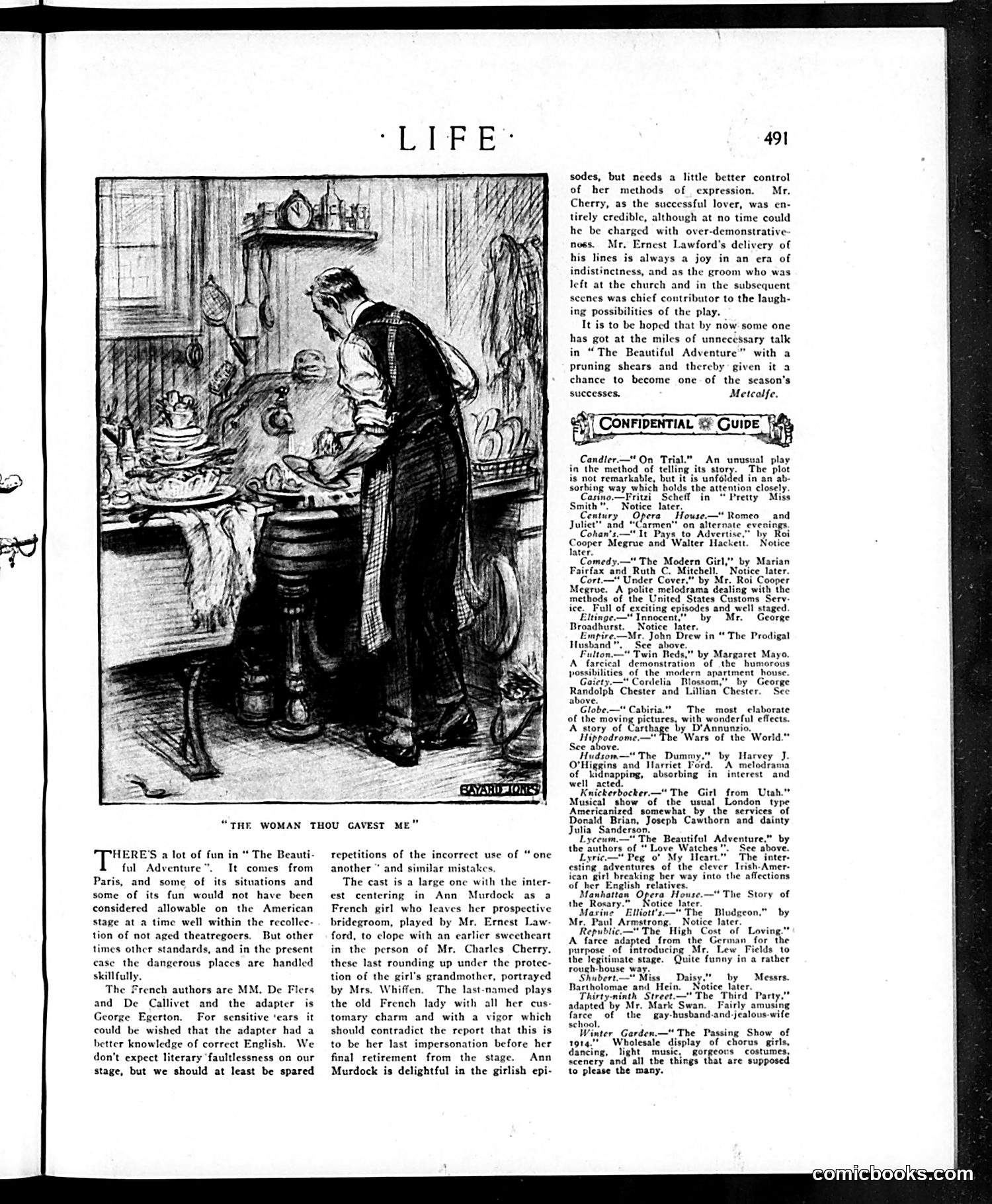
This page reviews "The Beautiful Adventure," a French play adapted for American audiences. The illustration shows a domestic scene—likely depicting the play's central plot about a woman choosing between suitors. The review praises the cast, particularly Ann Murdock (the French girl), Ernest Lawford (the jilted groom), and Charles Cherry (her former lover). Mrs. Whiffen earns special commendation for her grandmother role. The critic notes the play contains situations formerly considered unsuitable for American theater but now acceptable ("other times other standards"). However, he critiques the adapter's English grammar and suggests the script needs editing—it contains unnecessary dialogue that should be "pruned" to help it become a season's success. The remainder lists current theatrical offerings, mixing stage productions with moving pictures like "Cabiria."
📄 Transcribed text from this page (OCR, searchable)
Machine-transcribed from the original scan — historical spelling and the odd misread are preserved.
“THE WOMAN THOU GAVEST ME” HERE'S a lot of fun in * The Beauti- ful Adventure”. It comes from Paris, and some of its situations and some of its fun would not have been considered allowable on the American stage at a time well within the recollec- tion of not aged theatregocrs. But other times other standards, and in the present case the dangerous places are handled skillfully. The French authors are MM. De Flers and De Callivet and the adapter is George Egerton. For sensitive ‘ears it could be wished that the adapter had a hetter knowledge of correct English. We don't expect literary faultlessness on our stage, but we should at least be spared repetitions of the incorrect use of “one another ” and similar mistakes. The cast is a large one with the inter- est centering in Ann Murdock as a French girl who leaves her prospective bridegroom, played by Mr. Ernest Law- ford, to clope with an earlier sweetheart in the person of Mr. Charles Cherry. these last rounding up under the protec- tion of the girl's grandmother, portrayed by Mrs. Whiffen, The last-named plays the old French lady with all her cus- tomary charm and with a vigor which should contradict the report that this is to be her last impersonation before her final retirement from the stage. Ann Murdock is delightful in the girlish epi- 491 sodes, but needs a little better control of her methods of expression. Mr. Cherry, as the successful lover, was en- tirely credible, although at no time could he be charged with over-demonstrative ness. Mr, Ernest Lawford’s delivery of his lines is always a joy in an era of indistinctness, and as the groom who was left at the church and in the subsequent scenes was chief contributor to the laugh- ing possibilities of the play. It is to be hoped that by now: some one has got at the miles of unnecessary talk in “The Beautiful Adventure” with a pruning shears and thereby given it a chance to become one of the season's successes, Metcalfe, BY CONFIDENTIAL & Guibe i Candter.—" On Trial.” An unusual play in the method of telling its story. The plot is not remarkable, but it is unfolded in an ab sorbing way which holds the attention closely. Casine.—Fritzi Scheft in ety Miss Smith.” Notice later. Century Opera House—" Romeo and Juliet” and “Carmen” on aiternate evenings. Cohan’s.—"It Pays to Advertise,” hy Roi Cooper Megrue and Walter Hacketi. Notice later. Comedy.—" The Modern Girl,” by Marian Fairfax and Ruth C. Mitchell.’ Notice later. Cort.—" Under Cover,” by Mr. Roi Cooper Megrue. A polite melodrama dealing with the methods of the United States Customs Serv- ice. Full of exciting episodes and well staged. Eltinge-—" Innocent,” by Mr. George Broadhurst. Notice later. Empire-—Mr. John Drew in “ The Prodigal Husband *, "See above. Fulton.—" Twin Reds,” by Margaret Mayo, A farcical demonstration of the humorous possibilities of the modern apartment house. Gaiety.— Cordelia Blossom,” by George Randolph Chester and Lillian ‘Chester. See above. Globe.—" Cabiria.” The most elaborate of the moving pictures, with wonderful effects. A story of Carthage by D’Annunzio. Hippodrome.— The Wars of the World.” See above. Hudsom—" The Dummy," by Harvey J. O'Higgins and Harriet Ford. A melodrama of kidnapping, absorbing in ‘interest and well acted. Knickerbocker.—" The Girl Musical show of the usual from Utah.” London type. Americanized somewhat by the services of Donald Brian, Joseph Cawthorn and dainty Julia Sanderson. Lyceum.—" The Beautiful Adventure,” by the authors of “Love Watches". See above. Lyric.—" Peg o’ My Heart." The inter- esting adventures of the clever Trish-Amer- ican girl breaking ber way into the affections of her English relatives. Manhattan Opera House.—" The Story of the Rosary.” Notice later Marine Eltiott's—" The Bludgeon.” by Mr. Paul Armstrong. Notice later. | Republic.—" The High Cost of Loving.” A farce adapted from the German for the purpose of introducing Mr. Lew Fields to the legitimate stage. Quite funny in a rather rough-house way. Shubert.—" Miss Daisy." by Bartholomae and Hein. | Notice later. Thirty-ninth Street.—" The Third Party," adapted by Mr. Mark Swan. Fairly amusing farce. of the gay-husband-and-jealous-wife school. Winter Garden.—" The Passing Show. of 1914." Wholesale display of chorus girls, dancing, light music, gorgeots costumes, scenery and all the things that are supposed to please the many. Messrs.