
A complete issue · 60 pages · 1914
Life — March 5, 1914
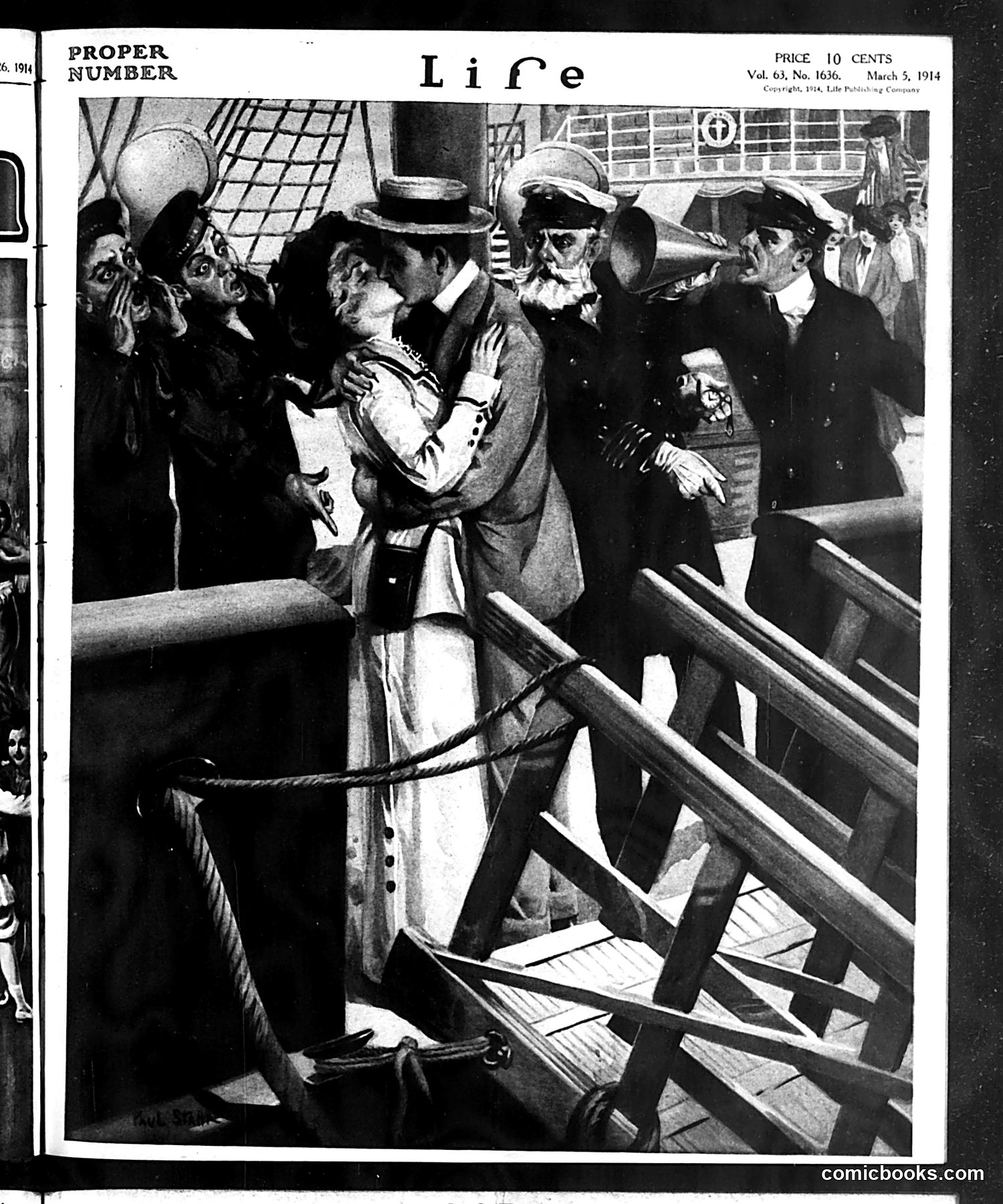
This appears to be a satirical illustration depicting immigration or arrival at a port, likely Ellis Island. The central figure—a woman in traditional dress holding a child—appears to represent an immigrant, surrounded by officials in suits and caps. The exaggerated facial features of some figures suggest ethnic caricature, common in early 1900s American satire. The railing and ship setting indicate this depicts the immigration process. Given 1914's context of heavy Eastern European immigration to America, this likely satirizes either the immigration system itself or contemporary anxieties about "new" immigrants. The woman's formal presentation to gathered officials suggests commentary on immigration screening, processing, or public reaction to newcomers. Without visible text identifying specific individuals, the precise satirical target remains unclear.
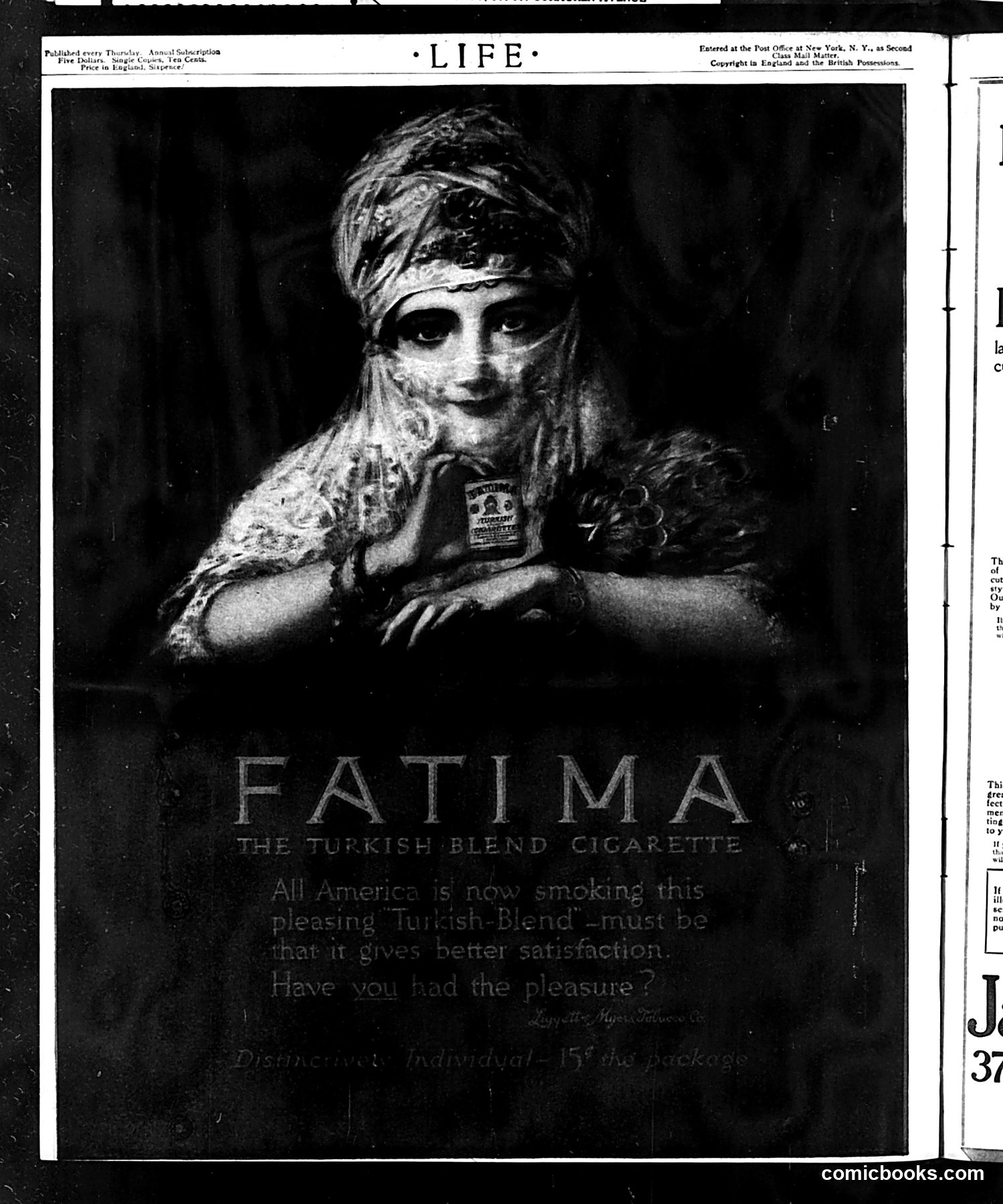
This page is primarily a **cigarette advertisement**, not political satire. It promotes "Fatima: The Turkish Blend Cigarette" featuring an exotic, orientalist image of a woman in Turkish dress with a headscarf and veil. The ad copy claims "All America is now smoking this pleasing Turkish-Blend—must be that it gives better satisfaction. Have you had the pleasure?" **Context for modern readers:** This reflects early 20th-century marketing that exploited "Oriental" imagery to sell products as exotic and desirable. The gendered, stereotypical depiction of a Turkish woman was standard advertising practice then. Such portrayals—romanticizing and exoticizing non-Western cultures through female figures—would be considered offensive today as perpetuating colonial-era stereotypes and objectification.
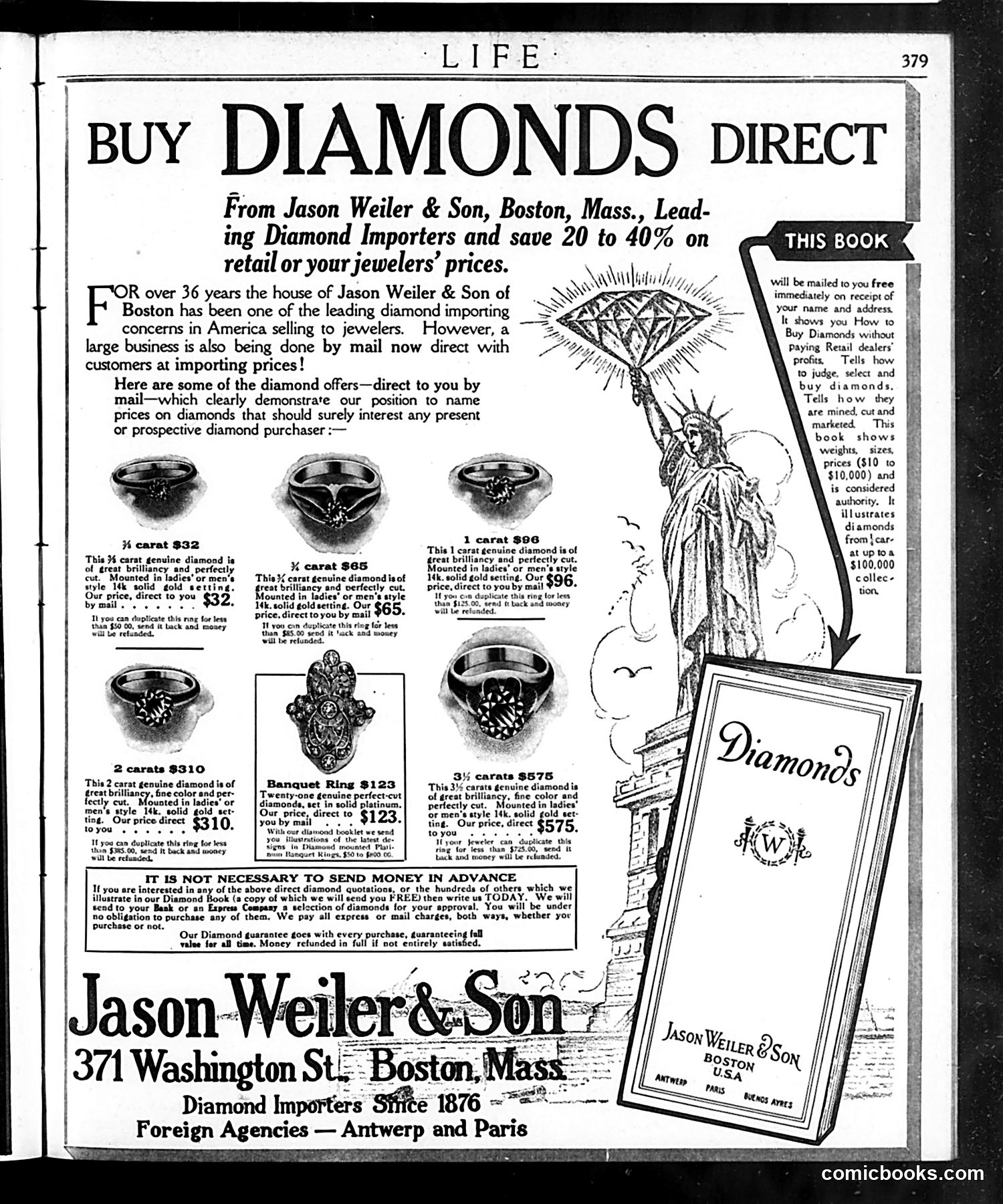
This is **not a political cartoon or satirical content** — it's a straightforward **diamond sales advertisement** from Jason Weiler & Son, a Boston diamond importer. The page promotes direct mail-order diamond purchases, claiming to offer 20-40% savings versus retail jewelers' prices. Various diamond rings are pictured with prices ranging from $32 to $576. The Statue of Liberty illustration is purely decorative, meant to evoke American patriotism and legitimacy for the business. The "Diamond Book" offer promises free information on diamond selection and pricing. This represents early 20th-century mail-order retail marketing. There is no satire or political commentary present — it's a genuine commercial advertisement using period design conventions and patriotic imagery as sales tools.
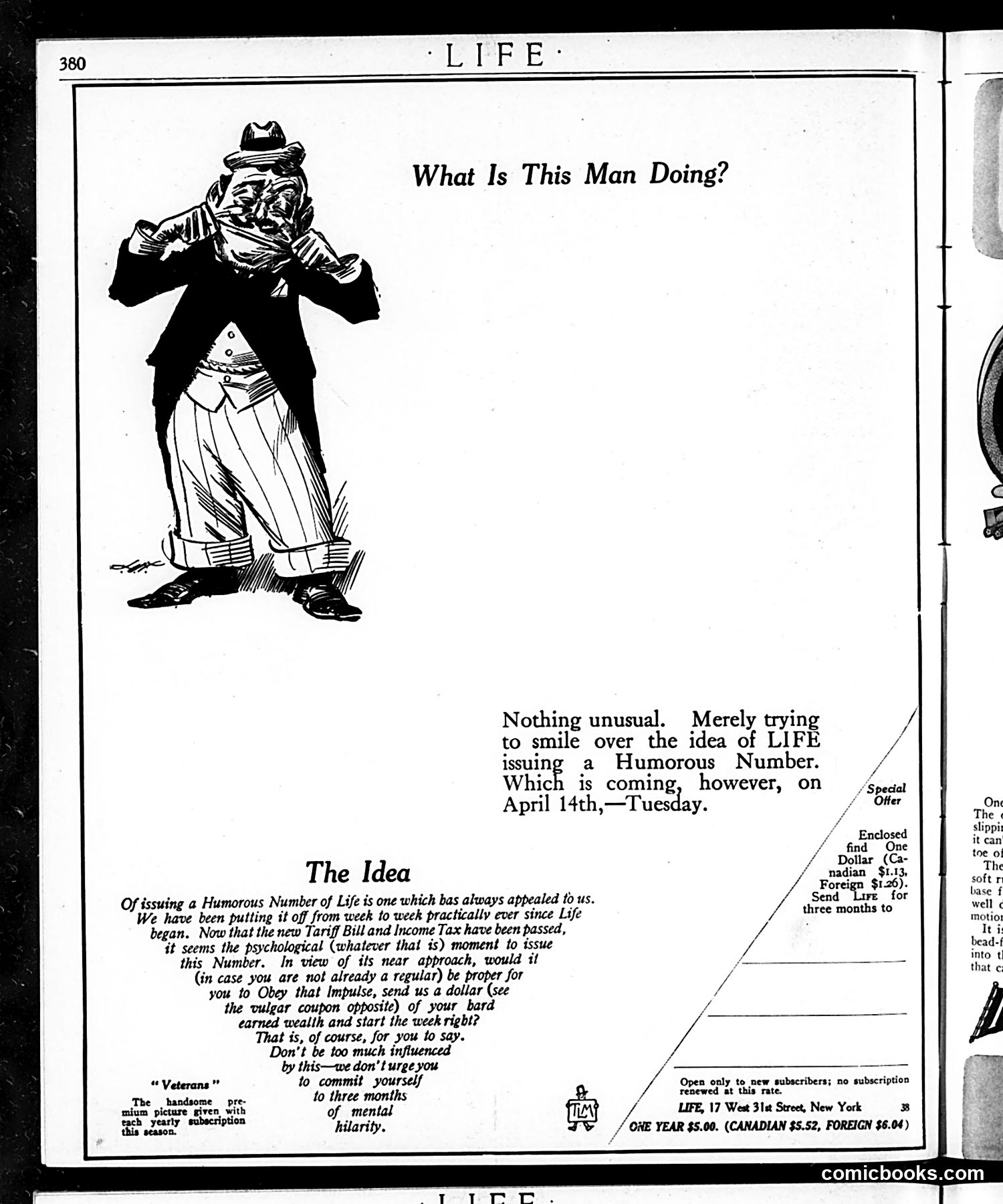
This page is primarily an advertisement for Life magazine's upcoming "Humorous Number," scheduled for April 14th. The cartoon shows a figure appearing to strain or exert effort while smiling, illustrating the concept of forced humor. The text explains Life's appeal: issuing a humorous edition has long been their practice. They note that recent tariffs and income taxes have passed, making this an opportune moment for a satirical issue. The ad suggests readers should send a dollar to encourage this "mental hilarity." The "Valerons" premium mentioned at bottom left appears to be a subscription incentive—a handsome picture given yearly with subscriptions. The page functions primarily as a sales pitch rather than political commentary, promoting Life's satirical tradition during what appears to be the early 20th century.
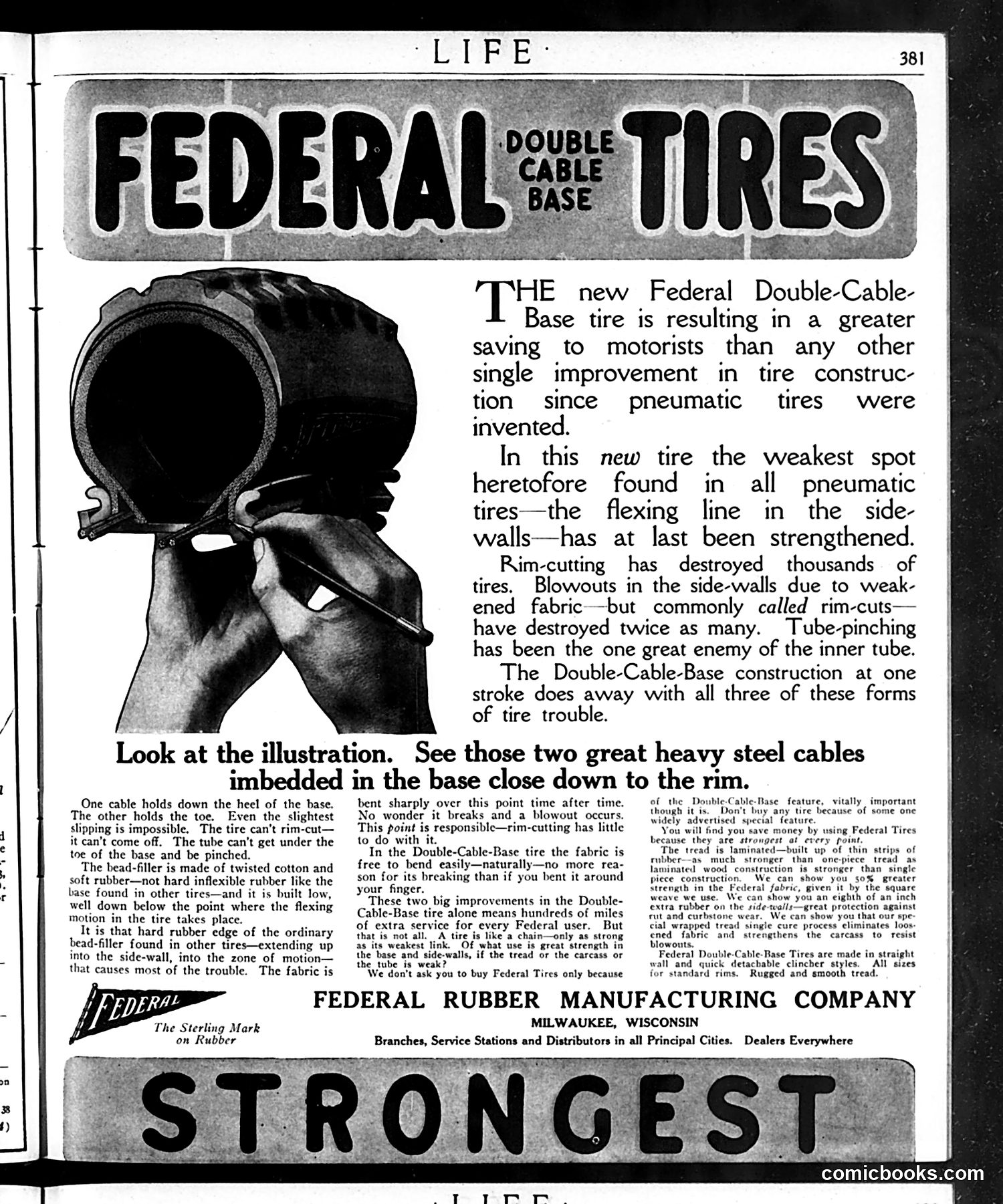
This is **not a political cartoon or satire**—it's a straightforward **advertisement for Federal Tires**, published in *Life* magazine (page 381). The page features: - **Product image**: Hands holding a tire cross-section, displaying the "Double-Cable-Base" construction - **Marketing claims**: The ad emphasizes that this tire design strengthens the sidewalls (previously the weakest point), preventing rim-cuts and blowouts - **Technical details**: Explains how two embedded steel cables near the rim prevent tire failures from flexing and tube-pinching The ad targets motorists by highlighting practical problems—rim damage, sidewall failures—and positioning Federal's innovation as a solution. This represents typical early-20th-century automotive advertising focused on technical superiority rather than lifestyle appeal. The *Life* magazine context suggests this reached educated, middle-class readers interested in modern conveniences.
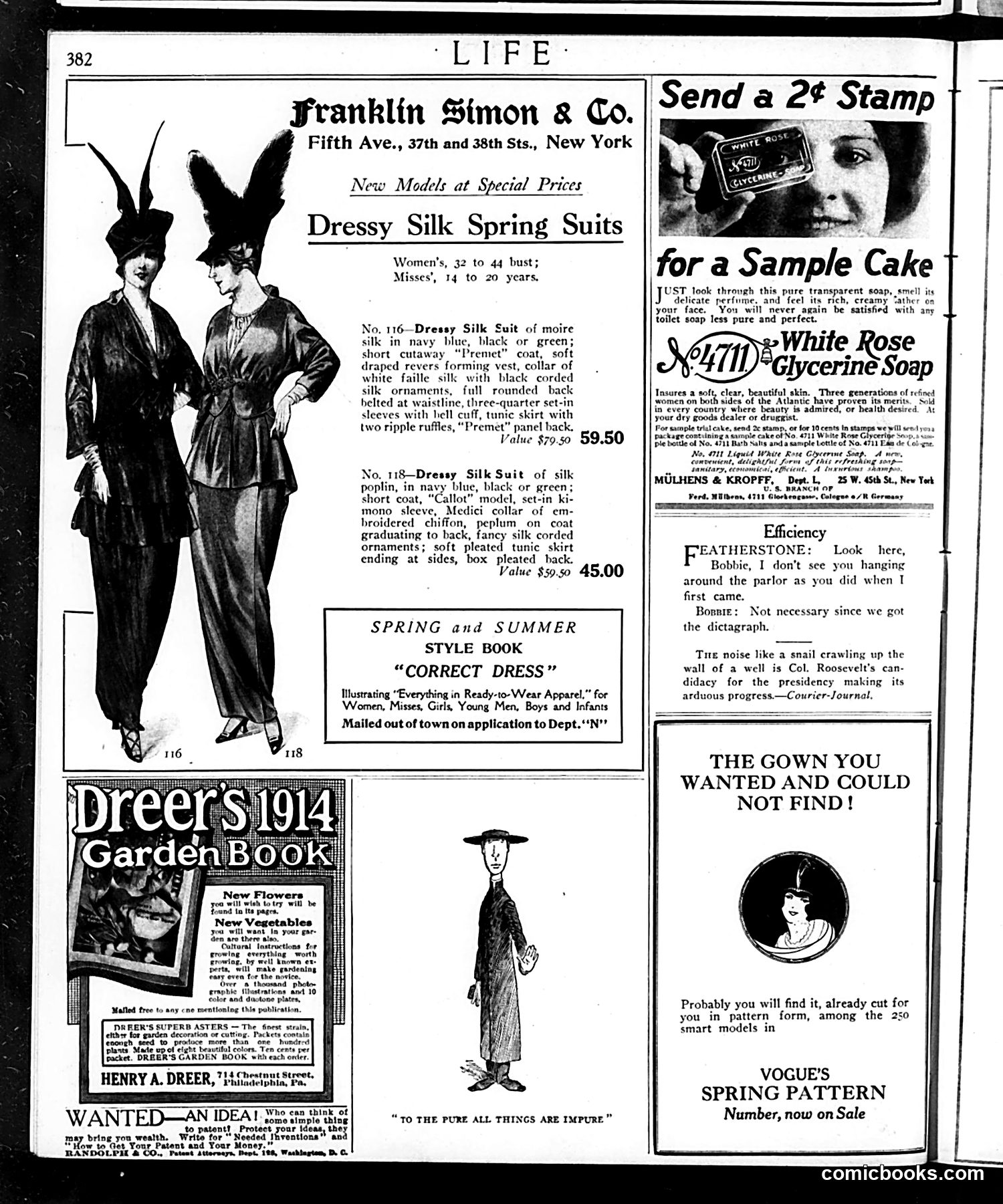
This page is **primarily advertising**, not political satire. It contains: 1. **Franklin Simon & Co.** fashion ads featuring "Dressy Silk Spring Suits" with elaborate feathered hats—typical high-end women's clothing from the 1910s era. 2. **White Rose Glycerine Soap** advertisement promoting toilet soap. 3. **Dreer's 1914 Garden Book** promotional material. 4. One small cartoon labeled **"To the Pure All Things Are Impure"** showing a tall, thin figure in a coat—this appears to be mild social commentary about prudishness or moral hypocrisy, though the specific reference is unclear. 5. **Vogue's Spring Pattern** advertisement. The page reflects 1910s consumer culture and advertising practices rather than political commentary.
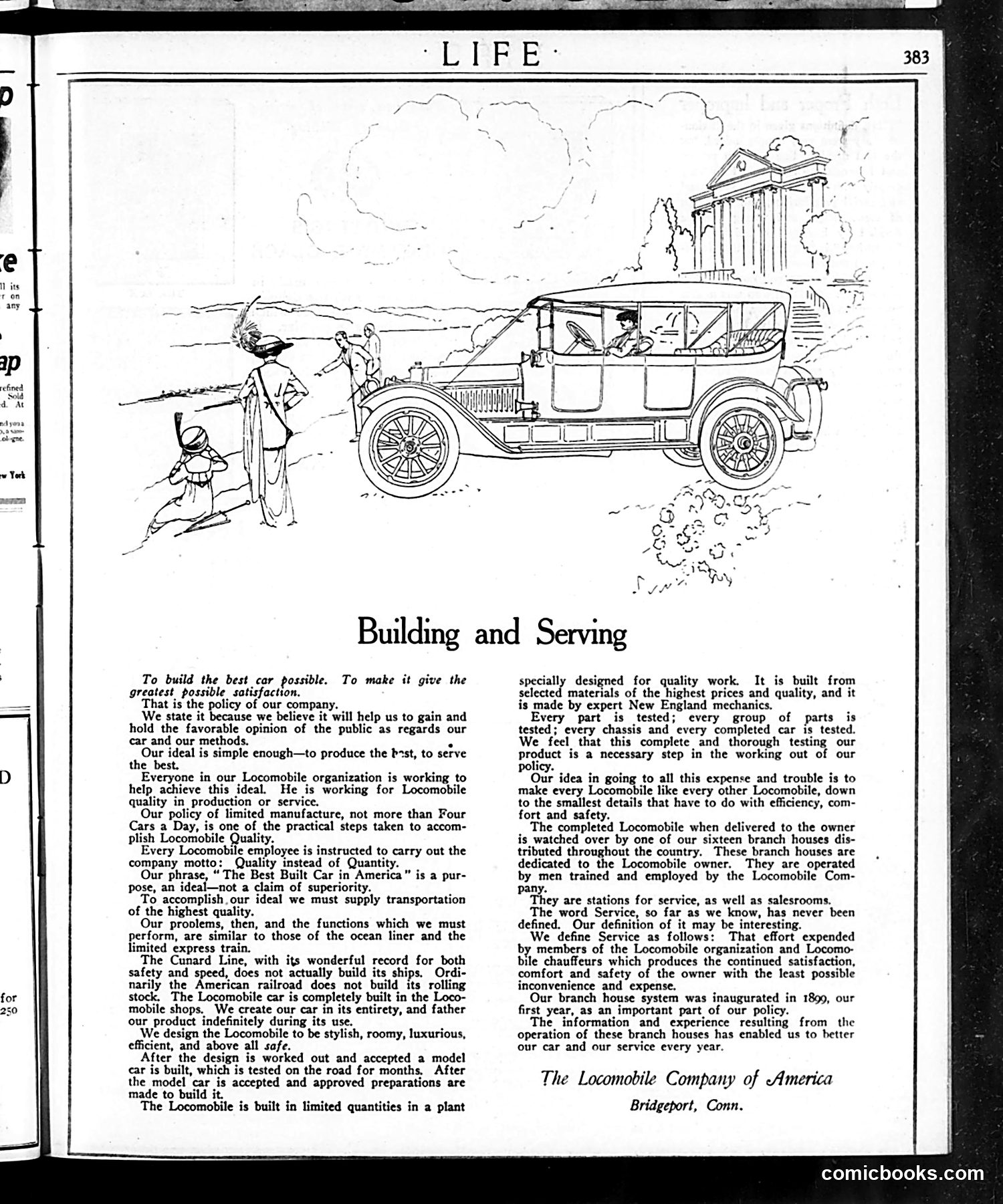
This page is primarily **advertising**, not satire or political commentary. It's a Locomobile Company advertisement titled "Building and Serving" that appears in Life magazine (page 383). The illustration shows an early automobile with well-dressed figures and a classical building in the background, establishing prestige and quality. The lengthy text emphasizes the company's manufacturing philosophy: limited production ("Four Cars a Day"), rigorous testing of every part, and a network of service branch houses across America. The ad claims Locomobile builds "The Best Built Car in America" and defines quality through comprehensive service infrastructure. This reflects early 1900s automotive marketing, when reliability and after-sale service were novel selling points for luxury vehicles, differentiating premium brands from mass-market competitors.
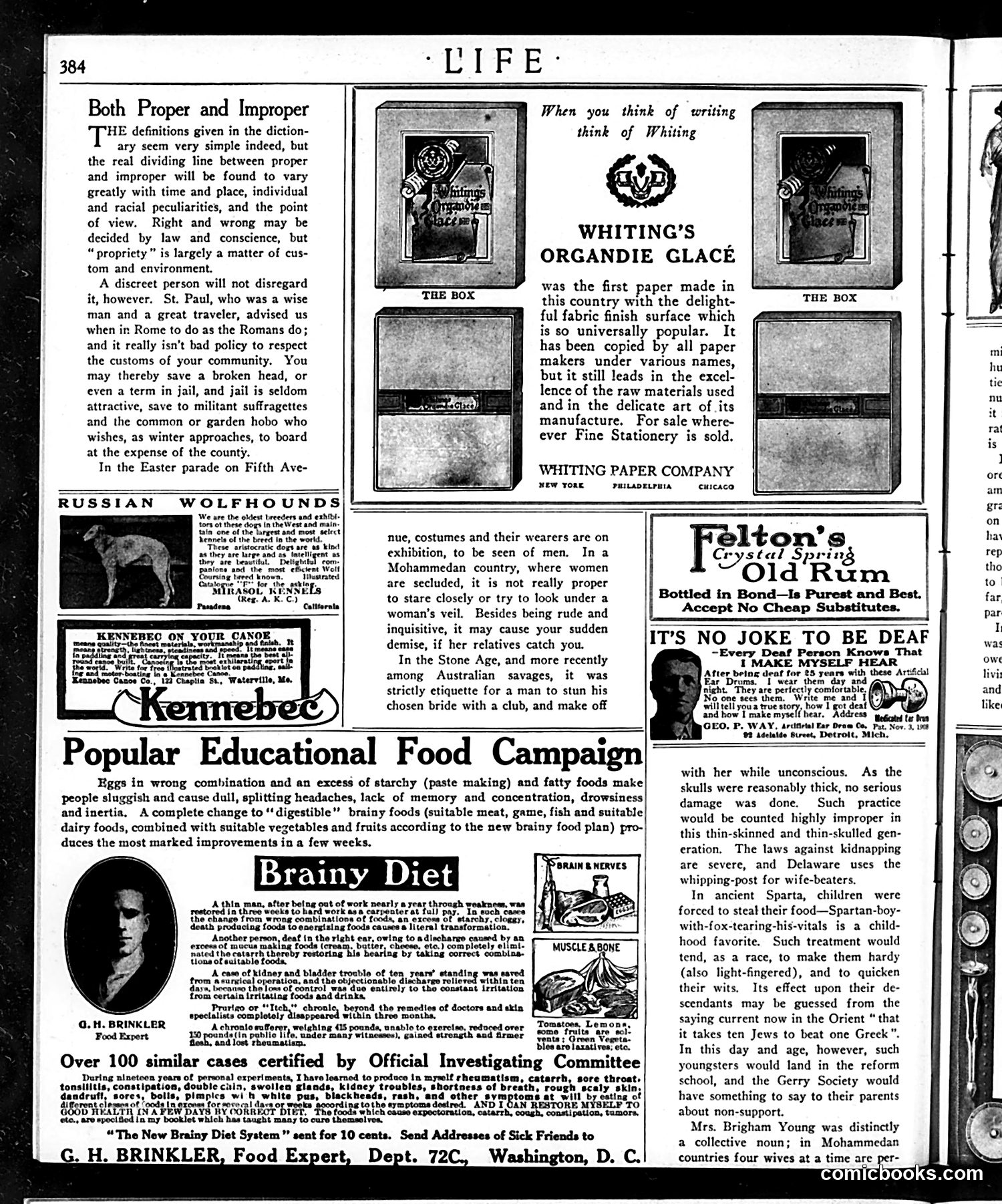
This page is primarily **advertising and educational content** rather than political satire. The main elements include: 1. **Whiting's Organdie Glacé** - an advertisement claiming this paper finish was the first of its kind in America and has been widely copied 2. **Russian Wolfhounds** - a small advertisement for dog breeding 3. **Kennebec Canoe** - a product advertisement 4. **Popular Educational Food Campaign** - a substantial section promoting "Brainy Diet" with testimonials from a "Food Expert" (G.H. Brinkler) claiming dietary changes improved health conditions like dandruff and sores 5. **Felton's Crystal Spring Old Rum** - liquor advertisement 6. **"It's No Joke to be Deaf"** - an advertisement for deaf communication services The page reflects early 20th-century advertising practices and health claims, with no apparent political cartoons or satire.
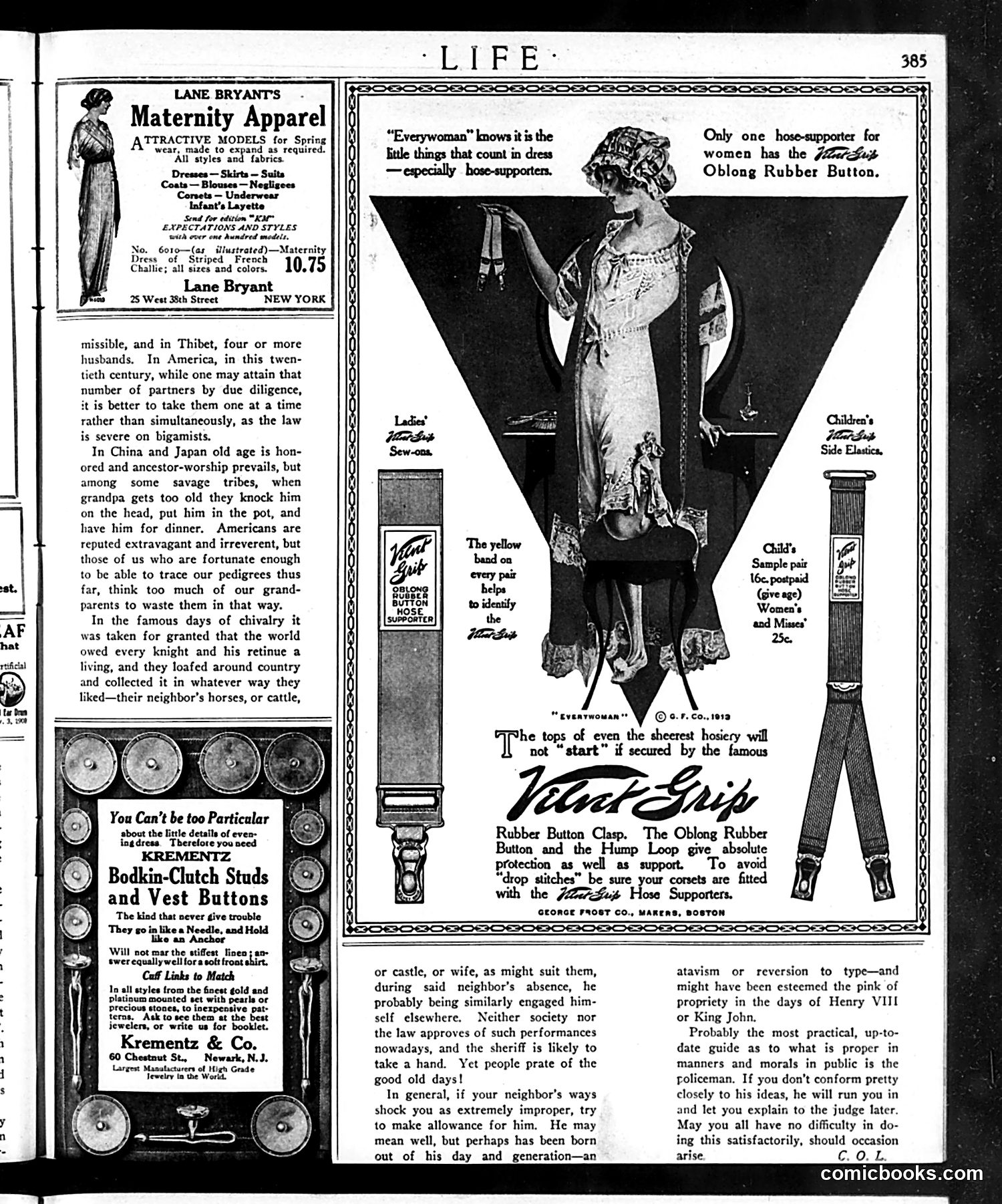
This page is **primarily advertising** rather than satirical content. The dominant feature is a large advertisement for "Nifti-Grip" hose supporters—elastic garters designed to keep women's stockings from slipping down. The ad uses a stylized illustration of a woman in undergarments to demonstrate the product's effectiveness. Smaller ads include Lane Bryant maternity apparel and Bodkment-Clutch Studs for formal wear. The satirical text column discusses historical attitudes toward neighbors' property and infidelity, apparently moralizing about proper conduct—typical of *Life* magazine's social commentary. However, this text is secondary to the commercial content dominating the page, which reflects the magazine's reliance on advertising revenue.
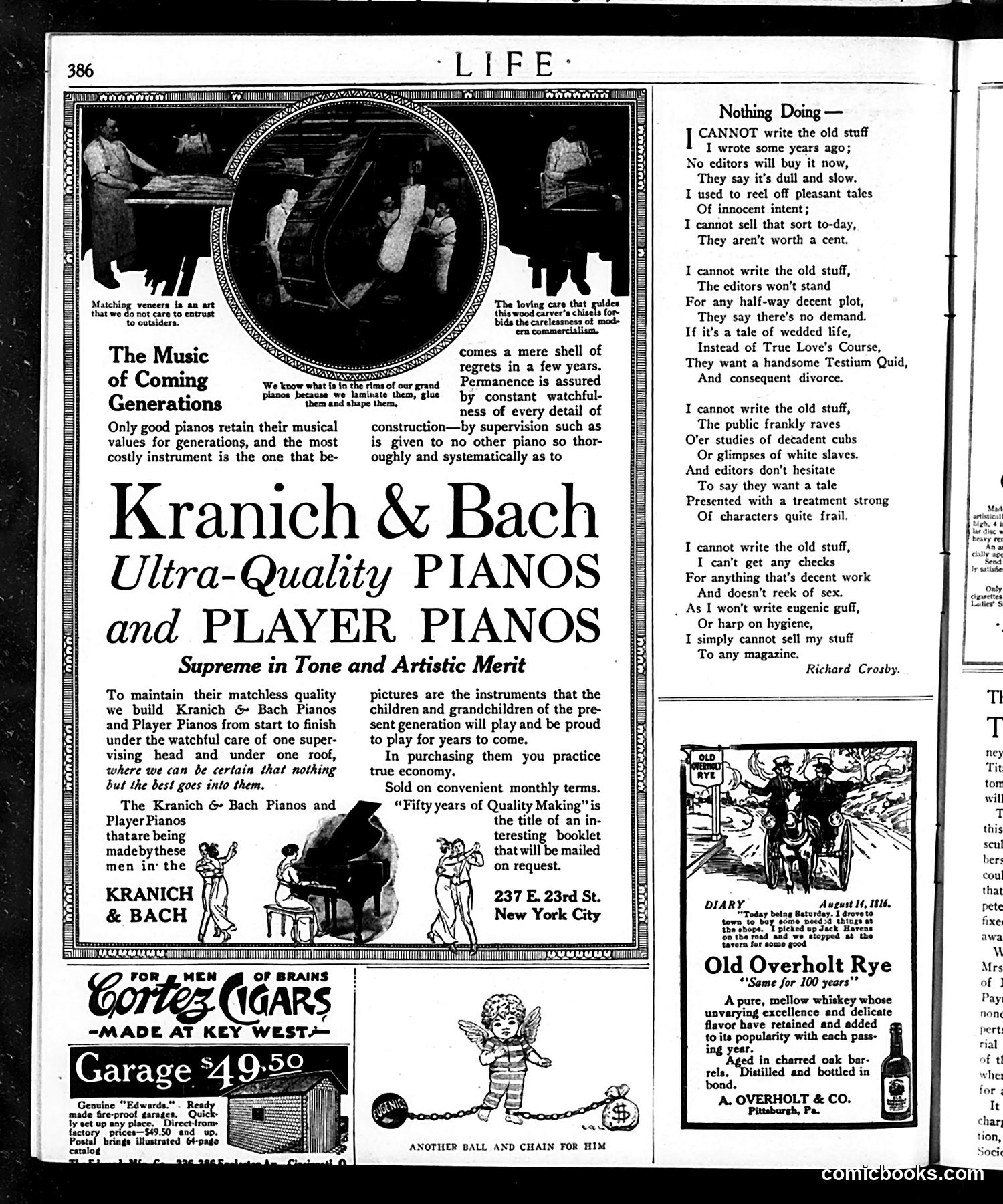
This page is primarily **advertising and poetry**, not political satire. The left side features a large **Kranich & Bach piano advertisement** emphasizing quality construction and multi-generational durability. Supporting imagery shows people playing pianos. The right side contains a poem titled **"Nothing Doing"** by Richard Crosby—a complaint about editorial rejection. The poet laments that editors won't buy his work anymore, dismissing his old "peasant tales" as valueless. He sarcastically lists what editors *do* want: sensational stories, "True Love's Course," divorce scandals, and shocking plots. The poem expresses frustration with changing magazine market demands. Below are smaller advertisements for **Cortez Cigars** and **Old Overholt Rye whiskey**, plus a cartoon showing a child with a "ball and chain" toy. The page reflects early 20th-century consumer advertising and literary frustration with editorial gatekeeping.
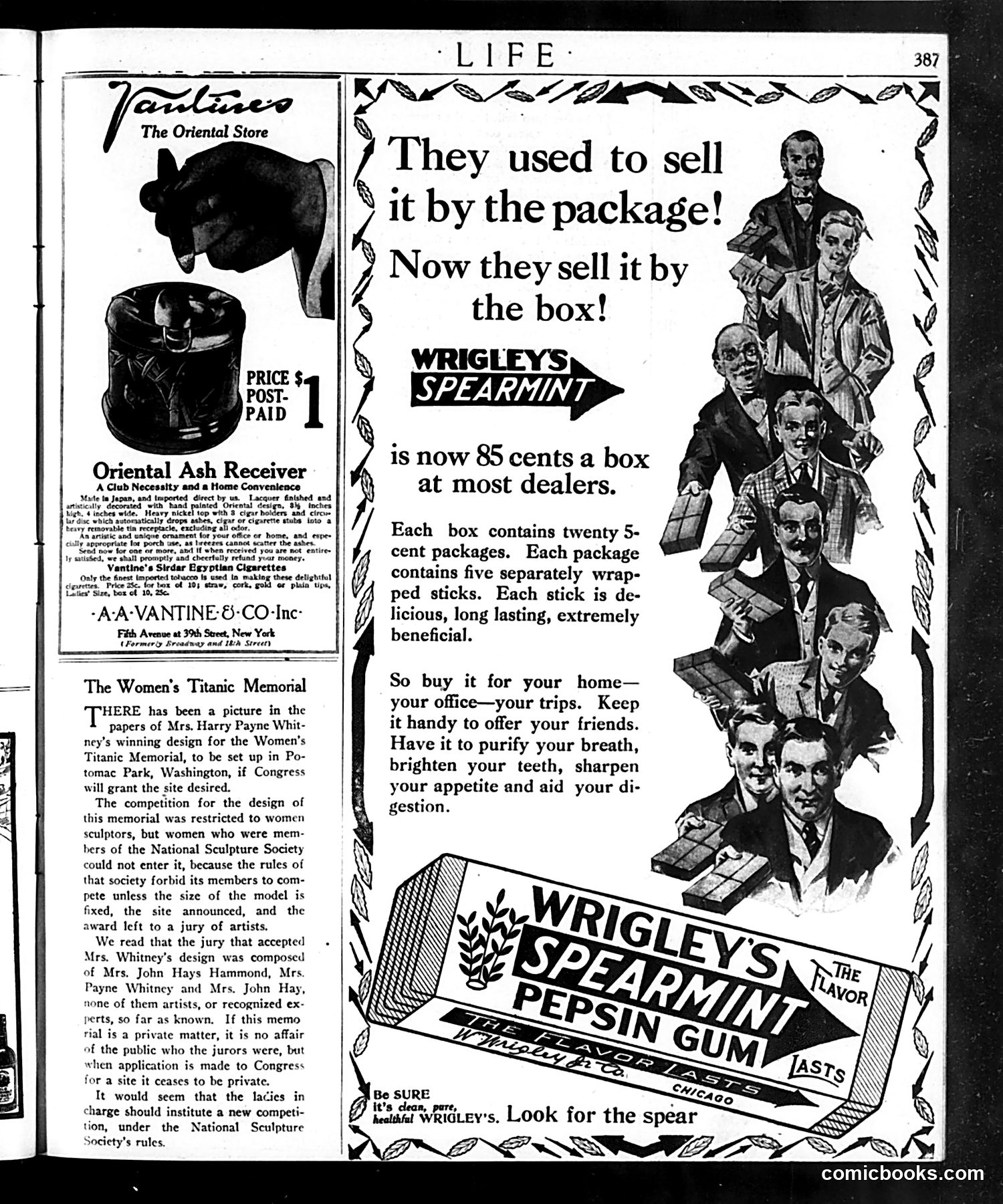
This page contains primarily **advertisements** rather than political cartoons. The main content is a Wrigley's Spearmint Gum ad announcing a packaging change—the product now sells "by the box" (85 cents) instead of "by the package." The ad features multiple illustrated faces of men and women, likely representing various consumer demographics. A secondary item discusses **Mrs. Harry Payne Whitney's design** for a Women's Titanic Memorial in Washington, D.C. The text explains competition rules restricted entries to women sculptors, with specific size and jury requirements. The **Valentine's Oriental Store** ad promotes an ash receiver priced at one dollar. The page is historically notable mainly for documenting early 20th-century consumer marketing strategies and product distribution changes.
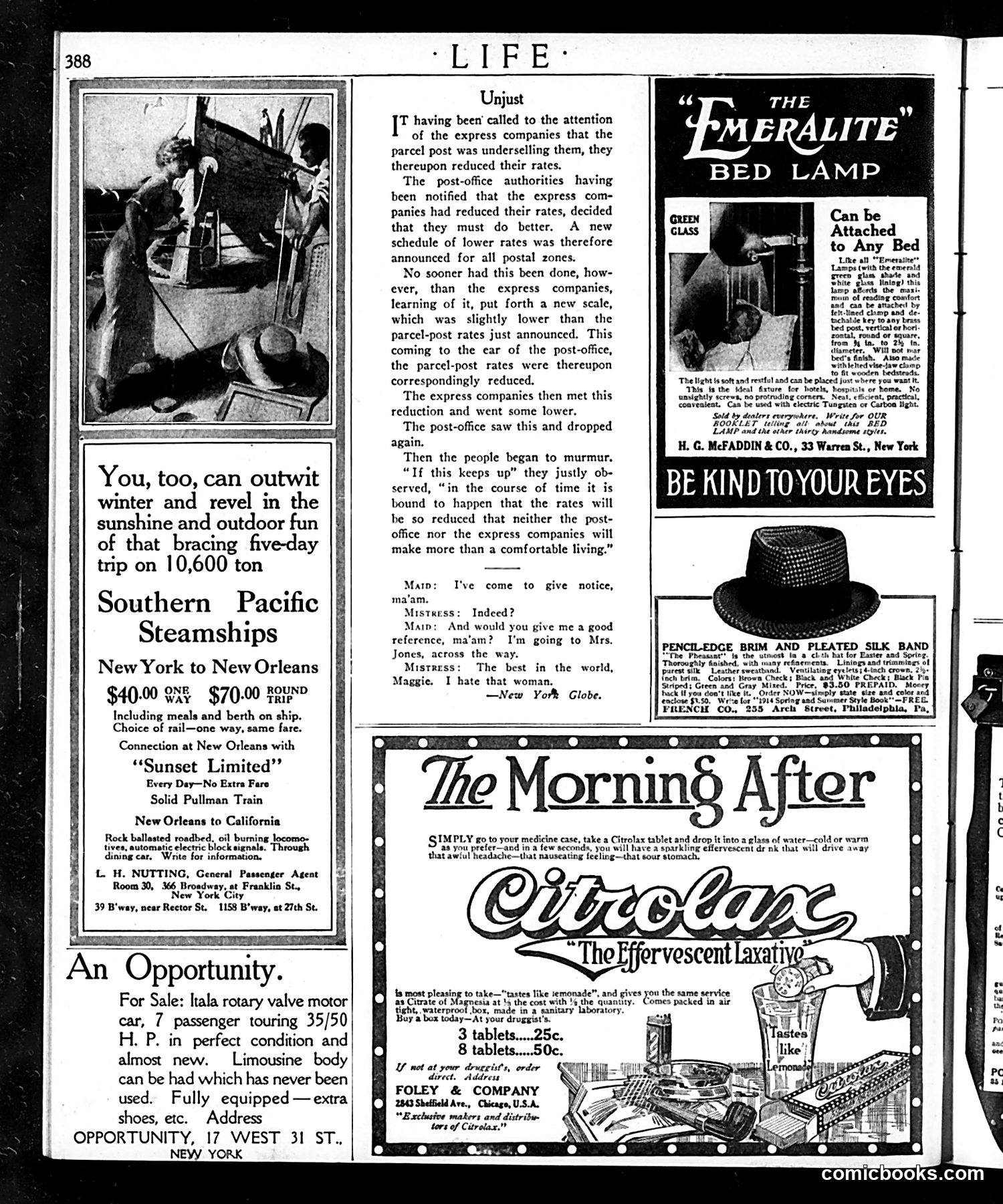
This page is primarily **advertising content** rather than political satire. The dominant feature is a large advertisement for "Citrolaxe," an effervescent laxative marketed as "The Morning After" remedy. The ad employs humor by depicting someone suffering from what appears to be a hangover, playing on the double meaning that this product addresses digestive issues from overindulgence. The page also includes travel advertisements for Southern Pacific Steamships and a car for sale. There is one small article titled "Unjust" discussing postal rate reductions and express company pricing disputes—a minor business/regulatory matter—but this is text-heavy commentary rather than cartoon satire. The page represents early 20th-century magazine advertising practices mixing commercial pitches with light editorial content.
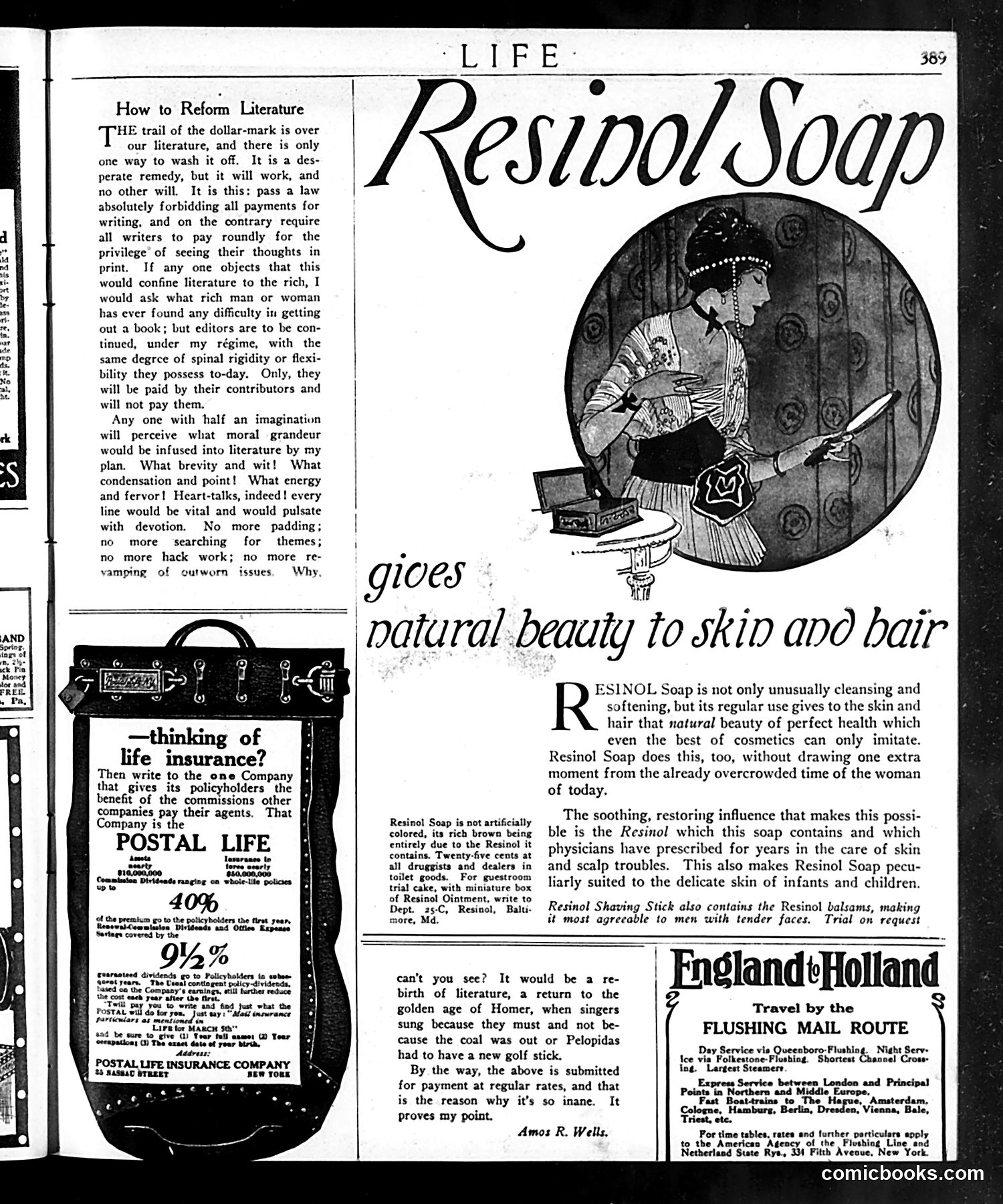
This page is primarily **advertising and opinion content** rather than political satire. The left column contains an opinion piece titled "How to Reform Literature" arguing for paying writers for publication and eliminating editorial gatekeeping. Below that is a **Postal Life Insurance Company advertisement** emphasizing dividend payouts (4% and 9½%). The dominant right side features a **Resinol Soap advertisement** with an illustration of a woman applying cosmetics. The ad emphasizes the soap's cleansing and beautifying properties for skin and hair, claiming physicians have prescribed it for years. A smaller **England & Holland travel advertisement** promotes the Flushing Mail Route steamship service between America and the Netherlands. No political satire or caricature is present on this page—it's a standard magazine layout of editorials, classifieds, and product advertisements typical of early 20th-century Life magazine.
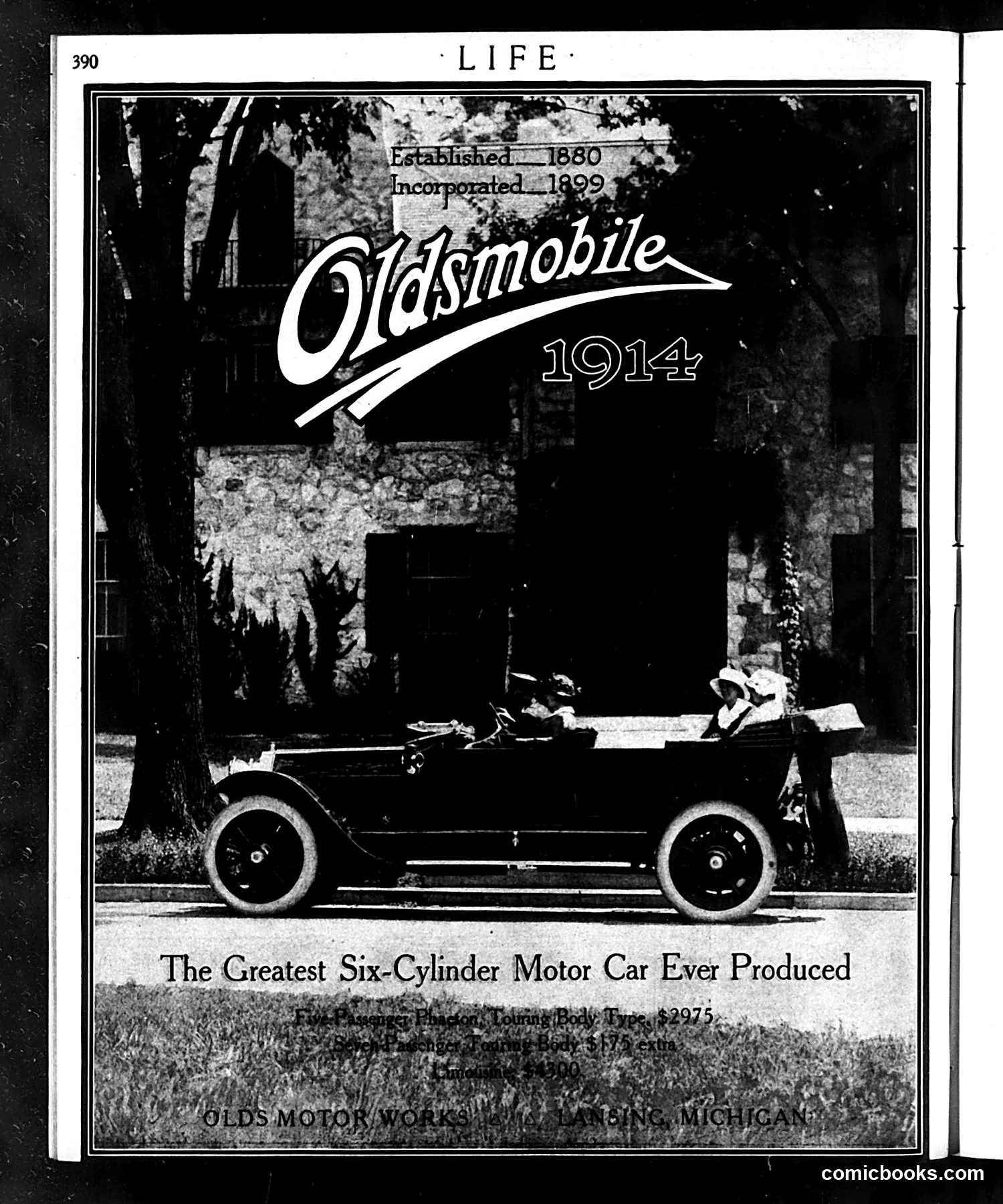
This is primarily an **advertisement**, not political satire. It's a full-page ad for the 1914 Oldsmobile automobile, appearing in *Life* magazine (page 390). The image shows a side-view photograph of an open-air touring car with two passengers, parked beneath large trees. The ad's headline claims it's "The Greatest Six-Cylinder Motor Car Ever Produced," emphasizing the vehicle's technical innovation (six cylinders were relatively advanced for 1914). The ad notes the car's established history (founded 1880, incorporated 1899) and lists pricing and features, though the text is partially obscured. For modern readers: this represents early automotive advertising's emphasis on mechanical superiority and luxury, targeting affluent consumers who could afford automobiles in the pre-mass-production era.
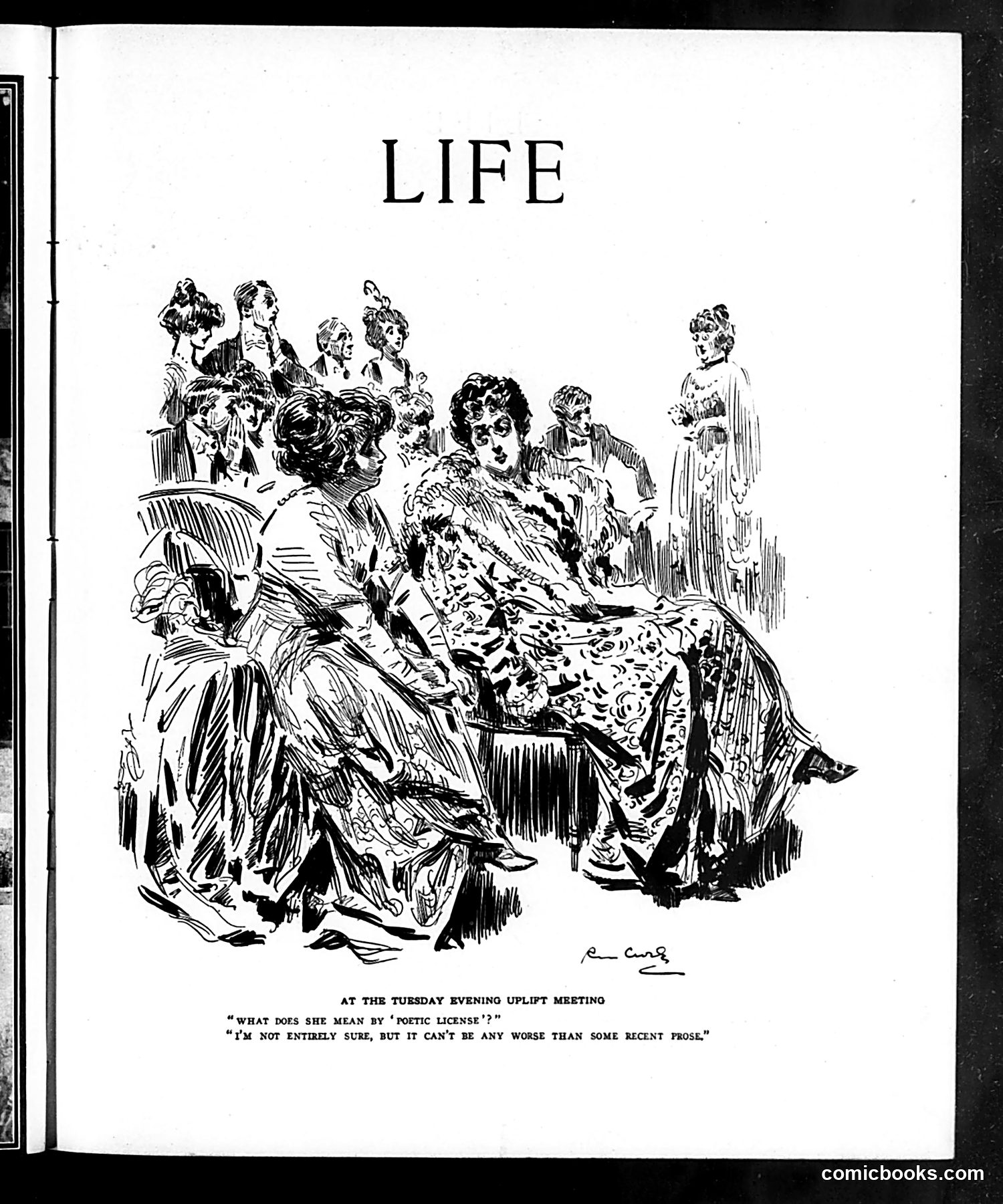
This satirical cartoon depicts a "Tuesday Evening Uplift Meeting"—likely a women's literary or cultural discussion group of the early 20th century. The drawing shows elegantly dressed women gathered in conversation, with one woman apparently using the term "poetic license" (artistic freedom in creative work). The joke's humor lies in the second woman's response: she suggests that poetic license cannot be worse than "some recent prose," implying contemporary prose writing is so poor that breaking literary rules through poetic license would be an improvement. The satire targets both pretentious literary circles and the quality of contemporary writing. The "uplift" meeting suggests earnest self-improvement among the middle/upper classes, which Life magazine frequently mocked for affected intellectualism and snobbery.
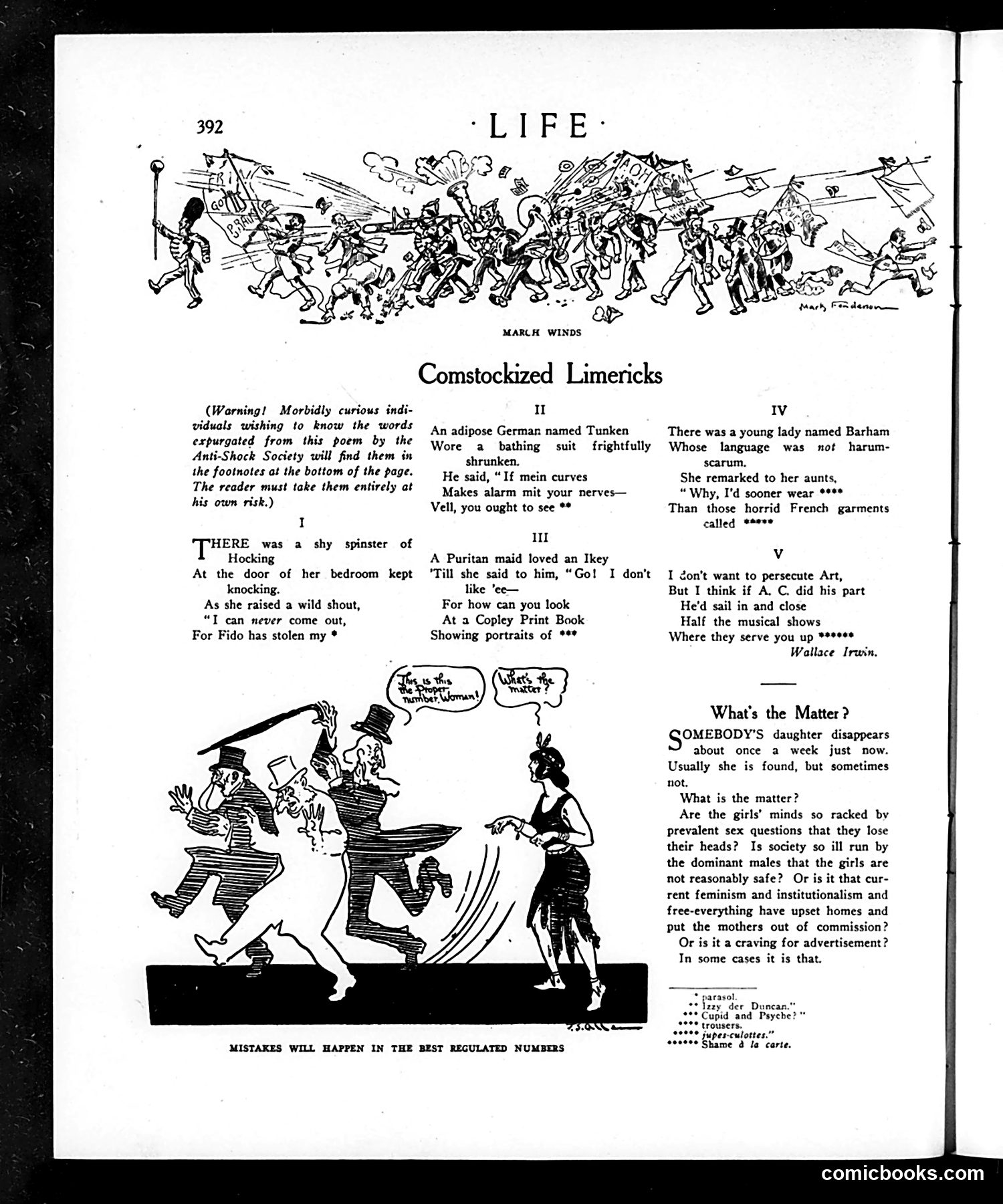
This page mocks Anthony Comstock, the powerful anti-obscenity crusader who aggressively censored American publications. The limericks are deliberately written with asterisks and footnotes replacing "offensive" words—satirizing how Comstock's influence forced publishers to censor their content. Each limerick contains mild sexual or suggestive innuendo (a dog stealing underwear, a German's shrinking bathing suit, Puritan prudishness about nudity, French undergarments, and risqué musical shows). By blanking out the words, the satire exposes how Comstock's censorship made publications absurd and unreadable while ironically drawing *more* attention to what was supposedly dangerous. The footnote warning readers can find expurgated words at the bottom—a direct jab at Comstock's moralistic crusade. The accompanying "What's the Matter?" essay sardonically questions whether over-regulation and institutional restriction are driving young women to reckless behavior, suggesting censorship and control create the very problems authorities claim to prevent.
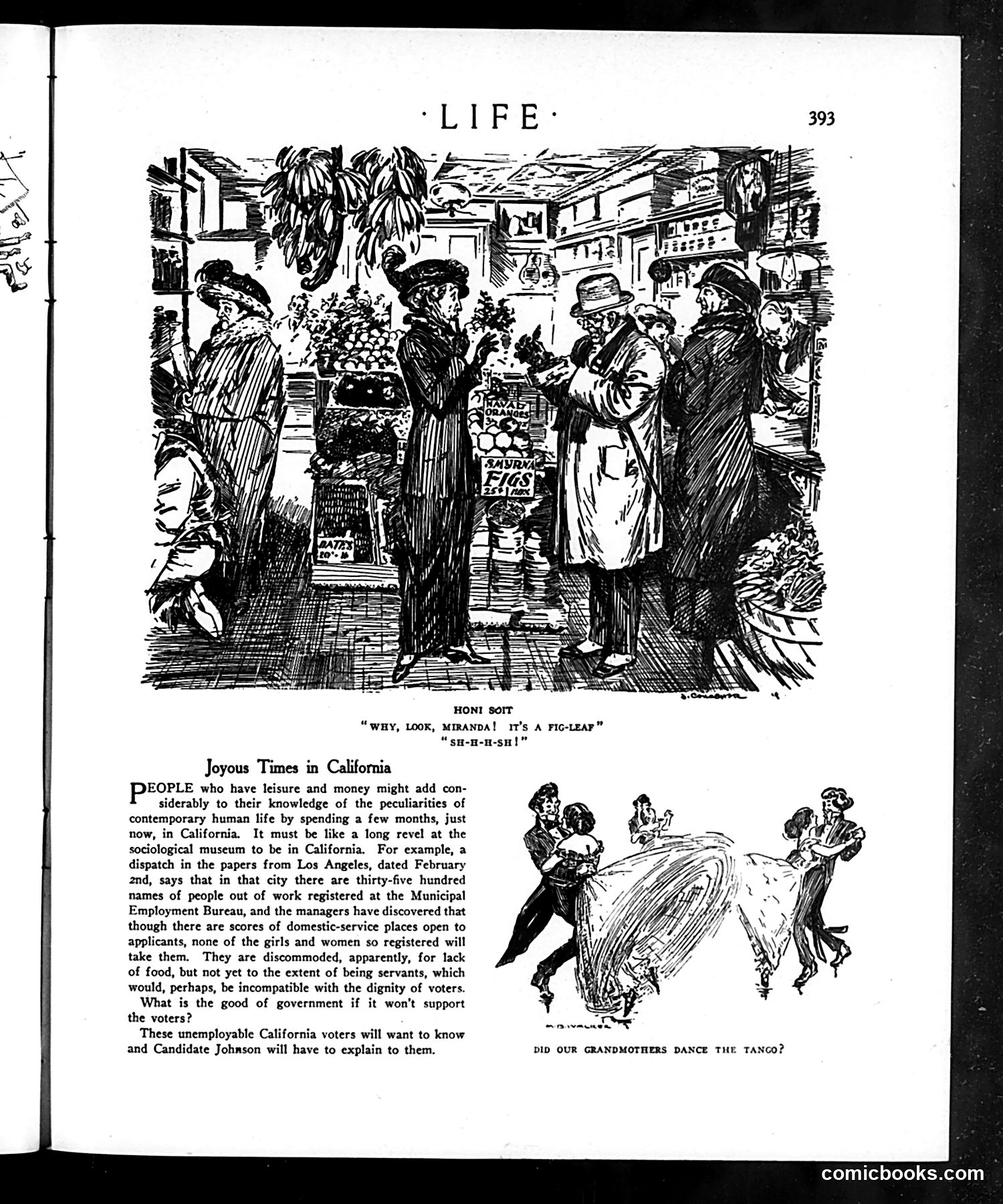
This 1912 Life magazine page satirizes unemployment relief in California. The top cartoon mocks public discomfort with servant work—a woman exclaims "It's a fig-leaf!" (suggesting indecency), using the "Miranda" reference (likely from Shakespeare's *The Tempest*). The article critiques 3,500 unemployed Los Angeles residents registered at the Employment Bureau who refuse available domestic-service jobs, deeming such work beneath their "dignity as voters." The satire questions government's obligation to support citizens who won't accept available work, suggesting this will become a campaign issue for "Candidate Johnson" (likely Hiram Johnson, California's progressive governor). The bottom cartoon about grandmothers and the tango appears unrelated—typical magazine filler. The piece reflects Progressive Era debates about welfare, work ethic, and government responsibility during economic hardship.
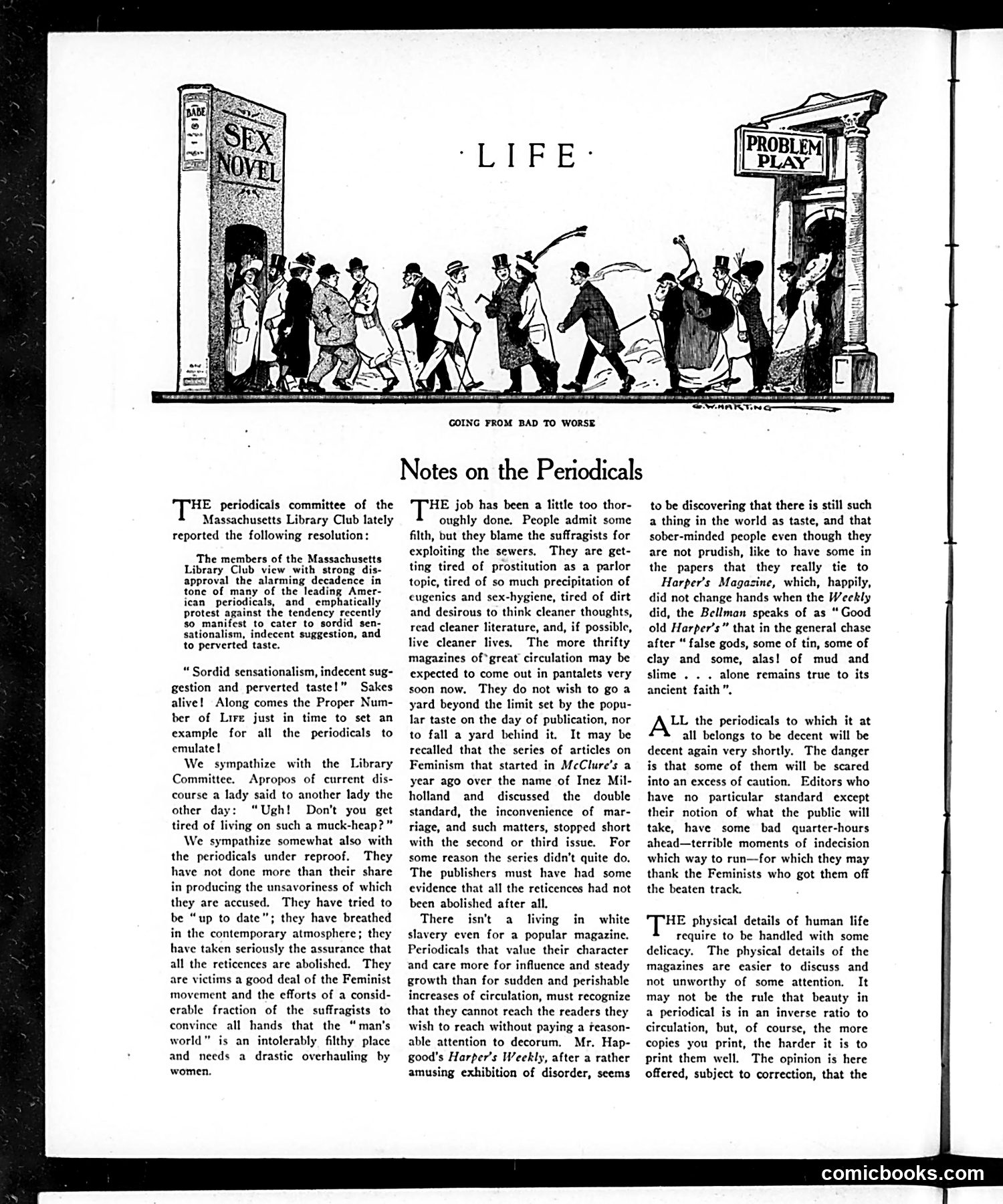
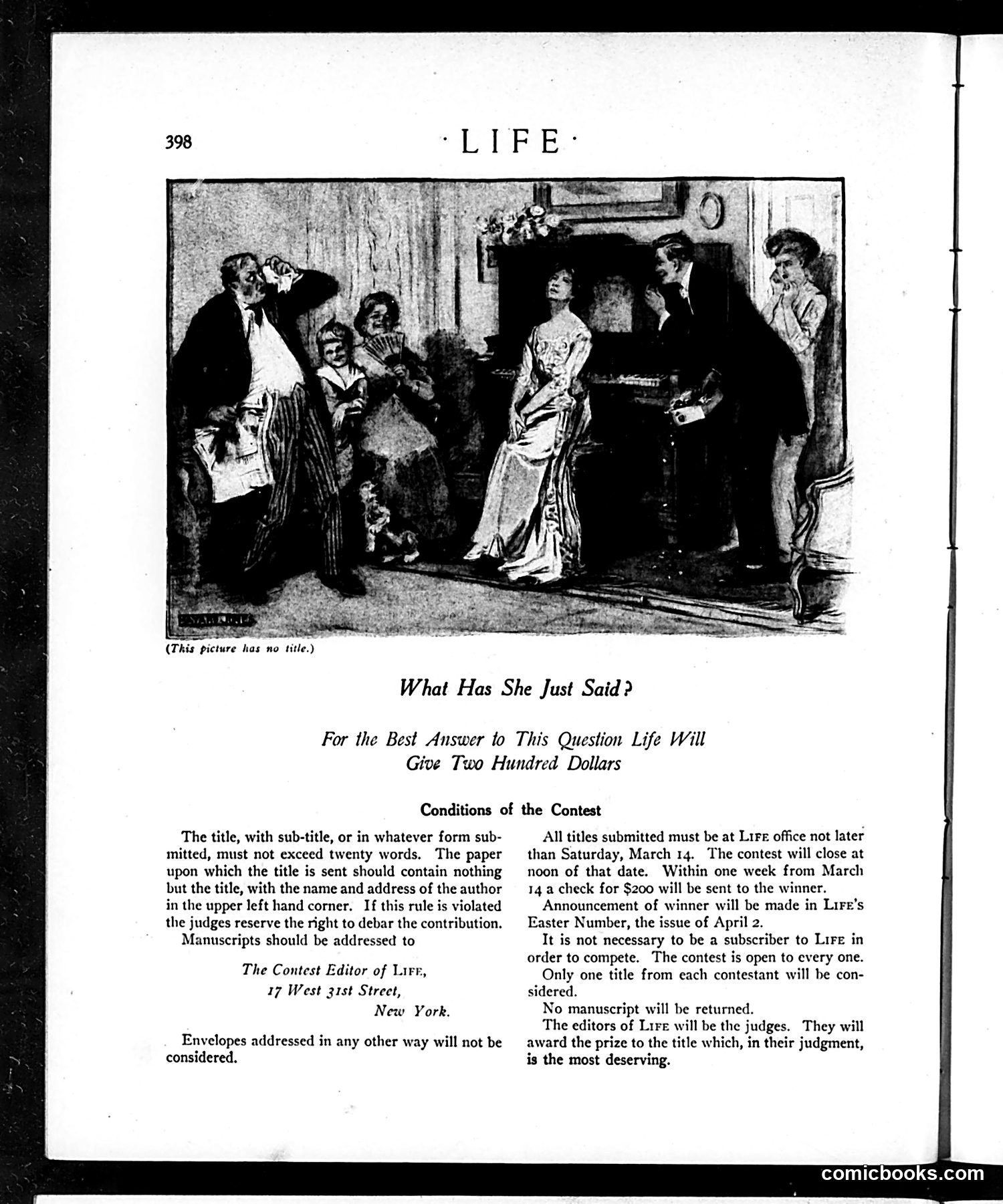
This satirical piece mocks the Massachusetts Library Club's resolution condemning American magazines for "sordid sensationalism" and "indecent suggestion." The cartoon shows figures progressing from a "Sex Novel" entrance toward a "Problem Play" exit—visual metaphor for society moving from one questionable entertainment to another. The author argues that magazines have overcorrected in response to feminist and suffragist pressure to expose social "filth" (prostitution, sexual double standards, eugenic debates). While sympathizing with both the Library Club and the periodicals themselves, the piece claims magazines are now exhausted by the trend and retreating toward propriety. The satire targets how quickly popular publications chase moral fashions: they sensationalize feminist critiques until readers tire of it, then retreat. The reference to *McClure's* stopping its feminism series suggests publishers abandon controversial content when circulation suffers—revealing their true priority is profit over principle.
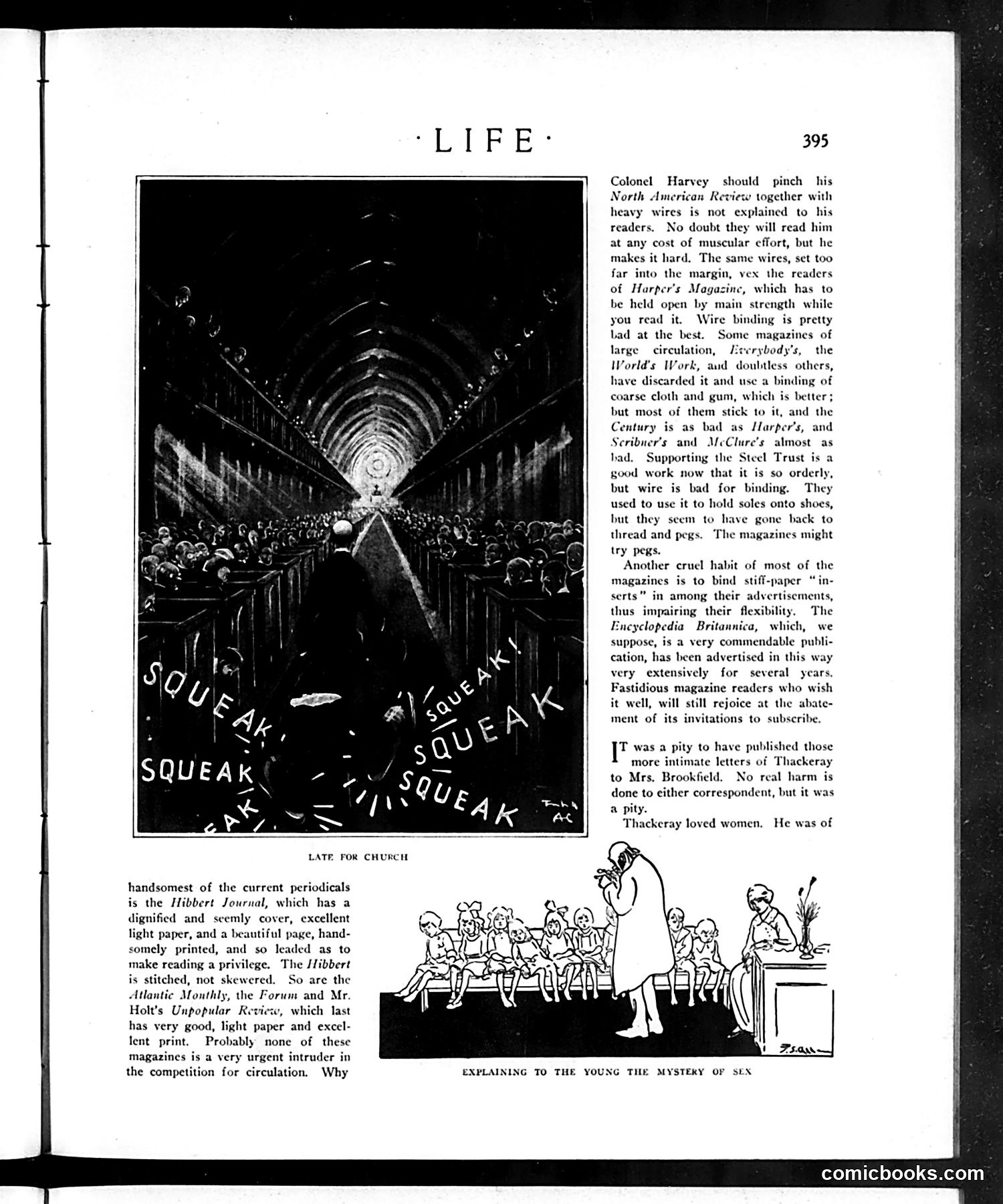
**Top Cartoon ("Late for Church"):** A crowded subway or train tunnel filled with passengers. The repeated word "SQUEAK" fills the image, depicting the noise of the packed transit system. This satirizes urban commuting chaos and how the noise and congestion make people late for religious obligations—a commentary on modern life's interference with traditional values. **Bottom Cartoon ("Explaining to the Young the Mystery of Sex"):** An adult addresses a group of children seated together, gesturing toward plants or flowers. This is social satire about the awkwardness adults face when discussing sex education with children, using nature/gardening as an indirect teaching method—reflecting early 20th-century prudishness about such topics. **Text Content:** A lengthy critique of magazine binding practices. The author complains that wire binding in publications like *Harper's* and *Century* is uncomfortable and outdated, advocating for cloth-and-gum binding instead. The piece also discusses magazine advertising practices and briefly mentions Thackeray's published letters to Mrs. Brookfield.
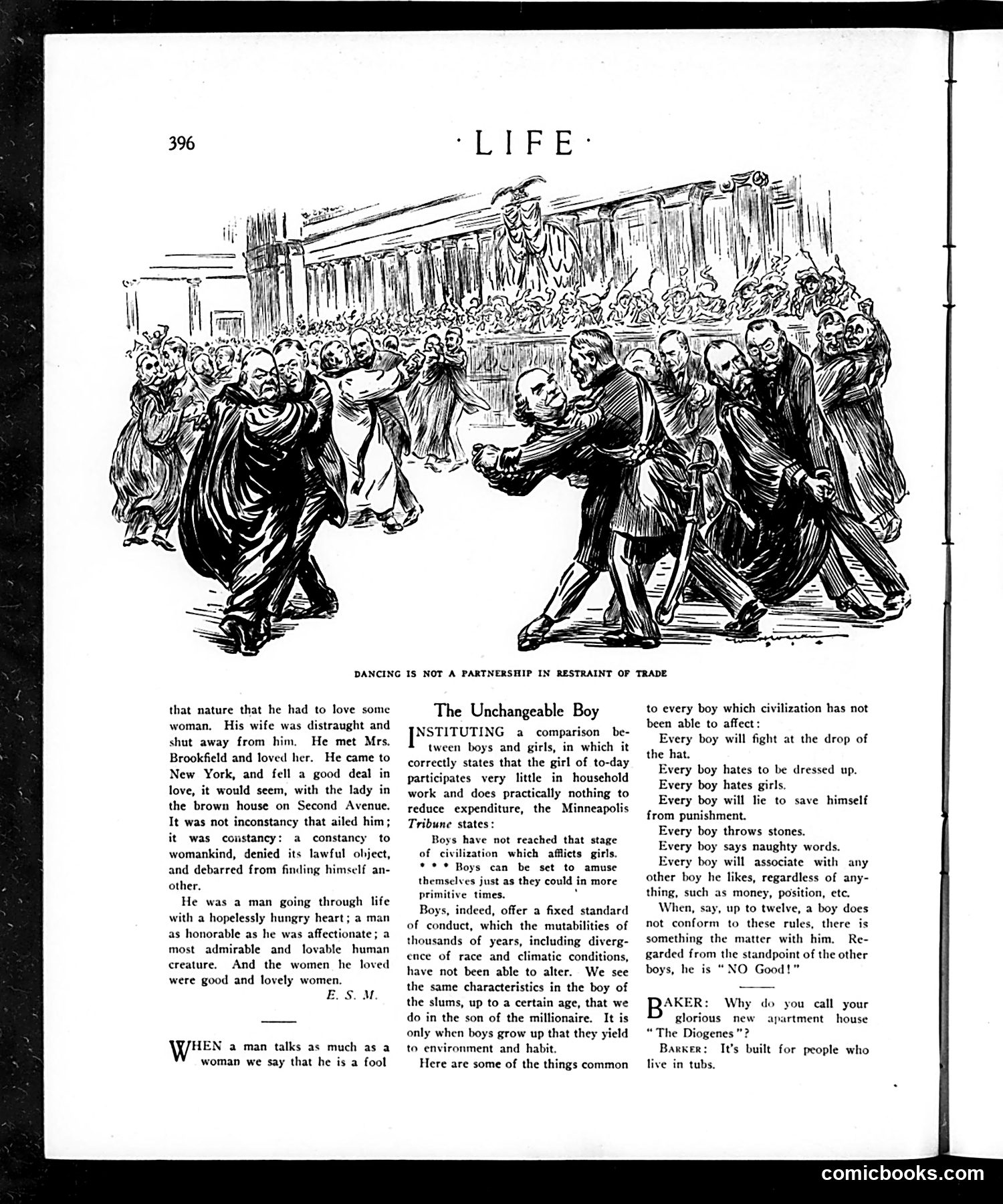
The page contains two distinct pieces of satire: **Top Illustration**: "Dancing Is Not a Partnership in Restraint of Trade" depicts a formal ballroom scene with couples dancing. The caption suggests satire about social propriety and business/trade regulations—likely mocking either overly strict social conventions around dance partnerships or regulatory language intruding into social life. The specific historical reference is unclear without additional context. **"The Unchangeable Boy"**: This article satirizes a Minneapolis Tribune piece claiming boys remain unchanging across class and geography, listing immutable boy behaviors (fighting, hating dressing up, lying to avoid punishment, throwing stones, saying naughty words). The satire critiques the Tribune's claim that boys are immune to civilization's influence—implying the Tribune's list actually proves boys *are* shaped by their environment, contradicting its own argument. **"The Diogenes" Joke**: A brief exchange mocking a pretentious apartment building name. Diogenes was an ancient Greek philosopher who famously lived in a barrel/tub to reject materialism—so naming a fancy building after him is absurdly contradictory.
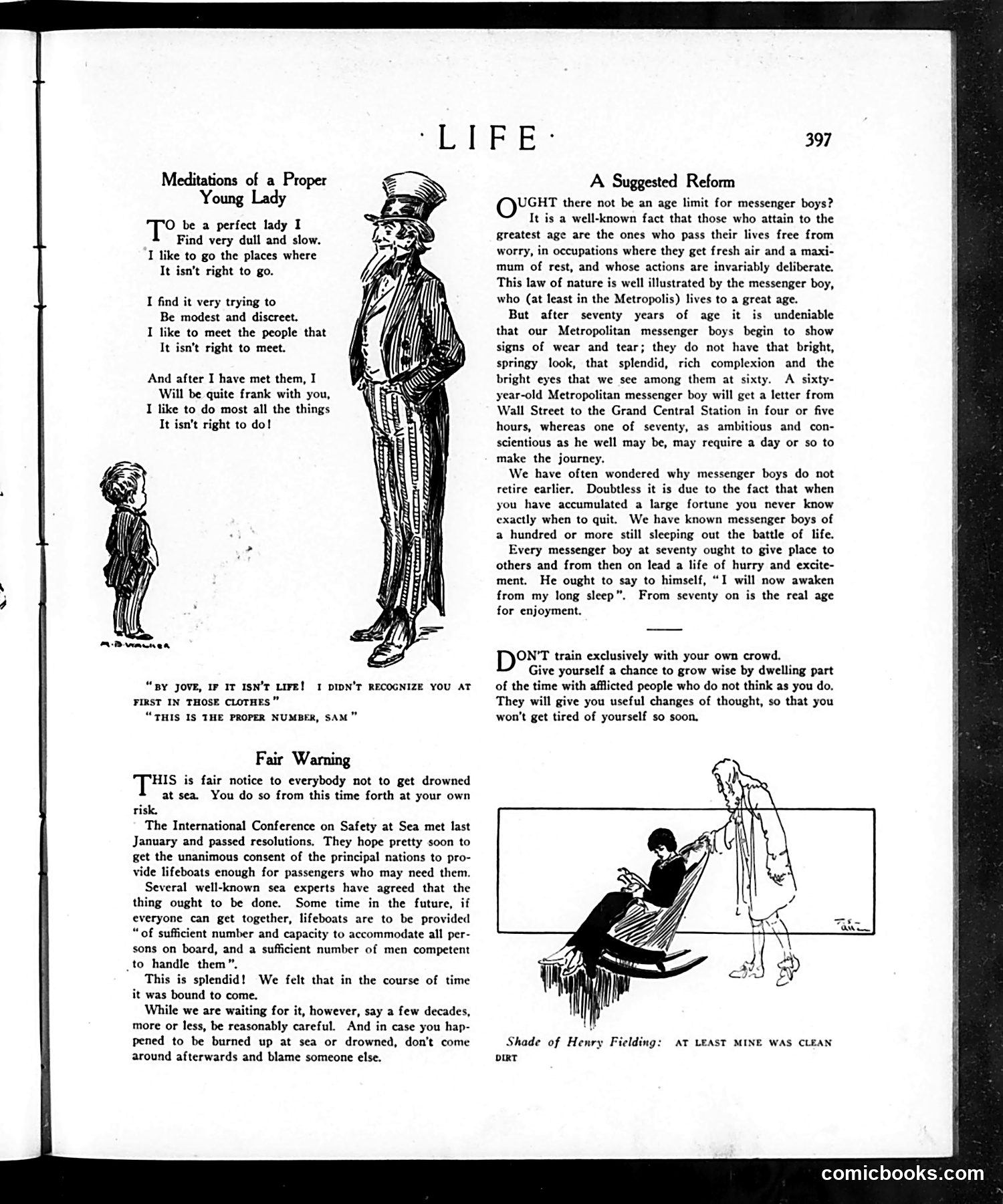
This page contains three distinct satirical pieces: **"Meditations of a Proper Young Lady"** mocks Victorian expectations of female propriety through a young woman's confession that she finds respectability boring and prefers transgressive behavior—a commentary on the tension between social convention and individual desire. **"Fair Warning"** sarcastically critiques maritime safety regulations. It notes that an International Conference on Safety at Sea has promised lifeboats "sometime in the future" (perhaps decades away), then darkly jokes that drowning passengers should therefore not "blame someone else"—sharp satire of bureaucratic inaction following maritime disasters. **"A Suggested Reform"** humorously proposes mandatory retirement for elderly messenger boys at seventy, sarcastically noting they're too slow for their jobs and should enjoy leisure rather than working until death. The bottom illustration, referencing Henry Fielding, appears to be unrelated commentary on cleanliness or morality. All three pieces exemplify *Life* magazine's characteristic irreverent tone toward social institutions and human folly.
This is a satirical essay, not a cartoon. Chesterton critiques modern misuse of the word "proper" and attacks self-righteous moralists who police social behavior. His main argument: "proper" is meaningless without context—something is proper *for* a specific occasion or setting. Yet modern journalism uses such words carelessly. Chesterton targets pious activists—particularly religious ministers and prudish women ("spinsters who write to papers")—who crusade against music halls and society dances. He argues these self-appointed morality enforcers are themselves *improper* because they lack social instinct; they behave inappropriately to occasions, like wearing nightgowns to criticize low necklines at balls. His central joke: people obsessed with propriety are often the least proper in behavior—like "a wild ass" plumed on being tame. They fail to recognize that laughter and human joy are themselves proper to many situations. The satire targets early-20th-century moral crusaders and journalistic cant.
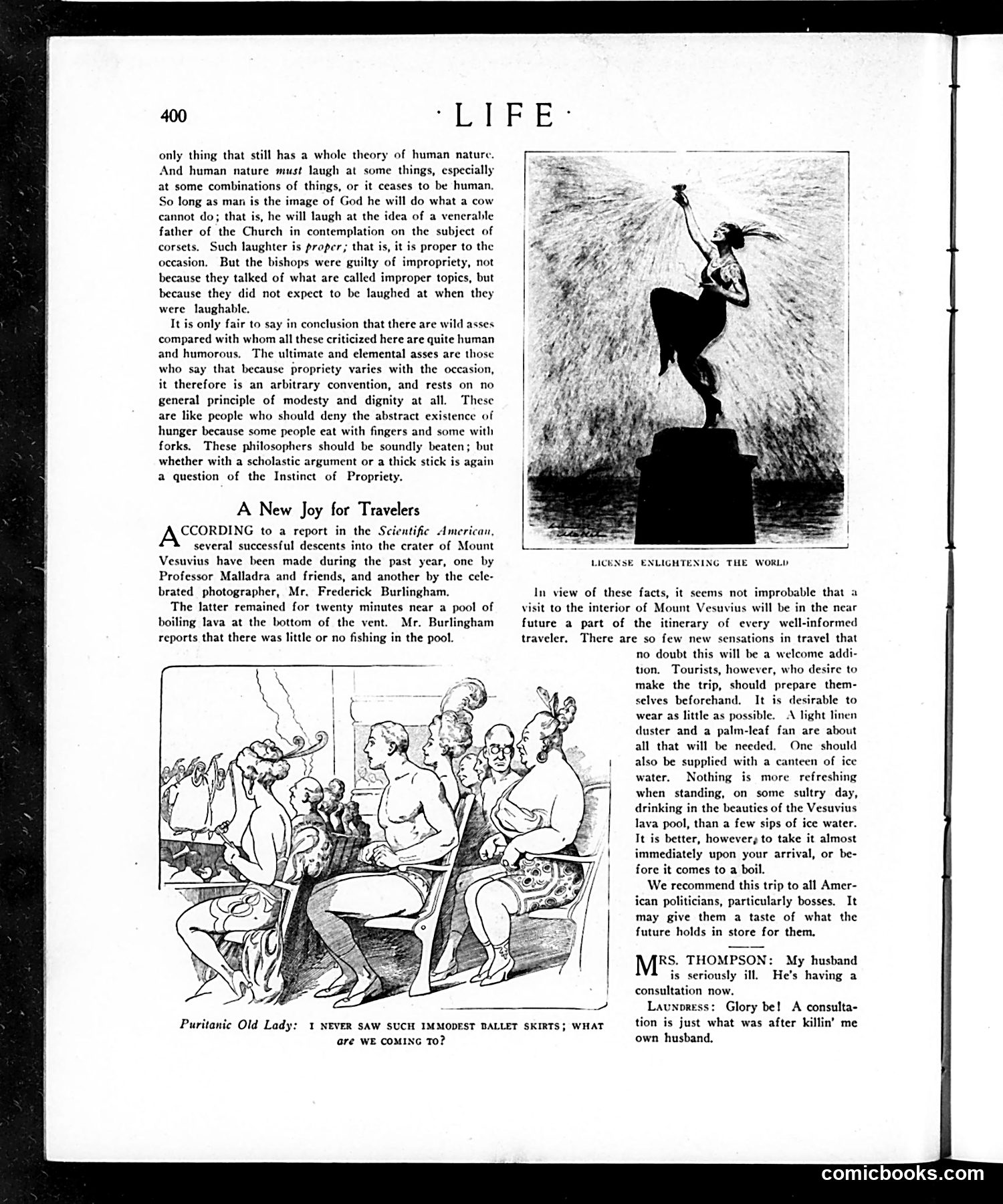
This page contains two distinct pieces of satire: **Top Section:** A philosophical essay defending laughter about propriety, arguing that human nature requires the ability to laugh at incongruities (like Church fathers discussing corsets). It mocks those who deny propriety has any universal basis. **"A New Joy for Travelers":** A satirical travel article about Mount Vesuvius descent expeditions. The humor lies in deadpan recommendations—wear minimal clothing, bring ice water that will boil immediately—treating a dangerous volcano visit as casual tourism. The concluding line is pointed political satire: recommending the trip to American politicians and "bosses," suggesting Vesuvius (hell/damnation) represents their deserved fate. **"Puritanic Old Lady" Cartoon:** Shows a scandalized elderly woman complaining about immodest ballet skirts, representing outdated Victorian prudishness that Life's editors mock throughout the page. **"Mrs. Thompson" Dialogue:** Dark humor about a laundress whose own husband died after a doctor's consultation, now hearing Mrs. Thompson's husband is having one—darkly suggesting medical consultations are fatal.
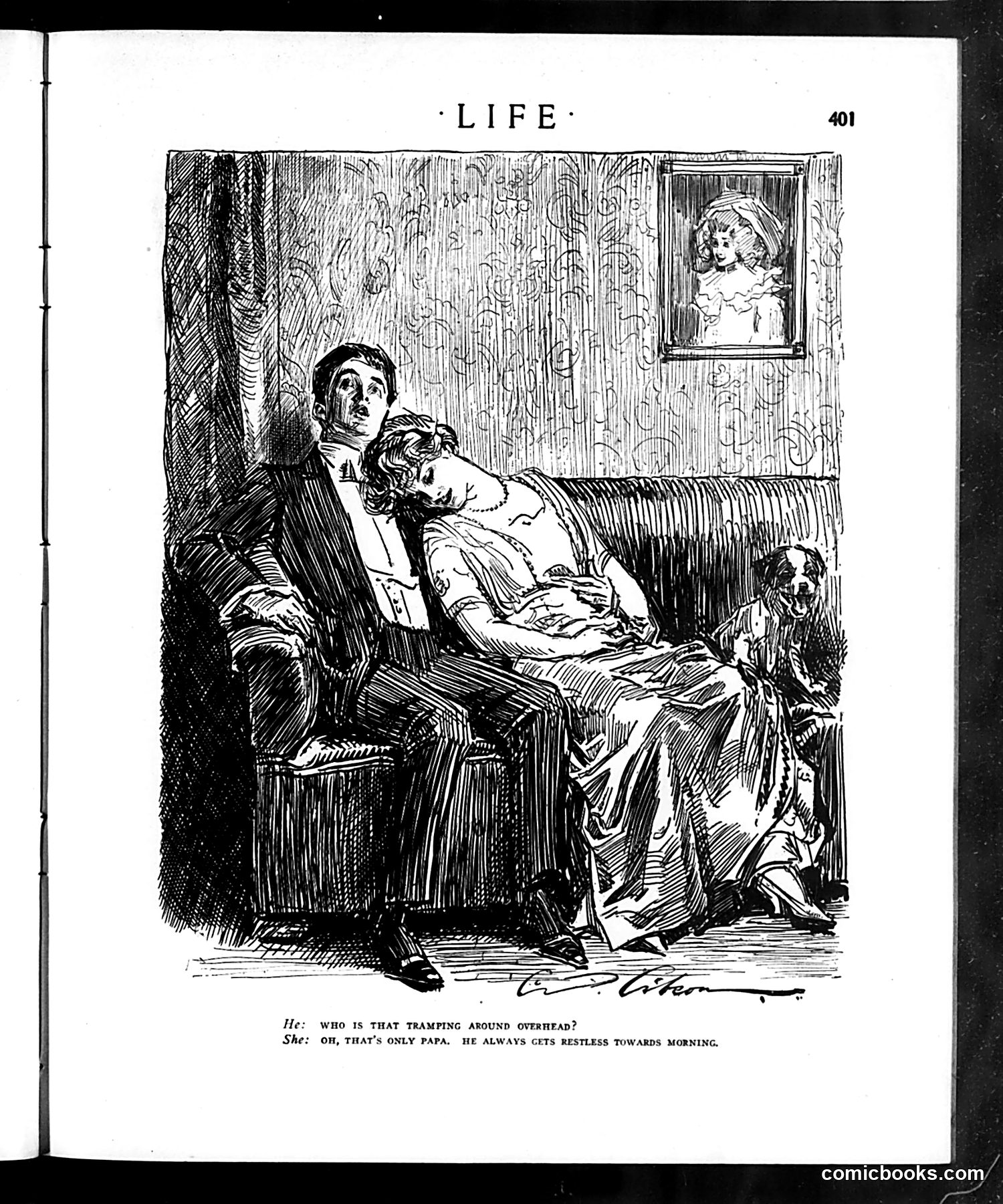
This is a domestic comedy scene depicting a couple in an intimate moment on a couch, interrupted by noise from upstairs. The woman reassures her companion that the overhead disturbance is merely "Papa"—her father—who apparently suffers from insomnia or restlessness in the early morning hours. The humor relies on the awkward situation: a man and woman in a romantic encounter are startled by sounds from the father-in-law pacing above. The joke plays on domestic anxiety and the cramped living conditions common to the era, where multiple generations shared homes. Papa's restlessness serves as both comic interruption and implicit reminder of parental oversight, a relatable embarrassment for courting couples living under family roofs in this period.
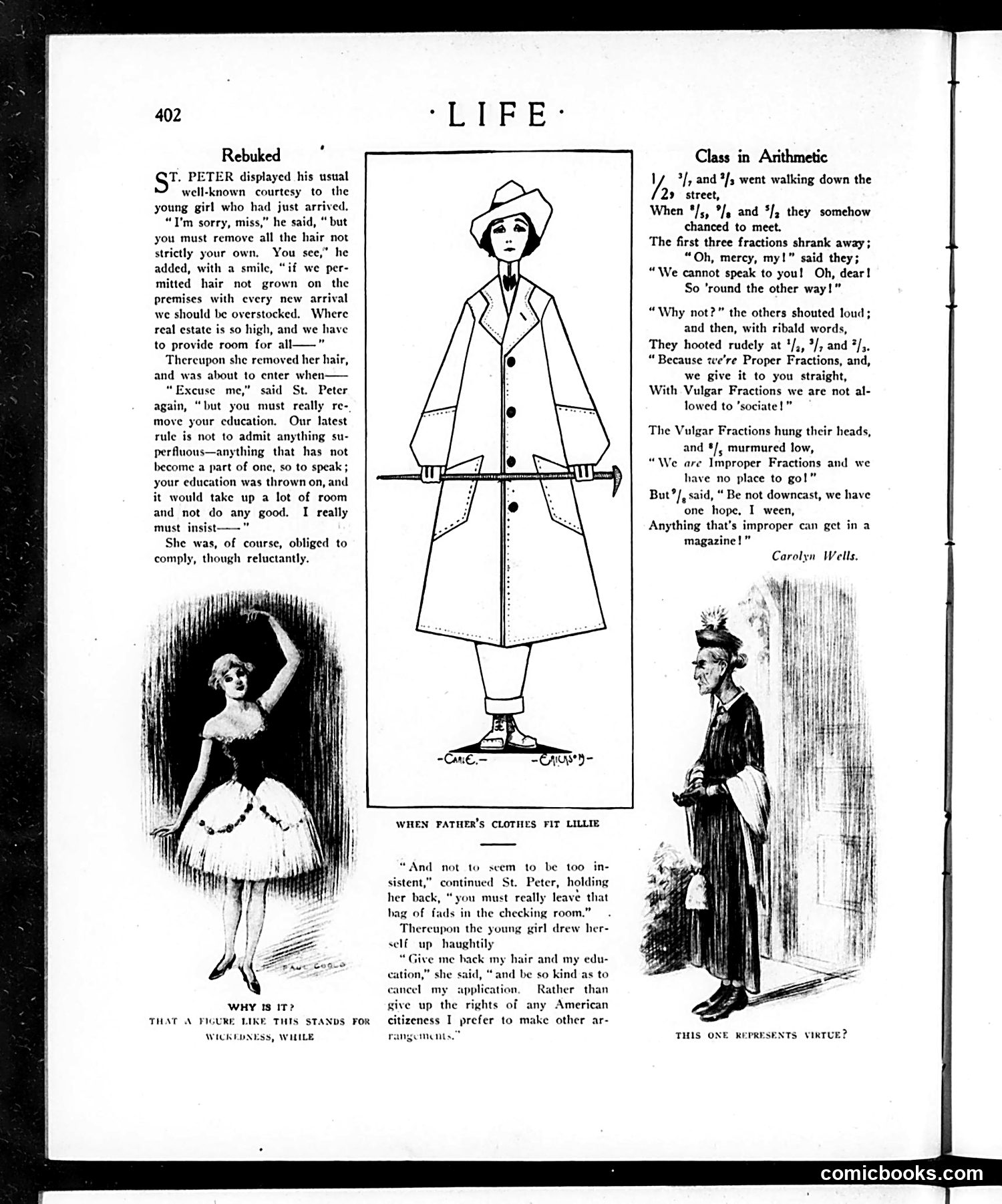
This page contains two satirical pieces mocking early 20th-century American attitudes. **"Rebuked"** (left): A story about St. Peter at heaven's gate denying entry to an educated woman unless she removes her "hair not strictly your own" (likely a wig, suggesting artifice), her education, and her "fads." When she refuses to surrender her education and rights as an American citizen, she withdraws her application. The satire targets gatekeepers who demand women abandon intellect and independence for admission to respectable society—presenting such demands as absurd. **"Class in Arithmetic"** (right): A poem by Carolyn Wells personifying mathematical fractions. "Proper" fractions (less than one) snub "Improper" fractions as socially unacceptable, mirroring class discrimination. The improper fractions' resigned acceptance—that only magazines accept "improper" things—satirizes both mathematical pedantry and the magazine industry's reputation for publishing lowbrow content. Both pieces mock rigid social hierarchies and the pressure to conform to arbitrary standards of propriety.
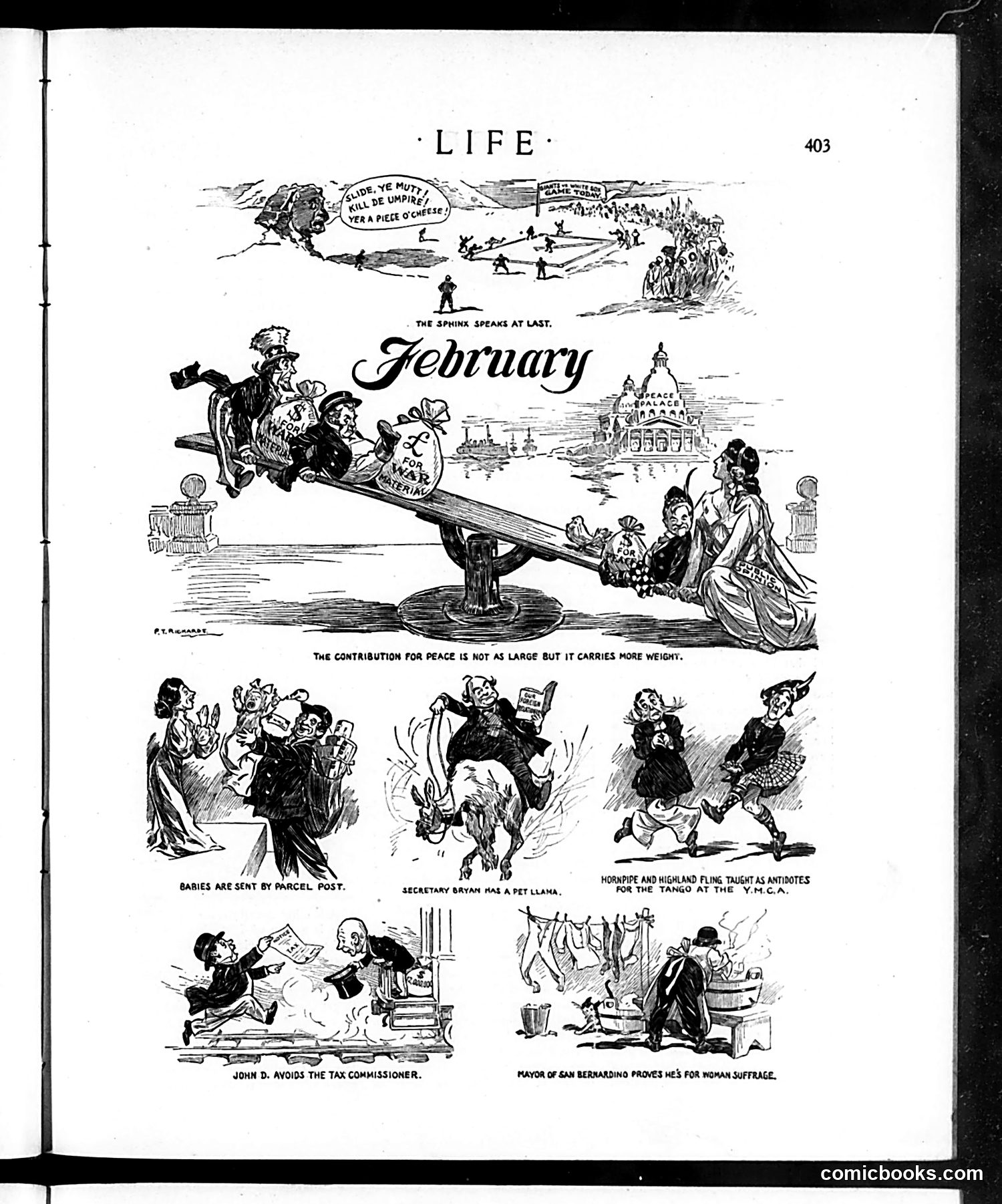
This page contains several satirical cartoons mocking contemporary early-20th-century issues: The main cartoon depicts a **seesaw labeled "Peace"** where contributions for peace efforts (represented as small) outweigh military/imperial spending (heavier side). It critiques the imbalance between peace initiatives and military expenditure. Lower cartoons mock: - **"John D. avoids the tax commissioner"** — likely targeting John D. Rockefeller's tax avoidance - **"Mayor of San Bernardino proves he's for woman suffrage"** — sarcastically depicting political performativity on women's voting rights - **Tango dancing at the Y.M.C.A.** being "countered" with traditional dances — social commentary on modern versus traditional culture The page satirizes political hypocrisy, wealth inequality, and cultural anxieties of the Progressive Era.
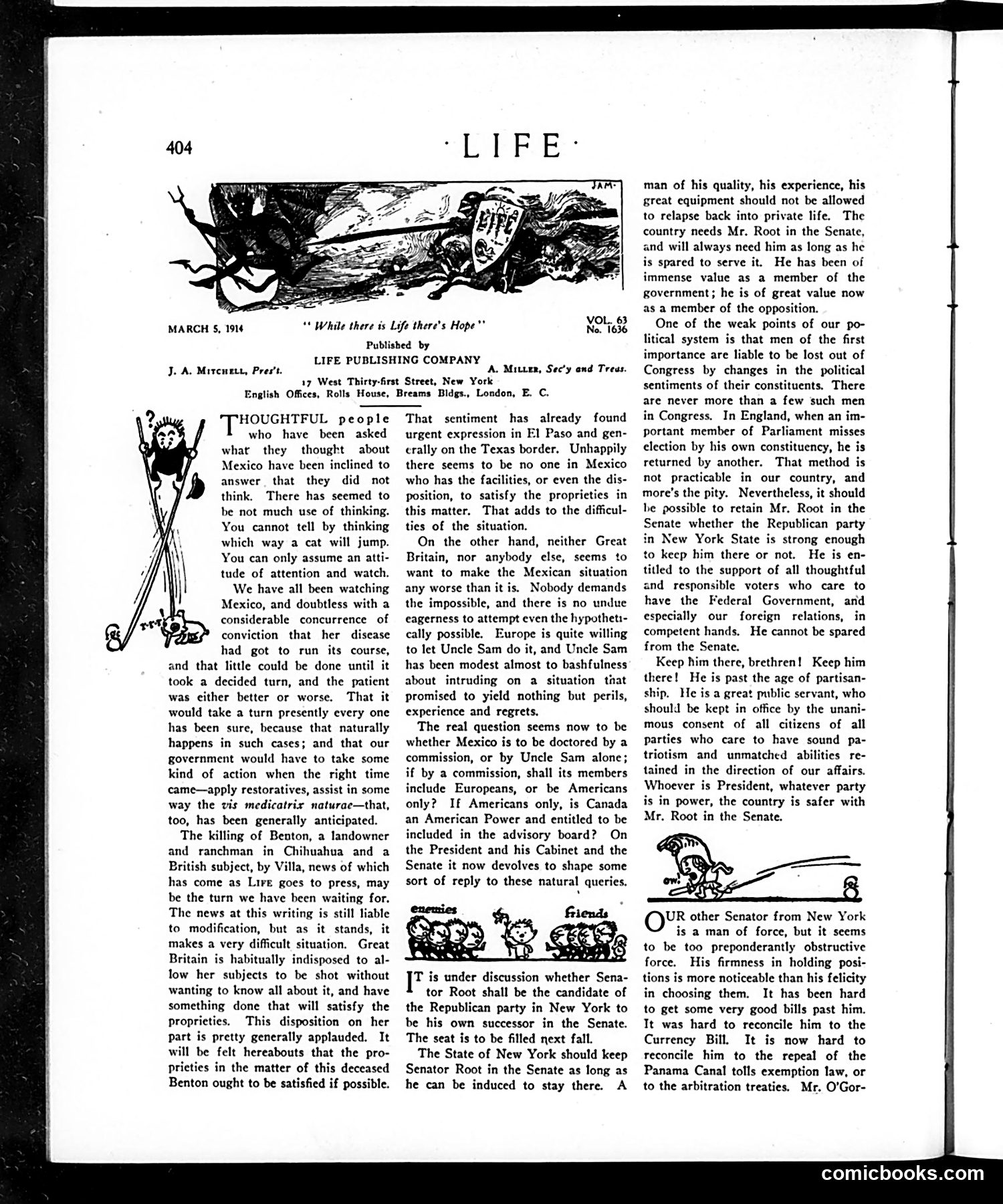
This page addresses two contemporary crises. The main article discusses the Mexican Revolution's instability, sparked by the recent killing of British rancher Benton by Pancho Villa's forces. The piece wrestles with whether the U.S. should intervene alone or through an international commission, and whether Canada should participate in advisory decisions. The secondary editorial advocates retaining Senator Elihu Root in the U.S. Senate. Root, a prominent Republican and former Secretary of State, was apparently considering retiring. The author argues his experience and abilities are too valuable to lose to private life, regardless of party affiliation—a notable appeal to transcendent national interest over partisanship during polarized times. The illustrated header ("While there is Life there's Hope") appears decorative rather than directly commenting on these pieces.
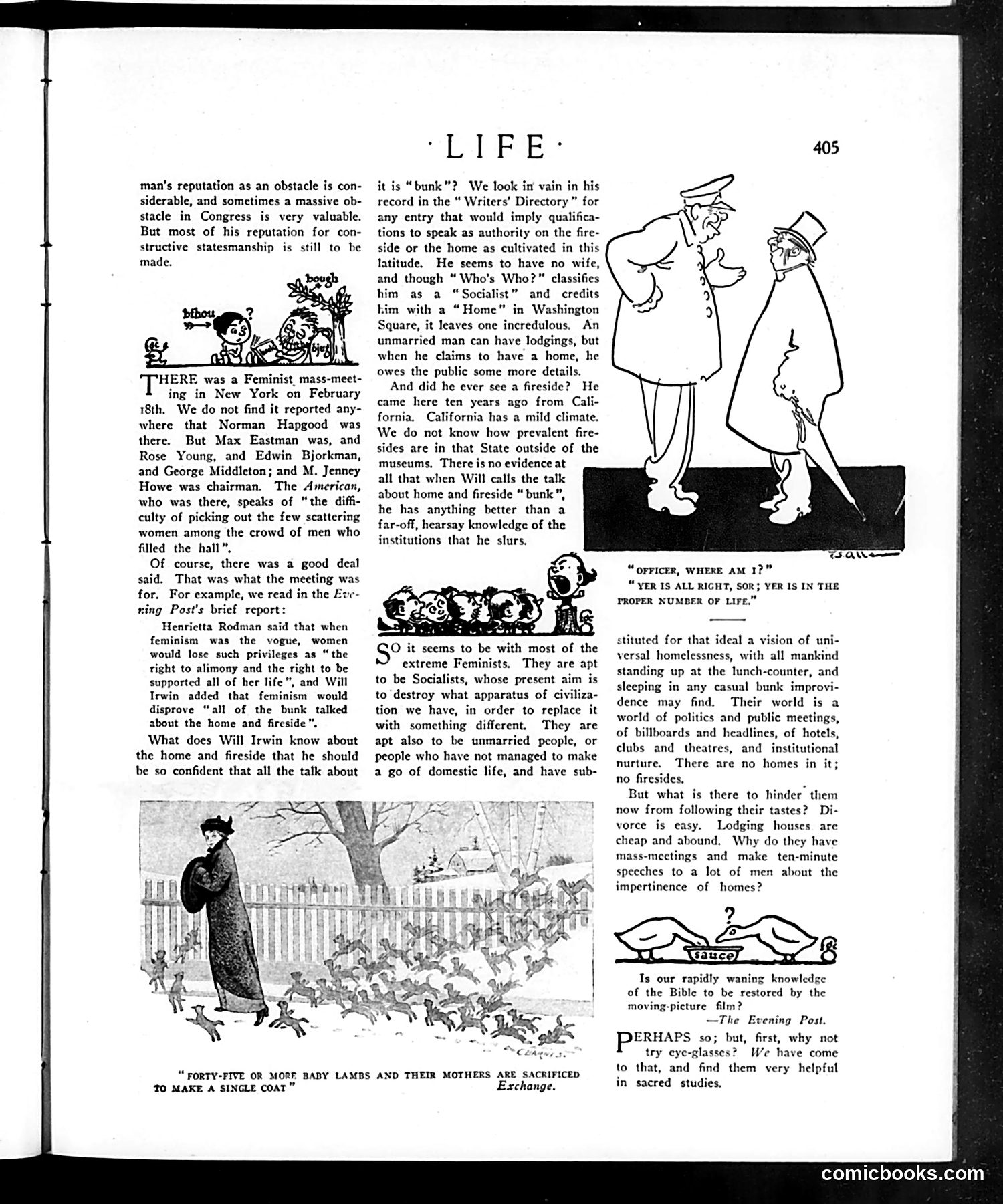
This page attacks early feminists and socialists through columnist satire. The article mocks speakers at a February 18th feminist meeting in New York, particularly criticizing writer Will Irwin for dismissing "home and fireside" talk as "bunk" despite having no domestic experience—he's unmarried, lives in a Washington Square lodging (not a real home), and came from California where fireplaces allegedly weren't common. The author argues extreme feminists are typically unmarried socialists who've failed at domestic life and now push universal homelessness (lunch-counter living, casual bunks) through public speeches. The cartoons reinforce this: one shows someone lost asking "where am I?", answering "proper number of Life"—a self-referential joke. Another depicts a woman surrounded by lambs, satirizing feminists' perceived moral inconsistency. The piece essentially argues: these reformers lack standing to critique home life since they've abandoned it themselves.
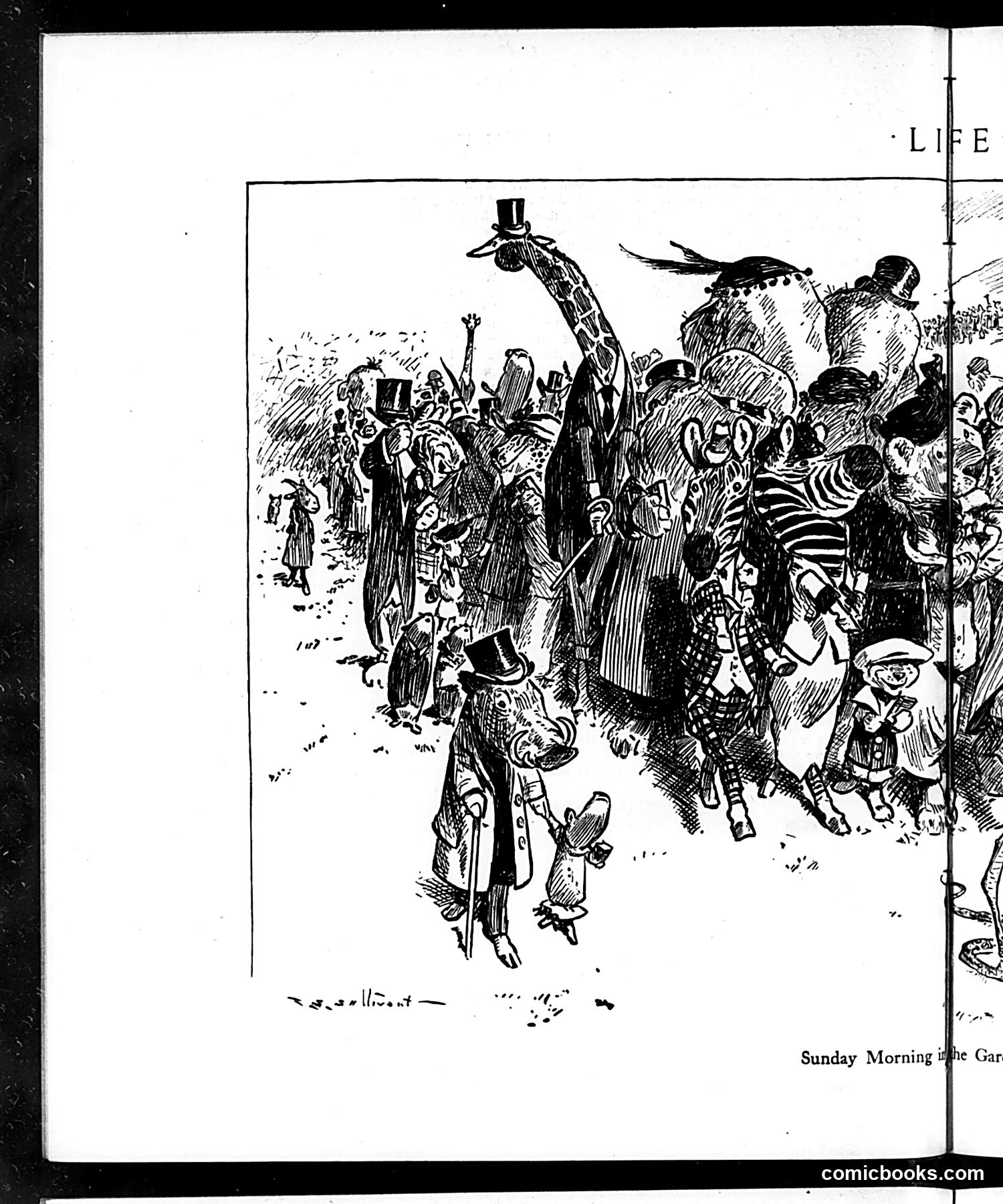
This is a satirical illustration depicting a chaotic street scene, likely from early-to-mid 20th century Life magazine. The central figure appears to be an exaggerated giraffe wearing a top hat, surrounded by a densely packed crowd of stylized human figures in various states of animated chaos—some gesturing wildly, others in formal dress with hats. The caption "Sunday Morning in the Gar[den]" (text appears cut off) suggests this satirizes a specific public gathering or event, likely in an urban park or public space. The giraffe's prominence and formal attire suggest it represents a notable public figure or perhaps absurdist commentary on celebrity spectacle. Without the complete caption or additional context, the precise subject remains unclear, though the scene clearly mocks crowded urban social dynamics or a particular well-known public event.
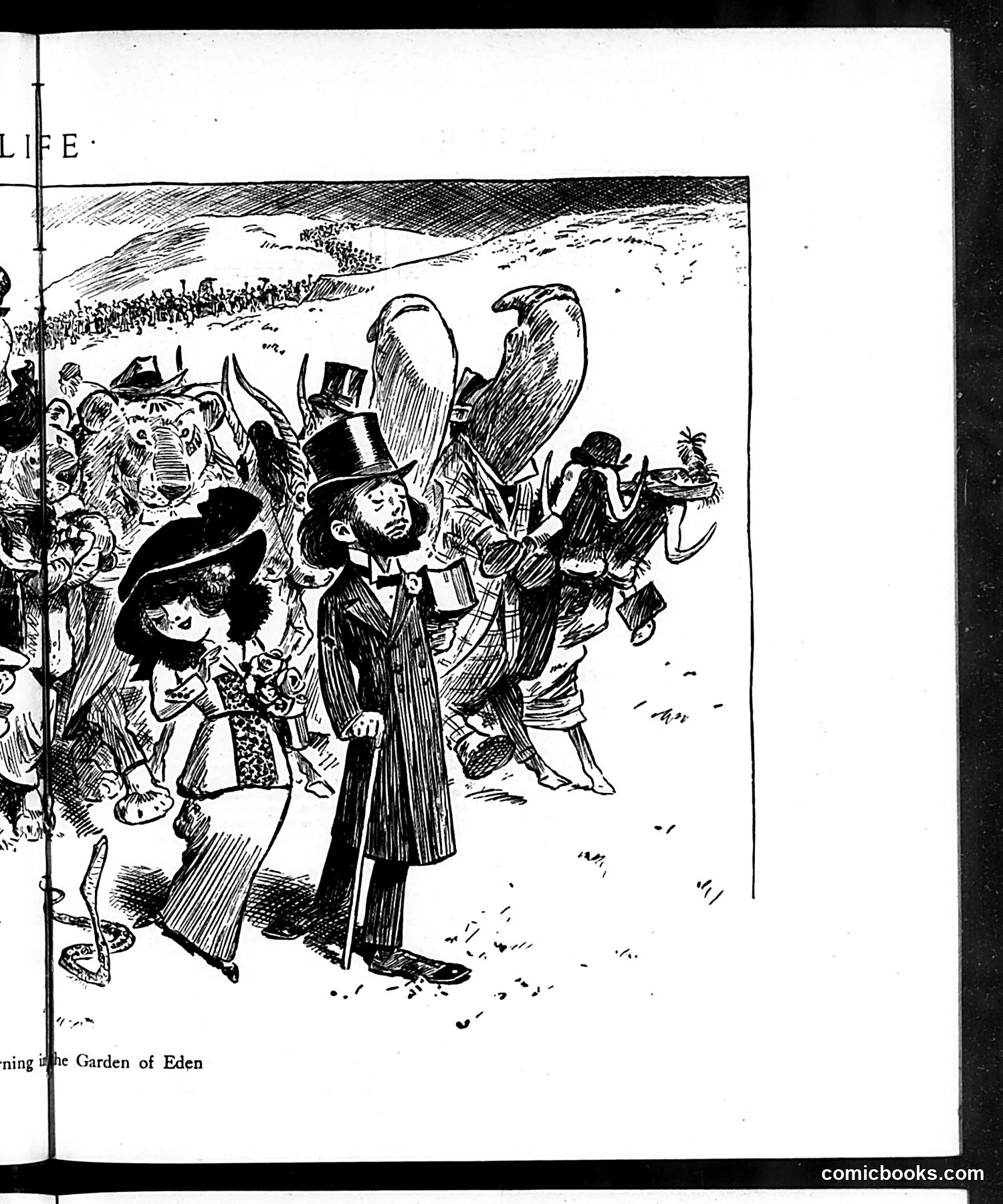
This satirical cartoon depicts well-dressed gentlemen in top hats (representing wealthy industrialists or capitalists) presenting a large eagle—likely symbolizing American imperialism or aggressive capitalism—to a crowd of common people. The landscape suggests a pristine, natural setting being corrupted or "ruined." The title "Ruining the Garden of Eden" uses biblical imagery to suggest that industrialization, commercialism, or imperial expansion is destroying natural innocence and paradise. The formal businessmen's proud presentation contrasts sharply with the title's condemnation, creating ironic commentary on how powerful figures destroy natural or social harmony while celebrating their own endeavors. The satire targets Gilded Age capitalism and its environmental or social consequences.
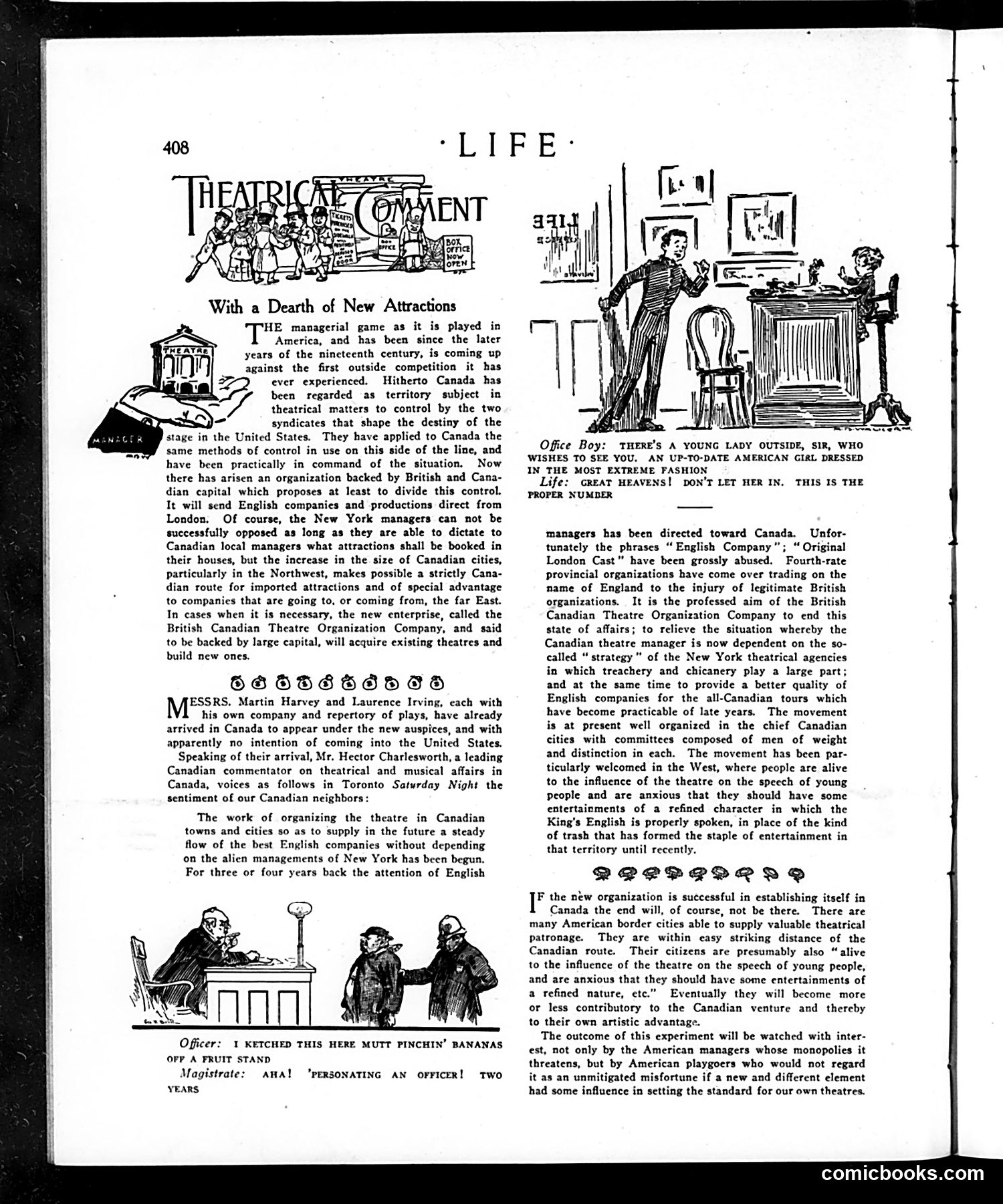
This page discusses the **theatrical monopoly** American companies held over Canadian theatre. The article announces a challenge to this control: a new British-Canadian Theatre Organization Company backed by British and Canadian capital, which will import English productions directly from London rather than through American New York managers. The satirical point: American theatrical syndicates had treated Canada as their exclusive territory, dictating which shows played in Canadian theatres. Now, growing Canadian cities—particularly in the Northwest—make competition feasible. The article emphasizes that Canadian theatre managers seek independence from what they call the "treachery and chicanery" of New York theatrical agencies, and desire "refined" English entertainment (with proper "King's English") for young Canadians. The three small cartoons at bottom appear to be unrelated humorous vignettes about mistaken identity and fashion, typical of *Life* magazine's satirical style.
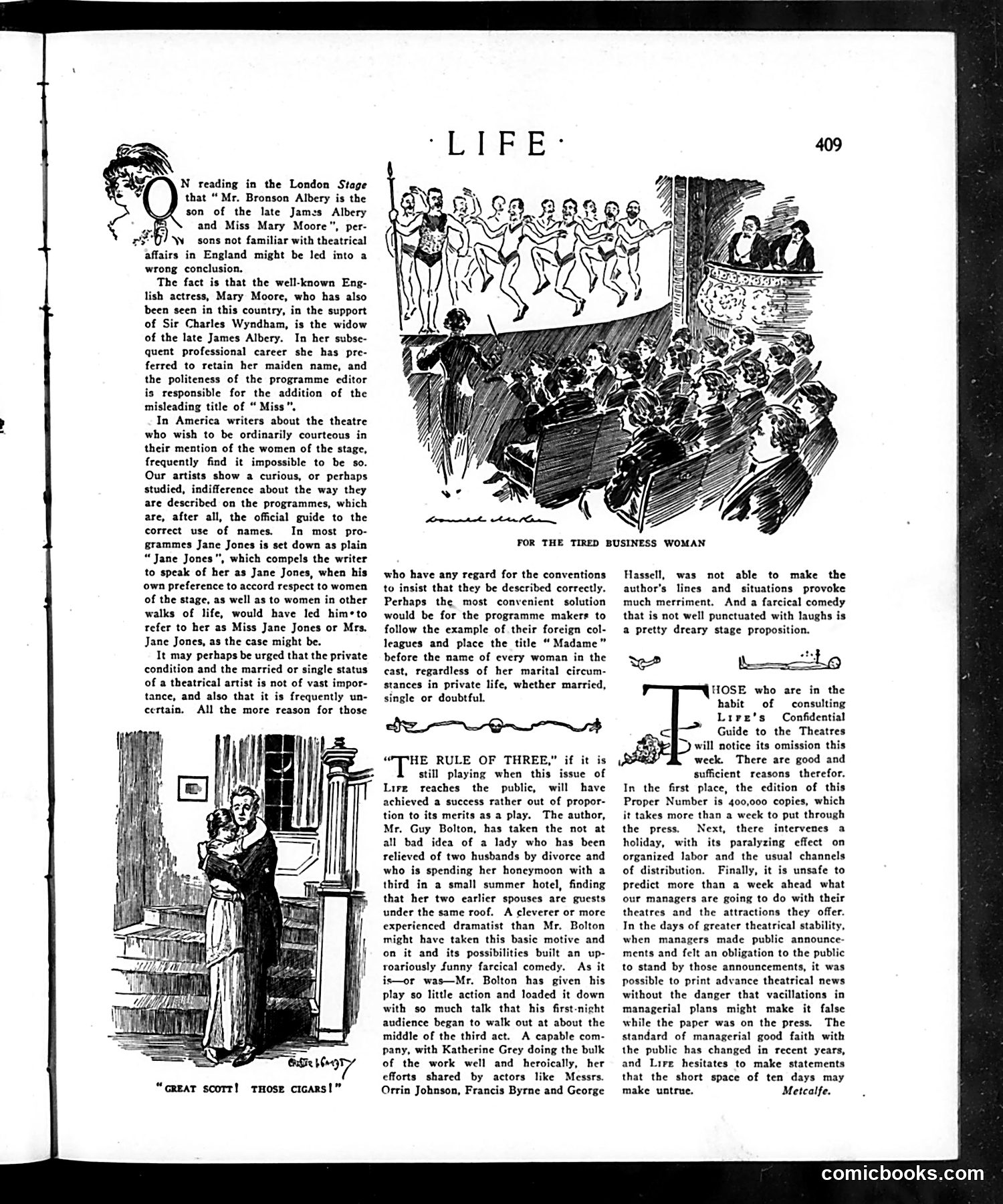
This page contains theater criticism and editorial commentary, not political cartoons. The content addresses professional theater conventions: **Main Article**: Criticizes British and American theater programs for inconsistent naming of female performers. The example concerns actress Mary Moore, widow of playwright James Albery—programs incorrectly listed her as "Miss Mary Moore" rather than acknowledging her married status or allowing her professional name choice. The piece argues theater programs should adopt the European convention of using "Madame" for all women performers, regardless of marital status, to avoid confusion and show respect. **Play Review**: "The Rule of Three" by Guy Bolton receives negative criticism. The plot involves a woman honeymooning with her third husband while her two ex-husbands (from divorces) happen to be guests at the same hotel. The reviewer faults Bolton for insufficient action and excessive dialogue, causing first-night audiences to leave mid-performance. **Side Note**: Announces omission of the theater guide this week due to printing delays, holiday disruptions, and distribution challenges. The small illustration captioned "Great Scott! Those cigars!" appears unrelated to main text.
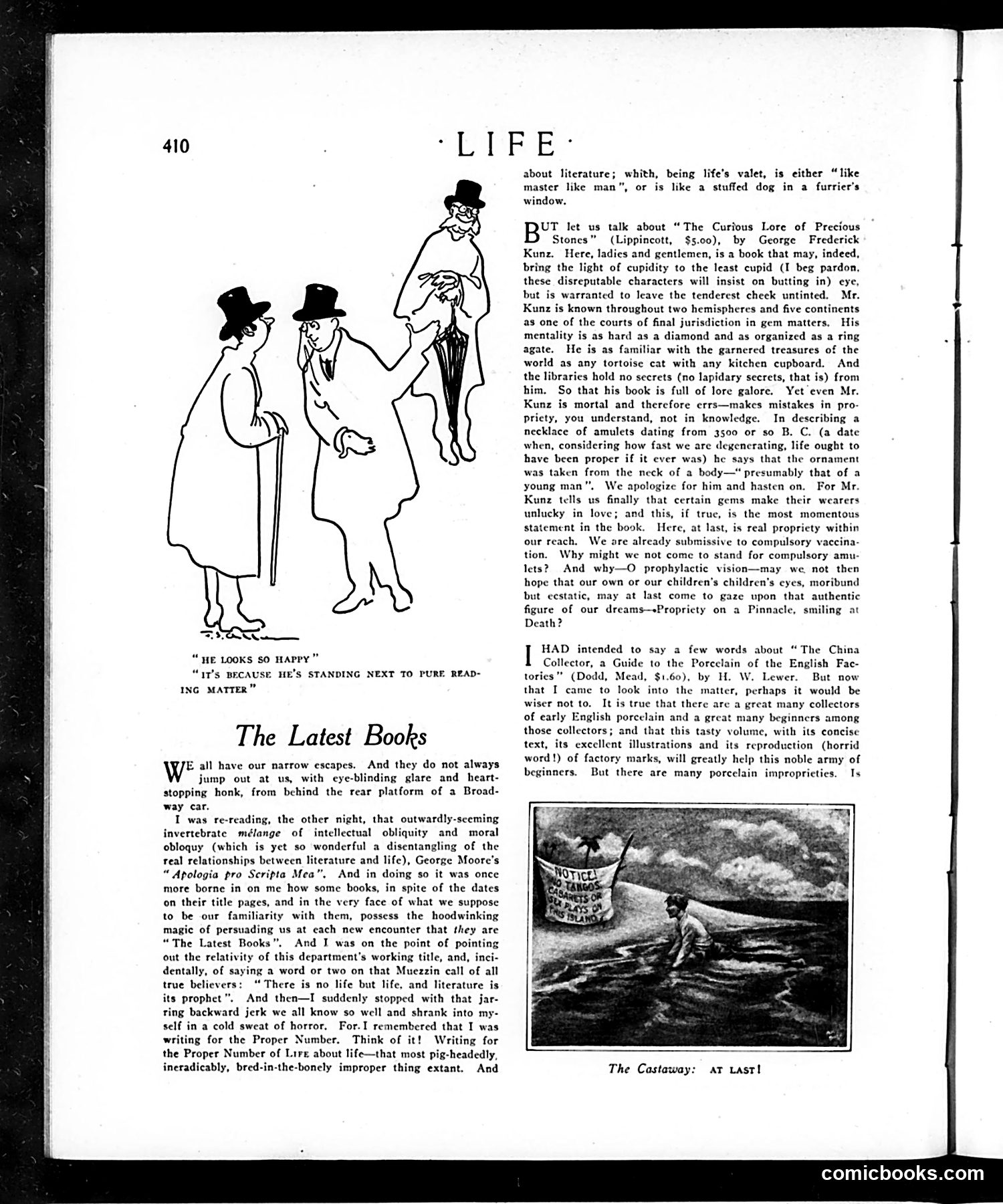
This page features a satirical book review column titled "The Latest Books." The cartoon (top left) depicts three well-dressed men in top hats, with the caption: "He looks so happy / It's because he's standing next to pure reading matter." **The satire:** The joke mocks intellectual pretension—the implication being that proximity to "pure reading matter" (fine literature) is more satisfying than actual human companionship. It's a critique of bibliophiles who prize books over life itself. **The reviews** discuss two volumes: George Frederick Kunz's "The Curious Lore of Precious Stones" and H.W. Lewer's "The China Collector." The author humorously chides these works for minor "improprieties" while acknowledging their scholarly value—a gentle mockery of both overly serious collectors and the tension between life's messiness and literature's pretense to order and propriety. The underlying theme: literature claims authority over life, yet constantly fails to capture it perfectly.
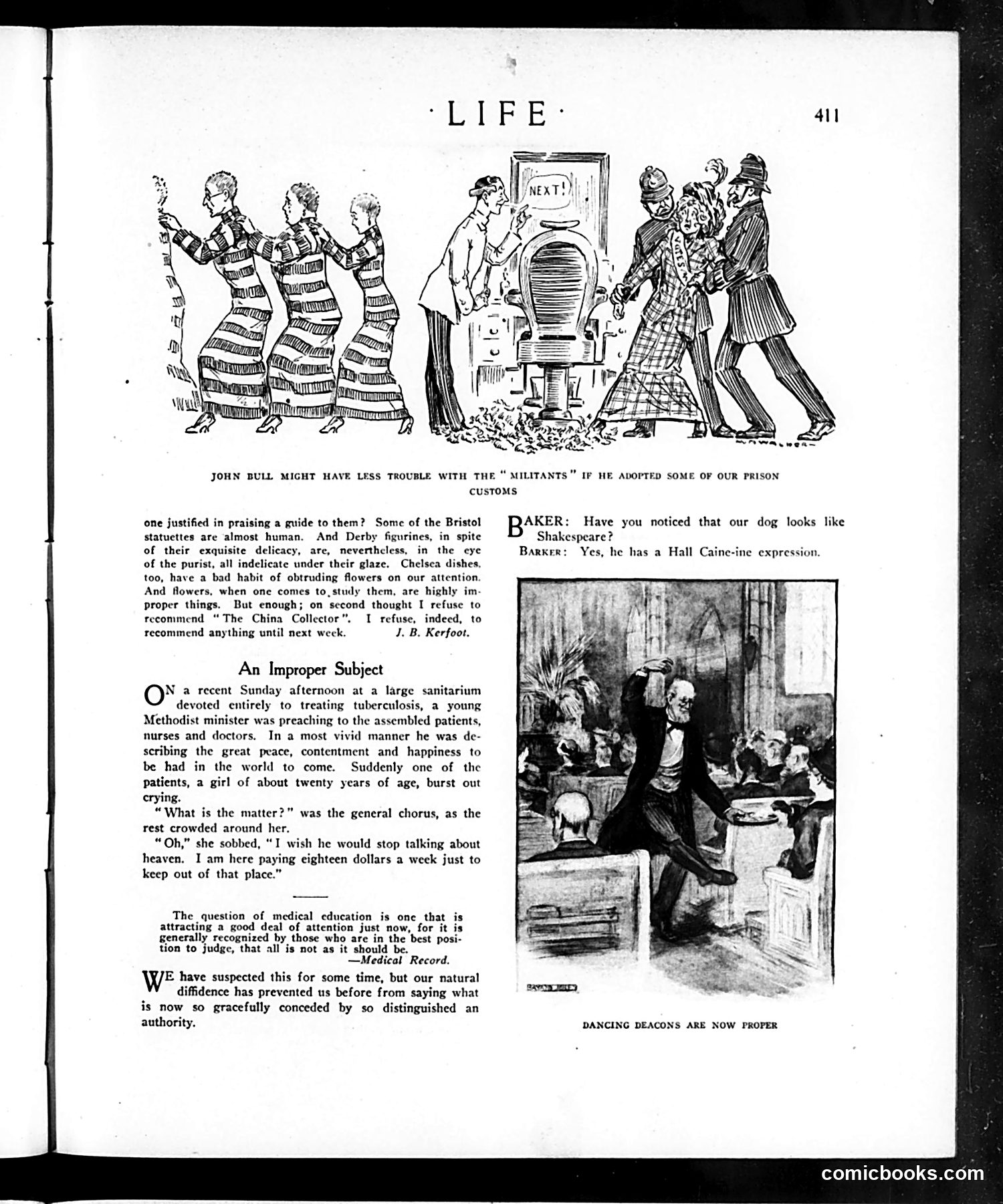
**Top Cartoon**: "John Bull Might Have Less Trouble with the 'Militants' If He Adopted Some of Our Prison Customs" This references the British suffragettes (militant women's rights activists), depicted on the left in striped prison garb. The cartoon satirizes harsh British prison treatment of suffragettes by suggesting America's prison system might be preferable. "John Bull" represents Britain. The joke contrasts British militant feminism with American approaches. **"An Improper Subject" Article**: Mocks a Methodist minister's heaven-focused sermon at a tuberculosis sanitarium. A dying patient ironically replies she's paying $18 weekly to *avoid* heaven, suggesting her present misery makes the afterlife unappealing—dark humor about suffering and religious platitudes. **Bottom Caption**: "Dancing Deacons Are Now Proper" appears to reference social debates about whether clergy should participate in secular entertainment like dancing, once considered improper. The page satirizes Victorian/early 20th-century social propriety and institutional hypocrisy across religious, political, and criminal justice contexts.
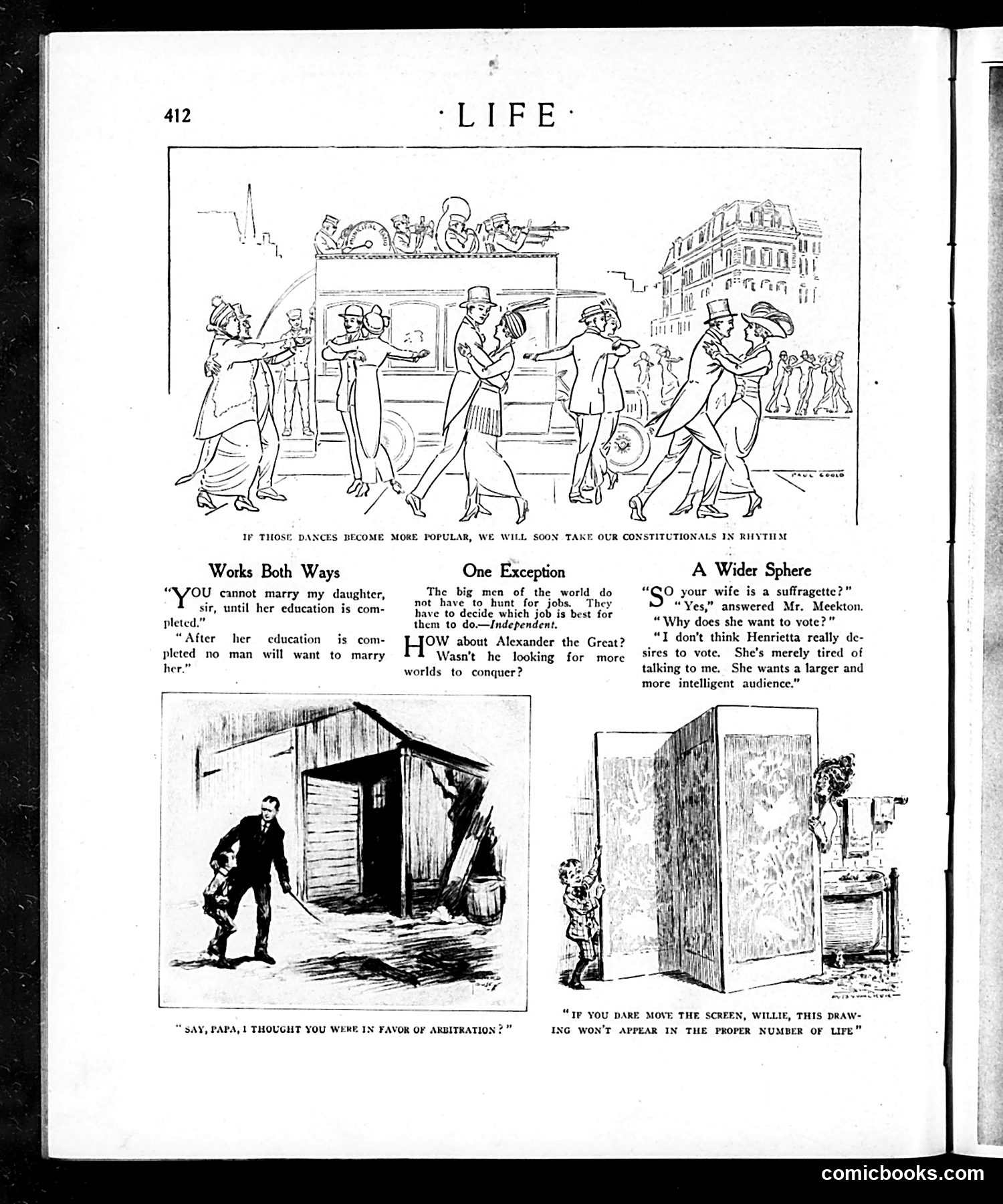
This page contains four separate satirical cartoons addressing early 20th-century social debates: **Top cartoon**: Mocks modern dance crazes (likely jazz-age dancing) by suggesting society will soon conduct formal walks ("constitutionals") in rhythm—satirizing how pervasive these dances have become. **"Works Both Ways"**: Jokes about women's education creating a paradox: educating daughters makes them unmarriageable, yet uneducated women are also undesirable. **"One Exception"**: References Alexander the Great to challenge the notion that powerful men passively receive opportunities. The point appears ironic—even great conquerors actively pursued goals. **"A Wider Sphere"**: Satirizes anti-suffrage arguments by showing a husband claiming his wife doesn't actually want to vote; she simply wants a "larger and more intelligent audience" than him. This mocks dismissive attitudes toward women's voting rights. **Bottom cartoon**: An in-joke about Life magazine's production, referencing page layouts. Overall, the page reflects 1910s-1920s debates over women's roles, education, voting rights, and changing social norms.
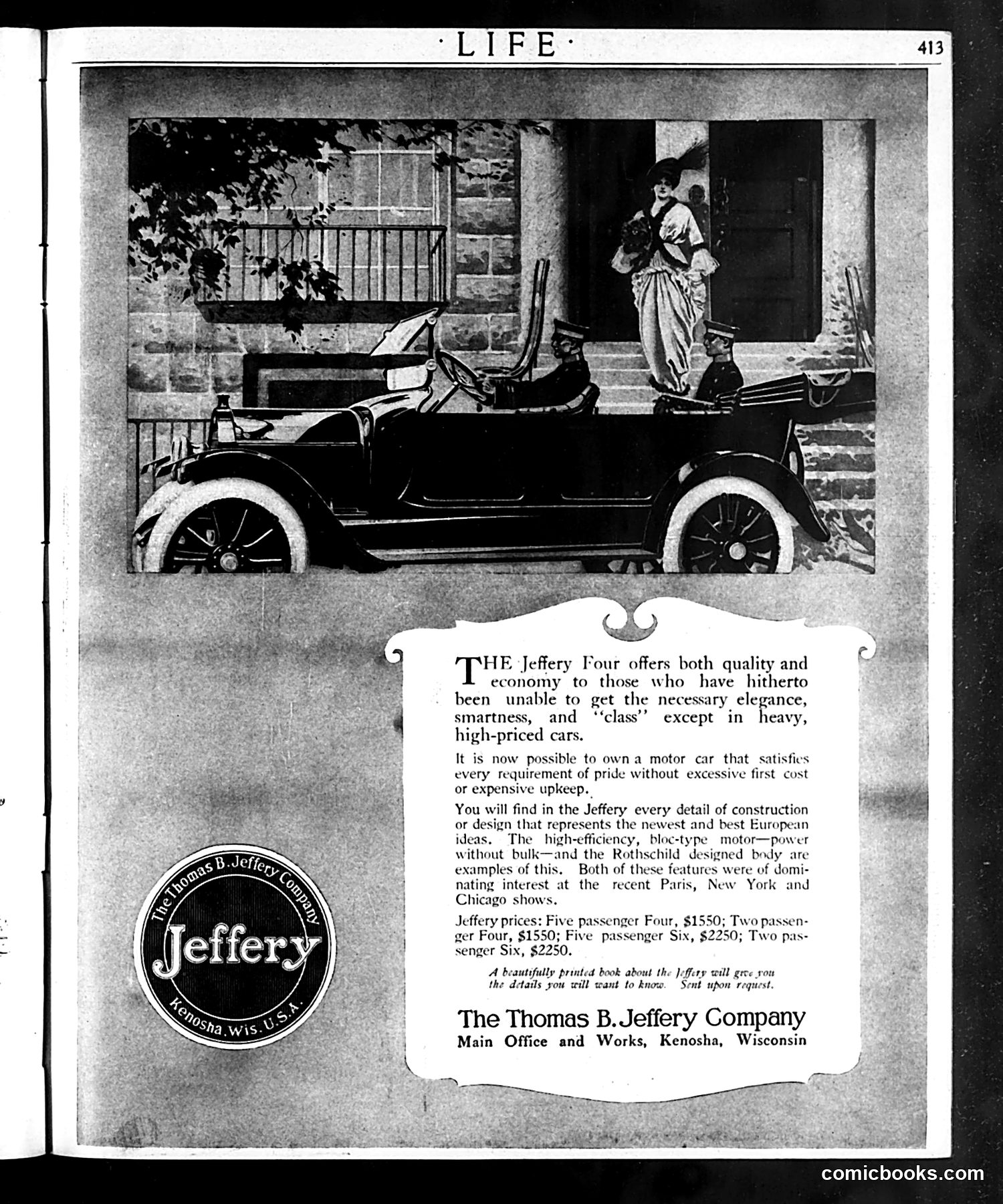
This is **not a cartoon or satire** — it's a straightforward automobile advertisement from Life magazine. The page advertises the Jeffery Four automobile, manufactured by the Thomas B. Jeffery Company in Kenosha, Wisconsin. The ad targets middle-class buyers who previously couldn't afford quality cars, positioning the Jeffery as offering "elegance, smartness, and 'class'" at reasonable prices ($1,150-$2,250 depending on model). The image shows a well-dressed couple with an open-air motorcar parked in front of a nice house, representing the aspirational lifestyle the car enables. Key selling points emphasized: European design, efficient motors, and recent acclaim at major auto shows (Paris, New York, Chicago). This represents early 20th-century automotive marketing — before cars were mass-market commodities, manufacturers pitched them as status symbols and engineering achievements to affluent consumers.
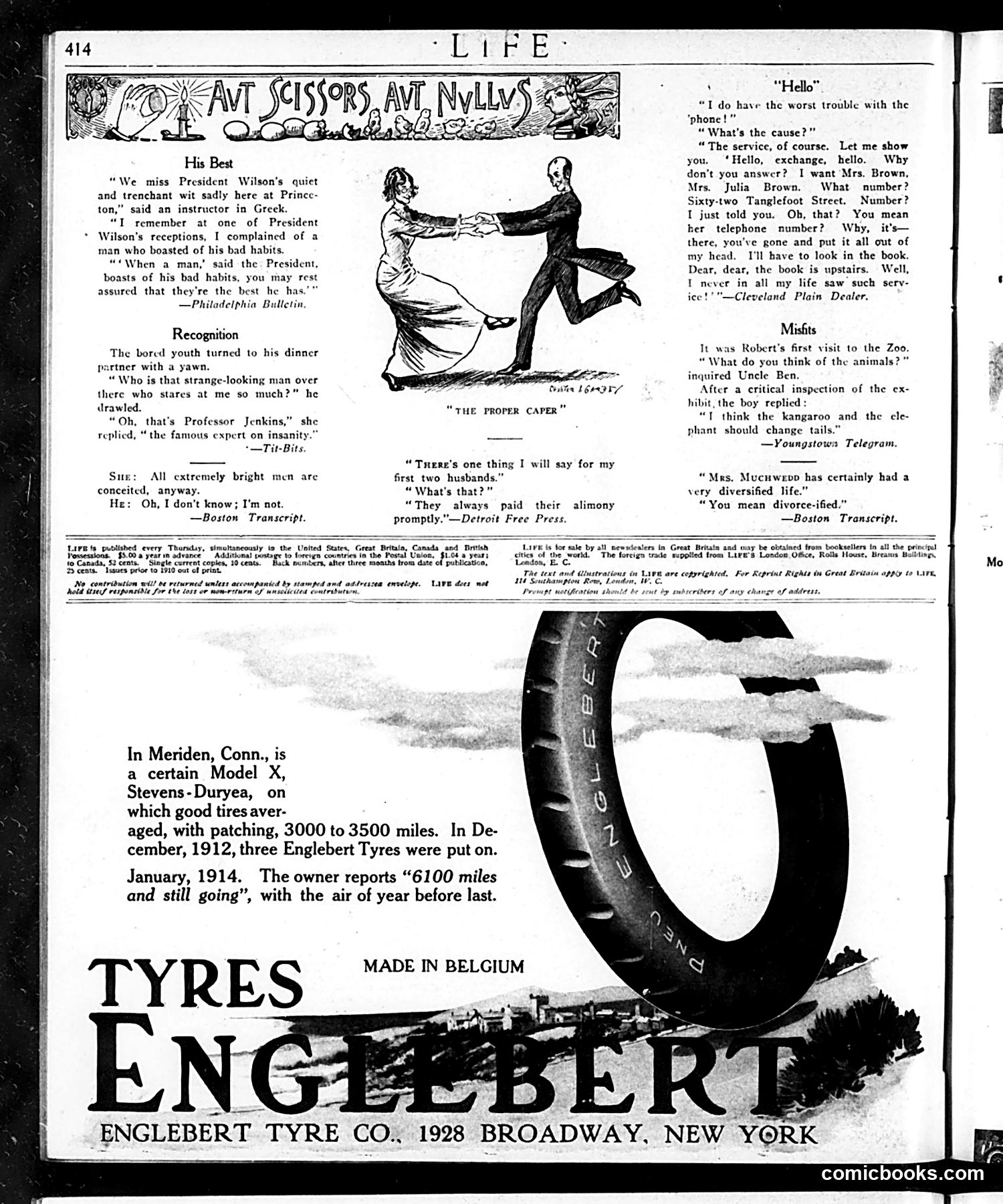
This page contains several short humor pieces typical of Life's satirical style, plus an advertisement. **"His Best"** mocks President Wilson's reputation for witty remarks—the humor lies in contrasting Wilson's celebrated verbal cleverness with an ordinary man's boastfulness about his own bad habits. **"The Proper Caper"** shows a couple in an exaggerated dance pose, captioned with dialogue about husbands paying alimony promptly—satirizing both marital discord and the financial obligations divorce created. **"Recognition," "Hello," and "Misfits"** are brief joke items poking fun at absent-mindedness, telephone operator frustration, and a child's innocent zoo observations. The lower half is a full-page **Englebert Tyres advertisement** (made in Belgium), featuring a large tire image and a testimonial claiming exceptional mileage. This represents typical early automotive advertising, emphasizing durability and real-world performance claims. The page exemplifies Life's format: light satirical humor about contemporary social situations (divorce, phones, marriage) alongside commercial advertising.
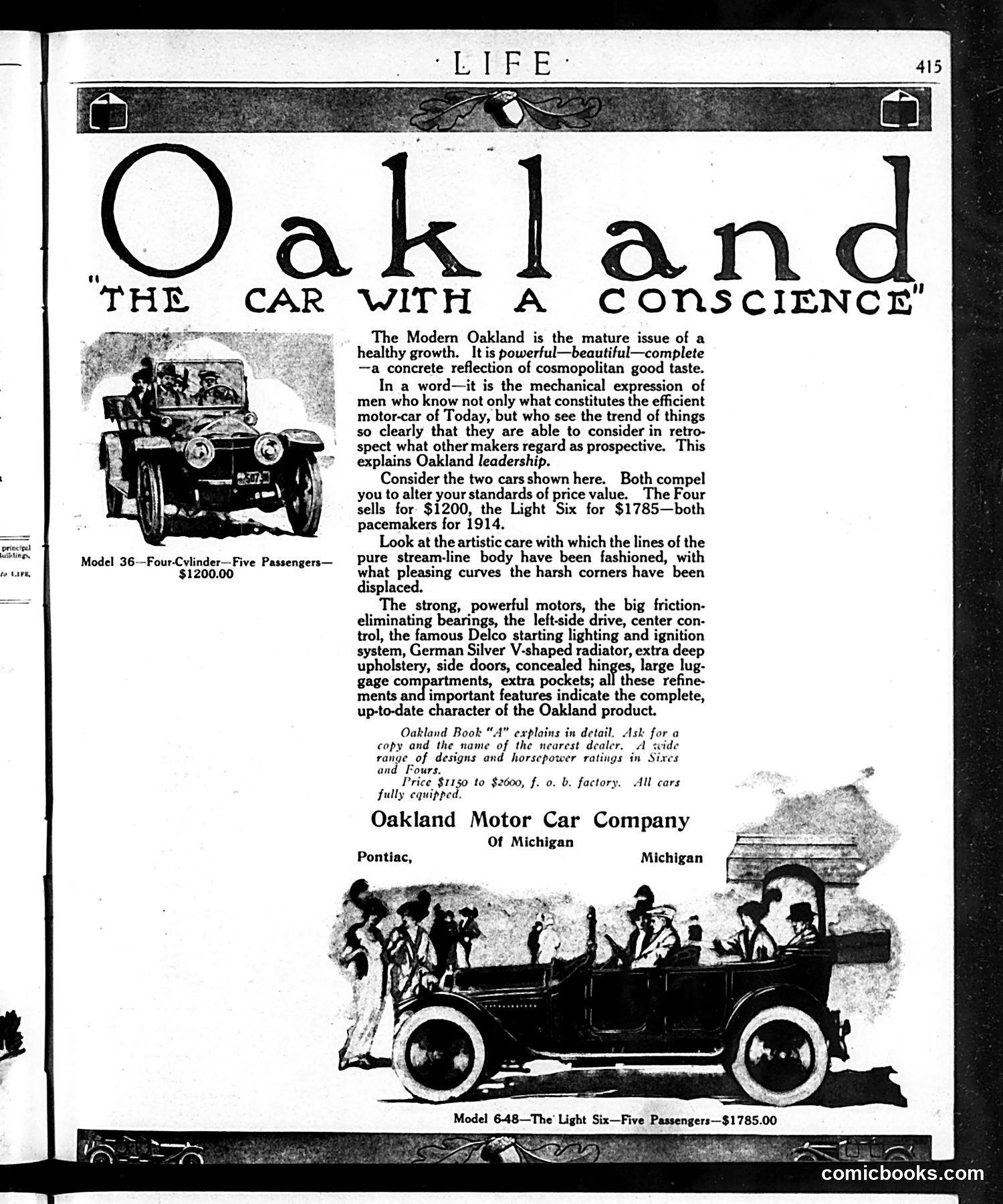
This is **not a cartoon or satire**—it's a straightforward automobile advertisement from *Life* magazine (page 415). The Oakland Motor Car Company advertises two 1914 car models: the Model 36 Four-Cylinder ($1,200) and the Light Six ($1,785). The ad emphasizes the brand's engineering sophistication and design leadership, claiming Oakland vehicles represent "cosmopolitan good taste" and mechanical innovation. The phrase "car with a conscience" (the headline) appears to be marketing language suggesting Oakland builds ethically and thoughtfully—a quality-focused manufacturer rather than a cut-rate producer. The accompanying illustrations show both vehicles and include a silhouette scene of people enjoying an Oakland automobile, emphasizing lifestyle appeal. The ad highlights period-specific features: Delco starting/lighting systems, left-side drive, V-shaped radiator—all genuine innovations that would have impressed contemporary buyers. The company was based in Pontiac, Michigan. This represents early 20th-century automotive advertising before mass-market standardization.
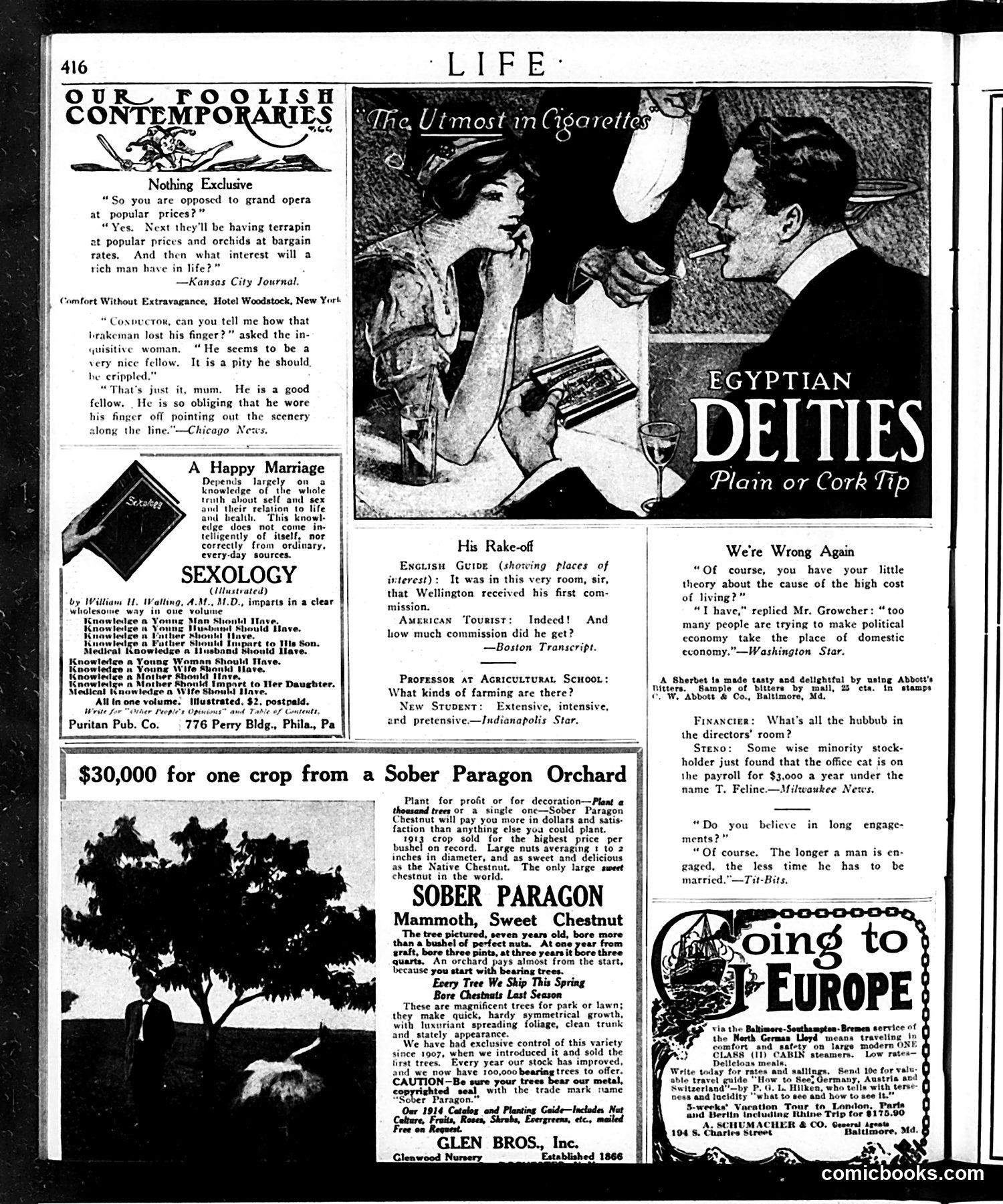
This page from *Life* magazine combines short humorous quips with advertisements, typical of the publication's format. **The cartoons/jokes satirize:** - **"Nothing Exclusive"**: Mocks wealthy anxiety about exclusivity. A rich man opposes affordable grand opera and terrapin dinners because losing exclusive access to luxuries diminishes his status. The satire targets class pretension. - **"His Rake-off"**: A brief anecdote about Wellington receiving a military commission, with a tourist's crack about whether he got "commission" (payment)—a play on words mocking military compensation or graft. - **"We're Wrong Again"**: Satirizes people blaming "the high cost of living" on political economy rather than genuine causes—poking fun at misplaced economic theories. - **Short quips throughout**: Mock various subjects (crippled brakemen, marriages, farming knowledge, office cats on payroll) with gentle, cynical humor typical of *Life's* style. The page is primarily **advertisement-heavy**, featuring promotions for *Sexology* books, the Sober Paragon Orchard, and European travel.
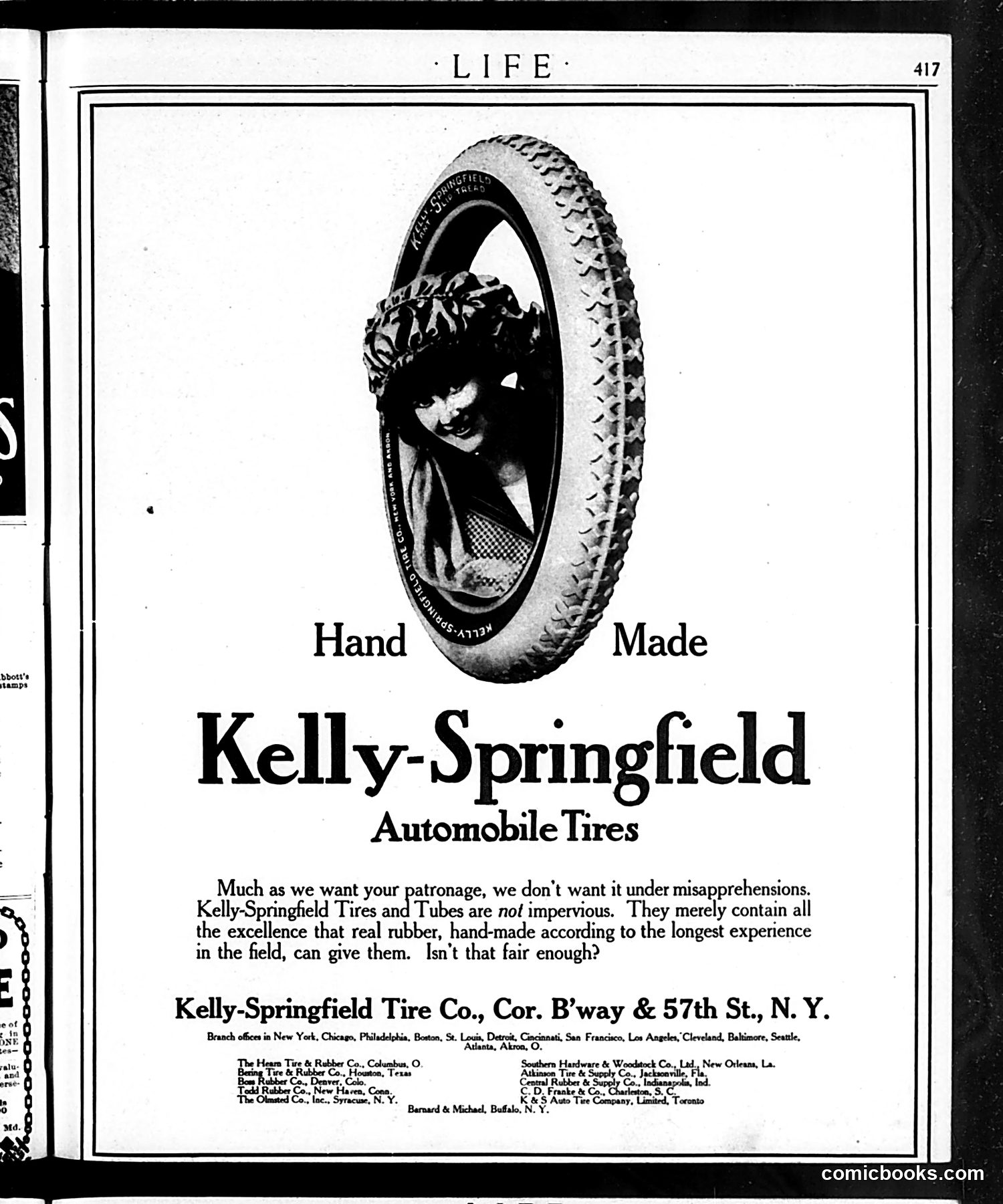
This is a straightforward **product advertisement**, not satire or political commentary. It appears on page 417 of *Life* magazine. The ad features a large photograph of a tire with text emphasizing honest marketing. Kelly-Springfield's key message is a **candid admission**: their tires are "not impervious" to damage—they're not perfect or indestructible. Instead, the company argues their value lies in quality rubber and expert hand-craftsmanship, asking consumers if that's "fair enough." This approach reflects early 20th-century advertising strategy: rather than make exaggerated claims, the company builds credibility through transparency about limitations while highlighting genuine manufacturing excellence. The ad lists branch offices across major U.S. cities and distribution partners, indicating this was a nationally significant tire manufacturer.
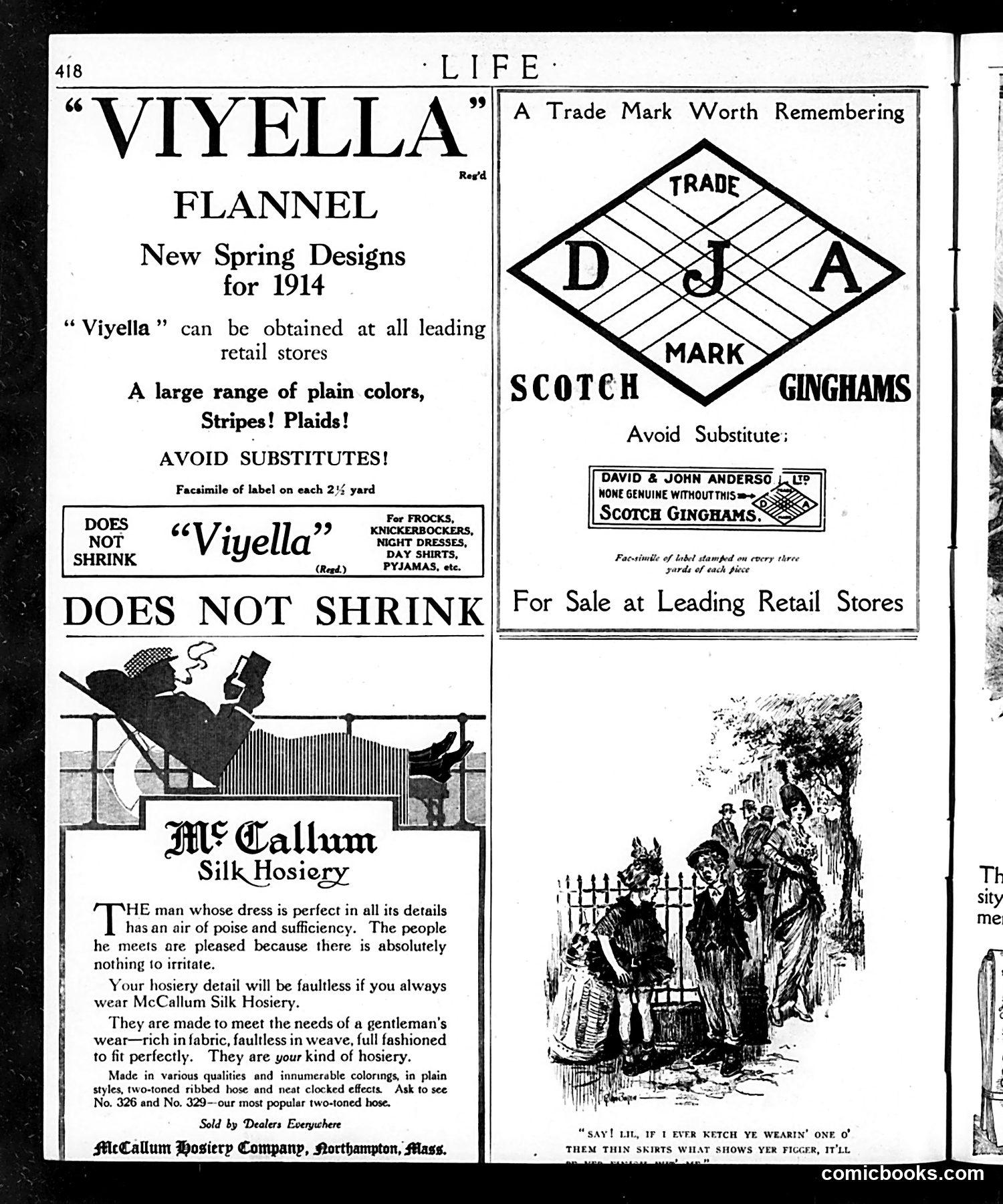
This page consists entirely of **advertisements**, not editorial content or political satire. There are no cartoons or satirical commentary here. The ads promote three products: 1. **"Viyella" Flannel** — promoting new spring fabrics (1914) that "does not shrink," available at retail stores 2. **D&A Scotch Ginghams** — with a trade mark warning against substitutes 3. **McCallum Silk Hosiery** — emphasizing quality and gentlemanly appearance The only content approaching humor is a small illustrated sketch at the bottom showing a man warning a woman about wearing thin skirts that reveal her figure—reflecting early 1900s modesty standards. This is mild social commentary about dress codes rather than political satire. The page reflects 1914 consumer culture and advertising conventions, with emphasis on brand authenticity ("avoid substitutes") and social propriety.
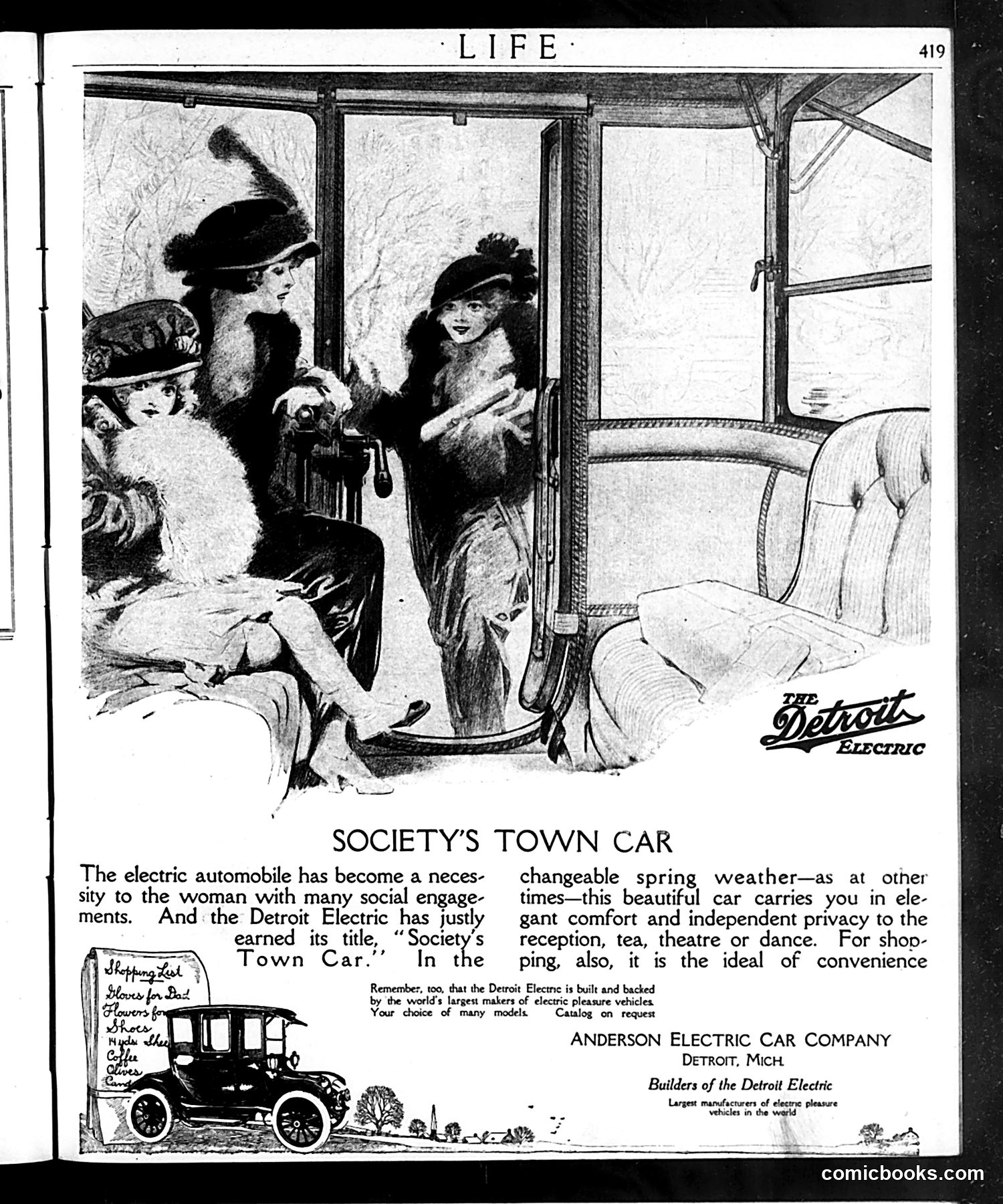
This is not satire but a **straight advertisement** for the Detroit Electric automobile, appearing in *Life* magazine (page 419). The illustration shows fashionably dressed women arriving at a social event via electric car—depicting the vehicle as essential for women attending tea, theatre, receptions, and shopping. The accompanying shopping list ("Shopping List / Stores for Best Flowers / Stores / Myles Shoes / Coffee / Gloves / Candies") humorously itemizes typical errand stops. The pitch targets wealthy women with "many social engagements," emphasizing the car's elegance, comfort, privacy, and convenience over gasoline vehicles. The Anderson Electric Car Company claims to be the world's largest electric pleasure vehicle manufacturer. **Modern context**: This represents the brief era (1900s-1910s) when electric cars competed viably with gasoline engines, marketed specifically to women as safe, quiet, and refined alternatives.
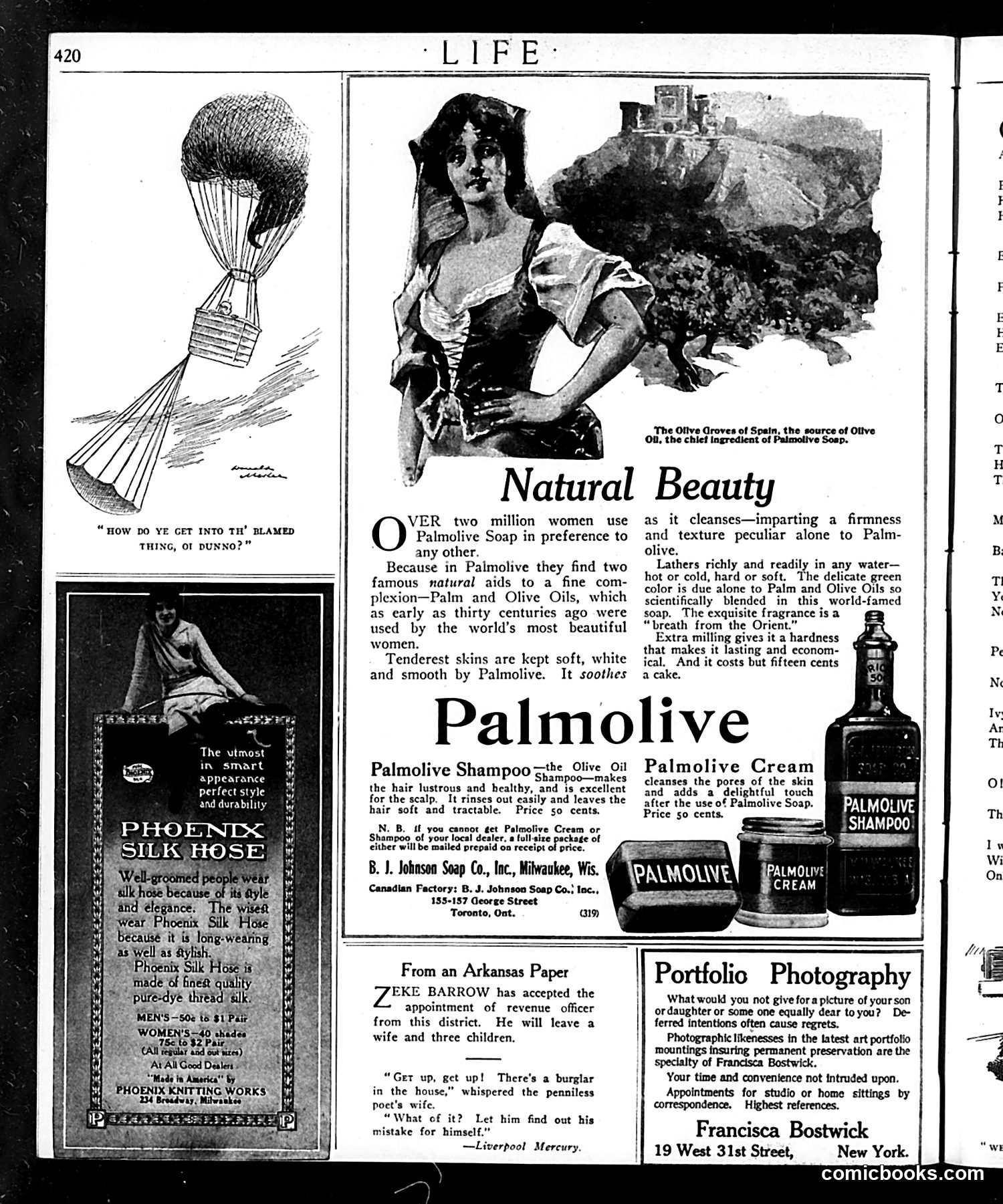
This page is primarily **advertising**, not political satire. It contains: 1. **Top left cartoon**: A humorous illustration titled "How do ye get into th' blamed thing, oi dunno?" showing a hot air balloon with tangled ropes—likely a visual gag about the difficulty of entering/operating early aviation equipment. The dialect suggests Irish or working-class characters confused by new technology. 2. **Main content**: Large Palmolive soap advertisements emphasizing the product's natural ingredients (palm and olive oils) and claims about skin care and beauty. The central image shows a woman in Spanish costume near olive groves, marketing the exotic "Oriental" origins of the soap. 3. **Supporting ads**: Phoenix Silk Hose hosiery and Francisca Bostwick photography services. 4. **Small items**: A brief news note about an Arkansas official and a joke from the Liverpool Mercury about a penniless poet. The page reflects early 20th-century consumer culture and marketing strategies emphasizing natural ingredients and aspirational beauty standards.
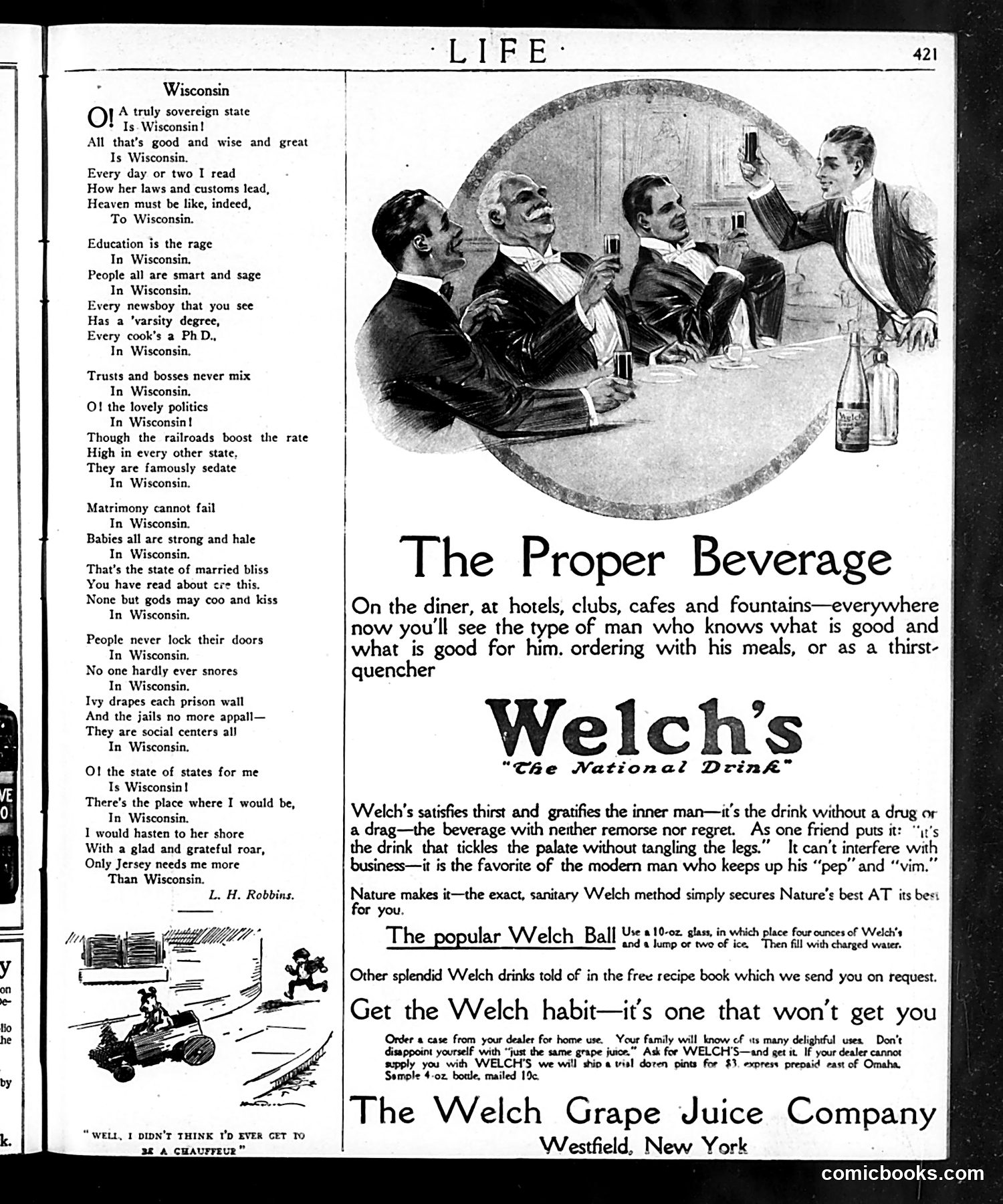
This Life magazine page combines satirical poetry about Wisconsin with a grape juice advertisement. **The Satire (left side):** L.H. Robbins's poem mockingly praises Wisconsin as a near-perfect state—where education is universal, politics are corruption-free, trains are reasonably priced, marriages never fail, people don't lock doors, and even prisons are pleasant social centers. The exaggeration is clearly ironic; the final twist ("Only Jersey needs me more / Than Wisconsin") deflates the praise entirely. This appears to satirize regional boosterism and overzealous state pride common in early 20th-century America. **The Advertisement (right side):** Welch's Grape Juice positions itself as "the proper beverage" for modern, respectable men—the drink that satisfies without intoxication ("without a drug or a drag"). The ad emphasizes it won't impair judgment or "tangle the legs," appealing to Prohibition-era sensibilities when non-alcoholic beverages were marketed as sophisticated alternatives to alcohol. The juxtaposition is notable: Wisconsin boosterism paired with Welch's as a patriotic, wholesome American product.
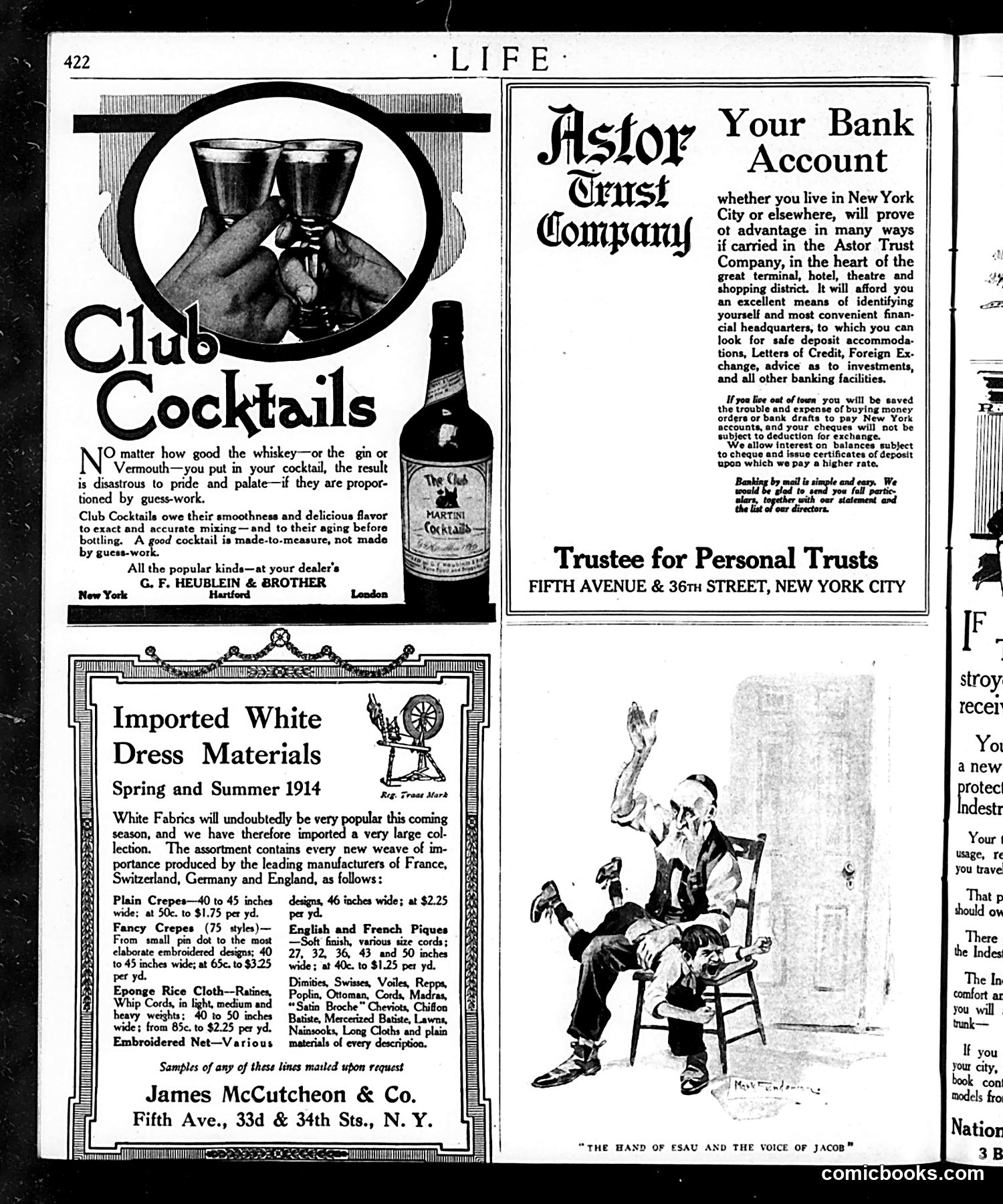
This page is primarily **advertising** from circa 1914, with minimal satirical content. The main advertisements promote: 1. **Club Cocktails** (Heublein & Brother) — emphasizes precision mixing ("made-to-measure, not made by guess-work"), appealing to sophistication over improvisation. 2. **White Dress Materials** (James McCutcheon & Co.) — catalogs imported fabrics from France, Switzerland, Germany, and England for spring/summer 1914, targeting wealthy female consumers. 3. **Astor Trust Company** — banking services positioned as convenient for out-of-town clients. The only apparent satirical element is the illustration captioned **"The Hand of Esau and the Voice of Jacob"** (bottom right), showing a figure at a desk. This biblical reference suggests deception or hidden identity — perhaps mocking someone's true nature versus public persona — but the specific target is **unclear** without additional context. The page reflects pre-WWI American consumer culture and advertising aesthetics rather than sharp political commentary.
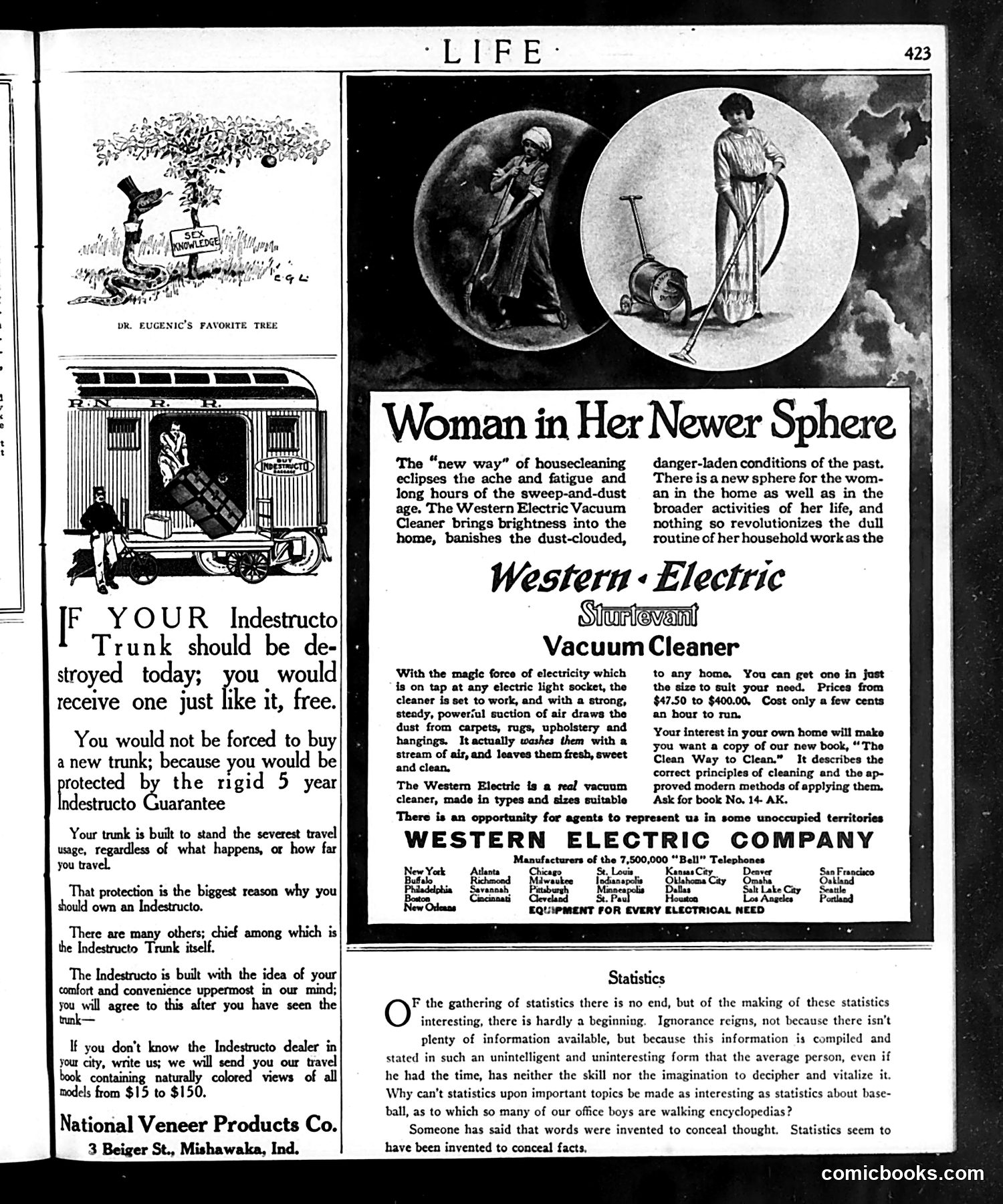
This page contains early 20th-century advertisements and a brief editorial comment rather than satirical cartoons. **Top Left:** A small cartoon titled "Dr. Eugenics's Favorite Tree" shows a tree labeled "See" with what appears to be figures beneath it—likely satirizing the eugenics movement, which was gaining popularity in this era. **Main Content:** Two substantial advertisements dominate the page: 1. **Indestructo Trunk** (left): Promotes luggage with a 5-year guarantee, targeting traveling businessmen. 2. **Western Electric Vacuum Cleaner** (right): The key phrase is "Woman in Her Newer Sphere." This advertisement reflects Progressive Era attitudes, suggesting that electric appliances liberate women from exhausting housework, allowing them broader life activities. The imagery shows women with the device, framing technological convenience as expanding women's roles. **Bottom:** A brief editorial on statistics criticizes how dry statistical presentation obscures facts from the average reader—a commentary on public discourse and information accessibility. The page reflects early 1900s consumer culture and emerging ideas about modernization, efficiency, and women's changing domestic roles.
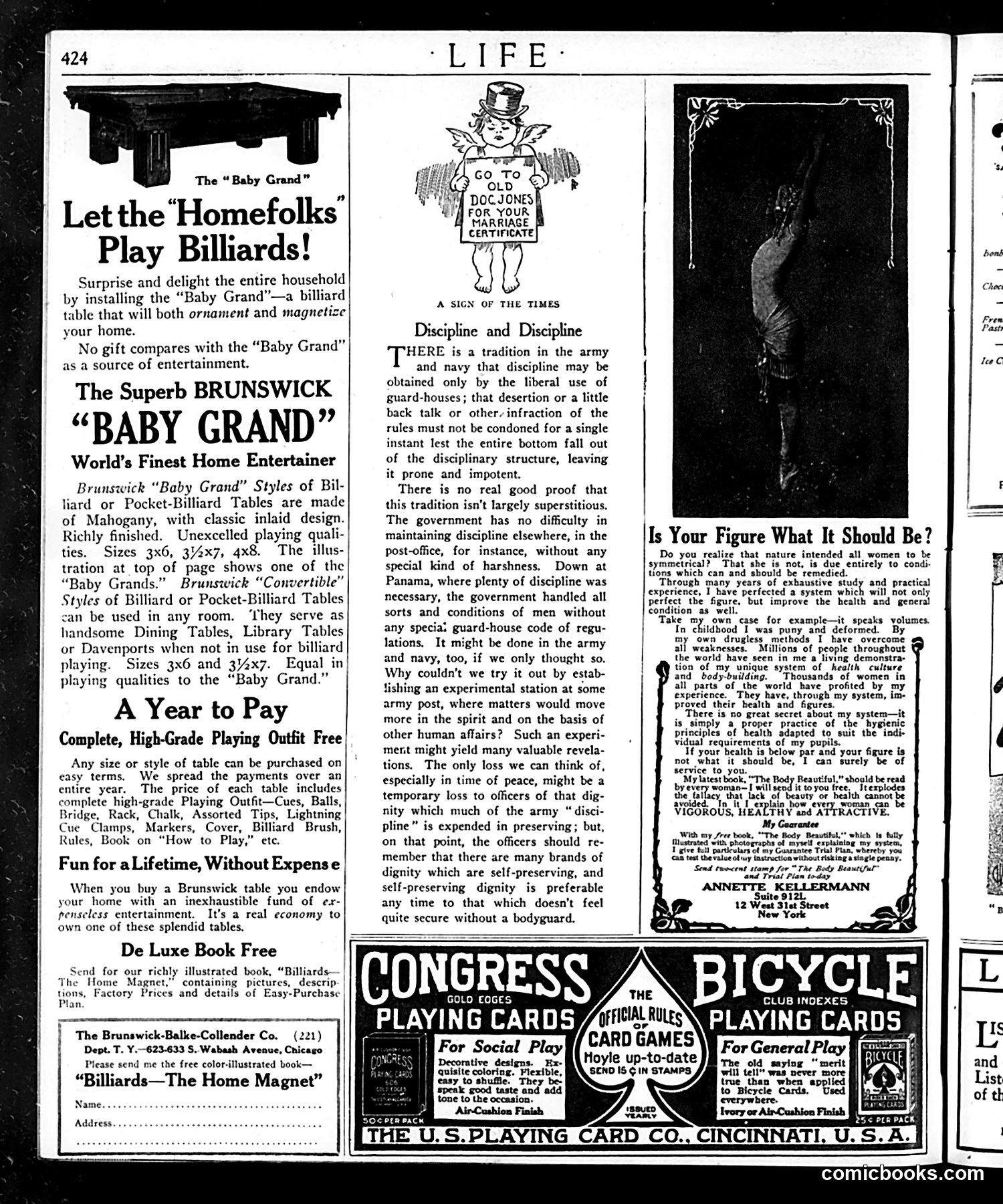
This page contains primarily **advertisements** rather than political satire. The main content advertises the Brunswick "Baby Grand" billiard table as home entertainment for families. The central cartoon—labeled "A Sign of the Times"—depicts a cherub holding a sign directing people to "Old Doc Jones for your birth certificate," satirizing concerns about **proving citizenship or legitimacy**. This likely references early 20th-century anxieties about immigration documentation or vital records. The lengthy article "Discipline and Discipline" argues for reforming harsh military disciplinary practices (guard-houses, severe punishment), suggesting experimental stations test gentler methods. This reflects **Progressive Era criticism** of rigid military hierarchy, proposing that civilian institutions (post-offices) manage discipline effectively without severity. The remaining content includes diet/fitness advertisements and playing card ads. The page is typical early-20th-century magazine advertising mixed with social commentary on military reform and bureaucratic documentation.
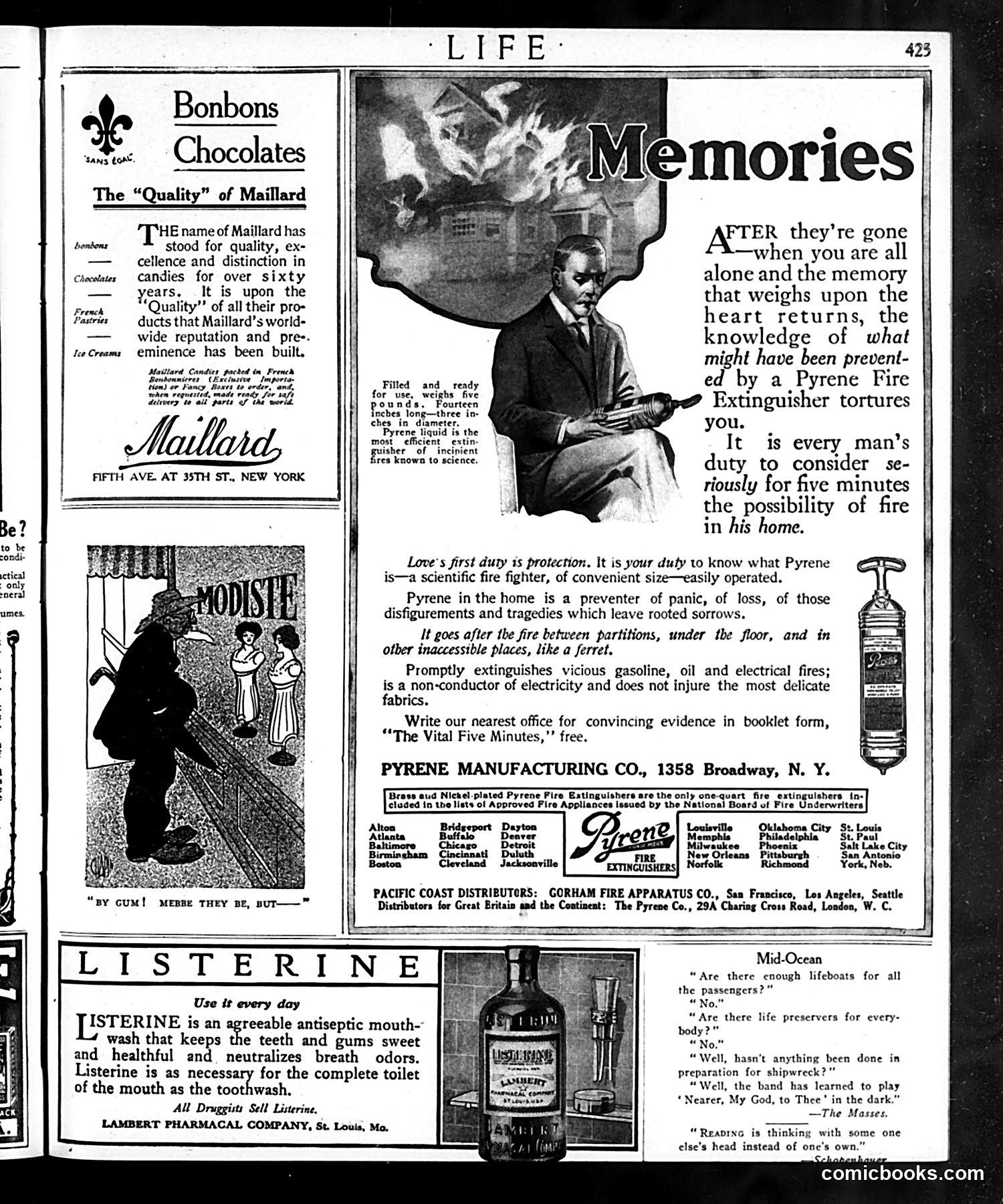
This page consists primarily of **advertisements**, not political satire. The main content includes: **Maillard Chocolates ad** (top left): A straightforward luxury candy advertisement emphasizing 60 years of quality. **Pyrene Fire Extinguisher ad** (center/right): The largest ad, featuring a photograph of a man holding a fire extinguisher. It appeals to domestic safety consciousness with the tagline "Love's first duty is protection," urging homeowners to consider fire risk. This reflects early-20th-century consumer anxiety about household fires. **Listerine mouthwash ad** (bottom left): Standard hygiene advertising. **"Mid-Ocean" humor section** (bottom right): Brief satirical exchanges about the Titanic disaster, with dark jokes about insufficient lifeboats and the band's final song. This references the 1912 sinking. The page shows how magazines blended commercial advertising with light humor and social commentary typical of the era.
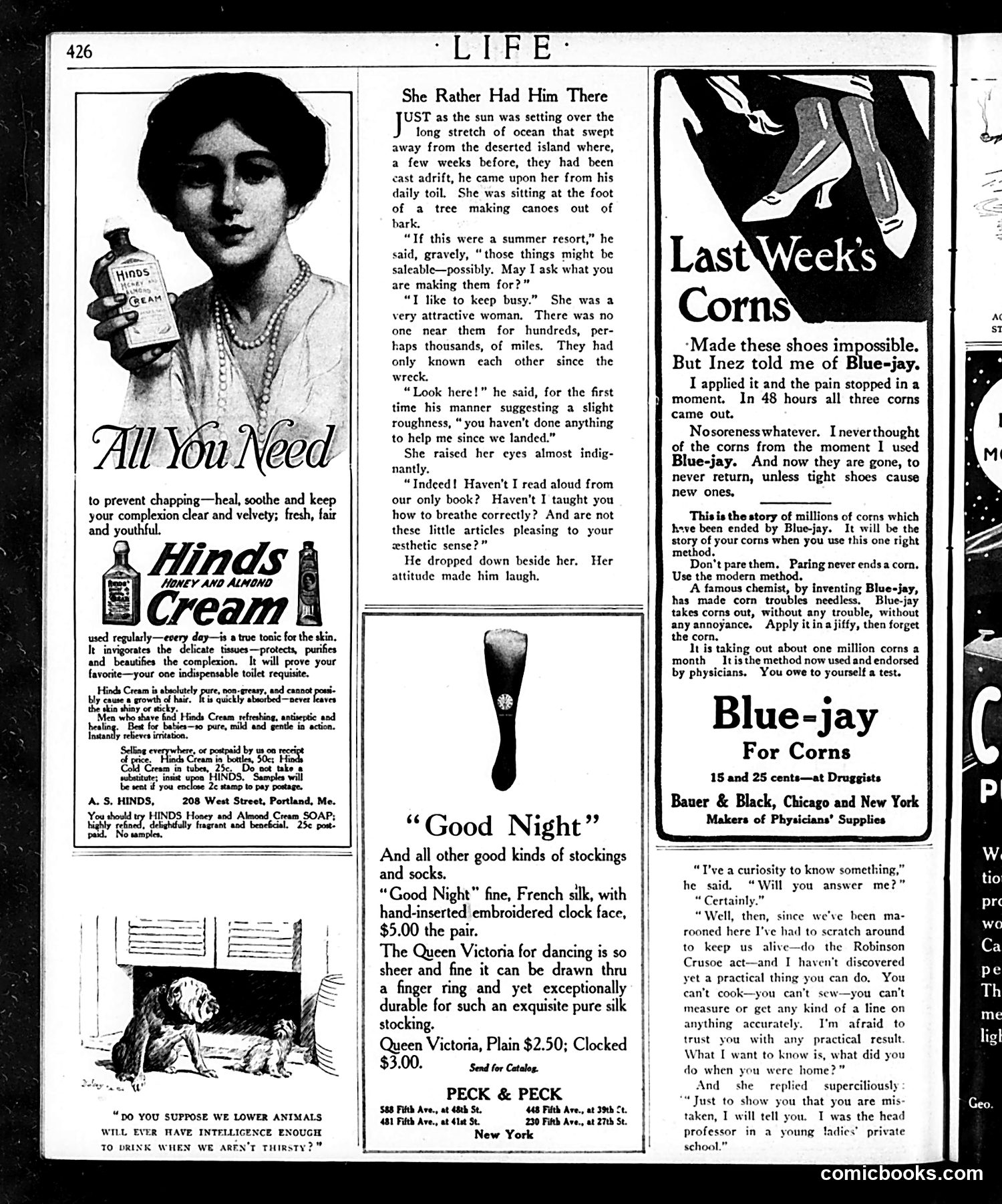
This page contains primarily **advertisements** interspersed with a short humorous story. The main narrative, "She Rather Had Him There," depicts a romantic survival scenario: a man and woman marooned on an island. The man complains that his female companion is useless—she can't cook, sew, or perform practical tasks. She deflects by pointing out she has provided intellectual and cultural value (reading aloud, teaching breathing exercises, creating aesthetically pleasing bark canoes). The humor relies on **gender role commentary**: her witty comeback that non-practical, cultured contributions have value challenges his dismissal of "women's work" as the only measure of usefulness. The advertisements—Hinds Cream (skincare), Peck & Peck stockings, and Blue-jay corn remover—represent typical 1920s consumer products marketed to women. The bottom cartoon features a dog asking a philosophical question about animal intelligence and thirst, unrelated to surrounding content.
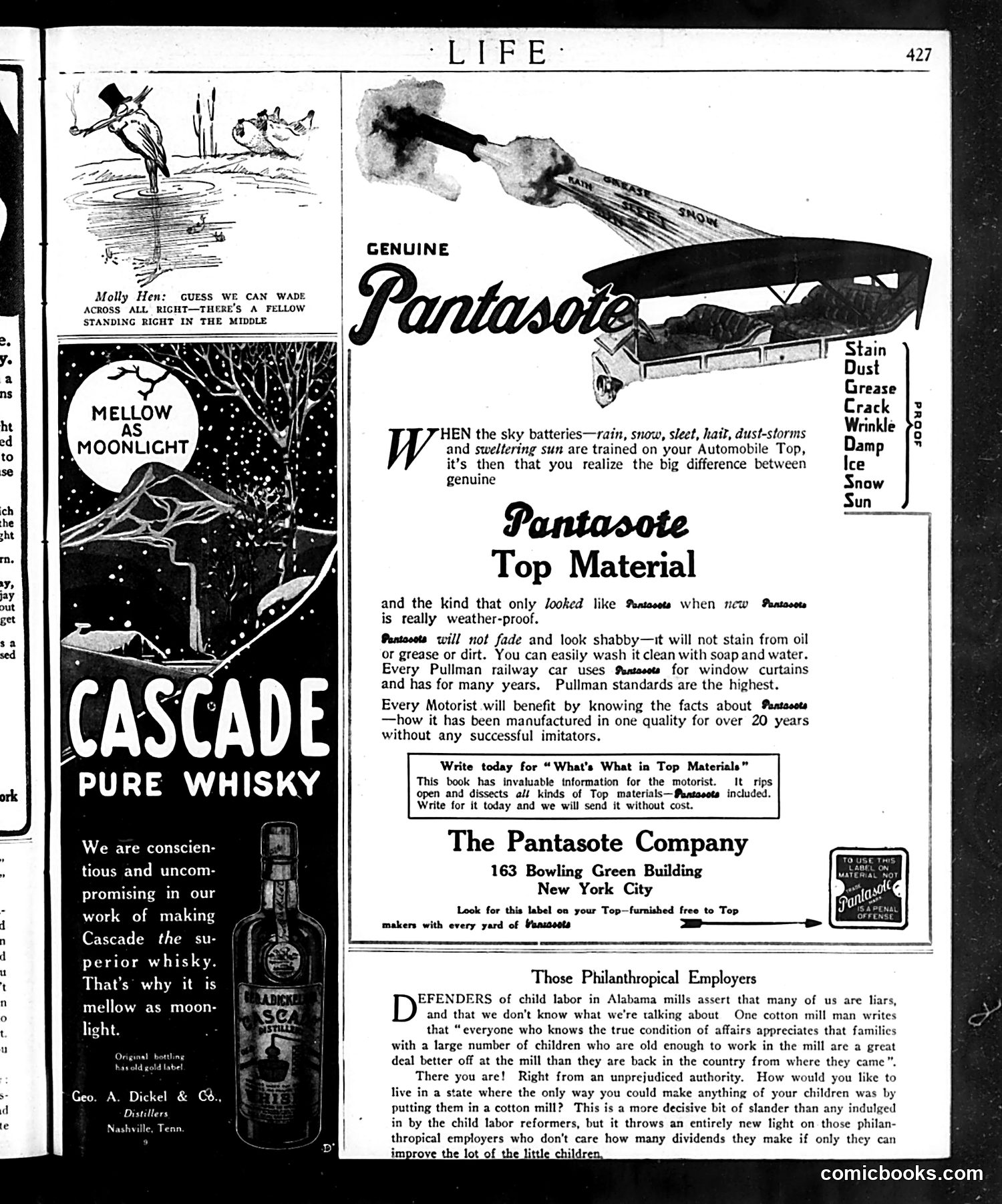
This page combines advertisements with social commentary. The **top section features ads** for Pantasote automobile top material and Cascade whisky, using humor (a duck cartoon about wading) to sell products. The significant content is the **bottom article, "Those Philanthropical Employers,"** which satirizes Alabama cotton mill owners' defense of child labor. The piece attacks mill operators who justify employing children by claiming rural families benefit from the work. Life's editors counter that this argument is actually insulting—suggesting the only way parents can improve their children's lives is by putting them in mills reveals how dire conditions truly are. The sarcastic tone ("Right from an unprejudiced authority") undermines the mill owners' claims as self-serving propaganda. This reflects Progressive Era activism against child labor exploitation, positioning Life as advocating for child welfare reform against industrial interests defending harmful labor practices.
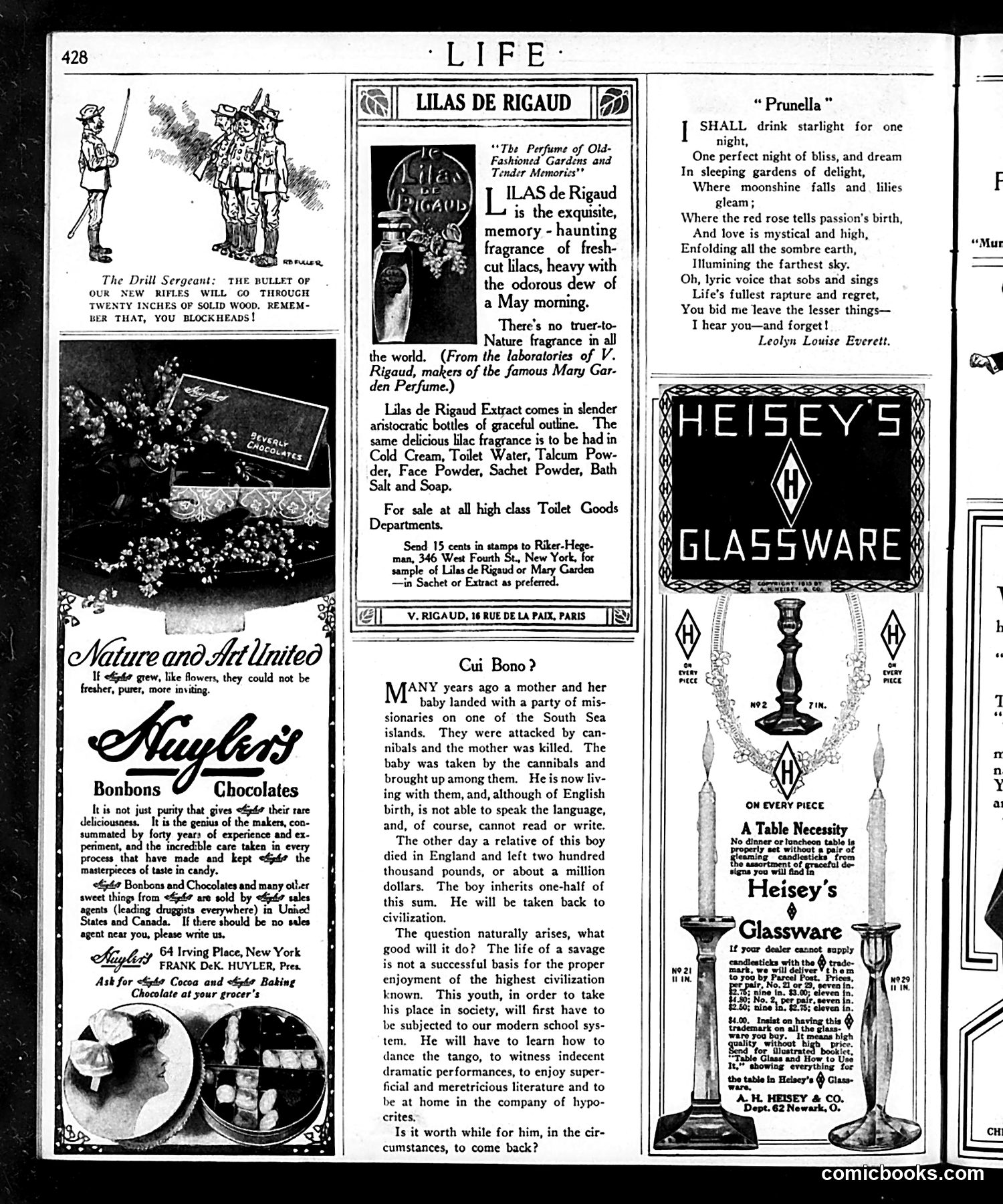
The page's main cartoon—"The Drill Sergeant"—depicts a military instructor boasting about new rifle ammunition's penetrating power through twenty inches of solid wood while addressing soldiers he dismissively calls "blockheads." This satirizes military culture: the sergeant's pride in destructive capability contrasts absurdly with his contempt for the men he commands, suggesting the dehumanizing nature of military hierarchy and the gap between officer confidence and enlisted personnel intelligence. The accompanying article "Cui Bono?" (Latin: "Who benefits?") extends this critique through a parable: an English boy raised by South Sea cannibals inherits wealth but must endure "civilization"—forced to learn the tango, watch indecent plays, and associate with hypocrites. The satire mocks modern society itself, implying that "civilization" offers no genuine improvement over primitive life and may actually be morally inferior, a critique of early 20th-century Western pretensions to superiority.
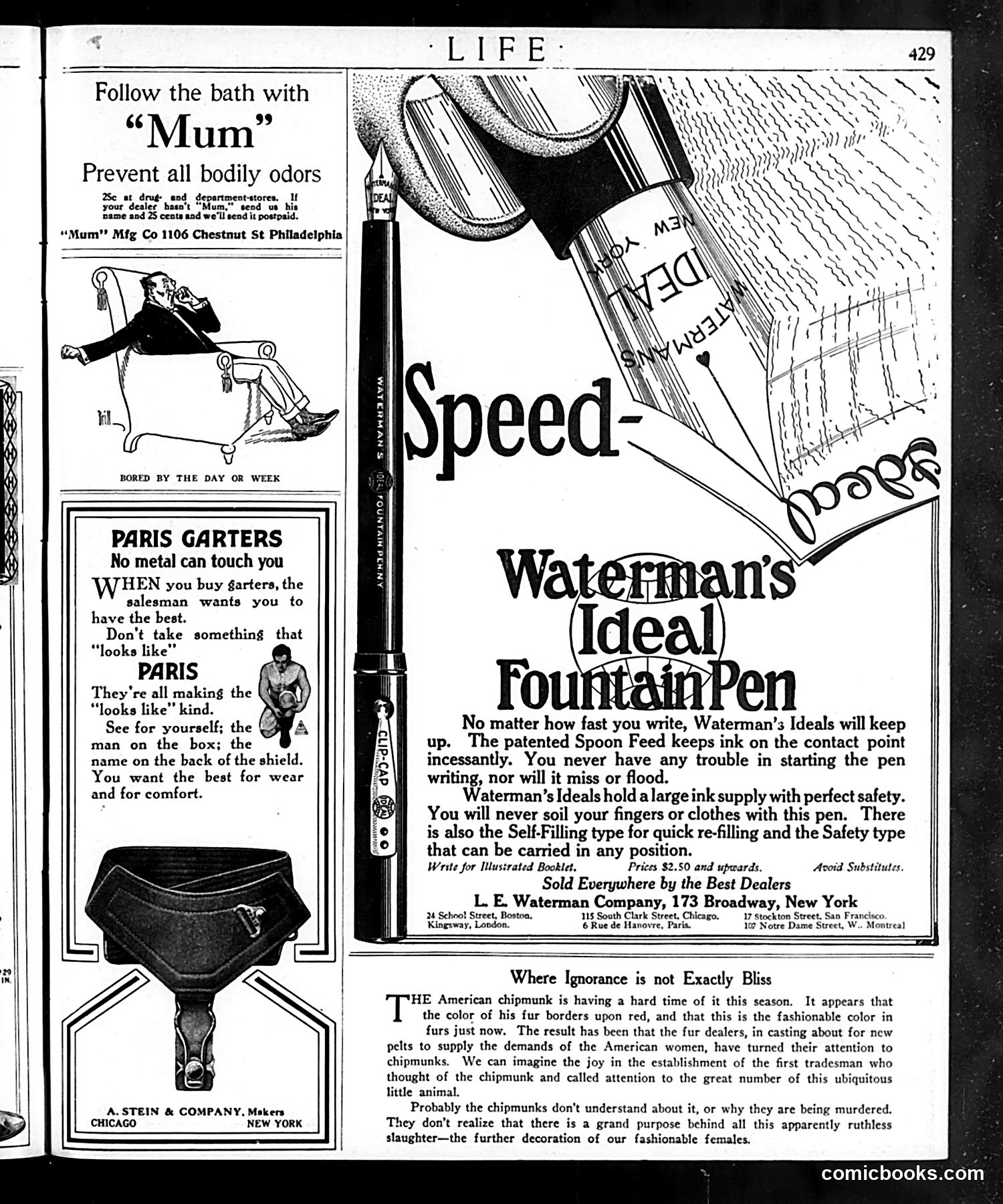
This page is primarily **advertisements** for consumer products, with one satirical article at the bottom. The ads include: "Mum" deodorant, Paris Garters, and Waterman's Ideal Fountain Pen—typical early 20th-century products emphasizing quality and brand distinction. The only satirical content is the final article, **"Where Ignorance is not Exactly Bliss,"** which mocks the fur fashion industry. It observes that American women's demand for red-tinted fur has created a market for chipmunk pelts. The piece uses sardonic humor to critique both the commercial exploitation and the casual cruelty involved: chipmunks are being killed en masse so fashionable women can wear their fur, yet the animals "don't understand" or consent to this "apparently ruthless slaughter." The satire targets **consumerism and vanity**—specifically how women's fashion preferences drive industries indifferent to animal suffering, treated as mere decoration rather than living creatures.
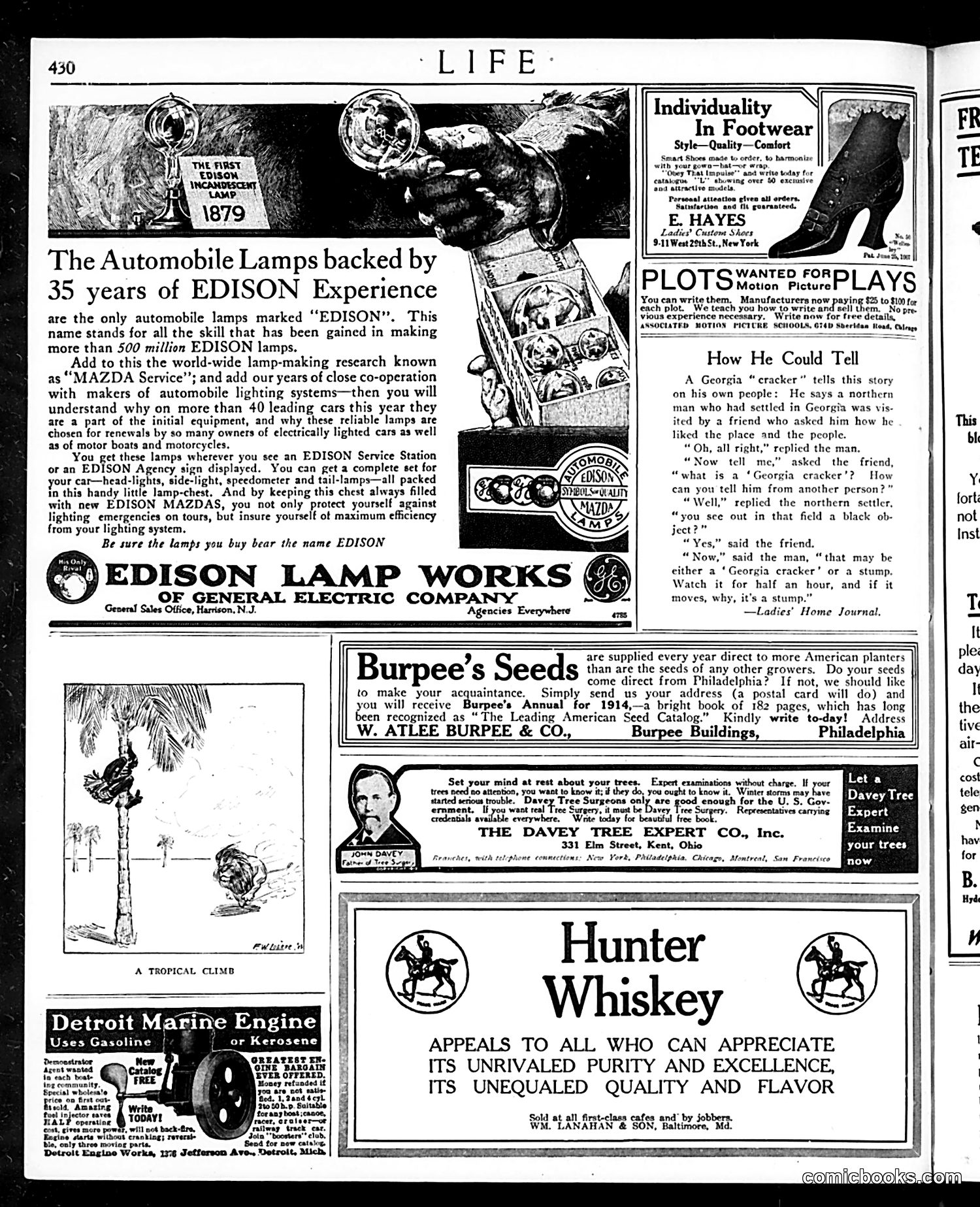
This page is primarily **advertising**, typical of early 1900s magazines. The main content includes: **Edison Lamp Works advertisement**: Promotes automobile lamps backed by Edison's 35 years of experience, emphasizing reliability for car lighting systems. References "MAZDA Service," indicating partnership with that lighting technology. **"How He Could Tell" anecdote**: A regional humor piece from *Ladies' Home Journal* mocking Georgia rural people ("crackers"). The joke relies on a stereotype of laziness or stupidity—a northern settler jokes that you can distinguish a Georgia cracker from a tree stump by waiting to see if it moves. This reflects early 20th-century regional prejudice common in national magazines. **Other advertisements**: Burpee's Seeds, Davey Tree Expert Co., Detroit Marine Engine, Hunter Whiskey, and footwear/film script services fill remaining space. The page reflects 1914-era consumer culture and regional stereotyping acceptable for mainstream publication at the time.
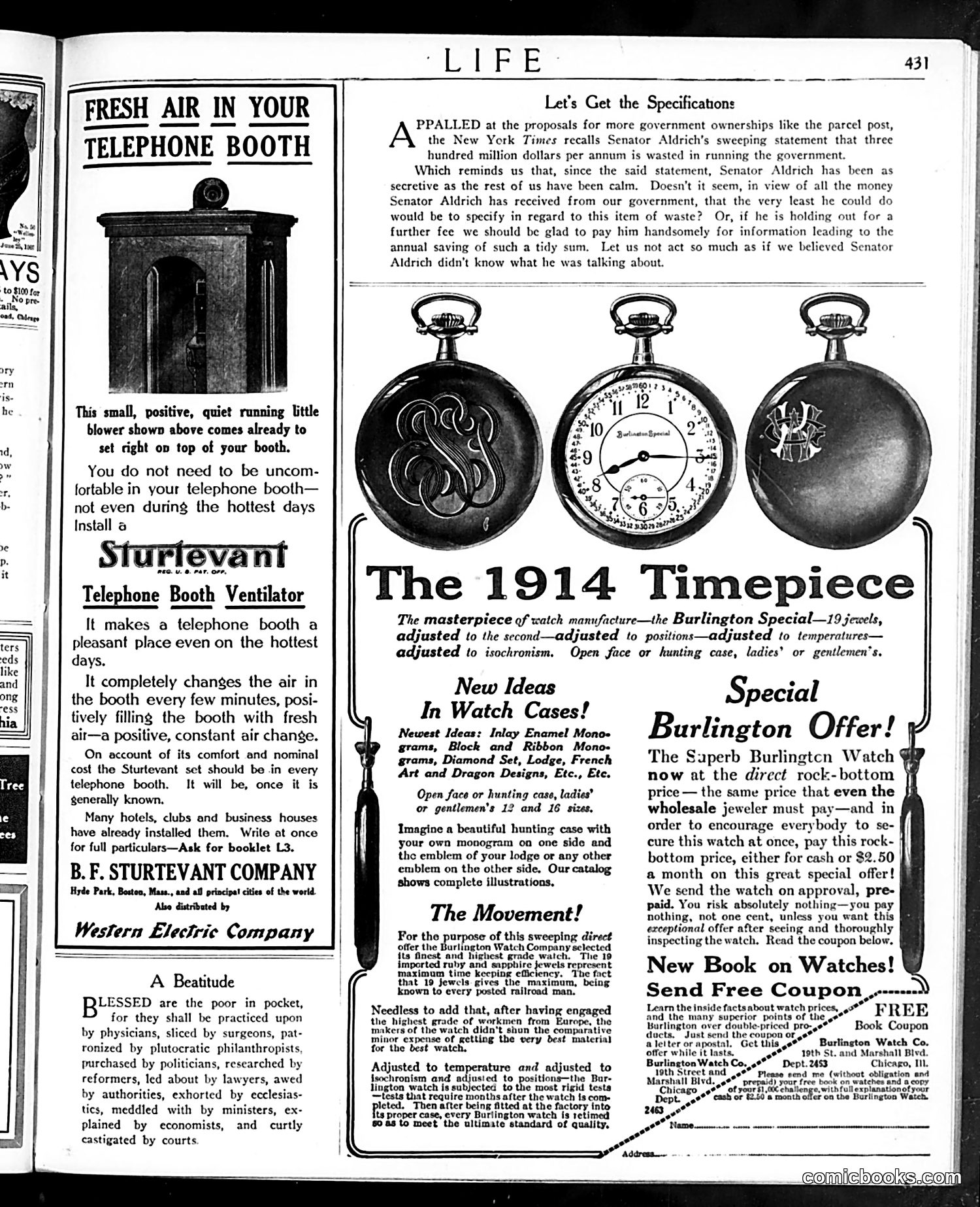
The page's main satirical piece critiques **Senator Nelson Aldrich**, a prominent Republican and financial industry ally. The New York *Times* had quoted Aldrich claiming the government wastes $300 million annually. Life's editorial sarcastically challenges him to specify what waste he means—suggesting either Aldrich doesn't actually know what he's talking about, or he's demanding payment for information (playing on his reputation for receiving government favors). The piece is politically pointed: Aldrich was associated with big business interests and accused of profiting from government relationships. By demanding he "specify in regard to this item of waste," Life mocks his vague accusations while implying his credibility is suspect. The remainder of the page consists of period advertisements (telephone booth ventilators, Burlington watches, philanthropic commentary). The "Beatitude" poem sardonically lists how the poor are exploited by various institutions—physicians, lawyers, politicians, clergy—a subtle critique of institutional power.
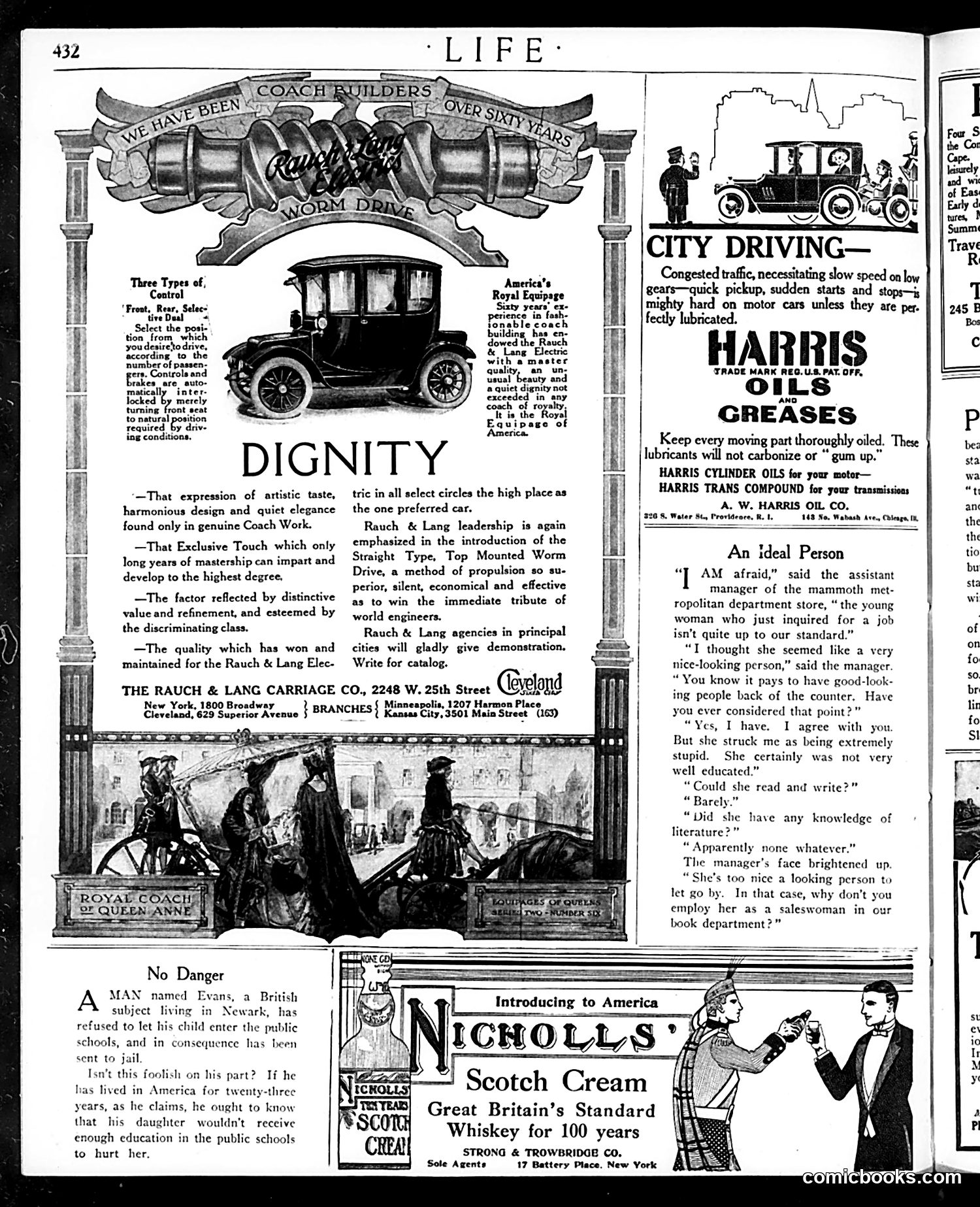
This page mixes automobile and product advertising with satirical commentary. **The Main Satire ("An Ideal Person" and "No Danger"):** Two brief satirical pieces mock class prejudice and educational snobbery. In "An Ideal Person," a store manager refuses to hire a qualified young woman because she's too intelligent and educated—but then eagerly rehires her as a saleswoman, implying beautiful but unintelligent women are only fit for customer-facing roles. "No Danger" sarcastically defends a British father jailed for refusing public school, sneering that American public schools are so poor they couldn't possibly educate his daughter anyway—a backhanded critique of American education quality. **The Advertisements:** The Rauch & Lang electric carriage emphasizes "dignity," "artistic taste," and "refinement"—appealing to wealthy, status-conscious buyers. Harris Oils and Nicholls Scotch Cream whiskey round out luxury product pitches. The satire contrasts sharply with the refined advertising, highlighting early-20th-century tensions between class aspiration and actual social mobility.
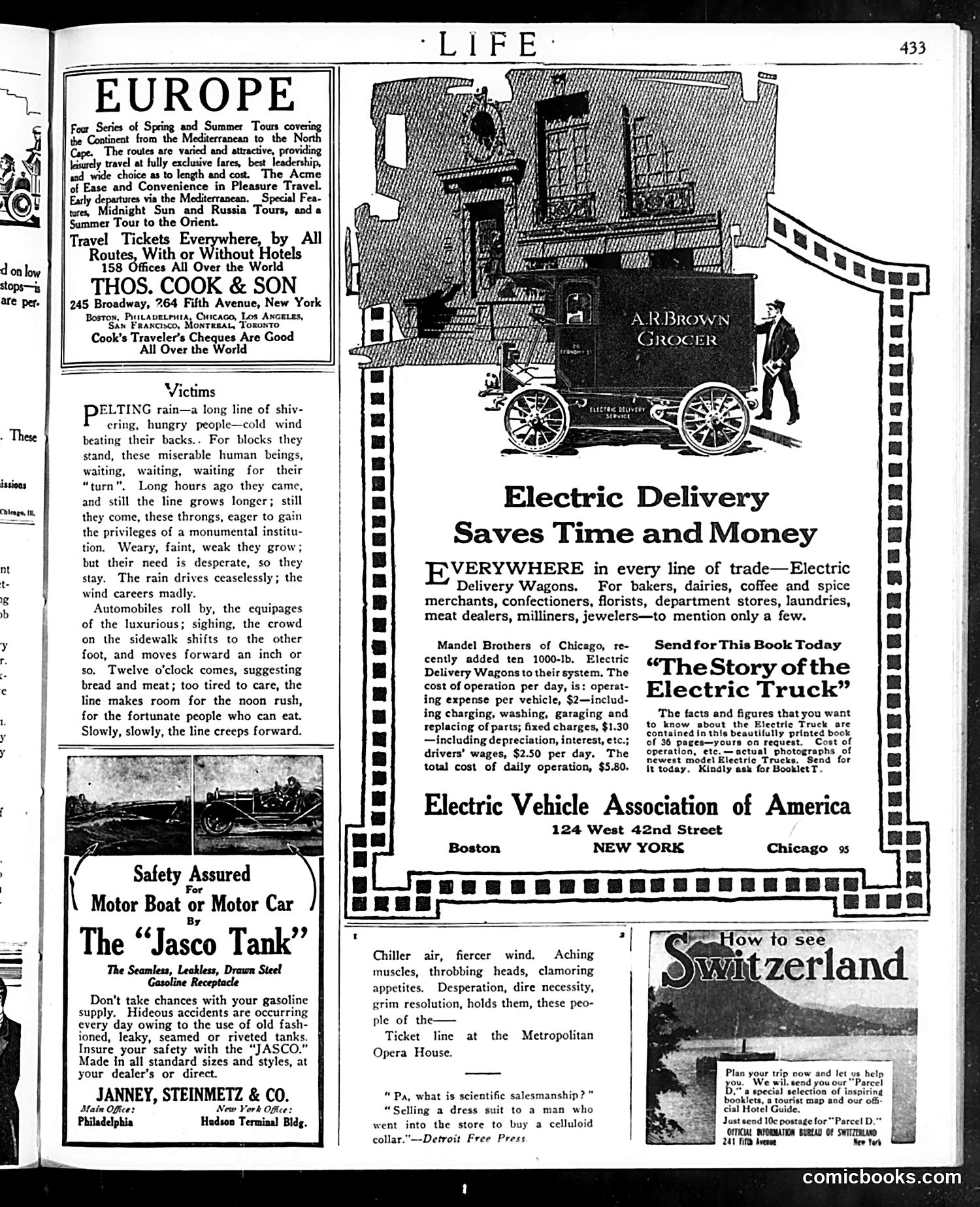
This page is primarily **advertising**, not political satire. The main content presents commercial advertisements for travel services, electric delivery vehicles, and industrial products typical of early 20th-century American business. The one narrative element—titled "Victims"—is a **social commentary piece**, not a cartoon. It describes the desperate conditions of people waiting in long lines at the Metropolitan Opera House, contrasting their cold, hungry suffering with wealthy people passing by in automobiles. The piece critiques economic inequality: the poor wait hours for opera tickets while the rich enjoy luxuries. The satire is subtle and sympathetic rather than mocking. It highlights class disparity during an era of rapid industrialization, when electric vehicles represented modern wealth and convenience for businesses, while ordinary citizens endured hardship. The small joke at bottom ("scientific salesmanship") offers light relief but doesn't relate to the main content.
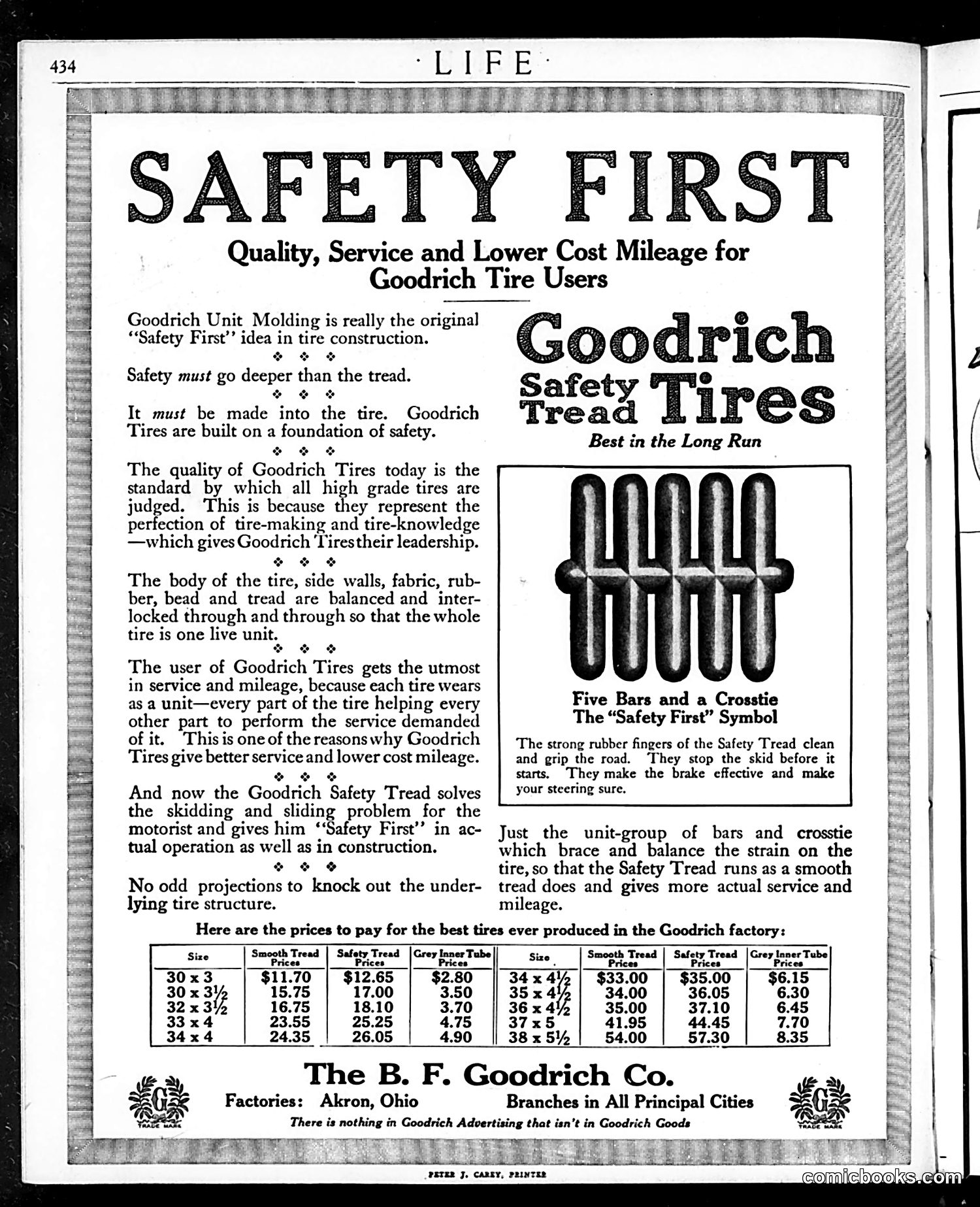
This is a full-page **advertisement**, not satire or political commentary. It promotes Goodrich Safety Tread tires using the popular "Safety First" slogan of the early 20th century. The ad emphasizes tire safety through integrated construction—all components ("body," "side walls," "fabric," "bead," "tread") work as one unit. The distinctive "Five Bars and a Crosstie" tread pattern is presented as the branded innovation that prevents skidding and improves braking. A pricing table lists various tire sizes and costs, positioning Goodrich as offering quality at competitive rates. The "Safety First" messaging reflects broader Progressive Era public health campaigns emphasizing accident prevention, particularly relevant as automobile adoption increased. The language appeals to motorists' practical concerns: durability, performance, and cost savings through longevity. This represents standard early automotive advertising positioning a manufacturer's technical features as consumer benefits.
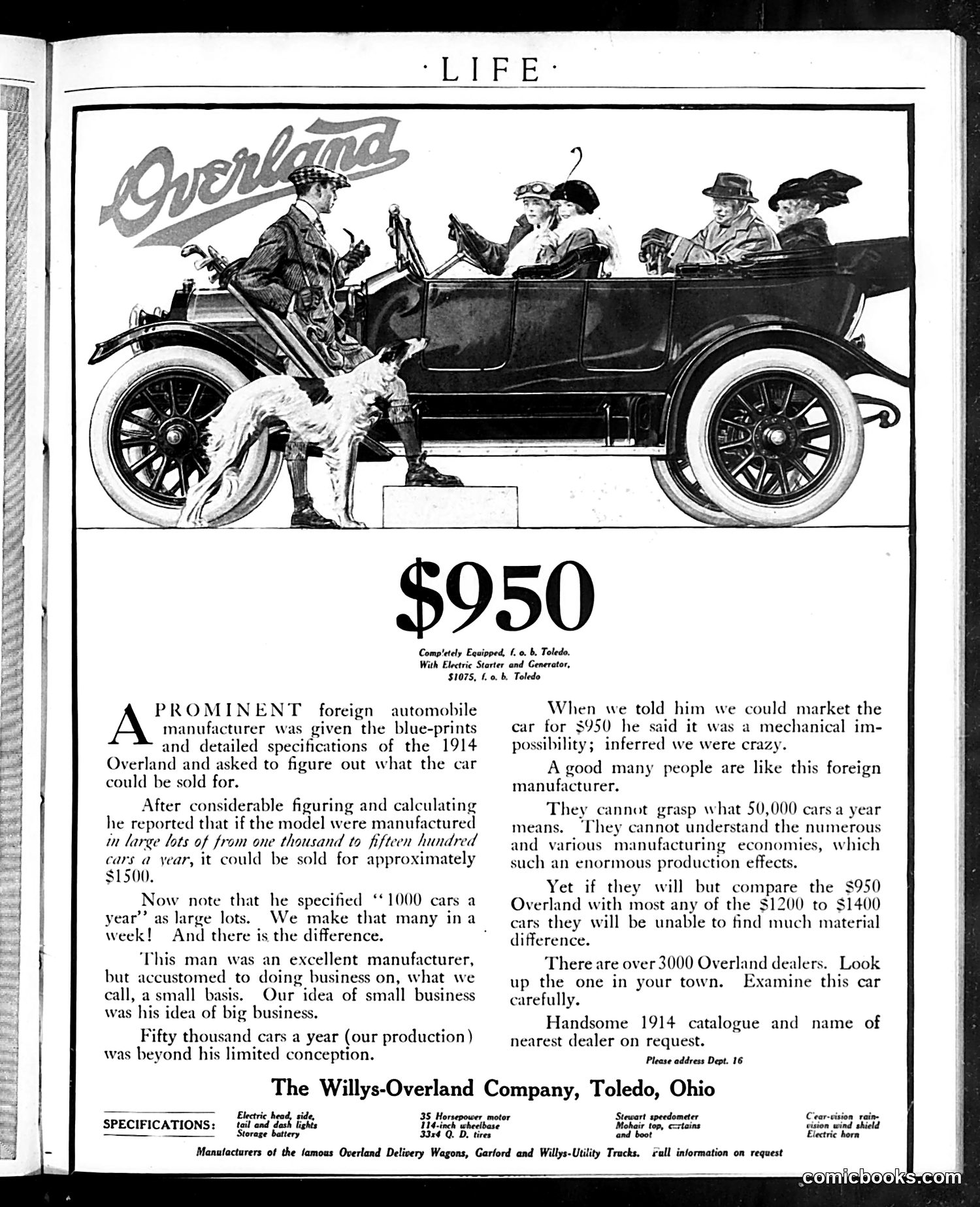
This is primarily an **advertisement**, not satire, though it employs a satirical narrative frame. The "cartoon" is an illustration of a well-dressed couple in a 1914 automobile. The ad's central argument: A foreign manufacturer, given the Overland's specs, calculated it could only sell for ~$1500 if produced in small batches (1,000-1,500 cars/year). Willys-Overland counters that they produce **50,000 cars annually**, enabling economies of scale that allow a $950 price point—impossible under conventional manufacturing wisdom. The satire targets those who cannot imagine mass production's transformative power. The foreign manufacturer represents "small business" thinking; Overland represents American manufacturing innovation and scale. **For modern readers**: This reflects early-20th-century American pride in mass production as a competitive advantage—the ideology Henry Ford epitomized. The ad suggests American manufacturers understood efficiency foreign competitors grasped only theoretically. The $950 price undercuts luxury cars costing $1200-1400, positioning affordability as revolutionary.
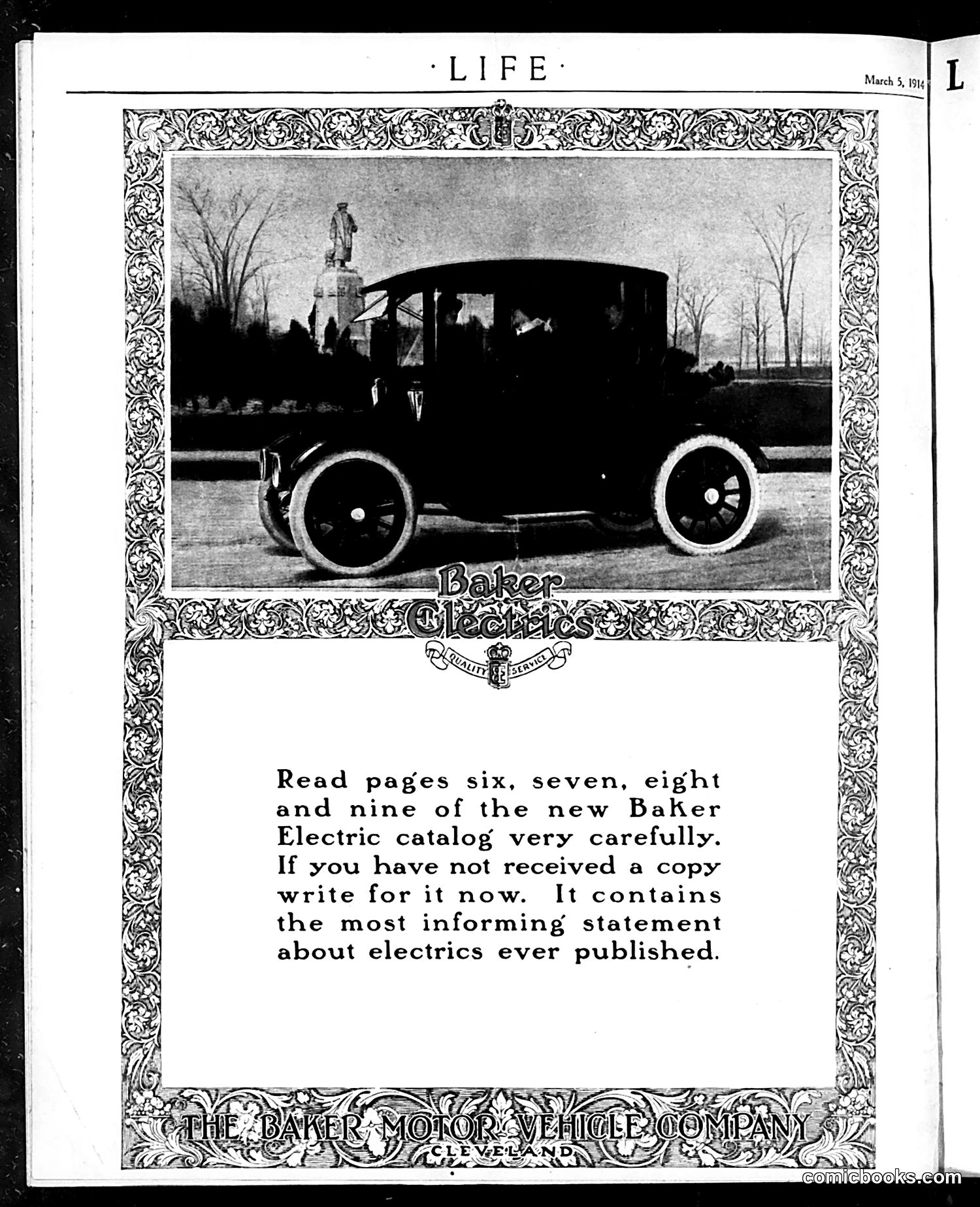
This is a full-page advertisement for Baker Electric automobiles, not political satire. The image shows a sleek electric car from approximately 1916, parked in front of what appears to be a public monument or statue. The text urges readers to consult the detailed Baker Electric catalog (pages 6-9) for information about electric vehicles. The ad reflects early automotive history when electric cars competed seriously with gasoline vehicles. The formal ornamental border and placement in *Life* magazine indicates this was premium advertising targeting affluent readers. Baker Motor Vehicle Company, based in Cleveland, was a legitimate manufacturer of electric automobiles during this era.