
Life, 1914-03-05 · page 18 of 60
Life — March 5, 1914 — page 18: what you’re looking at
What you’re looking at
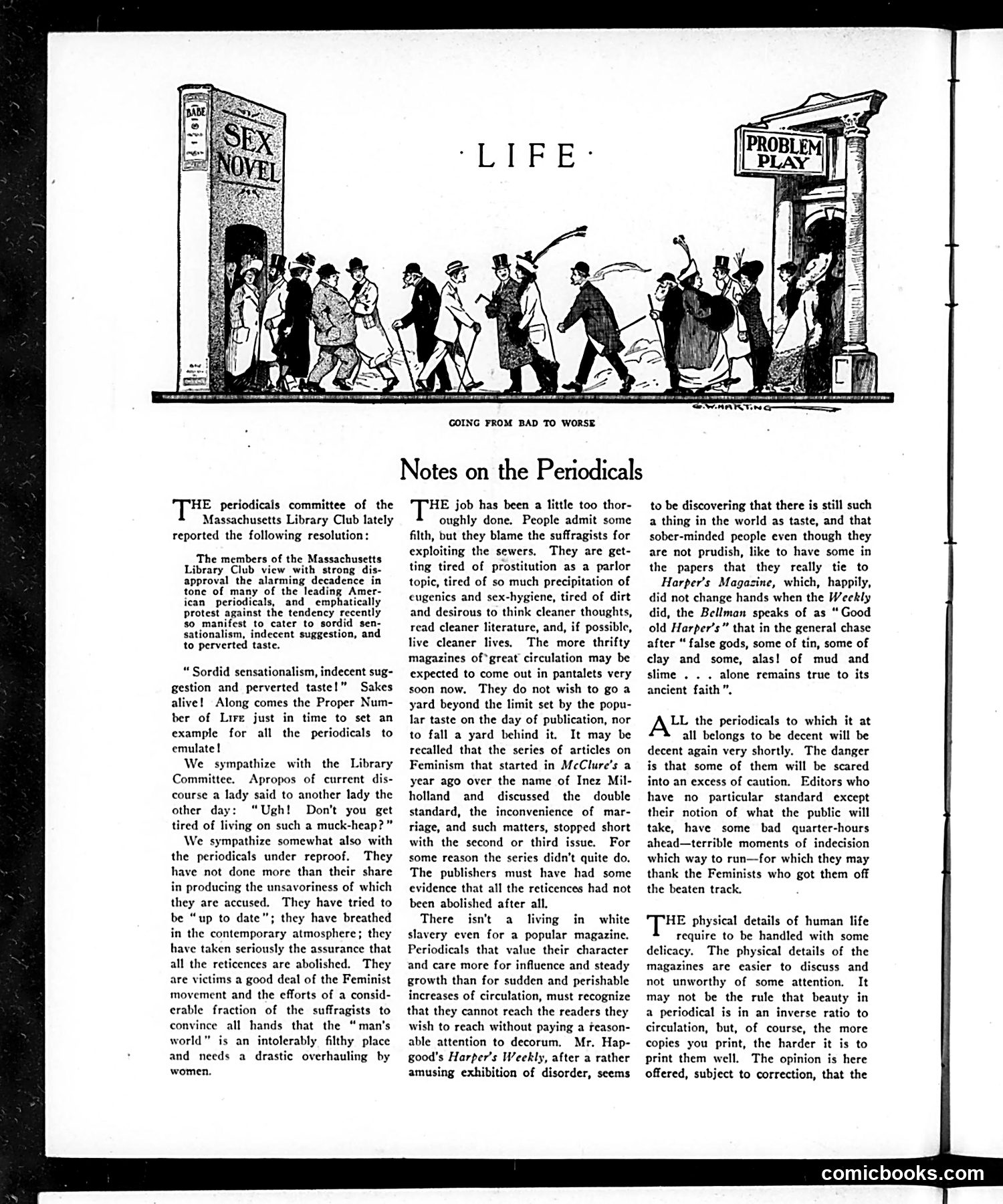
This satirical piece mocks the Massachusetts Library Club's resolution condemning American magazines for "sordid sensationalism" and "indecent suggestion." The cartoon shows figures progressing from a "Sex Novel" entrance toward a "Problem Play" exit—visual metaphor for society moving from one questionable entertainment to another. The author argues that magazines have overcorrected in response to feminist and suffragist pressure to expose social "filth" (prostitution, sexual double standards, eugenic debates). While sympathizing with both the Library Club and the periodicals themselves, the piece claims magazines are now exhausted by the trend and retreating toward propriety. The satire targets how quickly popular publications chase moral fashions: they sensationalize feminist critiques until readers tire of it, then retreat. The reference to *McClure's* stopping its feminism series suggests publishers abandon controversial content when circulation suffers—revealing their true priority is profit over principle.
📄 Transcribed text from this page (OCR, searchable)
Machine-transcribed from the original scan — historical spelling and the odd misread are preserved.
'HE periodicals committee of the Massachusetts Library Club lately reported the following resolution: The members of the Massachusetts Library Club view with strong dis- approval the alarming decadence in tone of many of the leading Amer- ican periodicals, and emphatically Protest against the tendency recently so manifest to cater to sordid sen- sationalism, indecent suggestion, and to perverted taste. “Sordid sensationalism, indecent sug- gestion and perverted taste!” Sakes alive! Along comes the Proper Num- ber of Lire just in time to set an example for all the periodicals to emulate! We sympathize with the Library Committee. Apropos of current dis- course a lady said to another lady the Ugh! Don't you get ing on such a muck-heap?” We sympathize somewhat also with the periodicals under reproof. They have not done more than their share in producing the unsavoriness of which they are accused. They have tried to be “up to date”; they have breathed in the contemporary atmosphere; they have taken seriously the assurance that all the reticences are abolished. They are victims a good deal of the Feminist movement and the efforts of a consid- erable fraction of the suffragists to convince all hands that the “man's world” is an intolerably filthy place and needs a drastic overhauling by women. GOING FROM BAD TO WORSE Notes on the Periodicals 'HE job has been a little too thor- oughly done. People admit some filth, but they blame the suffragists for exploiting the sewers, They are get- ting tired of prostitution as a parlor topic, tired of so much precipitation of eugenics and sex-hygiene, tired of dirt and desirous to think cleaner thoughts, read cleaner literature, and, if possible, live cleaner lives. The more thrifty magazines of*great circulation may be expected to come out in pantalets very soon now. They do not wish to goa yard beyond the limit set by the popu- lar taste on the day of publication, nor to fall a yard behind it. It may be recalled that the series of articles on Feminism that started in McClure’s a year ago over the name of Inez Mil- holland and discussed the double standard, the inconvenience of mar- riage, and such matters, stopped short. with the second or third issue. For some reason the series didn’t quite do. The publishers must have had some evidence that all the reticences had not been abolished after all. There isn't a living in white slavery even for a popular magazine. Periodicals that value their character and care more for influence and steady growth than for sudden and perishable increases of circulation, must recognize that they cannot reach the readers they wish to reach without paying a reason- able attention to decorum. Mr. Hap- good’s Harper's Weekly, after a rather amusing exhibition of disorder, seems to be discovering that there is still such a thing in the world as taste, and that sober-minded people even though they are not prudish, like to have some in the papers that they really tie to Harper's Magazine, which, happily, did not change hands when the Weekly did, the Bellman speaks of as “Good old Harper's” that in the general chase after “ false gods, some of tin, some of clay and some, alas! of mud and slime . . . alone remains true to its ancient faith”, LL the periodicals to which it at all belongs to be decent will be decent again very shortly. The danger is that some of them will be scared into an excess of caution. Editors who have no particular standard except their notion of what the public will take, have some bad quarter-hours ahead—terrible moments of indecision which way to run—for which they may thank the Feminists who got them off the beaten track. 'HE physical details of human life require to be handled with some delicacy. The physical details of the magazines are easier to discuss and not unworthy of some attention. It may not be the rule that beauty in a periodical is in an inverse ratio to circulation, but, of course, the more copies you print, the harder it is to print them well. The opinion is here offered, subject to correction, that the comicbooks.com