
Life, 1914-03-05 · page 34 of 60
Life — March 5, 1914 — page 34: what you’re looking at
What you’re looking at
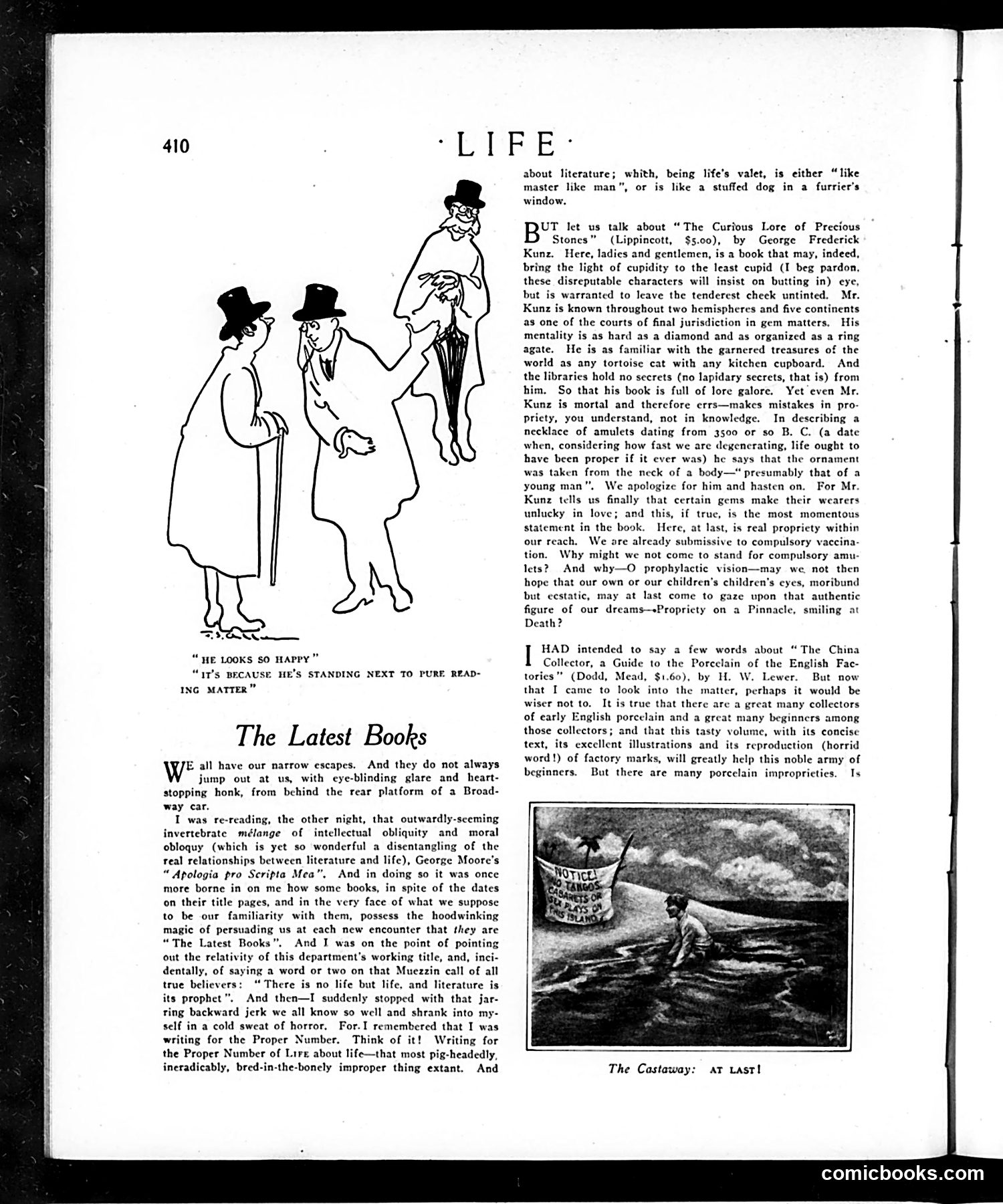
This page features a satirical book review column titled "The Latest Books." The cartoon (top left) depicts three well-dressed men in top hats, with the caption: "He looks so happy / It's because he's standing next to pure reading matter." **The satire:** The joke mocks intellectual pretension—the implication being that proximity to "pure reading matter" (fine literature) is more satisfying than actual human companionship. It's a critique of bibliophiles who prize books over life itself. **The reviews** discuss two volumes: George Frederick Kunz's "The Curious Lore of Precious Stones" and H.W. Lewer's "The China Collector." The author humorously chides these works for minor "improprieties" while acknowledging their scholarly value—a gentle mockery of both overly serious collectors and the tension between life's messiness and literature's pretense to order and propriety. The underlying theme: literature claims authority over life, yet constantly fails to capture it perfectly.
📄 Transcribed text from this page (OCR, searchable)
Machine-transcribed from the original scan — historical spelling and the odd misread are preserved.
"EEE about literature; whith, being life’s valet, is either “like master like man”, or is like a stuffed dog in a furrier’s window. UT let us talk about “The Curious Lore of Precious Stones” (Lippincott, $5.00), by George Frederick Kunz. Here, ladies and gentlemen, is a book that may, indeed, bring the light of cupidity to the least cupid (I beg pardon, these disreputable characters will insist on butting in) eye, but is warranted to leave the tenderest check untinted. Mr. Kunz is known throughout two hemispheres and five continents as one of the courts of final jurisdiction in gem matters, His mentality is as hard as a diamond and as organized as a ring agate. He is as familiar with the garnered treasures of the world as any tortoise cat with any kitchen cupboard. And the libraries hold no secrets (no lapidary secrets, that is) from him. So that his book is full of lore galore. Yet even Mr. Kunz is mortal and therefore errs—makes mistakes in pro- pricty, you understand, not in knowledge. In describing a necklace of amulets dating from 3500 or so B. C. (a date when, considering how fast we are degenerating, life ought to have been proper if it ever was) he says that the ornament was taken from the neck of a body— presumably that of a young man We apologize for him and hasten on. For Mr. Kunz tells us finally that certain gems make their wearers unlucky in love; and this, if true, is the most momentous statement in the book. Here, at last, is real propriety within our reach, We are already submissive to compulsory vaccina- tion. Why might we not come to stand for compulsory amu- lets? And why—O prophylactic vision—may we, not then hope that our own or our children’s children's eyes, moribund but ecstatic, may at last come to gaze upon that authentic figure of our dreams—sPropricty on a Pinnacle, smiling at Death? CK » HAD intended to say a few words about “The China “HE LOOKS SO HAPPY Collector, a Guide to the Porcelain of the English Fac- “11's BECAUSE HE'S STANDING NEXT TO PURE READ- tories" (Dodd, Mead, $1.60), by H. W. Lewer. But now ING MATTER” that I came to look into the matter, perhaps it would be wiser not to. It is true that there are a great many collectors of early English porcelain and a great many beginners among The Latest Books those collectors; and that this tasty volume, with its concise text, its excellent illustrations and its reproduction (horrid word!) of factory marks, will greatly help this noble army of i a s. And they do not always , Be he E all have our narrow escape: y YS beginners. But there are many porcelain improprieties. Is jump out at us, with eye-blinding glare and heart- stopping honk, from behind the rear platform of a Broad- way car. T was re-reading, the other night, that outwardly-sceming invertebrate mélange of intellectual obliquity and moral obloquy (which is yet so wonderful a disentangling of the real relationships between literature and life), George Moore’s “Apologia pro Scripta Mea”. And in doing so it was once more borne in on me how some books, in spite of the dates on their title pages, and in the very face of what we suppose to be our familiarity with them, possess the hoodwinking magic of persuading us at each new encounter that they are “The Latest Books”. And I was on the point of pointing out the relativity of this department's working title, and, inci- dentally, of saying a word or two on that Muczzin call of all true believers: “There is no life but life, and literature is its prophet". And then—I suddenly stopped with that jar- ring backward jerk we all know so well and shrank into my- self in a cold sweat of horror. For. remembered that I was writing for the Proper Number. Think of it! Writing for the Proper Number of Lire about life—that most pig-headedly, ineradicably, bred-in-the-bonely improper thing extant. And The Castaway: at Last! comicbooks.com